Psych 20 Final
 Call Kai
 Learn
Learn Practice Test
 Spaced Repetition
 Match
Match Flashcards
 Knowt Play
1/224

Earn XP
Description and Tags
Second half of class
Name | Mastery | Learn | Test | Matching | Spaced | Call with Kai |
|---|
No analytics yet
Send a link to your students to track their progress
225 Terms
Global workspace hypothesis
Consciousness functions as the “theater” of the mind, with explicit processing (consciousness) allowing for information to move into the working memory
Utilization behavior
Acting on objects w/o being conscious of acting on them
Seen with damage to frontal lobes (Exec func disorders, schizophrenia, infants)
Anarchic Hand (“Alien hand syndrome”)
Loss of conscious control of hand due to severe brain damage
The hand engages in utilization behavior on its own
Neural Correlates of Consciousness (NCC)
The unknown link between neurons in our brain and how that gives raise to consciousness
Blindsight
Cannot mechanically see (consciously) but can still respond to visual stimuli unconsciously
Due to damage/removal of primary visual cortex (V1)
Visual processing activity happens before V1
Affective blindsight
People with blindsight respond emotionally to stimuli presented in blind area
Galvanic skin response
Cannot identify, but can recognize familiarity and emotion
Since the amygdala is active, it must be before V1
Galvanic skin response
Physical response to scary faces, measuring sweat as a correlate to arousal
Neglect
Damage to temporal-parietal junction (dorsal stream) —> no subjective blindness, but rather the inability to attend to the visual field
Unilateral neglect
Unilateral Neglect
Neglecting ½ the visual field; opposite to the side of damage on the temporal-parietal junction (associated with switching attention)
Can still respond to the neglected half
Attention-switching issue
Priming effects
Information that is “known” without being consciously perceived
Works if people aren’t explicitly aware they are being primed
Semantic Priming
Exposing a person to one word or concept makes them recognize or process a related word faster
Semantically related pairs (ex: monkey-banana) leads to a faster response than non-semantically related pairs (ex: car-banana)
Backwards Masking
Presentation of a mask (in the future) overrides perception of something in the past, before the stimulus before can be percieved
Priming stimulus —> masked by consciously perceived stimulus
Masked Priming
People still show priming effects (in behavior) even if they don’t consciously perceive the prime
Subliminal Advertising
Advertising through subliminal messages, unconsciously affecting your behavior to be more inclined to purchase a product
Original Vicary “study” with popcorn is a hoax; never in replicated experimental setting
Not more effective than normal priming
Can impact brand choice, but mainly for those already intending to purchase the relevant product
Saccadic suppression
Eye jumps that our vision perceives as motion blur, otherwise they would make the world appear smeared
When our eyes jump, conscious vision is suppressed
Gist
The “big picture”; accessible before details (not verbatim)
We recognize general categories before objects
Intrusion errors can arise from this, if it fits with the general schema
Reverse hierarchy model
Models conscious vision as a domain general process that first outputs the most high-level broad output (feedforward), then goes back to determine fine details (feedback)
Perception vs Action
There can be discrepancy between what you see something as and how you act on it
Visual perception is conscious, but action on visual stimulus doesn’t have to be
Grasping vs looking in Ebbinghaus illusion, flicking vs pointing in hollow mask illusion
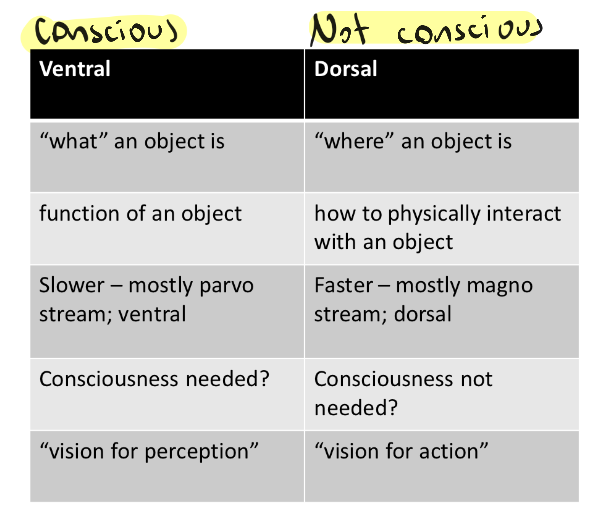
Dual Visual System Theory
Serial Position Curve
U-shaped graph demonstrating that a person's ability to recall items from a list depends on the item's position
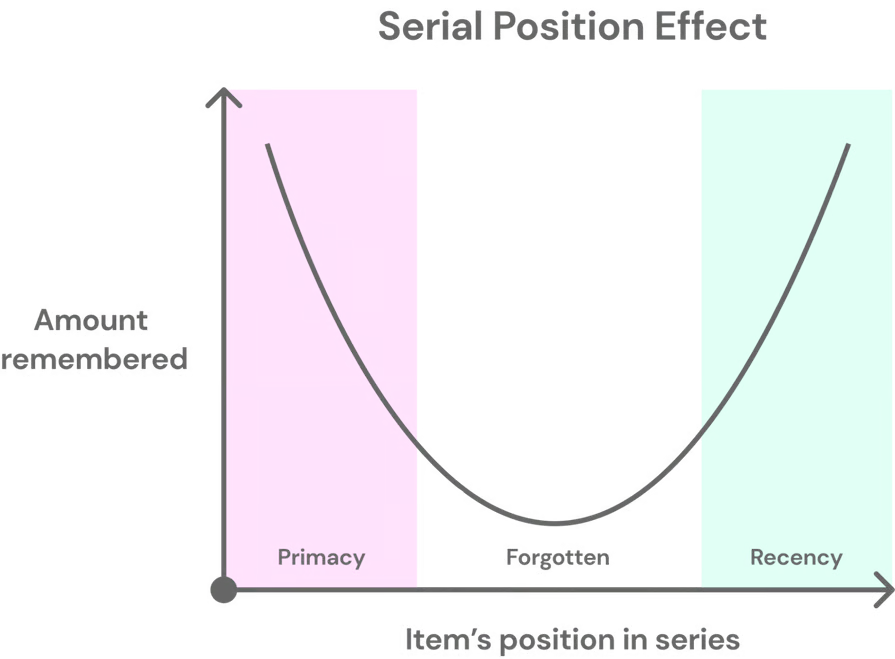
Primacy effect
Recall advantage with words presented at the beginning of list
Words untouched in LTM before other words wipe them
Does not disappear after 30 seconds
Recency effect
Recall advantage with words presented at the end of a list
Words you just heard, still in your STM
Disappears after 30 seconds
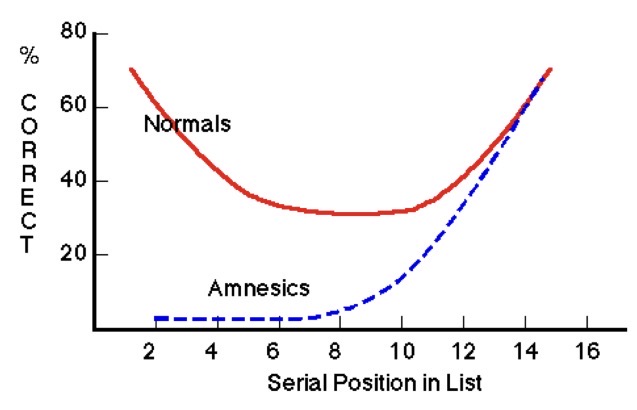
Anterograde Amnesia
Inability to form new long term memories
Does not show primacy effect and wipes out intermediates, but shows recency effect
Short term memory (STM)
The “working memory”
Requires active rehearsal of material to remain here
Key component of many cog abilities: language comprehension and production, thought, arithmetic, goal-oriented behavior, consciousness (global workspace hypoth)
Baddeley & Hitch Model (aka Multi-Component Model)
Model for “working” memory: emphasizes the role of active maintenance and manipulation
Top: Central Executive
Below: Phonological loop, Episodic buffer, Visuospatial sketchpad
Central Executive
Baddeley & Hitch Model
Putting in/taking out information (filtering relevant info) + rehearsing what’s in working memory
Directs attention, places info into proper short-term store (audio or visual)
Phonological loop
Baddeley & Hitch Model
Short term storage for auditory information, updated through rehearsal
Repeating information in your head to yourself
Episodic buffer
Baddeley & Hitch Model
Newest addition: bridge between working memory and LTM, allowing for chunking
Visuospatial sketchpad
Short term storage for visual/spatial motor information, updated through rehearsal
Span task
Quantifies working memory capacity
Found the average items to be 7 (+/-) 2 that can be held in working memory
Tests for WM (working memory)
Span task
Reading comprehension
Accuracy for spatial locations (tracking objects in space)
Recall tasks (immediate or small delay)
Chunking
Random digits are easier to remember in chunks of larger, familiar units (like a phone number, area code, etc)
4 (+/-) 1 can be held in working memory
Temporal grouping
Random digits are easier to remember when there are spaces in time between reading of digits
Overt rehearsal
Observable learning/memory process involving active practice of actions, words, or tasks out loud or through physical movements
Covert rehearsal
Mental technique involving imagining or practicing a behavior, conversation, or skill in the mind without any outward physical action
Longer words (in terms of articulatory duration - how long they take to speak) are harder to remember than short
Phonological loop capacity is related to the length of the items (capacity is temporal; chunking is too vague)
If unrehearsed, info lasts 2 seconds
Digit span variations across language
The more digits there are in a word, the less it is remembered throughout languages
Bilinguals are affected by this: the longer the word, the worse recall
Wing vs Ring
Children were told to remember a list of words including “ring”
Children that pronounce “ring” as “wing” chose a picture of “wing” after a pause
Testing immediately after presented, children chose “ring”
Shows that working memory relies of memory rehearsal, not pure perception
Chunking in VSWM (visual-spatial)
Chess experts can remember detailed chess positions better than amateurs, but only for game-appropriate formations
Corsi Blocks
Task used to assess VSWM function
Task: remember the order the colors flash, click the order blocks flash
Cognitive tradeoff hypothesis
Old theory that humans traded off bad visuospatial WM for good phonological WM (for language)
Supported by chimp preforming much better than humans on VSWM tasks, but this was only because it had much more practice
Concurrent tasks
Doing a verbal task during verbal rehearsal or spatial with spatial rehearsal reduces performance
But, doing verbal task during spatial rehearsal or vice versa doesn’t affect preformance
Executive Function
Includes willed attention, managing WM through central executive, planning, goal-oriented behavior, inhibiting impulses and emotions/behavior
Associated with frontal cortex
Inhibition
Inhibiting impulsive behavior (“raw” emotion produced in limbic system)
To evaluate in lab: teach participant to do one thing and have them do something else; it requires inhibition to '“unlearn”
Develops until adulthood, requires developed EF
A-not-B error
Inhibition experiment with babies:
Toy is always hiding under blanket A —> action is learned so strongly that even when hiding under B, baby still checks A
Baby has to inhibit response of checking A
Wisconsin card sort test
Inhibition experiment with adults:
Cards are sometimes sorted by number, shape, color etc. As new rules are introduced (not explicitly told), participants must adapt to these rules
People with worse executive functions cannot unlearn old rules and adapt to new ones
Marshmallow task
Inhibition experiment with children:
Eat now = 1 marshmallow, wait = 2 marshmallows
Performance on this task positively correlated with: academic achievement, socioemotional behavior, lots of good stuff (.. for rich kids)
From diverse sample: no correlates between delayed gratification and success
Delaying gratification
Do it right now, get reward. Wait for later to get bigger reward
Lead to a big emphasis on emotional intelligence
Disorders of Executive Function
Lower WM capacity and Wisconsin card sorting in: Major depression, schizophrenia, Parkinson’s, dementia
Related to dopamine
Alcohol and Executive Function
Alcohol acts as neural inhibitor —> reduces activity in frontal cortex —> lowers EF abilities
Factor g (general fluid intelligence)
Highly correlated with IQ test scores and academic performance
Likely a genetic component and related to function of prefrontal cortex
Related to WM capacity and attention
Brain training games
Games designed to increase working memory / attention capacities because they are related to general intelligence (gF)
Performance on similar tasks improved, but not on dissimilar tasks —> benefits do not transfer
Near transfer
Get better at similar skills with improvement of one specific skill
Far transfer
Get better at more unrelated skills with improvement of one specific skill
Long-term memory
Consists of implicit memory and explicit (declarative) memory
Implicit memory
Memory for motor skills (aka procedural memory)
Memory for perception
Priming
Explicit (declarative) memory
Semantic memory - facts, concepts, information
Episodic memory - life events, first-hand experiences
Recall tasks (3 types)
Used to study LTM
Free recall - write down as many items as you can remember, any order
Serial recall - write down items in correct order
Cued recall - write down the word that was paired with ____
Recognition tasks
Used to study LTM
More sensitivite than recall (easier to recognize than recall)
LTM Process (3 steps)
Encoding (getting info into LTM) —> Storage (store info in LTM) —> Retrieval (retrieveing info from LTM)
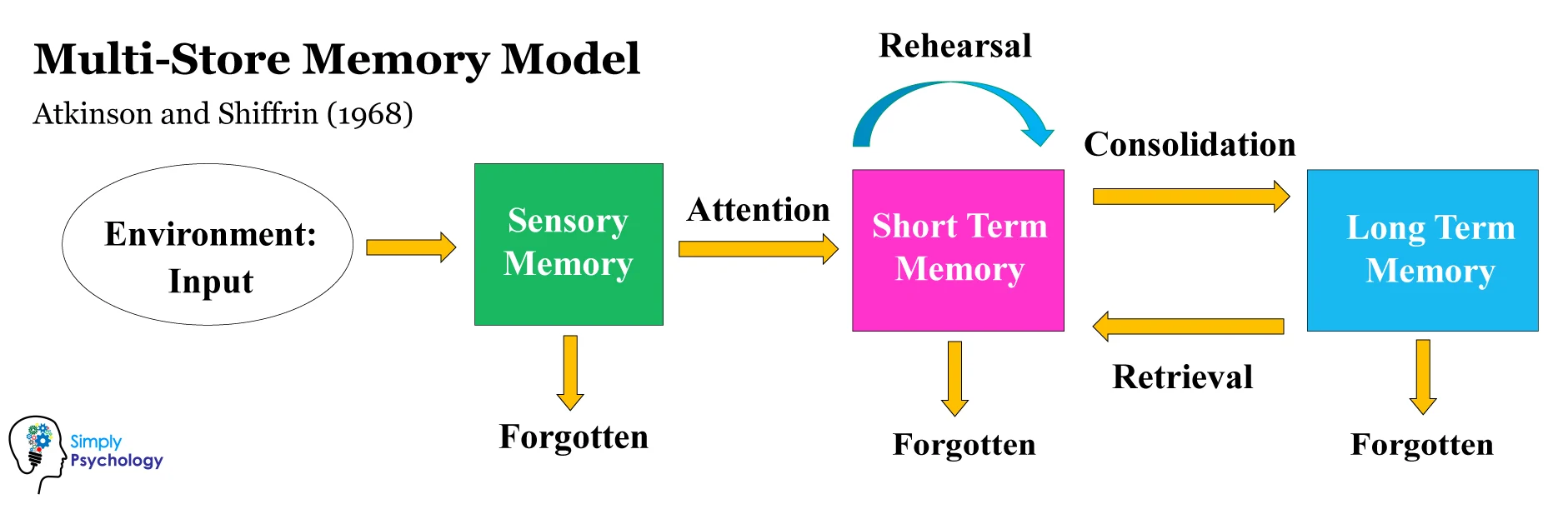
Atkinson-Shiffrin Model (aka Multi-store Model)
Model of encoding information from STM to LTM
Emphasizes rehearsal: more time in STM = more time rehearsed = stronger LTM encoding
LTM encoding is largely automatic (just straight repetition)
However: there is no correlation between time word has been rehearsed and rate recalled
Shallow processing
Shallow level of processing —> not encoded as well in LTM
Superficial ways of thinking about words that doesn’t relate to their meaning
Ex: does the word rhyme with another word?
Deep processing
Better quality of rehearsal —> better encoding in LTM
Thinking about words by their actual meaning
Ex: does the word fit into the sentence?
Levels of Processing (LOP) Task
Deep encoding vs shallow encoding —> Cued recalled tasks after
Deep encoding is usually, but not always, better than shallow
Cued recall
Tasks to test shallow and deep encoding on a list of items:
Shallow: “Was there a word that rhymed with ___”?
Deep: “Was there a word that meant ___?”
Encoding and recall tasks work best when they match (deep-deep & shallow-shallow)
Elaborative encoding
Method of encoding that involves linking new information to already stored (old) information
Elaboration = process of linking new information to old
Semantic Networks
A complicated web within your memory, connecting all concepts together
New information fits into this web by linking it with old info
Best way to remember new info is to link it with old
Non-hierarchical, local representation (associative)
Mnemonics
Conscious effortful strategies for memory, connecting new information to familiar, easy to remember concepts
Can dramatically increase memory capacity
Method of Loci, Peg method, Linguistic elaboration
Method of Loci
“Memory Palace” —> storing memories around an imaginary palace
Visual and spatial associations
Mnemonic
Peg method
Take a sequence you already know and “peg” new info to each item in that sequence
Ex of sequence: numbers, days of the week, etc
Mnemonic
Linguistic elaboration
Connecting new words to old, familiar words through acoustics, imagery, etc
Mnemonic
Testing effect
Learning method involving asking questions while learning, studying, reviewing
The more retrieval practice, the easier it’ll be to retrieve info in the future
Interleaving
Learning method involving interspersing old material with new material
Mixing and relating old material w new material
Generative learning
Learning method involving teaching the topic to someone else
Allows for new questions, different understandings
Re-learning
Learning method involving forgetting material and learning it again
Each new time you learn info, it becomes stronger
Distributed studying > cramming
Happens with addiction and relapse cycles —> stronger relapses
If given a set of digits to remember, people better recall repeated sequences, even if they don’t remember learning them the first time
Decay
Information decays with time (forgetting)
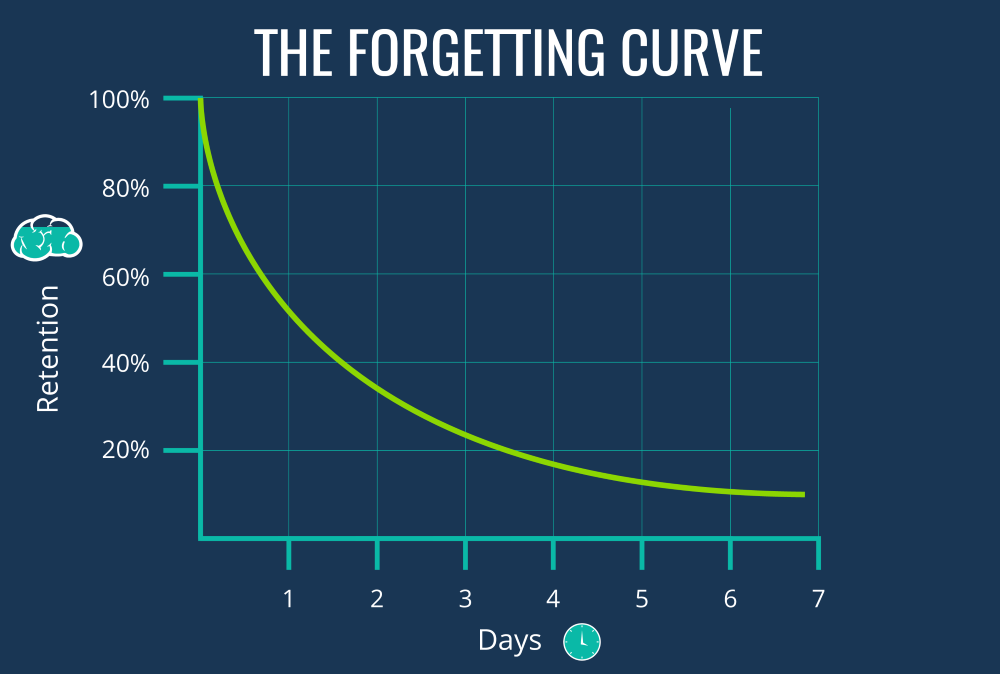
The Ebbinghaus Forgetting Curve
Illustrates natural exponential decay of memory over time when there’s no active attempt to retain it
Interference
New info/experiences interfere with old info/experiences or vice versa —> forgetting
Retroactive - new interferes with old —> forgetting old info
Proactive - old interferes with new —> harder to learn new info
Forgetting
Information must be first encoded in the LTM to be considered forgotten
Forgotten info isn’t completely gone, it’s just inaccessible
Memory consolidation
Long term memories consolidate gradually
SLEEP is super important for consolidation
Reactivating memory helps consolidate it
Interference can disrupt consolidation
Perma-store
Memories that stick along for a very long period of time —> the long, long term memory
State-dependent memory
Memories are more easily recalled if you are in a similar state (emotional, mental, state of consciousness) as when encoding
Internal similarity
Context-dependent memory
Memories are more easily recalled if you are in a similar environmental context (location, people, activity, objects) as when encoding
External similarity
To avoid, study in many different environments
Retrieval interference
Retrieving some items in a category interferes with retrieving the others
Ex: you keep thinking of the same retrieved items, blocking you from retrieving other items
Tip of the tongue phenomenon
You know you know a word, but you just can’t quite remember
Partial retrieval; word isn’t retrieved as one full unit
Pollyana effect
Pleasant items are usually processed more efficiently and accurately, compared to neutral or unpleasant info
Positivity bias
Rosy view
Events are remembered as more positive / less negative over time
Positivity effect
Source of nostalgia? (people attribute old times to being “good”)
Depressive realism
Individuals with depression may perceive certain aspects of the world more accurately than those without depression
No positive bias
Schema / Shemata
Mental model of the world and particular aspects about it, developed over our lifetime
Becomes more fixed/unchangeable with age and experience (as it’s reinforced)
Can allow us to navigate world in cognitively efficient manner but also distorts memory/perception (to fit schema)
Predictive processing
Brain is a prediction engine —> predict the next stage of the world based on new sensory info and past schemata
“Grand unified theory” of the brain
Correct = reinforce schema, incorrect = revise schema —> maximized accuracy
Everything our brain does is to minimize surprise
Bayesian statistics
Determining probability/likelihood of events given all old and new scientific or worldly knowledge
Takes schemata into account
Not just looking at isolated p-values; context matters
Serial reproductions
Experiment method where information is passed down sequentially from one person to the next
Ex: telephone game
Intrusion errors
Mistakes made in memory, not by random, but due to a schema
Reconstructive memory
Memory is a reconstructive process
When we retrieve memories, we reconstruct them based off of our schemata
—> Intrusion errors and filling-in effects
Seven sins of memory - Schacter
Classifies memory errors:
Transience
Absent-mindedness
Blocking
Misattribution
Suggestibility
Bias
Persistence
TABMSBP
(1) Transience
Memories degrade over time
Impermanent
(2) Absent-mindedness
Memory is dependent upon attention
No attention —> no memory of event
(3) Blocking
Irrelevant knowledge can interfere with (block) retrieval
(4) Misattribution
Failure to remember where information was obtained
Misattribute context but remember event
Ex: '“sleeper effect” - read fake news but forget it’s fake
(5) Suggestibility
Information from others distorts our own memory