CENG0002: Introduction to Chemical Engineering
 Call Kai
 Learn
Learn Practice Test
 Spaced Repetition
 Match
Match Flashcards
 Knowt Play
1/25

Earn XP
Description and Tags
This flashcard set covers the fundamental concepts of chemical engineering process analysis, including process types, variables, degrees of freedom, and unit consistency based on the CENG0002 lecture.
Name | Mastery | Learn | Test | Matching | Spaced | Call with Kai |
|---|
No analytics yet
Send a link to your students to track their progress
26 Terms
Process analysis
The procedure of determining values of unknown quantities such as flows, compositions, and temperatures given the process structure and specific known quantities.
All BATCH PROCESSES ARE?
Transient
Process Flow Diagram (PFD)
A diagram used in engineering to show the general flow of plant processes and equipment.
System thinking
A perspective that considers interactions, such as mass and energy balances, within and between processes to address global sustainability.
Continuous processes maybe?
Steady-state on transient
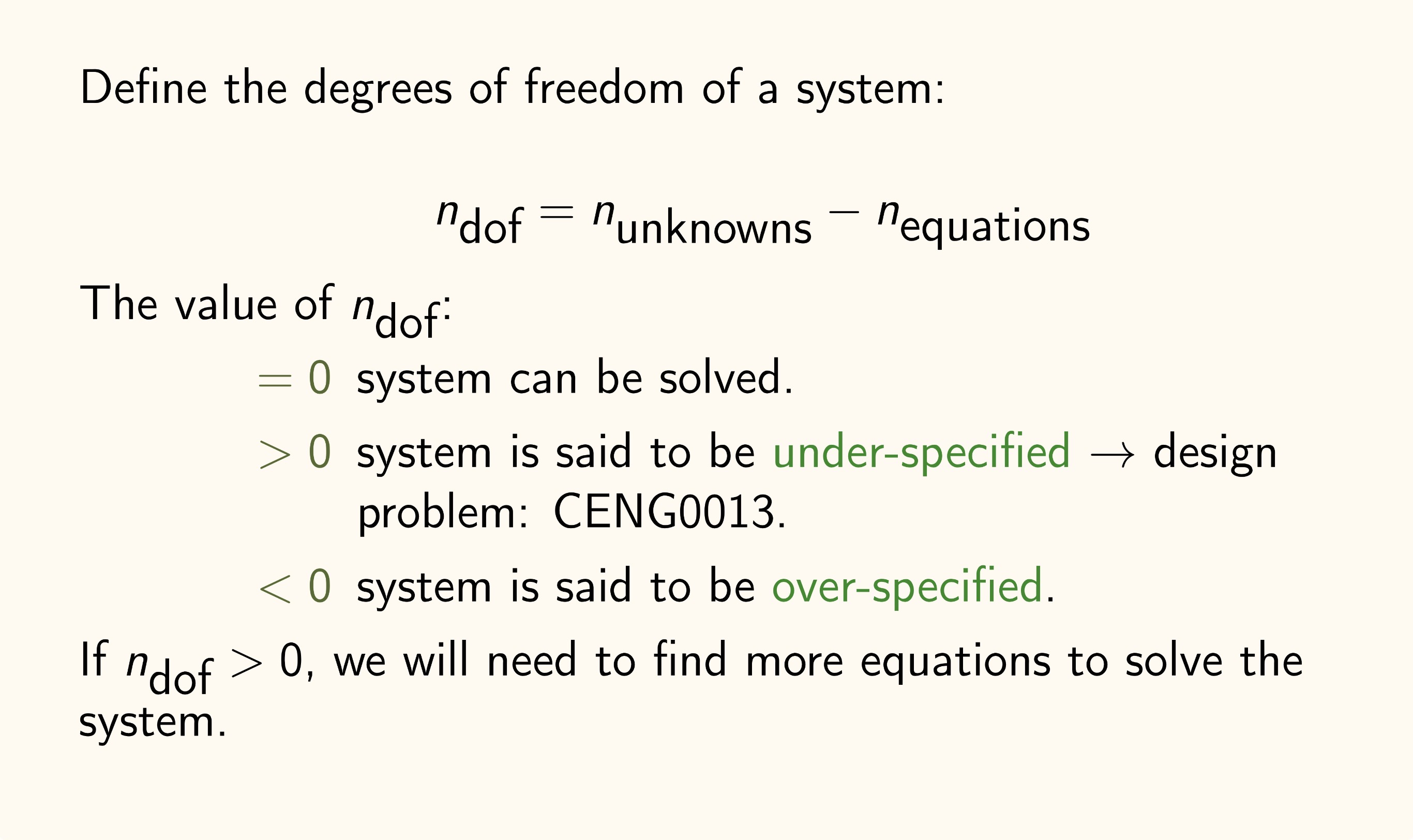
The DOF thing?
Process
A set of operations or steps which results in a physical or chemical change in a substance or a mixture of substances.
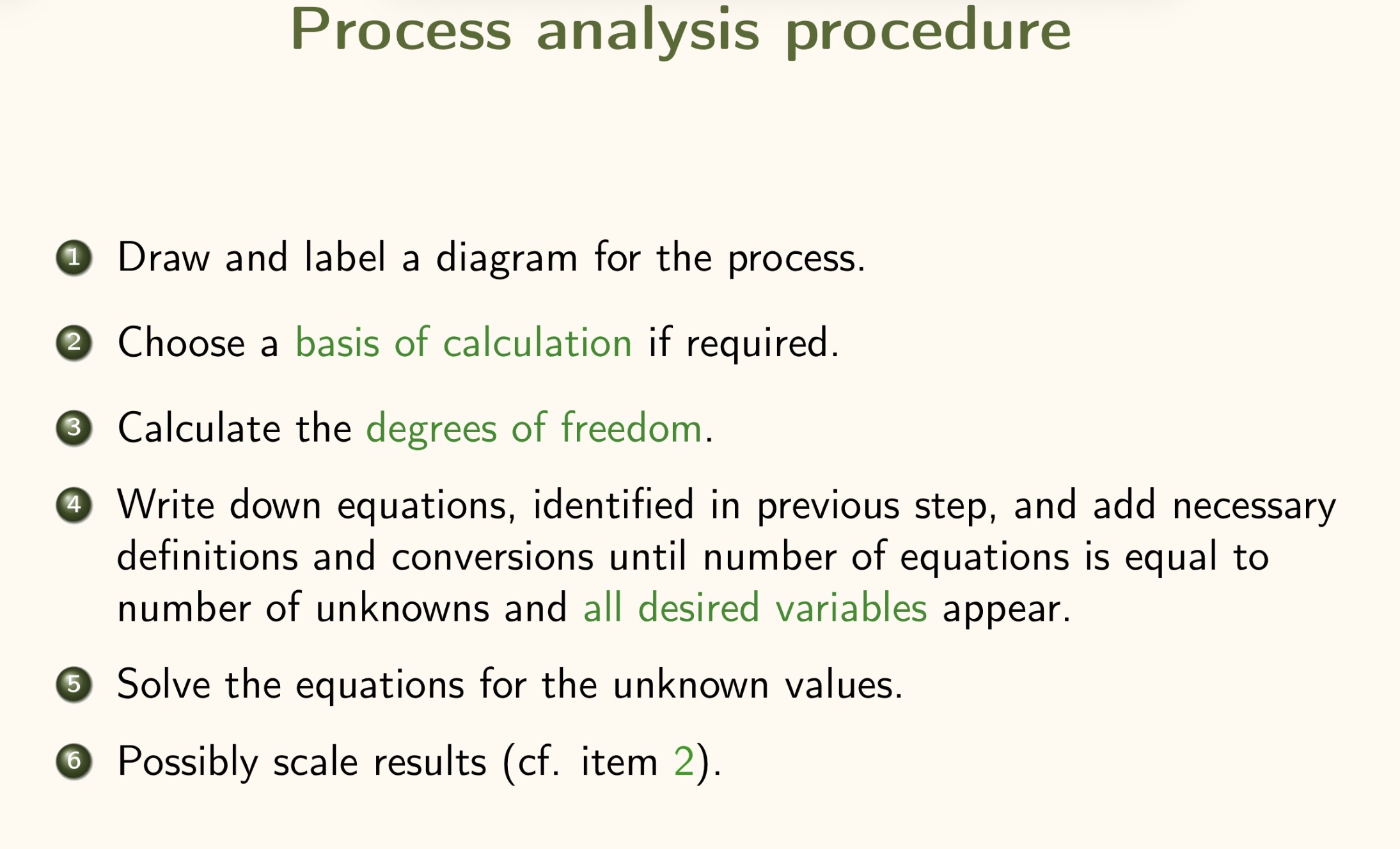
What are the steps?
Feed (Input)
Material which enters a process or process unit.
Product (Output)
Material which leaves a process or process unit.
Process unit
A setup where a processing step is carried out, having associated input and output process streams.
Batch process
A type of process where feed is added at the beginning and products are removed only at the end.
Continuous process
A process where inputs and outputs are continuously added to and removed from the system.
Semibatch process
A process type that falls in between batch and continuous operations.
Steady-state
A condition in a process where all variables do not change in time.
Transient
A condition in a process where one or more variables change in time.
Extensive variables
Variables that are proportional to the size of the system, such as mass and volume.
Intensive variables
Variables that are independent of the quantity of material, such as temperature, pressure, density, specific volume, and mass or mole fractions.
Degrees of freedom (process)
The number of extensive variables that must be assigned values for the remaining variables to be determined.
Degrees of freedom formula
ndof=nunknowns−nequations
Under-specified system
A system where ndof>0, meaning more equations are required to solve the system.
Over-specified system
A system where the number of degrees of freedom is less than zero (ndof<0).
Energy rate units
Represented by notations H∙, Q∙, or W∙ with units of J/s or W.
Mass flow rate
Represented by the notation m∙ with the consistent unit kg/s.
Molar flow rate
Represented by the notation n∙ with the consistent unit mol/s.
Validating results
Methods to ensure the accuracy of engineering calculations, including back substitution, order of magnitude estimation, and tests of reasonableness.