Chapter 4: Attention (Lecture Material)
 Call Kai
 Learn
Learn Practice Test
 Spaced Repetition
 Match
Match Flashcards
 Knowt Play
1/42

There's no tags or description
Looks like no tags are added yet.
Name | Mastery | Learn | Test | Matching | Spaced | Call with Kai |
|---|
No analytics yet
Send a link to your students to track their progress
43 Terms
Physical regularities
physical properties that occur frequently in the environment
Oblique effect
horizontal and vertical lines occur more frequently in our environment, making them easier to perceive
Light from above assumption
light comes from above more frequently
Semantic regularities
characteristics that occur frequently in a particular environment
Scene schema
knowledge of what a given scene typically contains
Bayesian inference
Our estimate of the probability of an outcome is determined by the prior probability and the likelihood of the outcome
Prior probability
internal belief about the probability of an outcome
likelihood
the extent to which the evidence is consistent with the outcome
Double dissociation
damage to brain region X affects task A, but not B; whereas damage to brain region Y affects task B but not A
Action pathway
landmark discrimination
Perception pathway
object discrimination
Mirror Neurons
neurons that respond in the same way when performing an action as when watching that action being performed
Selective Attention
attending to one thing while ignoring others
Divided Attention
paying attention to more than one thing at a time
overt attention
shifting attention from one place to another by moving the eyes
covert attention
shifting attention without moving the eyes
Dichotic listening task:
two different auditory messages in each ear; repeat the message in one ear (attended) while hearing a message in the other ear (unattended)
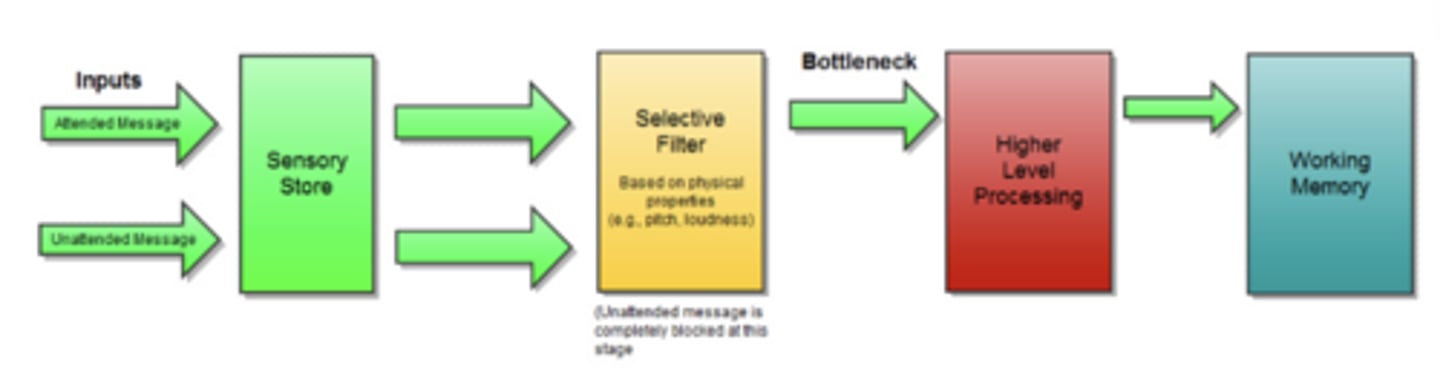
Broadbent's filter model
Information is filtered out early based on physical properties, early selection "bottleneck" model
Cocktail party effect
the ability to focus on one (attended) conversation where there are lots of other (unattended) conversations
Treisman's attenuation model
information is first attenuated based on physical properties and then filtered out based on meaning
Attenuator
assigns different strengths to information based on physical characteristics (pitch), language (syllables, words), and meaning
Dictionary unit
determines the threshold needed to detect information based on word frequency or importance
Intermediate selection models
unattended information is "filtered" out early and late in processing
Late selection models
unattended information is "filtered" out late in processing
McKay's late stage model
information is filtered out after being analyzed for meaning
Processing capacity
how much information a person can handle at any given moment
Load
amount of information to process, which is realted to the difficulty of a given task
Low-load (easy)
tasks use less processing capacity, lots of remaining processing capacity
High-load (difficult)
tasks use more processing capacity, minimal remaining processing capacity
Load theory of attention
the ability to ignore task-irrelevant stimuli depends on the load of the task
Spotlight theory of attention:
attention is like a movable "spotlight" that focuses on targets in a serial manner
Stimulus salience
physical properties of a stimulus (color, movement, volume)
Precuing method
present a cue to direct attention to a target without moving the eyes
Same-object advantage
directing attention enhances performance to other parts of the same object
Mind wandering
internal thoughts that drift from the task at hand
Inattention Blindness
visual stimuli that are not attended to are not perceived
Change Blindness
difficulty detecting changes in scenes
Binding
the process by which features are combined to create our perception of a coherent object
Feature Integration Theory
proposes that features are first analyzed (pre-attentive stage) and then combined (focused attention stage)
Preattentive stage
automatically separates objects into their features without effort or attention
Focused attention stage
features are recombined in a way that is guided by attention
Single Feature Search task
search an array for a target that differs by a single feature, "pop out", effortless, automatic, little to no variance
Conjunction search task
search an array for a target that differs by two or more features, difficult, attention-demanding, can no longer rely on pop out