Quantum Mechanics Unit 13 Key Terms
 Call Kai
 Learn
Learn Practice Test
 Spaced Repetition
 Match
Match Flashcards
 Knowt Play
1/24

There's no tags or description
Looks like no tags are added yet.
Name | Mastery | Learn | Test | Matching | Spaced | Call with Kai |
|---|
No analytics yet
Send a link to your students to track their progress
25 Terms
Statistical thermodynamics
The link between molecular properties (like energy levels) and the bulk thermodynamic properties (average behavior of a large number of molecules)
Ensemble
The collection of macroscopic systems in thermal equilibrium with a heat reservoir
Canonical ensemble
An ensemble with common N, V, and T shared among the systems
Boltzmann distribution
The probability of a system to be in the state j with energy Ej(N,V) . It describes how probable a state is within a system among all possible energies.
Boltzmann factor
e-E/kbT representing the fraction of collisions with at least the minimum required energy
Partition function
contains all the thermodynamic information about a system and thus provides a bridge between spectroscopy and thermodynamics, calculated by drawing on computed or spectroscopically derived structural information about molecules.
Ensemble average of a quantity
ensemble average of any quantity, calculated using the probability distribution, is the same as the experimentally observed value
Molecular partition function
the product of the degree of freedom partition functions q = qvibqrotqtransqelec. used to calculate the probability of finding a molecule with a given energy and state (i.e. vib, transl) in a system.

Translational partition function
Rotational partition function
Vibrational partition function
Electronic partition function
Characteristic vibrational temperature
Rotational temperature
Symmetry factor (or number)
Translational contributions
The contribution to the overall molecular energy due to translational energy/motion
Rotational contributions
The contribution to the overall molecular energy due to rotational energy/motion (monoatomic gases have no rotational contribution)
Vibrational contributions
The contribution to the overall molecular energy due to vibrational energy/motion (vibrational modes)
Electronic contributions
The contribution to the overall molecular energy due to electronic energy/motion (electron movement within and across energy levels)
Chemical potential
Same as Gibbs free energy, where the chemical potential is proportional to the ln of the partition function of the ground vibrational state of the molecule
Transition state theory
The theory of the rate of elementary reactions. It focuses on transient species (activated complex or transition state) located in the vicinity of the top of the barrier height (activation energy) of a reaction. The model of the elementary reaction is a two-step process.
Reactants and the activated complex are in equilibrium with each other. the rate of the reaction is given by the rate of a unimolecular process that transforms the activated complex into products
Transition state
The crucial configuration of reactant molecules at the maximum of the potential energy curve, where they have come to such a degree of closeness and distortion that a small further distortion will send them in the direction of products.
Activated complex
the cluster of atoms in the vicinity of the peak of the potential energy curve
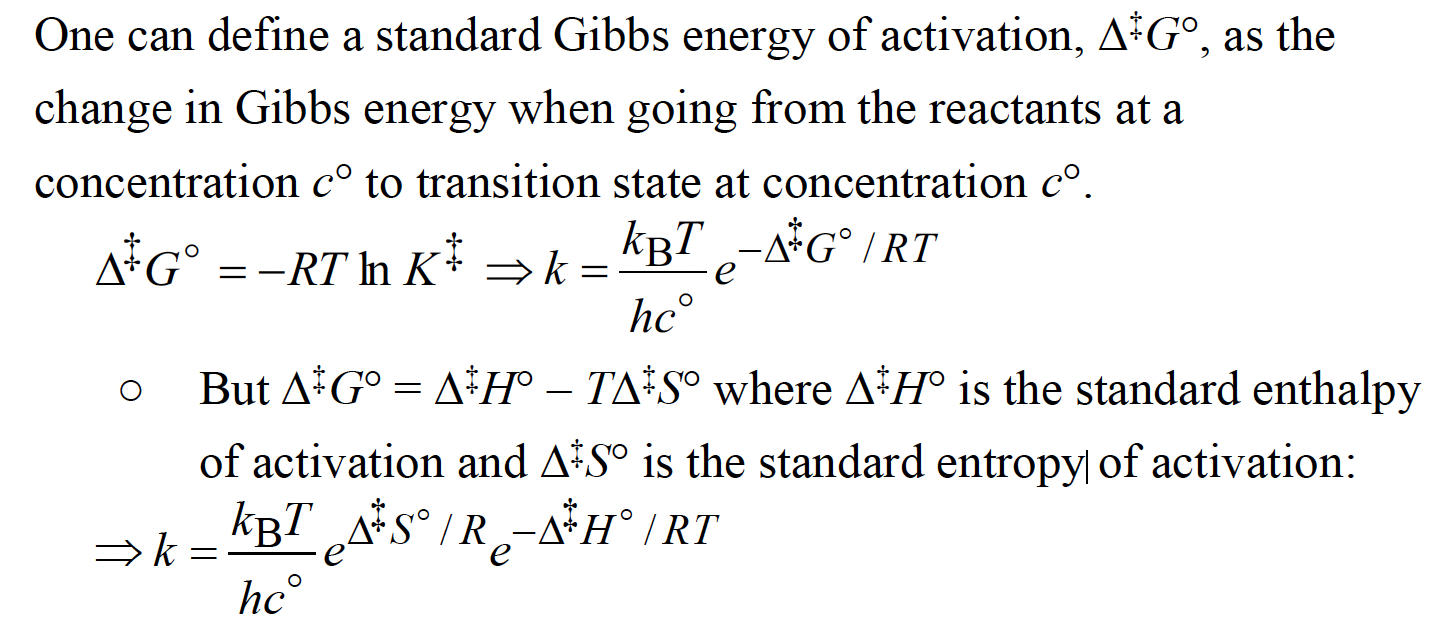
Gibbs energy/enthalpy/entropy of activation
The Gibbs energy of activation can be divided into an entropy of activation, ∆‡S and an enthalpy of activation, ∆‡H, by writing ∆‡G = ∆‡H -T∆‡S
The rate at which the activated complex forms products depends on the rate at which it passes through a transition state. The rate constant may be parameterized in terms of the Gibbs energy, entropy, and enthalpy of activation.
Potential energy surface
The electronic energy vs. the interatomic distance, where the potential energy depends on more than one single geometric parameter, such as its various bond lengths and angles. The potential energy as a function of the relative positions of all the atoms taking part in the reaction.
the energy function is of 2 geometric parameters and keeps the other(s) at a fixed value.