Week 5: Ch 5 (7,12): Chromosome Mapping in Eukaryotes
 Call Kai
 Learn
Learn Practice Test
 Spaced Repetition
 Match
Match Flashcards
 Knowt Play
1/69

There's no tags or description
Looks like no tags are added yet.
Name | Mastery | Learn | Test | Matching | Spaced | Call with Kai |
|---|
No analytics yet
Send a link to your students to track their progress
70 Terms
Chromosomes are the unit of transmission in meiosis, not genes
________ can not undergo independent assortment
Frequency of ________ on a single chromosome is proportional to distance between them
Crossing over results in ______
_______: indicate relative location of genes on chromosome
Linked genes
crossing over
recombination
Chromosome maps
Genes Linked on the Same Chromosome Segregate ______.
Together
______ consequences
– Independent assortment (No linkage exhibited)
– Linkage without crossing over (_______)
– Linkage with crossing over (Generates recombinant (crossover) gametes)
Meiotic
Complete linkage
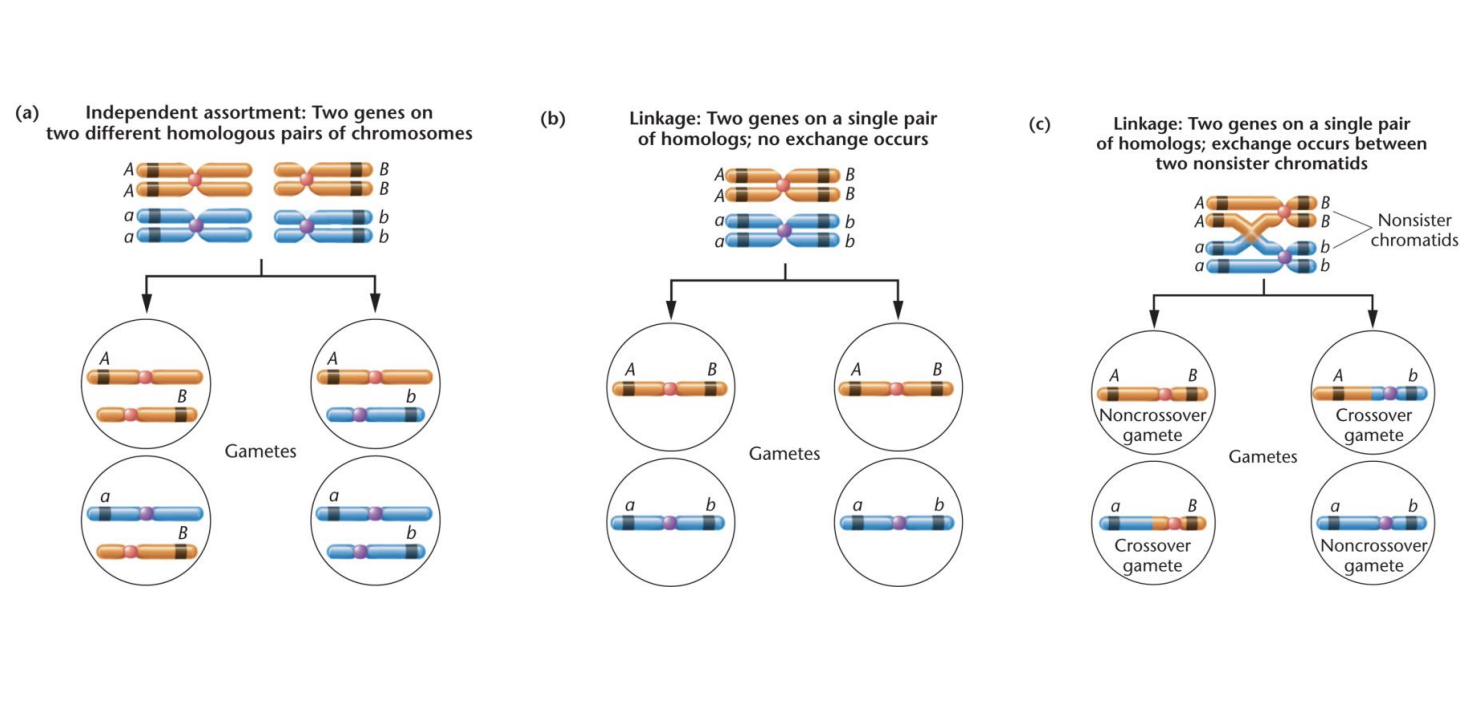
_______
– No crossing over between two genes
– Produces ——— (noncrossover) gametes
_______
– Occurs between two nonsister chromatids
– Both parental and recombinant (crossover) gametes are produced
Complete linkage
parental
Crossing over
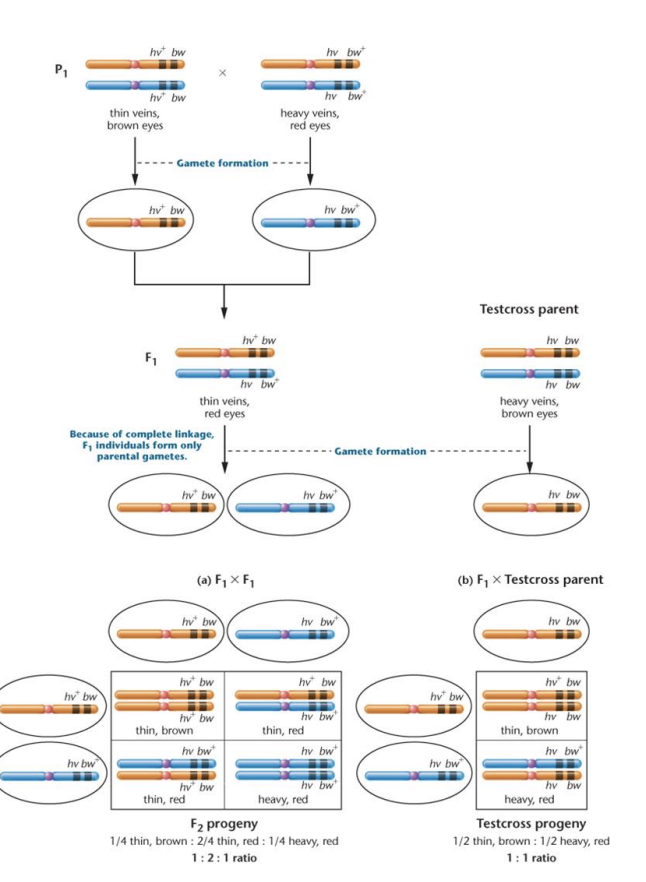
_______
– Complete linkage between two genes due to close proximity
– Unique F2 phenotypic ratio results
_______
– Genes on the same chromosome are part of this
– Number of linkage groups should correspond to haploid number of chromosomes
Linkage ratio
Linkage group
Crossing Over Serves as the Basis for Determining the ______ between Genes in Chromosome Mapping
Distance
______
– Synapsed chromosomes in meiosis wrap around each other
– X-shaped intersections with points of overlap
▪ Points of genetic exchange
Chiasmata
Two genes located close to each other along a chromosome are less likely to have _____.
chiasma
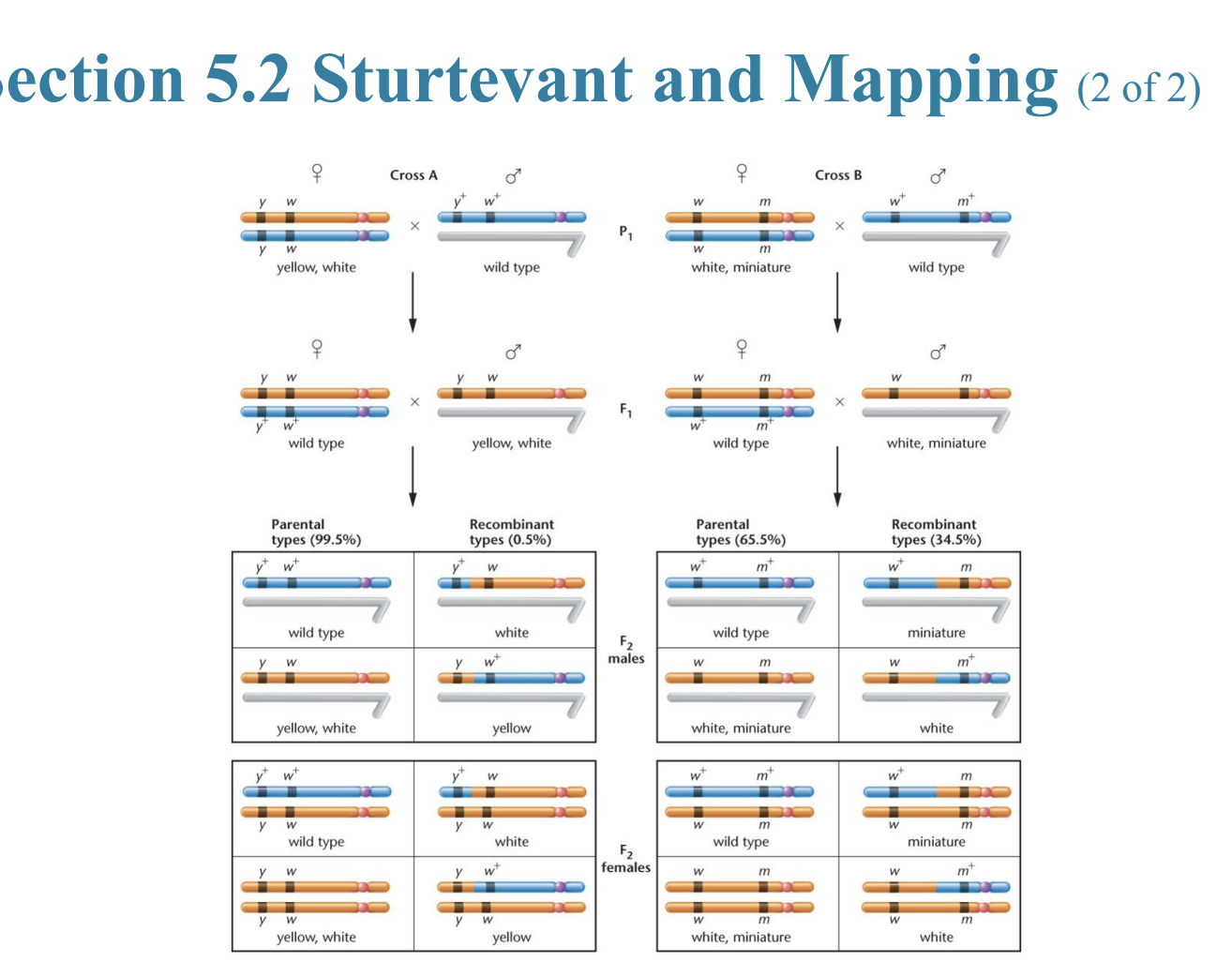
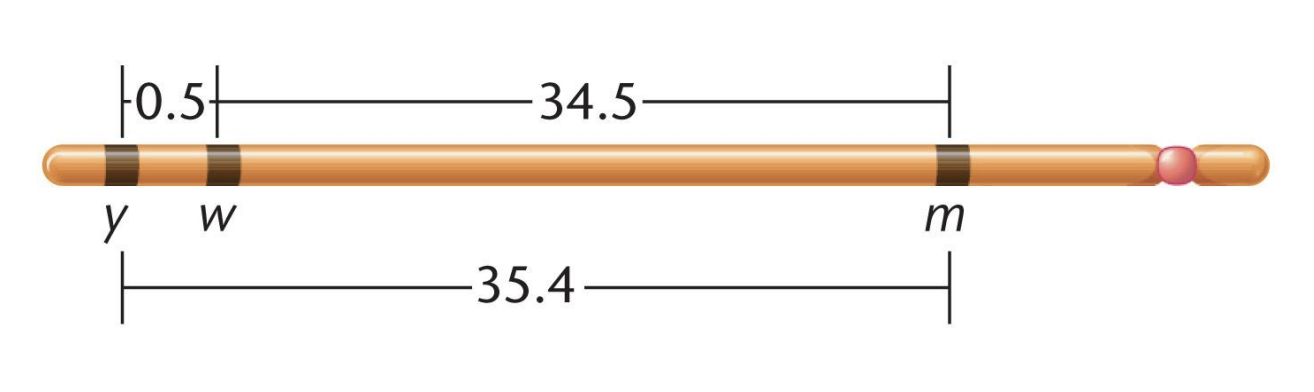
Sturtevant
– Compiled data from crosses
– Recombination frequencies between linked genes are ______
– Frequency of exchange is estimate of relative distance between two genes
additive
______
– 1 percent recombination between two genes on chromosome
– Also called ______
– Relative distances, not exact ones
Map unit (mu)
centi-Morgans (cM)
_______
– Occurs between two nonsister chromatids
– Recombination is observed in 50 percent of gametes
– In genes 50 map units apart, crossing over can be expected between 100 percent of tetrads
Single crossover (SCO)
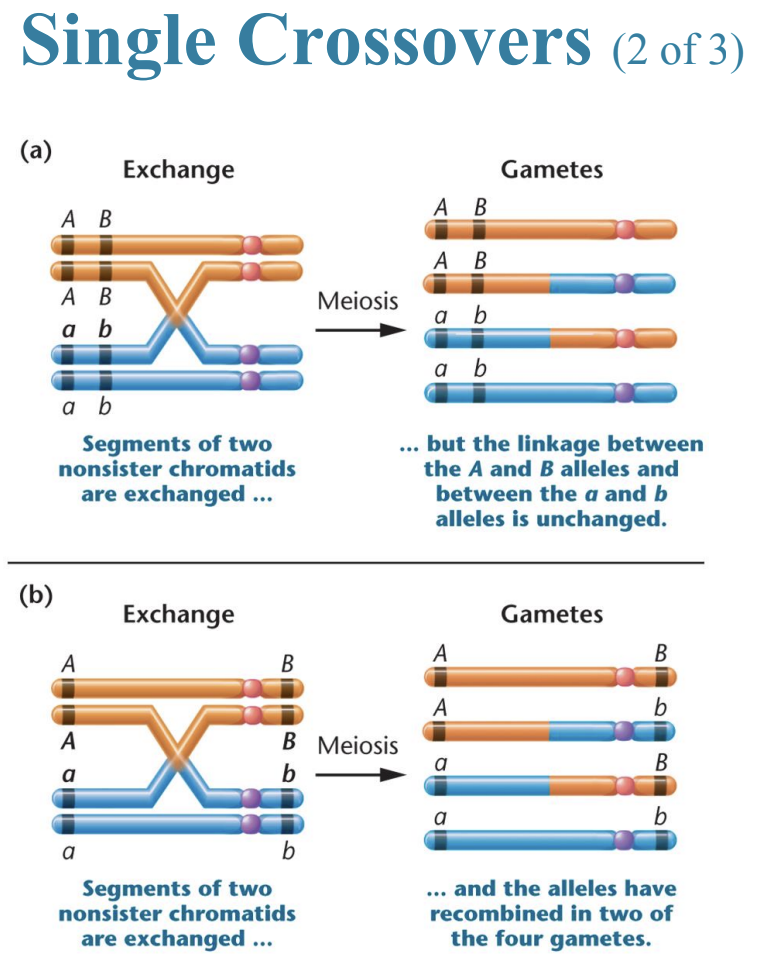
SCO is _____ between two nonsister chromatids in tetrad stage
– ______ gametes produced
– ______ gametes produced
Single exchange
Two noncrossover (parental)
Two crossover (recombinant)
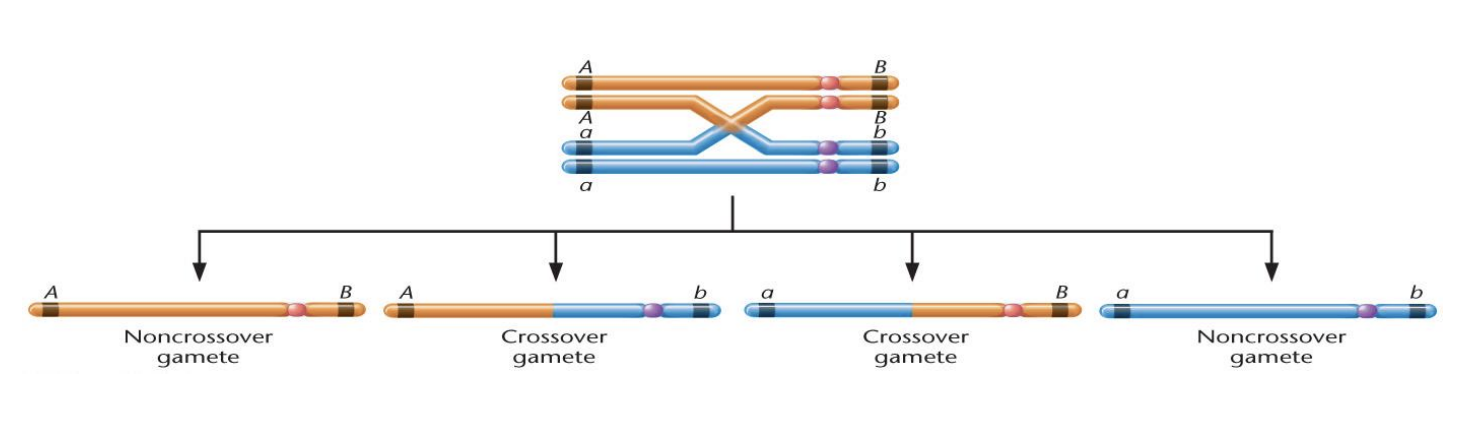
_____ crossover
– Used to determine distance between two linked genes
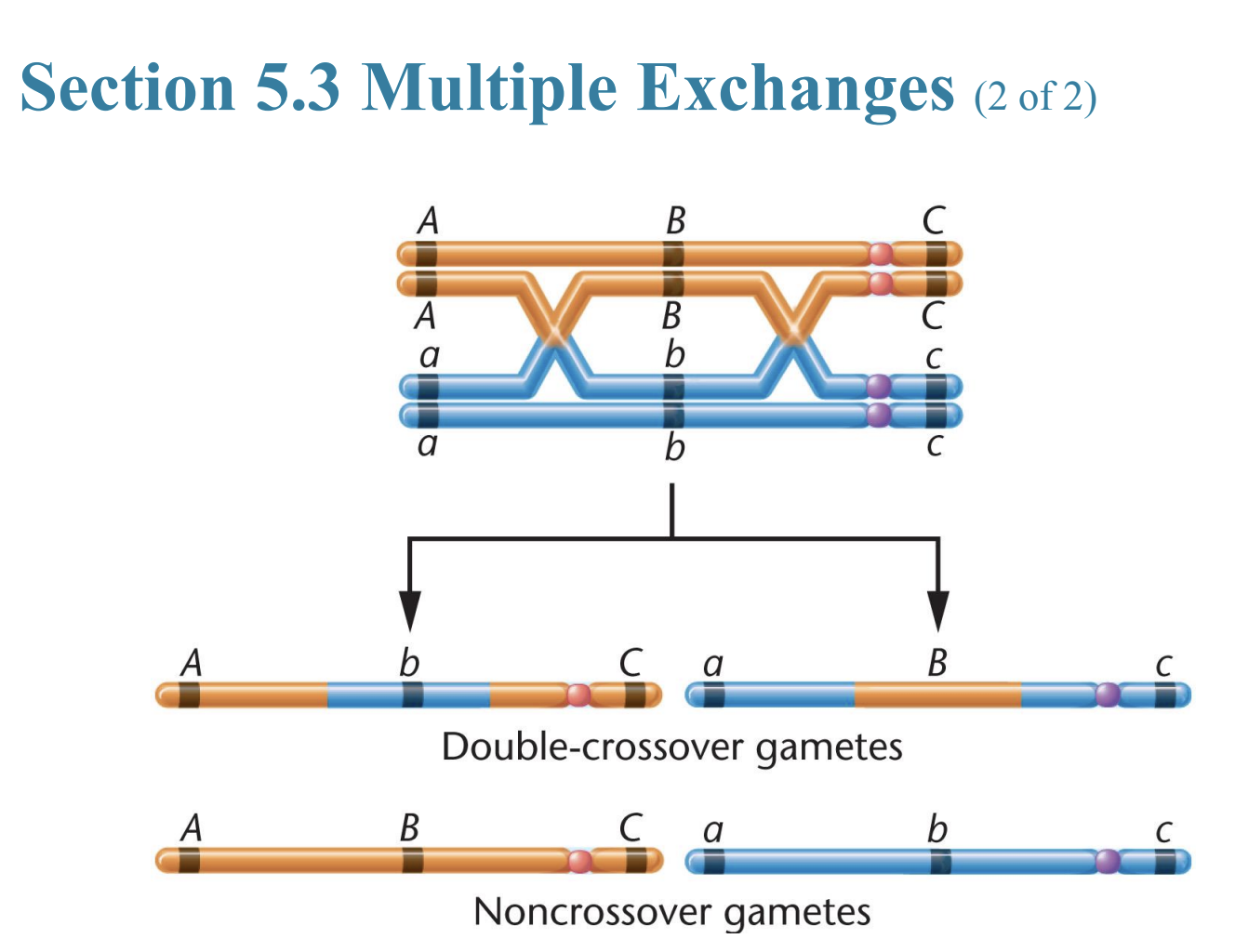
_____ crossover
– Double exchanges of genetic material
– Used to determine distance between three linked genes
– Genes must be _____ for two alleles
Single
Double
heterozygous
Three criteria of three-point mapping:
– Parent must be heterozygous for all three genes under consideration
– Phenotypic class must reflect genotype of gametes of parents
– Sufficient number of offspring must be produced for representative sample
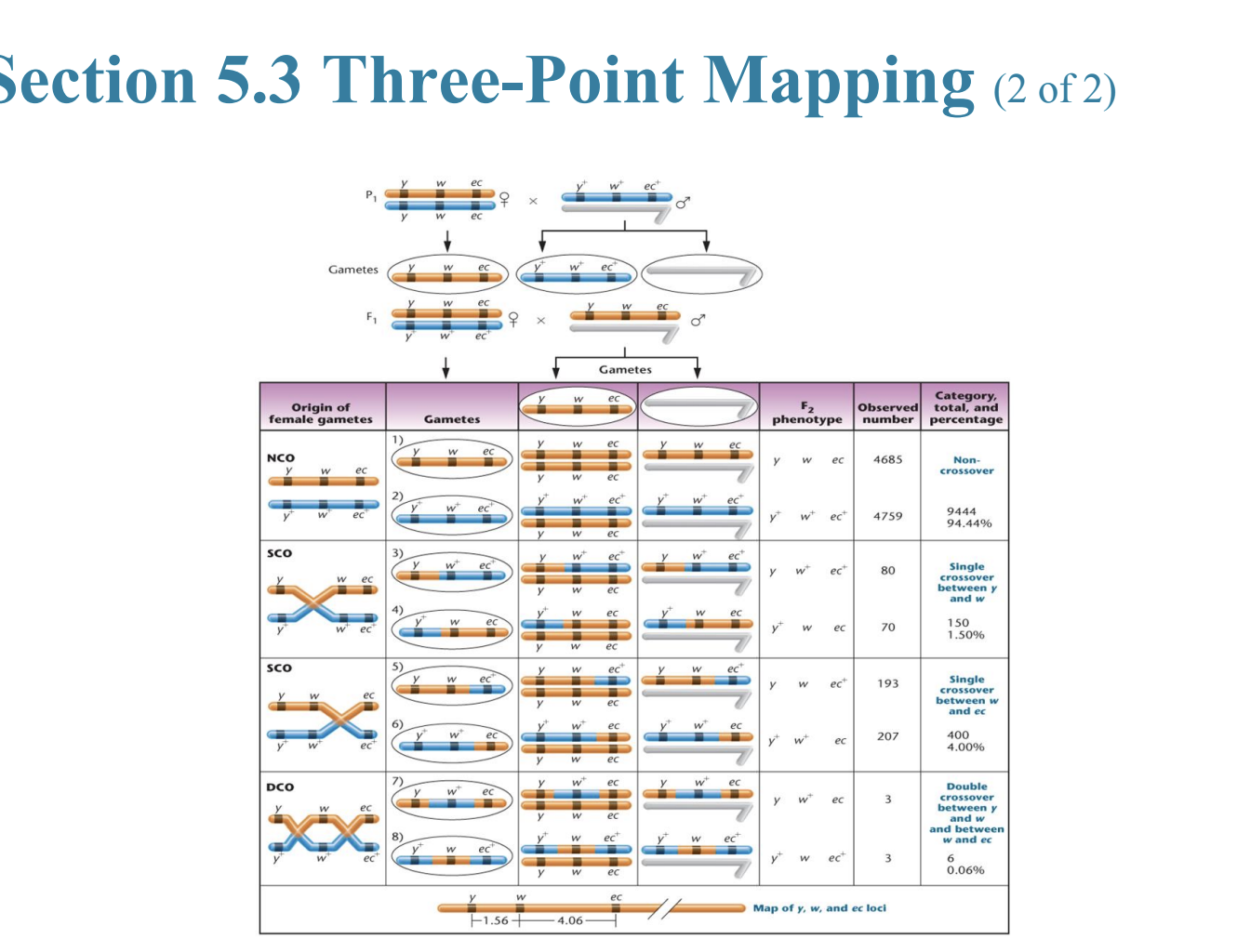
______ phenotypes
– Occur in greatest proportion of offspring
______ phenotypes
– Occur in the smallest proportion
Noncrossover F2
Double-crossover (DCO)
_____ classes of phenotypes
– F2 phenotypes complement each other
▪ Derived from heterozygote
▪ Have wild type and mutant for all three genes
Reciprocal
Determining gene sequence:
– Method 1 based on ______
– Method 2 uses _____ and Also considers _____
three possible arrangements of genes
three possible arrangements
double-crossover event
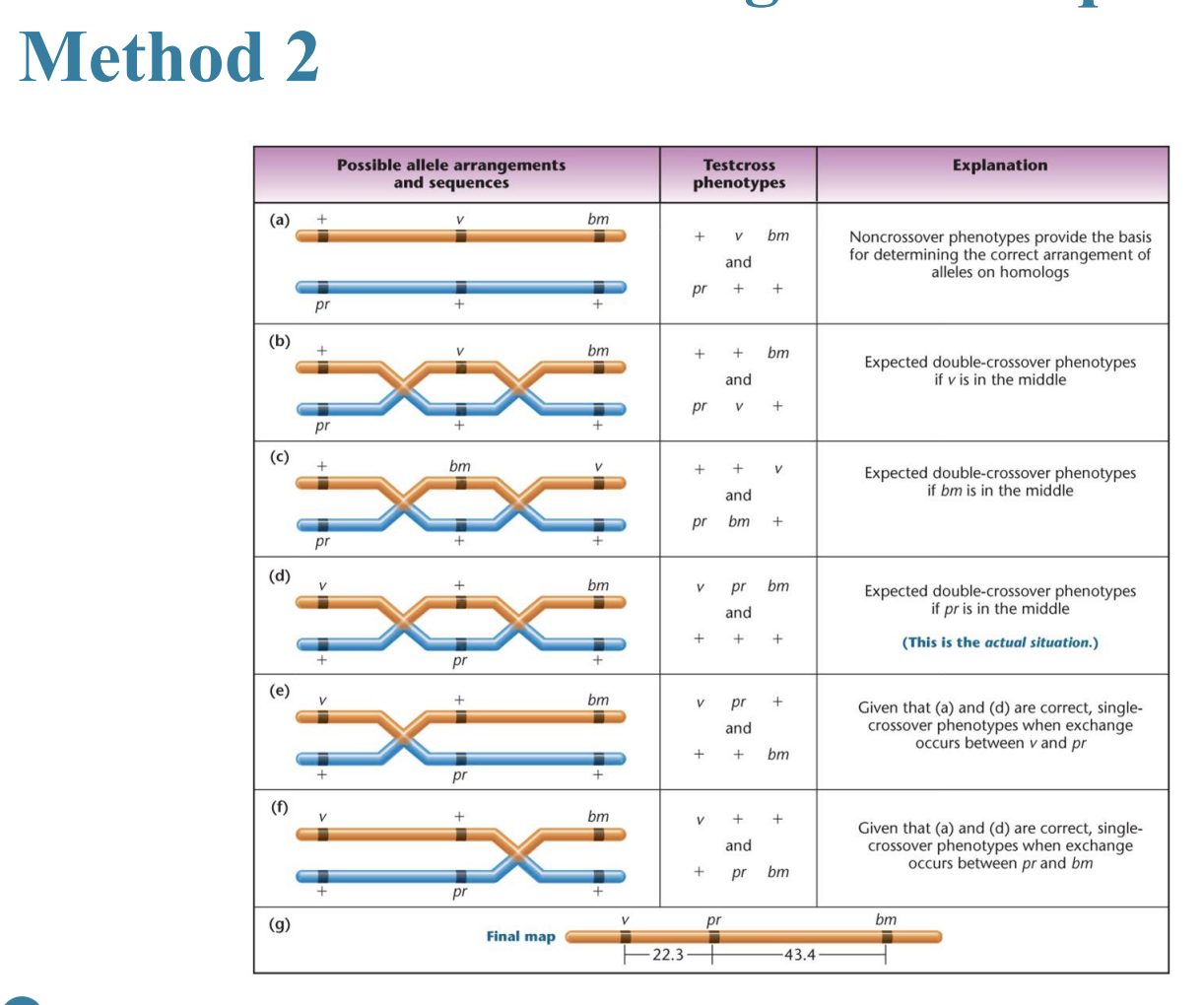
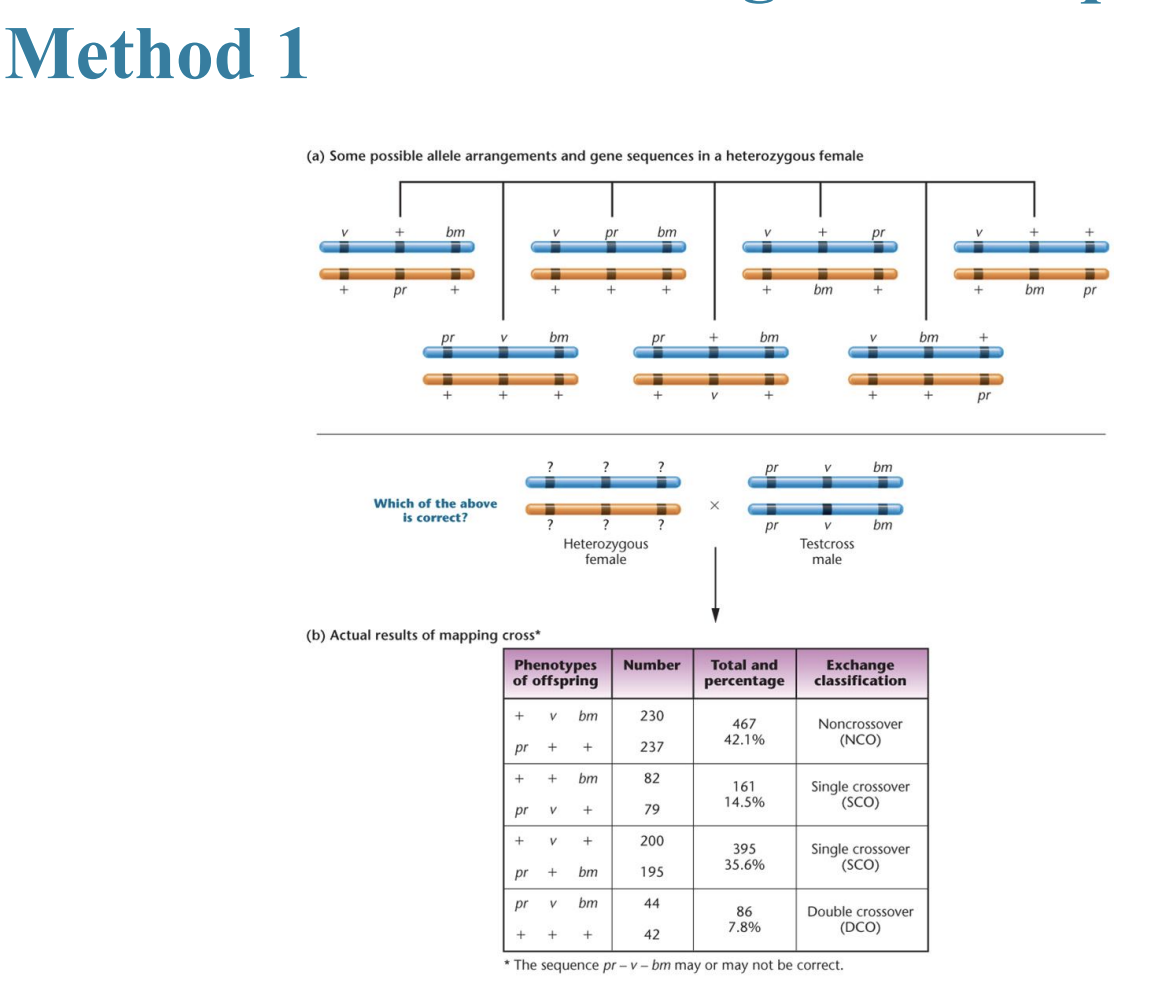
As the Distance between Two Genes Increases, Mapping Estimates Become _____.
More Inaccurate
_______
– Inhibition of further crossover events
– Inhibited by another crossover event nearby
– Reduces expected number of multiple crossovers
Interference
Interference: I = 1 − C
______: Calculated to quantify disparities that result from interference
Coefficient of coincidence (C)
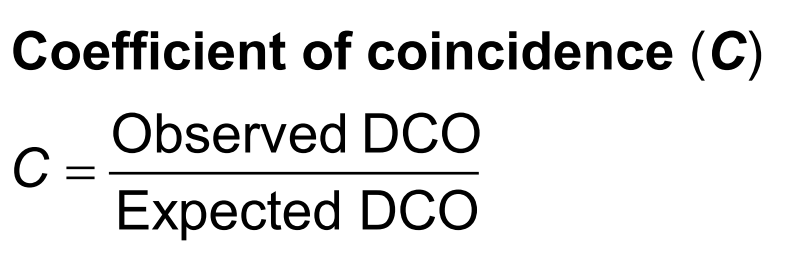
Interference
– _____ when no double crossovers occur
– _____: Fewer double-crossover events than expected occur
▪ I is a positive number
– ______: More double-crossover events than expected occur
▪ I is a negative number
Complete
Positive
Negative
Large number of mutants in organisms such as
– ______
• Allows for construction of extensive chromosome mapping
Drosophila
_______
– Relies on probability calculations
– Demonstrates linkage between two genes when linkage analysis relies primarily on pedigrees
– Assesses probability that pedigree with two traits reflects genetic linkage between them
Lod score method
________
– Made possible the assigning of human genes to their respective chromosomes
– Involves fusing two cells into a single hybrid cell: ______
Somatic cell hybridization
heterokaryon
________:
– Heterokaryons cultured in vivo—nuclei are fused together
Synkaryon
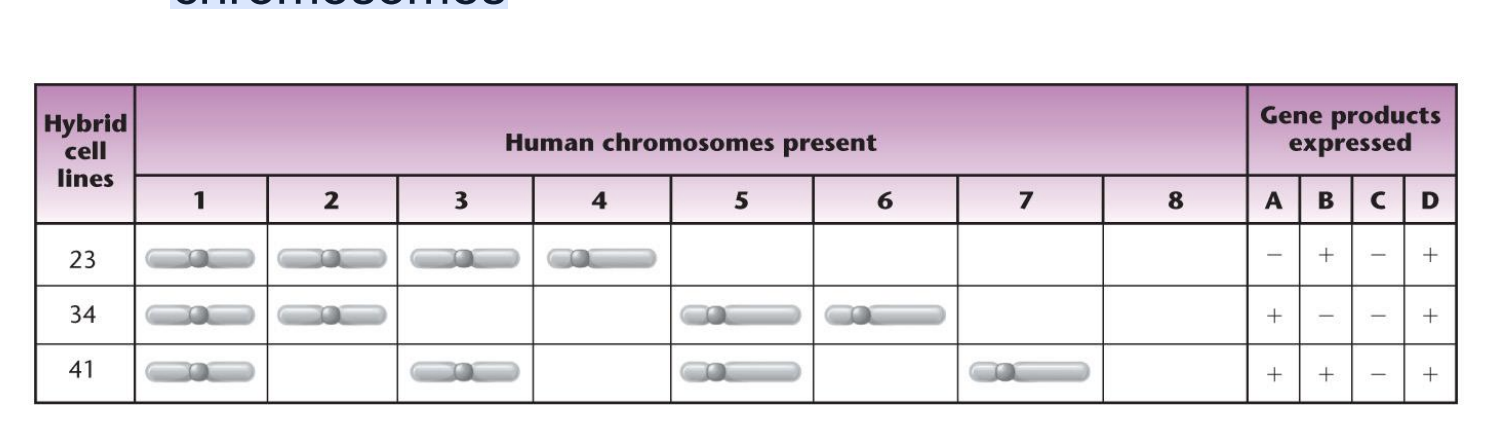
________
– Presence or absence of each chromosome, with presence or absence of each gene product
– Four gene products tested in relation to eight human chromosomes
Synteny testing
_______
– Short segments of DNA with known sequence and location
– Useful landmarks for mapping
– Earliest examples of DNA markers:
DNA markers
RFLPs and microsatellites
RFLPs: ____-___
– Polymorphic sites
– Generated when specific DNA sequences are recognized and cut by restriction enzyme
• Microsatellites
– Short repetitive sequences
– Found throughout genome
Restriction fragment length polymorphisms
SNPs: _______
– Found throughout genome
– Used by geneticists to identify and locate related genes
– Used to screen for diseases
▪ Example: ______
Single-nucleotide polymorphisms
Cystic fibrosis
________
– Gene located by using DNA markers
– Life-shortening autosomal recessive exocrine disorder
– Gene causing disorder found on chromosome 7
Cystic fibrosis
Genetic mapping techniques used to study relationship between _______.
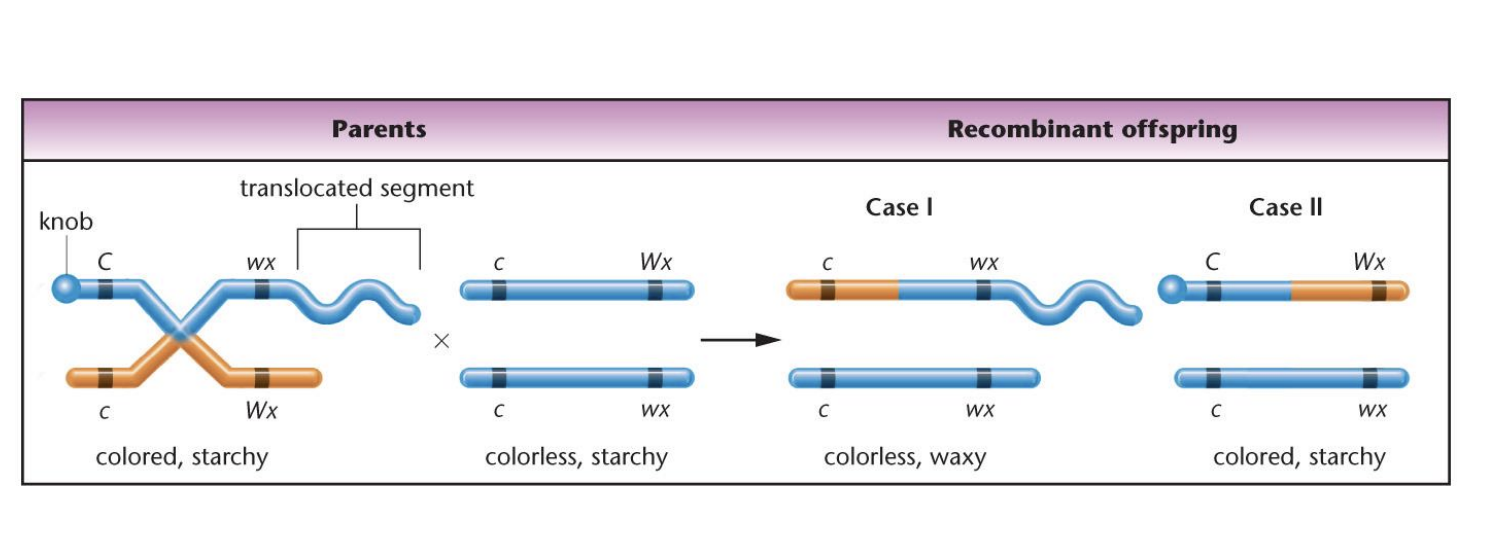
• Mapping in maize
– Used ________
– Established crossing over involves a physical exchange of chromosome regions
chiasmata and crossing over
cytological markers
_______ occur during mitosis but do not produce new allelic combinations.
Sister chromatid exchanges (SCEs)
________
– Reciprocal exchanges similar to crossing over
– Between sister chromatids (crossing over is between NONsisters)
_______ chromosomes
– Sister chromatids involved in mitotic exchanges
– Patch-like appearance when stained and viewed under a microscope
SCEs: Sister chromatid exchanges
Harlequin
Agents that induce chromosome damage
– ________
– Increase frequency of sister chromatid exchange in Bloom syndrome
______
– Human disorder
– Caused by mutation in ______ chromosome 15
– Prenatal and postnatal retardation of growth
– Excessive SCEs
– Many translocations
Viruses, X-rays, UV, mutagens
Bloom syndrome
BLM gene
BLM gene
– Encodes enzyme ______
– DNA helicase’s known role is _____
– Not known how it causes ______
DNA helicase
DNA replication
Bloom Syndrome
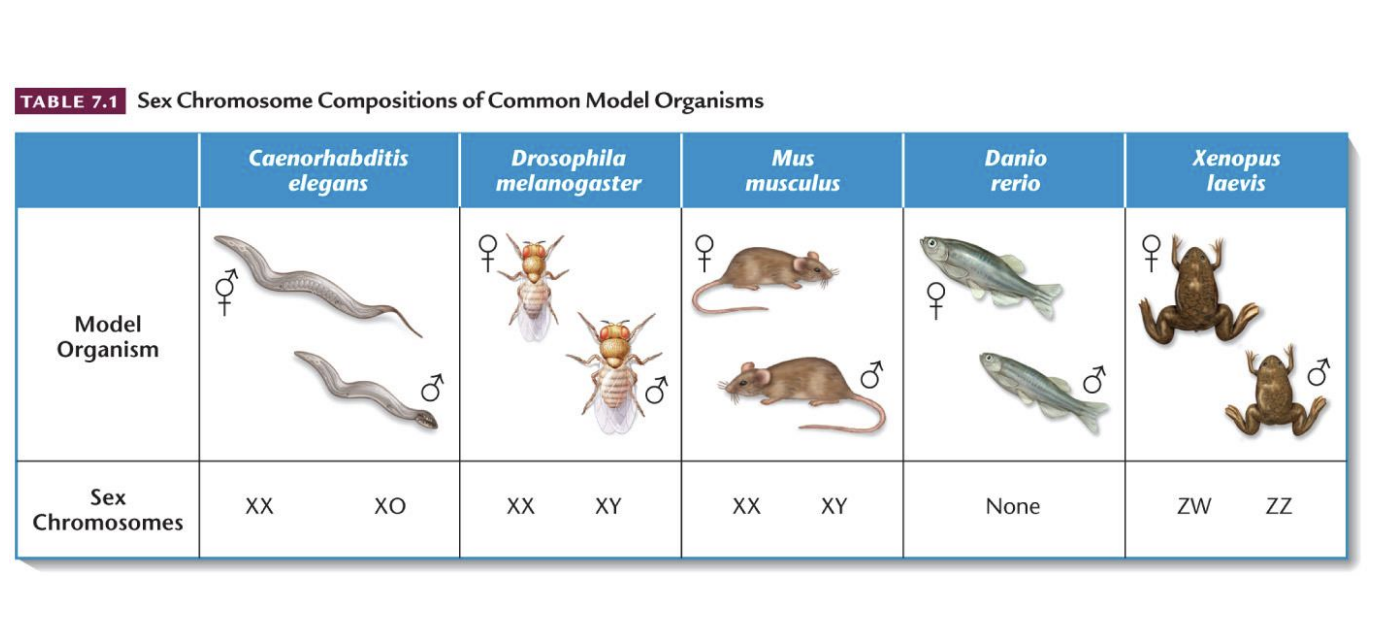
In animals, including humans, differentiation of sexes is evident via _____
_____ chromosomes
– Dissimilar
– Example: Sex chromosomes X and Y
________
– Characterize one sex or the other in a wide range of species
________
– By specific genes not entire chromosomes
phenotypic dimorphism
Heteromorphic
Sex chromosomes
Sex determination
Mode of sex determination: _____
– _____ of sex determination
– Depends on random distribution of X chromosome into half of male gametes
– Presence of _____ chromosomes in zygote results in female offspring
– Presence of _____ chromosome results in male offspring
Protenor
XX/XO mode
two X
one X
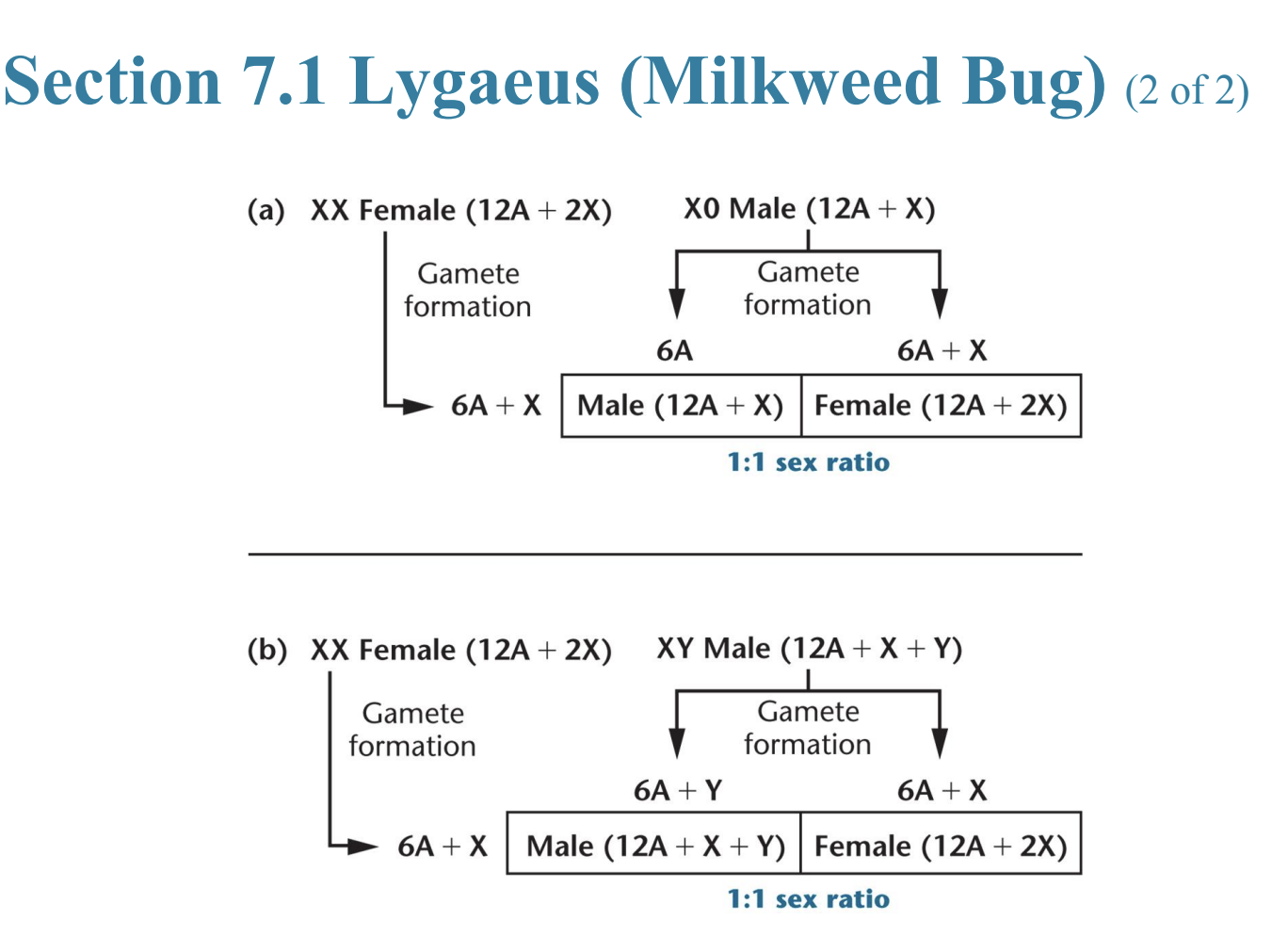
______ of sex determination
– ______ of sex determination
– Female gametes have one X chromosome
– Male gametes have either an X or Y chromosome
Lygaeus mode
XX/XY mode
_____ sex
– Producing like chromosomes
– Zygotes with two X chromosomes
– Results in female offspring
______ sex
– Producing unlike chromosomes
– Zygotes with one X and one Y chromosome
– Results in male offspring
Homogametic
Heterogametic
Females as ______ sex
–_______ sex determination
– Females are the heterogametic (ZW) sex
– Males are the homogametic (ZZ) sex
– Example: Chickens
heterogametic
ZZ/ZW
_______ determines maleness
– Human karyotype
▪ 22 pairs of autosomal chromosomes
▪ 2 sex chromosomes
▪ Reveals one pair of chromosomes differs in males
and females
– Females: XX
– Males: XY
Y chromosome
______ syndrome
– Two human abnormalities
– Characterized by aberrant sexual development
– Both syndromes result from _____
▪ Failure of X chromosomes to segregate during meiosis
Klinefelter and Turner
nondisjunction
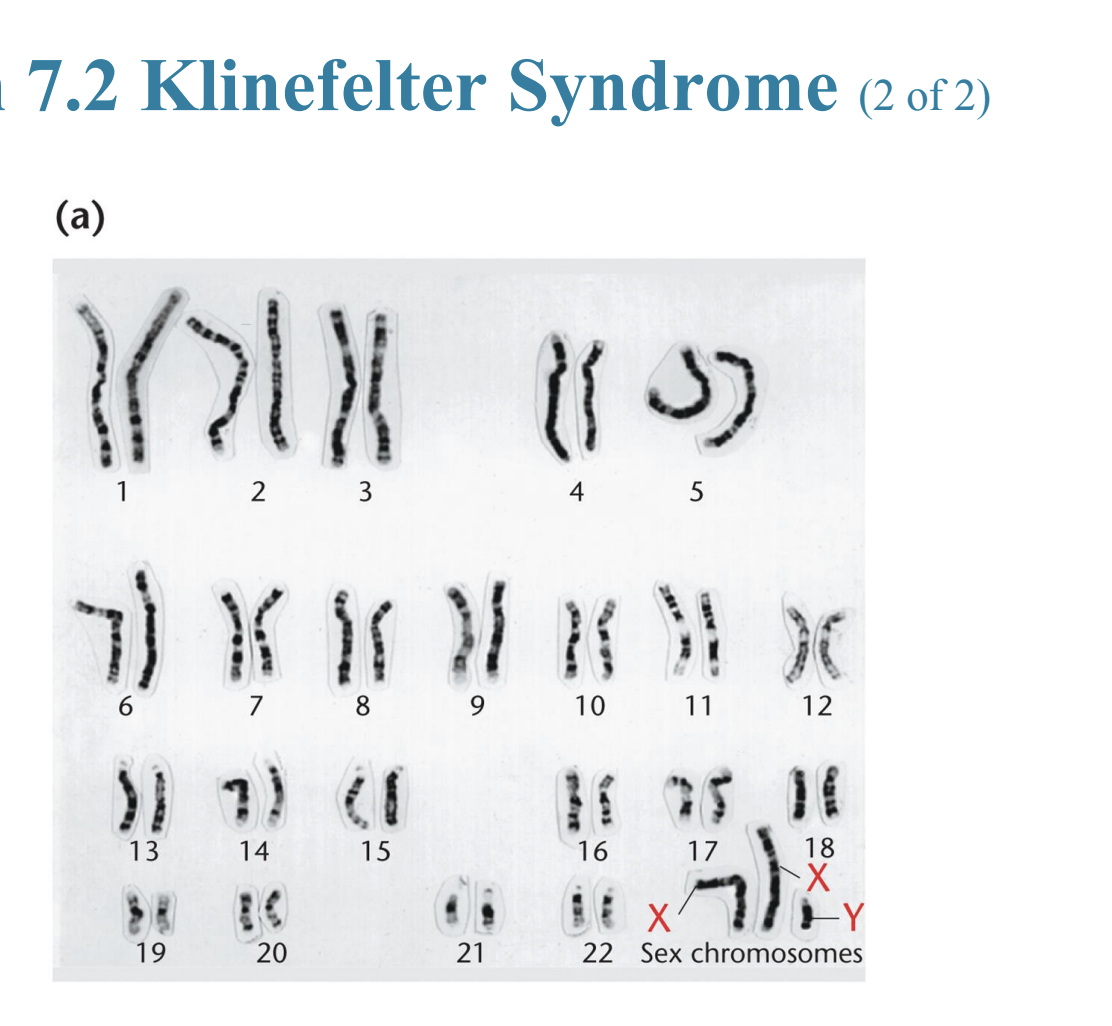
________
– Tall, long arms and legs
– Large hands and feet
– Internal ducts are male, rudimentary testes fail to produce sperm
– Feminine development not suppressed
▪ Enlarged breasts common, rounded hips
Klinefelter syndrome (47,XXY)
______
– Phenotypically female
▪ Female external genitalia and internal ducts
▪ Ovaries are rudimentary
▪ Underdeveloped breasts
– Short stature
– Cognitive impairment
Turner syndrome (45,X)
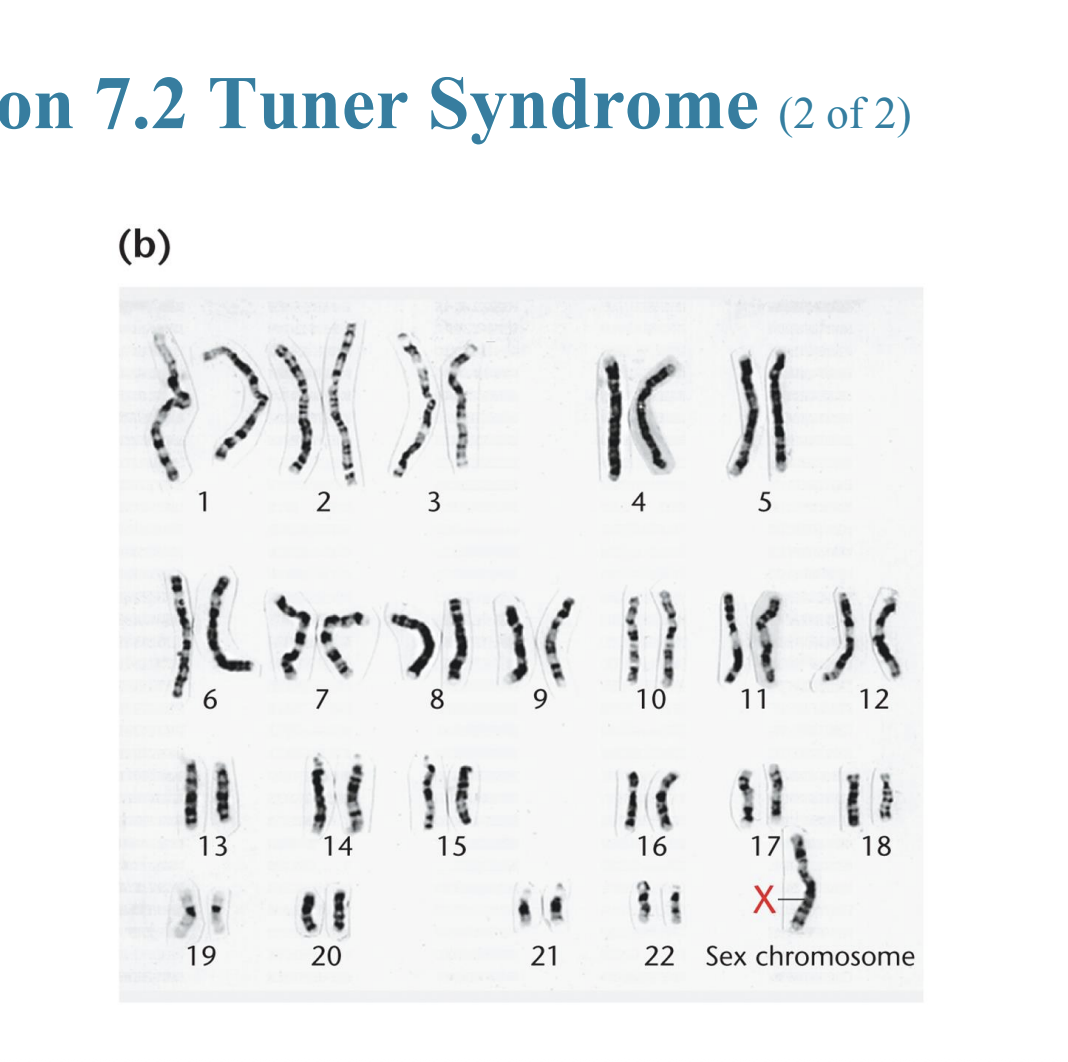
_________
– Three X chromosomes
– Normal set of autosomes
– Results in female differentiation
– Sometimes women are perfectly normal
– Sometimes underdeveloped secondary sex characteristics occur
▪ Sterility and mental retardation
-47,XXX syndrome: Triplo-X
_______
– Only consistently shared characteristic—males are over 6 feet tall
– Subnormal intelligence
– Personality disorders
47,XYY condition
_______
– The tissues that will form the gonad
By the fifth week of gestation, a pair of gonadal (genital) ridges associated with each embryonic kidney
Gonadal phenotype is sexually indifferent
– Primordial germ cells migrate to ridges
_______
– Gonadal ridges can form either ovaries or testes
Gonadal primordia
Bipotential gonads
Y chromosome and male development
– Y chromosome has at least ____ genes
– _____ genes than X chromosome (100 genes)
PARs: Pseudoautosomal regions
– Present on both ends of Y chromosome
– Share homology with regions on X chromosome
– Synapse and recombine with X during meiosis
50
Fewer
Pairing region critical to segregation of X and Y chromosomes during male gametogenesis
_________
– Nonrecombining region of Y chromosome
_______
– Located adjacent to PAR of the short arm of Y chromosome
– Controls male development
– Encodes protein: ______
MSY: Male-specific region of the Y
SRY: Sex-determining region Y
Testis-determining factor (TDF)
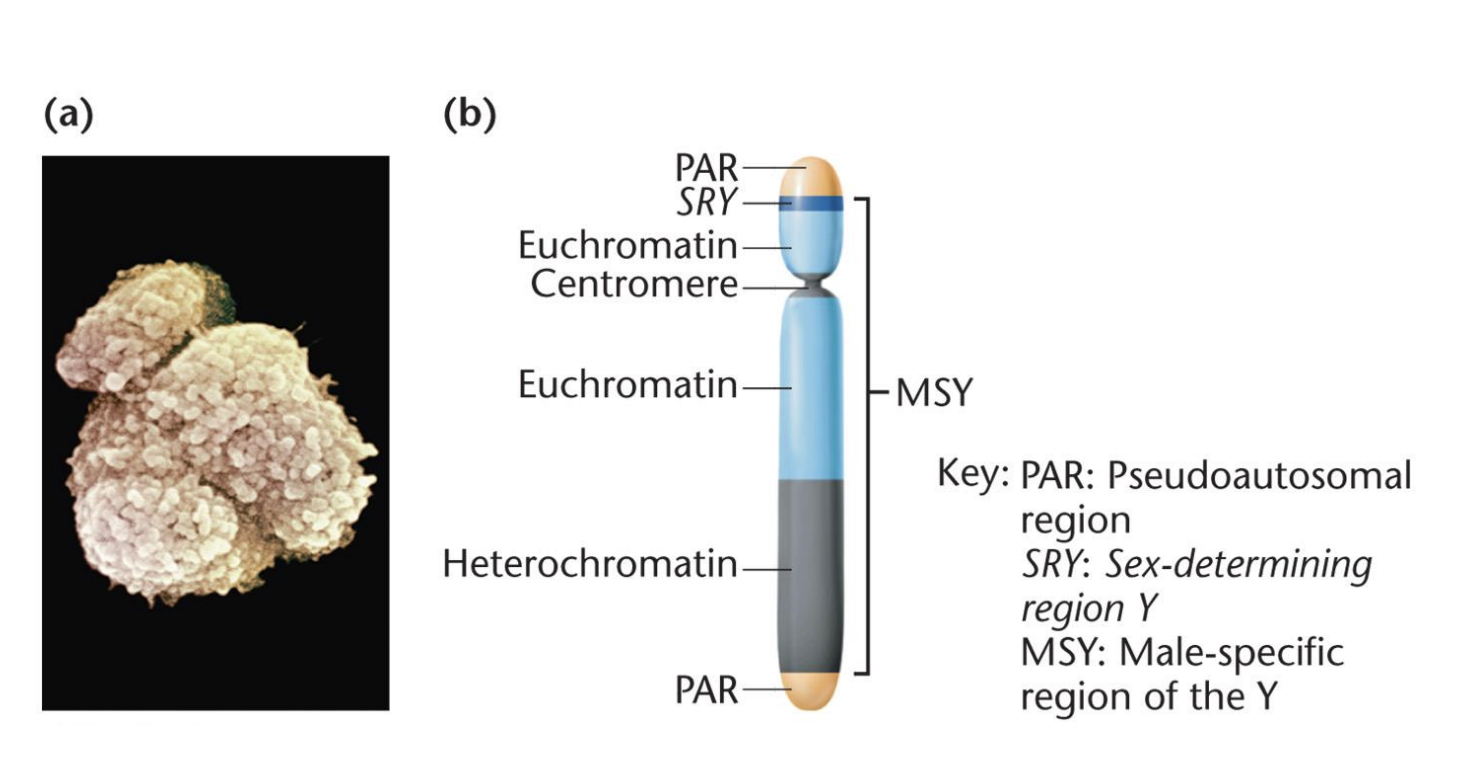
TDF: Testis-determining factor
– At 6–8 weeks of development, _____ gene becomes active in XY embryos
– Encodes protein that triggers testes formation
SRY
MSY: Male-specific region Y
23 million base pairs
Divided into three regions
– _______ region (15 percent of MSY)
– ________ region (20 percent)
– _______ region (30 percent)
▪ Encodes proteins specific to development and function of testis
X-transposed
X-degenerative
Ampliconic
_______
– Genetic mechanism
– Balances dose of X chromosome gene expression in males and females
– Prevents excessive expression of X-linked genes in humans and other mammals
Dosage compensation
________
– Genetic mechanism compensates for X dosage disparities
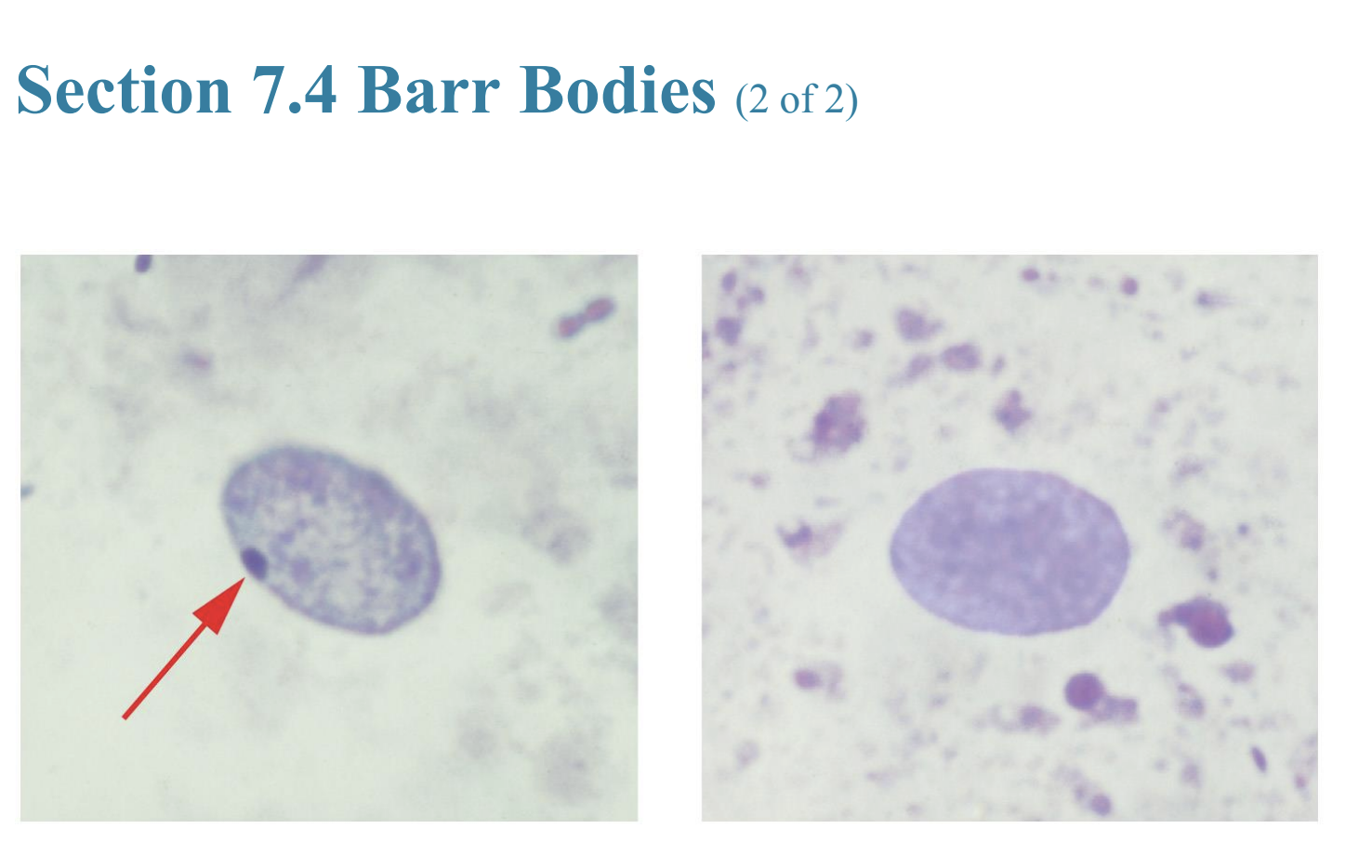
– Inactive X chromosome, highly condensed
– Darkly stained body in interphase nerve cells observed: _____
– Random inactivation
– Occurs early in embryonic development
Barr bodies (sex chromatin bodies)
Barr bodies
______
– Explains dosage compensation
– Follows N − 1 rule (N = total number of X chromosomes)
– Then why do we have Turner and Kleinfelter syndromes?
X-inactivation
Why does X-inactivation not affect syndromes such as Turner or Klinefelter?
– Chromosome inactivation not in early stages of development for cells destined for gonadal tissue
– Not all X chromosomes forming Barr bodies are inactivated
▪ 15% escape inactivation
______
– Glucose-6-phosphate dehydrogenase
– Synthesis of G6PD enzyme controlled by X-linked gene
– Experiment with G6PD mutants provides strong support of Lyon hypothesis
▪ Random permanent inactivation of X chromosome
G6PD
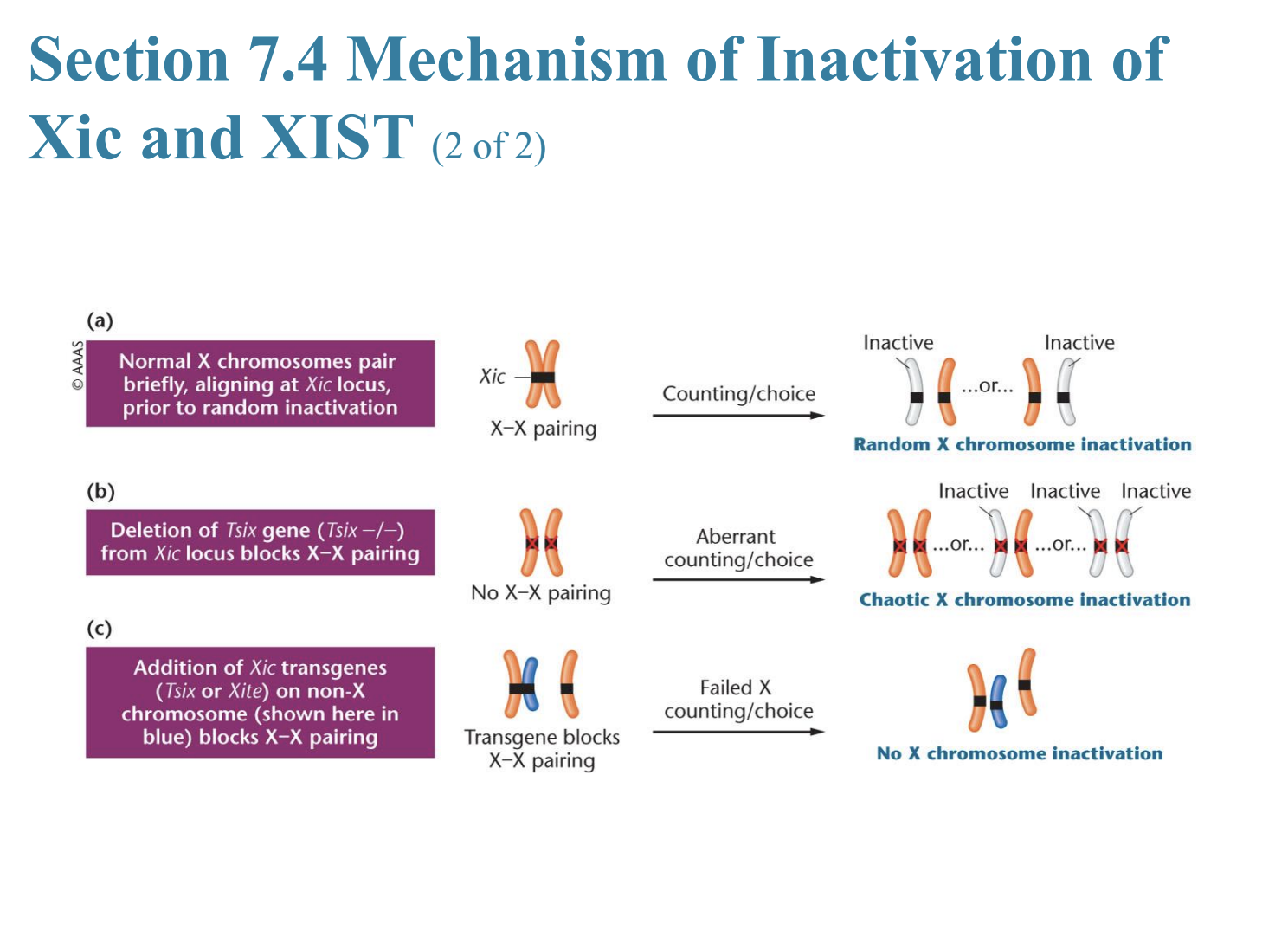
______
– Active only on inactive X
– Has ______ gene critical for X-inactivation
– Two noncoding genes in ____ locus
▪ _____ play important roles in X chromosome inactivation
Xic: X inactivation center
X-inactive specific transcript (XIST)
Xic
Tsix and Xite
_____
– At interphase, eukaryotic chromosomes uncoil and decondense into a form called chromatin
– During interphase, chromatin is dispersed throughout nucleus
– During cell division, chromatin coils and condenses back into visible chromosomes
Chromatin
______
– Positively charged proteins associated with chromosomal DNA in eukaryotes
– Contain large amounts of lysine and arginine
– Makes electrostatic bonding to negatively charged phosphate possible
• Five main types of histones
– H1, H2A, H2B, H3, and H4
Histones
_____
– Electron microscopic observations of chromatin revealed fibers composed of linear array of these spherical particles
– Resemble beads on a string
– Are condensed several times to form intact chromatids
Nucleosomes
_____
– Resemble beads on a string
– Are condensed several times to form intact chromatids
Nucleosomes
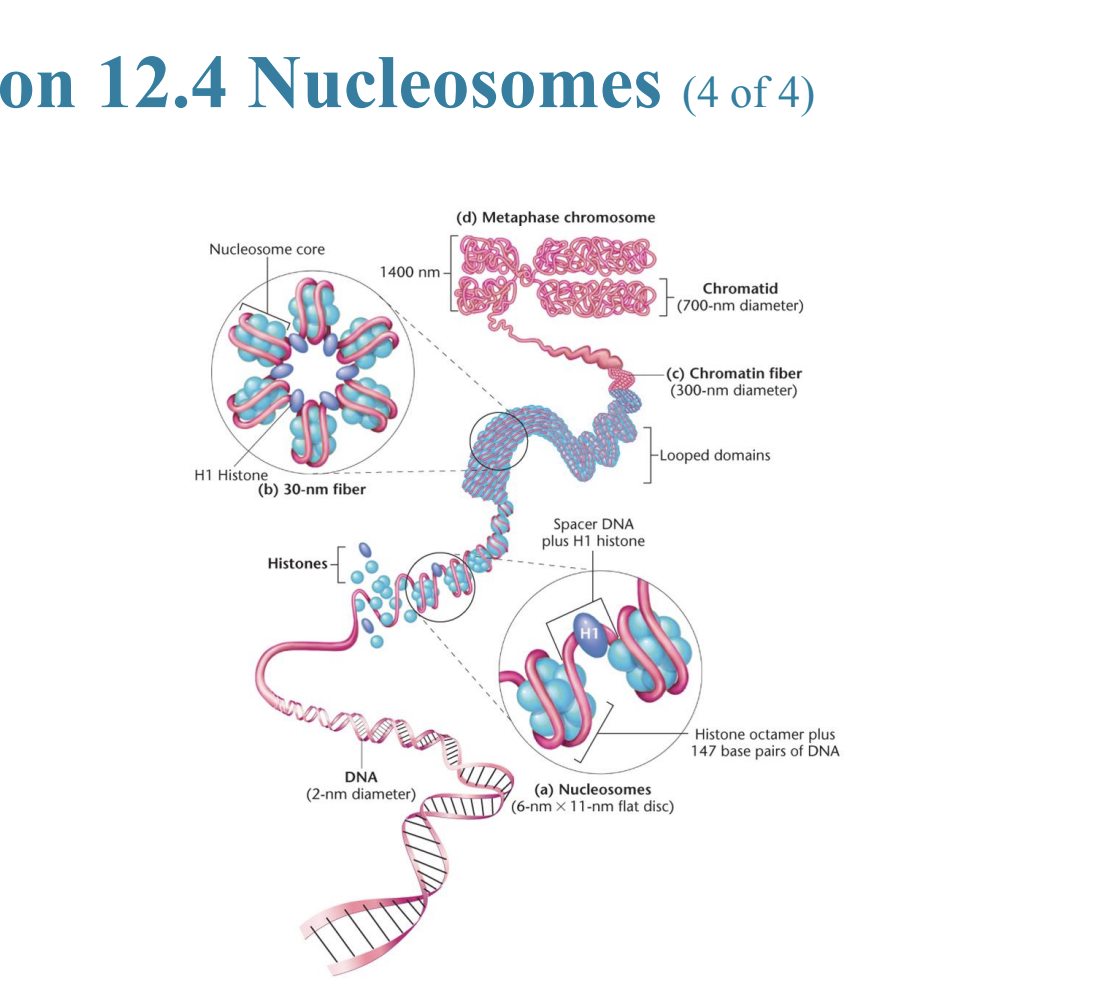
Twists and turns of DNA ____ encircle histones
Principal packaging unit of DNA in eukaryotic nucleus
Unstructured _____ are not packed into folded histone domains within nucleosome
– Tails devoid of secondary structure protrude through minor groove
superhelix
histone tails
_______ are important to genetic function
• Histone tails provide potential targets along chromatin fiber for chemical modifications
______
Chemical modifications
– Acetylation
– Methylation
– Phosphorylation
_______
– Enzyme histone acetyltransferase (HAT)
– Addition of acetyl group to positively charged amino group on side chain (lysine) changes net charge of protein by neutralizing positive charge
Acetylation
_____
– Enzyme methyltransferase
– Adds methyl groups to arginine and lysine residues in histones
– Positive correlation with gene activity
Methylation
______ of the nitrogenous base cytosine within polynucleotide chains of DNA
– Forms 5-methyl cytosine
– Usually negatively correlated with gene activity
Methylation
______
– Region of DNA where many cytosine guanine dinucleotides are present
CpG island
______
– Uncoiled and active
– Appears unstained during interphase
______
– Condensed areas are mostly inactive
– Appears stained during interphase
Euchromatin
Heterochromatin
_______
– Genetically ______: lacks genes or contains repressed genes
– Replicates later in S phase than euchromatin
– Telomere maintains chromosome integrity
– Centromere involved in chromosome movement
Heterochromatin
inactive