Business - Operations (Unit 4)
 Call Kai
 Learn
Learn Practice Test
 Spaced Repetition
 Match
Match Flashcards
 Knowt Play
1/86

There's no tags or description
Looks like no tags are added yet.
Name | Mastery | Learn | Test | Matching | Spaced | Call with Kai |
|---|
No analytics yet
Send a link to your students to track their progress
87 Terms
Operational Management
The process of managing resources and production activities to ensure goods or services are produced efficiently, on time, and to the required quality.
Examples of what operational management includes
- Planning production
- Quality control
- Improving efficiency
- Inventory and stock management
Operational objectives
specific, focused targets of the operations management function within an organisation
Why set objectives
To motivate, To lead to better decision making and for the greater coordination of resources
7 operational objectives
- Cost and Volume
- Quality
- Speed of response
- Flexibility
- Dependability
- Environmental objectives
- Added value
Cost and Volume
- Operations must be cost effective, so firms with the lowest unit cost are in a strong position over the market - Focus on Unit cost and productivity/ efficiency.
Quality
- The features of a product that allow it to satisfy customers. A reputation for quality becomes a USP - Focus on reducing scrap rates, improving reliability, developing customer loyalty and reducing complaints.
OTIF (Quality)
ON TIME and IN FULL - Measures how well a business meets customer delivery expectations - It is the % of customer orders that are delivered ON TIME and IN FULL.
Speed of Response
- Being a reliable and dependable supplier gives significant competitive advantage. SOR increases customer satisfaction and brand image, and can be achieved through a focus on stock management systems whilst streamlining the delivery process.
Flexibility
- Flexibility targets look at how effectively the assets of a business are being utilised and how responsive it is to short term changes - May have to adjust output levels, increase production without delays or scale down production if necessary.
Dependability
- Dependability relates to business' being able to keep promises E.G next day delivery - Focus on reducing product failure rate, on-time delivery rates, and increasing production reliability. Dependability can improve customer satisfaction, build trust and reputation as well as reduce costs.
Environmental Objectives
A positive attitude towards the environment gives a business a good reputation and helps attract staff - Focus on use of energy and reducing carbon footprint as well as supplying sustainable raw materials. Can improve brand image, meet legal requirements and attract customers and potential investors
Added Value
- Increasing the worth of products so the business can charge premium prices to improve profit margins and competitiveness - Focus on product design and innovation as well as offering customisation and personalisation. Can increase profits and support premium pricing.
Added value (Formula)
Selling price - cost of materials = added value 'mark-up'
Internal influences on operations objectives
- Business resources = Availability of staff etc...
- Finance = Budgets
- Business culture = Focus on innovation?
- Staff skills and expertise
- Management style = Can influence quality, output or innovation.
External influences on operational objectives
- Market demand = High/ low means change to production
- Competition = Create pressure
- Economic factors = Inflation, interest rates tec..
- Technological change = Faster and cheaper production
- Legal/ regulatory factors = Health & safety, environmental laws etc...
- Suppliers = Reliability and costs influence schedules
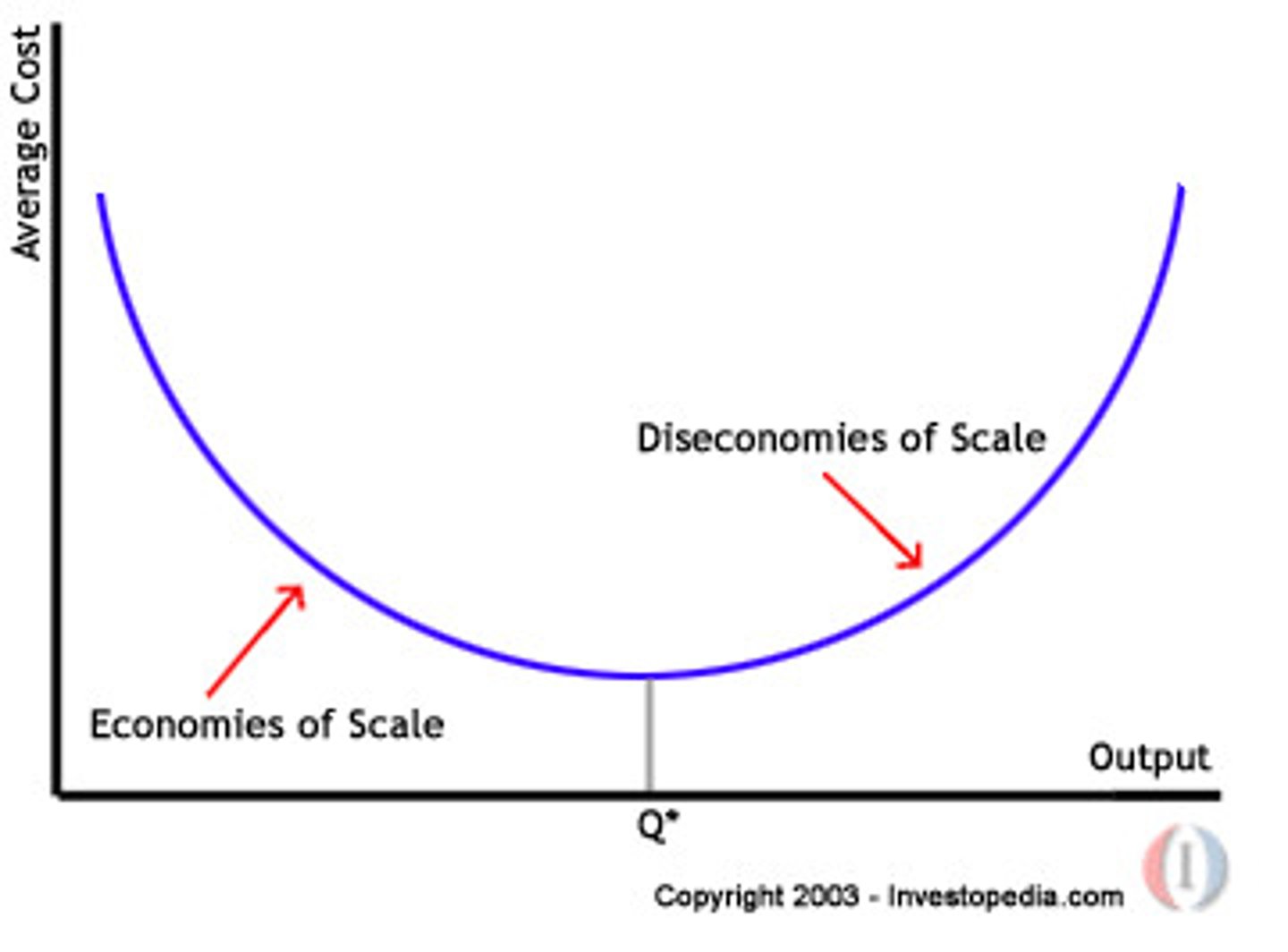
Economies of Scale
When an increase in the scale of production leads to reductions in average total costs.
Purchasing economies
Buying in bulk reduces the cost per unit of raw materials
Marketing economies
Advertising costs are spread across more units, reducing average cost per product
Technical economies
Using more efficient machinery or production techniques reduces costs
Managerial economies
The employment of specialist managers improves efficiency and decision making
Financial economies
Bigger firms can borrow at lower interest rates and access cheaper finance
Specialisation economies
Workers or machines focusing on specific tasks become more skilled and productive
R&D economies
Costs of innovation are spread over a large output reducing cost per unit
Social and welfare economies
Providing benefits like training, health and childcare improves productivity
Diseconomies of scale
As a business grows, many problems arise within its structure. Eventually, average unit costs begin to rise as output continues to rise.
Coordination diseconomies
This occurs due to a loss of control by management as the firm becomes more complex. Less control means staff are less likely to follow policies, which become more rigid as a firm grows, making it inflexible to changes in demand.
Communication diseconomies
Too many levels in a hierarchy can reduce the effectiveness of communication. Messages may become distorted, potentially resulting in standardised messages which make employees feel disvalued.
Motivation diseconomies
Bigger firm means more difficult to assess the needs of individuals. It also means there is less time for reward and recognition.
Other DEOS
- Technical
- Excessive bureaucracy
- Staff problems
- Less Flexibility
Capacity
Maximum total level of output or production that a business can produce in a given period
Capacity utilisation
The % of a firm's total possible production level that is being reached.
Under-utilisation of capacity
When a firm's output is below the maximum possible. Optimum is around 90%, so anything below that is a waste of resources and money.
Capacity shortage
When a firm's capacity is not large enough to deal with the level of demand for its products.
Capacity factors
- Flexibility of production line
- Demand
- Seasonality of output
- Seasonality of demand
- Implications of failure to meet demand
- Subcontracted production
Advantages of under-utilisation of capacity
- Time for maintenance
- Less pressure on employees
- Cope with sudden changes in demand
Disadvantages of under-utilisation of capacity
- Higher fixed costs per unit
- Employees feel bored and demoralised
- Negative image (unsuccessful)
Overcoming a capacity shortage
- Extend premises
- Offer overtime or extend hours
- Hire new staff
- Outsource
High capacity
Optimum capacity is around 90%, operating closer to 100% leaves little capacity spare.
Benefits of high capacity
- Lower average costs
- Higher profit margins
- Improved efficiency and competitiveness
Drawbacks of high capacity
- Burnout (staff & machinery)
- Diseconomies of scale
- Potential CSR issues
Subcontracting
When a firm asks another business to make all or part of its product.
Benefits of subcontracting
- Allows focus on core business
- Subcontractors can be specialised
- Respond to changes in demand
Drawbacks of subcontracting
- Quality not under direct control
- Subcontractor wants profit too, so can be expensive
- May require giveaway of confidential information
Rationalisation
A process by which a firm improves its efficiency by cutting the scale of operations.
Factors of production
CELL
Capital = machinery, tools etc...
Enterprise = Skills of entrepreneurs
Land = Natural resources
Labour = the workforce
Productivity
A measure of the overall production of a business, using the resources available to achieve maximum output.
Labour productivity
A measure of the output per worker
Advantages of high labour productivity
Lower labour cost per unit
Greater competitiveness
Higher profit margins
Increase output without increasing costs
Difficulties of improving labour productivity
Training is costly and time consuming
Costly to employ more staff
Financial motivation methods lose efficiency in long-term
Lean production
A management approach that aims to minimise waste and maximise efficiency by producing only what is needed and when.
Just in time production (element of Lean)
Items of stock arrive as and when needed, in only the quantities needed at the time.
Push - Pull comparison (JIT)
Traditional businesses 'push' the product through the production process but JIT businesses 'pull' the production through by the demand from customers.
Benefits of JIT
Lower costs - No stockpiling
Reduced waste - Arrive only when needed and in smaller quantities
Improved quality - Smaller deliveries so faults less likely
Drawbacks of JIT
High dependence on suppliers - Must be on-time
Risk of stock shortages - Potential of delays
Requires cultural shift - Not for all businesses
Kaizen
Eliminating waste and improving quality through continuous improvement in the form of small incremental changes.
Labour intensive
where production relies more heavily on labour relative to machinery
capital intensive
using more capital (machinery etc...) than labor in the production process
Examples of Technology to improve operational efficiency:
Automated stock control systems
Barcodes are used so firms know what comes in and out of the business, allowing up to date records and link goods to reorder systems.
- Can aid decision making by showing what goods do well and where.
CAD (Computer-Aided Design)
Use of computer systems to plan, operate and control production. E.G, 3D drawings that can be used to simulate testing and save costs hugely.
3D printing
Cheaply producing small or to scale prototypes from any digital design. Economies of scale no longer exist.
Robotics
The use of programmable machines to carry out production tasks automatically.
- Used in assembly, welding and quality control for example.
- Removes human errors and improves health and safety.
EDI
EDI = permanent link between PCs enabling specified types of data to be exchanged
- Can communicate with suppliers and monitor planning, control and operating.
ICT
Technological tools and resources used to transmit, store and create information. Sharing data through the use of the internet.
- Eliminates the need for high street stores and adds flexibility to operations
Quality
Providing what the customer wants at the right time, to the right standard of product and service. Poor quality can lead to a bad reputation and wastage.
Relationship between quality and demand
As quality rises, customer demands also change as they want more from a product or service.
Tangible measures of quality
Appearance
Durability
Reliability
Functions
Intangible measures of quality
Brand image
Exclusiveness
Benefits of improving quality
Competitive advantage
Increase in sales
Brand loyalty and reputation
Quality control
Improving quality by removing faults at the end. Checking only at the end of production
Quality assurance
Improving quality by building it into every stage of the production process. Getting it 'right first time'
Issues with quality control
- if one product is faulty the whole batch goes to waste
- does little to encourage individuals to improve the quality of their output.
Advantages of quality assurance
- Encourages individual to improve the quality of their own output
- cheap to use current staff rather than employing a specialised inspection team.
TQM (Total Quality Management)
A culture of quality that involves all employees of a firm aiming to remove all errors. Key philosophy includes a 'right first time' approach as well as building rapport with suppliers.
Benefits of TQM
Competitive advantage
Reduced defect rate
Reduced costs
THEREFORE LESS WASTAGE
Issues with TQM
Initial set up costs
Staffing issues (higher pay and more training)
Disruption to existing production
Other quality initiatives
1) Quality circles - employees who meet regularly to discuss issues and recommend changes
2) Zero Defects - A concept which aims to eliminate all errors focusing on prevention rather than inspection.
Competitive Advantage
The ability of a business to perform better than competitors by offering greater value for customers or operating at lower cost.
Managing the supply chain
The supply chain is the complete sequence of stages involved in getting raw materials into a finished good. Efficient management involves being tough with suppliers for lower costs and creating competition with suppliers to reach better deals.
Factors affecting choice of supplier
Cost
Quality
Reliability
Frequency
Flexibility
Payment terms
(Cont onto next cards)
Cost
- Lower supplier costs means reduced unit cost and rising gross profit.
Quality
High quality inputs reduce wastage and directly impacts the quality of the final goods. Cheap suppliers often relate to a lack of quality
Reliability
Just be able to deliver OTIF. This helps avoid delays and therefore shortages. Highly crucial for JIT businesses
Frequency
Frequent deliveries mean lower stock levels which lowers storage costs and unit costs.
Flexibility
Suppliers need to match the changing demand of businesses. Those with erratic demand need suppliers that can cope and deliver.
Payment terms
Use of credit to pay off bills. Generous terms improve cash flow and capital.