PSYCH 210 EXAM #4
 Call Kai
 Learn
Learn Practice Test
 Spaced Repetition
 Match
Match Flashcards
 Knowt Play
1/52

There's no tags or description
Looks like no tags are added yet.
Name | Mastery | Learn | Test | Matching | Spaced | Call with Kai |
|---|
No analytics yet
Send a link to your students to track their progress
53 Terms
CHAPTER 14: Assesment and Treatment of Challenging Behavior
Explain how problem behavior is culturally defined
Be able to identify “problem behaviors” and know what behavior analysts usually mean when they talk about problem behavior
Understand and be able to describe the three methods of determining the function (cause) of problem behavior
Know the antecedent manipulation, consequence for problem behavior, and likely reinforcer for each of the “standard” functional analysis conditions
Be able to interpret (determine the function of a behavior) a functional analysis outcome graph
Be able to explain what automatic reinforcement is, what condition tests for it, and what functional analysis graph patterns would indicate automatic reinforcement
Understand the criticism of a functional analysis, and be able to explain the allergist analogy as a response
Be able to identify the two goals of treatment
Understand the role of baseline and what a reversal (or withdrawl) design is
Be able to define/describe the “types” of differential reinforcement and how they might be applied to the treatment of problem behavior
Be able to define/describe NCR. Why does it work? Why doesnt it work? Why is it less preferred than DR?
CH 15: Respondent Conditioning
S-R Relationships
in the early days of behavioral psychology researchers attempted to force all behavior into the S-R relationship
skinner and others suggested that was NOT sufficient, and thus born the operant class conception
Synonyms for respondent conditioning
Respondent Conditioning
Pavlovian Conditioning
Classical Conditioning
Understand how the concept of stimulus control relates to respondent conditioning
Respondent conditioning is an instance of stimulus control applied to stimulus presentation, NOT consequential operations
Translation: we only manipulate the environment before behavior. We measure behavior after our manipulation, it there are no consequences for behavior
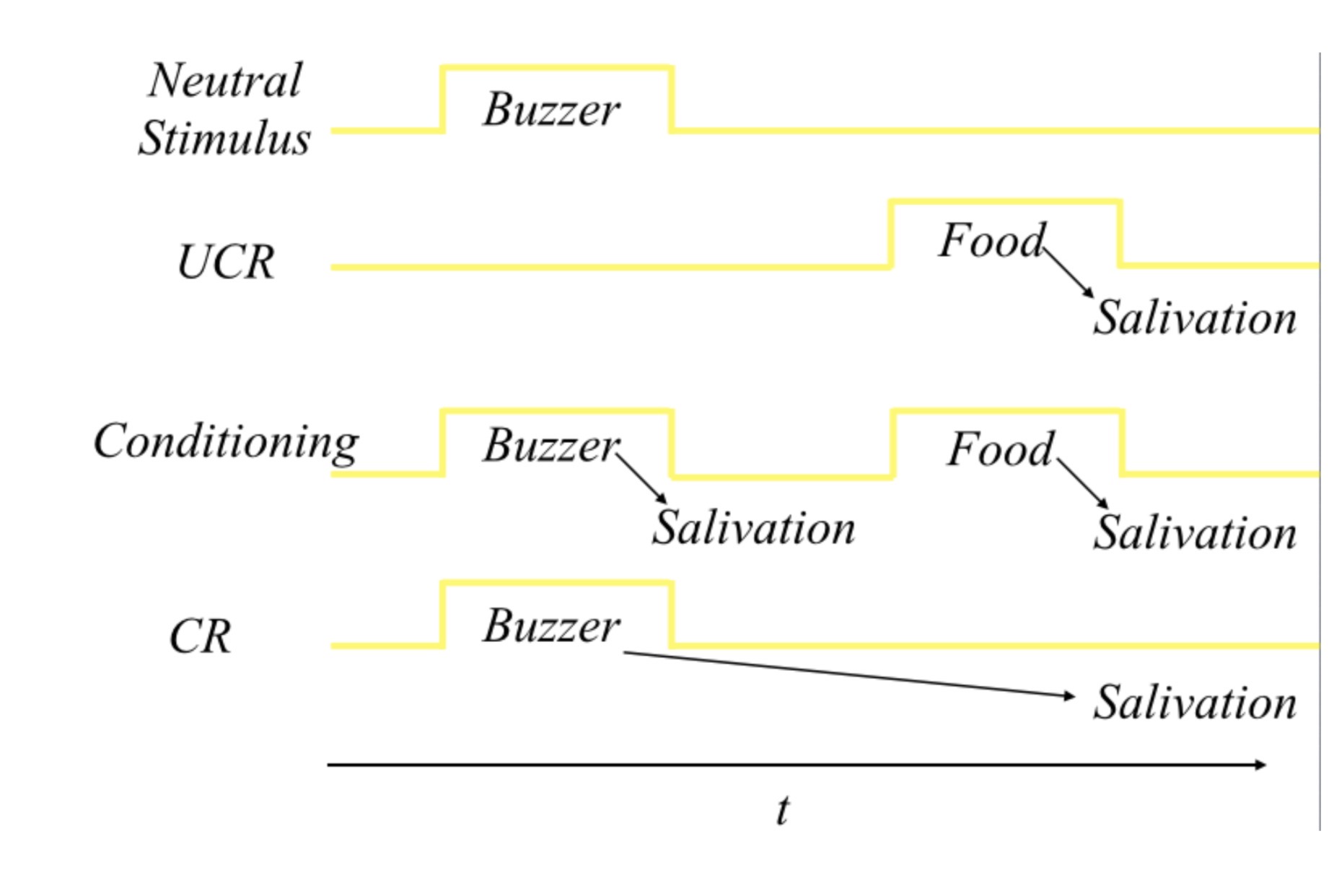
be able to descrube the essential features of Pavlovs experiments (using food and aversive stimulation)
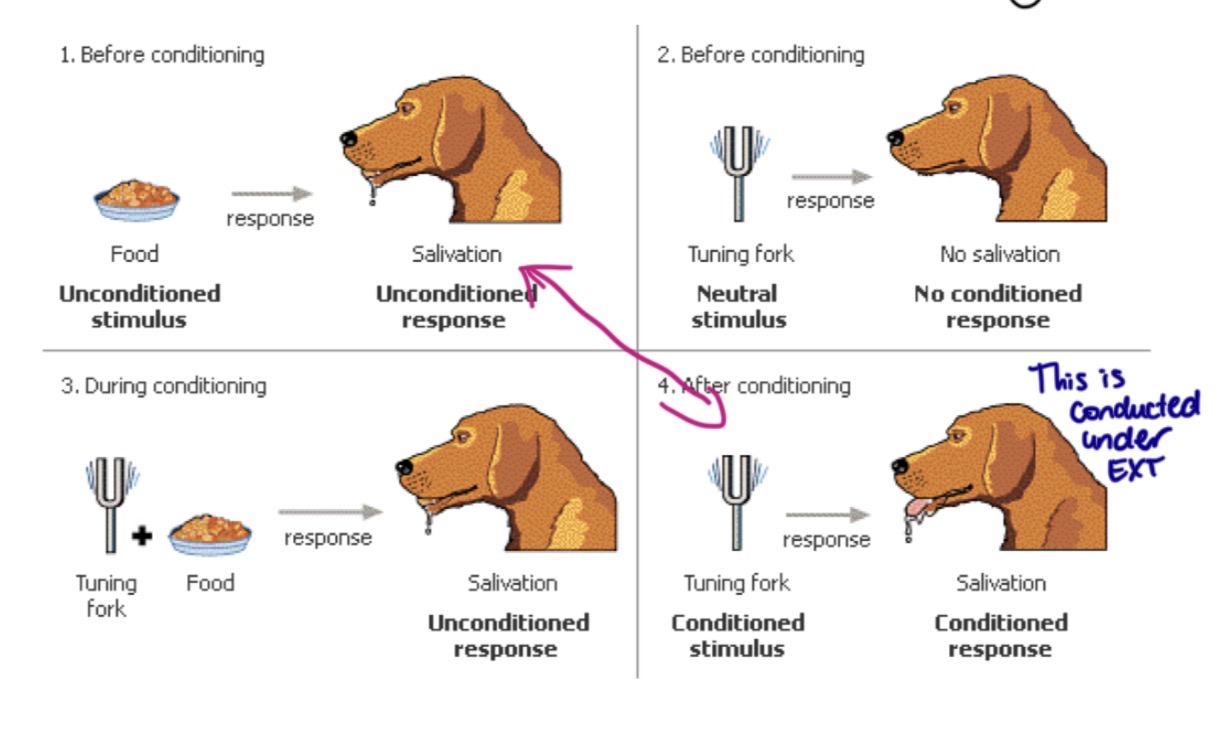
neutral stimulus (NS)
a stimulus has that no eliciting effect (beverage, money)
unconditional stimulus (US)
a stimulus that elicits a reflex (response) without any prior history
(stimulus that the baby WILL react to: hot, cold, bright, or even a pacifier)
conditional stimulus (CS)
a previously neutral stimulus that now elicits a response due to its pairing with a unconditonal stimulus
conditional response (CR)
the response that is learned. It occurs following following the presentation of the conditional stimulus
unconditional response (UR)
the response that occurs, reflexivity, following the presentation of the unconditional stimulus
respondent conditioning
the process whereby a neutral stimulus (NS) acquires characteristics of an unconditonal stimulus (US)
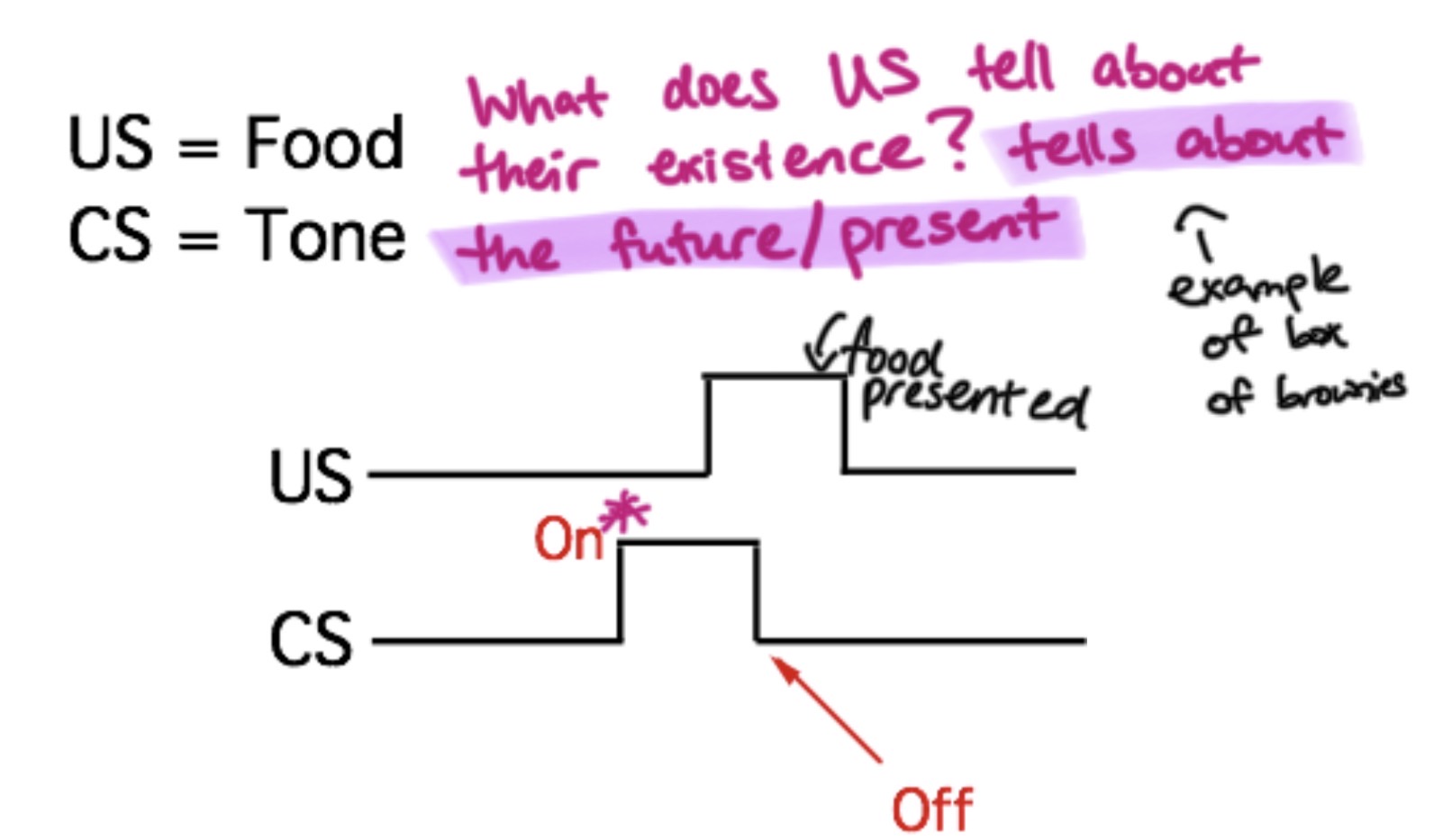
delay conditioning
The CS is presented for a period of time before the US, and may overlap with the US.
More effective when there’s an overlap
What does US tell the organism about its existence? Tells about the future/present
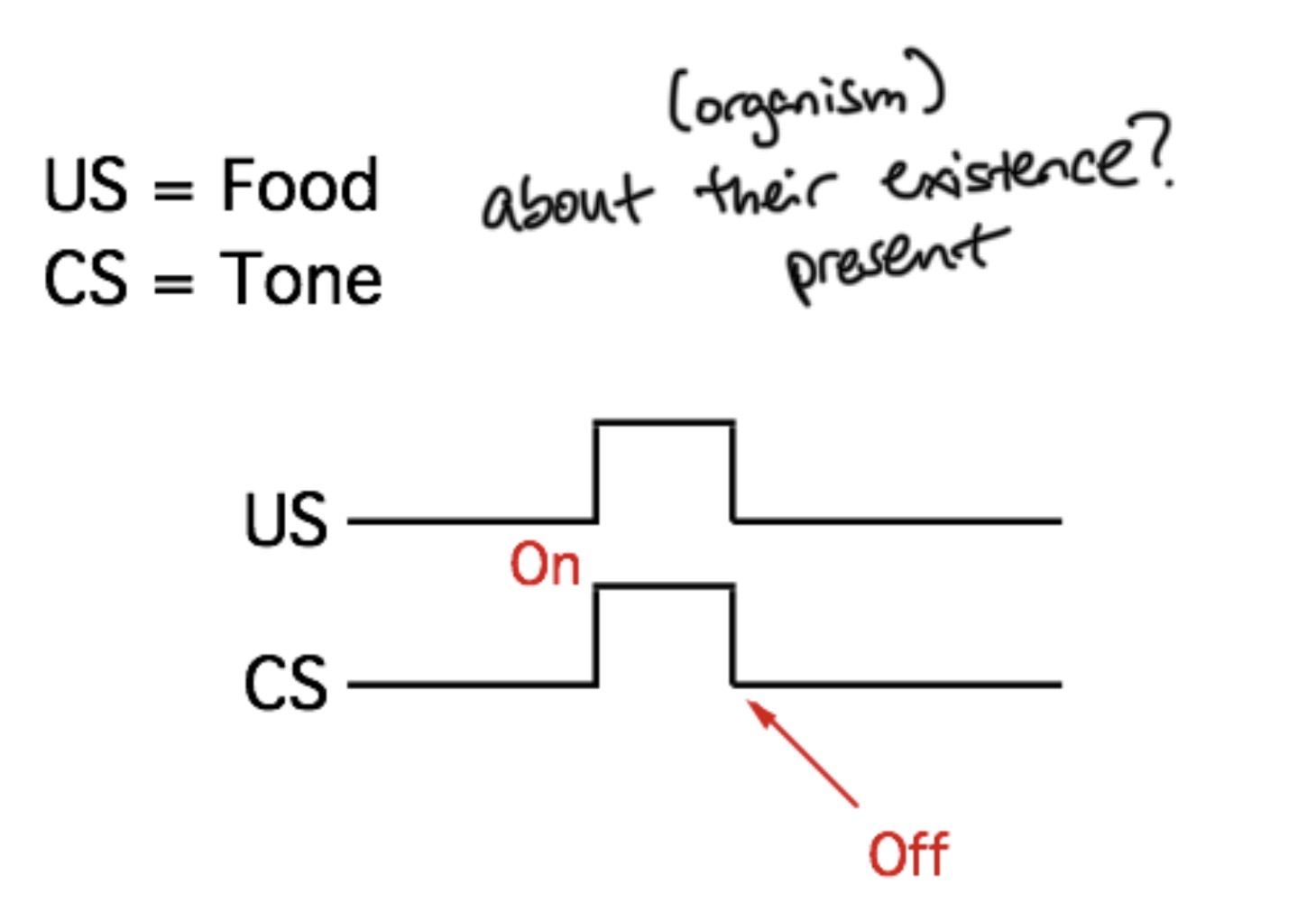
simultaneous conditioning
The onset of the CS preceeding that of US by no more than 5 seconds
Some have suggested that if the CS doesn't tell you anything (any information about what’s coming up), conditioning will NOT occur. But it DOES!
The fact that the CS tells you about what is coming probably makes conditioning more likely, but it’s not required
What does the US tell the organism about its existence? Their present
trace conditioning
The CS is presented for a brief period of time (it turns on and then off), and some time later, the US is presented
The effectiveness of this procedure will vary depending on the time between the CS and the US.
Trace and Delay conditioning are distinguished by whether the CS turns OFF (Trace) or remains PRESENT (Delay)
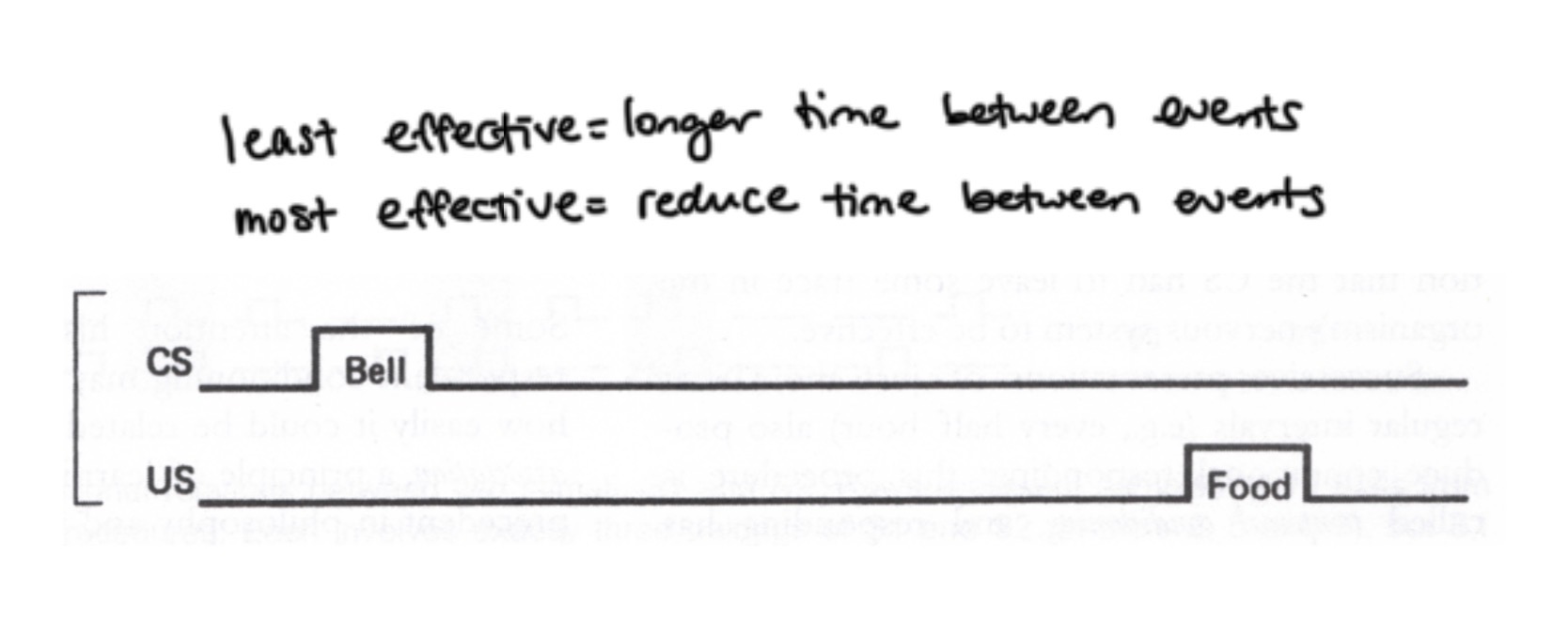
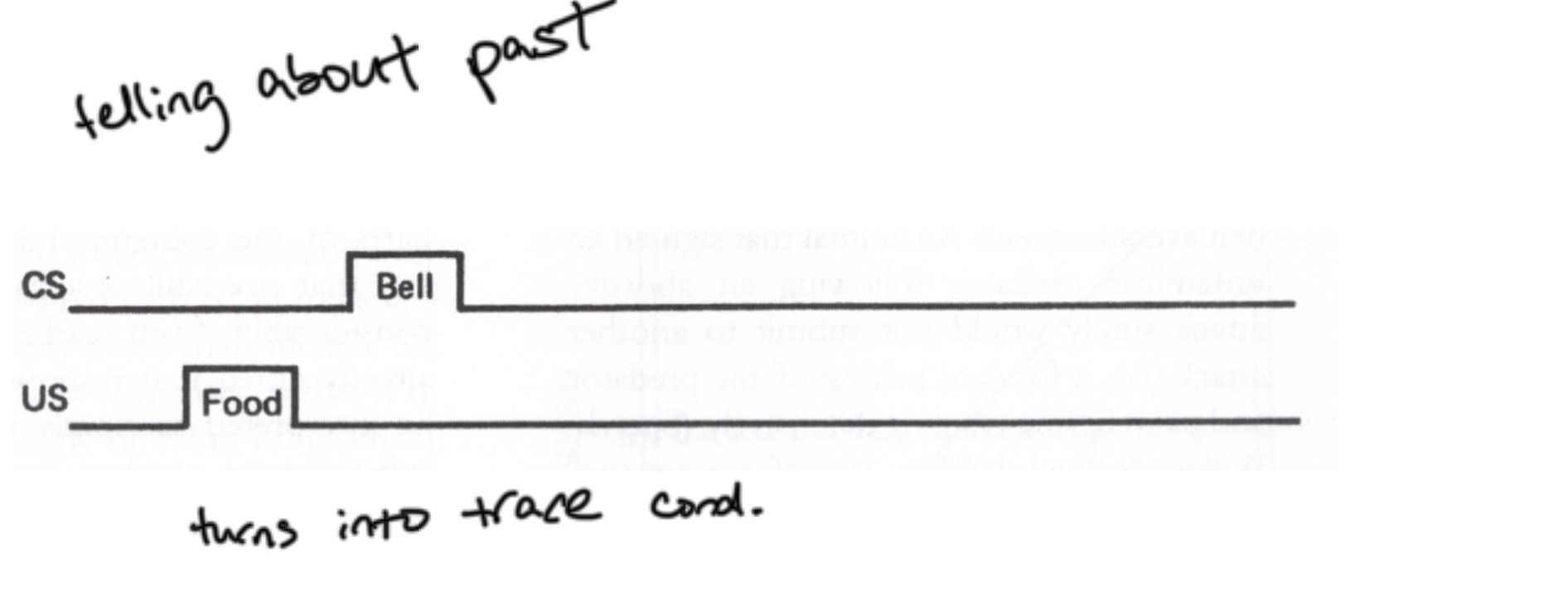
backward conditioning
The US is presented and consumed before the CS is presented
be able to describe the essential features of John B. Watsons experiment
Little Albert gets presented with various stimuli
Fire- reaches to touch
Monkey on a leash- Not scared and looking at the monkey
Dog- Not scared, tries to grab and touch it
Rat- not scared
Rabbit- not scared
Research will play a loud noise stimulus in the presence of animals
Rat- Albert tried to touch, the sound went off, Albert began to cry
Rabbit- He cries
When showing Albert the rest of the animals, he would cry because of the possibility of being startled by the loud stimulus
What’s the NS? The animals and the fire
How did the conditioning occur? the loud noise paired w/ reaching for the animals
Be able to describe the essential features of the respondent conditioning illustrations (videos) from a popular television program and an eager college student
The Office: Jim doing the Pavlov experiment on Dwight
Anytime Jims computer makes a sound, he would offer dwight candy, dwight would take it
He continued to do this for awhile
Jim computer makes a sound and Dwights hand immediately goes towards Jim to receive the mint, but Jim looks confused like he doesnt know why hes doing it
The NS- the computer sound
Conditioning occured by- pairing the computer sound with the reward of the candy
During the EXT trial- Dwight reached hand out for mint
College st
be able to describe why the conidtional stimulus is not a discriminative stimulus
It does tell you it will happen BUT doesn’t give you a particular way to behave that will reinforced
It is an antecedent because it simply describes the temporal order of things (it comes “before” or “first”)
but it does signal that a certain type of behavior will be reinforced
Understand how respondent conditioning plays a role in shaping human emotion
When we remember important, meaningful events that happen in our lives, we tend to recall things that co-occurred with those events (ie, we’re paired with those events)
This is applied to both tragedy and moments of sheer joy and happiness
Flashbulb memories- vivid memories created and retained
Historical- 9/11, WW1/2
Autobiographical-
when stimuli that were present during that initial pairing “reappear” these stimuli have to capacity to “elicit” responses that you experienced at the initial pairing
CHAPTER 16: Respondent Conditioning II
Dr. No Shot relates to respondent conditioning
stimuli that accompany aversive stimulation can become aversive. Stimuli that accompany positive reinforcement can become reinforcing
acquisition
initial learning of the coniditonal response. Speed of acquisition is measured by the number of trials until the CS elicits a CR without the US.
habituation
When a US repreatedly elicits a UR and the response gradually declines in magnitude
respondent extinction
Repeated presentation of the CS without the US
The CS will eventually lose its effects (CR)
spontaneous recovery
overshadowing
blocking
compensatory responses
tolerance
understand how acquisition can be facilitated by the magnititude of the US
If we pair 3 lights, of different color, with a different magnititude of the US, will the CR differ, in mangitiude
Slow US gives small mangitiude
Fast US gives larger magnititude
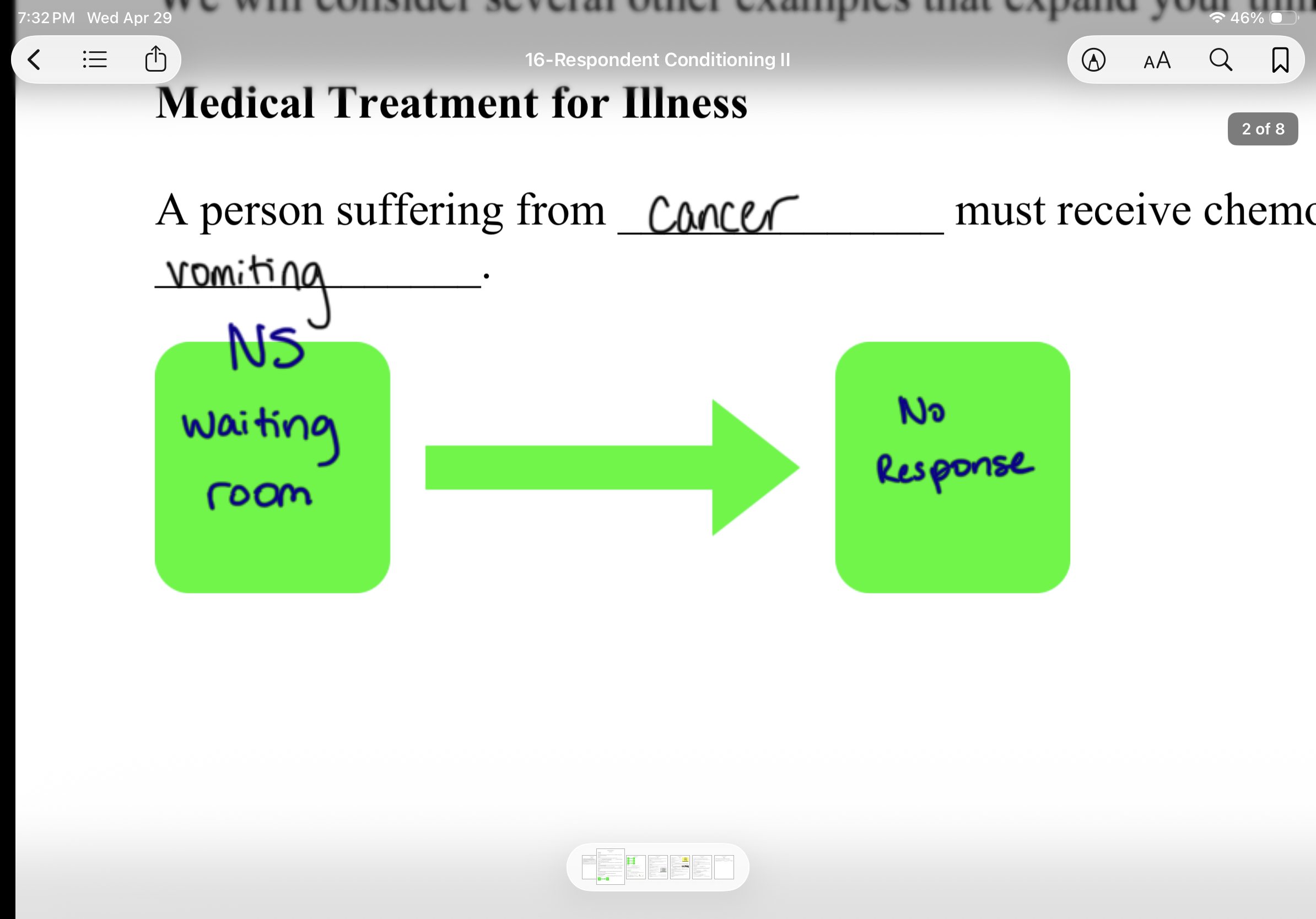
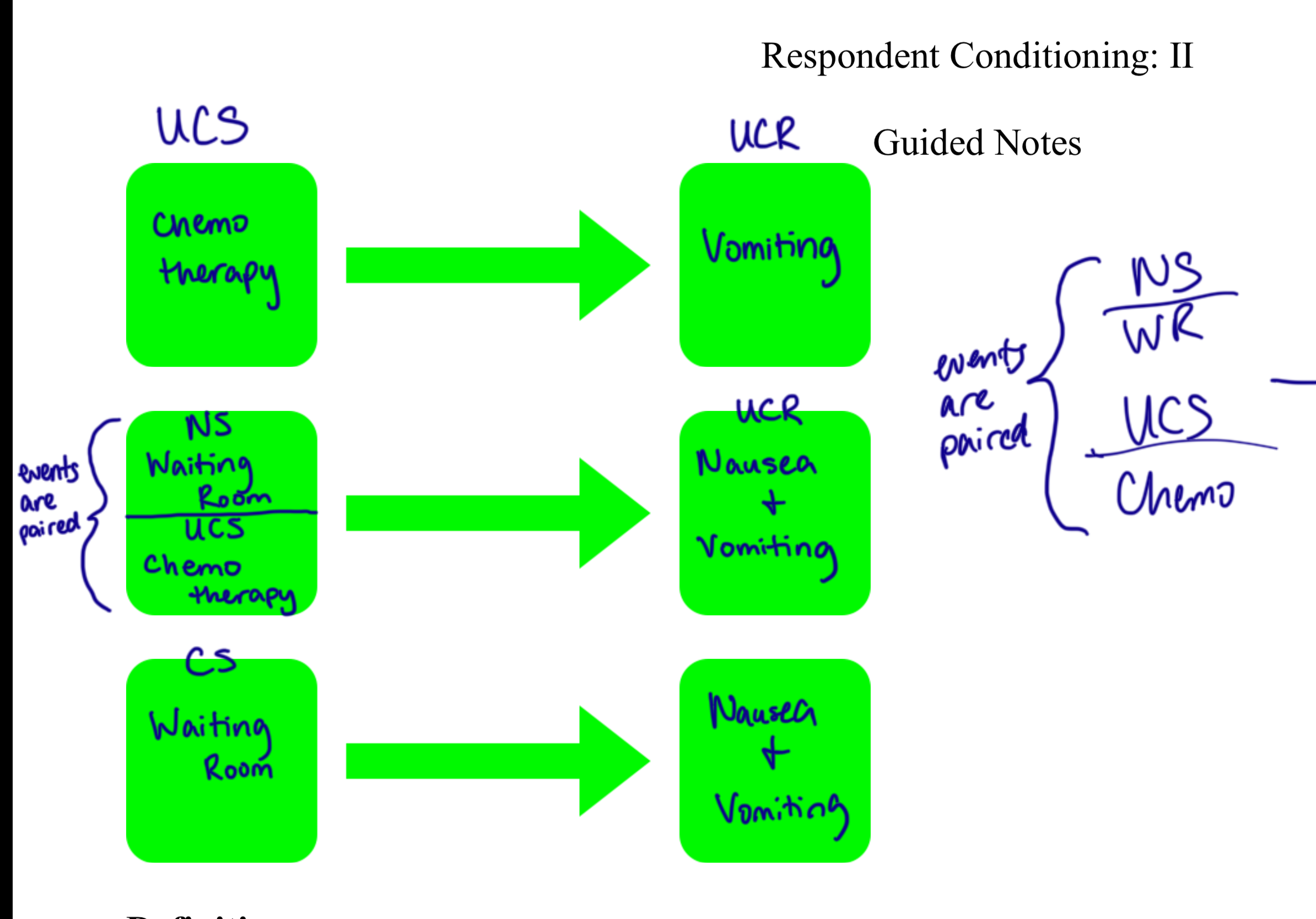
be able to describe the “medical treatment” example and the “alcohol” example in terms of taxonomy of respondent conditioning
be able to describe how respondent extinction would be conducted given an example, and distinguish between extinction as operation and process
be able to describe the operation of process of conditioned suppression, and be able to calculate the suppression ratio
be able to describe the process of seconf order conditioning, and the examples used to illustrate how this might occur
be able to describe how drug use and abuse can be described in terms of respondent conditioning
The CONTEXT in which individuals consume drugs may have a huge impact on the effects of the drug. With repeated pairings of drug (US), and injection (CS), the CR becomes smaller and acts in a direction that is the opposite of the drug
Substantial tolerance develops to the effects of opiates— the experienced user can survive a dose many times greater than that which would kill a novice user
yet a small percentage of experienced users die each year from overdose
Some fatalities are a result of true overdose. Other times, experienced use sees die from a dose that should NOT have killed them
be able to describe the findings from Reyes et al and Siegel et al.
Reyes et al.
To measure arousal, subjects are asked to wear a penile plethysmograph
After positioning the penile plethysmograph, subjects were seated in a chair, and various non sexual, non-nude stimuli were presented for 30-90 seconds at a time.
Males and Females (non-nude, of varying races)
4-5 years olds, 6-7, 8-9, Late Teens, Adult
Neutral Stimuli (boat, flag)
This assessment occurred prior to any “intervention.”
The interventions focus on respondent conditioning, and many are no longer permissible by law
Results of this assessment suggest that this subject is NOT ready for release from detention
Siegel et al.
Three groups of rats were studied. Two of the groups received heroin every other day for 30 days
On non-drug days, rats received sugar-water injections—why is this important? To establish the feeling of being injected