Thermoregulation, Pyrexia & Hypothermia
 Call Kai
 Learn
Learn Practice Test
 Spaced Repetition
 Match
Match Flashcards
 Knowt Play
1/26

There's no tags or description
Looks like no tags are added yet.
Name | Mastery | Learn | Test | Matching | Spaced | Call with Kai |
|---|
No analytics yet
Send a link to your students to track their progress
27 Terms
What is a poikilotherm?
Also provide some examples
'Cold blooded'
Temperature fluctuates with the environment (So blood not necessarily cold)
Examples: reptiles
An animal that cannot regulate its body temperature except by behavioural means such as basking or burrowing. Temperature determines their activity.
What is a homeotherm?
Also provide some examples
An animal that maintains a steady body temperature at a constant level, usually above that of the environment, by its metabolic activity.
Examples: penguins, sheep, bears, etc.
Can increase or decrease their body temperature
Remain active at all environmental temperatures.
Define the following alternative definitions:
Endotherm
Ectotherm
Endotherms - Internal heat production, are able to change their metabolic rate
'Broadly homeotherms'
Ectotherms - rely upon external heat sources (but muscle movement generates some heat), Low metabolic rates
'Broadly poikilotherms'
For body temp to increase, heat loss must _____.
If heat loss increases, heat production must ______.
increase, increase
Homeotherms/Endotherms want to maintain a _____ body temperature but there are regional variations, what does this mean?
stable
Core body temperature - temperature inside abdomen, cranium and thoracic cavity, important to keep at a stable temperature
Very narrow range: rectal temp -1C higher than oral temp
Shell Temperature: outer surface: oral temp and skin temp has a wide range, changes vastly because they are used to gain or lose heat
Physiologically regulated
Varying shell temperature helps maintain the core body temperature
Describe how the circadian rhythm in homeotherms/endotherms influences the core temperature.
In Diurnal Species (e.g. sheep)
Body temp lowest in morning → highest in the day, drops off in the evening again
In Nocturnal Species (e.g. the rat)
Body temp highest in the evening → lowest in the morning
What other factors may impact an animal’s body temperature?
Seasonal Variations
Environment
Exercise - as a result of muscular contraction
Digestion - 'Specific dynamic action' associated with the packaging of nutrient derived energy into stores
Gender
In humans, average core body temperature affected by gender
Males 36.3 - 37.1 °C; Females 36.5 - 37.3 °C (but colder extremities!)
Body temperature in females is influenced by steroids and thus varies with ovarian/menstrual cycle
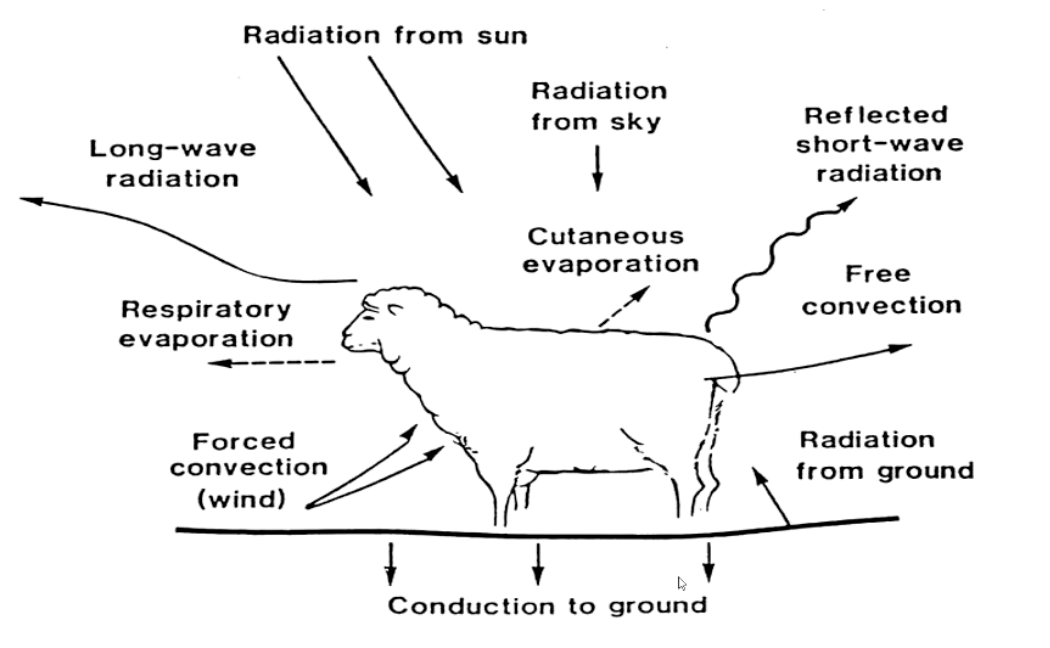
What are the mechanisms in which heat can be transferred?
RADIATION - energy, in the infrared portion of the spectrum given off or absorbed by an object.
CONDUCTION - energy transferred between an object and the material next to the object by direct passage. Eg. Skin to air, or skin to water, skin to metal.
Conductive losses are increased by convection.
EVAPORATION - loss of water from an organism in the form of water vapour requires significant heat input
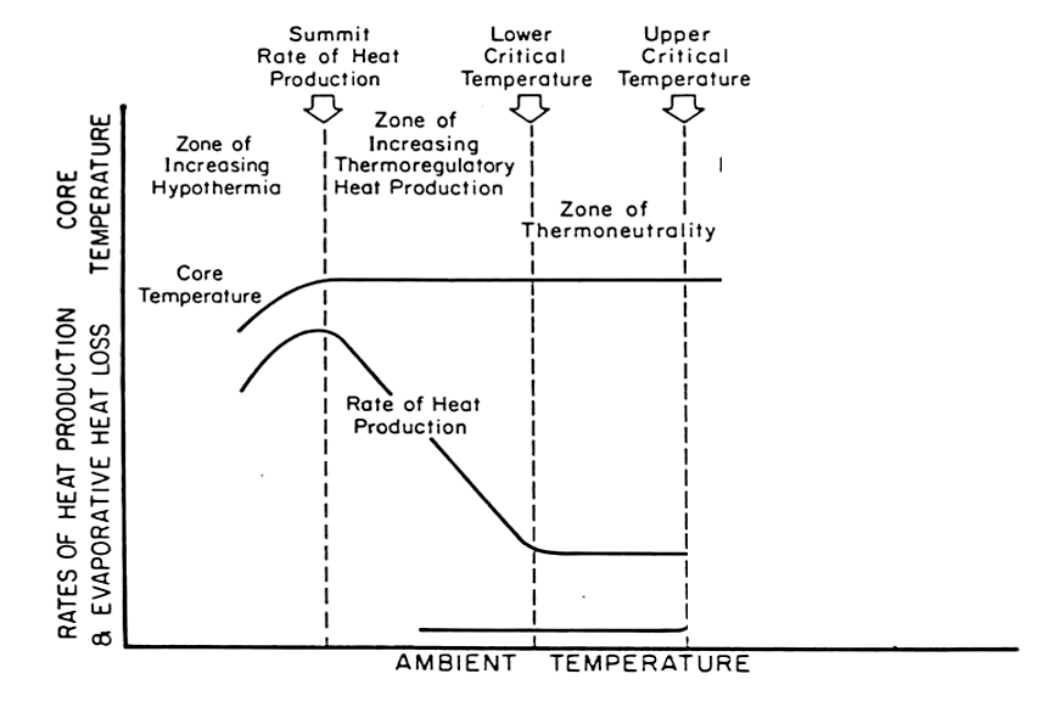
What is the zone of thermoneutrality?
The range of environmental temperatures in which the body can maintain normal core temperature without increasing metabolic heat production or activating active cooling mechanisms.
Where is the central central control of thermogenesis?
Regulated at the level of the preoptic area of the hypothalamus
Peripheral & central temperature sensors - send information to the POA.
POA acts as an Integrating Centre - 'set point'
POA sends information about the 'error' to either:-
heat promoting centre - more posterior region of the hypothalamus, to promote shivering, peripheral vasoconstriction etc.
heat losing centre - more anterior region of the hypothalamus, to promote sweating, panting, behavioral changes
A decrease in ambient temperature necessitates increased…
heat production / promotion
The summit rate of heat production (often referred to as summit metabolic rate, ) is the maximum amount of heat an endothermic animal can produce, typically measured during an experimentally induced cold challenge. It represents the highest possible rate of aerobic metabolism, which serves as a critical indicator of an individual's cold tolerance and thermogenic limits.
What are the behavioral changes associated with heat production/promotion?
Closed/curled up posture
Huddling together
What are the main physiological changes associated with heat production/promotion?
1) Cutaneous vasoconstriction
Sympathetic nervous system
Peripheral vasoconstriction - a1 adrenoreceptors
Divert blood to the “core”
Periodic vasodilation - need to ensure tissues still periodically receive some blood flow
Complications of vasoconstriction:
hypovolemia
Reduced effective circulating volume
Vasoconstriction can lead to hypovolaemia because it reduces blood flow to tissues and organs, especially the kidneys, which can reduce effective circulating volume and promote fluid loss or poor fluid regulation.
frost bite
2) Countercurrent exchange systems
It’s a system where:
Warm arterial blood flows toward the foot
Cold venous blood flows back toward the body
The vessels run very close together
Because they flow in opposite directions, heat transfers efficiently between them.
🔥 How it conserves heat
1⃣ Warm blood leaves the body core through arteries.
2⃣ Before it reaches the cold foot, it passes next to cold veins returning from the foot.
3⃣ Heat moves from the warm artery to the cold vein.
4⃣ The venous blood returning to the body is warmed.
5⃣ The arterial blood reaching the foot is already cooled.
❄ Why this saves heat
The foot stays cool, so it loses less heat to the environment.
The body core keeps more of its heat because the returning blood is already warmed.
3) Piloerection / Horripilation
Piloerection, commonly known as goosebumps or goose pimples, is the involuntary raising of hairs on the skin in response to cold, fear, or strong emotions
Purpose: In animals with thick fur, this reaction traps air for insulation against the cold or makes them appear larger to threats. In humans, it is a vestigial reflex.
4) Shivering Thermogenesis
Spinal reflex - muscle movement producing heat
5) Non-Shivering Thermogenesis
SNS (via B adrenoreceptors) and T4 stimulate Na/K ATPase, increases Metabolic rate, increases heat production. (Increase 30%)
In foetal animals utilise brown fat in which lipolysis is not linked to ATP synthesis - uncoupling protein THERMOGENIN
In adults, increased food intake
Increasing ambient temperature necessitates…
heat loss
What are the behavioral changes associated with increasing heat loss?
Open posture
Expose areas with low insulation
Minimal touching
Cool location
What are the physiological changes associated with increasing heat loss?
1) Altering conductance
Cutaneous vasodilation increases skin temperature
PROBLEM - Effectiveness of conduction and convection decrease as ambient Temperature increases.....
2) Evaporative heat loss
Works even at high temperatures
580kcal needed to evaporate 1kg water
25% heat loss in mammals is via evaporation
Sweating
Panting
Spreading saliva on fur
Describe the main features of heat loss by sweating.
Not all animals have sweat glands
Less effective if you have fur
Two types of sweat glands
Apocrine glands - developed from hair follicles, produce membrane bound secretions and watery sweat. Thermoregulatory in horses and cattle. Respond to adrenaline.
Eccrine glands - Thermoregulatory in man, cholinergic sympathetic innervation
Stimulated by increased central and skin temperature.
Cattle, antelopes, camels, horses, but especially humans depend on sweating for heat loss.
Describe the main features of heat loss by panting.
Movement of air in 'non respiratory zone' of airways 'forced convection'
Side effects
• Loss of CO2
• Work - which can generate some heat
Dogs - resp freq alternates between 30-40bpm and 300-400bpm
• Loss of salt
• Cools blood going to brain (nasal passages)
Dogs, Sheep, goats, gazelles - depend on panting
Birds pant/gular flutter
Describe the main features of heat loss by spreading saliva on the fur.
Very ineffective - limited use for heat loss
Seen in few species, Marsupials and rodents
How are animals able to adapt to adverse environmental temperatures?
In response to adverse environmental conditions a number of responses depending on temporal characteristics and magnitude of change
• Phenotypic Adaptation during lifetime
•Genotypic Adaptation
•Acclimatization in response to natural forces
•Acclimation in laboratory
What are the mechanisms in which animals use to adapt to chronic cold temperatures?
Adjustments to Chronic Cold Temperatures
Increase thermal gradient
Increased level of surface insulation
Summer vs winter fur, 52% difference in insulative value
Behavioural
Small mammals cant have enough fur!
Create microclimate e.g burrows, instead
Increase metabolic rate
Decrease core temperature
Hibernation
Decrease Body temperature, heart rate, respiration rate metabolic rate.
Fat used as energy source.
If temperatures get too low, hibernating animals MUST wake and move (energy dependent).
What are the mechanisms in which animals use to adapt to chronic hot temperatures?
Decrease thermal gradient
Decrease level of surface insulation
Summer vs winter fur, 52% difference in insulative value
Increase in core temperature
Camels, goats (without water)
Decrease the metabolic rate
Estivation — decreased metabolic rate and water loss - snails, crabs, tortoises, crocodiles, lungfish, Fat-tailed Dwarf Lemur
What are some of the main thermoregulatory disorders?
1. Pyrexia
2. Heat stress - Hyperthermia, Heat Stroke, Heat Exhaustion, Heat Fatigue
3. Cold stress - hypothermia
What are the key features of pyrexia / fever?
Pyrexia/Fever
alteration of the set point
Normal protective mechanism
promotes interferon activity
Interferons (IFNs) are natural signaling proteins (cytokines) released by white blood cells and other tissues to help the immune system fight infections, viruses, and cancer
Increases metabolic rate and accelerates tissue repair
Decreases bacterial and viral replication
Describe how Pyrexia/Fever occurs.
1) Neutrophils and macrophages secrete pyrogen, such as IL1
IL1 stimulates the anterior hypothalamus to secrete PGE
2) PGE raises the set point for Body temperature
Triggers heat generating mechanisms to raise body temp
3) Individual shivers and peripheral vasoconstriction increases Body temp
4) Body temperature osscilates around the new set point
Liver and spleen hoard Zinc and Iron depriving bacteria of the minerals needed to reproduce
5) When infection gone, pyrogen secretion land the set point is reset.
When reset body must activate:
6) Heat loss mechanisms → return to set point
Describe how the following heat-stress based thermoregulatory disorders may occur:
Heat Cramps
Heat Exhaustion
Heat Stroke
Heat cramps -excessive electrolyte loss (often after exercise and heavy sweating
Muscle spasms
Heat Exhaustion - severe water loss/dehydration, electrolyte loss
Hypotension dizziness, fainting, vomiting.
Heat Stroke (hot and Humid)
Gain heat by radiation and conduction but can't loose by evaporation
Delirium, convulsions coma tachycardia, hyperventilation, inflammation, multiorgan dysfunction
Describe how the following cold-stress based thermoregulatory disorders such as hypothermia may occur.
Stage 1 BT - decrease to 35-37°C, shivering, vasoconstriction. Breathing quick and shallow. Nausea, muscles become less responsive.
Stage 2 BT - decrease to 33-35°C. Shivering more violent. Muscle mis- coordination. Mild confusion. Surface blood vessels contract further. Extremities become blue.
Stage 3 BT - <32°C. Shivering stops. Cognitive impairment and physical inability present. Metabolic processes shut down. < 30°C, exposed skin, blue and puffy, muscle coordination very poor, incoherent/irrational behavior including terminal burrowing or stupor.
terminal burrowing - irrational behavior, removing clothes + burrowing
Pulse and respiration rates J, heart rates (ventricular tachycardia, atrial fibrillation). Major organs fail. Clinical death occurs.