Section 1: The Life Span Perspective
 Call Kai
 Learn
Learn Practice Test
 Spaced Repetition
 Match
Match Flashcards
 Knowt Play
1/141

Earn XP
Description and Tags
Contains the following topics: 1. The Life Span Perspective 2. The Nature of Development 3. Theories of Development 4. Research on Lifespan Development
Name | Mastery | Learn | Test | Matching | Spaced | Call with Kai | Chat |
|---|
No analytics yet
Send a link to your students to track their progress
142 Terms
Development
The pattern of change that begins at conception and continues through the life span. Most development involves growth, although it also includes decline brought on by aging and dying.
Life-span Perspective
The perspective that development is lifelong, multidimensional, multidirectional, plastic, multidisciplinary, and contextual; involves growth, maintenance, and regulation; and is constructed through biological, sociocultural, and individual factors working together.
Life Expectancy
122 years
Paul Baltes
An expert in lifespan development and gave definition to the lifespan perspective.
Components of the Life-span Perspective
Development is:
Lifelong
Multidimensional
Multidirectional
Plastic
Contextual
Development Science is Multidisciplinary
Normative Age-graded Influences
Influences that are similar for individuals in a particular age group.
Includes:
Puberty & Menopause
Beginning of formal education
Retiring from the workforce
Normative History-graded Influences
Influences that are common to people of a particular generation because of historical circumstances.
Examples:
Cuban Missile Crisis
The assassination of John F. Kennedy
The Beatles Invasion
The Great Depression
World War II
Nonnormative Life Events
Are unusual occurrences that have a major impact on the lives of individual people. These events do not happen to everyone, and when they do occur they can influence people in different ways.
Examples:
Death of a parent when a child is young
Pregnancy in early adolescence
A fire that destroys a home
Culture
The behavior patterns, beliefs, and all other products of a group that are passed on from generation to generation.
Cross-cultural studies
Comparison of one culture with one or more other cultures. These provide information about the degree to which development is similar, or universal, across cultures, and the degree to which it is culture-specific
Ethnicity
A characteristic based on cultural heritage, nationality characteristics, race, religion, and language.
Socioeconomic Status
Refers to the grouping of people with similar occupational, educational, and economic characteristics.
Gender
The characteristics of people as males or females.
Social Policy
A national government’s course of action designed to promote the welfare of its citizens.
Ethnic
comes from the Greek word for “nation”.
Growth, Maintenance, and Regulation of Loss
Development involves _______, _______, and ___________. Baltes and his colleagues (2006) assert that the mastery of life often involves conflicts and competition among these three goals of human development.
Biology, Culture, and the Individual
Development Is a Co-construction of these three factors working together. We can author a unique developmental path by actively choosing from the environment the things that optimize our lives.
Biological Processes
Produce changes in an individual’s physical nature.
Examples:
Genes inherited from parents, brain development, height and weight gains, changes in motor skills, nutrition, exercise, the hormonal changes of puberty, and cardiovascular decline are all examples of _____________ that affect development.
Cognitive Processes
Refer to changes in the individual’s thought, intelligence, and language.
Examples:
Watching a colorful mobile swinging above the crib, putting together a two-word sentence, memorizing a poem, imagining what it would be like to be a movie star, and solving a crossword puzzle.
Socioemotional Processes
Involve changes in the individual’s relationships with other people, changes in emotions, and changes in personality.
Examples:
An infant’s smile in response to a parent’s touch, a toddler’s aggressive attack on a playmate, a school-age child’s development of assertiveness, an adolescent’s joy at the senior prom, and the affection of an elderly couple.
Developmental Cognitive Neuroscience
Explores links between development, cognitive processes, and the brain.
Developmental Social Neuroscience
Examines connections between socioemotional processes, development, and the brain.
Bidirectional
In many instances, biological, cognitive, and socioemotional processes are ___________.
For example, biological processes can influence cognitive processes and vice versa.
Developmental Period
Refers to a time frame in a person’s life that is characterized by certain features.
Prenatal Period
The time from conception to birth.
It involves tremendous growth— from a single cell to an organism complete with brain and behavioral capabilities—and takes place in approximately a 9-month period.
Infancy
The developmental period from birth to 18 or 24 months.
Infancy is a time of extreme dependence upon adults. During this period, many psychological activities— language, symbolic thought, sensorimotor coordination, and social learning, for example— are just beginning.
Toddler
Often used to describe a child from about 1 ½ to 3 years of age. _____ are in a transitional period between infancy and the next period, early childhood.
Early Childhood
Developmental period from 3 through 5 years of age. This period is sometimes called the “preschool years.”
First grade typically marks the end of this period.
Middle and Late Childhood
The developmental period from about 6 to 10 or 11 years of age, approximately corresponding to the elementary school years.
Adolescence
The developmental period of transition from childhood to early adulthood, entered at approximately 10 to 12 years of age and ending at 18 to 21 years of age.
Begins with rapid physical changes—dramatic gains in height and weight, changes in body contour, and the development of sexual characteristics such as enlargement of the breasts, growth of pubic and facial hair, and deepening of the voice.
Early Adulthood
The developmental period that begins in the early twenties and lasts through the thirties.
It is a time of establishing personal and economic independence, advancing in a career, and for many, selecting a mate, learning to live with that person in an intimate way, starting a family, and rearing children.
Middle Adulthood
The developmental period from approximately 40 to about 60 years of age.
It is a time of expanding personal and social involvement and responsibility; of assisting the next generation in becoming competent, mature individuals; and of reaching and maintaining satisfaction in a career.
Late Adulthood
The developmental period that begins during the sixties or seventies and lasts until death.
It is a time of life review, retirement, and adjustment to new social roles and diminishing strength and health.
Four Ages
Life-span developmentalists who focus on adult development and aging increasingly describe life-span development in terms of ____.
First age
Childhood and adolescence
Second age
Prime adulthood, ages 20 through 59
Third age
Approximately 60 to 79 years of age
Fourth age
Approximately 80 years and older
Three Developmental Patterns of Aging
Developmental patterns that provide a portrait of how aging can encompass individual variations.
Klaus Warner Schaie
An American Psychologist who is the proponent of the 3 Developmental Patterns in Aging.
Normal Aging
Characterizes most individuals, for whom psychological functioning often peaks in early middle age, remains relatively stable until the late fifties to early sixties, and then shows a modest decline through the early eighties. However, marked decline can occur as individuals approach death.
Pathological Aging
Characterizes individuals who show greater than average decline as they age through the adult years. In early old age, they may have mild cognitive impairment, develop Alzheimer disease later on, or have a chronic disease that impairs their daily functioning
Successful Aging
Characterizes individuals whose positive physical, cognitive, and socioemotional development is maintained longer, declining later in old age than is the case for most people. For too long, only the declines that occur in late adulthood were highlighted, but recently there has been increased interest in the concept of successful aging.
Chronological Age
The number of years that have elapsed since birth.
Biological Age
Is a person’s age in terms of biological health.
Involves knowing the functional capacities of a person’s vital organs.
Psychological Age
An individual’s adaptive capacities compared with those of other individuals of the same chronological age.
Thus, older adults who continue to learn, are flexible, are motivated, have positive personality traits, control their emotions, and think clearly are engaging in more adaptive behaviors than their chronological age-mates who do not continue to learn, are rigid, are unmotivated, do not control their emotions, and do not think clearly.
Social Age
Refers to connectedness with others and the social roles individuals adopt.
Individuals who have better social relationships with others are happier and more likely to live longer than individuals who are lonely.
Nature-Nurture Issue
Debates about whether development is primarily influenced by nature or nurture.
Nature
Refers to an organism’s biological inheritance
Nurture
Refers to an organism’s environmental experiences
Stability-Change Issue
Involves the degree to which early traits and characteristics persist through life or change.
Developmentalists
Emphasize change take the more optimistic view that later experiences can produce change.
Emphasize stability in development argue that stability is the result of heredity and possibly early experiences in life.
Continuity-Discontinuity Issue
Focuses on the degree to which development involves either gradual, cumulative change (continuity) or distinct stages (discontinuity).
The Scientific Method
Is essentially a four-step process:
Conceptualize a process or problem to be studied
Collect research information
Analyze the data
Draw conclusions
Theory
Is an interrelated, coherent set of ideas that helps to explain phenomena and facilitate predictions.
Hypotheses
Specific assumptions and predictions that can be tested to determine their accuracy.
Psychoanalytic Theories
Theories that describe development as primarily unconscious and heavily colored by emotion.
Sigmund Freud: Psychosexual Stages
Erik Erikson: Psychosocial Stages
Behavior
Is merely a surface characteristic, and the symbolic workings of the mind have to be analyzed to understand behavior. Early experiences with parents are emphasized.
Freud’s Psychosexual Stages
He thought that as children grow up, their focus of pleasure and sexual impulses shifts from the mouth to the anus and eventually to the genitals.
In his view, if the need for pleasure at any stage is either undergratified or overgratified, an individual may become fixated, or locked in, at that stage of development.
Sigmund Freud
The pioneering architect of psychoanalytic theory.
Oral Stage
Age: Birth to 1 ½ Years
Erogenous Zone: Mouth
Anal Stage
Age: 1 ½ - 3 Years
Erogenous Zone: Anus
Phallic Stage
Age: 3 - 6 Years
Erogenous Zone: Genitals
Latency Stage
Age: 6 Years - Puberty
Erogenous Zone: Inactive
Genital Stage
Age: Puberty onwards
Erogenous Zone: Genitals
Erik Homburger Erikson
A Danish German-American child psychoanalyst known for his theory on psychosocial development of human beings.
Recognized Freud’s contributions but believed that Freud misjudged some important dimensions of human development.
Said we develop in psychosocial stages, rather than in psychosexual stages as Freud maintained:
It is social and reflects a desire to affiliate with other people.
Developmental change occurs throughout the life span.
Emphasized the importance of both early and later experiences.
Erikson’s Psychosocial Theory of Development
Eight stages of development unfold as we go through life.
At each stage, a unique developmental task confronts individuals with a crisis that must be resolved.
This crisis is not a catastrophe but a turning point marked by both increased vulnerability and enhanced potential. The more successfully an individual resolves each crisis, the healthier development will be.
First Stage: Trust VS Mistrust
Age: Infancy (Birth to 18 months)
Experienced in the first year of life.
Outcome:
Virtue of Hope.
The first psychosocial stage sets the stage for a lifelong expectation that the world will be a good and pleasant place to live.
Second Stage: Autonomy VS Shame & Doubt
Age: Infancy (1 - 3 years old)
Occurs in late infancy and toddlerhood.
Outcome:
Virtue of Will.
After gaining trust in their caregivers, infants begin to discover that their behavior is their own. They start to assert their sense of independence or autonomy.
Third Stage: Initiative VS Guilt
Age: Early Childhood (3 - 5 years)
Occurs during the preschool years.
Outcome:
Virtue of Purpose.
As preschool children encounter a widening social world, they face new challenges that require active, purposeful, responsible behavior.
Fourth Stage: Industry VS Inferiority
Age: Early Childhood (3 - 5 years)
Occurring approximately during the elementary school years
Outcome:
Virtue of Confidence.
Children now need to direct their energy toward mastering knowledge and intellectual skills.
Fifth Stage: Identity VS Identity Confusion
Age: Adolescence (10 - 20 years)
Occurs during adolescent years.
Outcome:
Virtue of Fidelity.
During the adolescent years, individuals need to find out who they are, what they are all about, and where they are going in life.
Sixth Stage: Intimacy VS Isolation
Age: Early Adulthood (20s - 30s)
Individuals experience during early adulthood.
Outcome:
Virtue of Love.
At this time, individuals face the developmental task of forming intimate relationships.
Seventh Stage: Generativity VS Stagnation
Age: Middle Adulthood (40s - 50s)
Occurs during middle adulthood
Outcome:
Virtue of Care.
By generativity, Erikson means primarily a concern for helping the younger generation to develop and lead useful lives.
Eight Stage: Integrity VS Despair
Age: Middle Adulthood (60s onwards)
Individuals experience in late adulthood.
Outcome:
Virtue of Wisdom.
During this stage, a person reflects on the past. If the person’s life review reveals a life well spent, integrity will be achieved; if not, the retrospective glances likely will yield doubt or gloom—the despair.
Cognitive Theories
Emphasize conscious thoughts.
Jean Piaget: Cognitive Developmental Theory
Lev Vygotsky: Sociocultural Cognitive Theory
Information Processing Theory.
Piaget’s Cognitive Developmental Theory
States that children go through four stages of cognitive development as they actively construct their understanding of the world.
Two processes underlie this cognitive construction of the world: organization and adaptation. To make sense of our world, we organize our experiences.
Jean Piaget
Swiss Developmental Psychologist
Identified four stages in understanding the world. Each stage is age-related and consists of a distinct way of thinking, a different way of understanding the world.
Sensorimotor Stage
Age: Birth to about 2 years of age
In this stage, infants construct an understanding of the world by coordinating sensory experiences (such as seeing and hearing) with physical, motoric actions.
The infant constructs an understanding of the world by coordinating sensory experiences with physical actions.
Preoperational Stage
Age: 2 to 7 years
In this stage, children begin to go beyond simply connecting sensory information with physical action and represent the world with words, images, and drawings.
The child begins to represent the world with words and images.
Concrete Operational Stage
Age: 7 to 11 years
In this stage, children can perform operations that involve objects, and they can reason logically when the reasoning can be applied to specific or concrete examples.
The child can now reason logically about concrete events and classify objects into different sets.
Formal Operational Stage
Age: 11 and 15 and continues through adulthood.
In this stage, individuals move beyond concrete experiences and begin to think in abstract and more logical terms.
The adolescent reasons in more abstract, idealistic, and logical ways.
Schemes
Are mental patterns, operations, and systems.
Organization
The process of forming schemes and using schemes to understand how the world works is called ___________.
Lev Vygotsky
A Russian Developmentalist who argued that children actively construct their knowledge.
Gave social interaction and culture far more important roles in cognitive development than Piaget did.
Vygotsky’s Sociocultural Cognitive Theory
A sociocultural cognitive theory that emphasizes how culture and social interaction guide cognitive development.
Portrayed the child’s development as inseparable from social and cultural activities.
Maintained that cognitive development involves learning to use the inventions of society, such as language, mathematical systems, and memory strategies.
Children’s social interaction with more skilled adults and peers is indispensable to their cognitive development. Through this interaction, they learn to use the tools that will help them adapt and be successful in their culture.
Scaffolding
Involves parental behavior that supports children’s efforts, allowing them to be more skillful than they would be if they had to rely only on their own abilities.
Information-Processing Theory
Emphasizes that individuals manipulate information, monitor it, and strategize about it. Central to this theory are the processes of memory and thinking.
Uses the computer as an analogy to help explain the connection between cognition and the brain
This approach is NOT a single theory but a framework that supports a wide range of theories and research.
Development is CONTINUOUS.
Robert Siegler
A leading expert on children’s information processing, states that thinking is information processing.
In other words, when individuals perceive, encode, represent, store, and retrieve information, they are thinking.
Microgenetic Method
Seeks to discover not just what children know but the cognitive processes involved in how they acquired the knowledge.
Artificial Intelligence
Focuses on creating machines capable of performing activities that require intelligence when they are done by people.
Developmental Robotics
Examines various developmental topics and issues using robots, such as motor development, perceptual development, information processing, and language development.
Learning Perspective
Sees development results from LEARNING. Thus, also sees development as CONTINUOUS.
Theories included:
Behaviorism
Classical Conditioning
Operant Conditioning
Social Cognitive Theory
Behaviorism
Essentially holds that we can study scientifically only what can be directly observed and measured.
Is a mechanistic theory that describes observed behavior as a predictable response to experience.
Considers development as REACTIVE and CONTINUOUS.
Operant Conditioning
The consequences of a behavior produce changes in the probability of the behavior’s occurrence.
A behavior followed by a rewarding stimulus is more likely to recur, whereas a behavior followed by a punishing stimulus is less likely to recur.
A response is increased or decreased due to reinforcements or punishments.
Burrhus Frederic Skinner
Proponent of Operant Conditioning, he is an American psychologist, behaviorist, inventor, and social philosopher.
Rewards and Punishments
According to Skinner, the key aspect of development is behavior, not thoughts and feelings. He emphasized that development consists of the pattern of behavioral changes that are brought about by ________ and __________.
Classical Conditioning
A neutral stimulus is associated with a natural response.
The Little Albert Experiment
Ivan Petrovich Pavlov
Was a Russian and Soviet experimental neurologist and physiologist known for his discovery of classical conditioning through his experiments with dogs.
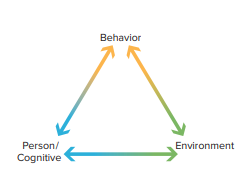
Social Cognitive Theory
The view of psychologists who emphasize behavior, environment, and cognition as the key factors in development.
Suggested that the impetus for development is Bidirectional.