Econ Ch.16 Book Questions
 Call Kai
 Learn
Learn Practice Test
 Spaced Repetition
 Match
Match Flashcards
 Knowt Play
1/27

There's no tags or description
Looks like no tags are added yet.
Name | Mastery | Learn | Test | Matching | Spaced | Call with Kai |
|---|
No analytics yet
Send a link to your students to track their progress
28 Terms
Which of the following formulas represents the expression for equilibrium real GDP?
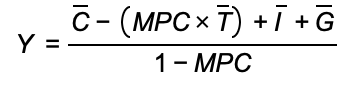
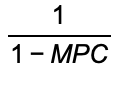
Which of the following is the formula for the government purchases multiplier?
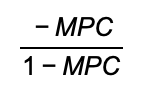
Which of the following is the formula for the tax multiplier?
Expansionary fiscal policy can return real GDP to potential GDP, but only at the expense of ___ in the inflation rate.
An increase
The balanced budget multiplier is always equal to 1.
True
Decreasing the tax rate decreases the value of the government purchases multiplier.
False
Countries with a higher marginal propensity to import (MPI) will have smaller multipliers than countries with a lower marginal propensity to import.
True
Slow growth in aggregate demand leads to
higher unemployment and lower inflation.
Which of the following are categories of federal government expenditures?
interest on the national debt
grants to state and local governments
transfer payments
The largest and fastest-growing category of federal expenditures is
transfer payments
The federal government's day-to-day activities include running federal agencies like the Environmental Protection Agency, the FBI, the National Park Service, and the Immigration and Customs Enforcement.
Spending on these types of activities make up
less than 10 percent of federal government expenditures.
The goal of expansionary fiscal policy is
to increase aggregate demand.
Over time, potential GDP ________, which is shown by the ________ curve shifting to the right.
increases; long-run aggregate supply
The higher the tax rate, the larger the multiplier effect.
False
The actual change in real GDP resulting from an increase in government purchases or a cut in taxes will be less than the simple multiplier effect indicates.
Final
Crowding out refers to
the decline in private expenditures that result from an increase in government purchases.
What is the long-run effect of a permanent increase in government spending?
The decline in investment, consumption, and net exports exactly offsets the increase in government spending; therefore, real GDP remains unchanged.
About ________ of the American Recovery and Reinvestment Act stimulus package took the form of increases in government expenditures, and about ________ took the form of tax cuts.
two-thirds; one-third
Between the beginning of 2009 and the end of 2010, real GDP ________, while employment ________.
increased by 4.0 percent; declined by 3.3 million
Budget deficits automatically __________ during recessions and __________ during expansions.
increase; decrease
The cyclically adjusted budget deficit
is measured as if the economy were at potential real GDP.
Few economists believe the federal government should attempt to balance its budget every year.
True
The national debt is best measured as
the total value of U.S. Treasury securities outstanding.
Which of the following statements about the federal debt is correct?
If the debt becomes very large relative to the economy, then the government may have to raise taxes to high levels or reduce other types of spending to make the interest payments on the debt.
The long-run growth rate of real GDP depends primarily on
the growth rate of labor productivity as measured by the growth in real GDP per hour worked, and the growth in the number of hours worked.
A simplified tax code would reduce economic efficiency by increasing the number of decisions households and firms make solely to reduce their tax payments.
False
The effect on the economy of tax reduction and simplification is
an increase in the quantity of real GDP supplied at every price level, and a shift in the long-run aggregate supply curve.
If a tax cut has supply-side effects, then
it will affect both aggregate demand and aggregate supply.