METAMORPHOSIS
 Call Kai
 Learn
Learn Practice Test
 Spaced Repetition
 Match
Match Flashcards
 Knowt Play
1/91

There's no tags or description
Looks like no tags are added yet.
Name | Mastery | Learn | Test | Matching | Spaced | Call with Kai |
|---|
No analytics yet
Send a link to your students to track their progress
92 Terms
Metamorphosis
This means changes in shape or form undergone by most insects during their development
Exopterygota
These are insects whos immature have external wing pads
Endopterygota
Species with internal wing pads as larvae
NYMPHS
They are an immature form of an insect that shares the general appearance and lifestyle of the adult
Paurometabolous exopterygotes
In winged insects, nymphs develop external wings as they molt and grow
NAIAD
These are free living, aquatic predators that feed on other aquatic insects, including their own species
Aquatic larvae of odonta, ephemeroptera, plecoptera
NAIAD is distinctive to these species
Hemimetabolous exopterygotes
Aquatic larvae of odonta, ephemeroptera, plecoptera which are also labelled as?
Subimago
A stage in development of some insects (such as the mayflies) between the nymph and imago in which the insect is able to fly but becomes mature only after a further molt
Imago
Refers to the last stage of insect’s metamorphosis (adult stage)
Instar
Is the form of an insect after each molt
Ametabolous
Indicates no change in metabolism; body proportions and internal organs remain similar after each molt or ecdysis
Collembola and Thysanura
Examples for Ametabolous
Ametabolous
This occurs in primitive wingless insects belonging to order Protura
Collembola and Thysanura
What belongs under the order Protura?
Gradual Metamorphosis
A type of metamorphosis in which the pupal stage is lacking, and the adult insect has the same general body plan as the immature form
Paurometabolous
This type of gradual metamorphosis is a gradual type because the young undergoes slow but steady change in each molt until an adult form is attained
Paurometabolous, Hemimetabola
Two types of gradual metamorphosis
Paurometabolous, Nymphs
A gradual metamorphosis whose immature normally develop terrestrially. Their ______ closely resemble the adult except for body proportions
Exopterygotes
Some ______ are paurometabolous
Grasshoppers, Milkweed bugs
Examples of Exopterygotes
Hemimetabola
This is an incomplete type of metamorphosis wherein the change from immature to adult is not extreme and the immatures inhabit water.
Young/Naiad
In Hemimetabola they do not resemble the adult
Complete Metamorphosis
Majority of insect species, approximately 85% undergo drastic alterations during development, particularly between the immature and adult stages
Egg, Larva, Pupa and adult stages
In complete metamorphosis, the phases pass through in which sequence:
Holometabola
Complete Metamorphosis is also called?
Larva
Some refers to all immature instars, others restrict the term to the immature instars of holometabolous insects. They are wormlike and without compound eyes, but with one or more pairs of lateral ocelli
Pupa
An insect in its inactive immature form between larva
Eruciform, Vermiform, Campodeiform, Scarabaeiform, Elateriform, Platyform, Carabiform
What are the types of Larvae
Eruciform
This larva, with hypoganthous mouthparts, cylindrical bodies, short thoracic legs & abdominal prolegs, and a reduced or no caudal appendage
Caterpillars of Lepidoptera, Larvae of Mecoptera, Hymenoptera
Examples of Eruciform
Vermiform
These larva are wormlike, cylindrical and lack locomotory organs
Maggots of Diptera, Larvae of Siphonaptera
Examples of Vermiform
Campodeiform
These larvae have prognathous mouthparts, elongate flattened bodies, long legs and usually caudal appendages of some kind. Mostly active predators
Larvae of Neuroptera, Megaloptera, Trichoptera, Raphidioptera, Coleoptera
Examples of Campodeiform
Scarabaeiform
These larvae inhibit the soil or plant tissues, and some species are enclosed in tunnels. They are quite helpless grubs especially when exposed on the surface of the soil.
Hypoganthous
Scarabaeiform are ____ with a usually curved body, usually inactive or sluggish
Elateriform
These larvae are prognathous with a hard and elongated cylindrical body, with short legs and reduced body bristles
Platyform
These larvae are larvae that are broad and flattened. In some species are present but this is not always the case.
Water penny
Example of Platyform larvae?
Carabiform
This insect larva have short legs, short cerci and a flattened body.
Carabidae
The name for carabiform is derived from this where ground beetles belong
Adecticous, Decticous
Two types of Pupa
Exarate, Obtect
Two types of pupa under Adecticous
Exarate
Other appendages are free from the body.
Hymenopteran and Coleopteran
Examples of Exarate
Strepsiptera and Diptera
These are also exarate but enclosed in puparium (sclerotized cuticle of the last larval instar)
Obtect
Pupa that have appendages cemented to the body
Lepidoptera, Diptera
Examples of obtect
Ditrysia and Monotrysia
Obtect: Examples of Lepidoptera
Nematocera and Orthorrhapha
Obtect: Examples of Diptera
Exarate
Decticous pupa are always?
Pupa
Is the resting and inactive stage in all holometabolous insects. During this stage, the insect is incapable of feeding and is quiescent. During the transitional stage, the larval characters are destroyed and new adult characters are created
Obtect, Exarate, Coarctate
What are the three main types of pupae
Obtect
Various appendages of the pupa such as, antennae, legs and wing pads are glued to the body by a secretion produced during the last larval molt. Exposed surfaces of the appendages are more heavily sclerotized than those adjacent to body. e.g. moth pupa
Chrysalis, Tumbler
two types of pupa under obtect
Chrysalis
It is the naked obtect pupa of butterfly. It is angular and attractively coloured. The pupa is attached to the substratum by hooks present at the terminal end of the abdomen called cremaster.
Substratum, gridle
The middle part of the chrysalis is attached to the _____ by two strong silken threads called _____
Tumbler
Pupa of mosquito is called ____. It is an obtect type of pupa. It is comma shaped with rudimentary appendages. Breathing trumpets are present in the cephalic end and anal paddles are present at the end of the abdomen. Abdomen is capable of jerky movements which are produced by the anal paddles. The pupa is very active
Exarate
Various appendages are visible. The antennae, legs and wing pads are not glued to the body. They are free. All oligopod larvae will turn into exarate pupae. The pupa is soft and pale e.g. Pupa of rhinoceros beetle
Coarctate
The pupal case is barrel shaped, smooth with no apparent appendages. The last larval skin is changed into case containing the exarate pupa.
Puparium
In coarctate, The hardened dark brown pupal case is called?
Fly pupa
Example of Coarctate
Behavioral Responses, Mechanical Defenses, Autonomy, Chemical Defenses, Collective Defenses in social insects Immunity, Phenotypic Plasticity
Defense mechanisms that withstood the test of time
Behavioral Responses
Identify to which defense mechanism do they belong:
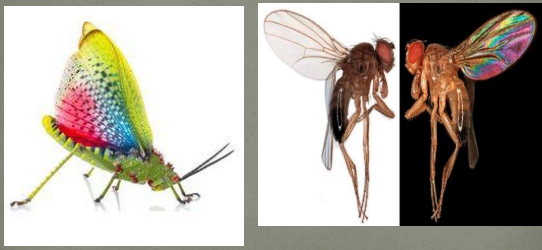
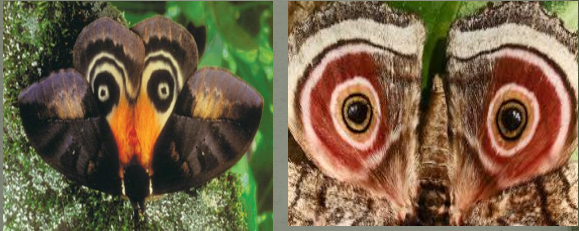
Hiding, Escape by flight or running, Firmly holding ground to fight, Flashing of bright colors to startle the predator, Feigning death or thanatosis/tonic immobility, Striking color patterns, like eyespots
Flashing of bright colors
Identify which behavioral response is shown
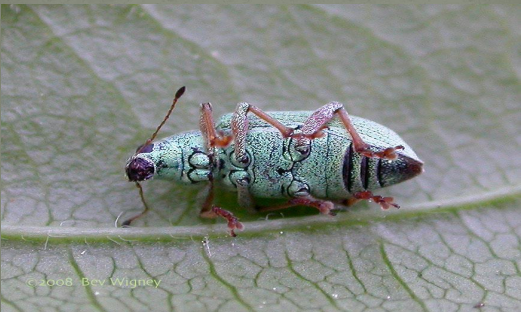
Feigning death or thanatosis/Tonic immobility
Identify which behavioral response is shown
Striking color patterns, eyespots
Identify which behavioral response is shown
Mechanical Defenses
The highly chitinized and sclerotized cuticle
Additional physical defenses include modified mandibles, horns, and spines on the tibia and femur
Some insects uniquely create retreats that appear uninteresting or inedible to predators.
Caddisfly larvae
This species encases their abdomen with a mixture of natural materials like leaves, twigs, and stones.
Order Trichoptera
To which order does caddisfly larvae belong to
Autonomy
This is the shedding of appendage to distract the predators and giving the prey a chance to escape
Walking sticks, Harvestmen
Organisms that performs autonomy as a defense mechanism
Phasmatodea
To which order do walking sticks belong
Chemical Defenses
Defense mechanism that produces chemicals that harm predators
Assassin bug
These bugs inject venom directly into the victim, some will regurgitate saliva that contains protease, phospholipase and hyalurinase that may cause intense pain
Reduviidae
To which family do assassin bugs belong to
Fontanellar gun
The majority of termite soldiers secrete a rubberlike and sticky chemical concoction that serves to entangle enemies, called?
Wasp
These insects produce ant repellent substance
Collective defenses in social insects
Social structures that help prevent predation. Termites, ants, bees and wasps rely on a caste system to protect their nests
Immunity
The Aedes mosquito carrying dengue virus has immune response that protects them from possible harm caused by the viruses’ presence. It has no mechanism of eliminating the virus from its system, so it allows the virus to multiply and give them higher chance to complete their life cycle when transmitted to humans
Phenotypic Plasticity
The capacity of a single genotype to exhibit a range of phenotypes in response to variation in the environment
Nemoria arizona caterpillars
The cryptic pattern of these caterpillars changes according to season and is triggered by dietary cues (Phenotypic Plasticity)
Oak catkins or flowers
In the spring, the first brood of caterpillars resembles what?
Camouflage
This is the use of any combination of materials, coloration or illumination for concealment, either by making animals or objects hard to see (crypsis), or by disguising them as something else (mimesis)
Crypsis
This is the ability of an organism to avoid observation or detection by other organisms. The organism blends to its environment
Mimicry
The close external resemblance of an organism, the ___, to some different organism, the model, such that the___ benefits from the mistaken identity, as seeming to be unpalatable or harmful
Batesian and Mullerian mimicry
What are the types of mimicry
Batesian mimicry
Mimic is restricted to those palatable species to deceive the predator
Mullerian mimicry
Both model and mimic are unpalatable, and the ingestion of either by vertebrate predators result in the avoidance of both
Aposematic colorations
In Mullerian mimicry 2 or more unrelated noxious or dangerous organisms have close resemblance, thus exhibiting very similar warning systems, like?