Islam MIDTERM 2026
 Call Kai
 Learn
Learn Practice Test
 Spaced Repetition
 Match
Match Flashcards
 Knowt Play
1/22

There's no tags or description
Looks like no tags are added yet.
Name | Mastery | Learn | Test | Matching | Spaced | Call with Kai |
|---|
No analytics yet
Send a link to your students to track their progress
23 Terms
Qur'an
translates to “Recitation”
Allah (God's) presence in the world
Only one version: Arabic
114 suras
Given to Muhammad by the Angel Gabriel
-Recited orally to his listeners
-Oral recitation is still the preferred method
Treated with respect
DEFINITION: Islam’s primary sacred text, regarded by Muslims as the direct words of Allah, revealed to Muhammad through the archangel Gabriel
Life story of the Prophet Muhammad
Seal of the Prophets: last of the prophets
Born in 570 AD/CE in Mecca:
Orphan → raised by his uncle
Grew up in the caravan industry
He married his boss Khadija:
-The first convert to Islam
610AD/CE: Angel Gabriel came to him while he prayed in the hills outside the city
Night of Power and Excellence
-Muhammad would meditate on God alone in a cave
-Angel Gabriel appeared to him and commanded him to “Recite!”
-Marked the beginning of Muhammad’s career as a prophet
Initial recitation: the beginning of Muhammad’s prophetic career
Shared his message of monotheism → not well received in Mecca
622 AD/CE: Goes on emigration to Yathrib → the Hijira
-Yathrib is later renamed Medina because of Muhammad
-First day of the Muslim Calendar (AH 1)
-Official Beginning of the Muslim Era
630 AD/CE: Muhammad reclaimed Mecca and rededicates the Ka'ba
632 AD/CE: Prophet Muhammad Died
POSSIBLE EXTENDED RESPONSE
Primary Beliefs/Iman
6 major articles of belief
Oneness of God: Allah
-Transcendent, superpersonal, genderless
Angels of God: Do God’s will in the world
Books of God: Allah revealed his divine message to messengers before Muhammad
-Torah, Psalms, Scrolls, Gospels, etc.
-But the Qur’an is the final revelation and the only book in its original form
Prophets of God: Adam, Noah, Abraham, Moses, and Jesus
-But Muhammad is the final prophet (Seal of Prophets)
Judgment Day: Humans will be judged for their actions
Divine decree: Muslims believe that God has a divine destiny for all things
Five Pillars
Shahada, Salat/Prayer, Zakat/Wealth Sharing, Sawm/Fasting, Hajj/Pilgrimage
DEFINITION: specific religious and ethical requirements for Muslims: the confession of faith (Shahada), prayer or worship, fasting during Ramadan, wealth sharing, and the pilgrimage to Mecca
POSSIBLE EXTENDED RESPONSE
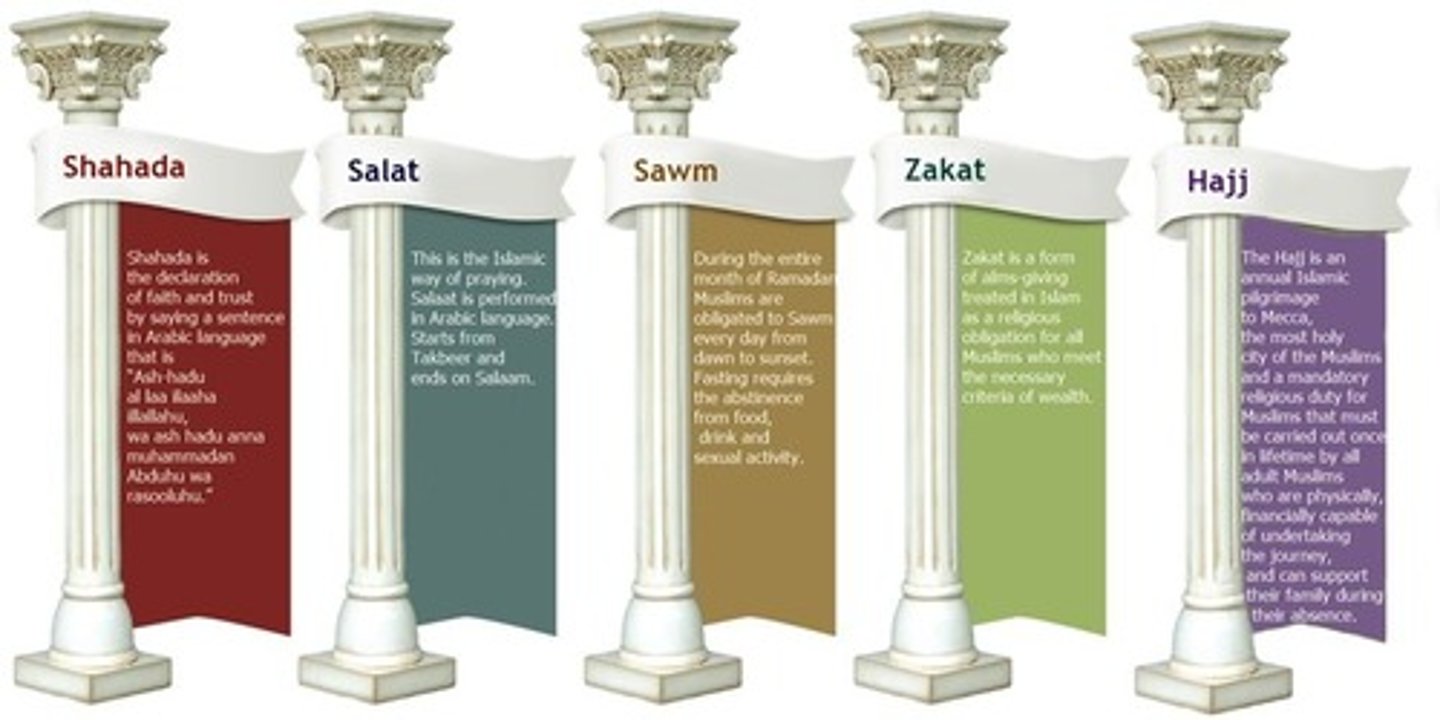
1. Shahada
central confession of faith
"There is no god except God. Muhammad is the messenger of God."
Monotheism of Islam
The uniqueness of Muhammad as a prophet
Repeated many times a day during their prayers
Pronouncement made by people converting to Islam
DEFINITION: confession of faith, first of the Five Pillars and central creedal statement of Islam: “There is no god except God. Muhammad is the messenger of God.”
2. Salat/Prayer
Muslims are required to pray 5 times a day: early morning, noon, mid-afternoon, sunset, evening
Prayer requires
Ritual washing of the hands and face (wudhu)
Prostration facing the Kaaba in Mecca
Friday: Public prayers are conducted in the mosque (Jummah)
Led by imam “leader”
3. Zakat/Wealth Sharing
Requires Muslims to contribute 2.5% of their wealth to a public treasury yearly
Poor people are exempt
Considered a form of worship
Acts of charity should be performed regularly
4. Sawm/Fasting
During Ramadan during the 9th month of the Muslim lunar calendar
Month in which Muhammad received revelation of the Qur’an
From dawn to sunset, Muslims fast and avoid: eating, drinking, smoking, and sex
Post-sunset: the festive breaking of the fast (iftar)
Fasting is required when Muslims reach puberty
Muslims are encouraged to read the Qur’an during this month
Eid al-Fitr “Festival of the Fast-Breaking”
Celebrates the completion of the Ramadan fast
First day of the month after Ramadan
Day of celebration, prayers, fasting, and gift-giving
5. Hajj/Pilgrimage
Once in their lifetime Muslims are required to journey to Mecca, Saudi Arabia
Mecca: home to the first house of worship of God → the Ka’ba
1. Stone cubical structure center of the courtyard of the Great Mosque of Mecca
2. It is believed to have been built by Abraham & Ishmael
Any pilgrim who dies on the journey to Mecca = martyr (witness to the faith)
Captures the communal ideal of the Umma → Muslims globally gather in Mecca
Male pilgrims wear white clothing: equality, purity (ihram)
Female pilgrims wear simple colorful clothing of their homelands
It takes place a specific month of the year for at least 15 days
During Hajj → perform religious acts (ex: the ritual act of circling the Ka’ba)
Eid al-Adha “Festival of the Sacrifice”
10th day of the month after the end of the pilgrimage
Celebrated by all Muslims
1. Special prayers
2. Feasts
3. Gifts and the sacrifice of an animal lamb or goat which is given to relatives, friends, and the needy
The two "Eids"
“eid = festival”
Eid al-Fitr (9th month of the Islamic calendar)
Eid al-Adha (12th month of Islamic calendar)
Eid al-Fitr
(9th month of the Islamic calendar)
Lesser Eid
Festival of the breaking of the fast
Celebrated at the end of Ramadan
3-day festival
Great feasts, sweets, family time
Eid prayer in the morning at a local mosque
Zakat-al-Fitr is made before the Eid prayer
Eid al-Adha
(12th month of Islamic calendar)
Holier Eid
Feast of the Sacrifice
Around the time of the Hajj pilgrimage
Celebration of the Prophet Ibrahim's sacrifice for Allah
Qurbani (sacrifice): sharing of cow, sheep, goat, bull, or camel into three portions
-1 for the person making the sacrifice, 1 friend/family, 1 for someone in need
Hijab
Muslim communities often require women to cover their hair and sometimes their entire body
Hijab: head covering worn by Muslim women/religious code governing wearing of the hijab
Veiling: pre-Islamic practice in Arabia, no longer universal among Muslim women
Meant so that women’s sexuality will not become a source of temptation or enter into their interactions with men
Considered by some Muslim women to liberate them from the male gaze
Jihad
"struggle"
Sometimes considered the 6th pillar of Islam
Preservation of the order Allah has willed for the world
Individual’s spiritual struggle against anything that separates one from Allah & divine will
Armed struggle/”holy war”
DEFINITION: sometimes counted as the sixth pillar of Islam, the general spiritual struggle to be a devout Muslim. In a more narrow context, jihad sometimes is used to refer to armed struggle (holy war) for the sake of Islam
Hajj
fifth of the five pillars; the journey to Mecca that all Muslims are to make at least once in their lifetime, if they can afford it and are physically able
Hijra
emigration of Muhammad and his followers from Mecca to Yathrib (Medina) in AD 622; the founding event of the Muslim community
imam
leader of the Friday worship service who directs the prayers and delivers a sermon
Ka'ba
the stone cubical structure in the courtyard of the Great Mosque of Mecca, believed to have been built by Abraham and regarded by Muslims as the sacred center of the earth
Mosque
Muslim place or building of worship, traditionally including a prayer hall and courtyard, with towers called minarets at the corners
Ramadan
ninth month of the Islamic lunar calendar, a period during which Muslims fast, in accordance with the third of the third of the Five Pillars
Sunna
teachings and actions of Muhammad recorded in writings known as hadith, which provide the model for being Muslim; Islam’s second most important authority
Umma
community of all Muslims
Four Foundations
Qur’an: primary sacred text
Prophet Muhammad
The Seal of Prophets
Iman: 6 major articles of belief
-Oneness of God: Allah
Transcendent, superpersonal, genderless
-Angels of God: Do God’s will in the world
-Books of God: Allah revealed his divine message to messengers before Muhammad
Torah, Psalms, Scrolls, Gospels, etc.
But the Qur’an is the final revelation and the only book in its original form
-Prophets of God: Adam, Noah, Abraham, Moses, and Jesus
But Muhammad is the final prophet (Seal of Prophets)
-Judgment Day: Humans will be judged for their actions
-Divine decree: Muslims believe that God has a divine destiny for all things
Umma: the global community of Muslims
Transcends race, ethnicity, language
POSSIBLE EXTENDED RESPONSE