Basic principles of foundation design [Lecture 14]
 Call Kai
 Learn
Learn Practice Test
 Spaced Repetition
 Match
Match Flashcards
 Knowt Play
1/12

There's no tags or description
Looks like no tags are added yet.
Name | Mastery | Learn | Test | Matching | Spaced | Call with Kai |
|---|
No analytics yet
Send a link to your students to track their progress
13 Terms
Types of settlement
uniform is ideal
foundation type is essential
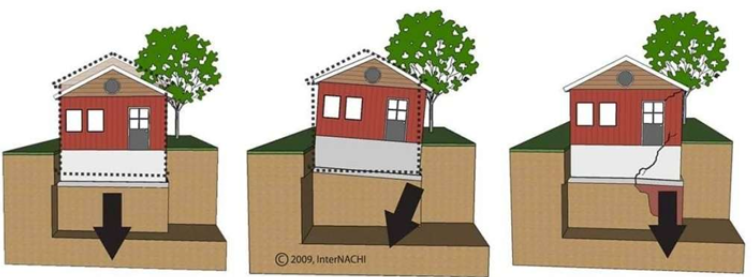
Soil liquefaction
ultimate limit state due to liquefaction under shallow foundations → poor foundation & geotechnical design
Foundation element
= Interfacing element that (properly) spreads the structural load to the ground
structural elements can be made of various materials & have various cross sections
Limit state design
analyses of soil-structure interaction scenarios that lead to excessive foundation settlement or collapse of the soil/structure
Ensure soil foundation:
is able to support the applied loads w/out moving excessively
= Serviceability Limit State (SLS)
2. will not collapse (thus preventing structural collapse as well)
= Ultimate Limit State (ULS)
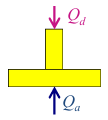
Allowable stress design
Qult/FS = Qa >= Qd
Qult = ultimate load (leading to an ULS)
Qa = allowable load
Qd = design (or working) load
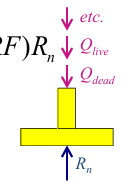
Load & resistance factor design
Σ(LF)iQni<=(RF)Rn
Qn = nominal load
Rn = nominal resistance
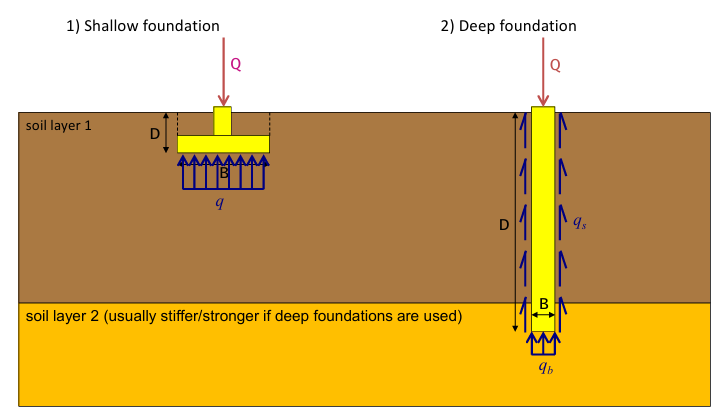
Foundation types
Shallow foundation
strip footing
Deep foundation (goes into stiffer / stronger soil layer) → friction
flight auger pile, driven concrete pile
Deep foundation bored pile/drilled shaft
1. Soil excavated with an auger to desired depth
2. Reinforcement is installed
3. Hole is filled with concrete
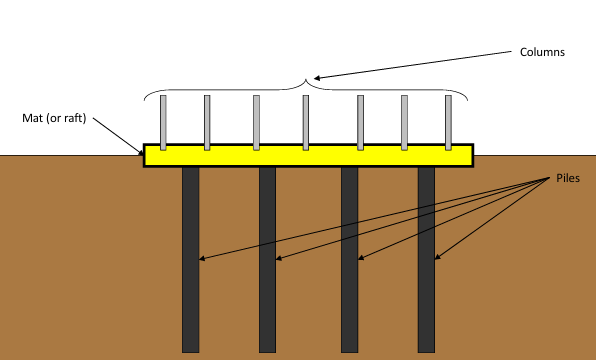
Piled raft foundation
Piles + mat
Effect of external loads
Soil-structure interaction alters the soil state
Stress changes may be followed by pore pressure changes ➞ changes in effective stresses
Soil deforms as a result of stress changes ➞ compression and consolidation
in practice fabric changes are usually accounted for as changes in soil density and/or water content
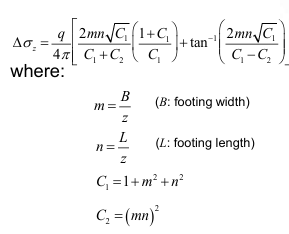
Change in vertical stress at point P under corner of a footing
Assumptions:
1) Semi-infinite, homogeneous, isotropic, linear-elastic soil mass
2) Uniform contact stress distribution (q) at the base of the rectangular area
Notes:
(1) the principle of superposition can be applied to assess stresses at other locations;
(2) the arctangent term must be a positive angle in radians (i.e. if C2> C1, pi must be added to that angle)
All explored solutions based on
elasticity theory
Applied loads analysis points
magnitude
geometrical features
➞ shape, direction, point of application
type
➞ static or dynamic
➞ monotonic or cyclic (permanent or temporary)
boundary conditions
➞ rigid, flexible
➞ 1D, 2D or 3D