Plant Transport
 Call Kai
 Learn
Learn Practice Test
 Spaced Repetition
 Match
Match Flashcards
 Knowt Play
1/66

There's no tags or description
Looks like no tags are added yet.
Name | Mastery | Learn | Test | Matching | Spaced | Call with Kai |
|---|
No analytics yet
Send a link to your students to track their progress
67 Terms
Where is the transport system of the plant located?
In the vascular bundle
What are these tissues/ what are the parts of a vascular bundle?
Phloem
Xylem
(they are tissues)
What is the function of the xylem
Transports water and dissolved mineral salts from the roots to other parts of the plant
Unidirectional flow from the roots up to the plant
Provides mechanical support to plants due to lignified walls
What is the function of the Phloem?
Transports manufactured food (sucrose and amino acids) from the leaves to other parts of the plant (primary)
Bi-directional flow of materials depending on sucrose concentration → (from photosynthesising leaves to other parts of the plants or from root storage organs to other parts of the plant) (secondary)
Why sucrose?
Sucrose → Disaccharide (efficient)
Starch → Polysaccharide (too big)
Glucose → Monosaccharide (inefficient, cells in stem also uses them)
What are the parts of a vascular bundle? (Dicot)
Phloem
Cambium
Xylem
What are the parts of the transport system in (Stem)
Cuticle
Epidermis
Cortex
Phloem
Cambium
Xylem
Pith
What is the epidermis?
A layer of cells that covers the stem. (outermost layer of cells.)
The epidermal cells are protected by a waxy, waterproof cuticle that greatly reduces evaporation of water from the stem.
What is the cortex?
The region between the vascular bundles and the epidermis.
Where is the cambium located? What is the function of the cambium?
The phloem lies outside the xylem with a tissue called the cambium between them. (stem)
Cambium cells can divide and differentiate to form new xylem and phloem tissues, giving rise to a thickening of the stem.
What is the pith?
Central region of a dicotyledonous stem, primarily used for storage
What is the similarity of the pith and cortex?
Both the cortex and the pith are storage tissues.
What are the parts of the vascular bundle from outside to inside. (root)
Epidermis → piliferous layer (root hairs)
Cortex
Endodermis
Vascular cylinder
Phloem
Xylem
Characteristics of vascular arrangement in root
In a dicotyledonous root, the xylem and phloem are not bundled together. They alternate with each other.
What is the function of the cortex in the root tissue?
The cortex of the root is a storage tissue.
What is the endodermis?
The innermost layer of root cortex is called the endodermis.
What is the epidermis of the root?
The epidermis of the root is the outermost layer of cells.
Where are the vascular bundles located in a leaf?
The midrib and veins of the leaf contains the vascular bundle which provide support for the leaf
What are the parts of the vascular bundle from outside to inside. (leaves)
Xylem (top of vascular bundle)
Phloem (below xylem in the vascular bundle)
Why is the xylem at the top of a leaf?
Mesophyll has a higher density of chloroplasts, thus xylem is at the top of a leaf for greater rate of photosynthesis.
What is the “source” and the “sink”
Source: Leaves
Sink: other parts of the plant
What is the structure of the phloem?
Made of sieve tube cells/sieve tube elements. These sieve tube cells are joined together end to end to form a column with sieve plates in between
Lacks a nucleus and vacuoles and most cell organelles → unable to maintain itself. (degenerate protoplasm, thin, functional layers of cytoplasm and membranes)
Next to the sieve tubes are companion cells, which help to maintain the sieve tube cells
Companion cells are living cells with a functional plasma membrane, mitochondria and a nucleus → capable of respiration to release energy
What are the characteristics of sieve tube cells
are elongated living cells
Lacks nucleus and vacuoles and most cell organelles → unable to maintain itself. (degenerate protoplasm, thin, functional layers of cytoplasm and membranes)
What are the parts of the phloem?
Sieve plate
Sieve tube
Companion cells
Structure of companion cell
Narrow, thin-walled cell with cytoplasm, nucleus and numerous mitochondria
What is the function of a companion cell?
Provide metabolic support for sieve element cells and facilitate the loading and unloading of materials at source and sink
What are sieve plates
Cross-walls with many small sieve pores
How are phloems adapted for their function?
Phloem sieve tube elements have very little protoplasm and are arranged to form a continuous column. This reduces the resistance of the flow of substances within the phloem.
Pores within the sieve plates allow rapid flow of manufactured food substances
Structure of xylems
Made of tracheids and vessels
Dead cells with no protoplasm fused together at the ends; with adjacent cell wall broken down (no cross walls) to form a long, continuous, thin, hollow lumen
Heavily lignified inner walls to provide strength (mechanical support) for the plant
How is the xylem adapted for its function?
Empty lumen without protoplasm or cross walls enables water to move easily through the lumen
Walls are lignified to prevent the collapse of vessels
Difference between tracheids and vessels
Tracheids - long, slender cells connected to each other by pits. Found in all vascular plants
Vessels - shorter, larger diameter cells with completely perforated cell wall ends. Found only in Angiosperms
Characteristics of xylem
Dead, thickened cell wall with lignin deposit
Long and continuous
Thin and hollow
What is the membrane surrounding a vacuole?
Tonoplast
What is the structure of root hair cells?
Delicate, tiny hair-like outgrowth from the root cells, usually long and thin.
Function of root hair cells
Absorption of water and mineral salts from the surroundings
What are some adaptations of the root hair cell
Long and narrow extension
High concentration of cell sap (mineral salts and sugars) in vacuole
Contains many mitochondria
Explain long and narrow extension
Increases surface area to volume ratio to increase rate of absorption of mineral salts and water
Explain High concentration of cell sap (mineral salts and sugars) in vacuole
To maintain a low water potential within the cells to facilitate the intake of water by osmosis
Explain Contains many mitochondria
Capable of aerobic respiration to release energy which is used to take in mineral salts/ions by active transport
Describe how roots take in water and mineral salts
Root hairs grow between and are in close contact with the surrounding soil particles.
Each soil particle has a thin film of liquid surrounding it. The soil solution is a dilute solution of mineral salts.
The sap in the root hair cell is more concentrated due to the presence of sugars and mineral salts; it has a lower water potential than the soil solution. Hence, water enters the root hair by osmosis.
The entry of water dilutes the root hair’s cell sap. The sap of the root hair cell now has a higher water potential than that of the next cell (cell B). Hence, water passes by osmosis from the root hair cell into the inner cell.
Similarly, water passes from cell B into the next cell (cell C). This process continues until the water enters the xylem vessels.
What are some ways water can move up the stems
Root pressure
Capillary Action
Transpiration pull
Describe how root pressure causes water to move up the stems
As root cells actively pump mineral ions into the xylem, water moves by osmosis into the xylem from the soil.
Water entering the roots constantly exerts a pressure on the water that is already present in the root
Forces the water to move up the plant through the xylem (because water cannot be compressed)
Partially responsible to move water up the plant
Not enough force to transport water all the way up
Describe how capillary action causes water to move up the stems
Result of the forces binding a liquid together (cohesion) and the attracting forces that bind water molecules to another surface (adhesion) are greater than the force of gravity
Adhesion of water to the walls of a vessel will cause an upward force on the liquid at the edges and result in a meniscus which turns upward.
Cohesion is the attraction between water molecules. Because water molecules stick to each other, they form an unbroken column inside the xylem
Surface tension acts to hold the surface intact, so instead of just the edges moving upward, the whole liquid surface is dragged upward.
What is cohesion and adhesion?
Cohesion is the attractive force that attract water molecules together, water molecules have strong cohesion forces between molecules
Adhesion is the attractive force that attracts water molecules to other molecules, it allows water molecules to ‘stick’ to the surface of its surroundings
What feature of the xylem makes capillary action the mode of water transport in plant?
Xylem is microscopically thin
What is transpiration
Transpiration is the loss of water vapour from the aerial part of the plant (mainly through the stomata at the leaves)
Describe how transpiration pull causes water to move up the stems
Transpiration is the loss of water vapour from the aerial part of the plant (mainly through the stomata at the leaves)
Water continually evaporates from the leaf cells into the air spaces inside the leaves. The water vapour diffuses into the atmosphere through the stomata of the leaves
More water from the xylem is needed to replace the loss of water at the leaves. This in turn pulls water upwards from the roots and the soil, against the force of gravity
This generates a force known as ‘transpiration pull’ which is the main force of moving water up the tallest tree.
How does water move against gravity?
Water moves out of the mesophyll cells form a thin film of moisture around the cells.
Water from the thin film of moisture evaporates to form water vapour in the air spaces. The water vapour accumulates in the air spaces near the stomata.
Water vapour diffuses out of the stomata into the environment. This is transpiration.
Movement of water out of the cells to replace the thin film of moisture that has evaporated decreases the cell sap’s water potential.
The mesophyll cells absorb water via osmosis from the cells deeper in the leaf.
These cells, in turn, absorb water from the xylem vessels.
This results in the production of a suction force that pulls the column of water in the xylem vessels up.
State the journey of a water molecule from the soil travelling throughout the plant
Water from soil → root hair cell → xylem → leaf → evaporation
How is water taken in?
Water is taken in by the root hair cells (projections of epidermis cells)
Root hair’s cell sap has a lower water potential than soil solution (due to accumulation of salts in the vacuole)
water enter into cells by osmosis
How is mineral salts taken in?
Mineral salts is also taken in by the root hair cells
Root hairs are living cells that can respire to release energy
Mineral salts taken in by diffusion / active transport
What is the definition of the rate of transpiration?
Measurement of the amount of water vapour leaving the plant per unit time.
How do we measure transpiration? Draw the diagram.
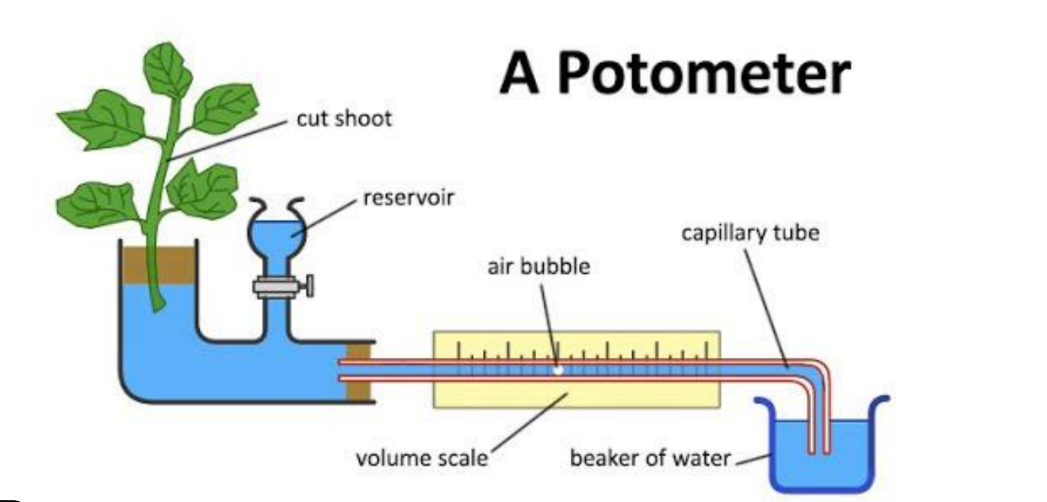
What assumption is used when we use a potometer?
All water taken in by the plant exits via transpiration and not used up by the plant
(99% water transpired, 1% used)
What affects the rate of transpiration?
Relative humidity
Wind speed
Temperature
Light
AND
Size of stomata
Explain how relative humidity affects the rate of transpiration
Higher humidity reduces the rate of diffusion of water vapour out of the stomata (hence reducing rate of transpiration)
At higher humidity, there is more water vapour surrounding the stomata. This reduces the concentration gradient of water vapour between the leaf and external air.
This results in slower rates of diffusion of water vapour out of the leaf
Explain how wind speed affects the rate of transpiration
Higher wind speed increases the rate of removal of water vapour from the leaves’ surface and hence increases the rate of transpiration.
At lower wind speed, there is more water vapour surrounding the stomata. The concentration gradient of water vapour in the leaf and in the surrounding atmosphere is reduced. This results in slower rate of diffusion of water vapour out of the leaf.
Explain how temperature affects the rate of transpiration
Higher temperature increases the rate of diffusion of water vapour out of the stomata and hence increases the rate of transpiration.
At higher temperatures, water molecules gain more kinetic energy, causing faster rate of evaporation from leaf cells inside the leaf. This increases the amount of water vapour in the air spaces of the leaf.
The concentration gradient of water vapour in the leaf and in the surrounding atmosphere is increased, resulting in faster rate of diffusion of water vapour out of the leaf.
Explain how light affects the rate of transpiration
The presence of light triggers the opening of the stomata leading to an increased rate of transpiration.
When stomata are wider, this allows for more space for water vapour to diffuse out. Hence, the rate of diffusion of water vapour out of the leaf increases.
What happens when a plant transpires too much?
Excessive transpiration
When rate of water loss exceeds rate of water absorption, wilting occurs.
What are the advantages and disadvantages of wilting?
Advantages of wilting
• Reduces rate of transpiration
• Prevents excessive water loss
Disadvantages of wilting
• Stomata close, decreasing intake of CO2
and rate of photosynthesis decreases.
• Leaves droop, decreasing absorption of
sunlight, hence rate of photosynthesis decreases.
examples of monocots and dicots
Monocots
– grasses
– lilies, tulips
– trees: palm, ginko
Dicots
– roses
– grapes
– trees: oak, maple
differences between dicots and monocots
Monocot:
One cotyledon
Veins usually parallel
Vascular bundle (usually) complexly arranged
Fiborous root systems
Floral parts usually in multiples of three
Dicot:
Two cotyledon
Veins usually netlike
Vascular bundles usually arranged in a ring
Taproot (usually present)
Floral parts usually in multiples of four or five.
Characteristics of arrangement of vascular bundles in stem (dicots)
Vascular bundles in circular arrangement.
Cambium tissue between xylem & phloem
Phloem is outside while xylem in inside of stem
Characteristics of monocot stem VB arrangement
Vascular bundles in scattered arrangement
• More are found at the periphery region
• No cambium tissue found
Arrangment of monocot root
Vascular bundle (stele) = xylem + phloem
VB, Endodermis, Cortex (for storage), Epidermis(piliferous layer, no cuticle)
Parts of a dicot root
Epidermis → piliferous layer (root hairs)
Cortex
Endodermis
Vascular cylinder
Phloem
Xylem