Political global governance
 Call Kai
 Learn
Learn Practice Test
 Spaced Repetition
 Match
Match Flashcards
 Knowt Play
1/22

There's no tags or description
Looks like no tags are added yet.
Name | Mastery | Learn | Test | Matching | Spaced | Call with Kai |
|---|
No analytics yet
Send a link to your students to track their progress
23 Terms
UNGA membership (4)
193 member states and 2 observer states
Vatican City and Palestine are observer states. UNGA passed Resolution in 1971, which recognised the People's Republic of China (PRC) as the only legitimate representative of China to the UN and expelled Taiwan's representatives.
China labelled themselves as a developing state, even though they have the 2nd largest economy.
Small nations, including island nations, hold the same voting power as larger states e.g. China and India have voiced concerns over small states having the same vote as them. They would want a more proportional voting system.
UNGA roles and actions (4)
In 2000, the UNGA endorsed the Millenium Development goals (MDGs). In 2015, UNGA agreed to replace these with new Sustainable Development Goals (SDGs). Only 35% of Sustainable Development Goals (SDGs) are on track to be accomplished before 2030
R2P has been invoked 35 times by the UNGA, e.g. In June 2023 the UNGA established the Independent Institution on Missing Persons in Syria to clarify the fate and whereabouts of all missing persons and provide support to victims, survivors and their families. 83 in favour. 11 against
The UN organised the 1992 Rio Earth Summit and oversees the UN Framework Convention on Climate Change, which is the basis for all international summits on climate change. The Paris Agreement in 2015 was negotiated by way of a UN summit. Donald Trump announced the U.S. withdrawal from the Paris Agreement in June 2017, but due to the agreement's rules, the formal exit didn't happen until November 4, 2020, with President Biden rejoining the U.S. in February 2021, although Trump initiated a new withdrawal process in January 2025
Division between developed and developing states, has challenged the UNGA's ability to reach consensus on Climate Change particularly over calls to phase out the use of fossil fuels by Oil Rich countries and countries dependent on cheap fuel for their development, including India and China (COP26, 2021)
Recent UNGA resolutions (3)
Gaza Ceasefire and Humanitarian Access, June 2025
Demands an immediate, unconditional, and permanent ceasefire in Gaza. Condemns the use of starvation as a weapon of war and calls for the release of hostages.
In Favor: 149 countries (including UK)
Against: 12 countries (including U.S., Israel, Argentina, Hungary, Paraguay)
Abstentions: 19 countries (including India, Georgia, Ecuador, Romania, Ethiopia)
Recognition of Palestinian Statehood and UN privileges, May 2024
Grants Palestine enhanced rights and privileges at the UN and urges the Security Council to reconsider full membership.
In Favor: 143 countries
Against: 9 countries (including U.S., Israel, Hungary, Micronesia, Palau)
Abstentions: 25 countries (including UK, Germany, Canada, Netherlands, Sweden)
Towards Regulation of Autonomous Weapons April 2025
Autonomous weapons systems (AWS) can select and engage targets without human intervention. Their rise raises ethical, legal, and strategic concerns
Adopted with strong support. 166 in favour and only 4 against (inc. Russian and Iran)
UNSC veto power (9)
In 2022, Russia vetoed a resolution calling on it to withdraw ‘immediately, completely and unconditionally from the territory of Ukraine’.
The USA last vetoed in 2020, refusing to support a resolution calling for foreign fighters from Islamic State to be allowed to return to their home countries as part of a rehabilitation programme.
Between 2010 and 2020, there were 33 vetoes cast by permanent members of the United Nations Security Council. These vetoes were used to block 23 draft resolutions over the 11-year span
Between 2020 and mid-2026, permanent members of the UN Security Council (UNSC) vetoed a total of 25 draft resolutions, 12 Russia, 12 USA, and 1 China
Russia and China have vetoed together 12 times.
The USA has vetoed alone four times and Russia has vetoed alone on 12 occasions.
The UK and France have not vetoed since 1981. China has not vetoed alone since 1999.
2023 Russia vetoed a nine-month extension of cross-border assistance to Northern Syria which left 4.1 million people with little or no access to food, water and medicine
Palestine UN membership vetoed by US in April 2024
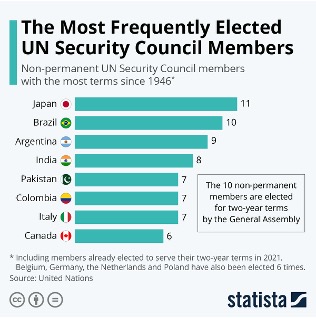
UNSC membership (2+diagram)
Non-P5 represent each continent e.g. currently include Algeria, Denmark, Pakistan, Korea, and Panama
50 states have never been on the UNSC.
UNSC peacekeeping and peacemaking (4)
2024 marked the tenth anniversary of the last UN Security Council decision to launch a new peacekeeping operation.
2022, UNSC established sanctions against Haiti to tackle the issues threatening peace, stability and security of Haiti
R2P has been invoked 90 times by the UNSC, e.g. R2P was invoked in 2011 when the UNSC sanctioned military action in Libya when the Gaddafi regime responded to protesters with military violence
In the 1990s unipolarity followed the end of the Cold War with the US dominating global politics. The UNSC was very proactive, particularly in carrying out peacekeeping operations and military operations. However, with the resurgence of Russia and Rise of China, reaching a consensus for decision-making has become increasingly challenging due to multipolarity. e.g. In 2022, Russia vetoed a resolution calling on it to withdraw ‘immediately, completely and unconditionally from the territory of Ukraine’.
Recent successful UNSC resolutions (4)
Children and Armed Conflict (2024)
Adopted unanimously.
Strengthened child protection mandates in UN peacekeeping operations.
Called for better monitoring and reporting of grave violations against children.
Urged member states to integrate child protection into peace processes and DDR (disarmament, demobilization, reintegration) programs
Somalia (2024)
Authorized the hand over of the UN Peacekeeping Mission to the African Union-led mission (AUSSOM).
Focused on Somali-led security transition and counterterrorism.
Emphasized capacity-building for Somali security forces
Democratic Republic of Congo (2025)
Condemned the M23 offensive and presence of armed groups in eastern DRC.
Extended the mandate of the Group of Experts monitoring sanctions.
Called for regional cooperation to address cross-border threats
Red Sea Security (2025)
Condemned Houthi attacks on commercial shipping.
Called for international naval coordination to ensure maritime safety.
Supported UN-led de-escalation efforts in Yemen
Recent vetoes UNSC resolutions (4)
Gaza Ceasefire Resolution (June 2025)
Vetoed by the United States (14–1 vote).
Called for an immediate, unconditional, and permanent ceasefire in Gaza.
Demanded the release of all hostages, unrestricted humanitarian aid, and restoration of essential services.
Supported a phased ceasefire framework (based on S/RES/2735).
The US objected due to lack of condemnation of Hamas and concerns it would undermine ongoing negotiations
Palestinian UN Membership (April 2024)
Vetoed by the United States.
Proposed full UN membership for the State of Palestine.
The US cited concerns over bypassing bilateral negotiations with Israel.
North Korea Sanctions Panel (2024)
Vetoed by Russia.
Would have extended the mandate of the panel monitoring DPRK sanctions.
Russia claimed the panel was biased and ineffective.
Gaza Ceasefire (March 2024)
Vetoed by China and Russia.
Called for a humanitarian ceasefire and protection of civilians.
Vetoed due to perceived imbalance and lack of condemnation of Israeli action
UN peacekeeping and making statistics
There are currently 11 UN peace keeping missions
70 Peacekeeping missions in the 80-year history of the UN – Highly active
NPT, 40 million landmines destroyed worldwide
2024 marked the tenth anniversary of the last UN Security Council decision to launch a new peacekeeping operation.
Reduced budget: $5.4 billion 2025-2026 fiscal year, down from $6.6 billion last year
In 2022, UNSC passed resolutions extending UN peacekeeping and assistance operations in Somalia, Iraq and Libya and non 2024, extended Yemen and Haiti
UN peacekeeping in El Salvador (1991-5) - not priority
Success
The UN peacekeeping mission was needed after the 12 year civil war
They had a broad and balanced mandate.
ONUSAL addressed military ceasefire and human rights, police reform and democratic institution budlings, tackling the root causes of the conflict
They had strong cooperation from all parties
Salvadoran gov and rebel forced supported UN involvement so ONUSAL had legitimacy and access to implement reforms effectively
Tangible post conflict progress
Successful demobilisation, creation of a civilian police force and credible elections ensuring a stable transition to peace
UN peacekeeping in Mozambique 1992-5
success
After a 16 year civil war
Strong political will and peace agreement
1992 Rome General Peace Accords between government and RENAMO rebels had genuine commitment from both sides. ONUMOZ invited to monitor and support implementation, giving it legitimacy and access
Effective demobilisation and election
ONUMOZ oversaw disarmament of over 90,000 combatant and helped to reintegrate them into civilian life
Supported free and fair elections in 1994, which marked Mozambique’s transition to democracy.
Comprehensive Support and Coordination:
The mission worked closely with humanitarian agencies, donors, and civil society to rebuild infrastructure, support refugees, and promote reconciliation—ensuring peace was not just political, but social and economic.
UN peacekeeping in Namibia and Lebanon - not priority
Namibia:
It has had multiple colonial leaders, a genocide and been the victim of civil war
Peacekeepers there to help rebuild the political system by helping to inform citizens of their rights and what it means to elect their own leaders
Lebanon
Israeli defence forces on one side and Hezbollah and other armed actors on the other side
1000s of UN peacekeepers in the midst
Southern Lebanon tends to have peacekeepers patrolling on foot, walking around local communities and visiting markets.
Peacekeepers set up medical clinics, and provide lots of employment
UN peacekeeping in Mali (2013-23)
launched in 2013 after military coup with goal of supporting political transition, protecting civilians and promoting human rights
Criticised for not salting to curb escalating violence and instability
Both France and UK removed troops following hostages of 300 peacekeeprs
Many non-state and military and terrorist organisations had increasing influence in the country, including al-Qaeda, Islamic State (IS) and African Corps. Russian backed Wagner Mercenaries
Mali’s military and leaders have moved closer to Russia, leading to Mali expelling the French embassy in 2022, accusing them of trying to hold onto its former colony
In 2023, Mali’s transitional gov, expelled all UN peacekeepers, citing their failure to deliver peace
UN Peacekeeping in DRC - not priority
Peacekeepers deployed to support peace and stability after decades of civil conflcit
Presence of numerous armed groups including military M23 - a “people’s liberation army” stemming from Rwanda with anti-western ideology. They have targeted UN peacekeepers, killing 13 military personnel and have carried out terrorist attacks within DRC
Congolese government initiated a withdrawal process in 2023
Responsibility to Protect (R2p) 2005
R2P has been invoked 35 times by the UNGA and 90 times by the UNSC to justify intervention.
R2P was invoked in 2011 when the UNSC sanctioned military action in Libya when the Gaddafi regime responded to protesters with military violence.
NATO security dilemma and multipolarity (6)
Article 5 states that an attack on one member state shall be regarded as an attack on all member states. NATO has only used Article 5 once, when NATO allies indicated their support for the US after 9/11
Warsaw Pact created in 1966 by USSR shortly after NATO. NATO has expanded from 12 original members to 31, including 10 former Warsaw Pact nations.
In 2016, President Vladimir Putin highlighted NATO specifically as a key national security threat to the Russian Federation. Putin pointed to the ‘intensification of military activities, further expansion of the alliance and moving military infrastructure closer to Russia's borders' as evidence of the perceived threat.
In 2018, Putin criticised NATO for trying to expand its membership to Ukraine and Georgia, urging NATO to 'think about the possible consequences of such an irresponsible policy'.
NATO allies expressed concern when member state, Turkey, purchased a $2.5 billion air defence system from Russia in 2019. The US went further, with President Trump issuing sanctions against its NATO ally. These sanctions were not lifted when President Biden took over in 2021.
New membership to NATO including the membership of Finland (2023) and Sweden (2024)demonstrates a renewed significance for NATO in providing collective security and a deterrent to Russian aggression.
NATO funding (4)
In 2006, NATO members agreed a 'guideline' that states should spend a minimum of 2% of GDP on defence. The number of states meeting this guideline has increased in recent years.
In 2015, only five states were meeting this commitment. In 2020, NATO confirmed that 10 states met this commitment (US, Greece, Estonia, UK, Poland, Latvia, Lithuania, Romania, France and Norway).
US accounts for more than 2/3 of the defence spending of all NATO allies. The Supreme Allied Commander of Europe (SACEUR) is traditionally an American. This is the highest military command position within NATO. Trump = Daddy of NATO
France, Germany and the UK account for ½ of NATO members’ defence spending of the non-US NATO allies. Secretary-General is always European
NATO activity (8)
NATO was prominent in Bosnia (1992–2004), and Serbia and Kosovo
Trident Juncture 2018 - NATO’s largest military exercise since the Cold War, involving around 50,000 participants. It was conducted in Norway and surrounding areas of the North Atlantic and Baltic Sea.
2016 - article 5 extended to include cyber-attacks.
Prominent in the war on terror following 911
NATO has also been involved in other counterterrorism, anti-trafficking and counter-piracy activity. For example, Operation Active Endeavour (2001–16) involved patrols of the Mediterranean to ‘detect and deter terrorism’ and Operation Ocean Shield (2009–16) resulted in a decline in piracy off the coast of Somalia.
Steadfast Defender 2021 - Conducted in Germany, Portugal and Romania, the aim of the exercise was to improve the ability of Allied forces to move quickly across the Atlantic and Europe to protect each other. It involved over 9,000 troops from more than 20 NATO allies and partners.
NATO provides continued military aid and training for Ukraine. In 2024, this amounted to £800m worth of pledged arms and training.
Since 2022, there has been an increase in the number of troops stationed in NATOs eastern border 13,000 to 40,000 across NATO as a deterrent to Russia. The troop surge reflects NATOs shift towards rapid, large-scale readiness in the threat of hybrid threats including airspace violations and destruction of gas and oil pipes in recent months.
The Treaty on the Non-Proliferation of Nuclear Weapons (NPT)
Came into force in 1970 and now has 190 signatories
P5 of UNSC all have nuclear weapons and have signed NPT
3 states posses nuclear reusing but have not signed NPT
India since 1974
Pakistan since mid 1980s estimated
North Korea who withdrew in 2003 and have had nuclear weapons since 2006.
Israel is widely suspected, but not confirmed, to have had nuclear weapons since perhaps the early 1960s.
Successes of MDGS (4)
Extreme poverty halved falling from 1.9billion in 1990 to 836 million in 2015. UN reported most progress had been made since 2000.
Increase in primary school enrolment from 83% in 2000 to 91% in 2015. Proportion of girls in education increased.
Child mortality reduced by more than half, from 90 to 43 deaths per 1,000 between 1990 and 2015.
Maternal health improved with mortality declining by 45% world wide since 1990, dramatic decrease of 64% in southern Asia.
Limitations of MDGs (5)
Economic development and rapid growth in China have been responsible for most of the success in eradicating extreme poverty.
Progress elsewhere has been less marked.
The target of halving the number of people suffering from hunger was missed.
Former UN Secretary General Ban Ki Moon acknowledge that global inequality remains a significant issue.
The private sector was not given enough of a role in the implementation of a role of the MDGs. This is a gap addressed in the SDGs.
SDG successes (7)
Implemented a more holistic approach to tackling poverty, with a focus on the environment including action on climate change, clean water and more sustainable management of the ecosystems.
In addition, reference to political freedom as a key goal for the first time, through the inclusion of peace, justice and strong institutions. This addresses a gap in the MDGs in not addressing conflict and makes developing peace and security one of the major factors in reducing underdevelopment and poverty.
Child marriage, maternal and child mortality rates continue to decline.
Effective HIV treatment has cut AIDS related deaths by 52% since 2010 and malaria prevention efforts have saved millions of lives.
110 million more children are in school, and the gender gap in education continues to shrink.
The proportion of women holding parliamentary seats globally has risen to 27%.
Access to electricity has expanded rapidly, reaching 92% of the global population.
SDGs failures (5)
Only around 12% of the SDG targets are on track due to significant funding gaps with the retraction of foreign aid and funding from western states who are focusing on building up defence following the invasion of Ukraine.
18% of targets are regressing due to factors including conflict, climate disruption and economic instability.
Over 800 million people still live in extreme poverty. Crises like the COVID 19 pandemic have reversed previous progress, adding millions to poverty and hunger statistics.
Progress on environmental goals like combatting plastic pollution and deforestation has been slow.
Lack of accountability and vague goals- the non binding nature of the goals and a lack of strong accountability measures means that political support often fails to translate into strategic policy and investment. The sheet number and complexity of the 17 goals and 169 targets can make them difficult to prioritise and implement effectively.