unit 6 - ER, GOLGI, LYSOSOMES
 Call Kai
 Learn
Learn Practice Test
 Spaced Repetition
 Match
Match Flashcards
 Knowt Play
1/305

There's no tags or description
Looks like no tags are added yet.
Name | Mastery | Learn | Test | Matching | Spaced | Call with Kai | Chat |
|---|
No analytics yet
Send a link to your students to track their progress
306 Terms
what is the main function of lysosomes
degradation of target compounds
lysosomes contain many enzymes for degradation give me 3 examples (there are more)
proteases
hydrolases
lysozymes
the endoplasmic reticulum is divided into 2
smooth ER
rough ER
what is the functions of smooth ER and rough ER
smooth = lipid synthesis
rough = glycoprotein synthesis
smooth ER synthesises ….. and ……
lipids and hormones
apart from synthesis of lipids the SER is also involved in what process
detoxification
what is detoxification
removal of toxic compounds (mainly hydrophobic compounds) by the addition of OH (alcohol group)
are hydrophobic compounds soluble or insoluble
insoluble
in detoxification why do we add alcohol groups
to increase solubility
rough ER is the synthesis of what type of proteins
glycoproteins
the particle that is produced from the SER or RER is transferred where
Golgi Apparatus
what happens in the Golgi complex
modify lipids and proteins
(final modification takes place here)
when the processes is done - so lipids and proteins have been modified in the Golgi complex - what is the destination of the lipids and proteins
the plasma membrane
endoplasmic reticulum
is composed of a set of membranes that form a network of saccules - called what
cisternae
endoplasmic reticulum
in the rough ER - it has …………….. 1 …. and the main function is
has ribosomes attached to the membrane
synthesis of glycoproteins
endoplasmic reticulum
in the smooth ER - it has…….1…… and the main function is…..2…
No ribosomes
synthesis of lipids and steroids
endoplasmic reticulum
RER and SER which has ribosomes
RER = ribosomes
SER = no ribosomes
Rough endoplasmic reticulum
membranes are thinner than the plasma membrane due to its composition of
_ proteins
_ lipids
70% proteins
30% lipids
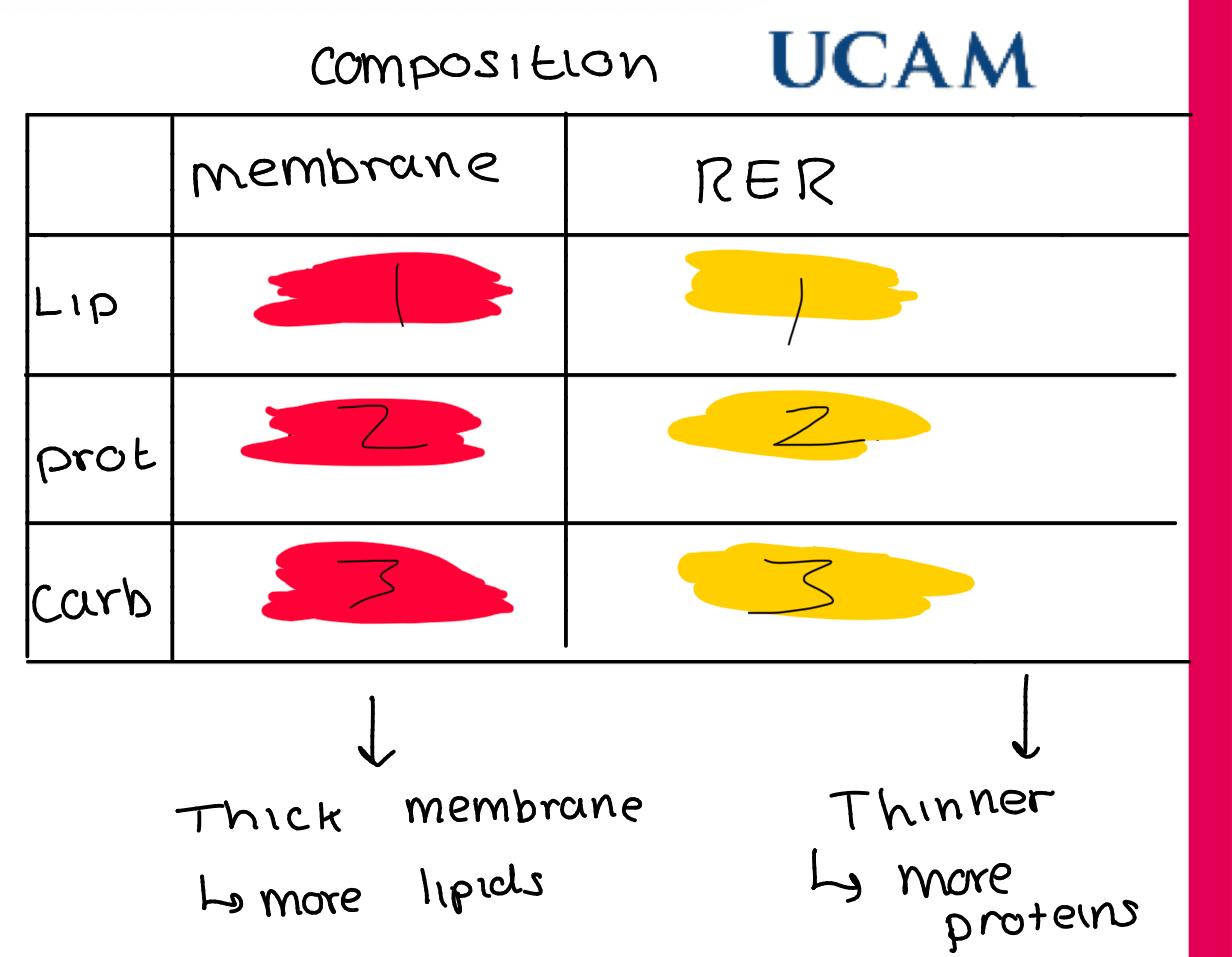
1
membrane = 45%
RER= 30%
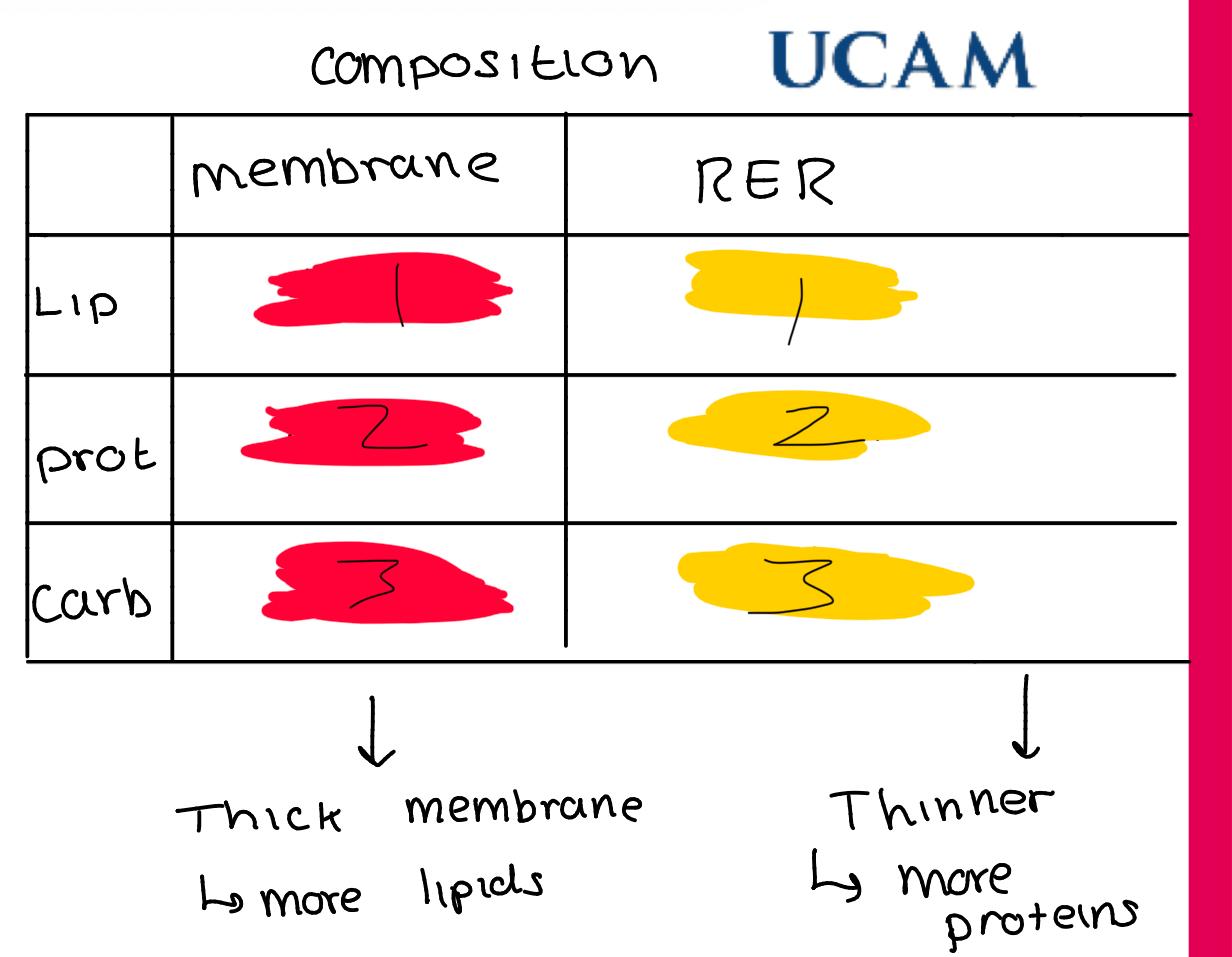
2
membrane = 45%
RER = 70%
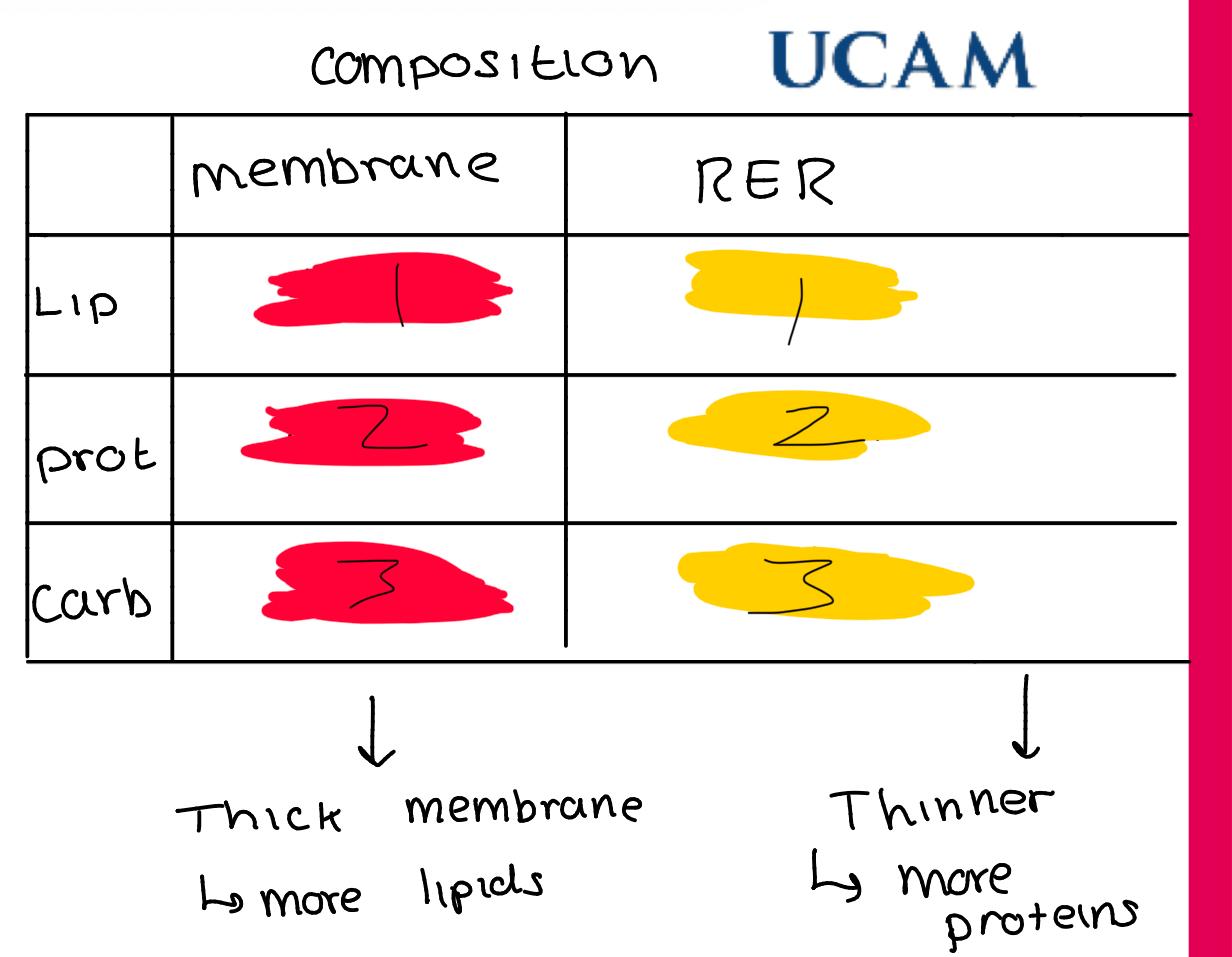
3
membrane = 10%
RER = 0%
when we have the proportion 45,45,10 % what is the characteristic of the membrane
thick
when we have high levels of proteins what is the characteristic of the membrane
thinner
Rough endoplasmic reticulum
the RER is composed of 2 parts
hyaloplasmic face (outer)
Luminal face or lumen (inner)
Rough endoplasmic reticulum
Hyaloplamsic face is the membrane surface where what happens
where the ribosomes are inserted
Rough endoplasmic reticulum
the luminal face or lumen is always the
internal part of organelles
Rough endoplasmic reticulum
the luminal face or lumen is the internal part o organelles and - does or doesn’t contain ribosomes?
NO ribosomes
function of RER
produce glycoprotein
folding of proteins
transport to Golgi
what is a glycoprotein
protein + carbohydrate and this process is called glycosylation
folding of proteins into what
their tertiary structure
enzymes are involved in the folding of proteins into their tertiary structure - which enzymes
chaperons
chaperons use ATP meaning they are what
ATPase
proteins fold into their three dimensional shape and packaged into what
vesicles which go to Golgi
Rough endoplasmic reticulum
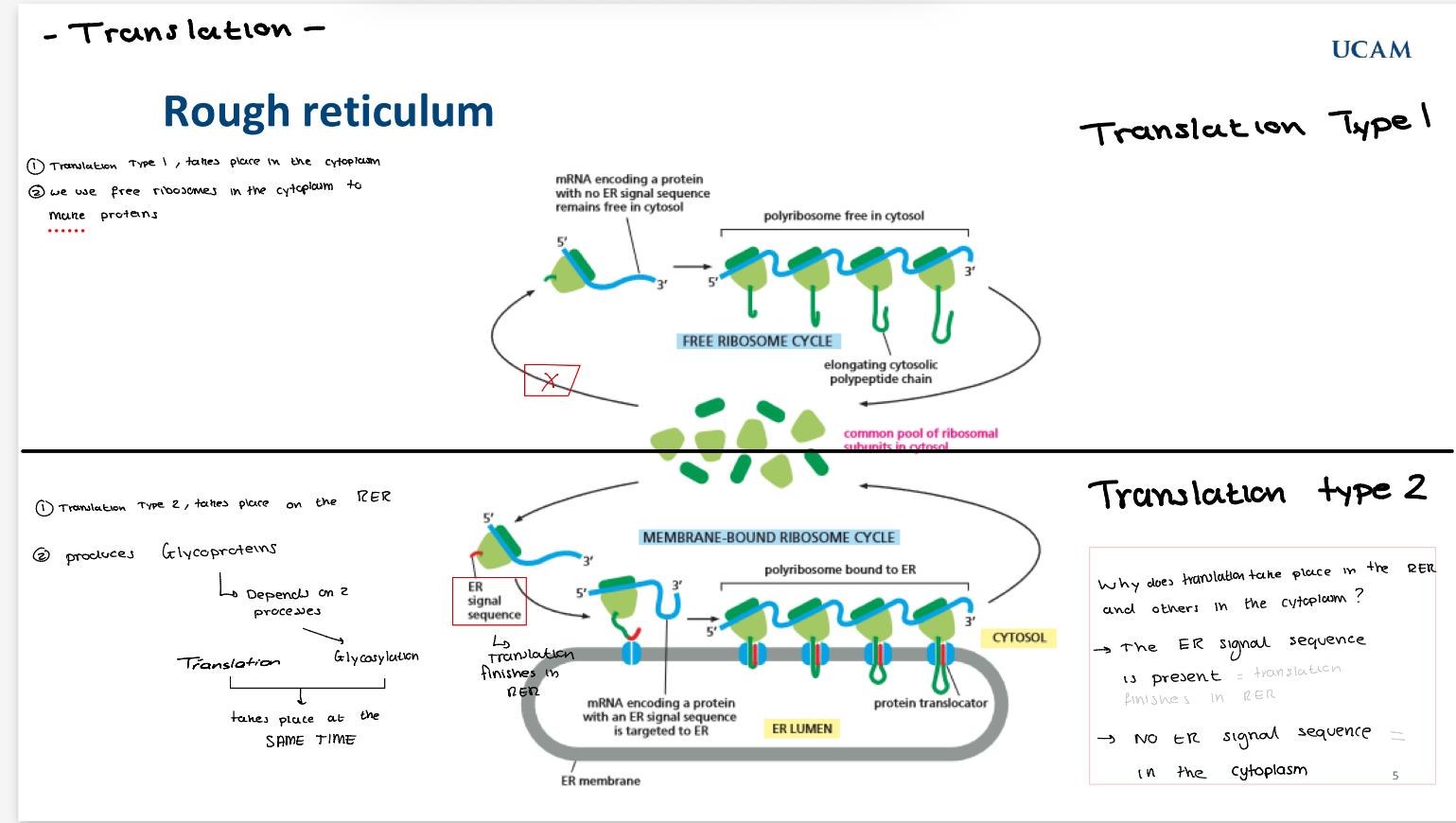
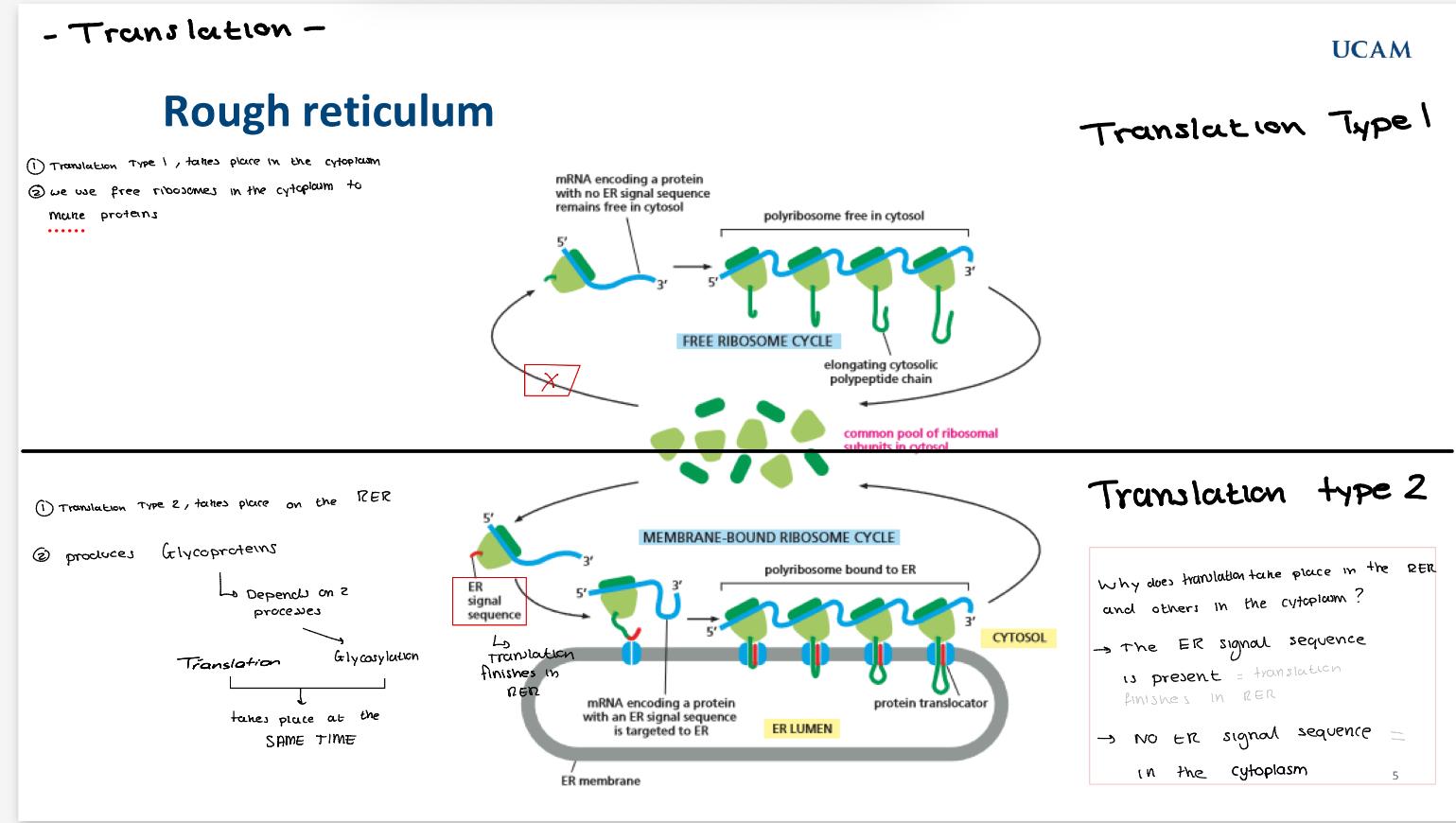
how many types of translation
2
Rough endoplasmic reticulum
translation 1 is called = 1
translation 2 is called = 3
1 = free-ribosome cycle
2= membrane-bound ribosome cycle
Rough endoplasmic reticulum
translation type 1 takes place where
the cytoplasm
Rough endoplasmic reticulum
translation type 1 (free ribosome cycle)
what happens
we us free ribosomes in the cytoplasm so make proteins
Rough endoplasmic reticulum
translation type 2 (membrane-bound ribosome cycle) takes place where
on the RER
Rough endoplasmic reticulum
translation type 2 - what molecule is produced
glycoproteins
Rough endoplasmic reticulum
translation type 2
the synthesis of glycoproteins depends on 2 processes
translation and glycosylation
Rough endoplasmic reticulum
translation type 2
the synthesis of glycoproteins depends on translation and glycosylation these two processes happen at (important)
THE SAME TIME
Rough endoplasmic reticulum
why does translation take place in the RER and others in the cytoplasm
The ER signal sequence is NOT present in the cytoplasm,
however it is present in the RER so translation finishes there
READ
DONE
what is the ER signal sequence composed of
at least 8 hydrophobic amino acids
if my protein shows the ER signal sequence made up of hydrophobic amino acids what is the consequence
translation finishes in the RER
the hydrophobic amino acids are mainly composed of what in the side chain
carbon and hydrogen
the ER signalling sequence is recognised by what
SRP
what is SRP
signal recognition particle
the SRP is a what protein
is a ribonucleoprotein (protein-RNA-complex)
the SRP and ER signal sequence complex is dissociated via what
GTP hydrolysis
Rough endoplasmic reticulum
translocation from cytoplasm to ER
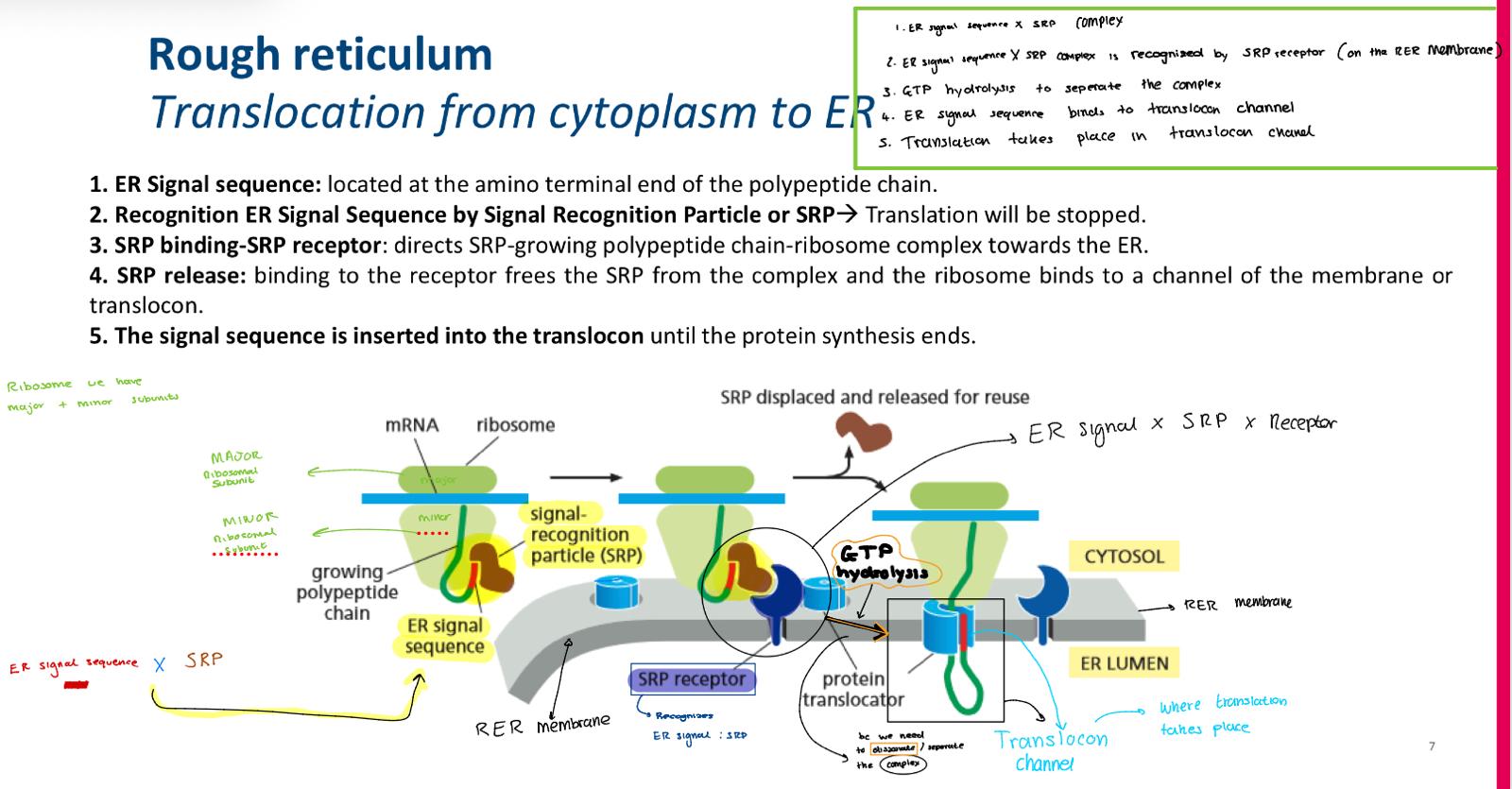
the ER signal sequence is located where
the amino terminal end of the polypeptide chain
Rough endoplasmic reticulum
translocation from cytoplasm to ER
recognition of ER signal sequence by Signal recognition particle results in
translation will be stopped
Rough endoplasmic reticulum
translocation from cytoplasm to ER
SRP binding-SRP receptor
directs what complex towards the ER
directs the SRP-growing polypeptide chain-ribosome complex towards the ER
Rough endoplasmic reticulum
translocation from cytoplasm to ER
SPR release - binding to the receptor frees the SRP from the complex and the ribosome binds to what
a channel of the membrane or translocon
Rough endoplasmic reticulum
translocation from cytoplasm to ER
the signal sequence is inserted into the translocon until what
protein synthesis ends
Rough endoplasmic reticulum
translocation from cytoplasm to ER
in ribosomes we have 2 subunits what are they
major and minor
Rough endoplasmic reticulum
translocation from cytoplasm to ER
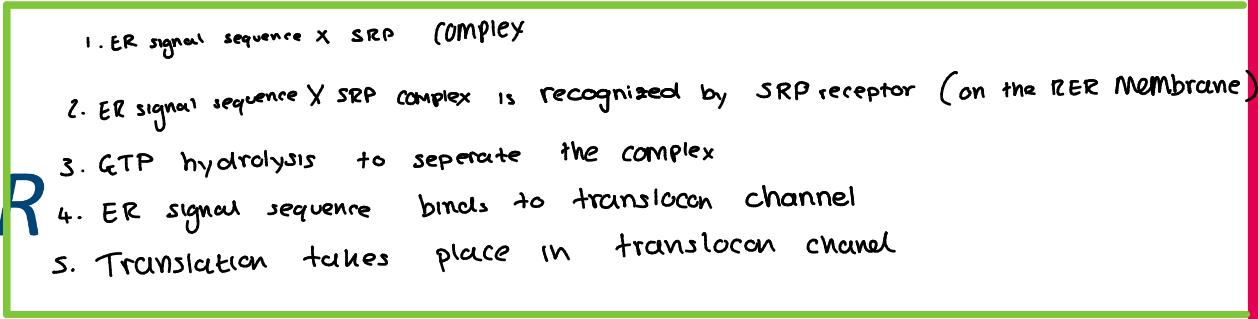
what recognises the ER signal sequence X SRP complex
SRP receptor (in the RER membrane)
Rough endoplasmic reticulum
translocation from cytoplasm to ER
what happens when we have
the ER signal sequence X SRP complex X SRP receptor
GTP hydrolysis
Rough endoplasmic reticulum
translocation from cytoplasm to ER
what binds to translocon channel
ER Signal sequence
Rough endoplasmic reticulum
translocation from cytoplasm to ER
what happens in translocon chanel
translation
READ VERY IMPORTANT
DONE
READ
done
there are 2 types of proteins that are translated from the translocon channel
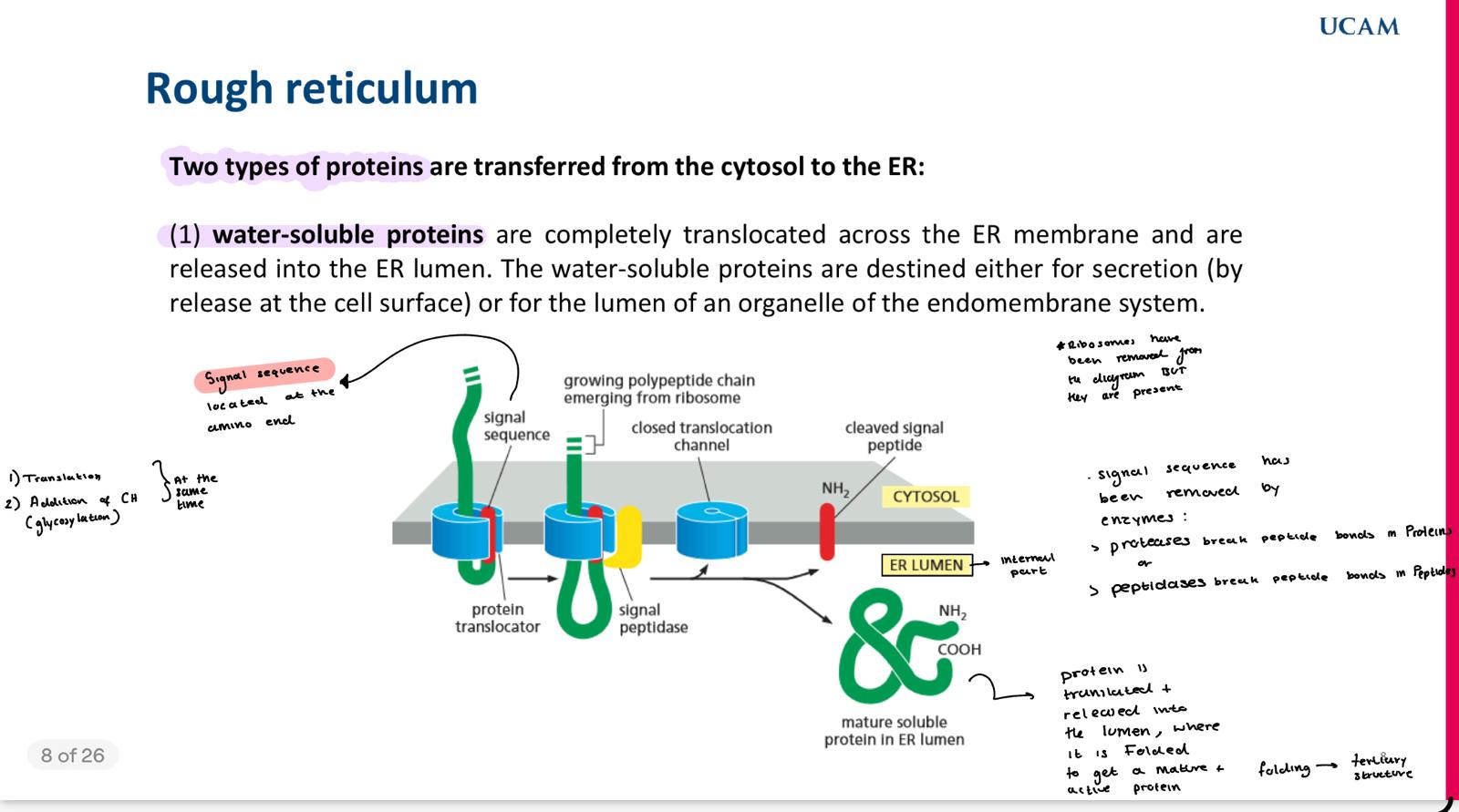
water soluble proteins
transmembrane proteins
water-soluble proteins
are ……….. translocated across the ER membrane
completely
water-soluble proteins
are completely translocated across the ER membrane and are ……………….. ( what happens after)
released into the ER lumen
water-soluble proteins
destination (2)
secretion at cell surface
lumen of an organelle of the endomembrane system
water-soluble proteins
where is the ER signal sequence located
in the amino end
water-soluble proteins
at the same time that the protein is being translated what is happening
glycosylation (addition of carbohydrates)
water-soluble proteins
the ER signal sequence is removed from the final protein by which enzymes
proteases
peptidases
water-soluble proteins
what do proteases do
break peptide bonds in proteins
water-soluble proteins
what do peptidases do
break peptide bonds in peptides
water-soluble proteins
the final protein is translated and released into the lumen - what happens here
it is folded into a tertiary structure to become a mature and active protein
water-soluble proteins
translated
released into lumen
folding
mature and active protein
true or false
true
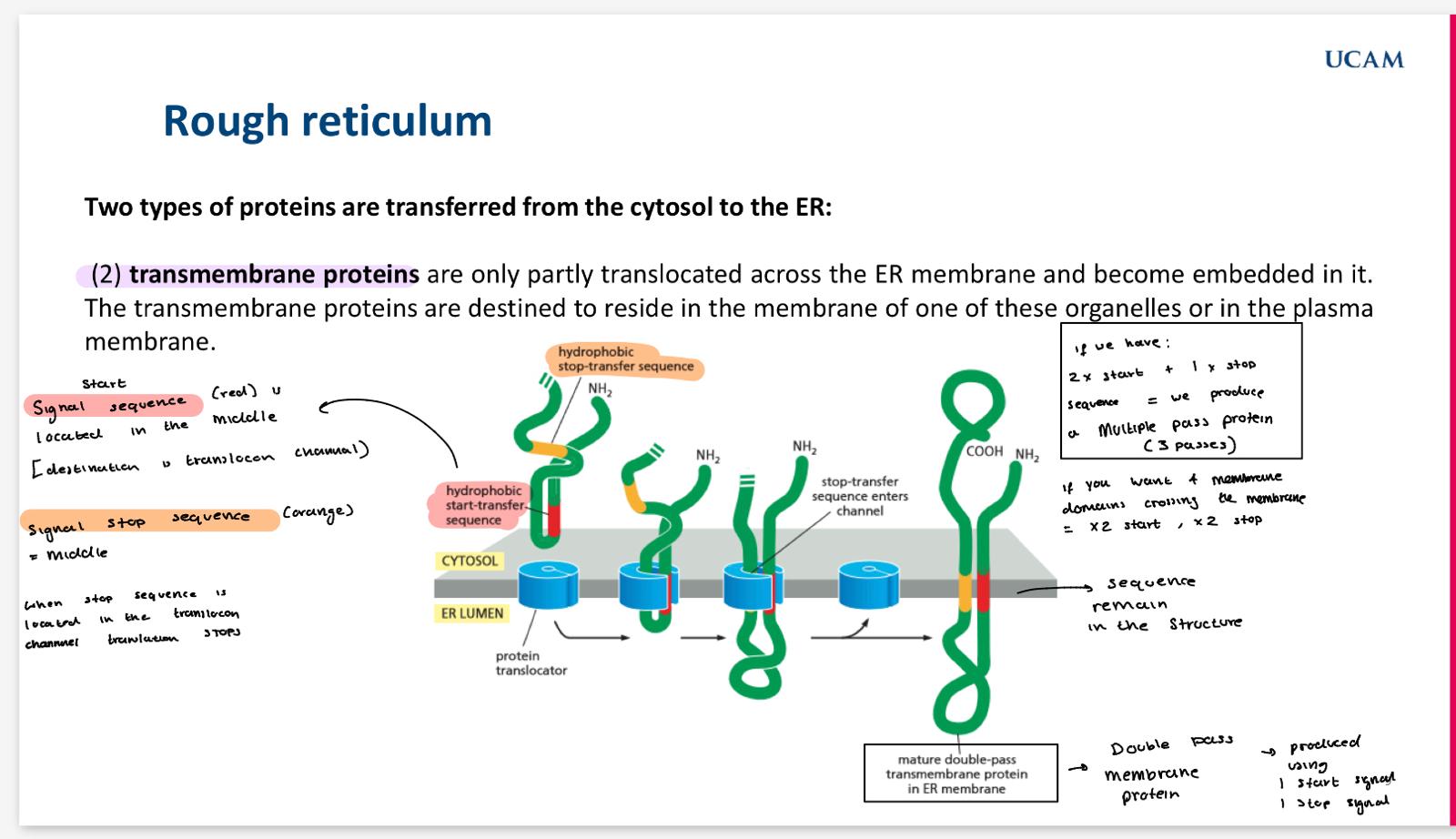
transmembrane protein
are ……1… translocated across the ER membrane and become ………2.
partly
embedded in it
transmembrane protein
are destined to ……. what (what happens to them their destination)
reside in the membrane of one of these organelles or in the plasma membrane
transmembrane protein
in the water soluble protein the ER signal sequence was located in the amino end and here where is it located
in the middle of the protein
transmembrane protein
destination of the ER signal sequence
translocon channel
transmembrane protein
here we have an additional sequence called what
signal stop sequence
transmembrane protein
where is the location of the signal stop sequence
also in the middle of the protein
transmembrane protein
what happens when this stop sequence is placed in the translocon channel
( both stop and start (ER signal sequence) are in the translocon channel)
translation STOPS
transmembrane protein
in the water soluble protein the ER signal sequence is removed from the final protein in this case are both the signal sequences removed ?
both the signal sequences remain in the final structure
transmembrane protein
what happens when we have 1 start and 1 stop signal
we get a double pass transmembrane protein
transmembrane protein
what happens if we have 2x start and 1xstop signals
we produce a multiple pass protein (3 passes)
transmembrane protein
if we want a protein that crosses the membrane 4 times what do we need
2x start
2x stop
read
done
read
done
rough reticulum - GLYCOSYLATION
what is glycosylation
addition of carbohydrates
rough reticulum - GLYCOSYLATION
glycosylation is the addition of carbohydrate but more specifically what type of carbohydrate
oligosaccharide
rough reticulum - GLYCOSYLATION
what is oligosaccharides made of
14 monomers (minimum)
rough reticulum - GLYCOSYLATION
oligosaccharide + …1…. = …….2…..
protein
glycoprotein
rough reticulum - GLYCOSYLATION
we have 2 types of glycosylation what are they
N-glycosylation
O-glycosylation
rough reticulum - GLYCOSYLATION
we are going to put carbohydrates into the protein so we need to link what
carbohydrates and amino acids
rough reticulum - GLYCOSYLATION
in the N-glycosylation what functional groups are involved in the linkage
amine group = NH2
alcohol group = OH group
rough reticulum - GLYCOSYLATION
what is bound to what from the protein and from the carbohydrate in N-glycosylation
the amine group (NH2) from the protein is bound to the alcohol group (OH) from the carbohydrate
rough reticulum - GLYCOSYLATION
when we perform N-glycosylation and the NH2 amine group is used, what amino acid is involved
Asparagine (Asn)
rough reticulum - GLYCOSYLATION
O-glycosylation, why is it called O
instead of the amine group alcohol groups are involved
rough reticulum - GLYCOSYLATION
what is the linkage in O-glycosylation
OH (alcohol) from the amino acid/protein and OH (alcohol) from the carbohydrate
rough reticulum - GLYCOSYLATION
what amino acids are involved in O-glycosylation
Serine (Ser)
Threonine (Thr)
rough reticulum - GLYCOSYLATION
READ
addition of oligosaccharide (14 monomers) to the protein → residue Asn (N-glycosylation) or Ser, Thr (O-glycoslyation) → Glycoproteins
done
rough reticulum - GLYCOSYLATION
what amino acid is used in
N
S
glycosylation
Asparagine
Serine or Threonine