Attention
 Call Kai
 Learn
Learn Practice Test
 Spaced Repetition
 Match
Match Flashcards
 Knowt Play
1/32

There's no tags or description
Looks like no tags are added yet.
Name | Mastery | Learn | Test | Matching | Spaced | Call with Kai |
|---|
No analytics yet
Send a link to your students to track their progress
33 Terms
Function of attention
Signal detection and vigilance
• Keep an eye out for what you need
Search
• Find signal among distracters
Selective attention
• Attend to some stimuli and ignore others
Divided attention
• Manage attention to coordinate work
Metaphor 1: The Spotlight
Attention acts like a spotlight
it 'illuminates' selected information
Enhances processing of whatever falls within the beam
Attended objects are processed faster & more accuratel
Spotlight can move (covertly, without eye movement)
Endogenous
Top-down / voluntary
• Internally driven
• You decide to focus
• Examples: studying, proofreading,
searching for a friend in a crowd
• Slower to deploy, but precise
Exogenous
• Bottom-up / reflexive
• Externally driven
• Stimulus captures you
• Examples: loud bang, flashing notification,
someone calling your name
• Rapid & automatic, hard to suppress
Signal detection theory
A signal is the important information we are trying to notice. REQUIRES:
Attention: focusing on possible signals.
Perception: interpreting what you sense.
Memory: comparing the signal to past experiences.
Decision-making: deciding whether the signal is real.
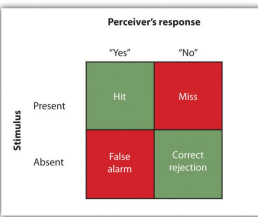
Vigilance
Waits for a signal that may come at unknown time
Watching clock hand jumps, miss rates rise over time
Training helps, but rest produces quicker results
Expectation of stimulus location affects efficiency
Metaphor 2: The Filter
Attention acts like a filter that gates information flow
Unwanted input is blocked before reaching higher processing
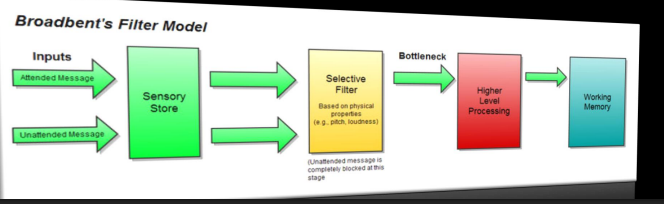
Broadbent's early filter model (1958): filter selects by physical features (pitch, loudness, location)
Problem: we still notice our own name in an unattended channel → selective filter / late-filter models
Key debate: Where in processing does selection happen?
CONTROLLED
Effortful and deliberate
Requires awareness
Serial (one thing at a time)
Resource-limited — draws heavily on working memory
Best for novel or complex tasks
AUTOMATIC
Effortless; requires little conscious attention
Fast, parallel (many things at once)
Involuntary — hard to stop
Develops through extensive practice
Examples: driving a familiar route, reading words
Similarity theory
Similarity of target to distracters reduces detection
Degree of disparity of targets and distracters important
Difference between distracters also plays a role
Dissimilar distracters make object easier to find
Selective Attention: Ignoring the Irrelevant
the ability to focus on task-relevant information while filtering out task-irrelevant information
Broadbent's Early Filter
Physical features (pitch, location) gate information before it's processed semantically. Unattended channel is completely blocked.
Treisman's Attenuation
Rather than blocking, the filter weakens non-target channels. Personally significant info (own name) can still break through
Late Selection Models
All info is fully processed for meaning; selection happens after semantic analysis. Explains how we can detect our name.
Vigilance Decrement
Sustained attention tasks show miss rates rise over time. The brain's alerting system fatigues — even for trained professionals (air traffic control, radiology).
Improving Vigilance
Rest & breaks restore performance faster than training. Knowing signal location helps. Moderate arousal is optimal (Yerkes-Dodson law).
Single Pool Model
One shared pool of limited cognitive resources
Any two tasks draw from same pool
Performance degrades as tasks compete
Explains: difficulty driving while in deep conversation
Multiple Resources Model
Separate pools for different modalities & stages
Tasks using DIFFERENT resources interfere less
Example: jogging + listening to a podcast (fine); jogging + reading (hard)
Explains: you can sometimes successfully dual-task if modalities differ
Automatization: From Novice to Expert
With practice, controlled processes become automatic — freeing up resources for higher-level tasks.
Capture errors:
Auto-pilot overrides new intention (drive home when meaning to stop at store
Perseveration
Repeat a completed step (add sugar twice to coffee)
Loss of activation:
Forget goal mid-routine (why did I open the fridge?)
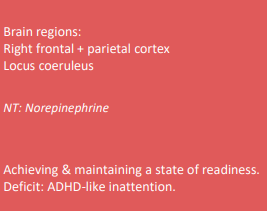
A L E R T I N G
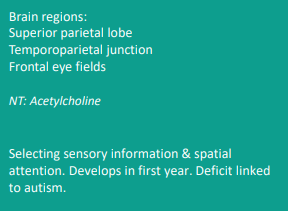
OR I E N T I N G
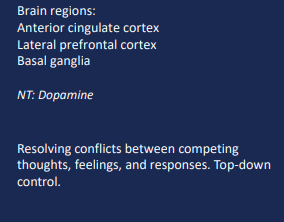
E XE C U T I V E C ON T R OL
🔄 Change Blindness
Fail to notice large changes in scenes when there's an interruption (cut, blink, flicker). Real-world risk: missing important changes in medical imagery or traffic.
👁 Inattentional Blindness
Fail to see clearly visible objects when attention is occupied elsewhere. The gorilla experiment (Simons & Chabris 1999) — ~50% miss it.
🗺 Spatial Neglect
After lesion (often right parietal/frontal lobe), patients ignore the contralateral hemifield. Draw only right side of a clock. Not blindness — attention deficit
Habituation
We give decreasing attention to repeated stimuli — a conscious process tied to episode count.
Sensory adaptation:
The senses themselves diminish response to constant stimuli (smell, touch) — unconscious, tied to stimulus intensity.
Dishabituation
A change in the habituated stimulus captures attention again — the basis of 'contrast effects' in advertising and alarm design.
Attention to Action: Norman & Shallice's Model
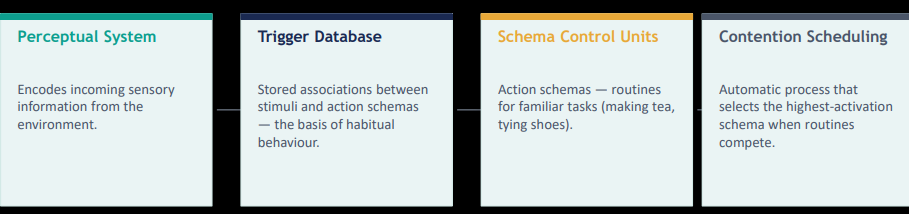
Supervisory Attentional System (SAS)
Top-down executive control that overrides contention scheduling for novel, dangerous, or complex situations — the prefrontal cortex in action.