Healy: War of 1812, Industrial Revolution, and Westward Expansion
 Call Kai
 Learn
Learn Practice Test
 Spaced Repetition
 Match
Match Flashcards
1/38

There's no tags or description
Looks like no tags are added yet.
Name | Mastery | Learn | Test | Matching | Spaced | Call with Kai |
|---|
No analytics yet
Send a link to your students to track their progress
39 Terms
What were the years of the War of 1812?
1812-1815 (Treaty of Ghent signed in December of 1814, but the biggest British defeat of the war at New Orleans takes place after in January of 1815 because news didn't reach there quick enough).
Who were the War Hawks and what did they want?
Republican Congressman who wanted War with England over impressment
Led by Henry Clay and John Calhoun
What was impressment?
It was when British captured/kidnapped American soldiers and forced them to be in the British navy. This is one of the major reasons Madison urges Congress to declare war against Britain in 1812.
What city was burned during the war of 1812?
Washington, D.C including the White House by the British. They did this in revenge/retaliation for America burning down govt buildings in the city of Toronto/York in Canada.
What battle was Francis Scott Key watching from a British prison ship when he wrote the poem, the Defence of Fort M'Henry, that would later become our national anthem?
Baltimore
What battle skyrockets Jackson into fame because he defeats the British while outnumbered with untrained forces (after the Treaty of Ghent had already been signed)?
New Orleans
What was the Industrial Revolution?
A change in the way goods were made (from by hand to machines) and in the way people worked (farms to factories).
Where and when did the Industrial Revolution first begin in the world?
Great Britain; 1750
Where/when did it first begin in America and why?
New England; 1800 (Samuel Slater set up the first textile factory Rhode Island). Conditions ripe in New England because:
-could not farm as a result of cold climate and poor soil conditions; had an availability of workers as a result who could leave the farm and work for money for the first time (including women and children); this led to the development of cities and towns.
-many rivers and streams in the region would be used to power the machines in factories (leads to pollution:()
Technology
The application of scientific discoveries to practical use.
Sam Slater
A British textile worker who slipped out of England to America with the plans to a spinning jenny in his head; he started the first textile factory in Rhode Island: "Slater the Traitor!" This prompted the Industrial Revolution in America!
Francis Lowell
Opened the first true factory system, which expanded on Slater's, by including all the steps to making textiles under one roof; America no longer had to rely on finished textile products from Europe.Employes mostly women in his factories.
Factory worker wages?
Men: $5/week; women: $2/week; children: $1/week.
Eli Whitney
Most fame for popularizing interchangeable parts and inventing the cotton gin (he made no money from the cotton gin...people copied his machine).
Benefits of Interchangeable parts
Products could now be put together and repaired easier, quicker, and much cheaper than if were completely handmade.
Cotton gin and it's effects
A simple machine that quickly and efficiently removed the seeds from the cotton fiber.
-1 person could now clean 50 pounds of cotton with the gin in 1 day, as opposed to just 1 pound before this invention
-caused and increase in demand for slave labor (which was decreasing up to this point) to plant and harvest the cotton
-huge demand for cotton by the Northern textile factories...also indirectly dependent on slave labor because of this!
-South becomes a cotton kingdom..."white gold"
-Natives get removed from ancestral lands to plant more cotton
-South produces up to 80% of the world's cotton
Advantages of using steam engine/power?
Transportation was no longer reliant on animals, wind, and currents.
Erie Canal
A man-made 363 mile canal in upstate NY that was used to transport items east and west; it connected the Hudson River/Albany to Lake Erie/Buffalo.
Benefits of Erie Canal
-Reduced travel time for shipping goods and people
-Lowered the cost of shipping goods immensely
-NYC became a center of commerce bc it becomes the gateway to the west: goods/people could be shipped from NYC to the West, and vice versa, using an all-water route which united the growing country!
-Economy of towns along the canal grew
-Success of Erie Canal prompted other states/countries to build canals.
What does Erie Canal connect?
Albany to Buffalo (Hudson River to Lake Erie)... NYC to the West!
Locks
Locks were the solution to passing through differences in land elevation along the canal; they raised or lowered water levels to assist boats as they they traveled. Water elevators!
How did boats travel on the Erie Canal in the early days?
Horses or mules pulled the boats (no current or wind).
What was the era called when James Monroe was elected?
"The Era of Good Feelings" because sectional differences are ignored for a time.
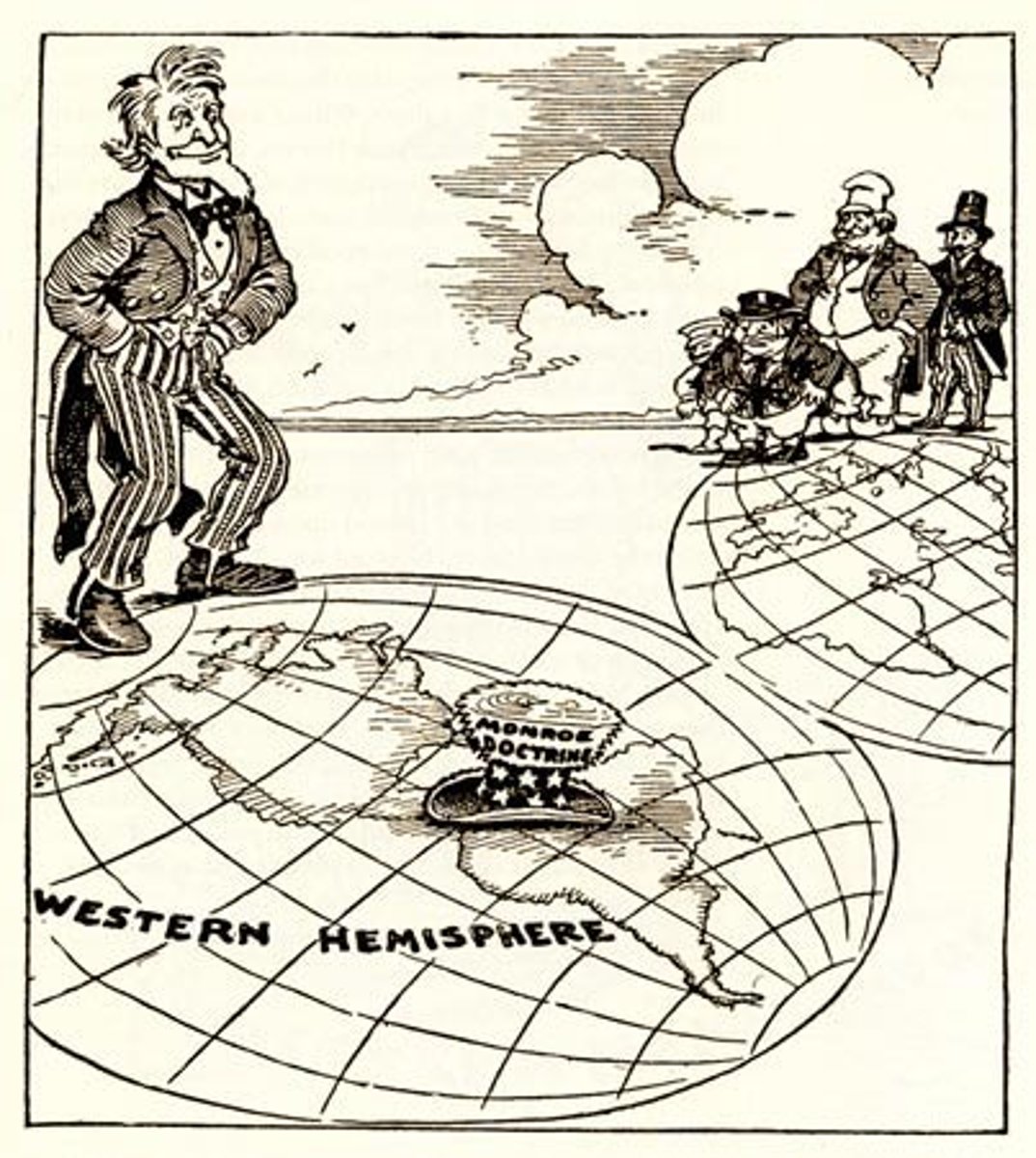
Monroe Doctrine
American policy which President James Monroe announced saying European countries were no longer allowed to interfere with any affairs of any nation in the Western Hemisphere, and we would stay out of the affairs of European nations; America will follow this policy for the next 100 years. European nations followed this policy in the beginning not because they were fearful of the United States, a very new country, but they were involved in other issues. The policy takes on greater importance as time goes on.
Andrew Jackson
First president to come from humble beginnings and first to be born in a log cabin. War of 1812 hero. Many people had mixed feelings about his policies; he was a very controversial President. Some felt he abused his power and the Constitution. Known as "Old Hickory" because he was extremely hard/tough. Natives called him "Sharp Knife" because of his brutality in battle. Known as the "people's president" and protected the rights of the common white man. Behind the Indian Removal Act/Trail of Tears. Father of the modern Democratic party.
Spoils System
The practice of a winning candidate replacing government employees with his/her supporters/friends. Jackson was accused of this.
What did John C. Calhoun advocate?
He argued for the states' rights to make their own laws without interference from the federal government.
Indian Removal Act
Andrew Jackson was behind this act which forced the removal of thousands of Indians at gunpoint from their ancestral lands east of the Mississippi: Trail of Tears! It was enacted in 1830 and led to the relocation of Native American tribes to designated "Indian Territory" in present-day Oklahoma, resulting in significant suffering and death.
What present-day state is the Indian Territory now in?
Oklahoma
Manifest Destiny
The long-held belief that white Americans had a God-given right to all the land between the Atlantic and Pacific Oceans, with no regard to how that was achieved! ANY obstacles in the way of achieving Manifest Destiny could be justifiably removed by any means.
Why did people want to move to the Oregon territory?
There was free, open land and excellent soil.
Reasons pioneers moved west
-Adventure and Opportunity
-Fertile and Free Land (Oregon!)
-Religious Persecution (Mormons/Utah)
-Gold (California!)
Effects on buffalo?
Shot for sport as trains passed by (left to rot on prairie); devastated the way of life of the Plains Indians who depended on the buffalo for survival.
Homestead Act and requirements?
Govt gave eligible people 160 acres of land for free (or for a very small price) in order to encourage western white settlement (must pay a small administrative fee, clear the land, and live there for at least 5 years).
When was the Gold Rush?
Gold was discovered late in 1848 by James Marshall, however word spreads and the "rush" (or influx of people from ALL around the world: China, Europe, Mexico, South America, eastern U.S. cities) does not occur until 1849 (hence...the 49ers!); it ends in only a few years, but has long-lasting effects on California's economy.
Where was the Gold Rush?
California
Who made the most profits from the Gold Rush?
Merchants who sold goods at inflated prices to newly arrived unprepared miners. Only 1/100 miners made it rich!
Vigilantes
Took the law into their own hands (because there was no organized police force to deal with the rapidly growing cities) and would act as police, judge, and sometimes even executioner in the boomtowns that sprung up almost overnight throughout California as a result of the gold rush.
Boomtown
A town that grew extremely rapidly as a result of the Gold Rush. Example: San Francisco went from a population of 800 non-Natives in 1848, to a population of 25,000 by 1850.