PSY 210: Social Psychology
 Call Kai
 Learn
Learn Practice Test
 Spaced Repetition
 Match
Match Flashcards
 Knowt Play
1/41

There's no tags or description
Looks like no tags are added yet.
Name | Mastery | Learn | Test | Matching | Spaced | Call with Kai |
|---|
No analytics yet
Send a link to your students to track their progress
42 Terms
What is the fundamental attribution error?
An individual's tendency to attribute another's actions to their character or personality, while attributing their own behavior to external situational factors outside of their control
What is the interactionist perspective?
Traits depend on situation, and situation is impacted by our characteristics
Who was Walter Mischel? What were his three arguments?
Psychologist who focused on impact of situation during a time where traits dominated the conversation.
Three arguments:
Unimpressive upper limit to predictive value of personality
Situations are more important than traits to explain behavior
No use to measure personality, as people display no consistency in behavior
What is the personality coefficient?
r=.30
What is an attitude?
A summary evaluation of an object
What is a mood?
A general state of feeling, not necessarily identified by a particular event or cause
What is an emotion?
A feeling experienced by a reaction to an event
Tripartite model of attitudes
Affect (feeling), Behavior (action), Cognition, (thoughts)
Attitude strength
How quickly attitude comes to mind
Attitude consistency
How much attitude aligns with the tripartite model
Self-Perception Theory
People determine their own attitudes and emotions by observing their own behavior and the context in which it occurs
Social Information Processing Theory
Use of environmental cues, including social interactions, to determine one’s attitude standing
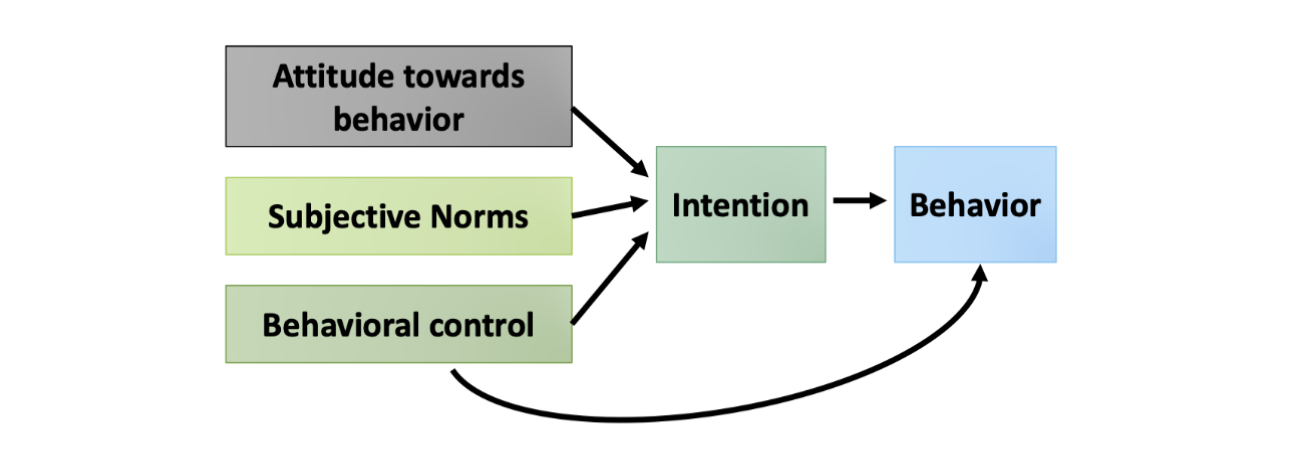
Theory of planned behavior
Behavior is shaped by attitudes, subjective norms, and behavioral control, which lead to intentions, and then behavior. Behavioral control also has a direct influence on behavior.
What is persuasion?
The process by which a person or entity attempts to influence another to change their beliefs or behaviors
Six aspects of persuasion
Reciprocation, Consistency, Social Validation, Linking, Authority, Scarcity
Reciprocation
Expectation of mutual exchange
Includes the door in the face technique (ask for something big, then the smaller thing you actually want when they say no)
Consistency
Tendency to seek alignment in behaviors, beliefs, and attitudes
Includes foot in the door technique (ask for something small, then something bigger after)
What is forewarning in terms of persuasion?
A reminder to individuals that what they are seeing is a persuasive attempt
Prejudice
Unfair negative attitude toward a social group
Stereotypes
Overgeneralizations about a group or its members
Discrimination
Unjustified negative behaviors toward members of outgroups based on their group membership
Test for measuring implicit attitudes
IAT
What type of tests study explicit attitudes?
Self-report measures
Traditional forms of prejudice are____. What are some ways to combat it?
Explicit, education, emphasize norms that prejudice is wrong, direct persuasive strategies, present counter-stereotypic examples
Contemporary forms of prejudice are____. What are some ways to combat it?
Implicit, techniques for discovering inconsistencies, intergroup contact, social categorization
Contact hypothesis
Increased intergroup contact will reduce prejudice
Social categorization
Cognitive process by which we place individuals into social groups; often results in “us” vs “them” categories
Decategorization
Seeing others as individuals
Recategorization
Creating a new “we” (be careful to retain positive distinctiveness)
Self-concept
A knowledge representation of one’s beliefs about oneself
Self-complexity
The extent to which individuals have different and independent ways of thinking about themselves
Self-esteem
Positive or negative feelings we have about ourself
Self-affirmation theory
Interventions may fail when the messaging threatens people’s sense of self, but when feeling affirmed about our own value in one domain, we may be better able to handle a message that challenges us in another.
Response-efficacy
A person's belief in the effectiveness of a recommended action to prevent or reduce a specific threat
What was the result of the self-affirmation study?
Self-affirmation promoted acceptance of message (response-efficacy)
Why are close relationships important?
Higher self-esteem, human need, inadequate social support linked to decrease well-being
Interpersonal attraction
The level of attraction between people which leads to the development of platonic or romantic relationships
Similarity attraction paradigm
Tendency for people to be attracted to those who are similar to themselves (status, liking, proximity)
Altruism
Any behavior designed to increase another’s welfare, particularly when actions provide no benefit to those who perform them
Kin altruism
Behaving to benefit a genetic relative’s chances of survival at some cost to one’s own chances
Reciprocal altruism
Helping another in a hope of receiving something in return
Diffusion of responsibility
Assuming others will help