Introduction to Force and Newtons Laws
 Call Kai
 Learn
Learn Practice Test
 Spaced Repetition
 Match
Match Flashcards
 Knowt Play
1/181

There's no tags or description
Looks like no tags are added yet.
Name | Mastery | Learn | Test | Matching | Spaced | Call with Kai |
|---|
No analytics yet
Send a link to your students to track their progress
182 Terms
What is this slide teaching?
A force is a push or pull that results from an interaction between objects
What is force?
A force is a push or pull exerted on an object
Why is force considered an interaction?
A force only exists when one object acts on another object
Can you directly see a force?
No. You can only observe the effects of a force on an object
What might indicate that a force us acting on an object?
A change in the object’s motion, direction, speed, or shape
What does it mean when a force is generated by an “agent”
An agent is the object or system that exerts the force
in the example of a rope pulling a box, what is the agent?
The rope is the agent because it exerts the pulling force on the box
In the example of a spring pushing a box, what is the agent?
The spring is the agent because it exerts the pushing force on the box
In the example of gravity acting on a box, what is the agent?
The Earth is the agent because it exerts the gravitational force on the box
What are the two ways forces can be applied according to the slide?
Forces can be applied by contact or through a field
What is a contact force?
A force that requires physical contact between objects
Why is a rope pulling a box an example of a contact force?
Because the rope must physically touch the box to exert the force
Why is a spring pushing a box an example of a contact force?
Because the spring must physically touch the box to exert the force
What is a long-range force?
A force that acts without direct physical contact between objects.
Why is gravity considered a long-range force?
Because the Earth can exert a force on an object without touching it
Which type of force is shown when a rope pulls a box?
A contact force
Which type of force is shown when a spring pushes a box?
A contact force
Which type of force is shown when the Earth pulls a box downward?
A long-range force (gravity)
How are contact forces and long-range forces different?
Contact forces require physical contact, while long-range forces act through a field without direct contact
If an object is accelerating, what does that suggest about forces acting on it?
It suggests that one or more forces are acting on the object.
Can a force exist if only one object is involved?
No. A force is an interaction and requires at least two objects
Is force a vector?
Yes it is a vector because it has both magnitude and direction
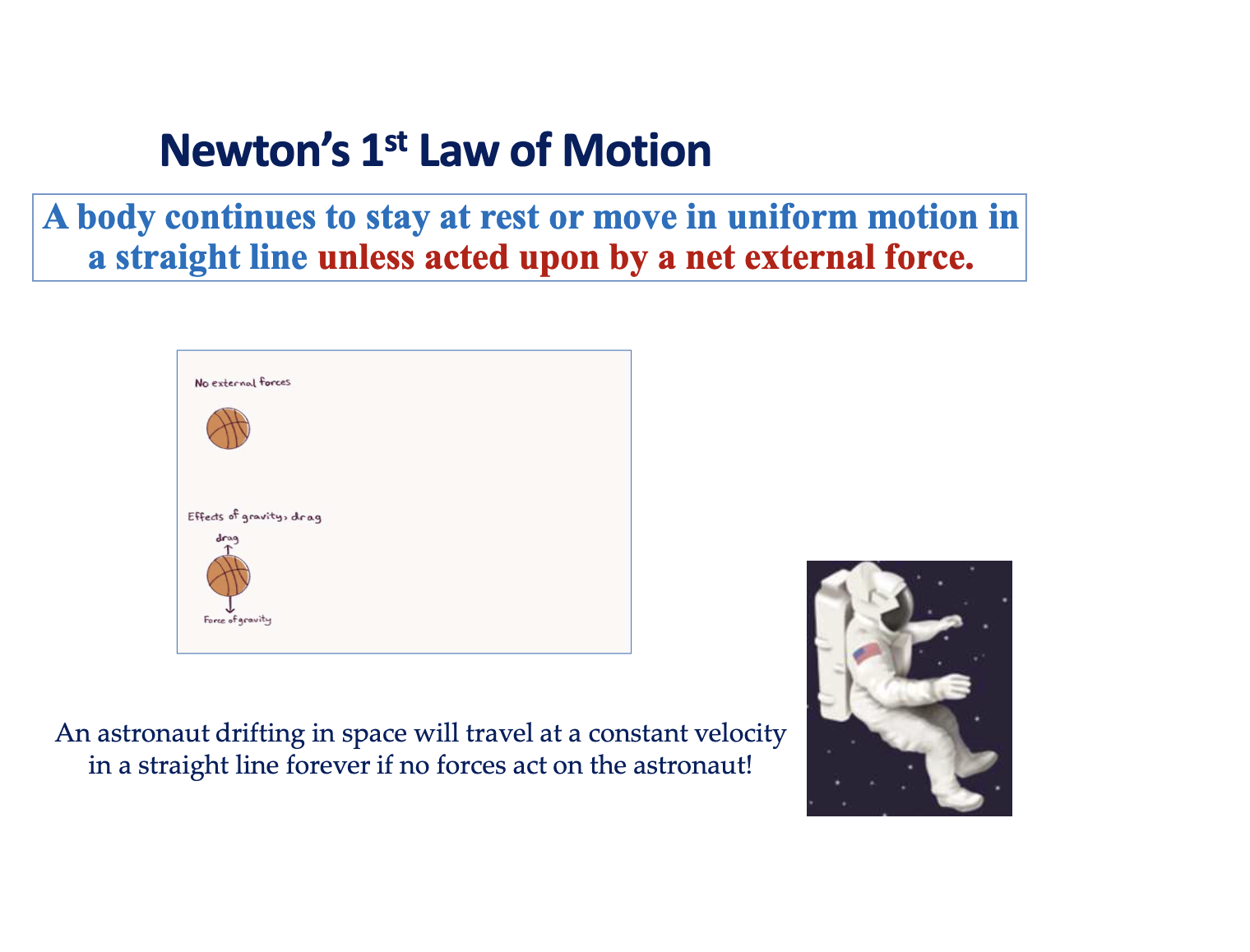
What are these slides teaching?
Newton's 1st Law states that an object will remain at rest or continue moving at a constant velocity in a straight line unless acted upon by a net external force. This tendency to resist changes in motion is called inertia
What is Newton's 1st Law of Motion?
An object remains at rest or moves with constant velocity in a straight line unless acted upon by a net external force
What does Newton's 1st Law tell us about objects at rest?
They will remain at rest unless a net external force acts on them
What does Newton's 1st Law tell us about objects already in motion?
They will continue moving at a constant velocity in a straight line unless a net external force acts on them
What is meant by a "net external force"?
The overall force acting on an object after all forces are combined.
Why is a net external force important in Newton's 1st Law?
Because only a net external force can change an object's state of motion
According to Newton's 1st Law, what happens if no net external force acts on an object?
Its velocity remains constant
What does "constant velocity" mean?
Both speed and direction remain unchanged.
Why does Newton's 1st Law mention motion in a straight line?
Because a change in direction is a change in velocity and requires a net force.
What is another name for Newton's 1st Law?
The Law of Inertia.
What is inertia?
The inherent resistance of an object to changes in its state of motion.
What does it mean to say an object has inertia?
It resists being started, stopped, sped up, slowed down, or redirected
Why do objects at rest tend to stay at rest?
Because of inertia.
Why do objects in motion tend to stay in motion?
Because of inertia
What quantity measures inertia?
Mass
Why is mass called inertial mass?
Because mass measures an object's resistance to changes in motion.
How does mass affect inertia?
he greater the mass, the greater the inertia.
Which object has more inertia: a bowling ball or a tennis ball?
A bowling ball because it has more mass.
Why is a bowling ball harder to start moving or stop than a tennis ball?
Because it has more mass and therefore more inertia.
According to Newton's 1st Law, what would happen to an astronaut drifting through space if no forces acted on them?
The astronaut would continue moving at a constant velocity in a straight line.
Why is an astronaut in space often used to illustrate Newton's 1st Law?
Because there is very little resistance, making it easier to observe motion continuing unchanged.
Looking at the basketball example, why doesn't a basketball continue moving forever on Earth?
Because external forces such as gravity and air resistance act on it.
What forces on Earth commonly prevent objects from moving forever?
Gravity, friction, and air resistance (drag)
Why does a basketball eventually slow down after being thrown?
Because external forces act on it and change its motion
If all external forces on a moving basketball could be removed, what would happen?
It would continue moving at a constant velocity in a straight line.
Does Newton's 1st Law say that moving objects naturally slow down?
No. Moving objects only slow down when external forces act on them.
A hockey puck slides across perfectly frictionless ice. What would Newton's 1st Law predict?
The puck would continue moving at constant velocity in a straight line.
A parked car remains motionless. Does this mean no forces act on the car?
No. Forces may act on the car, but they are balanced so the net force is zero.
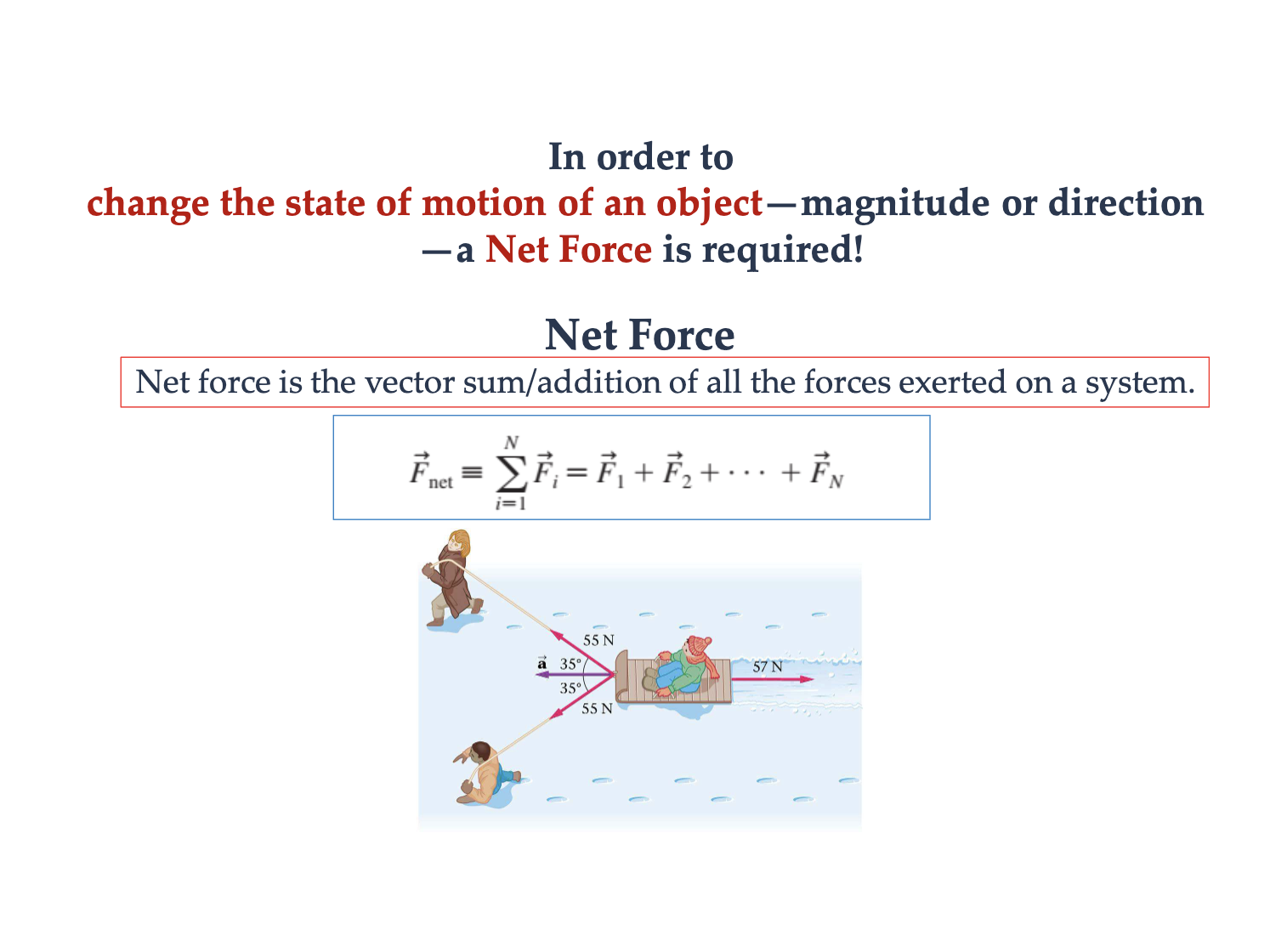
What is this slide teaching?
A net force is required to change an object's motion. The net force is the vector sum of all forces acting on the object.
What is a net force?
The vector sum (addition) of all forces acting on an object or system.
Why is a net force important?
because a net force is required to change an object's motion
According to the slide, what aspects of motion can a net force change?
The magnitude (speed) or the direction of motion.
Why does changing direction require a net force?
Because a change in direction is a change in velocity
Why does changing speed require a net force?
Because changing speed means changing the magnitude of velocity.
What does the equation for net force represent?
The addition of all forces acting on an object
Why is net force found using vector addition rather than ordinary addition?
Because forces have both magnitude and direction
What happens if the net force on an object is zero?
The object's motion does not change
If an object is at rest and the net force is zero, what will happen?
It will remain at rest.
If an object is moving at constant velocity and the net force is zero, what will happen?
It will continue moving at the same velocity.
What does a nonzero net force indicate?
The object's motion will change.
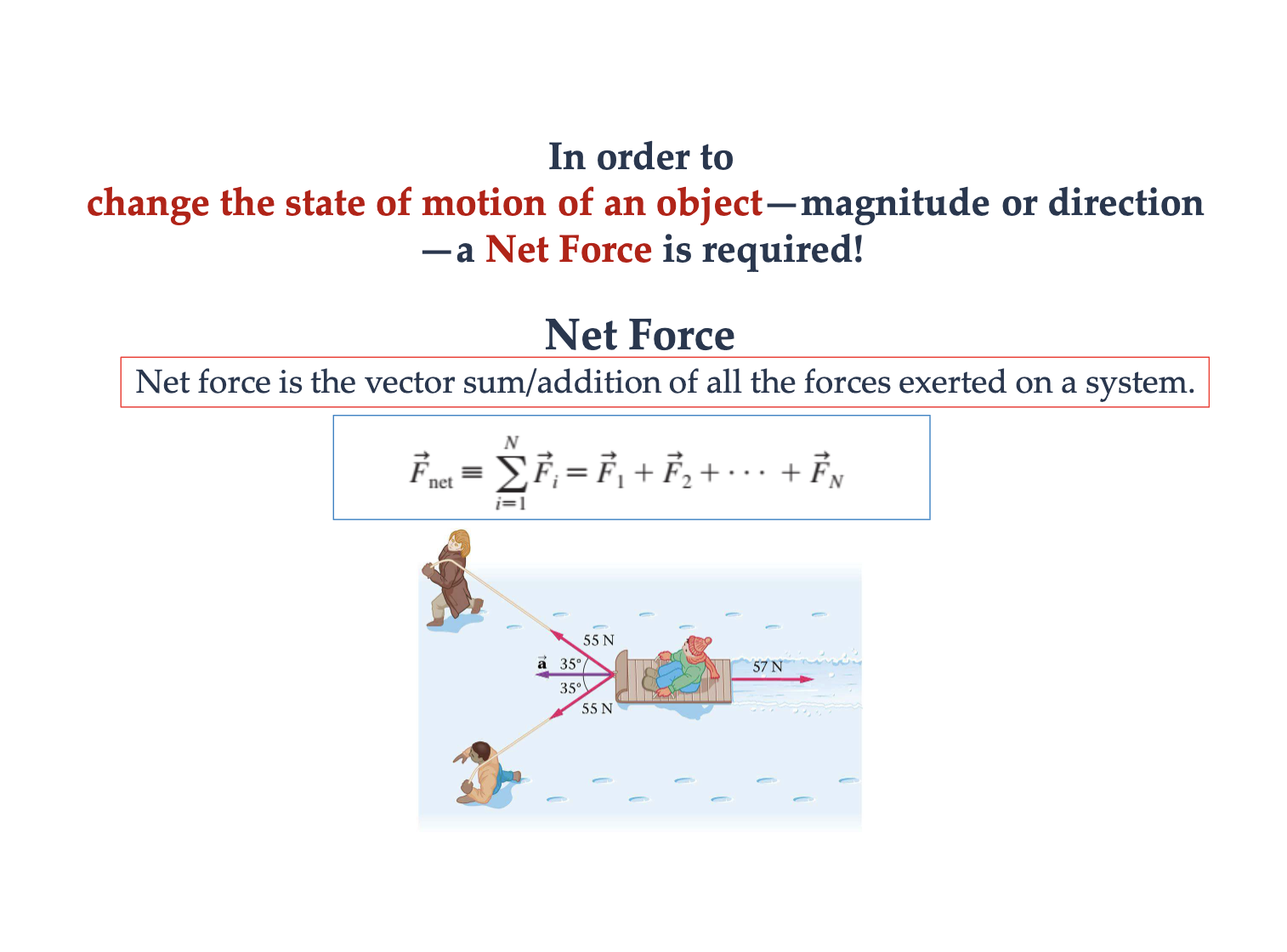
Looking at the sled example, why can't you simply add 55 N + 55 N + 57 N?
Because the forces act in different directions and must be added as vectors.
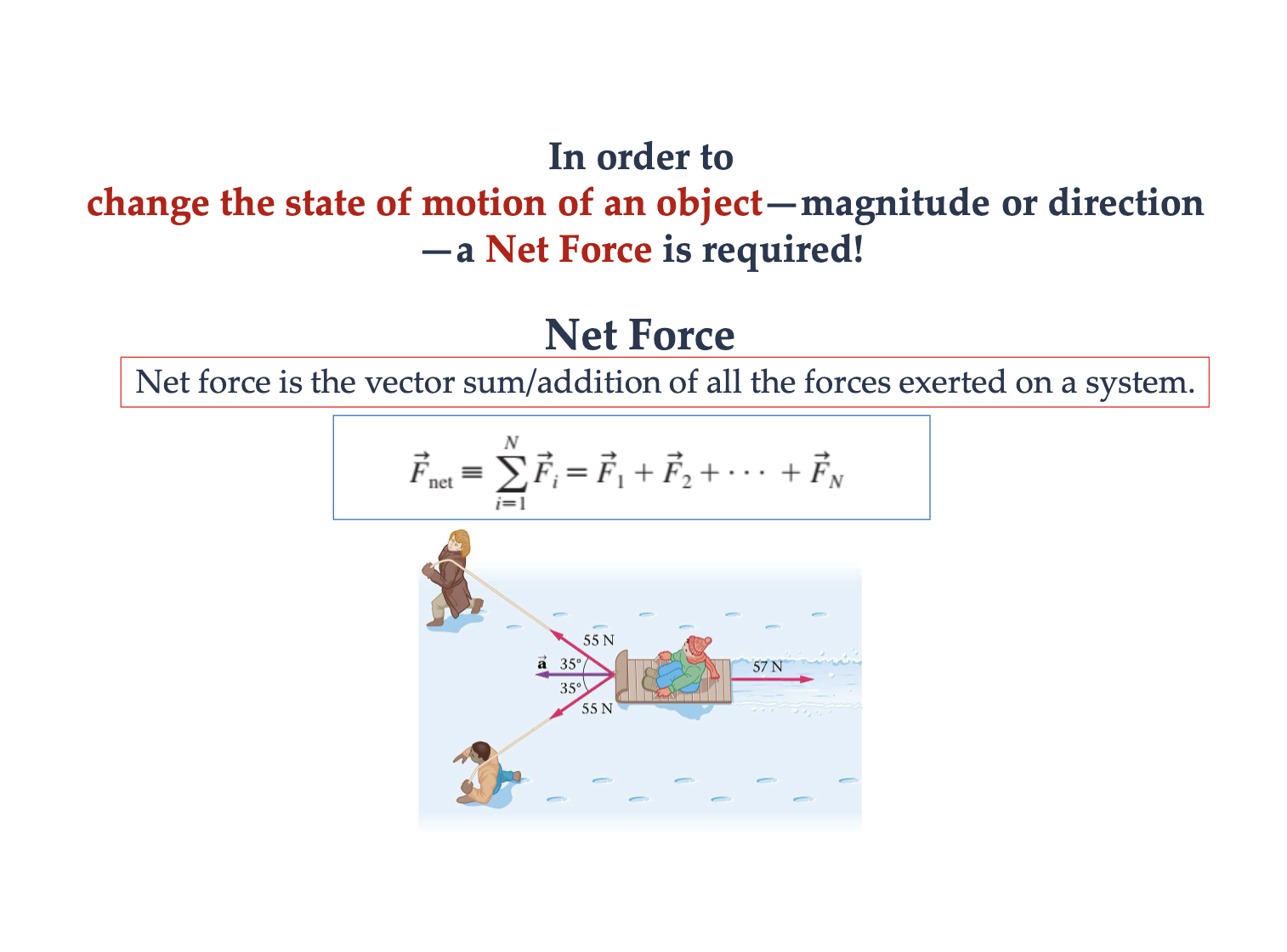
In the sled example, why do the two 55 N forces partially cancel each other vertically?
Because one force has an upward component and the other has a downward component.
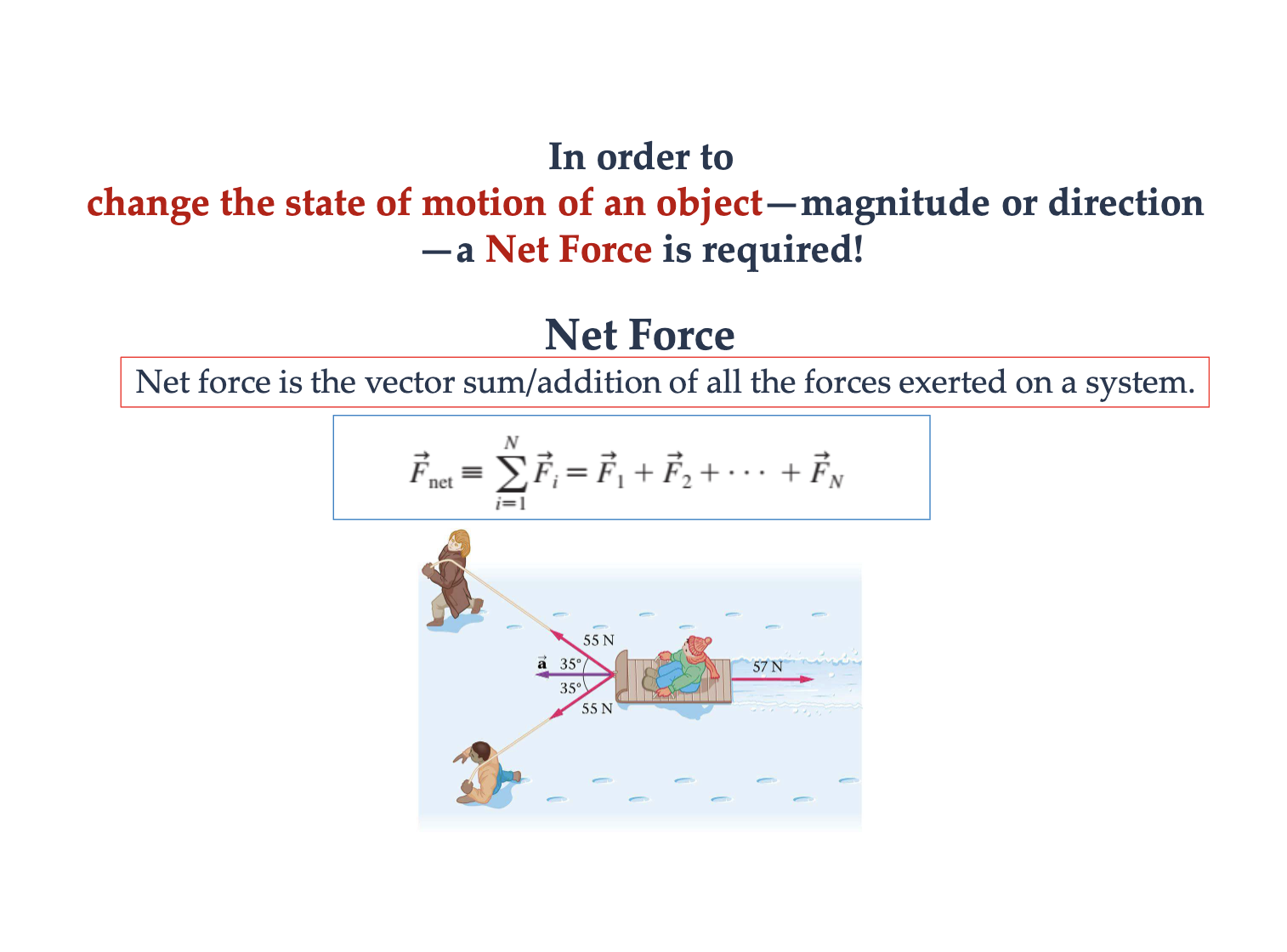
Looking at the sled example, what happens to the vertical components of the two 55 N forces?
They cancel because they are equal in magnitude and opposite in direction
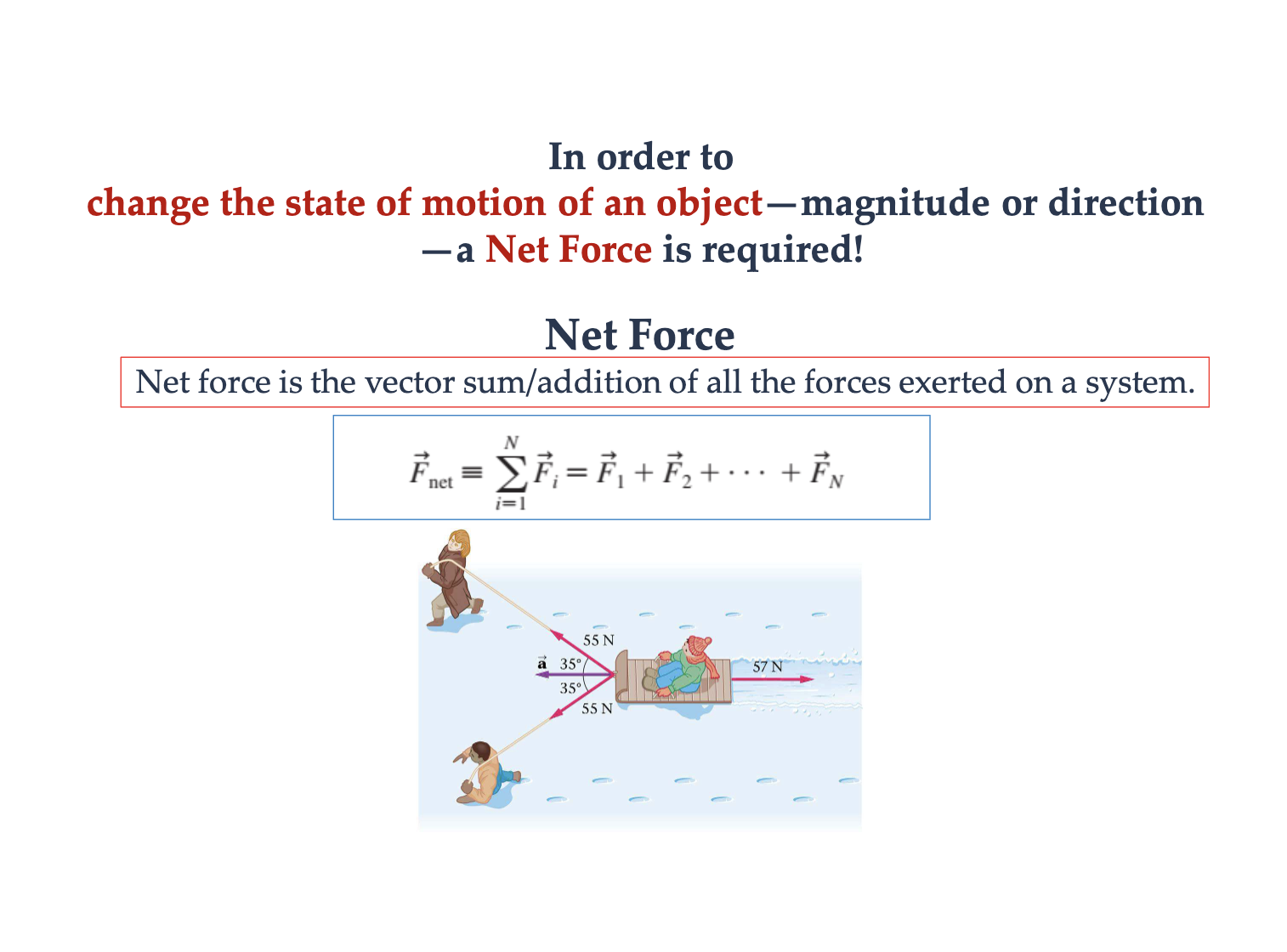
Looking at the sled example, why is there still a net force after the vertical components cancel?
Because the horizontal components of the forces remain.
Why can multiple forces acting on an object still produce zero net force?
Because the forces may balance each other exactly
Why can an object have several forces acting on it and still not change its motion?
Because the vector sum of the forces may be zero
If several forces act on an object, does that automatically mean the object will accelerate?
No. The forces may balance so that the net force is zero
A box is pulled with 10 N to the right and 10 N to the left. What is the net force?
0 N
A box is pulled with 20 N to the right and 5 N to the left. What is the net force?
15 N to the right
Can an object be moving and still have a net force of zero?
Yes. It can move at a constant velocity if the net force is zero
What are these slides teaching?
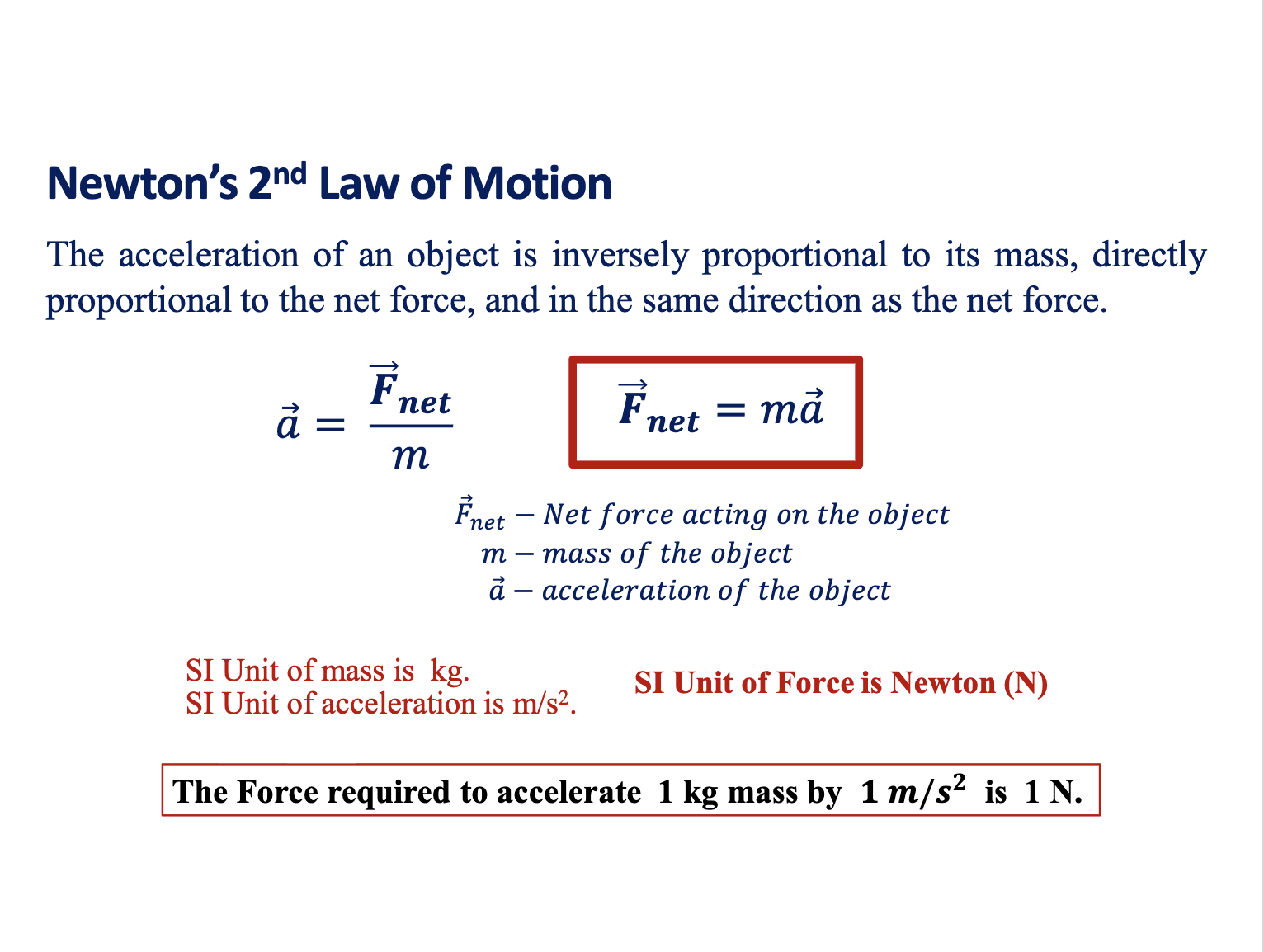
Newton's 2nd Law explains how force, mass, and acceleration are related. An object's acceleration depends on the net force acting on it and its mass
What is Newton's 2nd Law of Motion?
The acceleration of an object is directly proportional to the net force acting on it and inversely proportional to its mass
What equation represents Newton's 2nd Law?
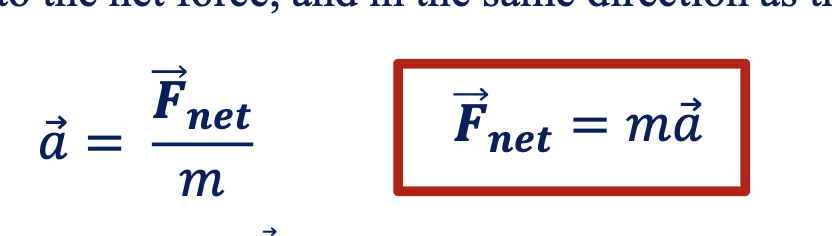
What does Newton's 2nd Law tell us about force and acceleration?
As net force increases, acceleration increases
What does Newton's 2nd Law tell us about mass and acceleration?
As mass increases, acceleration decreases
Why does a larger net force produce a larger acceleration?
Because acceleration is directly proportional to net force.
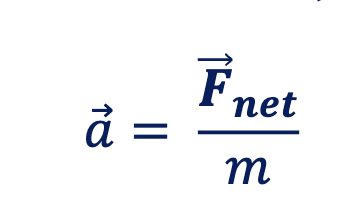
What does the equation tell us?
What does the equation
What does Fnet represent?
The net force acting on the object.
What does m represent?
The mass of the object
What does a represent?
The acceleration of the object
In what direction does an object accelerate?
In the same direction as the net force
Why is acceleration a vector quantity in Newton's 2nd Law?
Because it has both magnitude and direction
If the net force doubles while mass stays the same, what happens to the acceleration?
The acceleration doubles
If the mass doubles while net force stays the same, what happens to the acceleration?
The acceleration is cut in half.
Which is easier to accelerate: a 1 kg object or a 10 kg object if the same force is applied?
The 1 kg object because it has less mass.
Why is it harder to accelerate a more massive object?
Because greater mass results in greater resistance to acceleration.
What is the SI unit of mass?
Kilogram (kg)
What is the SI unit of acceleration?
Meters per second squared (m/s²)
What is the SI unit of force?
Newton (N)
What is one Newton?
The force required to accelerate a 1 kg mass at 1 m/s².
Why is the unit of force called a Newton?
It is named after Sir Isaac Newton.
What does the second slide emphasize about forces acting on an object?
An object may have several forces acting on it, but acceleration depends on the net force
Why doesn't Newton's 2nd Law use individual forces directly?
Because acceleration is determined by the net force, which is the vector sum of all forces
Can an object have several forces acting on it and still have zero acceleration?
Yes, if the net force is zero
If all forces acting on an object balance each other, what is the net force?
Zero.
If the net force is zero, what is the acceleration according to Newton's 2nd Law?
Zero
How are Newton's 1st and 2nd Laws connected?
Newton's 1st Law describes what happens when net force is zero, while Newton's 2nd Law describes what happens when net force is not zero
If three forces act on an object, does that mean the object must accelerate?
No. The forces may balance so that the net force is zero.