Unit 8.3 - Labour market faces and government intervention
 Call Kai
 Learn
Learn Practice Test
 Spaced Repetition
 Match
Match Flashcards
 Knowt Play
1/86

There's no tags or description
Looks like no tags are added yet.
Name | Mastery | Learn | Test | Matching | Spaced | Call with Kai |
|---|
No analytics yet
Send a link to your students to track their progress
87 Terms
What is a derived demand
Derived demand is demand for a factor of production that depends on the demand for the goods and services it helps to produce (e.g. labour demanded because consumers demand the final product).
Why is the demand for labour a derived demand
Because a firm’s demand for labour will take place not for its own sake, but because it is essential for the production of goods or services.
- The demand for labour is derived because firms hire workers to produce goods and services. It depends on the demand for the products labour helps to make, not on labour itself.
What does “derived demand” imply about labour demand when product demand changes
When demand for a firm’s products is high or is projected to increase, the firm will take on more workers.
At a time of downturn in the economy, demand for a firm’s products is expected to fall and the firm’s demand for labour will fall.
What is the marginal revenue product (MRP) of labour
The marginal revenue product (MRP) is the extra revenue earned by the firm when it employs one more worker.
- The addition to total revenue as a result of employing one more worker
How is MRP calculated
It is calculated by multiplying the marginal product from an additional worker by the price of the product.
- MRP = marginal product × marginal revenue (price)
In perfect competition, what does the marginal revenue equal
The price
What does the MRP curve show
The MRP curve increases up to the point where the optimal number of workers are employed, then it falls steeply, consistent with the law of diminishing returns.
What is the profit-maximising condition for hiring labour
A firm should continue to hire labour as long as the additional worker adds more to revenue than the firm’s costs
- Profit maximisation in the labour market is MC = MRP.
- Where MRP = wage rate
What is the MRP curve in relation to labour
The MRP curve is therefore the demand curve for labour.
When will a firm stop hiring additional workers (given the wage rate)
When the wage being paid is less than the value of the MRP, it can employ the worker - When MRP equals the wage rate, this is the profit-maximising point, no more workers should be employed.
What two assumptions is the demand for labour by a firm based on
The firm wishing to hire labour is operating in a perfectly competitive market (many buyers and sellers of labour; no single firm or worker can affect the wage).
The firm is a profit maximiser (maximising the difference between total revenue and total costs).
What are the three main factors that determine the demand for labour in a firm or in an occupation
Wage rate 2. Productivity 3. Demand for the product.
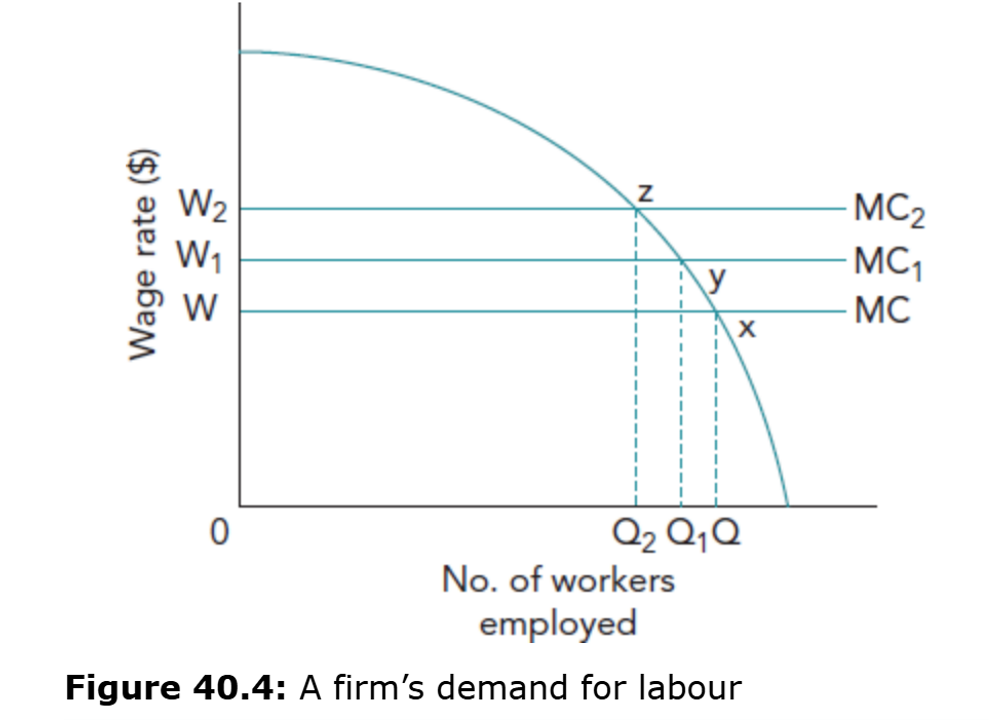
How does the wage rate affect the demand for labour + how is this shown on a diagram
The wage rate is essentially the price of labour so a rise in the wage rate will increase labour costs and is likely to lead to a fall in the quantity of labour demanded - A fall in the wage rate increases the quantity demanded.
As wages increase (W to W1 to W2), quantity demanded decreases (Q - Q1 - Q2)
How does productivity affect the demand for labour
A change in the marginal productivity of labour affects the position of the demand curve for labour.
- If workers are more productive, output increases and labour becomes a more attractive resource, so demand for labour increases.
- If productivity drops, demand for labour shifts left.
How does demand for the product affect the demand for labour
Given derived demand, a change in demand for a firm’s products will affect its demand for labour
- Higher product demand shifts labour demand right; lower product demand shifts it left.
What is the difference between a movement along and a shift of the demand curve for labour
A change in the wage rate is represented by a movement up or down the demand curve for labour
A change in factors such as productivity or demand for a firm’s product leads to a shift in the demand curve for labour to the right or left.
Why is measuring/using Marginal revenue product/productivity difficult + example
In many occupations it is not possible to measure marginal revenue productivity e.g. in a manufacturing firm it may be possible to determine MRP but for a teacher it's less possible
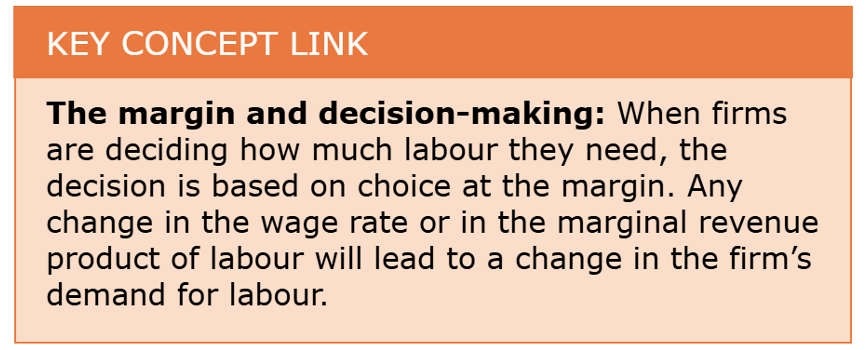
Key concept link - the margin and decision making
What is the supply of labour
The supply of labour is the total number of hours that labour is able and willing to work for a particular wage rate.
At what three levels can labour supply be considered
The supply of the individual worker; that of a firm or industry; and that of the economy as a whole.
What does an individual's supply curve look like (in relation to number of hours supplied and wage rate) + why
As the wage rises, more people are willing to offer their services to employers; leisure is substituted for work as the wage rate increases. - Beyond a certain point there is a trade-off between work and leisure. Individuals may decide they would prefer to work less and have more time for leisure (the backward-sloping curve).
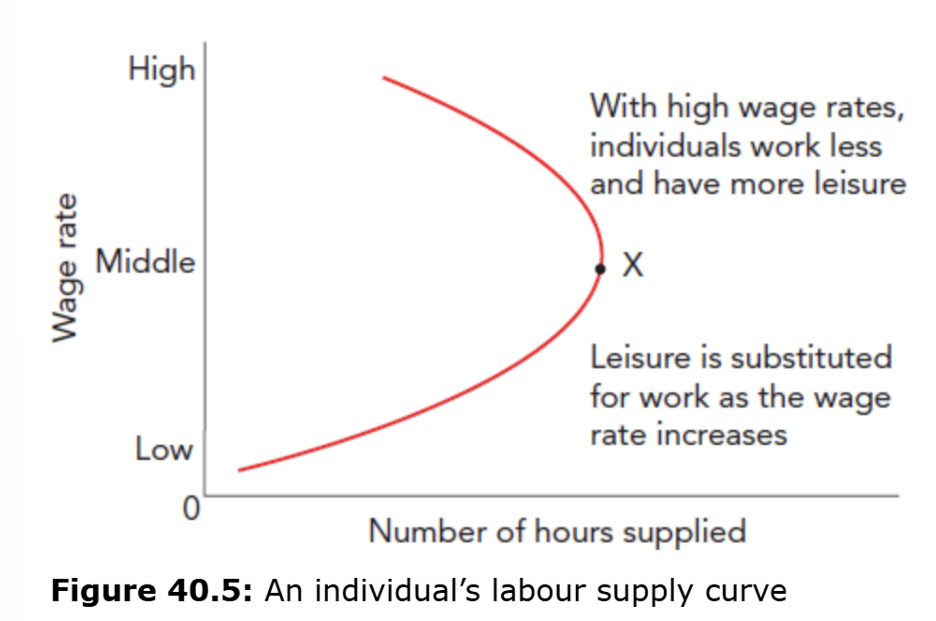
What 4 factors determine where the labour supply curve becomes backward-bending (point X)
The point depends on:
1. The individual’s attitude to work and leisure
2. Personal and family circumstances (especially the income required)
3. The type of economy
4. Income tax rate
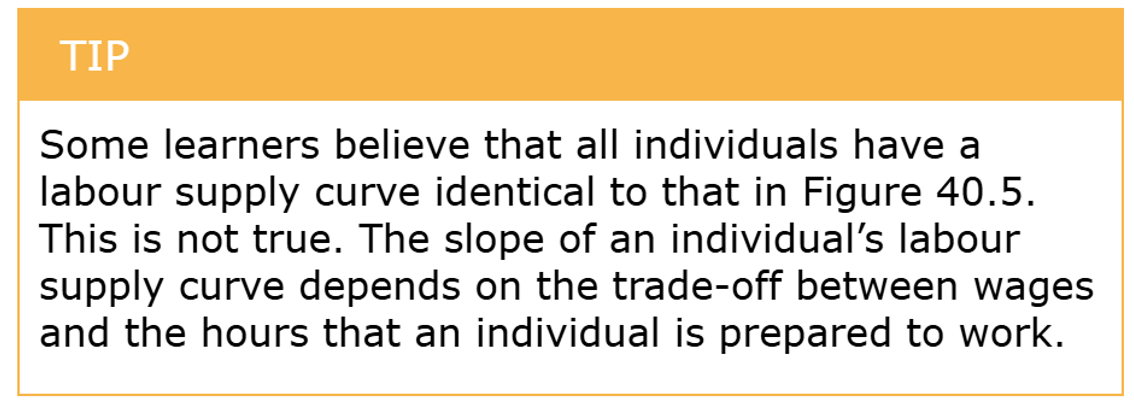
Tip - What does the slope of an individual's demand curve depend on
How can income tax affect an individual’s supply of labour
A high income tax rate suppresses the incentive to work - Governments must be careful as it is likely to adversely affect future economic prospects.
What is labour supply to a firm or industry
The supply curve of labour to a firm or industry consists of the sum of the individual supply curves of all workers employed in a firm or industry.
What does the supply curve of labour to a firm or industry look like
L1 = inelastic to wage rate changes L2 = elastic to wage rate changes
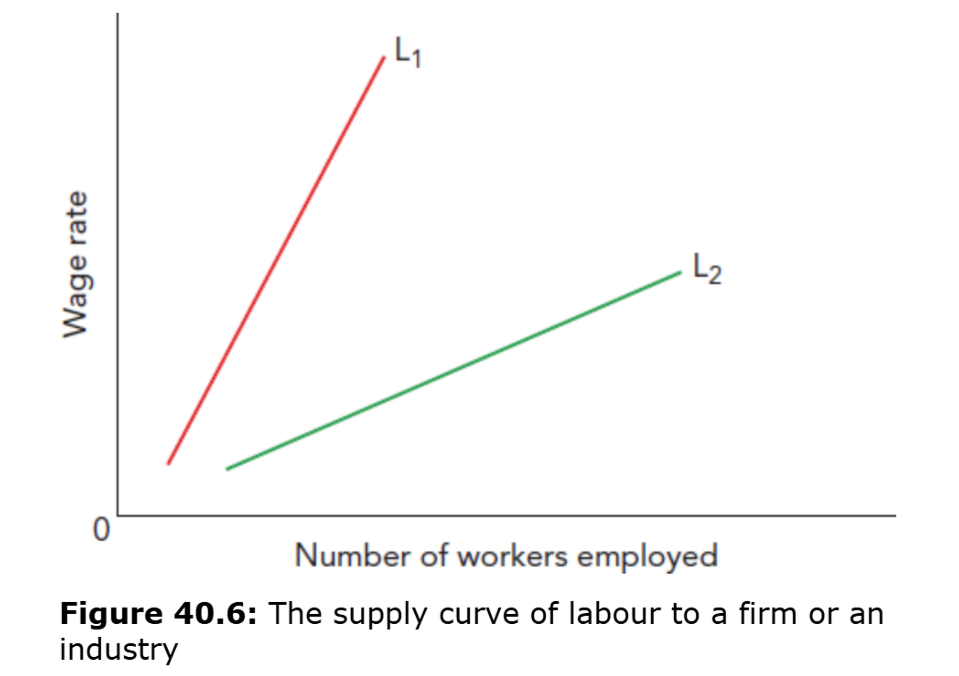
Why does labour supply to a firm or industry usually slope upwards
As with an individual worker, the number of workers wanting to supply their labour increases with the wage rate offered.
What measures the slope of labour supply to a firm/industry
The elasticity of supply of labour: the extent to which labour supply responds to a change in the wage rate.
Why might one labour supply curve be more inelastic than another
Skills required and the amount of education/training required.
- The more skills/qualifications required, the more inelastic the supply of labour (e.g., teachers more inelastic than street cleaners).
How do wages in other industries affect labour supply to a particular industry
In a competitive labour market, wage rates offered in other industries influence the supply of labour to a particular industry.
- Higher wages in an industry = higher supply for that industry
What 4 factors affect the long-run supply of labour for the economy as a whole
The size of the population
The labour participation rate
Taxes and benefits levels
Immigration and emigration.
What affects the extent to which the 4 factors affect the long-run supply of labour
If the country is a high income county vs lower middle income country
How does the size of the population affect the long-run supply of labour
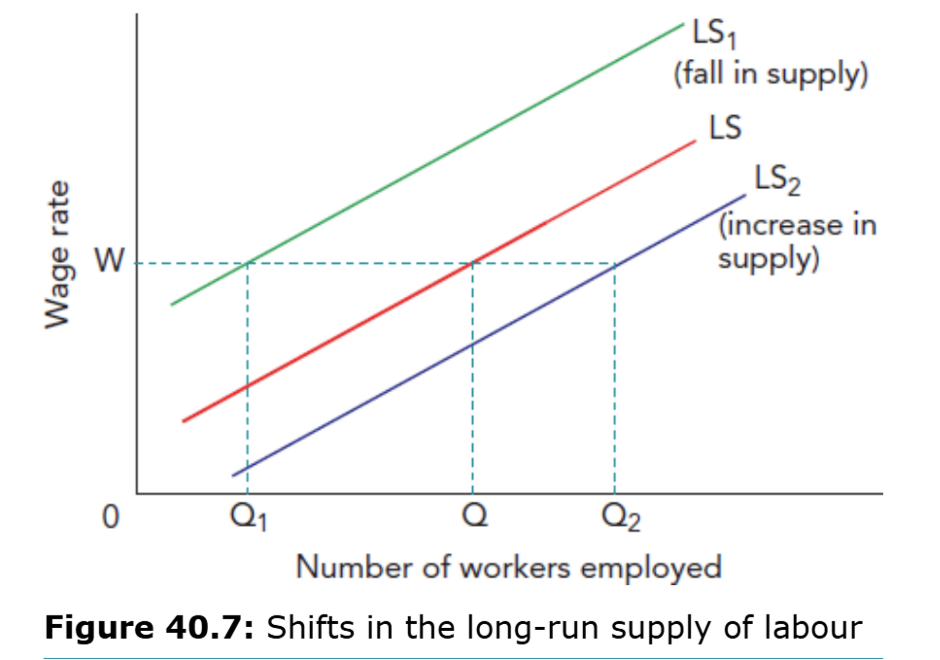
Higher birth rates and improved medical care for young children can increase the supply (increasing numbers of young people join the labour market - shifts supply outwards) Inversely population decline reduces the supply (inward shift).
What is the labour participation rate
It is the proportion of the population of working age actually in employment
How does the labour participation rate affect long-run labour supply + how is it caused (2 examples)
A reduction in the participation rate shifts the long-run labour supply curve left.
- E.g. early retirement and more students continuing studies reduce participation (mainly in HICs)
How do taxes and benefits affect the long-run supply of labour
High income tax, unemployment benefits and benefit payments can reduce incentives to work -> reducing labour supply
Through supply-side policies, governments seek to provide incentives to remain active in the labour market.
How do immigration and emigration affect the long-run supply of labour
Migration affects the long-run supply; inflows can increase supply, especially when labour shortages exist; changes in migration patterns alter long-run labour supply.
Show the effects of shifts (inwards and outward) of long run labour supply on a diagram.
What are “net advantages” of a job and how do they influence long-run labour supply to a particular firm
Net advantages are the monetary and non-monetary benefits and costs of a job In the long run, firms with higher net advantages can attract more workers even with lower wages, while firms with poor net advantages must offer higher wages to attract labour.
What are 5 examples of monetary advantages
Weekly wage or monthly salary
Bonus payments
Opportunities to work longer hours
Pension arrangements
Large “handouts” in some occupations.
What are 6 examples of non-monetary advantages
1.Hours of work
2. Job security
3. Holiday entitlement
4. Promotion prospects
5. Location of the workplace (+ whether the work can be done from home.)
6. Job satisfaction
What two important features of the workings of labour markets are established in perfect markets
1.The wage paid to labour equals the value of the marginal product of labour (MRP)
2. The willingness of labour to supply depends on the wage rate being offered.
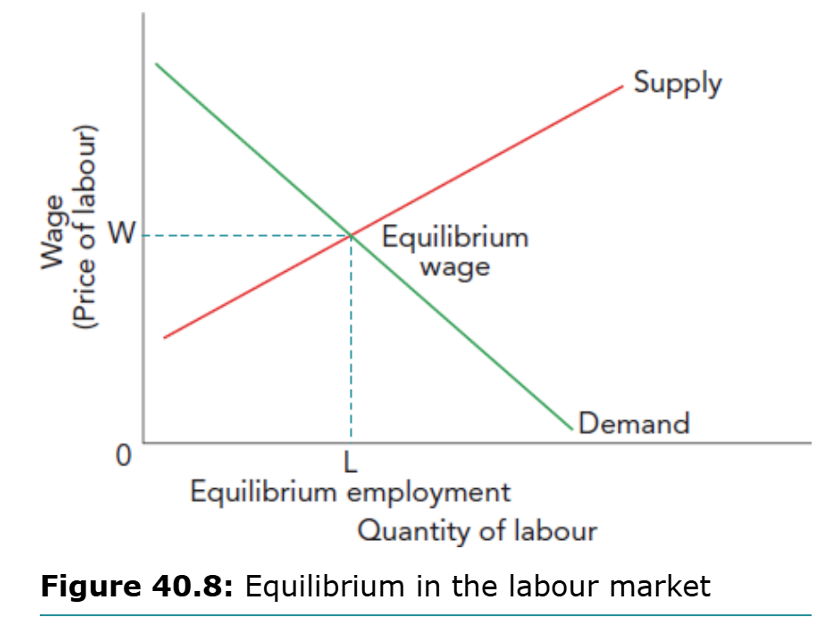
How is the equilibrium wage determined in a competitive labour market + diagram
Determined where supply and demand meet - The wage and quantity of labour adjust to balance demand and supply; the market clears at the equilibrium wage.
- The demand curve reflects the value of the marginal productivity of labour - In equilibrium the workers receive the value of their contribution to the production of goods and services - The market clears at equilibrium wage
Where does each firm purchase labour until
Each firm purchases labour until the value of the marginal revenue product equals the wage rate
What does it mean that the labour market is dynamic
Any change in the demand or supply of labour will change the equilibrium wage - The value of the marginal revenue product will also change by the same amount as, by definition, it must always equal the wage rate
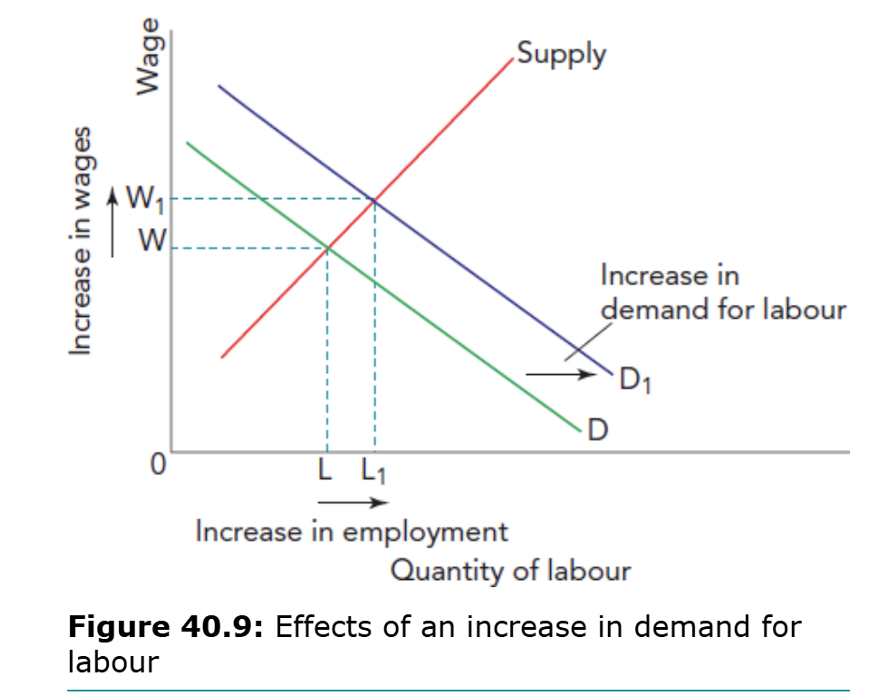
What happens to equilibrium wage and employment when demand for labour increases (diagram)
A shift right in demand for labour raises the equilibrium wage (W to W1) and increases employment (L to L1).
Give one example used to explain an increase in demand for labour
Clothing: an increase in disposable income in high-income countries shifts demand for clothing right, increasing demand for workers producing clothing.
What happens to equilibrium wage and employment when labour supply increases (diagram)
A shift right in labour supply reduces wages for all workers and increases employment.
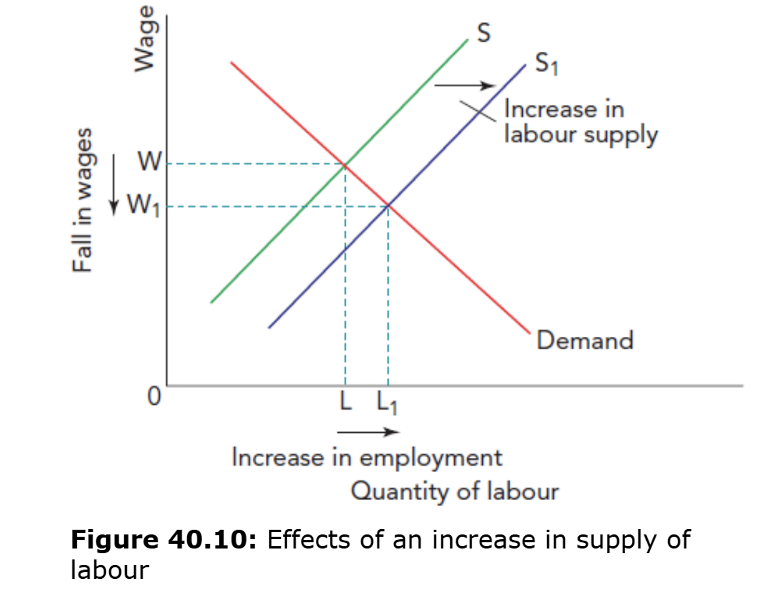
Why do wages fall when labour supply increases (chain of reasoning - 5)
As the number of workers increases, each extra worker adds less extra output than the previous one (law of diminishing returns) → marginal productivity falls → the value of marginal revenue product (MRP) falls → firms are only willing to pay lower wages → lower wage rate.
Why is perfect-market wage determination often unrealistic
In many labour markets, demand and supply are affected by the actions of trade unions and governments; these interventions produce imperfections.
What are the three influences on wage determination and employment
Trade unions 2. Government minimum wage 3. Monopsony
What are trade unions
An organisation of workers that aims to protect and enhance the well-being of its members through collective negotiations with employers and government
- Seek to represent labour in their place of work, because individuals (labour) have very little power to influence conditions of employment, including wages.
What is collective bargaining
Where trade union representatives get together with employers to negotiate.
What do trade unions aim to do (7)
1.Increase the wages of their members
2. Improve working conditions
3. Maintain pay differentials between skilled and unskilled workers
4. Fight job losses
5. Provide a safe working environment
6. Secure additional working benefits
7. Prevent unfair dismissals.
Where have trade unions traditionally been strong + where is bargaining power greatest
The public sector and most types of manufacturing; particularly strong in transport and in occupations where specialist skills are required - Bargaining power is greatest where labour has specialist skills or is in short supply.
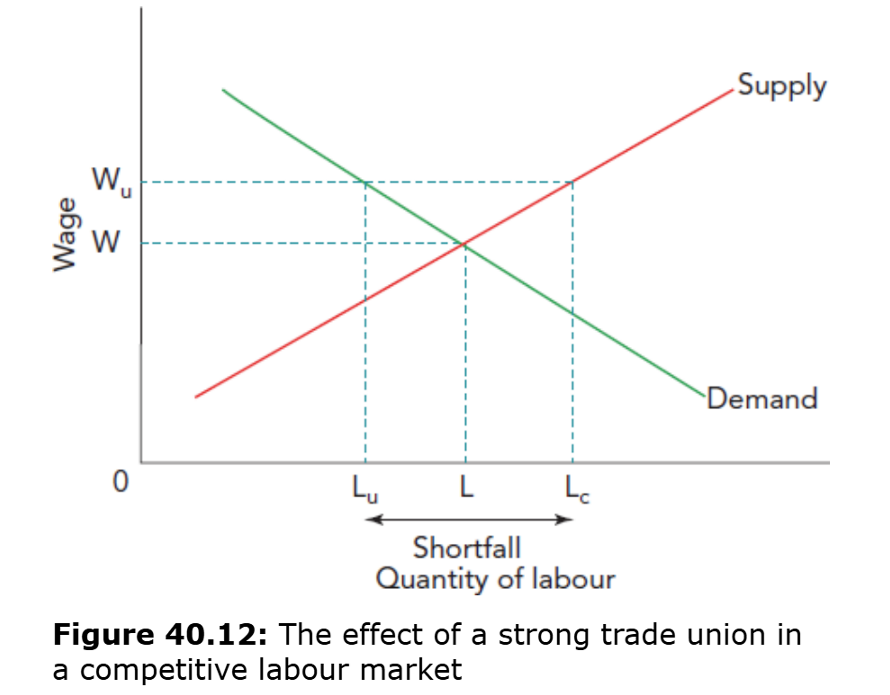
What is the effect of a strong trade union in a competitive labour market (Diagram)
A powerful trade union can secure wages above the equilibrium wage.
- If wages rise to Wu (above equilibrium), quantity of labour demanded falls to Lu, while quantity supplied rises to Lc, creating a shortfall between those who want to work and those who can actually work.
Why might trade unions have limited influence in practice (6)
Trade unions may have limited influence because:
• Membership is low or declining, reducing bargaining power
• Workers may fear job losses or firm relocation if unions push for higher wages
• Employers/firms may go out of business as can't afford to employ at higher wage rate
• Firms may replace labour with capital or outsource production e.g. Employers may transfer production abroad where wages are lower (globalisation).
• Government legislation may restrict union power
• Global competition reduces firms’ ability to raise wages
What is minimum wage legislation
Explicit government intervention through the introduction of a minimum wage.
Where do minimum wages exist / where are they most common
Minimum wages are adopted in most high-income countries.
Minimum wages in developing countries may exist but are often hard to enforce, especially in the informal sector.
In the UK a minimum wage has applied since 1999 for workers above age 21 In the USA each state sets its own minimum wage;
Why is a minimum wage controversial (costs & benefits)
A minimum wage is controversial because it has both advantages and disadvantages.
Benefits: It can reduce poverty and inequality, increase tax revenue, and reduce government welfare spending.
Costs: It may cause job losses if set above the equilibrium wage, increase firms’ costs, and lead to cost-push inflation if firms raise prices.
What determines the impact of a minimum wage on employment
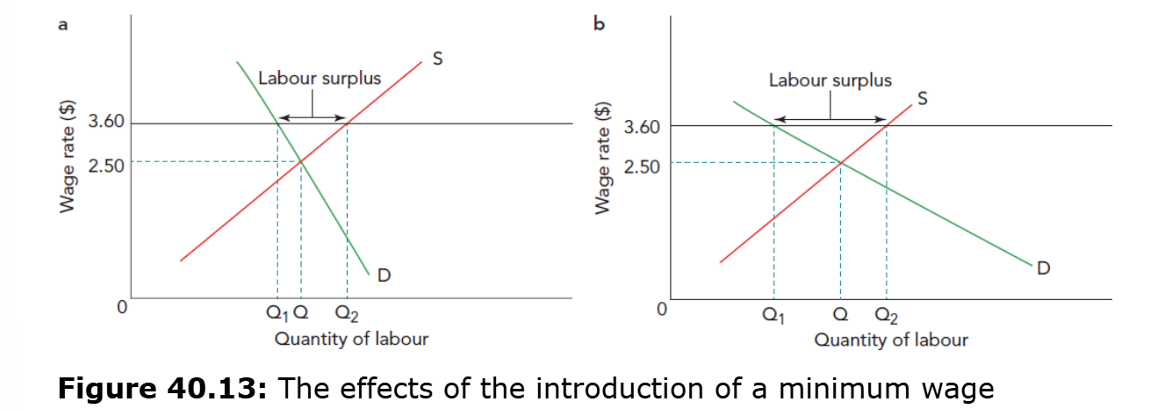
It depends on the elasticity of demand and supply of labour in the industry
- More inelastic demand means fewer jobs lost; more elastic demand means greater job loss and a larger excess supply.
Show on a diagram and explain the effect of the introduction of minimum wages (2 diagrams for different elasticities)
A minimum wage above equilibrium creates an excess supply of labour; the higher the minimum wage rate above the competitive equilibrium, the greater the excess supply of labour willing to work at the minimum wage.
What is a limitation of a NATIONAL minimum wage
It does not take into account variations in the cost of living across regions within a country.
What is a “living wage” and how does it differ from a minimum wage
A living wage is promoted and calculated on the basic cost of living, but unlike the minimum wage its not the law, employers choose to pay it on a voluntary basis.
Is a living wage the answer to poverty
No. It is just part of a package of measures including a range of benefits designed to improve the standing of those who are most vulnerable.
What is a monopsony
Where there is a single buyer in a market
What is a monopsony employer
A monopsony employer is a firm that is the only or dominant buyer of labour in a market, so it has the power to set wages and employment levels rather than being a wage taker.
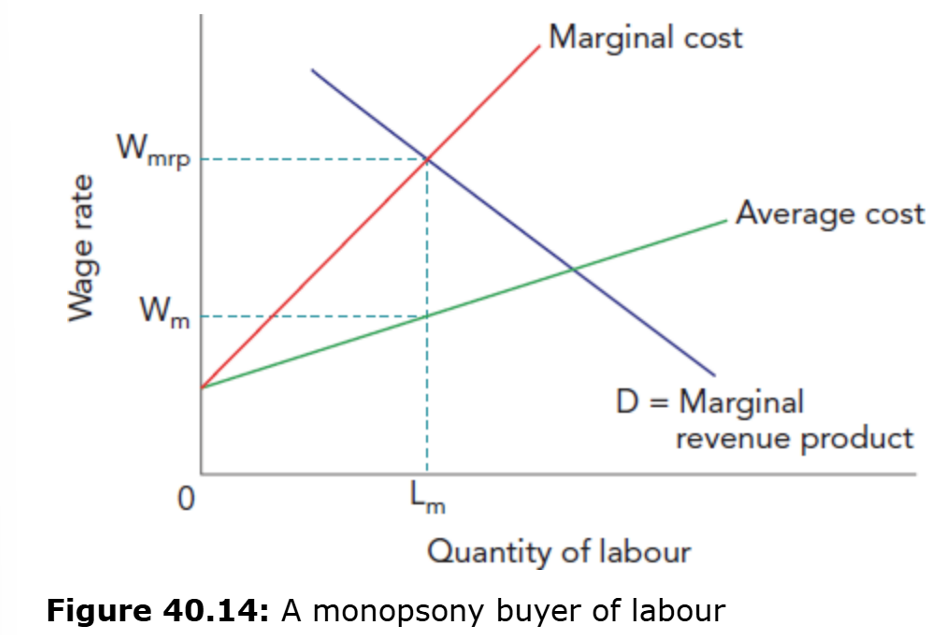
How does a monopsonist determine wage and employment (Diagram + explanation)
The monopsonist hires workers by equating the marginal cost of employing a worker with the marginal revenue product from this employment (MC = MRP) - This is the profit-maximising position. The wage paid (Wm) is below the wage if workers are paid the full value of their marginal revenue product (Wmrp), and employment is Lm.
Why can monopsony power be important in local labour markets
Monopsony power is important in local labour markets because if there is only one or a few major employers, they can dominate hiring and set lower wages and less favourable working conditions, as workers have limited alternative job options.
Give 3 examples of monopsony.
1. An extractive mining industry in an isolated town where workers have to be employed by one employer.
2. A large hospital that is the only major employer of nurses in a rural area. Since nurses have few alternative employers nearby, the hospital can have power to set wages and working conditions.
3. A government that is the main employer of teachers in a country or region. Because most teachers must work for the government, it has monopsony power to influence wages and working conditions.
What are wage differentials
Differences in wages between occupations; between industries; between firms in the same industry; and between regions of a country. - Difference in pay between workers with different skills and responsibilities
How can wage differentials be explained by labour market forces
An occupation in high demand and low supply will pay a higher wage rate than one where there is an abundant supply of workers.
What are 6 other causes of wage differentials (6) (beyond demand and supply)
1.Bargaining strength
2. Education and training
3. Skilled and unskilled workers
4. Male and female workers
5. Hours of work
6. Government policy.
How does bargaining strength affect wage differentials
Strong professional organisation or trade union membership can raise pay; workers with little bargaining power and who are easily replaced tend to be paid less.
How do education and training affect wage differentials
Some occupations (e.g., healthcare, legal services, teaching) require a long period of training; it is reflected in higher pay compared with occupations where little training is required.
How do skilled and unskilled differences affect wage differentials
Skilled workers earn higher wages than unskilled workers because their demand is higher, supply is lower, and their marginal revenue product (MRP) is higher. Skills increase productivity, often with capital, and skilled labour is harder to replace.
How does gender affect wage differentials
Despite equal pay legislation, men are still paid more than women in many occupations
- A plausible explanation is that on average the MRP of women is lower, partly because more women are in low-paid occupations that generate low marginal revenue.
How do hours of work affect wage differentials
Part-time workers on average are paid lower wage rates than full-time workers
- There is usually a larger pool of part-time workers in a local labour market; (many part-time workers are women)
How can government policy affect wage differentials
Government policy affects wage differentials by influencing occupational choices, addressing labour shortages in certain sectors (e.g., healthcare), and setting minimum wages, which can raise low pay and reduce wage gaps.
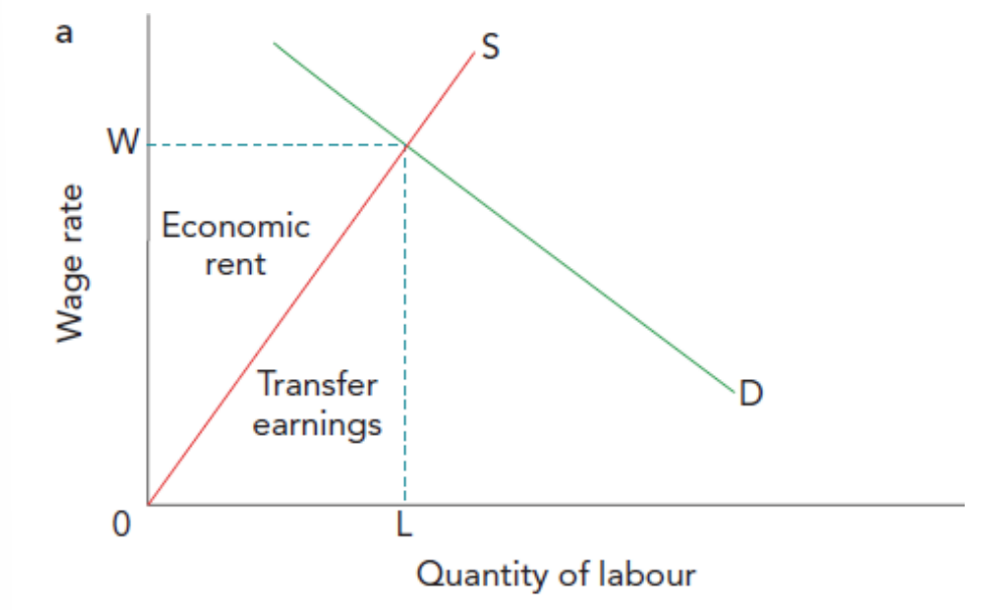
What are transfer earnings
Transfer earnings are the minimum payment necessary to keep labour in its present use. - The amount that is earned by a factor of production in its best alternative use
What is economic rent
Economic rent is any payment to labour which is over and above transfer earnings. - A payment made to a factor of production above that which is necessary to keep it in current use
How are transfer earnings and economic rent shown in a labour market diagram
Transfer earnings are indicated by the area under the labour supply curve up to the equilibrium; economic rent is the area above the labour supply curve and below the wage rate.
How do transfer earnings relate to a worker’s next-best alternative
Transfer earnings represent what a worker needs to receive to remain in the job (their best alternative/next-best option).
Why can workers in the same job earn different amounts of transfer earnings and economic rent
Because people have different willingness to work for a given wage - Some have low transfer earnings and gain economic rent, while others only work if the wage equals their transfer earnings (no economic rent).
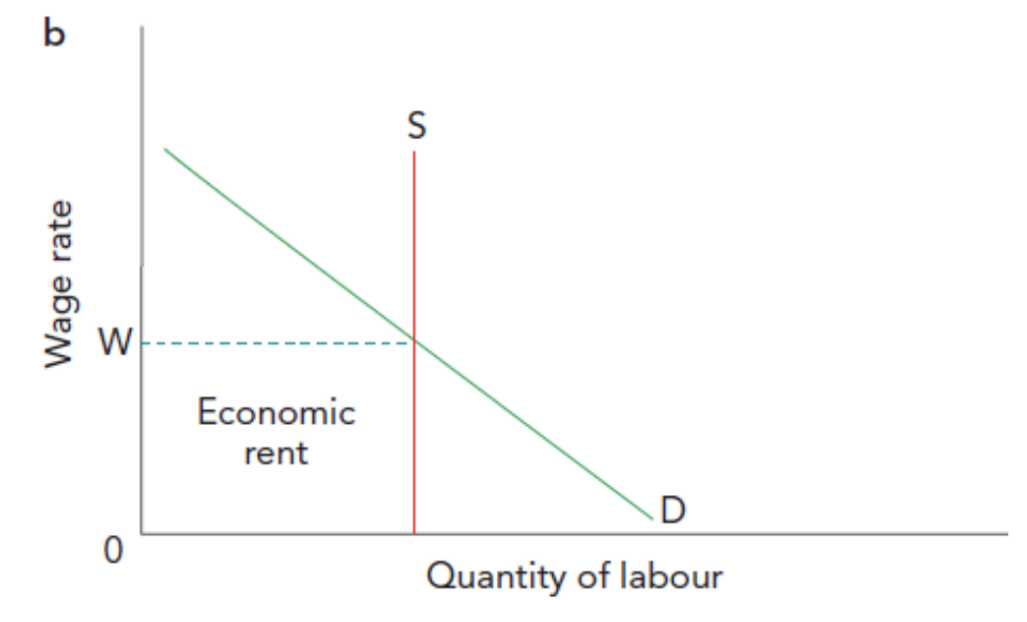
What happens to economic rent & transfer earnings when labour supply is perfectly inelastic (Diagram)
All earnings consist entirely of economic rent, no transfer earnings.
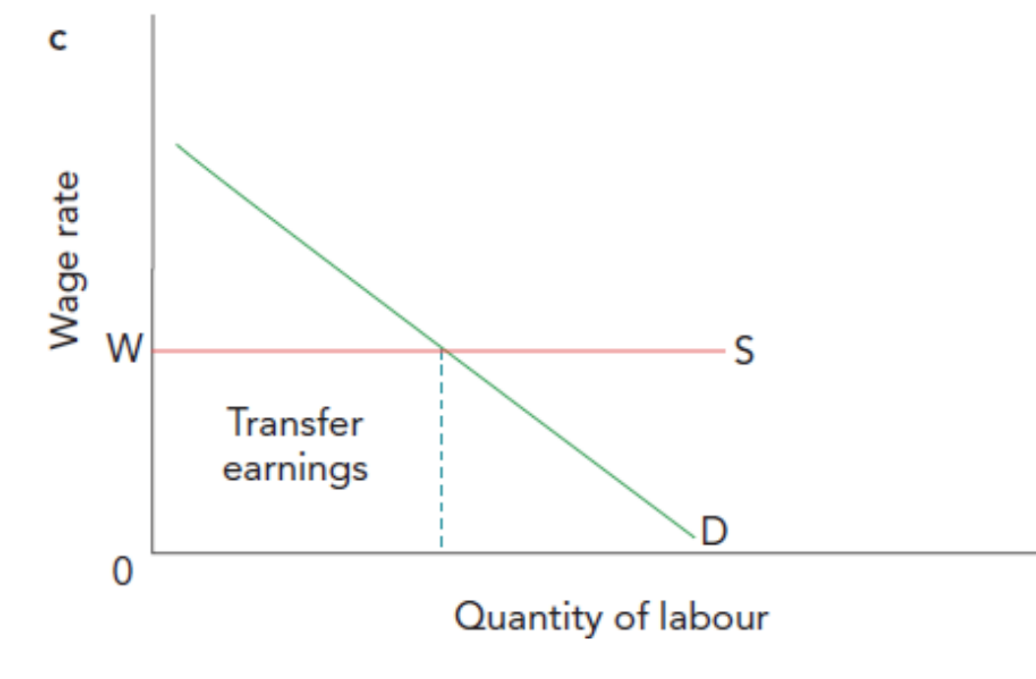
What happens to economic rent and transfer earnings when labour supply is perfectly elastic (Diagram)
Earnings consist entirely of transfer earnings; employers can hire an infinite supply of labour at the market wage.
How does elasticity of labour supply affect the size of economic rent
The more inelastic the supply of labour, the greater the potential economic rent; the more elastic the supply, the more earnings are transfer earnings.