Northern Renaissance
 Call Kai
 Learn
Learn Practice Test
 Spaced Repetition
 Match
Match Flashcards
 Knowt Play
1/18

Earn XP
Description and Tags
Art History 202
Name | Mastery | Learn | Test | Matching | Spaced | Call with Kai |
|---|
No analytics yet
Send a link to your students to track their progress
19 Terms
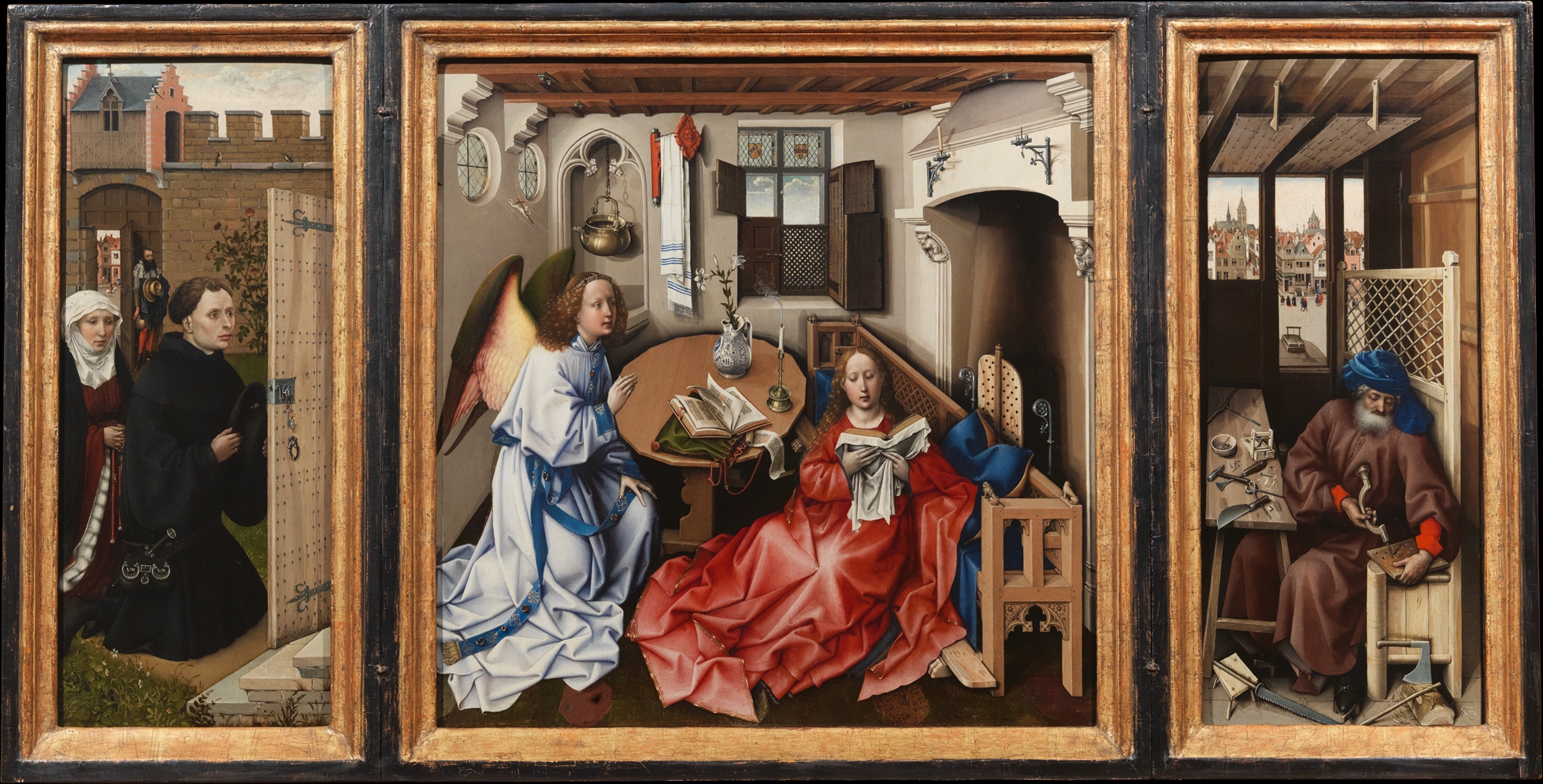
The Mérode Altarpiece, Robert Campin
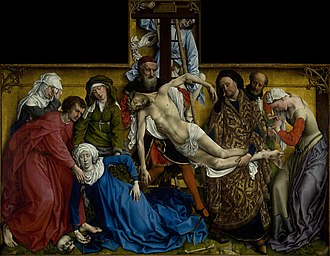
Deposition, Rogier van der Weyden
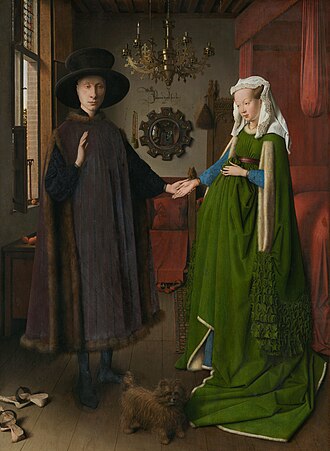
The Arnolfini Portrait, Jan van Eyck
Vernacular
The native, everyday, local language spoken by people.
As more texts were translated into the vernacular, people had more access to ideas, especially those that were outside of the Church. For example, Thomas Aquinas translated much of Aristotle’s work into the vernacular. This developed the shift in thought toward Aritotelian, empirical, humanist approaches and thinking.
Great Schism
A split of the Catholic church between East and West that created confusion and increased distrust in/disillusionment with the authority of the Church.
Black Plague
Devastating illness that swept through Europe, killing off 2/3 of the population. Increased distrust in/disillusionment with the Church because priests and church leaders were also affected, and couldn’t save themselves or others.
Aristotelian outlook
An empirical approach to the world focused on developing knowledge through sensory experiences. Aristotle taught that humans are born with blank minds, and as they experience through their senses, they develop knowledge. An approach grounded in observation, realism, and humanism.
Empiricism
All knowledge originates from experiences or observation.
Disguised Symbolism
The shift towards an Aristotelian outlook and St. Augustine’s teachings sparked the need for increasingly subtle symbolism in artwork. In an effort to preserve empiricism/naturalism, artists used everyday, common objects that would naturally appear in scenes in paintings to continue to convey religious meaning and sentiment.
Thomas Aquinas
Translated much of Aristotle’s work into the vernacular.
Popularized St. Augustine’s teachings about God’s creation of everything.
Triptych
Three panels connected (two side panels fold in to close).
Grisaille
Black and white drawing usually done before it was overlaid with oil paints. Used to develop shadowing and intuitive perspective.
St. Augustine
Catholic priest whose ideas were popularized by Thomas Aquinas. Taught that everything was created by God, and as such everything possesses a bit of divinity. Teachings influenced the development of disguised symbolism as a defining characteristic.
Atmospheric perspective
Artists tried to create perspective using fuzzier, lighter colors (an atmospheric effect) and less detail the further away the object was.
Intuitive perspective
Artists tried to create perspective using size differences, placement, etc. Not as mathematically precise, more of an eyeball (using intuition).
Thomas a Kempis
Wrote “Imitatio Christi”, a work that emphasized the suffering of Christ and Mary. Related to Devotio Moderna - people could observe and feel the suffering of Christ through reading or viewing, and thereby be closer to and more like Him.
Devotio Moderna
Sentiment that one could increase in holiness and closeness to Christ by viewing religious artwork.
Ars Nova
Style common during the time of Italian Renaissance. Influenced by ideas and figures like Aristotle, Thomas Aquinas, and St. Augustine. Attention to texture, detail, and color (Aristotelian empiricism). Disguised symbolism (St. Augustine, spread by Thomas Aquinas). Intuitive and atmospheric perspective. Oil paint on grisaille/chiaroscuro. Naturalist/humanist motifs (also Aristotle).
Dukes of Burgundy
High class group with discretionary spending money that patronized and sponsored artists and intellectuals.