3. Word Meanings
 Call Kai
 Learn
Learn Practice Test
 Spaced Repetition
 Match
Match Flashcards
 Knowt Play
1/35

There's no tags or description
Looks like no tags are added yet.
Name | Mastery | Learn | Test | Matching | Spaced | Call with Kai |
|---|
No analytics yet
Send a link to your students to track their progress
36 Terms
Recap: Input to Meaning
Two recurring ideas were that processing is incremental and that multiple possible words or meanings can be active at the same time.
• This lecture applies similar ideas to production: going from an intended meaning to spoken language.
Recap: speech to meaning
In speech comprehension, the listener starts with an unfolding sound signal and uses it to activate possible words.
• Early sounds such as /s/ and /n/ can activate several candidates, such as snow, snake, and snack.
• The listener also uses the surrounding sentence and situation to help decide which word and meaning fits best.
As more speech input arrives, the listener narrows down the possible word candidates.
• Context helps the system settle on the intended word and meaning.
• Today’s lecture reverses the direction: instead of speech to meaning, the question is how speakers go from meaning to speech.
In basic terms how do we go from intended meaning to speech?
speech production begins with an intended meaning: something the speaker wants to communicate
the speaker then has to choose words and produce the sounds needed to say them
a single situation can lead to several possible utterances, such as “it snowed overnight” or “the road is covered in snow”
this means production involves decisions about what to say and how to say it
the speaker must turn a general message into a specific sequence of words and sounds
What is involved in the simplified meaning to speech pathway?
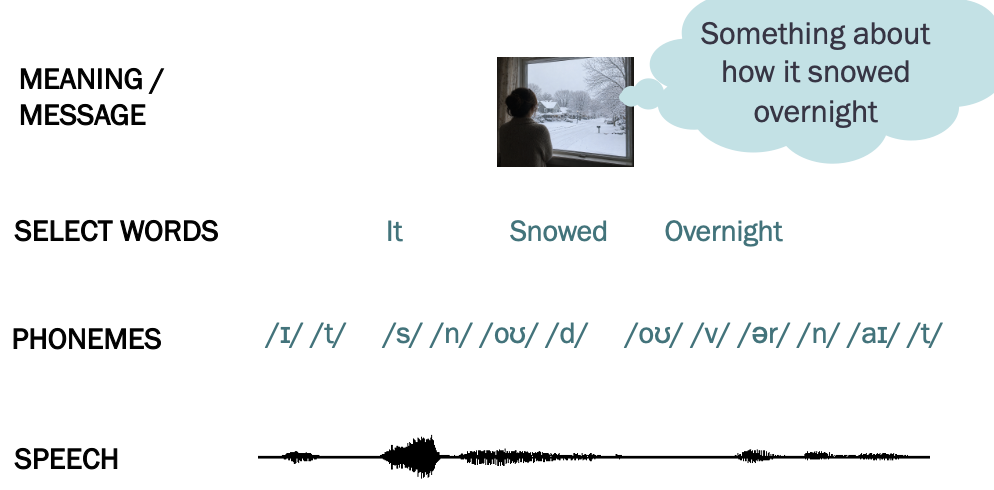
To say “It snowed overnight,” the speaker first has a message about snow falling during the night.
• The speaker then selects specific words, such as it, snowed, and overnight.
• For each word, the speaker also retrieves the sounds needed to say it before producing the utterance
How might the impression of speech be misleading?
speech seems fluent, we speak so frequently and without much conscious effort
looking closely at everyday speech shoes that it contains many pauses, restarts, and errors
What are common errors involved in speech?
common speech stumbles include filled pauses, such as um or ah
they also include false starts, repairs, and slips of the tongue
these are not just random imperfections; they provide evidence about how speakers build utterances in real time
How are speech stumbles useful and interesting?
speech stumbles give researchers a window into the production process
they suggest that speakers often begin talking before every detail of the sentence is fully prepared
studying where stumbles occur helps identify the units or chunks that speakers plan
What is involved in the idea that planning/production is incremental?
speakers usually do not prepare a complete polished sentence before starting.
• Instead, they plan and assemble utterances in smaller chunks.
• This helps explain why pauses and repairs often occur while a person is already speaking
How did Smith and Wheeldon study whether planning/production is incremental?
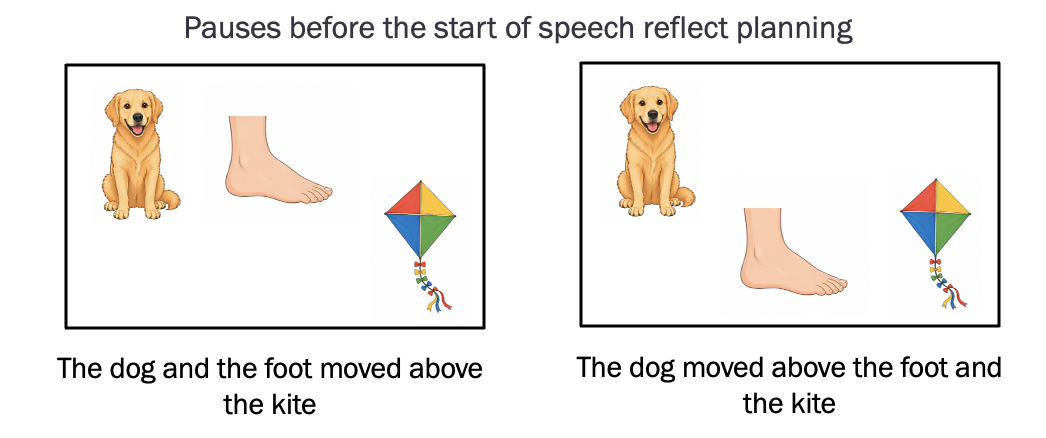
Smith and Wheeldon studied speech planning
• This study measured how long speakers paused before beginning an utterance.
• The logic is that more planning should lead to longer pauses before speech starts.
• They compared sentences that were similarly complex OVERALL, but differed in how complex the FIRST PART of the sentence was.
What did Smith and Wheeldon find studying whether planning/production is incremental?
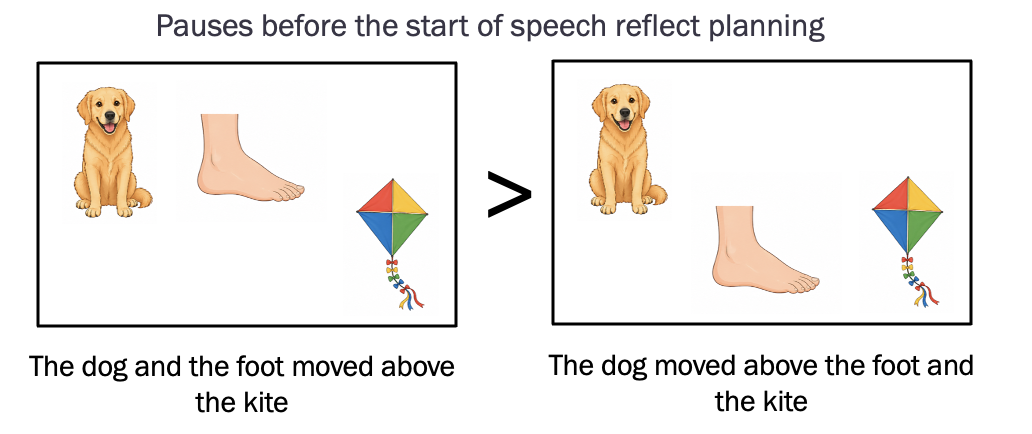
Speakers paused longer before “The dog and the foot moved above the kite.” vs “The dog moved above the foot and the kite”, even though sentences are equally complex
• The longer pause suggests that speakers were just planning the FIRST CHUNK, which is more complex in “The dog and the foot moved above the kite.” vs “The dog moved above the foot and the kite”
• The key factor was the complexity of the initial chunk of the sentence.
• When the opening phrase was more complex, speakers needed more time before beginning.
• This supports the claim that speakers plan at least the first chunk of an utterance in some detail
When do hesitations and stumbles tend to occur?
at boundaries between phrases, clauses, and other natural chunks.
• More complex upcoming chunks tend to produce longer hesitations / more stumbles, indicating chunk planning
So what does the evidence suggest about the incremental nature of planning/ production?
The main conclusion so far is that speech is planned chunk by chunk.
• Speakers do not usually plan the entire utterance in full detail before beginning.
• The next question is what exactly is planned within each chunk: the message, the words, the sounds, or all of these.
What is a word swap stumble and how might it reveal word planning?
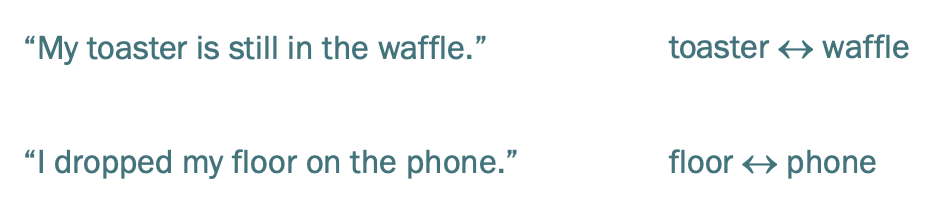
word swaps occur when a speaker intends one word order but accidentally exchanges two words
Word swaps show that planning goes beyond the general message.
• The words themselves must have been planned, because they could not be swapped unless both were active.
• This suggests that speakers prepare upcoming words before producing them.
What are spoonerisms and what does it reveal about phoneme planning?
errors in which sounds from different words are accidentally swapped
means that speakers often plan at least some of the sounds in an upcoming chunk before saying them
What can be found comparing word swaps and spoonerisms?
word swaps can occur over long ranges, between words that are relatively far apart in the sentence
sound swaps, or Spoonerisms, usually involve words that are close together
this difference suggests that word-level planning reaches further ahead than sound-level planning
Summary of planning ahead of speeach
Speech is planned incrementally, in chunks rather than as a fully prepared sentence.
• Within a chunk, speakers plan both words and sounds before speaking.
• Words seem to be planned over longer distances than the sounds that make up those words.
What is involved in the experimental approach used to study parallel activation in production?
test whether related words affect how quickly people name pictures.
• The picture-word interference task does this by presenting a picture to name along with another word.
• If the extra word changes naming speed, it suggests that related words influence production.
What is involved in the picture-word interference paradigm?
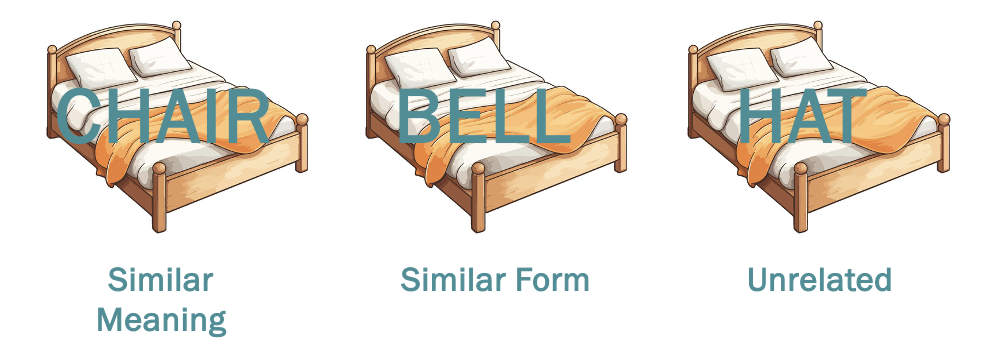
In the picture-word interference task, the participant names the picture, such as saying “bed.”
• At the same time, another word is presented visually or auditorily.
• Researchers measure whether that extra word affects how quickly the participant produces the picture name.
• The extra word can be related in meaning, related in sound form, or unrelated to the picture name.
• For a picture of a bed, “chair” is meaning-related, “bell” is sound-related, and “hat” is unrelated.
• Comparing these conditions shows whether meaning similarity and sound similarity affect word production.
What do results from Shreifers et al picture-word interference paradigm study?
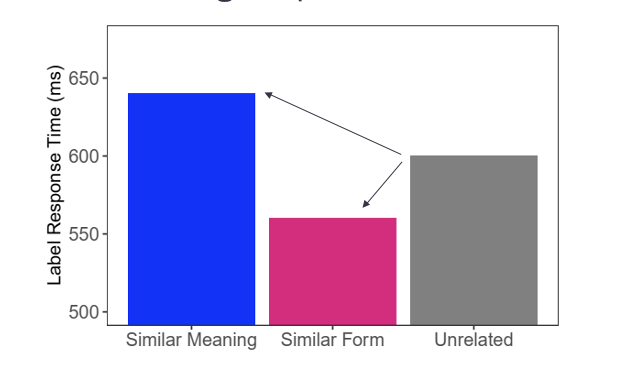
Meaning-related words tend to slow picture naming, suggesting that they compete with the target word.
• Sound-related words tend to speed picture naming, suggesting that shared sounds can help prepare the target word.
• This shows that not all related words have the same effect during production.
words similar in meaning compete; words similar in form facilitate
What is a limitation of the picture-word interference task?
the related word is deliberately presented to the participant.
• This means the task shows that related words can influence production, but it does not tell us whether they are activated SPONTANEOUSLY
• To study spontaneous activation, we can also look at naturally occurring speech errors.
What is involved in a semantic speech error? And what do they suggest
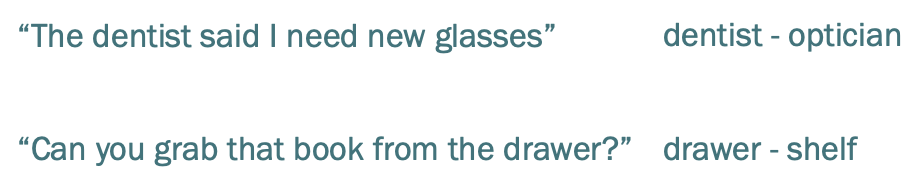
Semantic errors occur when a speaker says a word that is related in meaning to the intended word.
• For example, saying “dentist” when “optician” was intended suggests that meaning-related words were active together.
• These errors show parallel activation of words with similar meanings.
What is involved in a form speech error and what do they show?
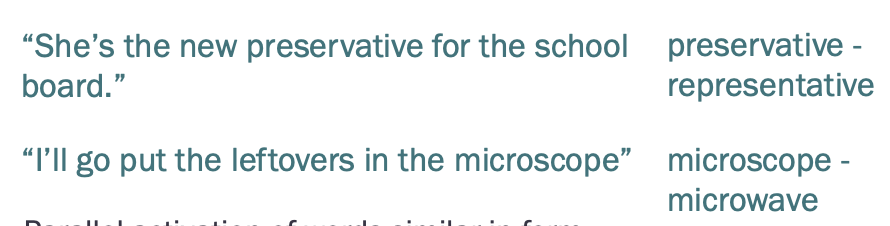
Form errors occur when a speaker says a word that sounds similar to the intended word.
• Examples include saying “preservative” instead of “representative,” or “microscope” instead of “microwave.”
• These errors show parallel activation of words with similar sound forms.
What is a mixed speech error and what does it show?

Mixed errors occur when the wrong word is similar to the intended word in both meaning and sound.
• Examples include rats for cats, or drawer for door.
• Mixed errors are especially common because the wrong word receives an activation boost from both meaning similarity and sound similarity.
What do we see comparing feedforward and feedback possibilities side by side?
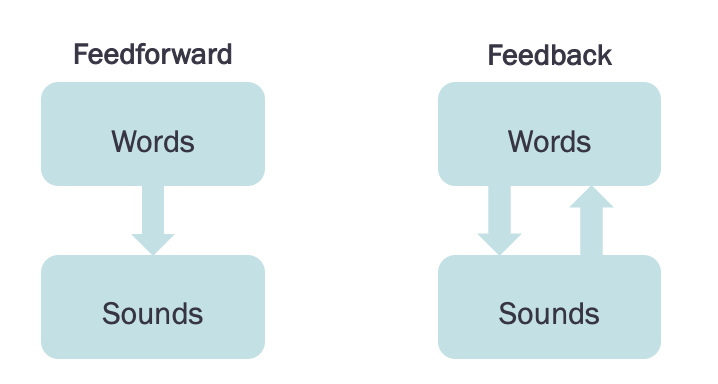
A feedforward system sends activation from words to sounds only.
• A feedback system allows activation to move from sounds back to words as well.
• We will use Spoonerisms to test which kind of system better explains speech errors.
How do Spoonerisms reveal sound to word feedback?
Some Spoonerisms are memorable because the swapped sounds still create real words.
• For example, “tasted a worm” and “shoving leopard” are errors, but the resulting words are still meaningful English words.
Not all sound swaps create real words; “marmer’s farket” is an example of an error that creates nonwords.
• The key question is whether speakers are more likely to make sound-swap errors when the result is a real word.
How did Motley and Baars use experientally-induced spoonerisms?
give ppts target phrase
Some target phrases would create real words if the first sounds were swapped, such as “light rain” becoming “right lane.”
Other target phrases would create nonwords if the first sounds were swapped, such as “large raise” becoming “rarge laise.”
Participants were exposed to phrases designed to make a sound swap more likely.
• For example, seeing or saying phrases with the opposite sound pattern could prime the mistaken swap.
• This allowed researchers to compare real-word and nonword outcomes under controlled conditions.
The crucial comparison is between sound swaps that would produce real words and sound swaps that would produce nonwords.
What did Motley and Baars find resulting from their experimentally induces spoonerisms method?
People were more likely to make sound-swap errors when the result would be real words.
• This pattern suggests that errors receive extra support when the swapped sounds match real words.
What would a feedforward-only system predict?
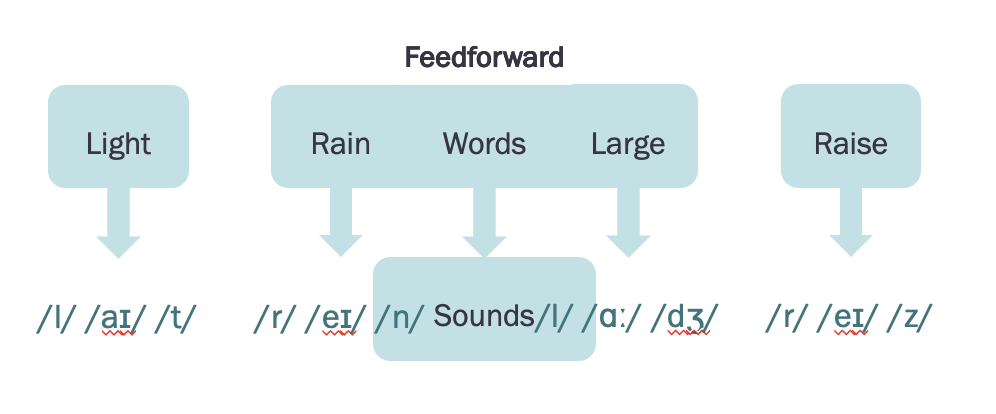
activation moves from words to sounds and then stops there
once the system is planning sounds, it would not have access to word-level information
A feedforward system could still make sound-swap errors.
• However, it should make real-word and nonword swaps at similar rates, because both are just sound errors.
• The observed real-word advantage therefore argues against a purely feedforward account.
What would a feedback system explain?
explains the real-world advantage more naturally
When swapped sounds accidentally form real words, those words can become active and reinforce the error.
• Nonword outcomes do not receive the same boost because there is no stored word to activate.
What do Spoonerisms reveal about sound → word feedback?
Sound-swap errors are more likely when they result in real words than when they result in nonwords.
• This pattern suggests that sound-level activation can feed back to the word level.
• Production therefore involves interaction between stages, not just a one-way movement from words to sounds.
Why does speech production look fragile?
speakers plan incrementally rather than preparing everything in advance.
Parallel activation can make incorrect words or sounds active alongside the intended ones.
• Feedback can also reinforce some errors
• The system needs ways to monitor and correct speech.
How does the production system do more than generate speech?
also monitors what is being produced
Monitoring can apply to speech that is about to be produced or has just been produced.
• When the system detects a problem, it can interrupt and repair the utterance.
What is self-interruption as a common repair strategy?
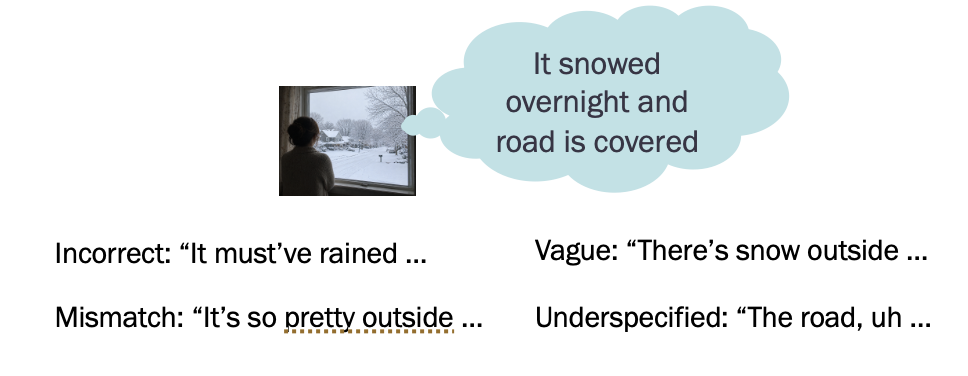
a speaker stops mid-utterance and changes course.
Speakers interrupt themselves more often when the emerging speech violates the intended message (mismatch errors)
• Errors that are incorrect or mismatched are more likely to trigger interruption than vague or underspecified speech.
• This suggests that monitoring is sensitive to how serious the error is for the intended meaning.
What often accompanies self-interruptions?
When speakers interrupt an error, they often add a signal such as “sorry,” “I mean,” “no,” or “wait.”
• These signals help the listener understand that the previous speech was not what the speaker intended.
• Repair therefore serves both the speaker’s production system and the listener’s interpretation.
What did Blackmer and Mitton find studying how quickly speakers began repairs after interrupting themselves?
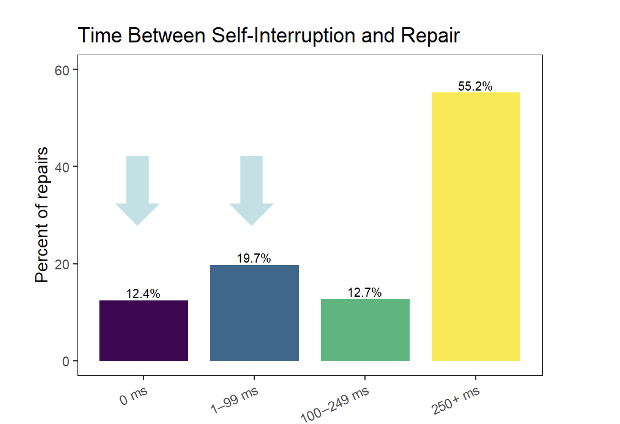
Some repairs began immediately or within less than 100 milliseconds after the interruption.
• Repairs this fast suggest that speakers had already detected the error and prepared the correction before the repair began.
In sum, how do we detect and repair errors?
the production system can monitor speech in a fast and flexible way
it can detect whether the emerging utterance conflicts with the intended message
at least some repairs are prepared pre-emptively, before the full error-repair sequence is spoken