Module 2 FINAL
 Call Kai
 Learn
Learn Practice Test
 Spaced Repetition
 Match
Match Flashcards
 Knowt Play
1/49

There's no tags or description
Looks like no tags are added yet.
Name | Mastery | Learn | Test | Matching | Spaced | Call with Kai |
|---|
No analytics yet
Send a link to your students to track their progress
50 Terms
Why does the Internet need a transport layer between the application and network layers? A. The network layer offers best-effort delivery with no guarantees; transport adds reliability and process-to-process delivery. B. The router fabric cannot accept packets unless transport-layer headers re-write IP source and destination addresses along the path at every intermediate hop. C. The network layer can only deliver fixed-size physical frames, so all segmentation, reassembly, and reordering of payloads must happen above it in a separate layer. D. Application code cannot itself construct IP packets and depends on transport to also compute IP routes, manage neighbor tables, and select egress interfaces.
A. The network layer offers best-effort delivery with no guarantees; transport adds reliability and process-to-process delivery. Why: Network = best-effort host-to-host; transport = process-to-process + reliability. The transport layer adds what IP alone doesn't give: port numbers (so the right process gets the bytes) and, for TCP, retransmission and ordering on top of IP's lossy datagram service.
An IP address alone is sufficient to deliver an incoming packet to the correct application process on a host, without using port numbers. True or False?
False. Why: IP gets you to the host, not the process. Without port numbers in the transport header, the OS can't decide whether a packet belongs to your browser, your SSH client, or your mail daemon — all of them share the same IP.
A receiving host uses connectionless (UDP) demultiplexing. Which field(s) does it use to identify the correct socket? A. Only the source IP address and the source port number carried in the segment header by the sender of the datagram. B. The destination IP plus destination port (the UDP socket). C. The full four-tuple of source IP, source port, destination IP, and destination port — exactly as TCP would use to identify a unique connection-oriented socket. D. The TCP sequence number embedded in the segment header, taken modulo 2^32 to give an offset into the receiver's per-socket buffer.
B. The destination IP plus destination port (the UDP socket). Why: UDP demux key = (dest IP, dest port). UDP is connectionless and stateless: any datagram with the same destination two-tuple lands on the same socket, regardless of who sent it.
A web server listens on port 80 and serves many simultaneous TCP clients. How can it demultiplex incoming segments that all carry destination port 80 to the right socket? A. By rotating clients through a single shared listening socket in strict round-robin order, one segment per client per scheduler tick. B. By renegotiating the destination port number for each new client during the TCP three-way handshake, using a special option in the SYN. C. Using the four-tuple (source IP, source port, destination IP, destination port). D. By assigning every client a unique destination IP alias at the server side and binding each one to a separate kernel-level TCP socket.
C. Using the four-tuple (source IP, source port, destination IP, destination port). Why: TCP demux key = 4-tuple. Even when many clients share destination (server IP, port 80), each client's connection is unique because (src IP, src port) differs — the kernel uses all four fields to pick the right socket.
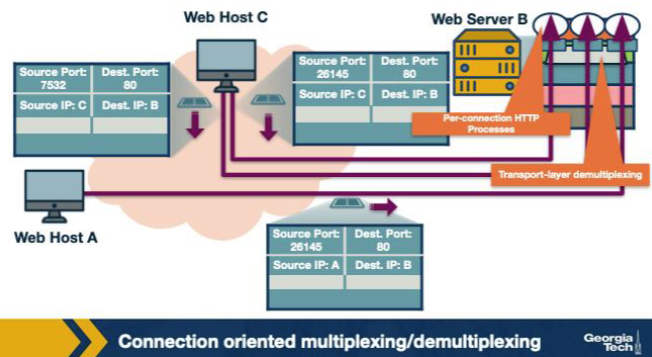
In the figure, two hosts initiate HTTP sessions to the same web server B on port 80. If both clients happen to pick the same source port number, how does server B still keep the connections separate? A. It refuses one of the two connections because source ports must always be globally unique across the public Internet for every concurrent TCP flow worldwide. B. It demultiplexes by inspecting the URL inside the application-layer payload of the GET request — the URL is what truly identifies a unique HTTP session. C. It assigns each client a freshly-allocated destination port at handshake time, signalled with a TCP option attached to the SYNACK so that two clients never share a destination port. D. It uses source IP (part of the 4-tuple) to distinguish the two sockets.
D. It uses source IP (part of the 4-tuple) to distinguish the two sockets. Why: Source IP breaks the tie. If two clients happen to choose the same source port, the 4-tuple still differs in the source-IP component — so the server's TCP can distinguish the two connections.
A single UDP server socket is bound to (192.0.2.7, 5060). It receives a datagram from (203.0.113.4, 41000) and shortly after another datagram from (203.0.113.9, 41000). Which statement is correct? A. Both datagrams are delivered to the same socket and the application can distinguish them by reading the sender address with recvfrom(). B. The host's UDP layer rejects the second datagram because two different sources cannot share the same source port. C. The host kernel creates a new socket on the fly for the second sender, transparently to the application. D. UDP demultiplexes using the four-tuple, so each unique source IP+port pair is mapped to a different listening socket on the server.
A. Both datagrams are delivered to the same socket and the application can distinguish them by reading the sender address with recvfrom(). Why: UDP socket is bound to dest (IP,port) only. Both senders land on the same socket; the application reads sender identity from recvfrom()'s return values, since UDP itself doesn't demux by source.
A user's laptop opens two TCP connections from the same browser to the same web server (203.0.113.10, 443). The kernel assigns source ports 51500 and 51501. Which statement explains why the server can keep the two connections distinct? A. The destination IP differs across the two connections because the server uses anycast. B. TCP demultiplexing uses the full four-tuple, and the two connections differ in their source-port component (51500 vs 51501). C. TCP gives every new connection a unique destination port number negotiated during the three-way handshake, making the destination ports the distinguishing field. D. The browser embeds a connection ID in the TCP options field that the server uses as a primary demultiplexing key in the kernel.
B. TCP demultiplexing uses the full four-tuple, and the two connections differ in their source-port component (51500 vs 51501). Why: Different source ports => different 4-tuples. The kernel assigns ephemeral ports per connection (51500 vs 51501), so even though everything else matches, the two flows demux to separate sockets.
A browser opens six parallel TCP connections to fetch images from one CDN edge. From the server's perspective, what makes the six connections separable at the transport layer? A. The browser sets a unique TLS Server Name Indication value per connection, which the kernel uses as an extra demultiplexing key beyond ports. B. UDP encapsulation underneath HTTP gives each of the six connections a different multiplexing channel ID at the network layer. C. Each of the six connections has a distinct source port chosen by the client, so their four-tuples differ even though source IP, destination IP, and destination port are identical. D. The CDN server allocates a unique destination port per connection and returns it in the SYNACK so that each browser-side request lands on its own listening port.
C. Each of the six connections has a distinct source port chosen by the client, so their four-tuples differ even though source IP, destination IP, and destination port are identical. Why: Six distinct source ports => six distinct 4-tuples. The browser opens parallel connections by letting the OS allocate a fresh ephemeral source port for each — same dest, different source-port component.
Two distinct UDP applications on the same host can listen on the same destination port without conflict, because UDP uses the full four-tuple — including source address — as its demultiplexing key. True or False?
False. Why: UDP demuxes only on (dest IP, dest port). Two processes binding the same UDP port on the same host conflict — the kernel can't route incoming datagrams to two different sockets that match the same 2-tuple.
Which of the following is NOT a reason that some real-time applications prefer UDP over TCP? A. UDP avoids the three-way handshake delay before sending data. B. UDP does not impose congestion-control back-off on the sender. C. UDP gives the application direct control over when data is sent. D. UDP guarantees in-order, loss-free delivery for time-sensitive flows like RTP or VoIP, with retransmissions of any dropped packets to maintain perfect fidelity.
D. UDP guarantees in-order, loss-free delivery for time-sensitive flows like RTP or VoIP, with retransmissions of any dropped packets to maintain perfect fidelity. Why: UDP gives NO guarantees — that's the opposite of why real-time apps pick it. Real-time apps choose UDP precisely to skip TCP's handshake, ordering, and back-off; they tolerate loss rather than tolerate the latency cost of guaranteed delivery.
The UDP header is 64 bits long and contains a source port, destination port, length, and checksum field. True or False?
True. Why: UDP header = 4 fields x 16 bits = 64 bits total. Source port, destination port, length, checksum — minimal, by design, so UDP adds almost no overhead over raw IP.
Most DNS queries are sent over UDP rather than TCP. Which is the BEST single reason for that design choice? A. DNS queries and responses are typically small enough to fit in a single packet, and avoiding TCP's connection-setup handshake saves a full round-trip per lookup. B. UDP gives DNS strong delivery guarantees that TCP does not provide because DNS itself enforces no application-layer retransmission. C. TCP packets are systematically dropped by recursive resolvers; only UDP traffic is forwarded to the authoritative servers. D. DNS resolvers require congestion-control rate limiting on every lookup, which TCP does not provide but UDP does at the kernel level.
A. DNS queries and responses are typically small enough to fit in a single packet, and avoiding TCP's connection-setup handshake saves a full round-trip per lookup. Why: DNS = small message + no handshake savings. Most DNS queries and replies fit in one packet; skipping TCP's three-way handshake saves a full RTT per lookup, which dominates web page load time.
An online multiplayer game sends fast-paced position updates 60 times per second. Which transport protocol is the more natural choice, and why? A. TCP, because the game absolutely needs in-order, lossless delivery of every position update so that no client ever falls behind on the latest game state. B. UDP, because losing one position update is acceptable; the next update arrives quickly anyway, and TCP's retransmissions/back-off would add stale data plus jitter. C. TCP, because UDP cannot pass through any of the home-router NATs that are typical in residential broadband deployments at scale. D. UDP, because the game needs guaranteed in-order delivery without any congestion control to keep the round-trip time predictable for the player.
B. UDP, because losing one position update is acceptable; the next update arrives quickly anyway, and TCP's retransmissions/back-off would add stale data plus jitter. Why: Stale data is worse than missing data. Position updates 60x/sec self-correct; TCP would buffer late packets to deliver in order, adding latency and jitter — exactly what real-time games can't tolerate.
VoIP traffic generally uses UDP rather than TCP. Which property of TCP makes it a POOR fit for an interactive voice call? A. TCP requires a third-party authoritative time service for each call, which prevents real-time audio delivery in the absence of synchronized clocks among the participants. B. TCP cannot carry the small audio payload sizes that VoIP codecs typically produce; UDP is the only transport that supports fragments smaller than 1500 bytes on the wire. C. A TCP segment loss triggers retransmission, and any retransmitted audio sample arrives too late to be played out — it would only add latency without benefit. D. UDP, unlike TCP, automatically applies forward error correction across consecutive packets to recover from loss, which audio codecs can leverage natively.
C. A TCP segment loss triggers retransmission, and any retransmitted audio sample arrives too late to be played out — it would only add latency without benefit. Why: Retransmitted voice = useless voice. By the time TCP recovers a lost audio frame, it's already past its playback deadline; better to skip it and keep latency low than wait and play out-of-time samples.
A user uploads a 4 GB ZIP archive over the Internet to cloud storage. Which transport protocol is the natural fit, and why? A. UDP, because file uploads are tolerant of loss and reordering and benefit from skipping the three-way handshake to minimize startup delay. B. TCP, because UDP packets are dropped by 80% of public ISPs as a matter of network-management policy and cannot be used for any file transfer at all. C. UDP, because TCP's window-scaled rate limits would prevent a multi-gigabyte transfer from completing on a typical home broadband link in a reasonable time. D. TCP, because every byte must arrive intact and in order, and TCP gives both reliability and congestion control without the application reimplementing them.
D. TCP, because every byte must arrive intact and in order, and TCP gives both reliability and congestion control without the application reimplementing them. Why: Bulk data needs every byte, in order. TCP gives lossless, ordered delivery plus congestion control for free — exactly what a file transfer needs and what UDP would force the application to reimplement itself.
A stock-exchange feed broadcasts tick updates to many subscribers continuously. Which trade-off best argues for using UDP in this design? A. Losing a single stale tick is acceptable since a fresher tick will follow shortly, and avoiding TCP's per-flow congestion control keeps the publish-side latency consistent and predictable. B. UDP guarantees in-order arrival of every tick to every subscriber, which is essential for any market data feed because subscribers must never see the prices in the wrong order. C. UDP, unlike TCP, has built-in multicast support that lets the exchange deliver each tick to every subscriber with zero protocol overhead compared to any reliable transport. D. TCP cannot be used at all because exchange firewalls block all connection-oriented traffic by policy to prevent attackers from establishing long-lived sessions inward.
A. Losing a single stale tick is acceptable since a fresher tick will follow shortly, and avoiding TCP's per-flow congestion control keeps the publish-side latency consistent and predictable. Why: Stale tick = useless tick, like VoIP audio. A fresher price will arrive in milliseconds, so retransmitting an old tick wastes bandwidth and adds latency; predictable per-packet timing matters more than zero loss.
In the third step of the TCP three-way handshake, the client sends an acknowledgment with the SYN bit set to 0. True or False?
True. Why: ACK only — no new SYN. The third segment is the client's final acknowledgment; the SYN bit is cleared because connection establishment was negotiated in segments 1 and 2.
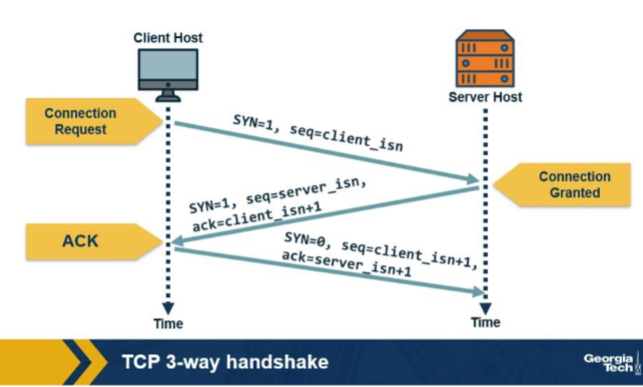
Based on the handshake shown in the figure, which field does the server place in the acknowledgment field of its SYNACK? A. Its own randomly chosen server_isn, identifying the half of the connection that the server itself controls and uses for its outbound stream of data segments back toward the client. B. client_isn + 1 (acknowledging the client's SYN). C. Zero, because no actual application-layer data has been received yet at the server when the SYNACK is constructed and dispatched back to the client. D. The TCP MSS value negotiated for the connection, which doubles as the initial sequence-number basis for the server's side of the bidirectional data exchange.
B. client_isn + 1 (acknowledging the client's SYN). Why: ACK = client_isn + 1. The server's SYNACK acknowledges the client's SYN by setting the ACK field to one past the client's chosen initial sequence number, indicating 'I expect client_isn+1 next.'
Which statement best describes the Go-back-N strategy described in the lesson? A. The receiver individually ACKs every out-of-order packet it sees, and the sender retransmits only the single packet that was missing from the sequence. B. The sender transmits one packet and then waits for its ACK to arrive before being allowed to send the next packet, completely serializing the data flow. C. The receiver ACKs the most recently in-order packet; the sender retransmits from the missing packet onward. D. The sender retransmits only after a hard retransmission timeout fires; under Go-back-N it never reacts to duplicate ACKs in any way, even repeated ones.
C. The receiver ACKs the most recently in-order packet; the sender retransmits from the missing packet onward. Why: Cumulative ACK of last in-order; sender retransmits from missing onward. The receiver doesn't buffer out-of-order packets, so the sender resends the entire window starting at the lost one — simple but wasteful.
How many duplicate ACKs does TCP wait for before triggering fast retransmit? A. One duplicate ACK — TCP retransmits as soon as the very first duplicate arrives at the sender. B. TCP fast retransmit never triggers on duplicate ACKs; it always waits for the retransmission timeout to fire. C. Two duplicate ACKs. D. Three duplicate ACKs.
D. Three duplicate ACKs. Why: Three duplicate ACKs trigger fast retransmit. RFC 5681's standard heuristic: three duplicates is strong evidence of a single packet loss (not just reordering), so retransmit immediately without waiting for the timeout.
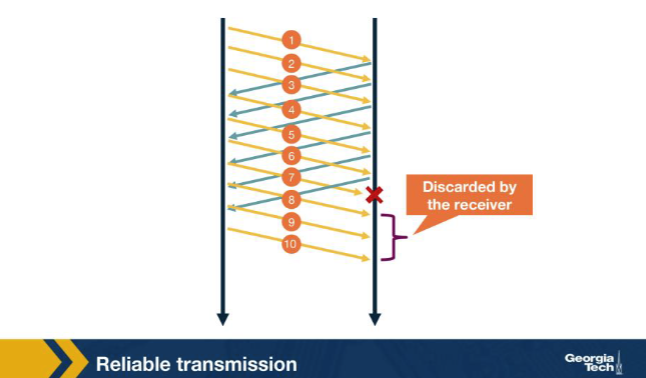
In the Go-back-N scenario in the figure, packet 7 is lost and the receiver continues to receive packets 8, 9, 10. Which ACKs does the receiver send for those later packets? A. Duplicate ACKs for packet 6 (the last in-order packet); packets 8–10 are discarded. B. Nothing — the receiver stays completely silent until packet 7 has been retransmitted and successfully received, only then resuming its acknowledgment stream. C. A single cumulative ACK 10, because all subsequent packets in the window have arrived intact and the receiver's protocol can summarize them in one ACK. D. ACK 8, ACK 9, ACK 10 — the receiver individually acknowledges each correctly received packet using the next-expected sequence number in each separate ACK segment.
A. Duplicate ACKs for packet 6 (the last in-order packet); packets 8–10 are discarded. Why: GBN: receiver discards everything after the gap. With cumulative ACKs only, the receiver keeps re-acking the last in-order packet (6) for every subsequent arrival, drops 8/9/10, and waits for retransmission.
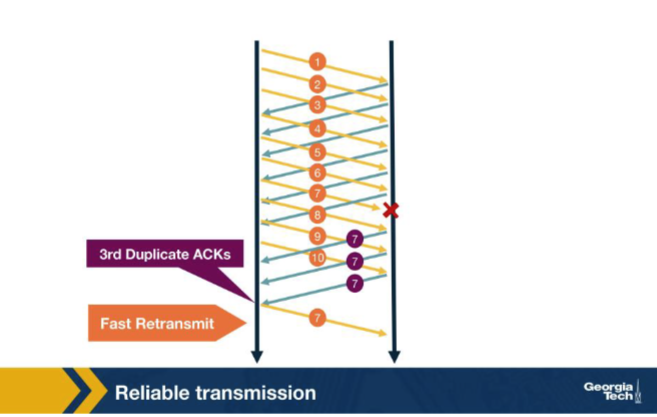
In the fast-retransmit figure, the sender receives three duplicate ACKs after packet 7 is lost. What number do those duplicate ACKs carry, and what does the sender do? A. They ACK packet 7 itself, because that is the packet the receiver still wants; the sender takes no action since seven was already acknowledged in the prior duplicate-ACK stream. B. They ACK packet 6; sender fast-retransmits packet 7 without waiting for the timeout. C. They ACK packet 10, signalling that all later packets arrived; the sender concludes the connection is healthy and continues sending new data segments forward. D. They are SYNACKs that reset the connection because three retransmissions in a row indicate the receiver thinks the connection has been lost.
B. They ACK packet 6; sender fast-retransmits packet 7 without waiting for the timeout. Why: Dup ACKs ACK the last in-order packet = 6. Three duplicates ACKing 6 mean 'I'm still missing 7'; the sender doesn't wait for the timer and immediately retransmits packet 7 (fast retransmit).
What does the TCP receive window (rwnd) represent? A. The number of packets per second the network path can deliver without loss, as measured by the sender during slow start. B. The number of bytes the sender has transmitted but not yet acknowledged, sometimes called 'bytes in flight'. C. The amount of free space currently available in the receiver's buffer. D. The maximum segment size (MSS) negotiated during the TCP three-way handshake.
C. The amount of free space currently available in the receiver's buffer. Why: rwnd = free space in the receiver's buffer. The receiver advertises rwnd in every ACK so the sender knows how much it can transmit before risking the receiver's buffer overflowing.
When the receiver advertises rwnd = 0, TCP fixes the resulting deadlock by having the sender continue to send small (one-byte) segments so it learns when buffer space frees up. True or False?
True. Why: Zero-window probe keeps the connection alive. If rwnd hits 0, the sender's persist timer fires and sends a 1-byte probe; the receiver's ACK carries the updated rwnd, breaking the deadlock without needing a separate signal.
Which statement correctly contrasts end-to-end and network-assisted congestion control as described in the lesson? A. End-to-end congestion control relies on routers sending explicit feedback such as ICMP source quench messages to the sender after every congestion event. B. Network-assisted congestion control requires the receiver to infer congestion from RTT measurements alone, without any cooperation from intermediate devices in the network core. C. End-to-end and network-assisted approaches both forbid routers from ever marking packets, even with explicit congestion notification (ECN). D. TCP traditionally uses end-to-end congestion control, inferring congestion from packet loss and delay.
D. TCP traditionally uses end-to-end congestion control, inferring congestion from packet loss and delay. Why: TCP = end-to-end: infer from loss/delay. The traditional model gets no help from routers — TCP deduces congestion from packet drops and RTT growth, treating the network as a black box.
Which signal did the earliest TCP implementations use to infer congestion, and why? A. Packet loss, because TCP already had to detect and handle loss for reliability. B. ICMP source-quench messages, because routers always send them under load and the messages are highly reliable indicators of incipient congestion along the path. C. The receive-window size, because rwnd directly reflects router queue depth at every hop along the network path. D. Round-trip time variance, because delay is the most stable and least noisy congestion signal in real networks.
A. Packet loss, because TCP already had to detect and handle loss for reliability. Why: Free signal: loss-detection was already there. Early TCP needed loss-detection for reliability, so reusing it as a congestion signal added no extra mechanism — congestion-induced drops were already visible to the sender.
TCP Reno treats three duplicate ACKs and a retransmission timeout as DIFFERENT events. Which interpretation explains why dup-ACKs are considered a less severe congestion signal than a timeout? A. Duplicate ACKs always come from a different congested router than the one that causes timeouts, so the duplicate-ACK signal is geographically less severe. B. Duplicate ACKs prove that later packets are still reaching the receiver — i.e., the pipe is mostly working; a timeout suggests the path may be entirely blocked. C. Timeouts are generated only by the receiver-side flow-control logic and are unrelated to network congestion, while duplicate ACKs come from the routers themselves. D. Duplicate ACKs are sent in response to receiver buffer overflow, not network loss, so they signal an application-layer issue rather than a transport-layer congestion event.
B. Duplicate ACKs prove that later packets are still reaching the receiver — i.e., the pipe is mostly working; a timeout suggests the path may be entirely blocked. Why: Dup ACKs prove later packets still arriving => pipe partly working. A timeout means the sender hears nothing — the path may be wholly broken; dup ACKs say 'one packet was lost but the rest got through,' so it's a milder signal.
Reno's response to a triple-duplicate-ACK event differs sharply from its response to a timeout. Which choice describes the rationale for this asymmetry? A. The protocol designers found that halving cwnd was too aggressive in early experiments, so they chose to halve only on dup-ACK and reset on timeout to push receivers into faster discovery of available bandwidth in the bottleneck queue. B. Halving cwnd on a triple dup-ACK is a way to mimic legacy stop-and-wait protocols; resetting on a timeout exists for backward compatibility with experimental T/TCP, which used a non-standard cwnd state machine. C. Halving cwnd on a triple dup-ACK matches the probabilistic estimate that one segment was lost while the rest of the window arrived; resetting cwnd on a timeout reflects the much higher risk that the path is severely impaired. D. Triple duplicate ACKs always arrive from network-internal ECN-aware switches, while timeouts are produced by the sender's local kernel — both behaviours reflect entirely different congestion-signaling code paths and ideological assumptions about packet loss.
C. Halving cwnd on a triple dup-ACK matches the probabilistic estimate that one segment was lost while the rest of the window arrived; resetting cwnd on a timeout reflects the much higher risk that the path is severely impaired. Why: One lost segment vs path possibly down => different cuts. Halving cwnd assumes a single drop in a mostly-healthy pipe; resetting to 1 MSS assumes the path may be severely impaired, since no ACKs at all reached the sender.
Explicit Congestion Notification (ECN) lets routers mark packets to signal congestion without dropping them, giving TCP a 'softer' signal that ACKs the same kind of information as packet loss but earlier in the build-up. True or False?
True. Why: ECN = router marks instead of drops, earlier softer signal. ECN-aware routers set the CE bit on packets they would otherwise drop, letting senders react to congestion before any actual loss occurs.
The amount of unacknowledged data a TCP sender may have outstanding is bounded by min(cwnd, rwnd). True or False?
True. Why: Outstanding bytes <= min(cwnd, rwnd). The sender obeys whichever ceiling is lower — network capacity (cwnd) or receiver buffer (rwnd) — to avoid either congesting the network or overrunning the receiver.
TCP Reno's cwnd is currently 16 packets when a triple-duplicate-ACK loss event occurs. What does cwnd become immediately afterward? A. One packet — Reno resets to the initial window on any loss event of any kind, including duplicate ACKs. B. 17 packets, because Reno continues to grow additively on duplicate ACKs. C. 15 packets — Reno decreases additively by one on every duplicate-ACK group, mirroring its additive-increase rule in reverse. D. 8 packets.
D. 8 packets. Why: Triple dup ACK = halve cwnd. Reno's mild-loss response: 16/2 = 8, then resume additive increase from there. Multiplicative decrease, additive increase = AIMD.
TCP Reno distinguishes two loss signals. How does it react to each? A. Triple dup ACK halves cwnd (mild); timeout resets cwnd to the initial window (severe). B. On a timeout, cwnd is doubled as an aggressive probe for capacity; on a triple duplicate ACK, cwnd is halved as a conservative back-off. C. Both triple duplicate ACKs and a timeout cut cwnd in half, since Reno treats the two signals identically regardless of severity. D. Triple duplicate ACKs reset cwnd all the way to one packet; a timeout merely halves cwnd as a softer response.
A. Triple dup ACK halves cwnd (mild); timeout resets cwnd to the initial window (severe). Why: Dup ACK -> halve; timeout -> reset to 1 MSS. Reno treats the two signals very differently: dup ACK suggests one drop in a still-functioning path, while timeout suggests the path may be entirely broken.
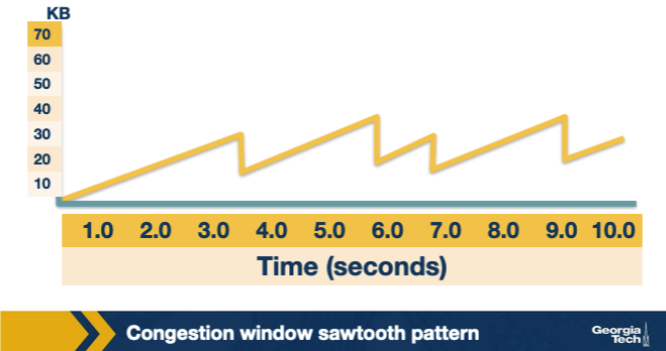
The figure shows TCP Reno's cwnd over time. Why does the plot have a sawtooth shape? A. cwnd grows exponentially without bound until the receiver's rwnd is fully exhausted at the application layer, at which point cwnd drops to zero and the connection idles. B. cwnd grows additively by one packet per RTT, then is halved on a triple-duplicate-ACK loss event, producing repeated rise-and-cut cycles. C. cwnd oscillates because the receiver advertises rwnd in a sinusoidal pattern that the sender mirrors back, producing a wave-like teeth shape over the lifetime of the connection. D. cwnd actually remains constant throughout; the saw-tooth shape on the plot is an artifact of variable RTT estimates being misinterpreted as window changes by the visualization tool.
B. cwnd grows additively by one packet per RTT, then is halved on a triple-duplicate-ACK loss event, producing repeated rise-and-cut cycles. Why: +1 per RTT additive, /2 on triple dup ACK => saw-tooth. AIMD's slow rise and sharp cut produces the characteristic sawtooth, which on average tracks the bottleneck capacity.
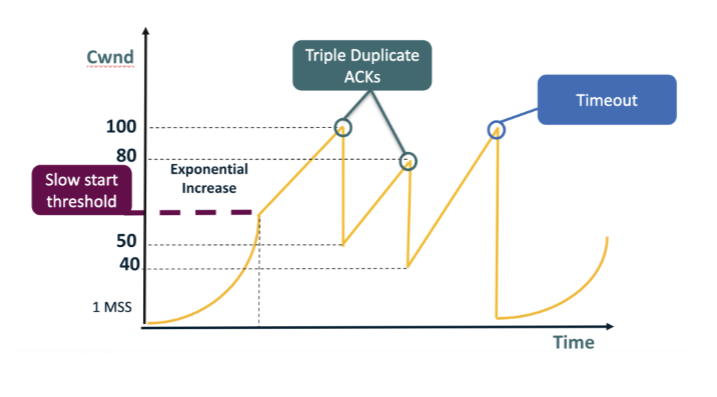
In the figure, cwnd grows up to the labeled peak of 100 and then suddenly drops to 50 in one step. Which event most likely occurred at that peak? A. A retransmission timeout, because cwnd was simply reduced to roughly half of its previous value rather than being reset all the way to the smallest possible window. B. The receiver re-advertised rwnd = 50, forcing the sender to immediately throttle cwnd down to the new flow-control ceiling indicated by the receiver. C. A triple-duplicate-ACK loss event, since cwnd was halved (100 → 50) rather than reset to 1 MSS. D. The application gracefully closed the TCP connection at that exact moment, which always halves cwnd before fully tearing down the local socket.
C. A triple-duplicate-ACK loss event, since cwnd was halved (100 → 50) rather than reset to 1 MSS. Why: Halving = triple-dup-ACK signal. The drop from 100 to 50 is exactly multiplicative decrease / 2 — Reno's response to a mild loss event, not a full reset to 1 MSS.
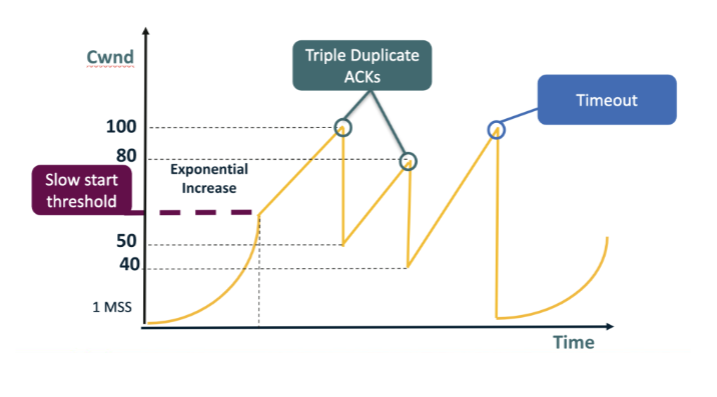
Later in the figure, cwnd climbs back up to 100 again but then drops ALL the way down to 1 MSS (not just to 50). What event explains this? A. A flow-control deadlock between sender and receiver, which always pins cwnd at exactly 1 MSS until rwnd is unfrozen by the next zero-window probe sequence. B. A triple-duplicate-ACK event in Reno; the protocol always cuts cwnd more aggressively whenever three duplicate ACKs are reordered, sometimes all the way to 1 MSS. C. The receiver advertised rwnd = 1, capping the sender at exactly one segment of in-flight data and forcing cwnd downward to match the new ceiling. D. A retransmission timeout — the more severe loss signal: cwnd is reset to the initial window (≈ 1 MSS), reflecting Reno's worst-case assumption about path connectivity.
D. A retransmission timeout — the more severe loss signal: cwnd is reset to the initial window (≈ 1 MSS), reflecting Reno's worst-case assumption about path connectivity. Why: Reset to 1 MSS = timeout signal. A full collapse to the initial window indicates Reno saw no ACKs at all for a full RTO and conservatively assumed the path may be down.
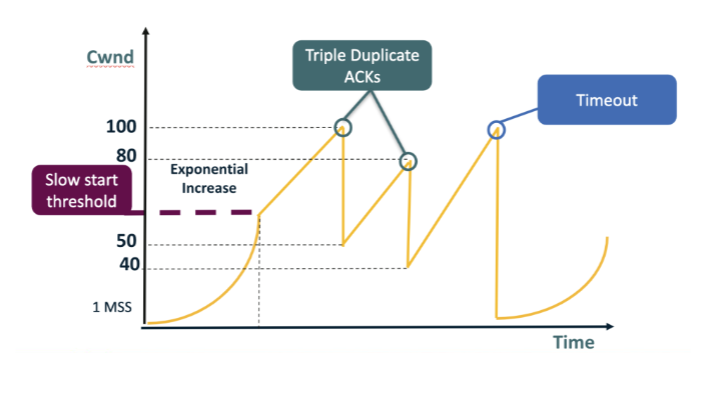
After a triple-dup-ACK halves cwnd (e.g., 100 → 50 or 80 → 40), what growth rule does Reno use in the climbing slope visible in the figure right after the cut? A. Additive — cwnd increases by approximately 1 MSS per RTT (congestion-avoidance mode). B. Exponential — cwnd doubles every RTT in slow-start fashion until reaching the previous peak again before the next loss event occurs in the connection's flight. C. Multiplicative — cwnd is multiplied by approximately 1.5 every RTT until ssthresh is reached or the next loss event interrupts the climb in the flight. D. Constant — cwnd is pinned at its post-halving value (e.g., 50 or 40) until another loss is detected, at which point it drops further by another multiplicative factor.
A. Additive — cwnd increases by approximately 1 MSS per RTT (congestion-avoidance mode). Why: Additive: +1 MSS per RTT (congestion avoidance). After the cut, Reno enters congestion-avoidance mode, growing linearly to gently probe for available capacity without immediately recreating the loss.
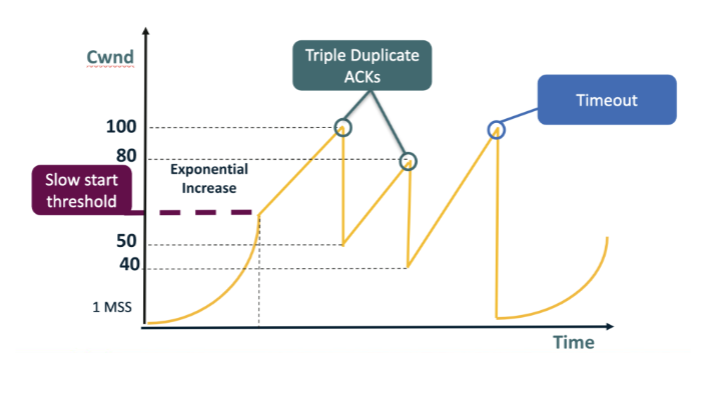
Looking at the figure: the leftmost curve grows EXPONENTIALLY from 1 MSS up to the slow-start threshold (~50), then growth becomes LINEAR. After a TIMEOUT (cwnd → 1 MSS), exponential growth restarts. When is Reno in slow start vs congestion avoidance? A. Slow start runs only once, at the very start of the connection; once it ends, Reno is in congestion-avoidance mode forever, regardless of any loss events or timeouts that occur. B. Slow start runs whenever cwnd is below ssthresh; congestion avoidance runs when cwnd ≥ ssthresh. C. Slow start runs whenever cwnd is above ssthresh; congestion avoidance runs whenever cwnd is below it, the exact reverse of the convention shown in the figure. D. Slow start and congestion avoidance both run continuously in parallel and average together; the visible sawtooth is the result of their interaction at the sender's pacing rate.
B. Slow start runs whenever cwnd is below ssthresh; congestion avoidance runs when cwnd ≥ ssthresh. Why: cwnd < ssthresh => slow start (exponential); cwnd >= ssthresh => congestion avoidance (linear). ssthresh marks the boundary between aggressive ramp-up after a reset and cautious probing near the suspected capacity.
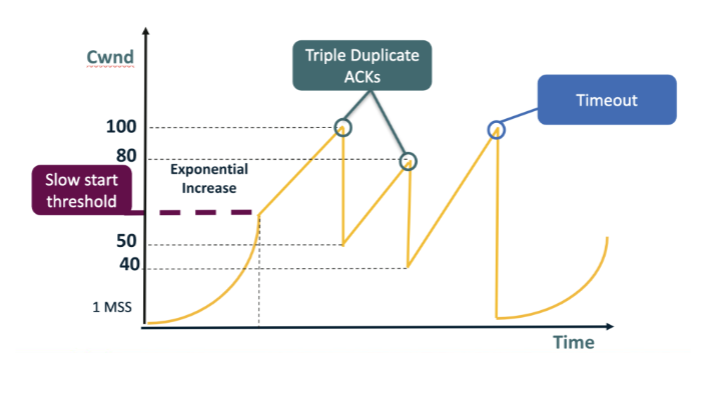
Why does the cwnd curve in the figure repeatedly climb up to a peak (e.g., 100) and then get cut back, instead of growing unbounded? A. Because TCP's additive increase is so slow that no flow ever reaches the bottleneck; the visible peaks in the figure are unrelated to actual network capacity and are purely artifacts of the plot's vertical scale. B. Because the receiver-advertised rwnd is statically set to half the bottleneck capacity, capping the sawtooth from above at a value the sender's cwnd can never exceed even momentarily. C. Because cwnd grows until the bottleneck queue overflows and a packet is lost; the resulting dup-ACK or timeout cuts cwnd, so the average sending rate stays near the link's capacity. D. Because routers advertise their capacity to the sender via ICMP source-quench messages, telling Reno exactly when to stop and start the cwnd cycle that produces the saw-tooth shape.
C. Because cwnd grows until the bottleneck queue overflows and a packet is lost; the resulting dup-ACK or timeout cuts cwnd, so the average sending rate stays near the link's capacity. Why: AIMD peaks track the bottleneck. cwnd grows until it overruns the queue, a packet is lost, and cwnd is cut — so the average sending rate oscillates around the actual link capacity rather than running away.
During slow start, TCP increases cwnd linearly (by one packet per RTT) rather than exponentially. True or False?
False. Why: Slow start doubles cwnd per RTT (exponential), not linear. The name is historical: it's slow compared to sending the full pipe immediately, but it ramps up much faster than congestion avoidance.
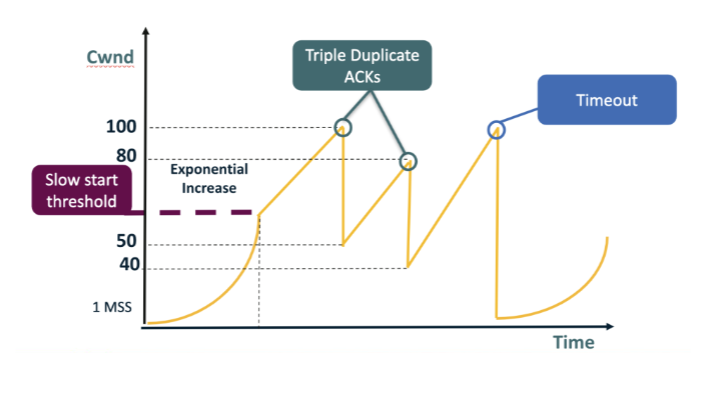
In the slow-start figure, what is happening to cwnd as each round of ACKs arrives? A. cwnd stays constant for the entirety of slow start until the slow-start threshold ssthresh expires; only then does the sender begin to actually increase its window size at all. B. cwnd grows by one packet per RTT (linear additive increase), then continues to grow at the same modest pace once congestion-avoidance mode begins, with no acceleration. C. cwnd is halved each RTT to probe for capacity gently, since slow start is designed as a cautious back-off mechanism rather than as an exponential ramp-up phase. D. cwnd is incremented by one for every ACK received, so it roughly doubles each RTT (exponential growth) until reaching ssthresh.
D. cwnd is incremented by one for every ACK received, so it roughly doubles each RTT (exponential growth) until reaching ssthresh. Why: +1 MSS per ACK => doubles each RTT. Every ACK bumps cwnd by one segment; over one RTT you receive ~cwnd ACKs, so cwnd doubles — exponential growth until ssthresh is hit.
Two TCP connections with equal RTT sharing a bottleneck link of capacity R will, under AIMD, converge toward each receiving approximately R/2. True or False?
True. Why: AIMD with equal RTTs => both converge to R/2. Equal RTTs grow cwnd at equal rates; multiplicative decrease equalises the cut; the equilibrium is the fair share.
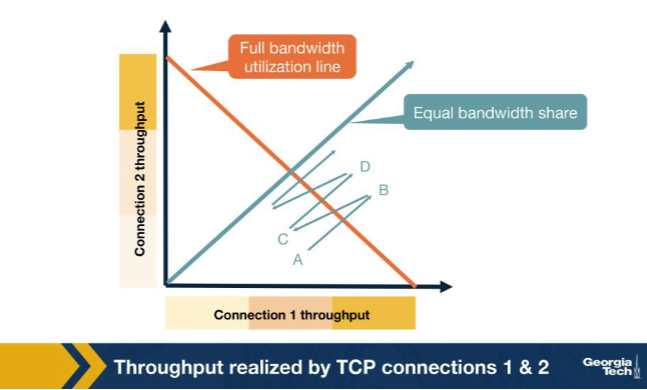
The fairness graph plots throughput of connection 1 vs. connection 2 sharing a link of capacity R. Why does AIMD push the operating point toward the intersection of the equal-share line and the full-utilization line? A. Additive increase moves both connections equally toward the capacity line; multiplicative decrease moves them along a line toward the origin (the equal-share line), so iterations converge to that intersection. B. AIMD always picks the connection with the larger throughput and starves it until both shares equalize, regardless of any other policy or queue management at the router along the bottleneck path. C. Routers explicitly signal each sender how much to slow down so that perfect fairness is achieved across all sharing connections at any given moment without any randomization in the schedule. D. TCP randomizes cwnd at the start of every single RTT in such a way that, statistically over many rounds, both flows happen to average out to exactly R/2 share each by pure chance alone.
A. Additive increase moves both connections equally toward the capacity line; multiplicative decrease moves them along a line toward the origin (the equal-share line), so iterations converge to that intersection. Why: AI moves both up the same diagonal; MD pulls them toward the origin along the equal-share line. Geometrically, iterating these two moves converges to the intersection of equal-share and full-utilization lines — the fair operating point.
Why might TCP be unfair between two connections that share a bottleneck? A. TCP gives whichever connection started first a permanently larger cwnd by design — first arrival permanently locks in a higher fair share by protocol mandate. B. Connections with smaller RTT grow cwnd faster, and apps that open many parallel TCP connections get a disproportionate share of the bottleneck. C. TCP always allocates available bandwidth proportionally to the destination port number, so flows to higher-numbered ports systematically receive more capacity than those to lower ports. D. Connections with larger RTT are given strict priority service by routers along the bottleneck path, displacing shorter-RTT flows in the queue.
B. Connections with smaller RTT grow cwnd faster, and apps that open many parallel TCP connections get a disproportionate share of the bottleneck. Why: Smaller RTT grows cwnd faster + N parallel flows get Nx. RTT bias: per-RTT additive increase favours short paths; and an app opening many connections gets a per-flow share each, multiplying its bandwidth.
TCP CUBIC uses W(t) = C(t - K)^3 + Wmax. What does the variable t represent? A. The number of ACKs received since the connection was first established, summed across all RTTs to give a cumulative count of forward progress. B. The current RTT estimate, expressed in milliseconds and refreshed continuously by exponentially weighted moving averages over every newly observed sample. C. The time elapsed since the last loss event (makes CUBIC RTT-fair). D. The number of duplicate ACKs received since the most recent Wmax checkpoint, used as a substitute for true wall-clock time in CUBIC.
C. The time elapsed since the last loss event (makes CUBIC RTT-fair). Why: t = wall-clock time since the last loss event. Tying growth to real time, not RTT-count, is what makes CUBIC RTT-fair: two flows with different RTTs progress at the same wall-clock pace.
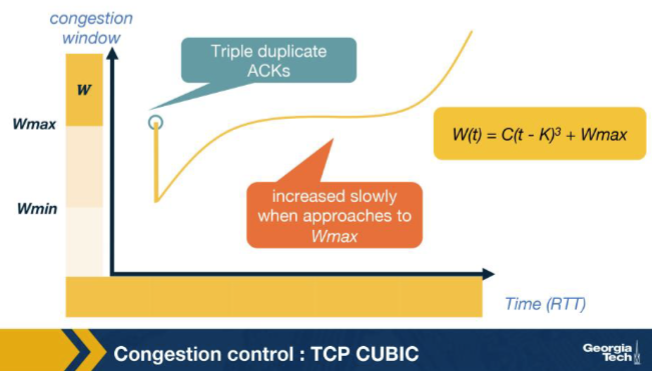
Looking at the CUBIC window-growth curve in the figure, why is the growth aggressive far from Wmax but slow near Wmax? A. Because the receiver advertises a progressively smaller rwnd as cwnd approaches Wmax, which throttles the sender from above and produces the visible slow-down in the plot at the inflection. B. Because CUBIC is required by RFC to mimic Reno's linear additive-increase rate exactly when near Wmax for backwards compatibility with legacy slow-start implementations in the kernel. C. Because RTT measurements become unreliable near Wmax due to queue buildup at the bottleneck, forcing CUBIC to pause its window growth until the RTT estimator restabilizes itself again. D. Wmax is the suspected congestion point, so CUBIC probes cautiously near it and grows fast elsewhere.
D. Wmax is the suspected congestion point, so CUBIC probes cautiously near it and grows fast elsewhere. Why: Wmax = suspected congestion point => slow near it, fast far away. CUBIC grows aggressively when far below Wmax to recover lost throughput quickly, then slows near Wmax to avoid triggering another loss.
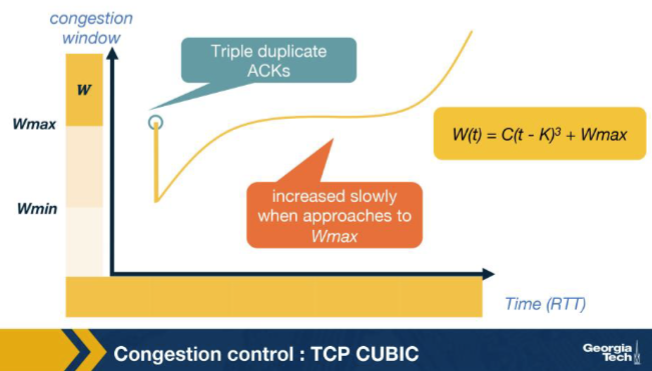
In the CUBIC growth curve, the CONCAVE region appears just before W(t) reaches Wmax. What is CUBIC doing there? A. Slowing its growth as it approaches Wmax, because Wmax is the suspected congestion point and CUBIC wants to land there cautiously. B. Probing aggressively above Wmax in case the bottleneck has cleared. C. Mimicking Reno's exponential slow-start to ensure backwards compatibility with legacy receivers. D. Halving cwnd preemptively whenever it nears Wmax, to avoid the next loss event entirely.
A. Slowing its growth as it approaches Wmax, because Wmax is the suspected congestion point and CUBIC wants to land there cautiously. Why: Concave near Wmax: cautious approach. CUBIC decelerates as cwnd nears the last known congestion point, landing softly to maximise time near the bottleneck capacity without overshooting.
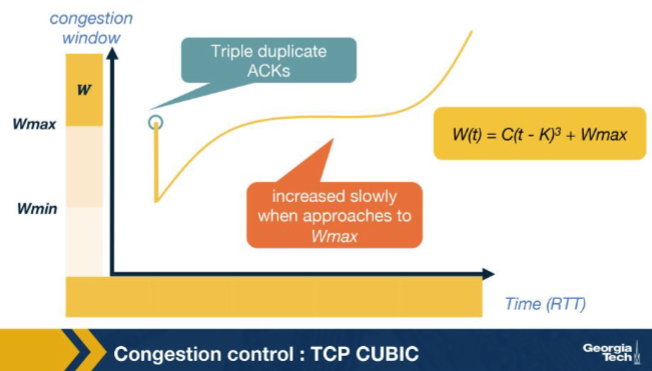
After cwnd reaches and passes Wmax, the CUBIC curve enters its CONVEX region. What does CUBIC do there? A. It freezes cwnd at Wmax and waits for an explicit ECN signal to indicate that it may grow further. B. It accelerates growth again, probing for new available bandwidth above the previous Wmax, since no new loss event has occurred. C. It immediately halves cwnd as a precaution, then enters slow start to re-discover capacity. D. It switches to Reno's additive-increase rule (one packet per RTT) and stays in that mode for the lifetime of the connection.
B. It accelerates growth again, probing for new available bandwidth above the previous Wmax, since no new loss event has occurred. Why: Above Wmax: accelerate to probe for new capacity. If no loss has happened by the time cwnd exceeds the old Wmax, the bottleneck may have grown; CUBIC ramps up cubically to find the new ceiling.
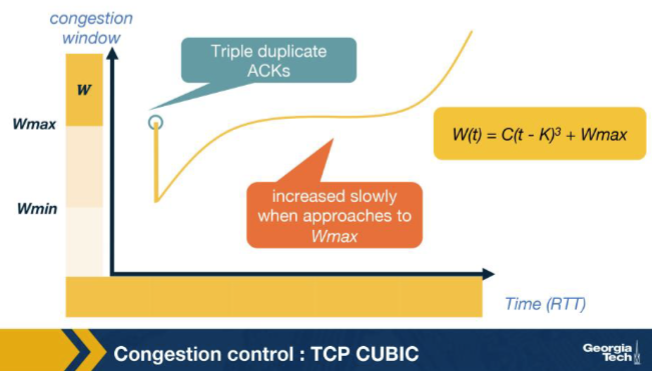
CUBIC is said to be RTT-fair while Reno is not. Which property of W(t) = C(t - K)^3 + Wmax produces this? A. W(t) depends on RTT directly, so connections with shorter RTT grow faster — which gives short-RTT flows priority just as in Reno. B. CUBIC negotiates RTT values with the receiver during the handshake, equalizing all flows at the same artificial RTT for the purpose of cwnd updates only. C. W(t) depends only on real (wall-clock) time elapsed since the last loss, so two flows with different RTTs grow at the same wall-clock pace and converge to similar throughputs. D. CUBIC's W(t) uses RTT^3 in the denominator, exactly cancelling the RTT-dependence of additive increase, leaving Reno's well-known short-RTT bias intact in practice anyway.
C. W(t) depends only on real (wall-clock) time elapsed since the last loss, so two flows with different RTTs grow at the same wall-clock pace and converge to similar throughputs. Why: W(t) depends on wall-clock t, not on ACK-driven RTT counts. Two CUBIC flows with very different RTTs grow at the same real-time pace, so they converge to similar throughputs — the property Reno lacks.
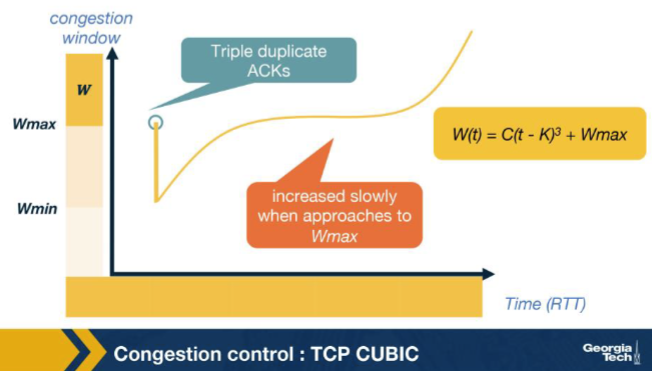
At small cwnd values right after a loss event, CUBIC checks whether Reno's cwnd estimate would be larger than its own. When that happens, CUBIC enters its 'TCP-friendly' mode. What does TCP-friendly mode do? A. It runs an independent slow-start episode for the next several RTTs and rebases Wmax to the value at which the most recent loss event was observed, then resumes. B. It pauses cwnd updates entirely for one full RTT in order to let coexisting Reno flows catch up before resuming CUBIC's cubic growth function. C. It switches to UDP-style send pacing for that RTT, disabling congestion control altogether while the Reno estimate is still ahead of CUBIC's window. D. It tracks the Reno-equivalent cwnd estimate so CUBIC's growth never falls below what Reno would have achieved, preserving fairness when sharing a link with Reno flows.
D. It tracks the Reno-equivalent cwnd estimate so CUBIC's growth never falls below what Reno would have achieved, preserving fairness when sharing a link with Reno flows. Why: TCP-friendly = floor cwnd at Reno-equivalent. When sharing a link with Reno, CUBIC ensures its window never sits below what Reno would have used, preventing CUBIC from being unfairly slower than Reno.
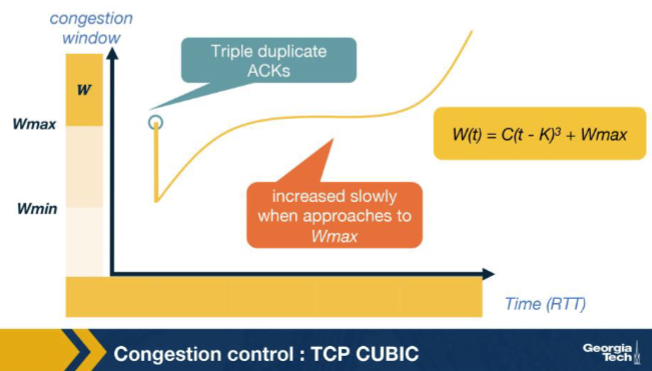
In the CUBIC plot, the inflection point of the cubic curve sits exactly at cwnd = Wmax. Why? A. Because the cubic function W(t) = C(t - K)^3 + Wmax changes its curvature at t = K (where the cube term is zero), and t = K corresponds to cwnd = Wmax by construction. B. Because Wmax is the cap value imposed by the receiver, and CUBIC's growth must visibly slow when cwnd hits that cap. C. Because at Wmax the connection's RTT estimator transitions from slow start to congestion-avoidance, which mathematically inverts the curvature of any cwnd-vs-time plot. D. Because Wmax is the only value at which TCP-friendly mode and CUBIC mode produce the same cwnd; outside of that single point the two modes always diverge at first-order rate.
A. Because the cubic function W(t) = C(t - K)^3 + Wmax changes its curvature at t = K (where the cube term is zero), and t = K corresponds to cwnd = Wmax by construction. Why: Inflection of (t-K)^3 is at t=K, where W=Wmax. The cubic function's curvature flips sign at its root; by design K is chosen so cwnd = Wmax at that instant — the natural mathematical inflection.