Meteorology - Pressure
 Call Kai
 Learn
Learn Practice Test
 Spaced Repetition
 Match
Match Flashcards
 Knowt Play
1/9

There's no tags or description
Looks like no tags are added yet.
Name | Mastery | Learn | Test | Matching | Spaced | Call with Kai |
|---|
No analytics yet
Send a link to your students to track their progress
10 Terms
Indicated altitude
Is the altitude value currently shown on your altimeter without fixing any temperature corrections
True altitude
Where you plane is at physically, it’s indicated altitude corrected for any temperature error
Barometric altimeter
Is the altitude of an aircraft as measured by a barometer which determines altitude by measuring air pressure
Low pressure systems
Acts as a vaccum, causing the air to rise and as it rises the surrounding pressure reduces, causing the rising air to expand, cool and condense, producing clouds
Low pressure systems on charts
Are shown on weather charts by being closer together
How does wind behave below 3000ft in a low pressure system?
below 3000ft friction is in force, slowing the wind down enough that it loses its balance with the coriolis force and the vaccum effect wins, dragging the air up
How does wind behave above 3000ft in a low pressure system?
Friction dissapears, so the wind isn’t slowed down but speeds up. It is now balanced with the coriolis force and doesn’t get vaccumed but blows parallel to the isobars, spinning in a circle around the low
High pressure system
Dense, cold air sinks towards the Earth’s surface
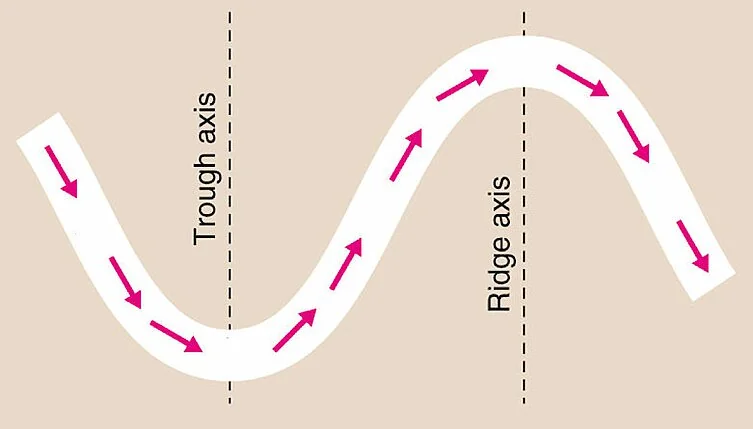
Trough
An elongated region of relatively low atmospheric pressure. They are the dip. A trough forces air to crash together at the surface, which pumps the air upward to create storms.
QNE
The indicated height on landing when 1013.25 hPa is set; it is a height (not a pressure setting) used at high-elevation airfields when QFE/QNH cannot be set