Chapter 16: Managing Human Resources Globally
 Call Kai
 Learn
Learn Practice Test
 Spaced Repetition
 Match
Match Flashcards
 Knowt Play
1/18

There's no tags or description
Looks like no tags are added yet.
Name | Mastery | Learn | Test | Matching | Spaced | Call with Kai |
|---|
No analytics yet
Send a link to your students to track their progress
19 Terms
HRM in a global environment
The environment in which organizations operate is rapidly becoming a global one, entering international markets
Organizations therefore need employees who understand customers and suppliers in other countries, and need to understand local laws and customs and be able to adapt plans to local situations
Employees in an international workforce
Parent country: the country in which the organization’s headquarters is located
Parent-country nationals — from the country where the organization’s headquarters is located
Host country: a country (other than the parent country) in which an organization operates a facility
Host-country nationals — employees who are citizens of the host country
Third country: a country that is neither the parent or host country and may be a source of labor or finances
Third-country nations — employees neither from the parent or host country
Expatriates (expats) — employees assigned to work in another country
Employers in the global marketplace
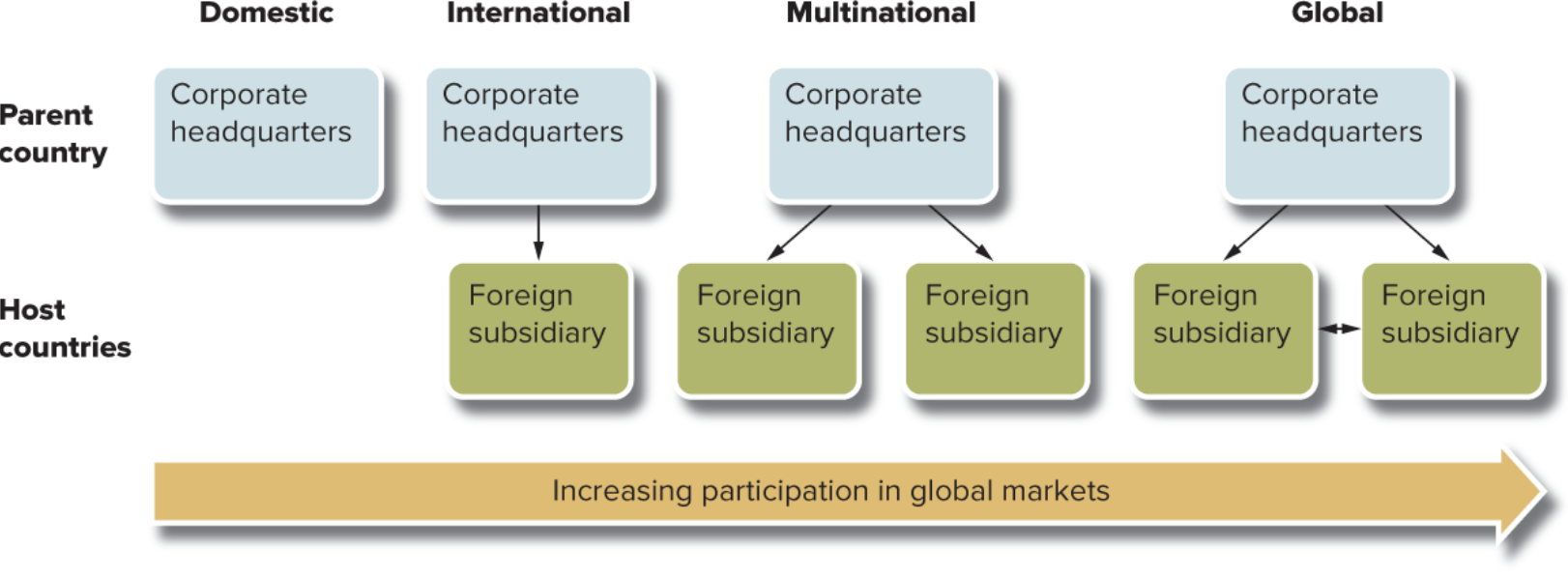
Domestic marketplace — Most organizations begin by serving customers and clients within a domestic marketplace, even so are affected by issues related to the global economy due to immigrant workers
International organization — An organization that sets up one or a few facilities in one or a few foreign countries
Multinational organization — Go overseas on a broader scale and builds facilities in a number of different countries to minimize production and distribution costs
Global organization — Chooses to locate a facility based on the ability to effectively, efficiently, and flexibly produce a product or service, using cultural differences as an advantage (may have multiple headquarters)
Transnational HRM system
HRM system that makes decisions from a global perspective, includes managers from many countries, and is based on ideas contributed by people representing a variety of cultures
Factors affecting HRM in international markets
Organizations operating in more than one country must recognize that the countries differ in many factors:
Culture
Education
Economic systems
Political-legal systems
International HRM factor: Culture
Culture is a community’s set of shared assumptions about how the world works and what ideals are worth striving for
Consists of 6 dimensions:
Individualism/collectivism describes the strength of of the relation between an individual and other individuals in society
Power distance concerns the way the culture deals with unequal distributions of power and what inequality is ‘normal’
Uncertainty avoidance describes how cultures handle the fact that the future is unpredictable—high avoidance prefers structured situations and low avoidance take each day at a time
Masculinity/femininity is the emphasis on masculine qualities (achievements, money-making, competition, assertiveness) vs feminine qualities (relationships, service, care for the weak, environmental conservation)
Long-term/short-term orientation whether cultural values are geared towards the long term or the past and present
Indulgence/restraint is the extent to which a culture controls the desire to pursue enjoyment and fun
International HRM factor: Education
Countries differ in the degree to which their labor markets include people with education and skills of value to employers
International HRM factor: Economic systems
The system may be capitalist or socialist. The government’s involvement in the country’s economy, such as through taxes and price controls, has a strong effect on HRM practices
International HRM factor: Political-legal systems
The political-legal system arises to a large degree from the culture in which it exists, so laws and regulations reflect cultural values
HR planning in a global economy
As organizations consider decisions about their level of international activity, HR professionals should provide information about the relevant human resource issues, such as local market pay rates and labor laws
Decisions about where and how many employees are needed for each international facility
Some countries limit employers’ ability to lay off workers, so organizations would be less likely to staff for peak periods
Other countries allow employers more flexibility in meeting HR needs
Selecting employees in a global labor market
Criteria that should be considered in foreign assignments
Competency in area of expertise
Communication ability
Cross-cultural suitability
Family support
Factors most associated with success in foreign assignments
Comfort of the employee’s spouse and family
Extroverted (outgoing), agreeable (cooperating and tolerant), and conscientious (dependable and achievement oriented)
Emotional stages associated with a foreign assignment
Honeymoon: Initial fascination and euphoria as the employee enjoys the novelty of the new culture
Culture shock: The disillusionment and discomfort that occurs during the process of adjusting to a new culture and its norms, values, and perspectives
Recovery: If employees persist and continue learning about their host country’s culture, they can recover from shock and develop a greater understanding and a social network
Adjustment: Finally, the employee’s language skills and comfort increase and they reach a stage where they accept and enjoy the host country’s culture

Training a global workforce
Training and development programs should be effective for all participating employees, regardless of country of origin (Follow same process as Ch 7)
When choosing training techniques, strategies, and media, organizations need to consider differences among trainees (language, education, culture, etc.)
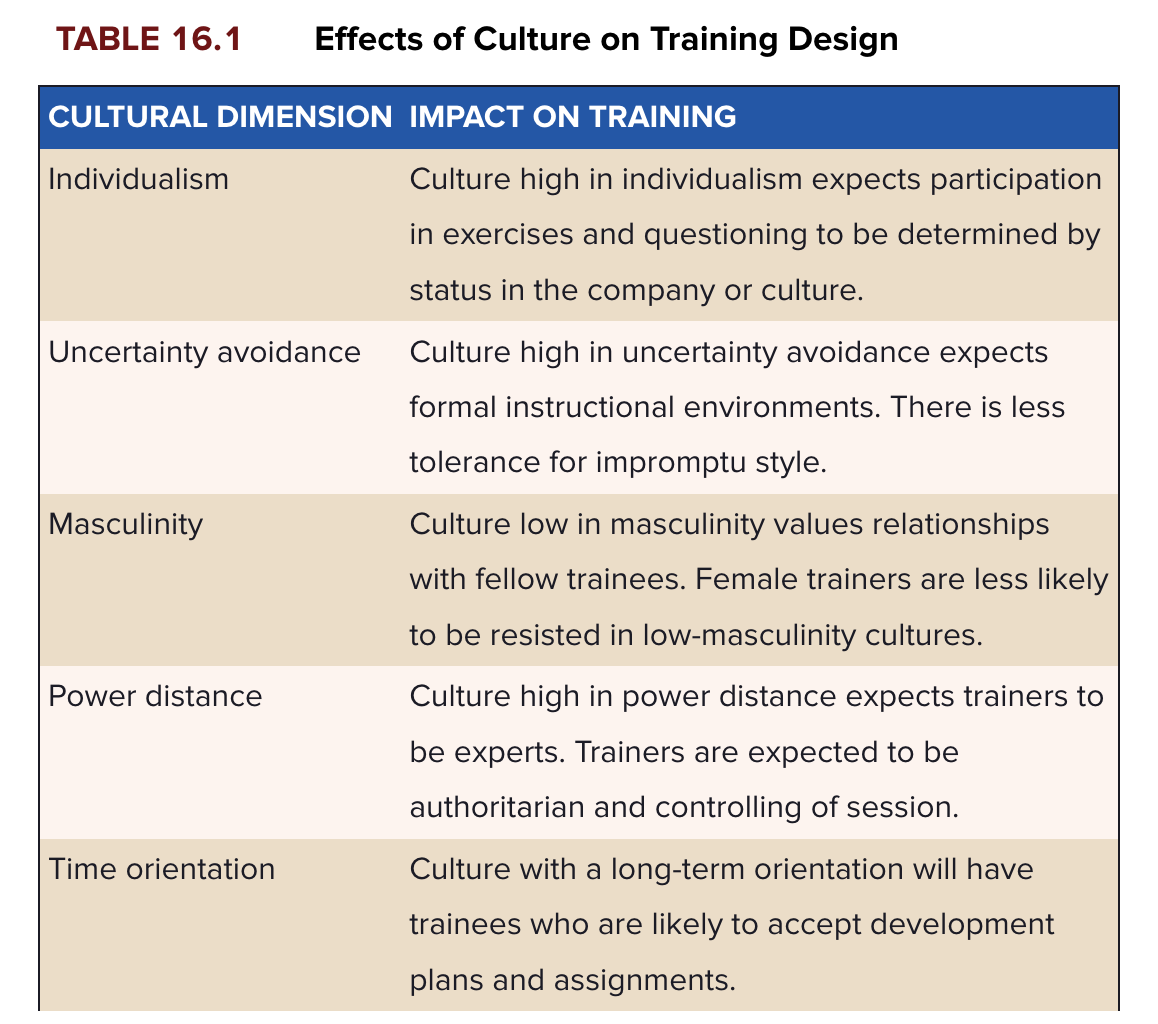
Effects of culture on training design
Individualism: High individualism cultures expect participation in exercises and questioning to be determined by status in the company or culture
Uncertainty avoidance: High uncertainty avoidance expects formal instruction environments with less tolerance for impromptu styles
Masculinity: Low in masculinity values relationships with fellow trainees
Power distance: High in power distance expects trainers to be experts and controlling the session
Time orientation: Long-term oriented cultures will have trainees who are more likely to accept development plans and assignments
Cross-cultural preparation
Training to prepare employees and their family members for an assignment in a foreign country consisting of three phases
Preparation for departure — Language instruction and an orientation to the foreign country’s culture
Assignment — The actual assignment, which is some combination of a formal program and mentoring relationship to provide ongoing further info about the foreign country’s culture
Return home — Providing information about the employee’s community and home-country workplace, and providing future development to aid retention
Performance management across national boundaries
Important to consider legal and cultural differences when managing performance
Scoring behaviors like smiling, making eye contact may not translate to other cultures
In rapidly changing regions, performance plans may update more often
U.S. employees are more used to direct feedback while other countries may expect positive feedback before discussing improvements
Compensating an international workforce
Pay structure issues
Pay at the parent country or host country rate?
Average hourly labor costs in industrialized countries are far higher than newly industrialized countries
Labor costs may be outweighed by other factors, such as transportation costs or access to resources and customers
Cultural and legal differences also affect pay structure
Pay packages for foreign assignments
Base salary
Benefits
Tax equalization
Allowances
Cost of living
Housing
Education
Relocation
Foreign service inducement
Hardship premium
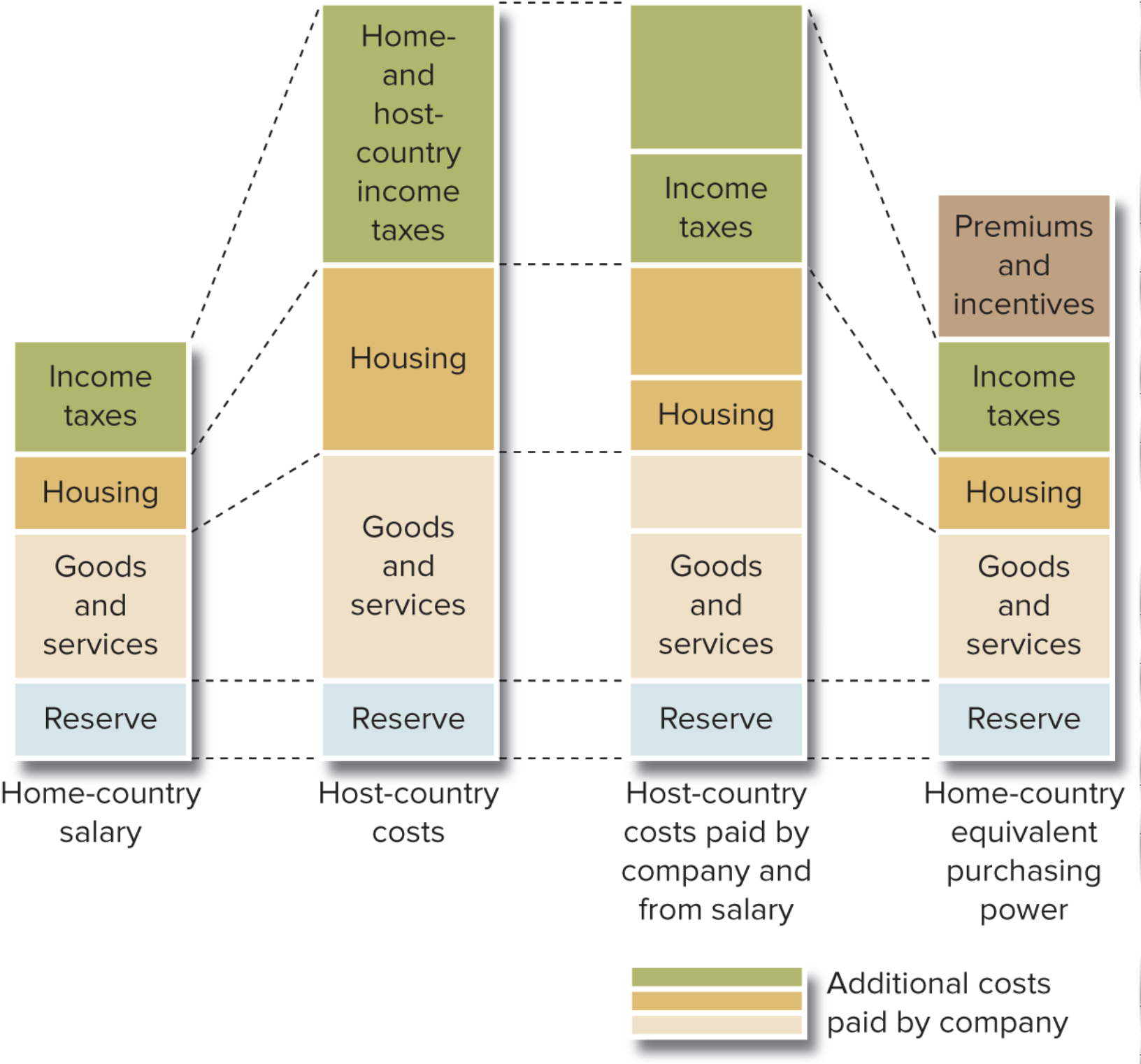
Balance sheet approach
Adjusting the expatriate manager’s compensation so that it gives the manager the same standard of living as in the home country plus extra pay for the inconvenience of locating overseas
Begins with purchasing power of compensation for the equivalent job in the manager’s own country
Then it is compared with the cost of the same expenses in the foreign country
Finally, the expatriate receives additional purchasing power from premiums and incentives
Divides amount into the four components of a total pay package:
Base salary
Tax equalization allowance — companies have different systems for taxing incomes and it varies across countries
Benefits — pension and health care plan differences and acceptance across borders
Allowances to make a foreign assignment more attractive — cost of living allowances make up the differences in expenses for day-to-day needs; housing allowances ensure the expat can maintain the same standard of living; education allowances reimburse expatriates who need to pay tuition for their children to attend English-accommodating schools; relocation allowances cover the expenses of moving to the foreign country
Repatriation
The process of preparing expatriates to return home from a foreign assignment
Possibility of reverse culture shock
Activities that support repatriation:
Communication (throughout assignment)
Validation (recognizing international experience)