PSYCH 355 EXAM 3
 Call Kai
 Learn
Learn Practice Test
 Spaced Repetition
 Match
Match Flashcards
 Knowt Play
1/26

There's no tags or description
Looks like no tags are added yet.
Name | Mastery | Learn | Test | Matching | Spaced | Call with Kai |
|---|
No analytics yet
Send a link to your students to track their progress
27 Terms
response interference paradigms
reaction times increase when paired with distracting or conflicting information, which prompts a conflicting or incorrect response.
flanker task
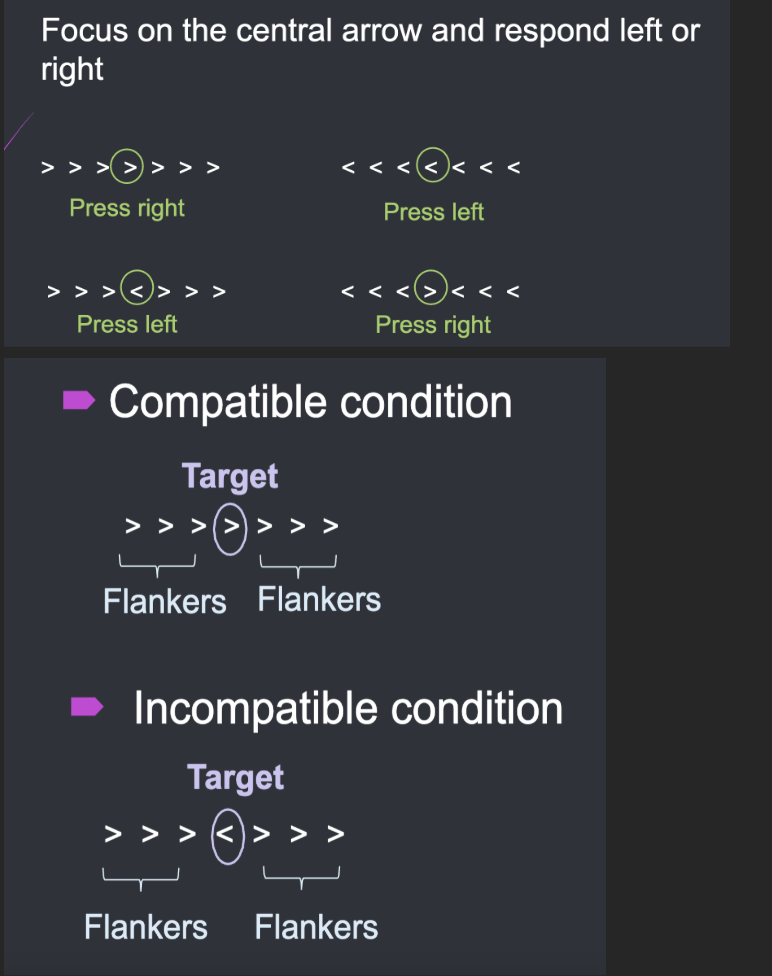
Had to focus on the circled arrow, and respond by pressing either left or right.
circled arrow is the target, everything else is flanker.
When compatible, flanker arrow helps, but when incompatible, slows down reaction time
flanker effect
incompatible rt-compatible rt for a given condition
types of flanker tasks
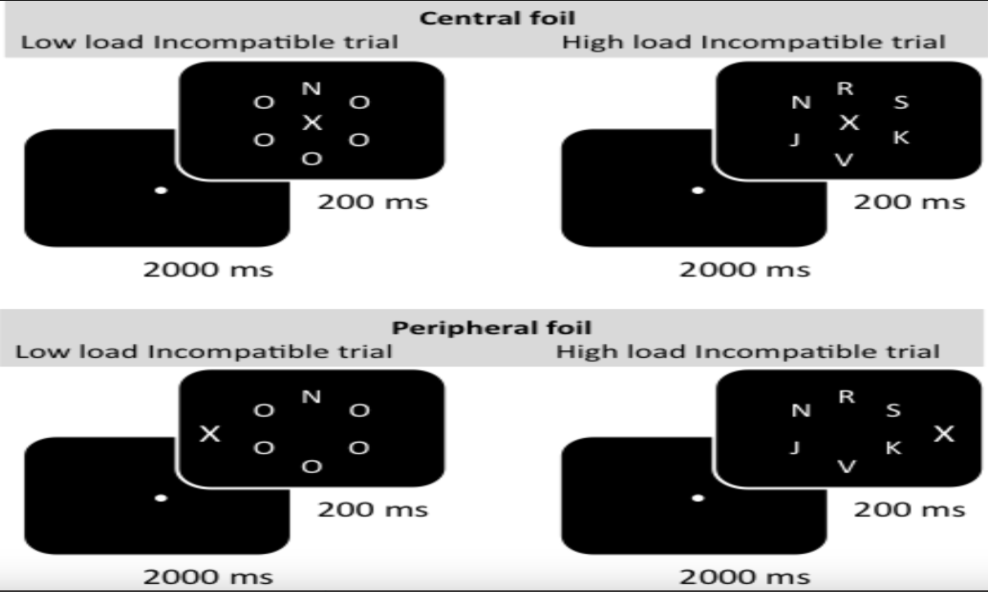
Central foil interferes more with performance than peripheral foils.
Flanker effect central foils > flanker effect for peripheral foils.
Interference: foil will interfere more with performance under low than high low condition
Flanker effect low road>flanker effect high road.
You need to suppress the response for something right in the middle.
load theory
generalized flanker task findings to real life to reduce distractions in real life. Proposed we need to work in crowded/cluttered environments, because high incompatible trial had least interference.
HOWEVER foils in flanker task are part of the same attentional set (letters)
If were circles or squares, would have less of an effect on performance.
Inattentional Blindness Paradigm
Buetti, Lleras, Moore.
. Had to complete hard task in the center of the screen, and briefly answer if A or an E was presented.
When unexpected stimulus was a letter, 80% noticed.
When square, only 40% different (inattentional blindness)
stroop task
Step 1: Reading the words in black and white ink, and timing performance
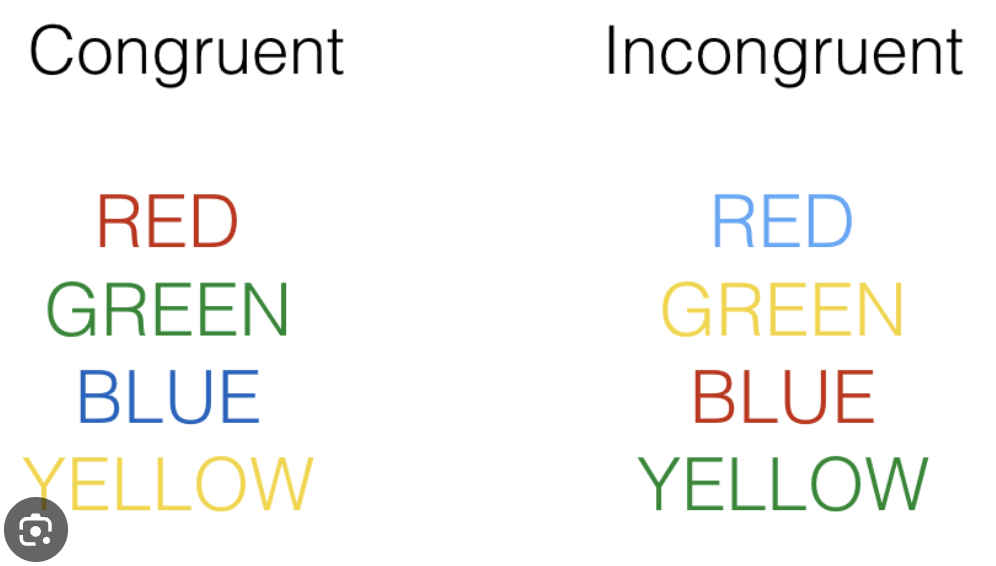
Step 2: Congruent ink color reading: Name the INK COLOR not the words, and time performance
Step 3: Incongruent color reading: Name the COLOR of the words, IGNORE INK, and time performance
Explanation: Word processing is faster than color processing. Naming colors is less automatic, requiring more time and attention
Congruent condition is faster than incongruent.
Mismatch between ink color and word causes interference
Effect can be reduced in populations who aren’t familiar with the language the task is in.
stimulus response compatibility
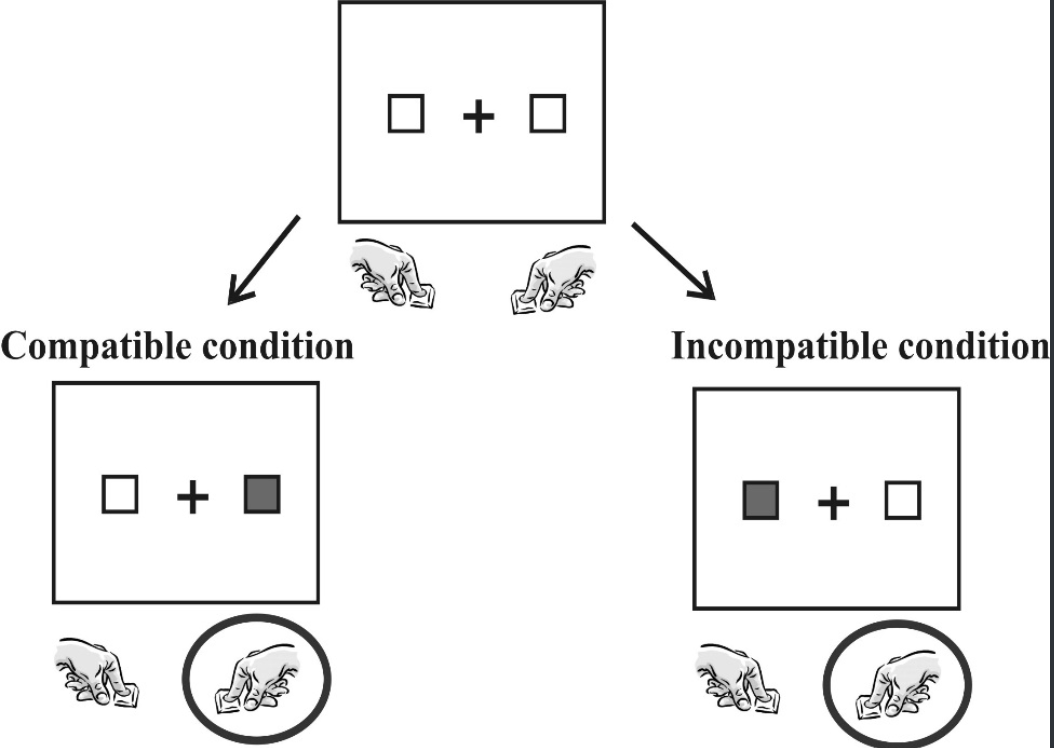
Stimulus is presented on either left or right side, and requires either left or right key to be pressed
Compatible condition: Reponds to the same location of stiulus
Incompatible condition: Opposite side of where stimulus response is.
SRC effect
Slow down is observed when stimulus appears at location incompatible with response.
Incompatible RT – compatible RT = SRC effect
simon task
In classic SRC paradigms, the stimulus varys only along one task-relevant dimension (location) but in the Simon Task various along both relevant (color) and irrelevant (location) dimensions
simon effect
The position of the stimulus is automatically processed, even if not relevant to the response. Slow down is observed when relevant and irrelevant dimensions activate different responses. Robust and shown with different types of stimuli
Rt non-correspond – RT corresponding
Corresponding trials: the stimulus and response locations correspond
Non-corresponding trials: the stimulus and response locations do not correspond
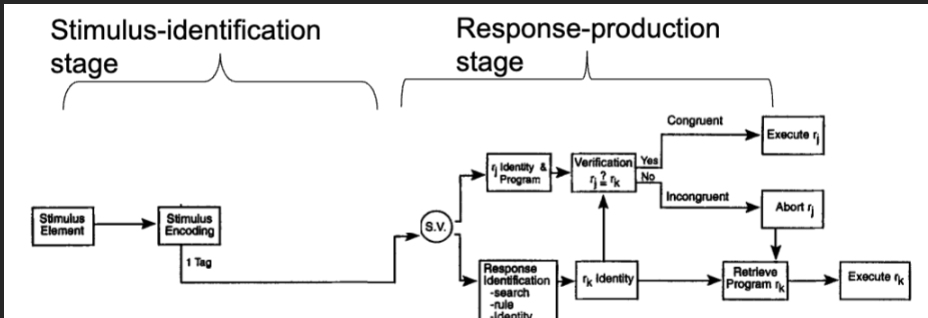
Kornblums dimensional overlap model
reaction times and accuracy depend on the similarity (overlap) between stimulus and response sets. Contains stimulus-identification response and response production stage.
simon effect ERP studies
Confirmed the existence of automatic and controlled routes. Typically, there is an early response associated with stimulus location, and a later response reflecting instructed response
additional findings for simon effect
Same effects when stimuli are presented within one hemifield: the stimulus locations are coded one relative to the other.
Same effects when two fingers of the same hand are used: the two effectors were also coded one with respect to the other.
Same effects with crossed hands: effect depends on the relative location of the responses, not on the anatomical identity of the effectors.
simon effect and context
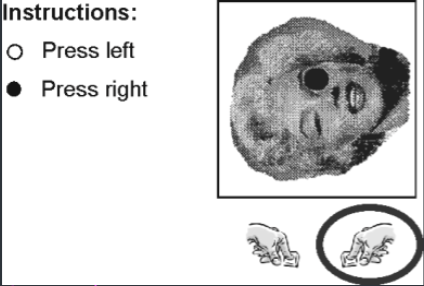
• A black or white dot was presented on the left or right eye of a human face rotated by 90.
• Participants were instructed to press the left key when the white dot was presented and the right key for a black dot.
• The circle indicates the correct response.
Results:
Participants coded the dots as left and right (e.g., press right was faster when
the black dot was on the right eye than on the left eye).
Participants used the visual context as reference frame (i.e., the face in a natural position)
mind wandering
Common everyday experience.
Our attention disengages from the external environment and focuses on internal trains of thoughts.
There is a continuous oscillation between outward attention and inward attention.
mind wandering in the lab
• Participants engage in a task that does not require all their attentional resources
• While they complete the task, participants respond to probes asking whether they were mind-wandering.
• If the answer is YES, then other questions might be asked (e.g., content of thoughts, rating of how interesting/useful the thoughts are, rate mood, etc.)
effects of mind-wandering on reading
Poor comprehension
Superficial perceptual encoding of written material
Reduced variability in speech porosdy when reading out loud
mind wandering and sustained attention
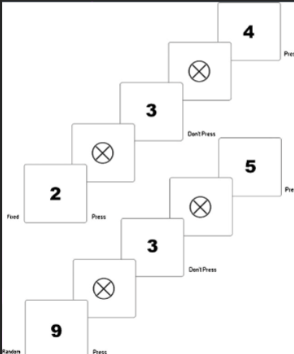
Sustained Attention to Response Task: go/no-go vigilance task
Participants don’t respond when expected and respond when not expected.
More variability in responses compared to when participants are focused on task.
mind wandering on mood and effect
M-W associated with negative changes in mood and affect.
Inducing negative mood increases M-W
In an experiment where they used cell- phones to administer probes to theparticipants, Killingsworth and Gilbert (2010) found that
When M-W, people report being less happy.
M-W plays an important role in happiness ratings: M-W precedes the negative mood
effects of mind wandering on working memory
M-W during testing is associated with lower working memory (WM) capacity scores and general fluid intelligence.
M-W is a predictor, not a consequence
We don’t mind wander because the task is too difficult for us, and we fail to remain engaged in the task.
mindfulness meditation
involves bringing one's attention to the present moment and observing one's thoughts, feelings, and bodily sensations without judgment.
Disrupts effects of MW on task performance
Negative correlations between dispositional mindfulness and 4 measures of mind-wandering.
studying mindfulness
1. Mindful-breathing condition (8 minutes): focus attention on the sensations of their breath. Breath freely. Return attention to the breath when distracted.
2. Reading condition: browse newspaper
3. Passive rest condition: just relax but don’t fall asleep!
Then completed Sustained Attention to Response Task (SART)
Results: Group 1 made fewer errors that are markers of inattention and are typically caused by wandering.
mindfulness on attentional control
Method: 20 novice meditators participating in a 10- day intensive Mindfulness meditation retreat
Measures taken at Time 1 (before retreat) and Time 2 (7-10 days after retreat)
Mindfulness (MAAS), rumination (RRS), affect (BDI, BAI, PANAS), WMC (backward digit span), sustained attention and attention switching (Internal Switching task).
Results: In sustained attention, the control group did not significantly improve between T1 and T2, but mindfulness training group did.
mindfulness training in adolescents with ADHD
The training was based on a mindfulness program for children with ADHD and other programs.
Adolescents were trained on enhancing attention, and awareness while doing homework assignments
Parents were trained about being present in a non-judgemental way.
Measures: Behavioral symptoms, executive functioning
Results: After training, behavioral symptoms were reduced, and executive functioning improved.
benefits of mind-wandering
planning and creativity, positive mood and affect, reduces boredom