37. MANDIBULAR FRACTURES. ORTHOPAEDIC TREATMENT
 Call Kai
 Learn
Learn Practice Test
 Spaced Repetition
 Match
Match Flashcards
 Knowt Play
1/21

There's no tags or description
Looks like no tags are added yet.
Name | Mastery | Learn | Test | Matching | Spaced | Call with Kai |
|---|
No analytics yet
Send a link to your students to track their progress
22 Terms
what is closed reduction and what are the 2 types?
= reduction of the fragments without surgical exposure
- manual.= directly reducing fragment
- elastic traction = gradually reducing over time via elastics (useful for more displaced + mobile fragments)
what are the indications of closed reduction?
recent fracture
mobile fragments
minimal displacement
what are the indications of open reduction?
- failed closed reduction
- when closed reduction is contraindicated (surgical tx needed e.g.
cyst in fracture line
osteomyelitis
edentulous/ severe malocclusion {no teeth/occlusion for fixation})
- old, immobile fracture
what are the indications for orthopaedic treatment of mandibular fractures?
stable teeth
minimal/no displacement
mobile fragments
fracture in which closed reduction is indicated
what are the contraindications for orthopaedic treatment of mandibular fractures?
- old fractures
- significant dislocation between fragments
- grade 3 mobility of teeth (advanced periodontitis)
what are the most common orthopaedic methods for mandibular fractures?
Dental ligatures
Arch bars
Splints
what are the types of orthodontic splints?
According to Material:
Aluminum
Steel
Acrylic
Reinforced acrylic
According to Support
Tooth-borne
Attached to teeth.
Ridge-borne
Attached to edentulous alveolar ridges.
IMF Splints
Contain hooks that receive elastics for IMF.
what are types of temporary immobilisation methods used in the dental office?
Gilmer's Ligature: temporary wire fixation.
Ivy Loop: Loop wiring for IMF.
Ernst Wiring: Emergency stabilization technique.
when can splints be used?
when there are enough stable teeth
when there is minimal dislocation
when we can use inter maxillary fixation
when there are maxillary and mandibular teeth which are stable
what are the types of custom splints we can use?
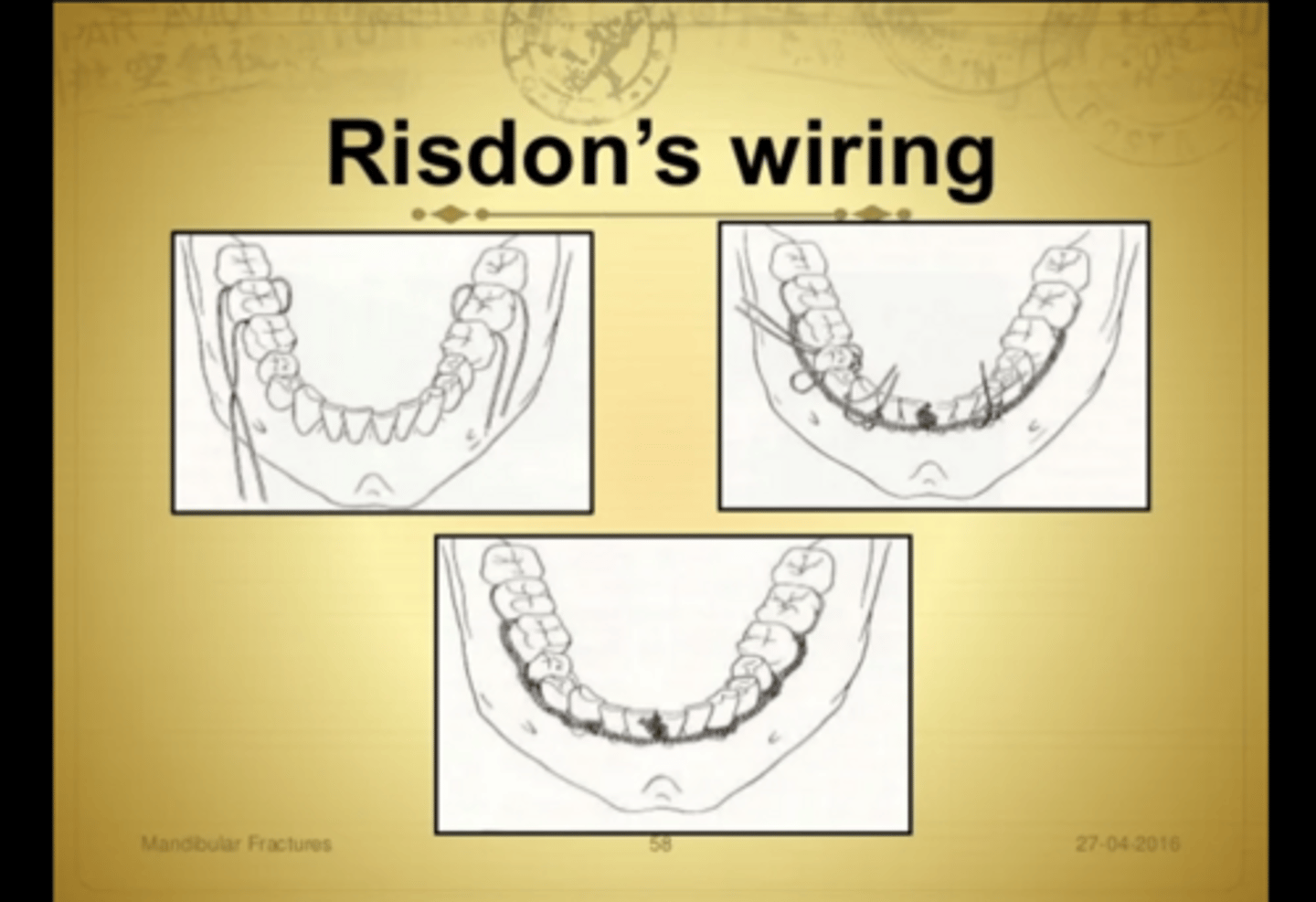
1. risdon's wiring
2. chavdarov's wiring
3. roy-stout wiring
4. baronov's wiring
5. atanasov's wiring
how is Risdon's wiring splint made?
0.4mm thick, 25cm long wire (2 wires)
- 2 wires twisted around distal molars on each side
- ends of each wire twisted buccally
- both wires connected at midline = buccal base wire
tie the ligatures in the cervical region of each tooth to anchor each tooth to buccal base
- hooks at lengths of 6-8mm can be placed for IMF
how is Chavdrov's wiring splint made?
0.4mm thick, 45-50cm long wire (1 wire)
modified risdon technique in which 1 wire is used instead of 2 (simpler)
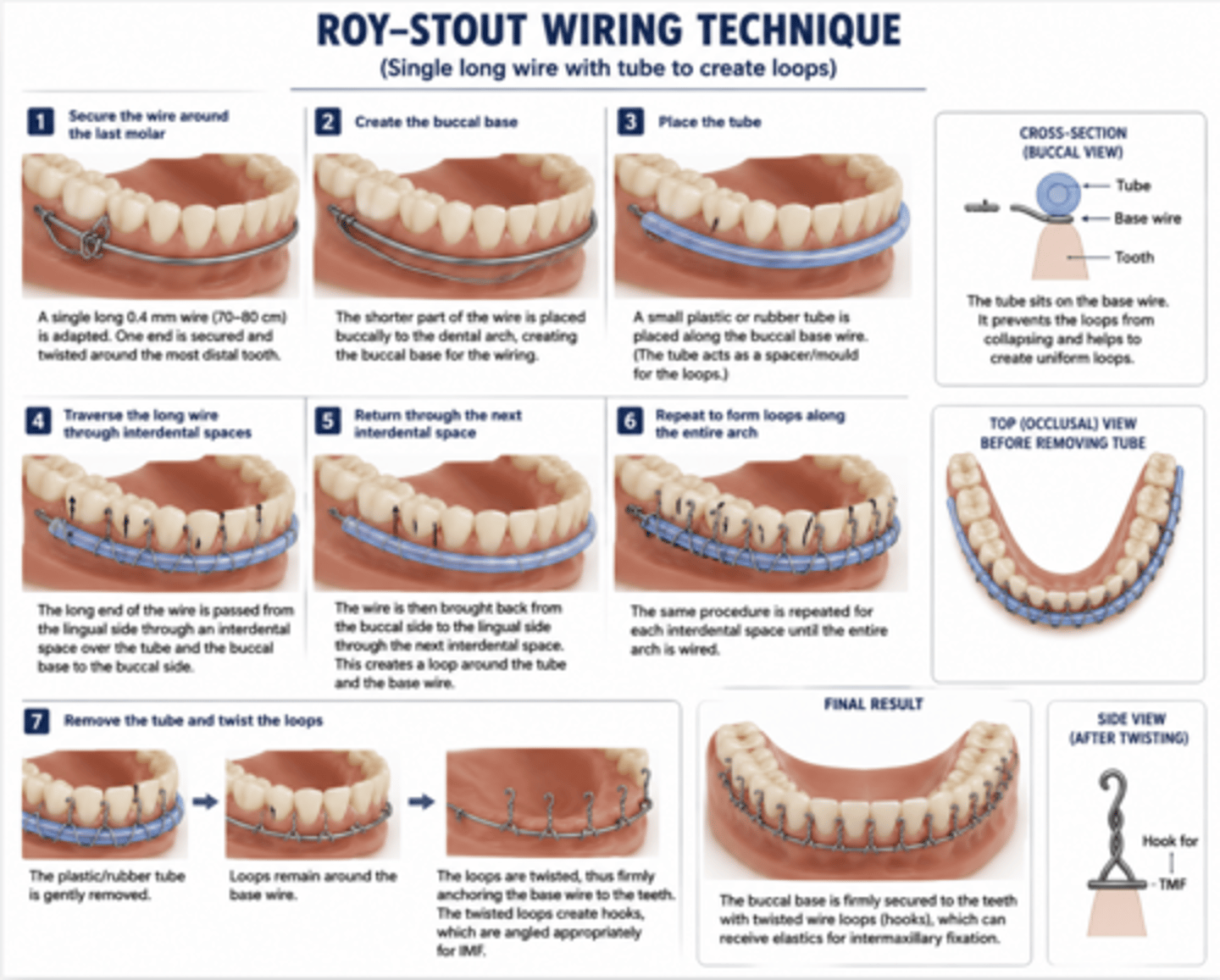
how is Roy Stout wiring splint made?
0.4mm thick, 70-80cm long wire
- loop wire around most distal mandibular tooth
- short part of wire used to form buccal base
- place a small rubber tube along the base
- he long part of the wire is passed lingually to bucally through the interdental spaces
- bring the wire back from the lingual side and make loops
- remove the rubber tube and twist the loops to anchor the wire to the teeth
- twisted loops form rigid hooks - can be used for IMF
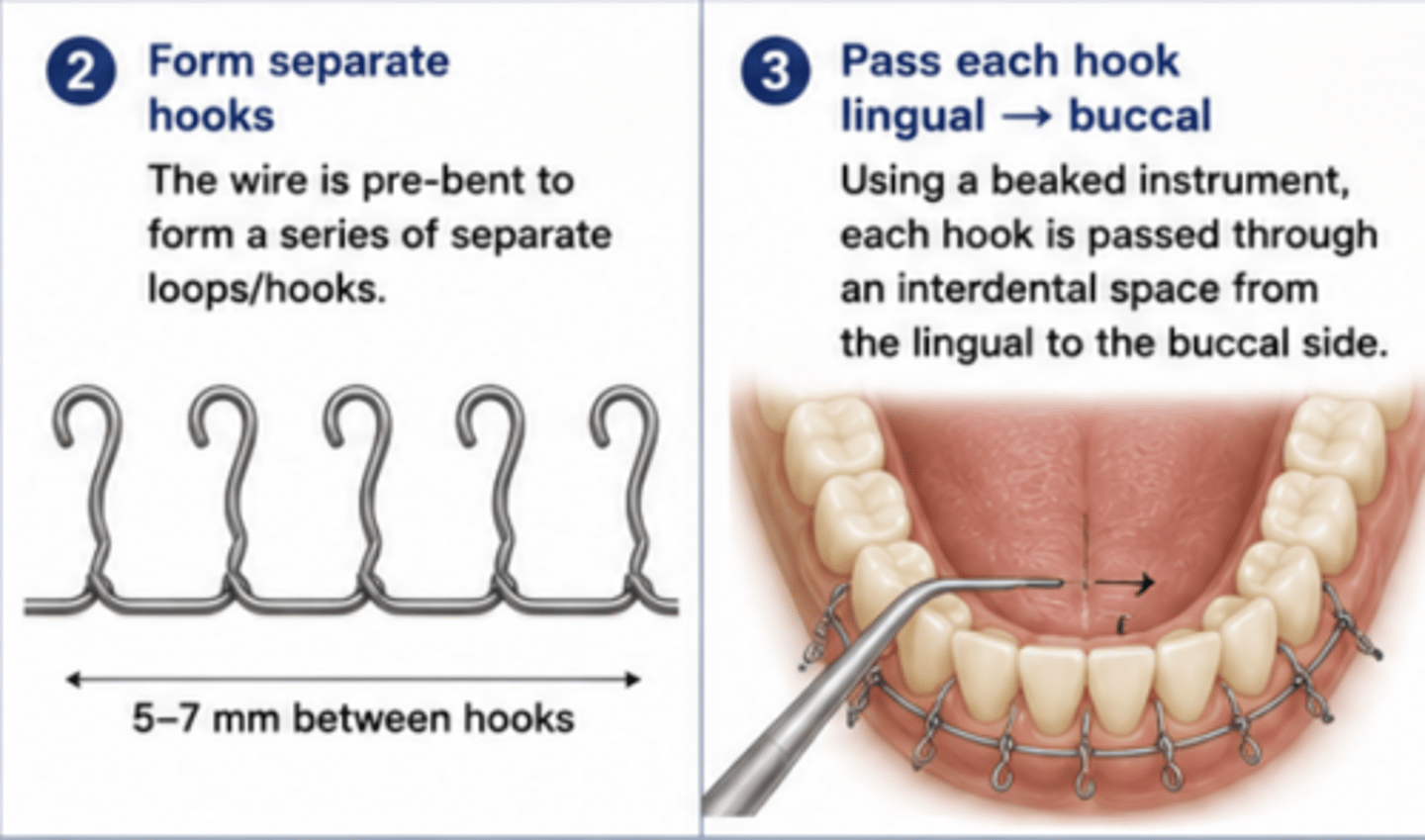
how is Baranov's wiring splint made?
0.4mm thick, 70-80cm long wire
- form separate loops and hooks, drive them between the teeth from lingual to buccal direction
- adjacent hooks are twisted together in pairs on the buccal side
- The enlarged hooks serve as attachment points for:
elastics
ligature wires
to achieve intermaxillary fixation (IMF).
why might baranovs wiring be preferred over roy-stout wiring?
better oral hygiene
less plaque accumulation (dt no horizontal buccal base wire)
how is Atanasov's wiring splint made?
create 12-14 loops of wire 8-10mm apart
smooth part of the wire should be left to curve around the last molar
loops insert interdentally and tightened
smooth part of the wire passes through all the loops creating a continuous buccal base
can be reduced to 3-4 loops for improved hygiene
what are the standard dental splints?
these are commercially available arch bars
give an example of a standard dental splint
Dimac Ligature
- 0.5mm thick, 5-6cm long
- wire has threaded end + plastic head (hexagonal shape)
- threaded end past through interdental spaces
- plastic head tightened with special wrench
- elastics are attached to these plastic anchor points
what are the advantages of the Dimac ligature?
easy to fit
good for oral hygiene
what are the disadvantages of the Dimac ligature?
only suitable for fractures with minimal fragmentation
schuchardt's splint (laboratory-made splint)
- consists of a buccal base and perpendicular seats
- buccal ends form IMF
- occlusal ends remain on teeth and are removed after ligation
- self-curing acrylic is used to fixate splint to teeth
gunning-port-limberg splint (laboratory-made splint)
- maxillary and mandibular splints fabricated after impression of edentulous jaws
- joined together via self-curing acrylic
- anchored to jaws via special screws + grooves