clinical psychology and mental health
 Call Kai
 Learn
Learn Practice Test
 Spaced Repetition
 Match
Match Flashcards
 Knowt Play
1/95

There's no tags or description
Looks like no tags are added yet.
Name | Mastery | Learn | Test | Matching | Spaced | Call with Kai |
|---|
No analytics yet
Send a link to your students to track their progress
96 Terms
deviations
ideal mental health
social/ cultural norms
failure to function adequately and statistical infrequency
• The behavioural approach to explaining and treating phobias:
the two-process model, including classical and operant conditioning; systematic desensitisation, including relaxation and use of hierarchy; flooding.
The cognitive approach to explaining and treating depression:
Beck’s negative triad and Ellis’s ABC model; cognitive behaviour therapy (CBT), including challenging irrational thoughts.
• The biological approach to explaining and treating OCD:
genetic and neural explanations; drug therapy.
statistical infrequency
deviation from statistical norms
2 standard deviations f the mean population would be within normal
those either end of bell curve are considered abnormal
evaluation of statistical infrequency criticisms rare and desirables
High IQ
IQ scores over 13- are just as unusual as those below 7o, but we wouldn't think of super-intelligence as an undesirable characteristics that needs treatment. Just because very few people display certain behaviour does make the behaviour statistically
evaluation of statistical infrequency criticisms frequent behaviours may be seen as abnormal or undesirable
anxiety
depression
phobias
evaluation of statistical infrequency positives, real life application
All assessment of paitients requires an evaluation of how severe their symptoms are compared to the statistical norms. Statistical deviation is a useful part of critical assessment
evaluation of statistical infrequency criticisms temporal validity
behaviour that was statistically rare years ago may not be rare now. some statistical norms may be outdated
being born out of wedlock or homosexuality.
deviation from social/ cultural norms criticisms (supresses individuality and therefore social control)
Behaviours that challenge social norms may be labelled as abnormal
This risks labelling non-conformists or minorities as mentally ill
For example, political dissidents or people with alternative lifestyles may be unfairly judged
deviation from social/ cultural norms criticisms (social context, culture and time in which behaviour occurs
What is considered abnormal varies depending on the situation
For example, shouting may be unacceptable in a classroom but acceptable at a football match
This reduces the reliability of the definition
abnormality is culturally relative
Social norms differ between cultures
Behaviour seen as abnormal in one culture may be normal in another
For example, eye contact norms differ across cultures
This makes the definition ethnocentric
norms change over time
Behaviours considered abnormal in the past may be normal today
For example, homosexuality was once classed as a mental disorder
This shows that the definition lacks temporal validity
strength of deviation from social norms
clarity in most instances if you have lived within a culture for a long time, you will be aware of what is, and what is not acceptable
helps society: adhering to social norms means that society is ordered and predictable. this is argued to be advantages
cultural relativisim
Cultural relativism is the idea that behaviour should be judged according to the norms and values of the culture in which it occurs, rather than against a single universal standard.
What is considered abnormal depends on cultural norms
Diagnosing abnormality using one culture’s standards may be unfair
This can lead to misdiagnosis of individuals from different cultural backgrounds
failure to function adequately strength
It recognises the subjective experiences of the patient, perhaps the most humane method of defining abnormality as it comes from the patients perspective
failure to function adequately limitation
Subjectivity & Lack of Objectivity:
What constitutes "adequate functioning" varies, making it hard to set clear cut-offs and prone to individual biases or interpretations by clinicians or observers.
Cultural Bias:
Behaviours considered abnormal in one culture might be normal in another, leading to cultural disparities in diagnosis.
Eccentricity vs. Abnormality:
Highly eccentric but harmless behaviours (e.g., unique lifestyles) might be labelled abnormal, while some abnormal conditions don't impair daily functioning.
Distinguishing Normal Distress from Disorder:
Severe distress (like during bereavement) or temporary dysfunction doesn't automatically mean mental illness; it's hard to know when it crosses the line into abnormality.
Whose Perspective Matters?:
A person might function well enough for themselves but cause distress to others (e.g., an aggressive person), or vice versa, creating disagreement on what's problematic.
Hiding Dysfunction:
Some individuals can mask inner distress and maintain outward functioning, making the definition miss internal suffering.
deviation from ideal mental health strength
It is a comprehensive definition- covers a range of criteria and most of the reasons why someone would seek help.
The ideal mental health provides a checklist which can be used to assess ourselves and others with a range of professionals. For instance, psychiatrists may focus on the physical symptoms whereas humanistic counsellors may be interested in self-actualisation.
deviation from ideal mental health
- Unrealistically high criteria we would all be abnormal if we measured ourselves against these unrealistically high criteria.
The definition like the others is culturally relative. Self-actualisation is perhaps desirable in individualist cultures, where independence is encouraged, however it is not relevant to collectivist cultures, where people work for the good of the community.
specific phobias
a fear of a specific thing or item
social phobia
fear of humilitation in public places
using public toilets, etc
blushing, trembling hands, quavering voice, think badly of them.
avoidance of some social activities and situations
agoraphobia
fear of public places
series of panic attacks
impending doom and fears dying, going mad, or losing control
fear safety rather than embarrasement
two process model
abnormla behaviour is learned in exactly the same way as normal behaviour through classical and operant conditioning
HOBART MOWRER
classical conditioning; initiation
phobia is acquired thorough association.
association of which we initially had no fear (NS) with something that already triggers a fear response (UCS)
case of the little albert study
nine month old
normal an dhealthy from birth
NS (rat) baby no fear
hammer (Unconitioned stimulus) and fear (unconditioned response)
rat (NS) + hammer striking metal (US) = UR fear
rat conditioned stimulus = fear conditioned response
operant conditioning
phobias are longer lasting so this must be a result of operant conditioning
negative reinforcement the individual avoids a situtation which is unpleasant which might produce fear and anxiety,. this behaviour results in desirable consequence so the behaviour will be repeated
ngegative of behavioural approach biologically preparedness
P: The Two factor theory does not account for evolutionary factors. In the past, we became fearful of things that were perceived dangerous/life threatening e.g. snakes, heights and the dark.
Seligman (1971) called this ‘biological preparedness’ which is about how humans have a genetically based tendency to responds quickly to danger, often without thinking.
E: Ohman et al (1975) offers supporting evidence for biological preparedness as he tested a group of participants that were conditioned to fear snakes and spiders by pairing slides of them with an electric shock and he conditioned a second group to fear houses and flowers, he found that the first group retained their fear of snakes and spiders for much longer.
E: This supports the preparedness theory as its difficult to see how fear of flowers would help the survival of a species. Excellent, well done for linking back to the theory here. However this study has low ecological validity. Explain why specifically in this study.
L: Therefore, there is more to acquiring a phobia that classical conditioning and this suggests that there is a biological cause to phobias.
Empirical support can be found in the Watson and Rayner study.behvaioural approach
P: Support for the behavioural approach to explaining phobias comes from the Watson and Rayner (1920) study.
E: Watson and Reyner attempted to condition a baby boy called little albert to develop a phobia of white rats. For several weeks, Albert happily played with a white rat, showing no fear, one day, while he was playing with the rat, the experimenters struck a steel bar with a hammer close to Alberts head. Albert was very frightened by the noise. ALlbert then developed and intense fear of white rats whether the steel bar was hit in the presence of the rat, or not.
E: This experiment shows that phobias are acquired through classical conditioning. We can see that the unconditioned stimulus( loud bang) produced the unconditioned response(fear). The neutral stimulus(white rat) then becomes associated with the unconditioned stimulus( the loud noise) which produces the conditioned response(fear). as soon as he was shown the rat ' he began to crawl away so rapidly that he was caught with difficulty before he reached the end of the mattress."
L: This suggests that little albert was conditioned to have a fear of white rats through classical conditioning and through repetition.
evaluation of little albert
Evaluation of study:
Ethics-is not ethical to induce fear/a phobia in a person, especially a baby who has little concept of what is going on. No time after the experiment to desensitise little Albert as he went in to hospital after the study. POP- not left in the same physical and psychological state as when entered the laboratory.
Sample- limited to one case study of only one boy so cannot generalise. Ethnocentric and androcentric and restricted to one age. Cannot be generalised to other phobias and people. Individual differences- unique as he was unafraid of rats, burning newspaper- unemotional. He was ‘stolid and unemotional’ which might have meant that it was harder to evoke a fear in him. Lacks population validity as cannot be generalised to participants outside of the sample.
Diathesis-stress model/individual differences negative for behavioural approach
P: According to the two-step process model of phobias, an association between a neutral stimulus and a fearful experience will result in a phobia. However, Di Nardo et al found that not everyone who is bitten by a dog develops a phobia of dogs
E: DI NArdo studied a sample of patients presenting with anxiety disorders. He investigated if people with high diathesis explain what this means? developed phobias following a specific stressor what did Di Nardo find? Research by Di nardo has found, for example, that’s not everyone who is bitten by a dog develops a phobia of dogs
E: this could be explained by the diathesis stress model, which proposes that we inherit a genetic vulnerability for developing mental disorders, however a disorder will only manifest itself if triggered by a life event, such as being bitten by a dog. So the dog bite would lead to a phobia in only those with such vulnerability.
L: therefore the diathesis-stress model acts as a comprehensive interactionist framework that recognises individual differences by combining nature and nurture to explain why some people are more susceptible to illness than others.
Has led to some very successful therapies. For example, systematic desensitisation. positive for behavioural approach
P: a strength of the two process model is its real world application in exposure therapies (such as systematic desensitisation)
E: the distinctive element of the two process model is the idea that phobias are maintained by avoidance of the phobic stimulus. This is important in explaining why people with phobias benefit form being exposed to the phobic stimulus. Once the avoidance behaviour is prevented, it ceases to be reinforced by the experience of anxiety reduction and avoidance and therefore declines. Explain briefly how systemtic desensitisation could be used to treat a phobia. By pairing the feared stimulus with relaxation techniques and putting a client with a phobia and a therapists and forcing them to confront it and exposure therapy
E: In behavioural terms the phobia is the avoidance behaviour so when this avoidance is prevented the phobia is cured. This shows the value of the two-step process approach because it identifies a means of successfully treating phobias
L: Therefore, the two process model explanation of phobias has useful real-world applications.
What constitutes OCD
Characterised either by obsessive thought, compulsive behaviours or both.
behavioural characteristics of OCD
Include compulsions to repeat behaviours, usually to reduce anxiety, and avoidance of situations.
Compulsions:
|
Avoidance: They attempt to avoid situation that cause them anxiety .
|
emotional characteristics of OCD
Main characteristic is anxiety, often accompanied by depression and guilt.
Anxiety and distress:
|
Accompanying depression:
|
Guilt and disgust:
|
cognitive characteristics of OCD
Recurrent obsessive thoughts, accompanied by rituals to cope with the obsession, and insight into excessive anxiety.
Obsessive thoughts: - thoughts that recure over and over again, these vary from person to person but are always unpleasant. e.g. If a door is unlocked an intruder may enter through it. |
Insight into Excessive anxiety:
|
OCD Disruption to day to day life
As people with OCD repeat compulsions it can take up a lot of time of the day and they may avoid certain situation that tigger OCD which means that they may not be able to go to work, see friends or family, eat out, go outside. These obsessive though can make it hard to concentrate and lead to exhaustion.
impact on relationships
May feel the need to hide the OCD
Have anxiety and doubt from OCD may affect relationship and may make it too difficult to continue.
They may even struggle to move on from arguments and problems
People with OCD may also feel ashamed or lonely
This may be because the obsessive thoughts or worries may make them feel ashamed or feel like a bad person and they may feel the need to hide this part from other people and find it hard to be around people or go outside. Leading to feeling isolated and lonely.
Impact on their self esteem
Guilt about thoughts or feelings
May do or say things you regret when struggling with OCD and it may stop you from achieving things you want to do.
Feeling anxious
Obsessions and compulsions are making you feel anxious ad stressed. E.g. people feel that they have to carry out their compulsion so often that they have little control over them
symptoms of OCD
intrusive thoughts- when an unwanted thought pops into your mind
RITUALS
checking
reassurance (asking others to say you ok)
rumination (thinking about the same thing again and again)
avoidance
contamination (OCD DEEP CLEANERS)
flooding
Flooding involves exposing the patient to the phobic stimulus in a safe and controlled environment.
strengths of flooding cost effective
J It is cost effective.
One strength of flooding is that it is cost effective. Clinical effectiveness= how effective the therapy is at tacking symptoms.
strengths of flooding highly effective for specific phobias and quicker
Highly effective for specific phobias and quicker than alternatives. Therefore, it is a cheaper treatment as it can be performed in 1-4 hours. This has cost effective for the NHS. It can work in one session rather than 10 sessions like Systematic desensitisation. Therefore, more people can access the treatment. However, it may not be the cheapest option if the patient cannot tolerate the treatment
flooding weaknesses less effective for social phobias
Less effective for social phobias. This is because social phobias normally have a cognitive element, which leads to irrational thoughts about the situation, which are not tackled with flooding treatment. Therefore, the most effective treatment would be Cognitive Behavioural Therapy (CBT).
flooding weaknesses treatment is unethical
One limitation of flooding is that it is an unpleasant experience. Participants will consent but may not be able to complete the treatment, due to the distressing nature of facing the phobic situation/ stimulus. Therefore the participants kay be psychologically harmed, and may drop out (subject attrition). Systematic desensitisation (SD) is more ethical and participants are more likely to participate to the end. There are financial and time implications for someone who does not see the treatment through, which makes the treatment less effective. The treatment is costly to the NHS and therefore if people drop out that has economic implications.
how does flooding work
The phobic stimulus will create extreme anxiety (which will inevitable decrease over time) in the patient which will lead to exhaustion.
The patient confronts their phobia and realises that it is not harmful.
The patient creates a new association between the phobic stimulus and the response (no anxiety).
In classical conditioning terms the process is called extinction.
A learned response is extinguished when the conditioned stimulus (spider) is experienced without the unconditioned response (crawling in your ear). The conditioned stimulus (spider) will no longer produce the conditioned response (fear).
The phobia is no longer negatively reinforced (via operant conditioning) as the patient cannot avoid the phobia
Reductionism
reducing complex behaviours to simple components In order to scientifically test the contribution of that components
Opposite of reductionism is holism
Determinism
the position that behaviours are governed by internal factors. E.g. genes or external influences such as stimulus response bonds.
biological explanations for OCD
While, we still do not know the exact cause or causes of OCD, research suggests that differences in the brain and genes of those affected may play a role.
genetic explanations of OCD
Nestadt - firs degree relatives with OD had a five times greater risk of having the illness themselves at some time in their life, compared to the general population
Its inherited through our parents.
There may be a genetic influence in OCD, because parents pass on genes to their offspring.
However, children also share the same environment as their parents, and therefore it could be that OCD is learnt
twin studies and OCD
the findings suggest that there is a strong genetic influence in OCD. As the MZ twins are 100% genetically similar, we would expect a high concordance rate between them if OCD was genetically inherited. We would expect this concordance rate to be greater than that of the DZ twins which is what the evidence shows, as DZ twins are 50% genetically similar
However as the concordance rate for MZ twins is not 100%, we cannot claim that OCD is entirely genetic. There must be an environmental interaction which accounts for this.
Furthermore the very nature of identical twins looking the same means that their shared environment is also very similar and more similar than that of non-identical twins therefore we cannot claim that the high concordance rate of 68% is due to genetic influence there may be a stronger environmental influence.
0 concordance rate for OCD was 68% in identical twins compared to just concordance rate in non-identical twins
candidate genes
These are individual genes that create vulnerability for OCD.
SERT gene (5HT1-D) – is involved in regulating the development of the serotonin system and the transport of serotonin.
Mutation of this gene causes higher reuptake of serotonin and therefore lower levels at the synapse.
serotonin
neurotransmitter for regulation of mood.
polygenic
However OCD may be polygenic, that is it may not be caused by a single gene but several genes. Up to 230 genes may be involved in the development of OCD. Mutated genes associated with both serotonin and dopamine have been identified.
This may be because one group of genes may cause OCD in one person but a different group of genes in another à AETIOLOGICALLY HETEROGENEOUS
Aetiologically Heterogeneous – Means that the origin of OCD has different causes.
Different types of OCD may be the result of particular genetic variations.
E.g. Particular genetic variations such as hoarding disorder and religious obsessions.
diathesis stress model - interactionist approach
Whilst OCD may have a genetic influence, it may need an environmental trigger for the disorder to express itself . The diathesis stress model is a theory that suggests that a person may have a predisposition for a mental health disorder, however a stressful environmental trigger is need for it to develop.
A gene creates a vulnerability for a disorder (diathesis) as well as other conditions, it is an environmental factor (stressor) which determines what condition develops, or if it develops at all.
Eg. Someone may be a carrier of a mutated SERT gene, but not develop the condition at all, because there hasn’t been an environmental interaction to trigger the gene.
Diathesis – vulnerability
What evidence is there to suggest that this may be the case?
Cromer et al (2007) found that over half the OCD had a traumatic event in their past and the more traumatic events, the more severe the disorder.
genetic explanation for OCD (REDUCTIONIST)
P- it is genetically reductionist to suggest that OCD is caused by genes
E-Cromer et al found that over half the OCD patients in their sample had a traumatic event in their past, and that OCD was more severe in those with more than one trauma
E- it seems that environmental factors can also trigger or increase the risk of developing OCD (the diathesis stress model.
L- this suggest that OCD cannot be entirely genetic in origin, at least not in all cases. It may be more productive to focus on the environmental causes because we are more able to do something about these
genetic explanation for OCD twin evidence is flawed
Twin evidence may be flawed because it makes the assumption that identical twins are only identical in genetic inheritance. Their shared environment is also more similar than that of non-identical twins because of the fact that they look identical. This environment interacts with them in a similar way because of this.
neural explanations for OCD
The genes associated with OCD are likely to affect the levels of key neurotransmitters as well as structure of the brain, these are called neural explanations
What evidence is there to suggest that low levels of serotonin are involved in OCD?
There is evidence to support the role of some neural mechanisms of OCD. For example, some anti-depressants work purely on the serotonin system, increasing levels of this neurotransmitter. Such drugs effective in reducing OCD symptoms and this suggest that serotonin system is involved in OCD. Also, OCD symptoms form part of a number of a number of other conditions that are biological in origin. Eg. Parkinsons disease. Which suggests that the biological processes that cause the symptoms in those conditions may also be responsible for OCD.
Explain why the argument based on this evidence may be flawed?
There is evidence to suggest that various neurotransmitters and structures of the rain do not function normally in patients with OCD. However, this is not the same as saying that this is abnormal functioning causes OCD. These biological abnormalities could be a result of OCD rather than its cause.
Research treatment aetiology fallacy –what does this term mean? How does it relate to the above point?
The treatment aetiology fallacy (also known as the treatment-causation fallacy or backwards reasoning) is a logical error where someone wrongly assumes that because a specific treatment alleviates a symptom, that treatment must be addressing the root cause of the disorder.
SSRI antidepressants are effective in treating OCD symptoms, therefore, early biological theories assumed OCD was caused solely by a lack of serotonin. The fallacy of this is that the beneficial effects of increased serotonin did not prove that low serotonin is the root cause of OCD as it is more complex
One strength of the explanation that serotonin is involved comes from the effectiveness of antidepressants such as SSRI (selective serotonin reuptake inhibitors) in treating the symptoms of OCD, and improving mood
Patients with OCD having taken SSRI show improvement in symptoms which suggests that there is some validity to this explanation. However this evidence may be flawed. The SSRIs may remove the symptoms of OCD but not actually treat the cause of OCD. When patients stop taking the SSRIs, the symptoms return. This is known as a treatment aetiology fallacy.
neural mechanisms
Neural mechanisms relate to the brain structures. An area involved in OCD is the prefrontal cortex, which is involved in decision making and the regulation of primitive aspects of our behaviour. An over active PFC, causes an exaggerated control of primal impulses such as hand washing.
Another area associated is the left parahippocampal gyrus, which is associated with processing unpleasant emotions
Explain two evaluative points relating to neural mechanisms and structures.
The neurochemical argument is flawed as it does not account for individual differences. For example, low serotonin is involved in a large number of mental health disorders such as depression and eating disorders therefore there must be individual factors which contribute to the onset of OCD besides serotonin alone. Therefore the explanation is incomplete
The evidence focusing on neurochemicals is only correlational whilst there are various neural mechanisms which do not function normally in people with OCD, we should not assume that they cause the disorder, in fact they may be an effect from the disorder itself. There is bi-directional ambiguity; so cannot assume cause and effect.
antidepressants and antianxiety
Antidepressants (Prozac)
Antianxiety (benzodiazepine)
Drug therapy
SSRI’s : The standard medical treatment used to tackle the symptoms of OCD involves a particular type of anti-depressant drug called Selective serotonin reuptake inhibitor (or SSRI for short) SSRIs work on the serotonin system in the brain. SSRIs work on the serotonin system in the brain.
Serotonin is released by certain neurons on the brain
It is released by presynaptic neurons and travels across a synapse (see diagram below)
The neurotransmitter chemically conveys the signal from the presynaptic neuron to the postsynaptic neuron and then it is reabsorbed by the presynaptic neuron where it is broken down and re-used.
By preventing the re-absorption and breakdown of serotonin SSRIs effectively increase its levels in the synapse and thus continue to stimulate the postsynaptic neuron. This compensates for the reduction in functioning of the serotonin system in the brain.
Antidepressants improve mood and reduce the anxiety which is experienced by patients with OCD
EVIDENCE
Simpson et al (2004) 45% of patients treated with clomipramine relapsed back into the disorder within 12 weeks of completing their medication treatment
This suggests that the treatment treats the symptoms but not the actual OCD.
This is poor in comparison to psychological treatments (only 12% relapse rate)
This suggests that psychological treatments are more effective at treating OCD.
Which drugs are administered?
Fluoxetine is usually administered but doses and other advice vary according to which SSRI is prescribed. A typical dose of 20mg a day of fluoxetine is usually effective, although this may be increased if it is not benefiting the patient. It usually takes up to three or four months of daily use for SSRIs to have much impact on symptoms
Evaluation point | Explanation |
Drug therapy is effective at tackling OCD symptoms: There is clear evidence for the effectiveness of SSRIs in reducing the severity of OCD symptoms and so improving quality of life for OCD patients. Soomro et al (2009) reviewed studies comparing SSRIs to placebos in the treatment of OCD. He concluded that all 17 studies reviewed – showed significantly better results for the SSRIs than placebo conditions.
However symptoms decline for around 70% of patients taking SSRIs. | Therefore this has real life application as the findings suggest that SSRI's do work
The findings suggest that SSRI's did work. However we saw that only in 70% of the patients that their symptoms declined but the other 30% found that they didn’t work which suggests that the drugs don't work for everybody which suggests there are individual differences in how we respond to the SSRI's; this might be because of the severity of their OCD or how long they had it.
|
There is evidence refuting the effectiveness: FOA ET AL (2005) compared the effectiveness of clomipramine to CBT (cognitive behaviour therapy) in a randomised control trial. The conditions were:
Clomipramine CBT CBT & Clomipramine Control group (an inactive pill placebo)
After 12 weeks, all 3 treatments were more effective than the placebo There was no difference between CBT and drug/CBT combination However both of these treatments were more effective than the drug treatment alone. | These findings suggest that the SSRI's have some effect but that effect is not as great as that of CBT conditions as they have the highest effect
Random allocation ensures that everyone has equal chance of being chose for the different conditions This ensures that any individual differences found in the participants are distributed across conditions according to chance
|
Drugs are cost effective and non-disruptive An advantage of drug treatments in general are that they are cheap compared to psychological treatments. Using drugs to treat OCD is therefore it is good value for the NHS and has impacts for the economy. Compared to psychological therapies SSRIs are non-disruptive to patient’s lives. You can simply take the SSRIs until symptoms decline without having to engage with psychological therapy which can often be time consuming and has long waiting lists. |
|
Drugs can have side-effects Although SSRIs can significantly improve symptoms of OCD, a significant majority will see no benefit from SSRIs. Patients can suffer side effects such as irritability, sleep pattern disturbance, headaches and loss of appetite. Some sufferers would argue that the side effects of the drug are actually worse than OCD itself. |
|
|
|
Behavioural characteristics of depression
Activity levels – reduced energy level making them lethargic and it has an knock on effect, with people tending to withdraw from work, education and social life. In extreme cases the person may not be able to get out of bed.
In some cases depression can lead to the opposite effect- psychomotor agitation. Agitated individuals struggle to relax and may end up pacing up and down a room.
Disruption to sleep and eating behaviours – depression is associated with changes to sleeping behaviour. A person may experience reduced sleep(insomnia), particularly premature waking, or an increased need for sleep (hypersomnia). Similarly, appetite and eating may increase or decrease, leading to weight gain or loss. The key point is that such behaviours are disrupted by depression
Aggression and self-harm – people with depression are often irritable, and in some cases they can become verbally or physically aggressive. This can have a serious knock-on effect on a number of aspects of their life.
Depression can also lead to physical aggression directed against the self. Including self har, e.g. cutting or suicide attempts
Emotional characteristics of depression
- lower mood – defining emotional element of depression but it is more pronounced than in the daily kind of experience of feeling lethargic and sad. People with depression often describe themselves as 'worthless' and 'empty'
Anger although people with depression tend to experience more negative emotions and fewer positive ones during episodes of depression, this experience of negative emotion is not limited to sadness. People with depression also frequently experience anger, sometimes extreme ager. This can be directed at the self or others. On occasion such emotions lead to aggressive or self-harming behaviour- which is why this characteristic appears under behavioural characteristic as well.
Lowered self- esteem- the emotional experience of how much we like ourselves. People with depression tend to report reduced self-esteem, in other words they like themselves less than usual. This can be quite extreme, with some people with depression describing a sense of self-loathing.
cognitive Characteristics of depression
Poor concentration – depression is associated with poor levels of concentration. The person may find themselves unable to stick with a task as they usually would, or they might find it hard to make decisions that they would normally find straightforward. Poor concentration and poor decision-making are likely to interfere with individuals work
Attending to and dwelling on the negative – when experiencing a depressive episode people are inclined to pay more attention to negative aspects of a situation and ignore the positives. In other words they tend to see a glass as half-empty rather than half- full
People with depression also have bias towards recalling unhappy events rather than happy ones- opposite bias that most people have when not depressed.
Absolutist thinking- most situations are not all-good or all-bad, but when a person is depressed they tend to think in these terms. This is sometimes called 'black-and-white thinking'. This means that when a situation is unfortunate they tend to see it as an absolute disaster.
becks theory
Explains vulnerability to depression in cognitive terms.
Beck's theory of depression has 3 components:
They have negative schemas
The negative cognitive triad
They engage in cognitive biases or have faulty information processing.
Negative schemas:
Schemas develop as a result of ____negative______ _____experiences ___
Traumatic or unhappy experiences early in life may lead to faulty assumptions about the self ,i.e. a negative self-schema.
Negative schemas, or core beliefs, when activated can lead to ____negative________ ___automatic__ thoughts____ (or NATs). These are considered to be ___maladaptive and dysfunctional
These schemas can be activated when faced with a similar situation later on in life.
The Negative Cognitive Triad
negative views of oneself (low self-esteem)
Negative views of the world
negative views about the future
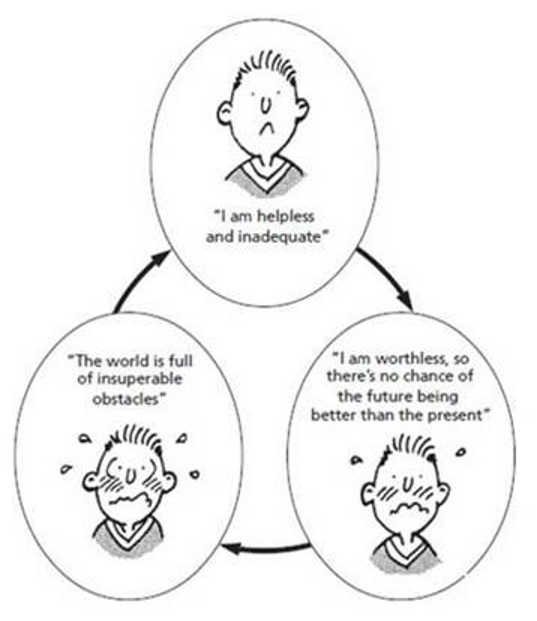
cognitive biases
Cognitive Bias | Explanation |
Minimisation | reducing the importance of positive or successful outcomes. |
Magnification | exaggerating the importance of trivial failures. |
Selective abstraction | Focusing on negative details while ignoring positive ones i.e. selecting the negative bits. |
Arbitrary inferences | Drawing negative conclusions from insufficient evidence. |
Overgeneralisation | Applying a single negative evaluation to other areas of your life |
☹ The relationship seems to be an association rather than causal.
- there is a correlational relationship between depression and negative thoughts so you cannot establish cause and effect. There may be a third variable which causes depression e.g. biological factors such as low serotonin levels
One of the limitations of the theory is the problem of bidirectional ambiguity i.e. it is uncertain which direction the relationship goes in. Hammen argues that negative cognition. I.e. negative thinking may be the result of rather than the cause of depressed moods
Beck himself argues that the relationship is bidirectional: depression can make thinking more negative and negative thinking can probably cause and certainly worsen depression.
Therefore the cognitive explanation is reductionist as it only examines the cognitive causes of depression ad ignores social and biological explanations. A more holistic explanation of depression would be the diathesis-stress model which would suggest that a person needs to have genetic vulnerability to depression as well as an environmental trigger.
😊Supporting evidence
One strength generally of Beck's cognitive model of depression is the existence of supporting research.
'Cognitive vulnerability' refers to ways of thinking that may predispose a person to becoming depressed, for example faulty information processing, negative self-schema and the cognitive triad. In a review David Clark and Aaron Beck (1999) concluded that not only were these cognitive vulnerabilities more common in depressed people but they preceded the depression. This was confirmed in a more recent prospective study by Joseph Cohen et al. (2019). They tracked the development of 473 adolescents, regularly measuring cognitive vulnerability.
It was found that showing cognitive vulnerability predicted later depression.
This shows that there is an association between cognitive vulnerability and depression
😊Practical application in CBT
A further strength of Beck's cognitive model of depression is its applications in screening and treatment for depression.
Cohen et al. (see above) concluded that assessing cognitive vulnerability allows psychologists to screen young people, identifying those most at risk of developing depression in the future and monitoring them. Understanding cognitive vulnerability can also be applied in cognitive behaviour therapy (CBT - see next spread). These therapies work by altering the kind of cognitions that make people vulnerable to depression, making them more resilient to negative life events.
This means that an understanding of cognitive vulnerability is useful in more than one aspect of clinical
It is generally considered the most successful therapy for depression.
Ellis’s ABC model (1962)
irration thoughts → depression
A- Activating event
is a situation in which irrational thoughts are triggered by external event.
B- Beliefs
irrational beliefs
an example of belief that they must be perfect or succeed which is called 'musturbation'
C- Consequences
irrational beliefs will lead to unhealthy emotion e.g. depression and behaviours not going out, feeling depressed
J Practical applications of CBT and REBT ellis ABC
choen et al. Concluded that assessing cognitive unerability allows psychologists to screen young people identifying those most at risk of devloping depression in the future and montoring them. Understanding cognitive vulnerability can also be applied in CBT. These therapies work work by altering the kind of cognitions that make people vulnerable to depression, making them more resilient to negative life events. This means that an understanding of cognitive vulnerability is useful in more than one aspect of clinicla pr
ellis approach to cognitive therapy is called rational emotive behaviour therapy or REBT. The idea of REBT is that by vigorously argung with a depressed person the therapist can alter the irrational beliefs and relieve the symptoms of depression. This means that REBT has real-world value
LJ Partial explanation
Partial explanation- explains why some depressive episodes follow on from a traumatic experience – reactive depression. However, not all depression is caused by an event
doesn’t explain aggression and why some are more prone to depression than others,
does not explain aggression and why some are more prone to depression than others- diathesis- stress model-those with a genetic vulnerability may be more affected by a negative environment.
What is CBT (Beck)?
It was orhinally designed for the treatment of depression but now it is used with many other mental health problems. It is a short term, strructured therapy that focuses on the experiences of 'here and now' and a person's associated thoughts, feelings and behaviours
It assumes there is a relationship between our thoughts (cognitions), our emtions and the things we do (called behaviours). Hence CBT
How does CBT work?
Identify and correct _____irrational ________ ______thoughts _____________ about the self, world and future (negative triad) and unhealthy behaviour.
The client is encouraged to identify thinking patterns which are associated with depressive feelings.
Once identified these _______irrational ____________ _____thoughts__________ are challenged ___________ (reality testing) to restructure cognitions
Make notes using page 152 of your textbooks and the Psychology review article above to make notes on:
Reality testing is where the patient tests the reality of their negative beliefs. For example, by asking them to record an occasion when they did well at work. Therefore, if in future therapy sessions the person claims they are rubbish at their job the therapist can introduce evidence to contradict this statement.
Homework
clients are often asked to complete assignments between therapy sessions. This might include asking a person out on a date when they had been afraid to do so before for fear or rejection, looking for a new job, asking friends to tell them what they really think about the person and so on. Such homework is vital in testing irrational beliefs against reality and putting new rational beliefs into practice
Behavioural activation
CBT often involves a specific focus on encouraging depressed clients to become more active and engage in pleasurable activities. This is based on the common sense idea that being active leads to rewards that act as an antidote to depression. A characteristic of many depressed people is that they no longer participate in activities that they previously enjoyed. In CBT, therapists and clients identify potentially pleasurable activities and anticipate and deal with any cognitive obstacles.
Reality testing
Reality testing is where the patient tests the reality of their negative beliefs. For example, by asking them to record an occasion when they did well at work. Therefore, if in future therapy sessions the person claims they are rubbish at their job the therapist can introduce evidence to contradict this statement.
Homework
clients are often asked to complete assignments between therapy sessions. This might include asking a person out on a date when they had been afraid to do so before for fear or rejection, looking for a new job, asking friends to tell them what they really think about the person and so on. Such homework is vital in testing irrational beliefs against reality and putting new rational beliefs into practice
Behavioural activation
CBT often involves a specific focus on encouraging depressed clients to become more active and engage in pleasurable activities. This is based on the common sense idea that being active leads to rewards that act as an antidote to depression. A characteristic of many depressed people is that they no longer participate in activities that they previously enjoyed. In CBT, therapists and clients identify potentially pleasurable activities and anticipate and deal with any cognitive obstacles.
DEF of ellis mdoel
D = dispute ( challenge the thoughts)
E = effect ( see more beneficial effect on thoughts and behaviour)
F= feelings ( new emotions which are produced)
REBT
Therefore the central technique of REBT is to identify and dispute the patient’s irrational thoughts
REBT challenges the client to prove these statements, and then replace them with more reasonable realistic statements
Logical argument may be used which involves disputing whether the negative thoughts logically follow on from the facts. Self-defeating beliefs do not follow logical from information available.
Empirical argument- is there any actual evidence to support the irrational belief? Are self -defeating beliefs consistent with reality?
Evaluation of the cognitive approach to treating depression
Research support –Ellis (1957) or March et al (2007)-see textbook
There is research to support the effectiveness of rational emotional behavioural therapy (REBT) in treating patients with depressions.
For example Ellis (1957) claimed a 90% success rate for REBT over 27 sessions
However, Ellis did recognise that REBT is not always effective as some clients do not put their revised beliefs into action. It is apparent that CBT is better than no treatment.
However, variations in outcomes may be influenced by skill of the therapist and the quality of the patient-therapist relationship.
Time consuming
For example, Ellis (1957) found it took an average of 27 sessions to be effective. This is time consuming and takes a high level of commitment. This would be costly. In REBT the client’s cognitions are quite forcefully challenged which could be considered unethical.
An alternative treatment would be to use anti-depressants(SSRI's). These would require less effort and they are effective with severe cases of depression, where the patient needs to be treated with medication first before they can access therapy.
individual differences
Individual differences may effect the effectiveness of CBT. For example, Elkin et al (1985) found that CBT was less effective for clients who are resistant to change. It also requires the client to complete homework task which they may find onerous/boring and be resistant to. This suggest that some people are more suitable to CBT than others. Some patients may be severely depressed and therefore need to be treated with anti-depressants before they can access therapy.
Cognitive treatments may minimize the importance of a person's social circumstances. For instance, a person may have experienced adverse life events e.g. bereavement, unemployment (Brown and Harris, 1978). Therefore, to treat holistically we need to consider the social-cultural, biological and cognitive causes of depression.
L An eclectic approach to treatment would be more beneficial
Butler et al (2006) reviewed several meta-analysis of efficacy of studies for CBT and concluded that CBT is highly effective for depression. However, the effect is not usually greater than medication alone. The most effective treatment is a combination of CBT and medication
what is REBT
Rational Emotive Behavior Therapy (REBT)
ABC ellis model