AP MICRO Unit 2: Supply & Demand
 Multiple Choice & FRQ
 Call Kai
1/55

Earn XP
Description and Tags
56 Terms
Demand
The willingness and ability of consumers to buy a range of quantities at every possible price
Demand Schedule
The quantity of a good or service that an individual in a market will be willing and able to consume at every possible price.
Market
The exchange of goods and services within a certain setting or geographic area and a certain period of time.
Quantity Demanded
The number of units of a good or service that will be purchased at a particular price.
The Law of Demand
The quantity demanded of a good or service is inversely related to its price, ceteris paribus.
Price goes up, lower quantity demanded
Price goes down, higher quantity demanded
Why the Law of Demand has a inverse relationship
Income effect, substitution effect, Law of Diminishing Marginal Utility (LDMU)
Income Effect
The principle that says as price increases, people are willing to buy less because higher prices means taking a greater portion of their income
Purchasing Power
The quantity of goods and services that a consumer can buy with an amount of income
Substitution Effect
The greater the price, the more likely consumers will find a substitute product to purchase instead, reducing the quantity demanded for original good
Determinants of Consumer Demand
The factors that move the entire demand curve for a good or service
Determinants that Affect Consumer Demand
TRIBE: Tastes & preferences, Related goods & services, income, (number of) Buyers, Expectations of Price
Substitutes
Products that directly compete with a good or service for consumer demand
Complements
Products brought with a good or service
Normal Goods
Something that people will buy more of when their income increases
Inferior Goods
Something that people will buy less of when their income increases
The Law of Supply
The quantity supplied of a good or service is directly, or positively, related to its price, ceteris paribus
Supply Schedule
The quantity that will be supplied of a good or service at every possible price
Determinants of Supply
Factors that change the quantity supplied at every price level.
Determinants that Affect Supply
ROTTEN: Resource cost & availabiltiy; other goods’ prices; taxes, subsidies, & governemnt regualtion; technology; expectations of producer
Subsidy
A government payment to an individual or business to encourage a certain activity
Elasticity
How responsive supply or demand is to a change in price or income
Determinants that Affect Elasticity
SPLAT: Substitutes, Portion of income, Luxury or necessity, Addictive or habit forming, Timescale

Perfectly Elastic Good
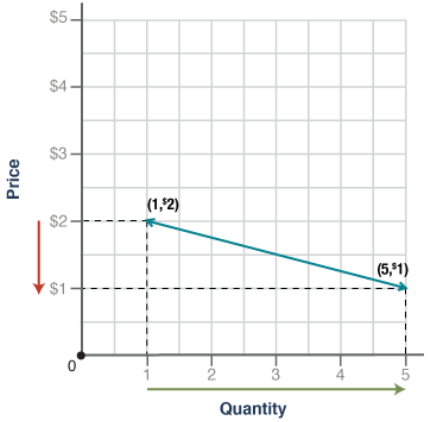
Elastic Good

Inelastic Good

Perfectly Inelastic Good

Unit Elastic Good
Price Elasticity of Demand
How sensitive consumer demand is to a change in price
Elasticity Coefficient
The relationship between the change in quantity and change in price, mathematically expressed as the percentage change in quantity over the percentage change in price
Total Revenue Test
Determining if demand is in the elastic, unit, or inelastic range by tracking total revenue
Direct Relationship
A positive connection between two variables such that when one increases, the other increases as well, and when one decreases, the other decreases as well
Indirect Relationship
An opposing or negative connection between two variables such that when one increases, the other decreases, and when one decreases, the other increases
Determinants that Affect Price Elasticity of Supply
Input availabitiliy & time

Elastic Market Supply
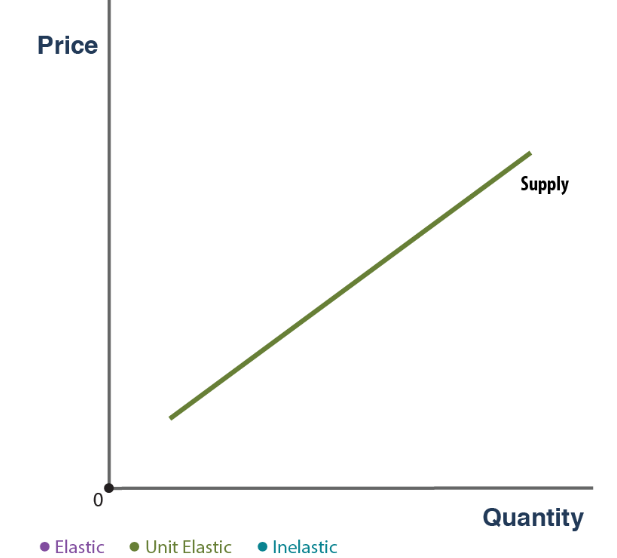
Unit Elastic Market Supply

Inelastic Market Supply
Income Elasticity of Demand
Distinguishes between normal and inferior goods
Cross-price Elasticity of Demand
Helps businesses recognize goods that are related to those that they sell
Market Equilibrium
The price and quantity level where supply and demand are in balance
Consumer Surplus
The difference between what buyers would have been willing to pay and what they actually had to pay
Producer Surplus
The benefit or revenue gained from selling a product above the economic cost of production
Total Economic Surplus
The sum of consumer surplus and producer surplus. It is always maximized at the equilibrium point.
Market Shortage
When quantity supplied is less than quantity demanded at the current price
Market Surplus
When quantity supplied is greater than quantity demanded at the current price
Disequilibrium
A market situation in which quantity demanded and quantity supplied are not equal
Minimum Wage
A pay level floor for labor (workers) that is set by policy; employers must pay workers at least this set level
Tariffs
Taxes on imports or exports
Allocative Efficiency
When resources are used to maximize consumer satisfaction, to best meet consumer demand
Income Tax
Tax on household revenue, which can come from multiple sources such as a job, wages, rent, earned interest, and profit
Excise Tax
A tax applied to the sale of a particular good
Price Ceiling
A maximum price set by policy
Price Floor
A minimum price set by policy
Deadweight Loss
The losses of buyers and sellers from a market intervention or market failure
Seller’s price
The amount of money producers receive in the sale of a good
Binding
With respect to price floors or ceilings, actually affecting the market
Protectionism
The practice of a country taxing imported goods