Optics - Final
 Call Kai
 Learn
Learn Practice Test
 Spaced Repetition
 Match
Match Flashcards
 Knowt Play
1/135

There's no tags or description
Looks like no tags are added yet.
Name | Mastery | Learn | Test | Matching | Spaced | Call with Kai |
|---|
No analytics yet
Send a link to your students to track their progress
136 Terms
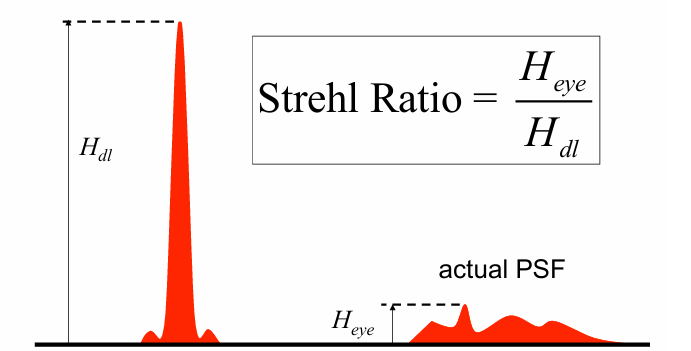
Stehl ratio. What it tells us? What is the ideal ratio?
gives us information about PSF
Stehl ratio = height of PSF measured/height of PSF in ideal case
closer to one = better
ideal case = limited by diffraction only
What causes chromatic aberration?
Dispersion: refractive index varies with wavelength, so different wavelengths are refracted by different amounts
What is dispersion?
Variation in refractive index with wavelength
how does wavelength and refractive index vary. What happens to refractive index when wavelength increases?
short wavelengths are refracted more strongly. Aka the refractive index/lens power increases as wavelength decreases (and vice versa).
Short wavelength/blue light has higher n, travels slower, bends more, and focuses closer to the lens.
what is optical path length? what can it be used to measure
will travel slower
OPL = n x distance
n is higher for short wavelength light
OPL will be greater

when light enters a new (higher) medium, what changes
frequency
wavelength
speed
frequency stays constant
wavelength decreases
speed decreases
v=c/n
v=f/λ
How many types of chromatic aberrations are there? What are they called and describe them.
Longitudinal chromatic aberration
different colours focus at different planes.
since power increases with decreasing wavelengths, different wavelengths focus at different axial distances.
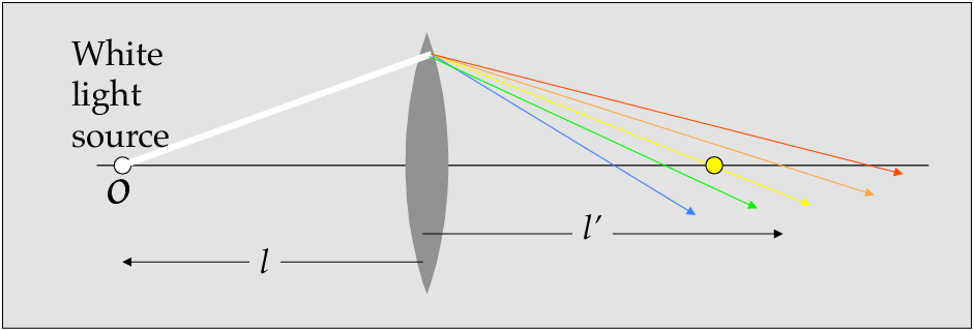
Longitudinal chromatic aberration occurs for what kind of object point?
mainly described for an on-axis object point
What is transverse chromatic aberration?
Different wavelengths focus at different heights
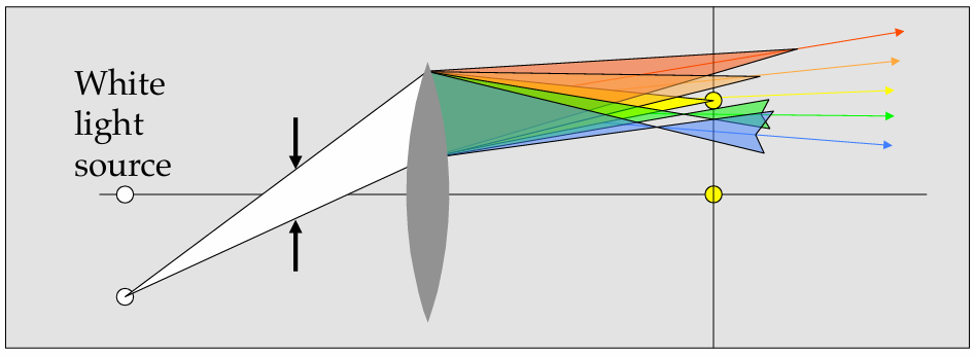
Longitudinal chromatic aberration occurs for what kind of object point?
mainly described for off-axis object points.
What ray trace would differ in longitudinal chromatic aberrations?
what ray would differ in transverse chromatic aberrations?
Longitudinal
PMR (cross axis at different points)
Transverse
PPR (rays at different heights)
What is dispersion measured as? (important) What do higher/lower values mean.
Abbe V-value describes dispersion (variation in refractive index with wavelength)
related to the difference in power ΔF between hydrogen blue & red wavelengths is related to V-value by the equation
lower v-value = more dispersion (more chromatic aberrations)
higher v-value = less dispersion (more aberration)
if the aperture stop is at the lens would you get chromatic aberration?
no transverse chromatic aberration when the AS is at the lens!
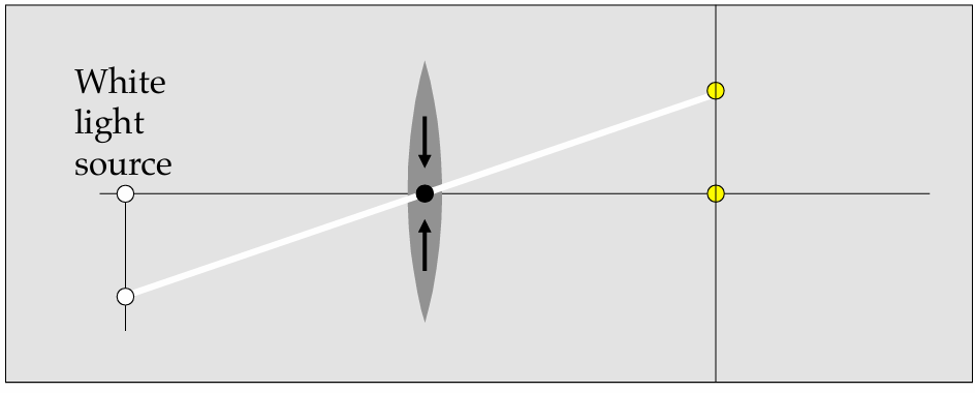
when the AS is infront of the lens do you get chromatic aberrations?
YEW
AS in front = positive transverse chromatic aberrations
positive = blue lower
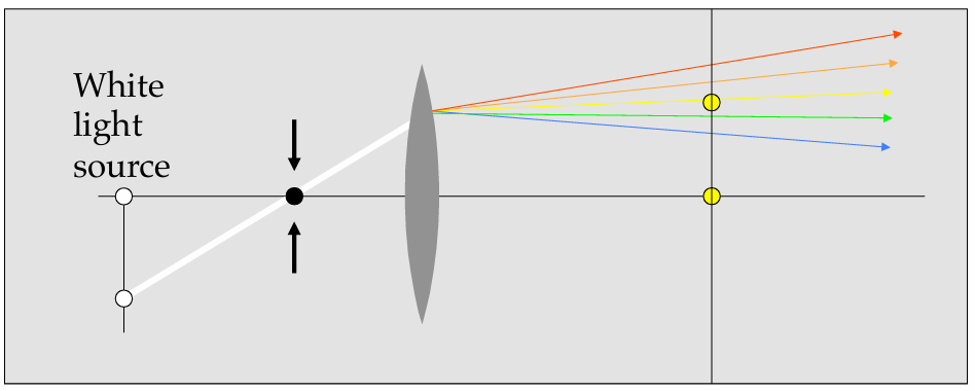
when the AS is infront of the lens do you get chromatic aberrations?
AS behind the lens = Negative transverse chromatic aberration
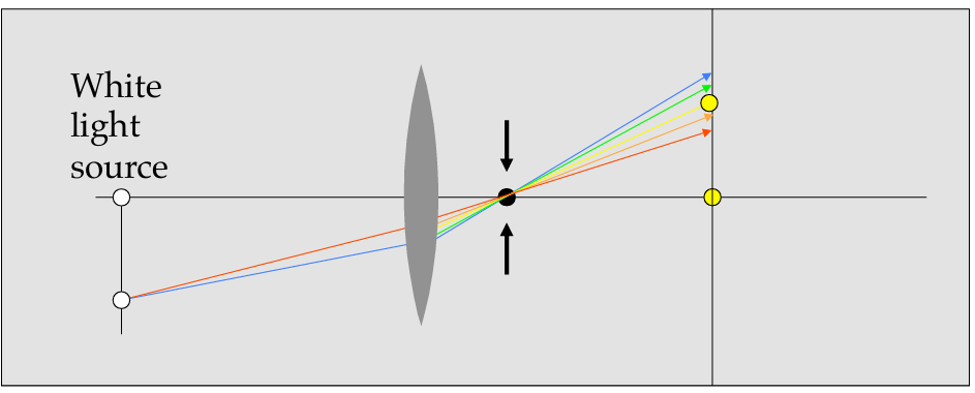
Key aperture stop rule for chromatic aberration?
LCA not really affected by stop position; TCA depends strongly on stop position
What is an achromatic doublet? How does it work?
Two lenses, usually different materials and powers, combined to reduce chromatic aberration.
· two thin lenses in contact (F1 + F2 = F)
Uses materials with different Abbe V-values and lens powers so chromatic aberrations partly cancel.
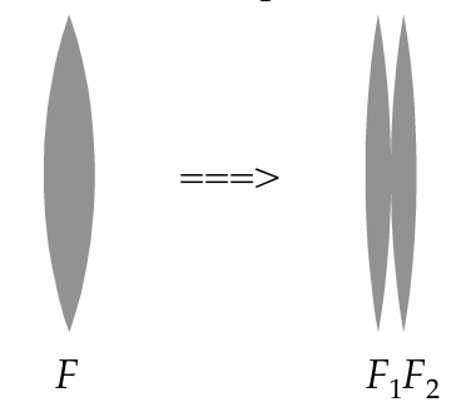
What signs of lenses are often combined in an achromatic doublet?
a positive and negative lens combination to cancel out and control aberrations.
Does an achromatic doublet remove all chromatic aberration?
no, there is still some residual chromatic aberration. This technically only fully reduces red and blue because these are how the abbe value is calculated
sign of chromatic aberration (longitudinal and transverse) depends on what?
longitudinal
always the lens power
keplarian = positive
galilean = negative
transverse
depends on:
aperture stop position
lens powers
in a keplarian telescope, does it have transverse and longitudinal aberrations? Where do they come from?
Transverse aberrations are ONLY COMING FROM THE EYE LENS
objective stop is the AS!!
positive chromatic aberrations
Does the human eye have chromatic aberration?
Yes. The eye has both longitudinal and transverse chromatic aberration
what is the MTF?
The modulation transfer function describes how well an optical system transfers contrast from object to image as a function of spatial frequency
photon energy, wavelengths and frequency
shorter wavelengths have higher frequency and higher photon energy
snell’s law
describes how much light bends when it crosses from one medium to another
how will light bend/change speed from:
low n → high n?
slower, bend toward normal
how will light bend/change speed from:
high n → low n?
faster, bend away from normal
Optical path length
Optical path length (OPL) = n x distance
Fermat’s principle, Snell’s law link?
The path taken must be the path with the least travel time
Snell’s law follows from Fermat’s principle because light bends at a boundary to minimise/stabilise optical travel time.
critical angle
the angle of incidence where the refracted ray bends so much that it travels along the boundary between the two media
it only happens when light travels from:
higher refractive index → lower refractive index
At the critical angle:
θr=90∘
Total internal reflection
Total internal reflection occurs when light travels from a higher refractive index medium to a lower refractive index medium and the angle of incidence exceeds the critical angle
angle of incidence > critical angle
describe what happens to light:
below the critical angle
at the critical angle
above the critical angle
Below critical angle
Some light is refracted out into the second medium, and some is reflected.At critical angle
The refracted ray bends to 90°, so it travels along the boundary.Above critical angle
No refracted ray exits into the second medium. The light is totally internally reflected back into the original medium.
apply critical angle and TIR to telecommunication
Critical angle is important in optical fibres.
Light travels through a high refractive index core surrounded by lower refractive index cladding.
If the angle of incidence at the core-cladding boundary exceeds the critical angle, total internal reflection occurs, so light is guided along the fibre with minimal loss over long distances.
apply critical angle and TIR to telecommunication
Critical angle/TIR can be relevant to light guiding in retinal structures, especially photoreceptors/Müller cells acting partly like optical waveguides. This helps direct light toward photoreceptor outer segments.
refracted and reflected ray will be on what side of the normal to the incident ray?
Opposite side of the normal
filters can alter light beams in which way
intensity
spectral distribution (ex. spectral filters transmitting specific wavelengths)
define scattering
Scattering is the redirection of light after interaction with particles, molecules or structures
Rayleigh scattering. What is scattering intensity proportional to?
happens when light is scattered by tiny particles/molecules smaller than the wavelength of light (e.g. N2 & O2)
Scattering intensity is proportional to: 1/λ4
this is why blue light gets scattered more!
Rayleigh scattering and polarisation
In Rayleigh scattering, the degree of polarisation depends on scattering angle. Light scattered at 90° to the incident beam is maximally polarised, while light scattered directly forward or backward is unpolarised.
Mie scattering
Mie scattering occurs with particles larger than the wavelength (dust, water droplets) and is less wavelength-dependent
light sprays in all directions
why is the sky blue and black in space
in space, no particles smaller than wavelength so no rayleigh scattering of blue wavelengths
sky blue because blue gets scattered most
why are sunsets red
At noon: sunlight travels through less atmosphere, so only some blue is scattered away. The sun still looks yellow-white.
At dawn/dusk: sunlight travels through much more atmosphere, so much more blue/short-wavelength light is removed from the beam.
Sunsets look red because the blue light has been scattered out of the direct beam before it reaches you.
mars atmosphere (yellow/brown). Why?
looks yellow/brown due to mie scattering through fine dust
scattering (including absorption) of sunlight by dust in the atmosphere account for this colour
what is polarisation? (important)
Polarisation describes the direction of oscillation of the electric field in a transverse light wave.
states of polarised light (4) (important)
plane
unpolarised
partially-polarised
elliptically polarised
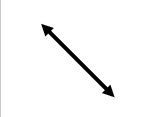
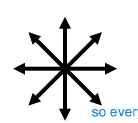
arrows in these pictures depict the electric field strength and direction
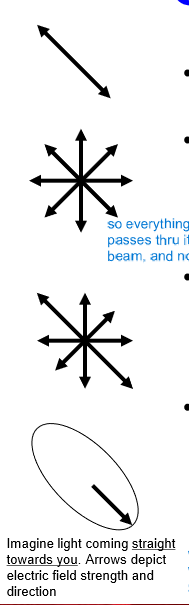
describe plane polarized light
the electric field vector is confined to a single plane
describe unpolarized light and give example
light that’s electric field is randomly oriented in any direction
e.g. sun
describe partially-polarised light and give an
mix of unpolarised and plane polarised light
What does it mean that light is an electromagnetic wave?
Light is a transverse electromagnetic wave made of oscillating electric and magnetic fields. The electric and magnetic fields are perpendicular to each other and both are perpendicular to the direction of propagation. The wave can be described by wavelength, frequency, amplitude and phase.
what is reflected unpolarised light?
partially polarised!
bias toward one direction
light is rarely perfectly polarised or unpolarised.
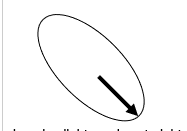
what is elliptically polarized light?
the electric field direction rotates as the light travels, and the tip of the electric field traces an ellipse.
Luminous flux
Luminous flux is the total visible light output of a source, measured in lumens (F)
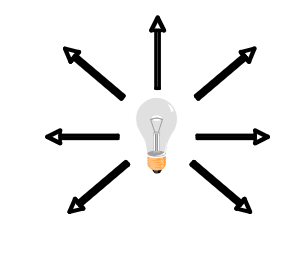
luminous intensity
Luminous intensity is luminous flux emitted per unit solid angle, measured in candela
candela = lumens/steradian (I)
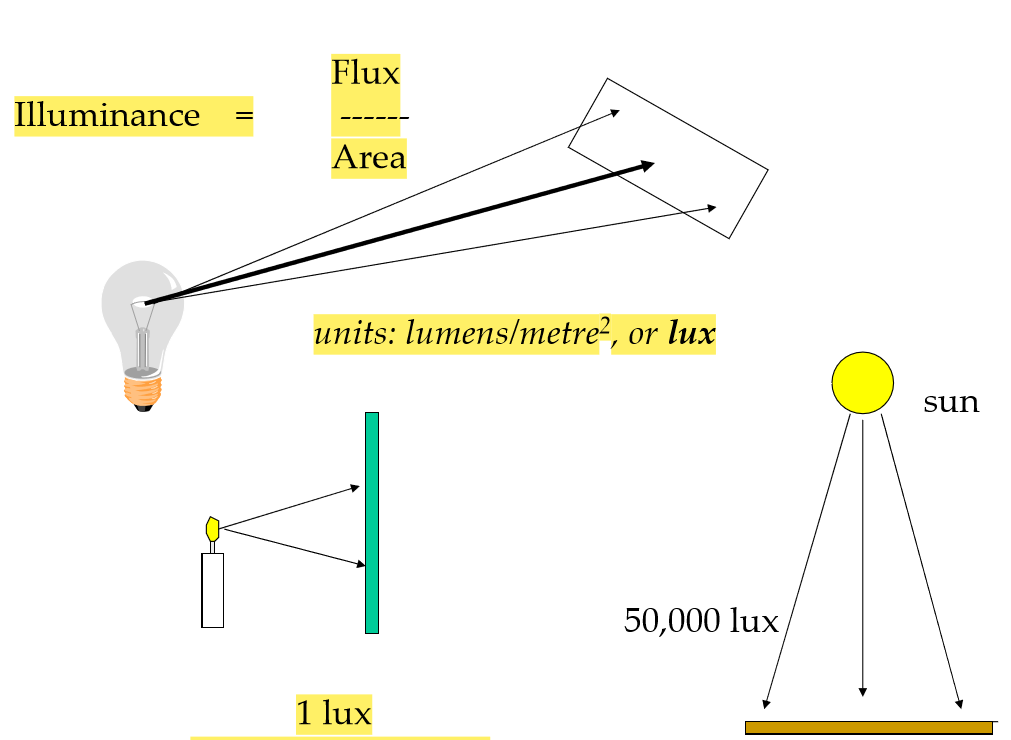
Illuminance
illuminance is luminous flux that falls upon a surface per unit area
Luminous flux / m2
measured in lux (E)
Unit: lm/m2
Illuminance = flux /area
Luminance
Luminance describes the visible light emitted or reflected from an extended surface in a particular direction per unit area.
luminance = luminous flux (lumens) / (steradian x metre2)
cd/m2
(luminous intensity/m2)
inverse squared relationship - illuminance
illuminance = luminous intensity / d2
A POINT SOURCE IS ASSUMED
compare real and virtual images
✅ Real image
image is on the opposite side of the optical sysetm to the object
rays converge after leaving the system
image can be seen on a screen
❌ Virtual image
on the same side of the optical system as the object
image can’t be seen on screen
rays diverging after leaving the system
Vergence
Vergence describes whether light rays are diverging, converging or parallel at a given point
Aperture stop
The component that limits the amount of light entering the system
decreasing the AS → decreases image brightness
vignetting
the blocking of rays by a surface other than the aperture stop (or field stop), typically occurring at the edge of a field.
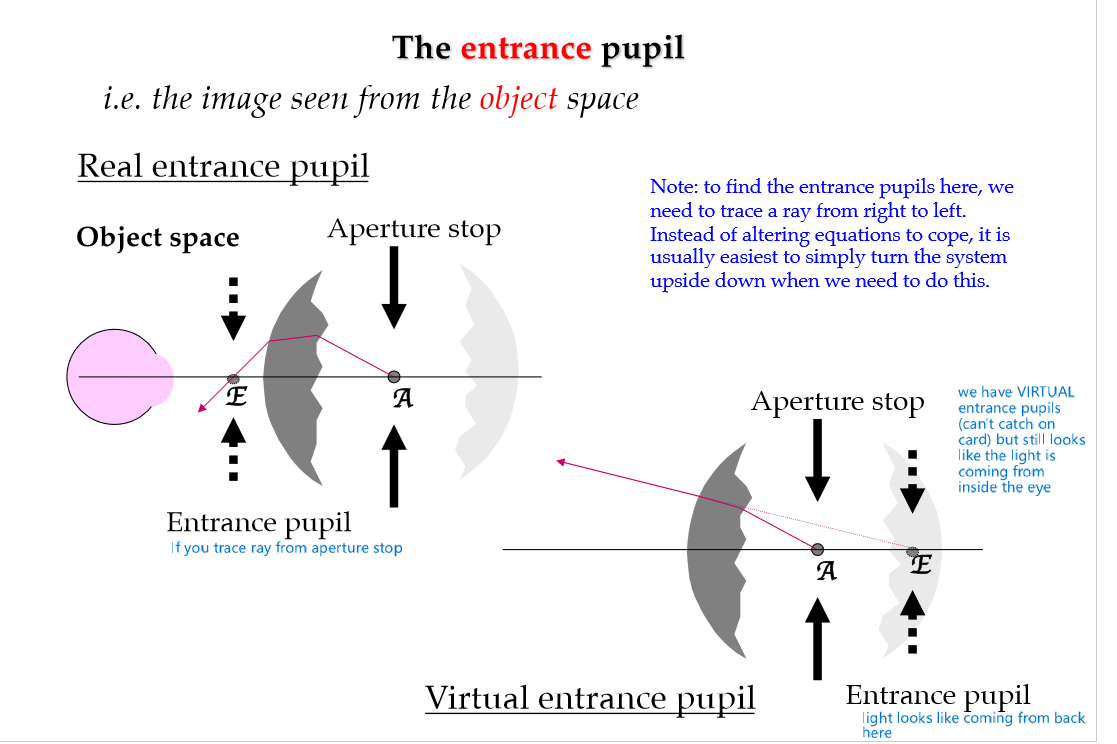
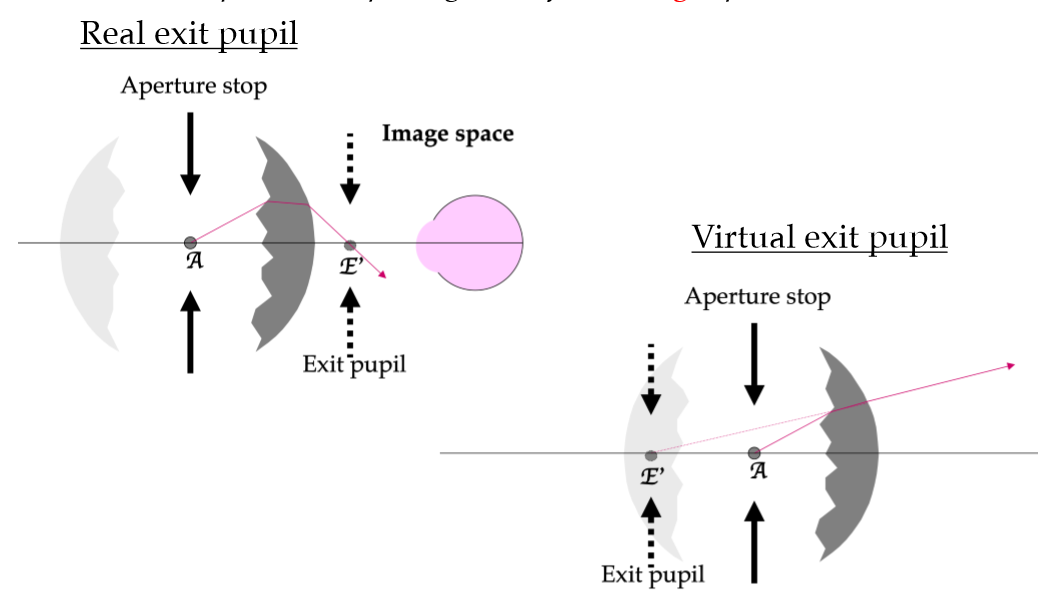
Entrance pupil (draw real / virtual)
image of the AS as seen from object space
field stop definition and effects
Field stop = limiting aperture placed at an intermediate real image plane or final image plane → limits field of view with a sharper cut-off.
2 main things that reduce the field of view in a telescope?
vignetting
field stop
define pupil matching
Pupil matching means placing the observer’s eye pupil at the instrument’s exit pupil to maximise field of view and light collection.
no exit pupil in galilean telescope (pupil is the AS limiting the rays) To get the widest field of view, place the eye as close to the eye lens as possible to reduce vignetting
Pupil size
Pupil size affects image quality by changing the balance between light throughput, aberrations, depth of focus and diffraction
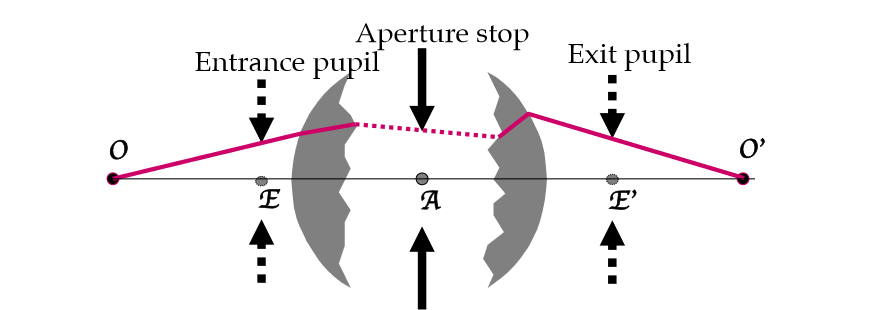
paraxial marginal ray
PMR = ray from an on axis object point, that touches the edge of the aperture stop, and intersects the optical axis at the image plane
determines image position
paraxial pupil ray
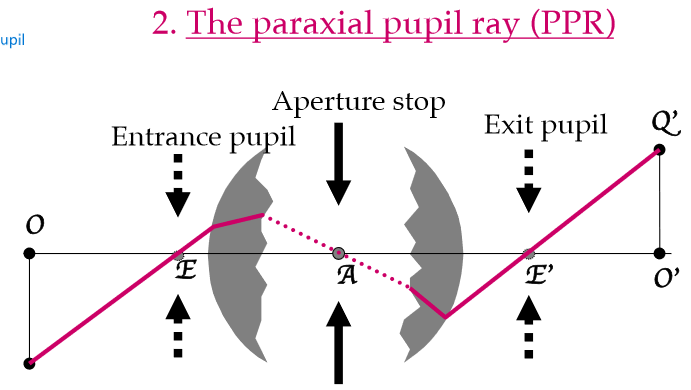
PPR = ray from the edge of the object field, passing through the centre of the AS, and finally intersecting the paraxial image plane at Q’
determines image height
exit pupil (real and virtual)
the image of the AS as seen from image space
Field stop
The field stop limits the extent of the field of view by restricting off-axis rays
Paraxial ray
rays that are very close to the optical axis
ray angles are very small
ray heights are very small
because the angles are small sin(0.1) = 0.1
can remove the sign
i think good to study cause less aberration
different between degrees and radians
angle: 2 intersecting lines deviating from one another
radian: portion of a circumference of a circle
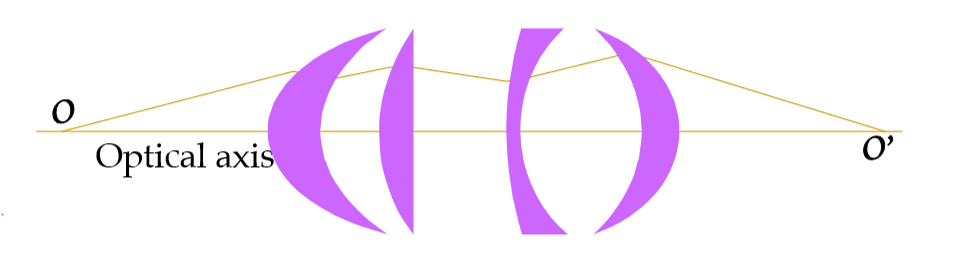
ray tracing
opening equation to find h at first surface
paraxial refraction equation to find angle of refraction (u’)
transfer equation to find h’
paraxial refraction equation to fine (u’’)
when using the paraxial approximation do you express in radians or degrees
radians
surface power. what is it determined by?
Surface power is the refracting power of one surface, determined by the radius of curvature and refractive index change
F = C(n’-n)
C = 1/r
Paraxial refraction equation
The paraxial refraction equation describes how a ray’s angle changes at a refracting surface depending on refractive index, surface power and ray height.
Transfer equation
The transfer step describes how ray height changes as a ray travels a distance through space or a medium
Equivalent power
Equivalent power is the overall vergence-changing power of a lens or optical system
Vertex power
Vertex power is lens power referenced to a physical front or back vertex of the lens
Principal planes
Principal planes are conjugate planes used as reference planes when treating a thick lens as an equivalent thin lens
Focal points
Focal points are points where parallel rays focus, or from which rays must appear to originate to emerge parallel
what points coincide in thin lens?
vertex points
principal points
nodal points
because lens thickness is ignored
keplarian v galilean
image orientation
magnification
length
intermediate image
real exit pupil
AS
field of view
eye positioning
main limitation
Image orientation | Inverted | Upright |
Magnification | Negative sign, about 2.25× | Positive sign, about 2.25× |
Length | Longer | Shorter |
Intermediate image | Yes | No |
Real exit pupil | Yes | No |
Aperture stop | Objective lens (usually) | Real eye pupil |
Eye positioning | Easier due to exit pupil | More sensitive |
Field of view | Usually wider | Usually narrower |
Main limitation | Inverted image, longer | No pupil matching. Vignetting, no real exit pupil |
positive v negative field lens
positive field lens → increased field of view, decreased eye relief
negative field lens → decreased field of view, increased eye relief
Why is Galilean field of view more limited?
It has no real intermediate image plane or real exit pupil to match to the eye, so field is more sensitive to eye position and vignetting.
myopia
Myopia occurs when distant rays focus in front of the retina because the eye is too long or too powerful
Hyperopia
Hyperopia occurs when distant rays would focus behind the retina without accommodation because the eye is too short or underpowered
what does one degree correspond to on the retina? What about 3 degrees
0.3 mm on the retina
linear relationship:
3 degrees = 0.9 mm on retina
what is optical design
Optical design involves choosing components to achieve required image position, magnification, field of view, system length and image quality
simplest eye model (model 1)
thin lens in air
the whole eye is replaced by one thin lens
Emsley reduced eye
still a single refracting surface but takes into account that the back of the eye is essentially water (vitreous)
n = 1.33 (4/3)
where would the nodal point be on emsely reduced eye
centre of rotation of the spherical cornea
normally the nodal points coincide with principle and vertex points for a thin lens in air, but because the n is different on opposite sides it is different
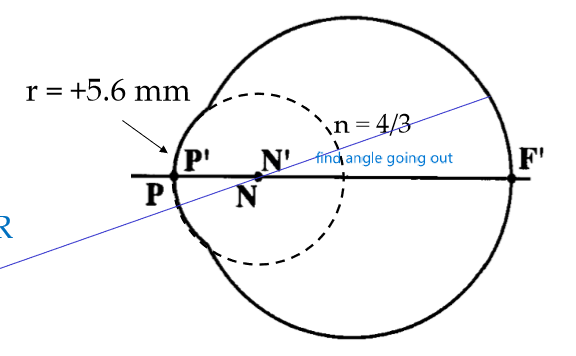
how to find focal length
F = n/f
so for emsely n = 1.33 and for air n = 1
6 limitations of thins lens models? how to address these?
does not distinguish between cornea and crystalline lens
ignores refractive indices of the ocular media
does not consider accommodation
will give inaccurate measure of aberrations
note easy to use with biometry data from actual eye (corneal curvature, axial length)
to address these limitations, we introduce models with multiple refracting surfaces
two more complicated eye models. How many surfaces
Gullstrand simplified (No. 2) - 3 surfaces
Gullstrand exact (No. 1) - 6 surfaces
gullstrand exact eye model
6 surfaces
cornea has thickness = 2 surfaces
lens has thickness = 4 surfaces
lens is made of two zones (the nucleus and the cortex)
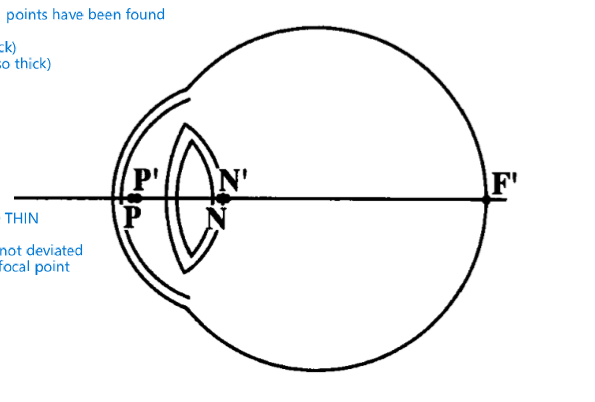
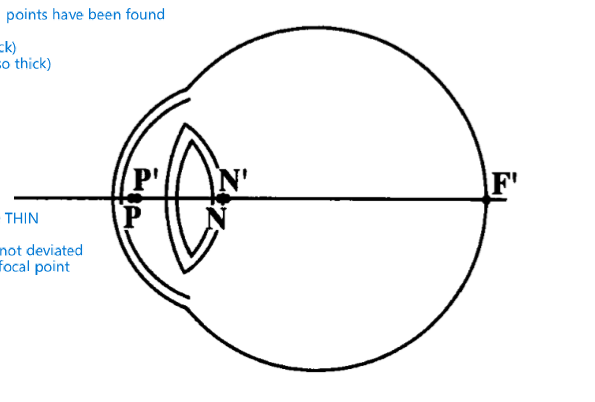
where would we stick a thin lens in gullstrands exact eye model
P’ !!
great strength of Gullstrand’s exact eye model. Limitations?
explains accommodation
still does not predict real aberrations and real optical performance
Why is the full accommodation in model change in 11D but the change in power of lens actually 14D irl?
becuse this is measuring the change in vergence at the cornea. Actually bigger change in power at lens position, but when measured from further away account for this.
placement matters
what did the more precise (Liou and Brennan) models account for?
aspheric surfaces
prolate ellipsoid (steeper in the centre than periphery)
gradient refractive index of the lens
decentred pupil
angle alpha (fovea not exactly on the optical axis) - 5deg
Nodal points
Nodal points are points on the optical axis where the nodal ray appears to cross. The nodal ray enters and exits the system at the same angle to the optical axis.