Chapter 27: MALE
 Call Kai
 Learn
Learn Practice Test
 Spaced Repetition
 Match
Match Flashcards
 Knowt Play
1/168

There's no tags or description
Looks like no tags are added yet.
Name | Mastery | Learn | Test | Matching | Spaced | Call with Kai |
|---|
No analytics yet
Send a link to your students to track their progress
169 Terms
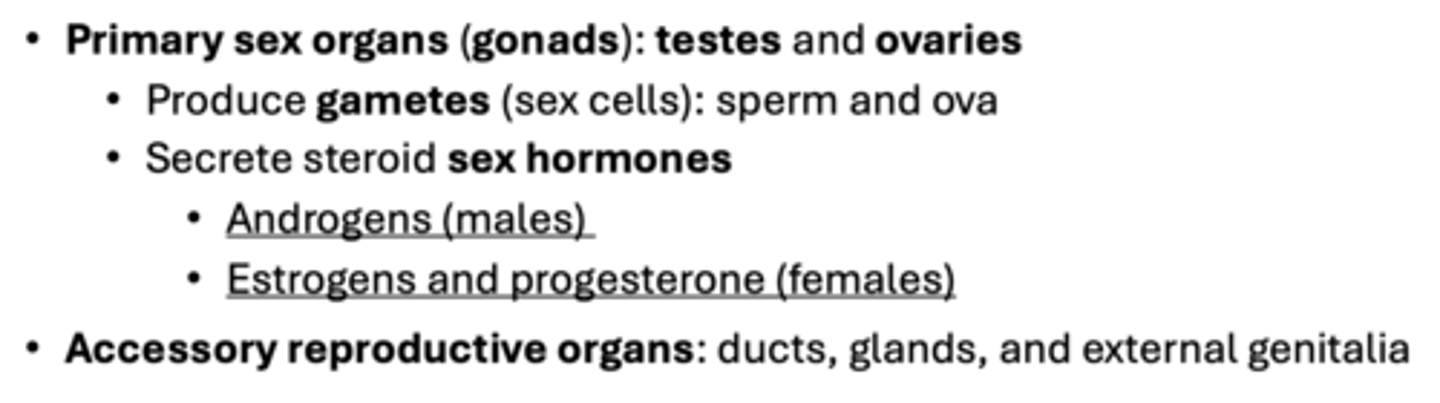
Primary Sex Organs
testes and ovaries AKA gonads
What do testes and ovaries produce?
gametes (sperm and ova)
Gametes secrete what sex hormone?
steroid
Sperm secretes what steroid sex hormone?
androgens
Ova secretes what steroid sex hormone?
estrogens and progesterone
Accessory Reproductive Organs
ducts, glands, and external genitalia
Body cells have what number of chromosomes?
46
There are two sets of chromosomes which contains how many?
23
Maternal and Paternal are referred to as:
homologous chromosomes
46 chromosomes are referred to as:
diploud chromosomal number (2n)
23 chromosomes are reffered to as:
haploid chromosomal number (n)
Haploid chromosomal number only contains ___ member of homologous pair.
one
Gamete formation involves what process?
meiosis
Meosis involves:
2 consecutive cell dividions and one round of DNA replication
Meosis produces:
4 daughter cells
Functions of Meosis
number of chromosomes are cut in half (2n -> n), introduces genetic diversity (daughter cells are genetically different from original cell)
During Meosis 1, the number of reduces from ____ to ____.
2n to n
What phase is not seen in mitosis or meiosis II?
prophase I
Synapsis
homologous chromosomes pair up fromaing tetrads consisting of 4 chromatids
Crossover (Chiasmata)
exchange of genetic material between male and female chromatids
The Crossover (Chiasmata) results in:
unique chromosomes that are mixtures of materal and paternal chromosomes
What happens during metaphase I?
tetrads line up randomly at spindle equator
What happens during anaphase I?
sister chromatids of one homologous chromosome are separated from sister chromatids of other
At the end of meiosis I, each daughter cell has how many copies?
2 copies of one member of each homologous pair and none of the other
At the end of meiosis I, each daugter cell has haploid chromosomal number because:
still-united sister chromatids are considered one chromosome
At the end of meiosis I, haploid chromosomal cells are considered one, why?
they contain twice the amount of DNA in each chromosome
First Task Meiosis I Accomplishes:
reduces chromosomal number by half
Second Task Meiosis I Accomplishes:
Introduces genetic variability
What leads to genetic variability?
random alignment of homologous paurs in meiosis I
Crossover is also known as:
variability of gametes
Crossover results in 2 gametes that are exactly alike OR exactly different?
exactly different (no two gametes are alike, they are all different from original mother cells)
Meiosis II results in:
equational division
What is the difference between meiosis and mitosis?
in meiosis, there are no chromosome replication before the process begins
In meiosis I, sister chromatids are separated OR aligned in meiosis II?
separate, they are pulled to opposite sides of poles
Meiosis II results in how many chromatids per cell?
one
Spermatogenesis
production of sperm in the seminiferous tubules
Spermatogenic cells give rise to:
sperm
3 Steps of Spermatogenesis
mitosis, meiosis, spermiogenesis
Mitosis of Spermatogonia
forms 2 spermatocytes
Meiosis
spermatocutes form secondary spermatocytes, which form spermatids
Spermiogenesis
spermatids become sperm
How long does spermatogenesis take?
64-72 days if conditions are hospitable
What pressure pushes immotile sperm to gain motility and fertilizing power?
testicular fluid into epididymis
When does spermatogenesis begin?
puberty
Spermatogenesis begins with:
spermatogonia
During spermatogonia, stem cells are in contact with:
epithelial basal lamina
During spermatogonia, mitotic division yields two types of one:
type A daughter cell and type B daughter cell
Function of Type A Cells
maintain germ cell line at basal lamina
Function of Type B Cells
move toward lumen and develop into primary spermatocytes
In meiosis, spermatocyte become:
spermatids
Primary spermatocytes will undergo meiosis I, forming:
two secondary spermatocytes
Secondary spermatocytes rapidly undergo meiosis II, becoming:
two spermatids
Spermatids
small, nonmotile cells found close to lumen of tubule
Spermigenesis convert spermatids to:
sperm
Spermatids contain the correct number of what for fertilization?
haploid chromosome
Spermiogenesis is a streamlining process where:
spermatid elongates, loses excess cytoplasm, and forms tail to become a spermatozoon (sperm)
Sperm Production: Head
genetic region that includes nucleus and helmetlike acrosome containing hydrolytic enzymes that enable sperm to penetrate egg
Sperm Production: Midpiece
metabolic region containg mitochondria that produce ATP to move tail
Sperm Production: Tail
locomotor region that include flagellum
Testes
sperm-producing male gonads that lie within the scrotum
The delivery of sperm in ORDER
epididymis, ductus deferens, ejaculatory duct, urethra
Accessory Sex Glands for Males
seminal glands, prostate, and bulbo-urethral glands
Scrotum
sac of skin and superficial fascia
Location of Scrotum
hangs outside abdiminopelvic cavity
Composition of Scrotum
paired testes
Temperature of Scrotum
3°C lower than core body temperature, low temp = necessary for sperm production
Testes are surround by two tunics which are called:
Tunica vaginalis and tunica albuginea
Tunica Vaginalis
outer layer derived peritoneum
Tunica Albuginea
inner layer forms fibrous capsule
What divided the testis into ~250 lobules that can contain 1-4 seminiferoys tubules?
septa
What is the site of sperm production?
testes
Where do testicular arteries arise from?
abdominal aorta
Where do testicular veins arise from?
pampiniform venous plexus which surround each testicular artery
Testicular veins absorb heat from where and why?
testicular arteries because they are cooler
Spermatic Cord
encloses nerve fibers, blood vessels, and lumphatics that supply testes
Order of Sperm Conveying
seminiferous tubules, straight tubule, rate testis, efferent ductules, epididymis
What makes up the epididymis?
head, body, and tail
Where is sperm stored and prepared for ejaculation?
tail
Interstitial Endocrine Cells
located in soft tissue surrounding seminiferous tubules
Production of Interstitial Endocrine Cells
androgens, such as testosterone
Secretion of Interstitial Endocrine Cells
interstitial fluid
Penis
male copulatory organ
External Genitalia
scrotum and penis
What does the penis consist of?
root, shaft, glans penis, prepuce
Prepuce (Foreskin)
cuff of loose skin covering glans
Composition of Penis
spongy urethra, 3 cylindrical bodies of erectile tissue, spongy network of connective tissue, and smooth muscle with vascular spaces
Corpus Spongiosum
surronds urethra and expands to form glans and bulb
Corpora Cavernosa
paired dorsal erectile bodies
Erection
erectile tissue fills with blood, causing penis to enlarge and become rigid
Ducts carry sperm from testes to body exterior through:
epididmyis, ductus deferens, ejaculatory duct, and urethra
Epididymis
nonmotile sperm enter, pass slowly through (~20 days), become motile
Sperm can be stored in the epididmyis for how long?
several months
During ejaculation, epididymis contracts which causes:
expelling of sperm into ductus deferens
How long is the ductus deferens?
~ 45 cm long
The ductus deferens passes through the ________ cavity to _______ cavity
inguinal, pelvic
The ductus deferens joins what vesicle to form the ejaculatory duct?
seminal
What muscle propels sperm from epididymis to urethra?
smooth
Vasectomy
cutting and ligating ductus deferens
A vasectomy is nearly 100% effective form of:
birth control
Urethra
conveys both urine and semen (at different times)