Unit 4 Ap bio
 Call Kai
 Learn
Learn Practice Test
 Spaced Repetition
 Match
Match Flashcards
 Knowt Play
1/61

There's no tags or description
Looks like no tags are added yet.
Name | Mastery | Learn | Test | Matching | Spaced | Call with Kai |
|---|
No analytics yet
Send a link to your students to track their progress
62 Terms
etc
a collection of proteins that are structurally linked into units
chemiosmotic hypothesis
ETC energy is used to move protons across the cristae membrane, ATP is generated as the protons diffuse back into the matrix
atp synthase
uses the flow of protons to make ATP
autotrophs
produces personal nutrients; “self-nourish”
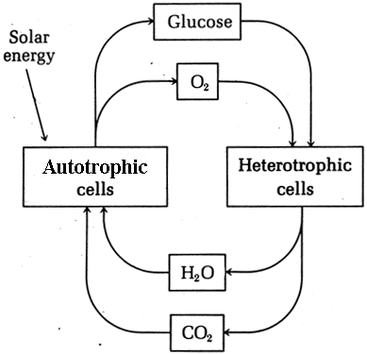
carbon cycle
carbon goes from the atmosphere into autotrophs which is then passed to heterotrophs then eventually released back into the atmosphere
photosynthesis
process by which plants use light energy to make food; reduction process; requires chlorophyll and light
photosynthesis equation
6 CO2 + 6 H2O -> C6H12O6 + 6 O2
photosynthesizing organisms
plants, algae (protists), euglena (protists), cyanobacteria
plant photosynthesis location
any green part of the plant, mainly the leaves, happens in MESOPHYLL CELLS
mesophyll cells
middle layer cells, surrounded by epidermis cells on both sides, cuticle (waxy layers)
stomata
small holes that gasses in and out, usually on the underside of leaves
photosynthesis reactions
light reaction: occurs in the thylakoid membrane, calvin cycle: occurs in the stroma
stroma
liquid that surrounds the thylakoid membrane
light
a form of electromagnetic radiation (visible light is used for photosynthesis)
action spectrum
red and blue light are absorbed and used in photosynthesis, green light is reflected or transmitted
chlorophyll
Has Mg2+, several types possible (A-D)
accessory pigments
absorb light energy and transfer the energy to chlorophyll
chlorphyll
absorbs light, gets stored when photosynthesis isnt possible (like the winter)
cyclic electron flow
no input of electrons needed
non-cyclic electron flow
constant input of electrons needed
photosystems
the light dependent reaction contains two photosystems, occurs in thylakoid membrane
cyclic photophosphorylation
uses PS1 only, produces ATP, requires light
noncyclic photophosphorylation
uses PS1 and PS2, splits water releasing protons, a pair of electrons, and ½ O2, produces ATP and NADPH
calvin cycle inputs
CO2 (used to make sugar), ATP, NADPH
calvin cycle products
sugar, ADP, NADP+
C3 photosynthesis
most dominant type, CO2>rubisco>glucose
C4 photosynthesis
happens in two cells, found in grasslands, CO2>4C acid>rubisco>glucose; adaptive value: prevents photorespiration>prevents water loss
CAM photosynthesis
divided by time, found in deserts, CO2>4C acid>rubisco>glucose; adaptive value: limits transpiration, minimizes water loss
ATP
powers ALL functions
aerobic cellular respiration equation
glucose+oxygen →carbon dioxide+water+energy (as ATP)
cytoplasm
glycolysis location
mitochondrial matrix
pyruvic oxidation location
mitochondrial matrix
citric acid cycle location
cristae
etc location
glycolysis
splitting of glucose/sugar
ATP cycle
ATP → ADP+Pi
ADP
created when the third phosphate falls off, releases energy for the cell to use
ATP energy
renewable energy resource, unstable bond
food energy
long term energy storage, stable bonds
cellular respiration
the release of chemical energy for use by cells; breaks down glucose into a usable form of energy (ATP)
electron carriers
carry electrons to the electron transport chain
NAD+ and FAD
function as electron carriers, uncharged batteries
NADH and FADH2
charged batteries
glycolysis yield
2 ATP, 2 NADH
glycolysis input
1 Glucose (6C)
2 ATP
4 ADP + Pi
2 NAD+
glycolysis output
2 Pyruvates (3C)
2 ADP
4 ATP
2 NADH
citric acid cycle yield
2 ATP, 8 NADH, 2 FADH2
citric acid cycle input
2 Pyruvate
8 NAD+
2 ADP
2 FAD
citric acid cycle output
6 CO2
8 NADH
2 ATP
2 FADH2
etc yield
34 ATP
etc input
NADH or FADH2
ADP
O2
etc products
NAD+ or FAD
ATP
H2O
etc function
convert energy from NADH and FADH2 into ATP
citric acid cycle function
break down Pyruvates to CO2
glycolysis function
splitting glucose (6C) into 2 Pryuvic Acid (3C each)
metabolism
converting food into energy
ATP composition
nitrogenous base, pentose sugars, THREE phosphate groups
catabolic pathways
breaking down of complex molecules, releasing energy
anabolic pathways
building of complex molecules, consuming energy
exergonic
chemical reactions with a net release of free energy, warm
endergonic
chemical reactions that absorb free energy from the surroundings, cold
energy
the ability to do work