organic synthesis maps
 Call Kai
 Learn
Learn Practice Test
 Spaced Repetition
 Match
Match Flashcards
 Knowt Play
1/44

There's no tags or description
Looks like no tags are added yet.
Name | Mastery | Learn | Test | Matching | Spaced | Call with Kai |
|---|
No analytics yet
Send a link to your students to track their progress
45 Terms
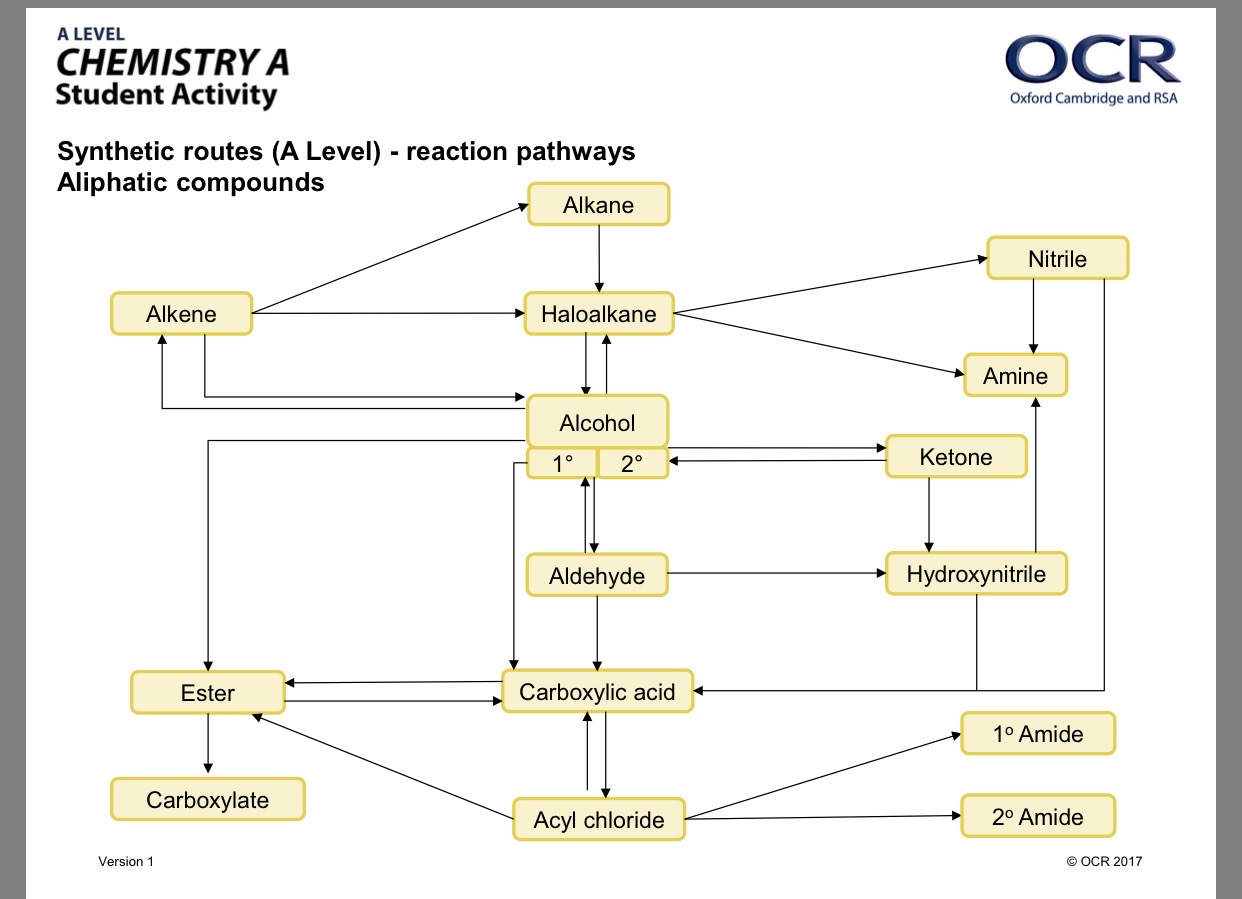
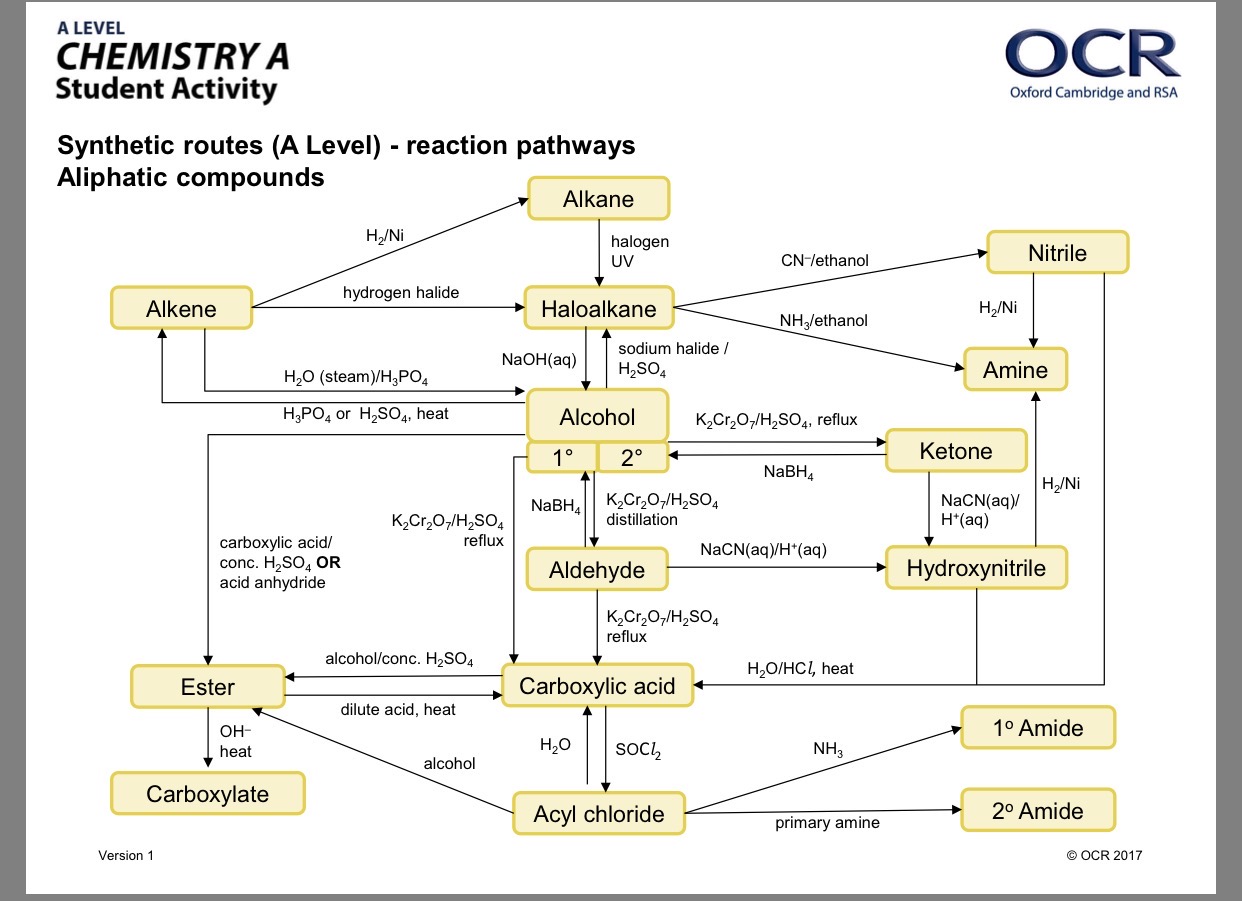
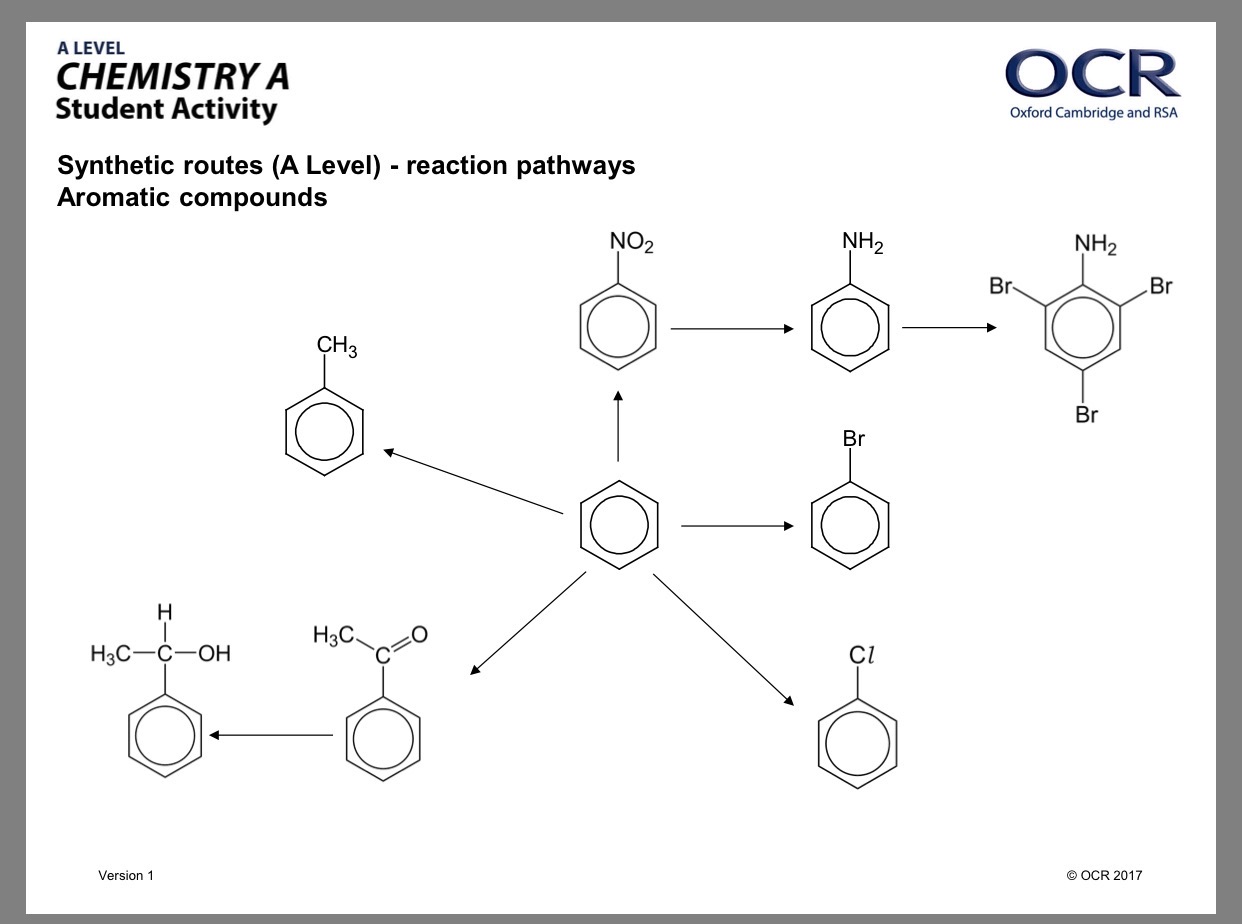
Alkane to halohalkane
Conditions: halogen, UV light
Mechanism: homolytic fission, free radical substituition
Alkene to alkane
Conditions: Nickel catalyst, Hydrogen gas
Alkene to haloalkane
Conditions: Hydrogen halide or Halogen, room temp
Mechanism: electrophilic substituition
Major products: tertiary>secondary>primady
Haloalkane to nitrle
Reagents: KCN or NaCN
Conditions: CN⁻, ethanol solvent, reflux
Mechanism: Nucleophilic substituition
Haloalkane to amine
Reagent: Ethanolic Ammonia (NH₃), test tube
Mechanism: Nucleophilic substituition
Nitrile to amine
Reagents: Hydrogen gas, Nickel catalyst
Mechanism: Reduction
Alkene to alcohol
Reagents: Steam (H₂O gas), H₃PO₄ Phosphoric acid catalyst
Conditions: 300 °C, 60 atm
Mechanism: Electrophilic addition
Alcohol to alkene
Reagents: Concentrated sulfuric/phosphoric acid
Conditions: 170 °C, Reflux
Mechanism: elimination
Haloalkane to alcohol
Reagent: NaOH
Conditions: Aqueous solution, heat under reflux
Mechanism: Nucleophilic substituition
Alcohol to haloalkane
Reagents: Sodium Halide, H₂SO₄
Conditions: Heat under reflux
Mechanism: Nucleophilic substitution
Secondary alcohol to ketone
Reagent: Acidified Potassium dichromate (K₂Cr₂O₇ / H₂SO₄)
Conditions: Heat under reflux
Mechanism: Oxidation
Colour change: Orange to Green
Ketone to secondary alcohol
Reagent: NaBH₄
Mechanism: Reduction, Nucleophilic addition
Primary alcohol to aldehyde
Reagents: Acidified Potassium dichromate (K₂Cr₂O₇ / H₂SO₄)
Conditions: Distilation
Mechanism: Oxidation
Colour change: Orange to Green
Aldehyde to primary alcohol
Reagents: NaBH₄
Conditions: Reduction
Mechanism: Nucleophilic addition
Primary alcohol to carboxylic acid
Reagents: Acidified Potassium dichromate (K₂Cr₂O₇ / H₂SO₄)
Conditions: Reflux
Mechanism: Oxidation
Colour change: Orange to Green
Alcohol to ester
Reagents: Carboxylic acid, H₂SO₄
Conditions: Reflux
Mechanism: Esterification, Condensation
Aldehyde to hydroxynitrile
Reagents: NaCN or KCN and dilute sulfuric acid
Mechanism: Nucleophilic substitution
Ketone to hydroxynitrile
Reagents: NaCN or KCN and dilute sulfuric acid
Mechanism: Nucleophilic substitution
Hydroxynitrile to amine
Reagents: Hydrogen gas, Nickel catalyst
Mechanism: Reduction
Aldehyde to carboxylic acid
Reagents: Acidified Potassium dichromate (K₂Cr₂O₇ / H₂SO₄)
Conditions: Reflux
Mechanism: Oxidation
Colour change: Orange to Green
Hydroxynitrile to carboxylic acid
Reagents: dilute sulfuric acid
Conditions: heat under reflux
Mechanism: Acid hydrolysis
Nitrile to carboxylic acid
Reagents: dilute sulfuric acid
Conditions: heat under reflux
Mechanism: Acid hydrolysis
Carboxylic acid to ester
Reagents: Alcohol, H₂SO₄
Conditions: Heat under reflux
Mechanism: Esterification
Ester to carboxylic acid
Reagents: dilute acid or dilute alkali + strong acid
Conditions: Heat under reflux
Mechanism: hydrolysis
Ester to carboxylate
Reagents: Aqueous alkali
Conditions: heat under reflux
Mechanism: Alkaline hydrolysis
Acyl chloride to ester
Reagents: Alcohol
Conditions: Room temp
Mechanism: Nucleophilic addition, Elimination, Acylation
Observed product: Dense white fumes of HCL
Acyl chloride to carboxylic acid
Reagents: water
Conditions: room temperature
Mechanism: Nucleophilic addition, elimination, hydrolysis
Observed reaction: violent reaction
Carboxylic acid to acyl chloride
Reagents: SOCl₂
Conditions: Room temp, Fume cupboard
Mechanism: Nucleophilic substituition
Observed products: Sulfur dioxide, hydrogen chloride
Acyl chloride to primary amide
Reagents: Concentrated excess Ammonia
Conditions: room temp
Mechanism: Nucleophilic addition, Elimination, Acylation
Observed products: Dense white funes of ammonium chloride
Acyl chloride to secondary amide
Reagents: Primary amide
Conditions: room temp
Mechanism: Nucleophilic addition, Elimination, Acylation
Observed products: Dense white funes of ammonium chloride
Acyl chloride to tertiary amide
Reagents: secondary amide
Conditions: room temp
Mechanism: Nucleophilic addition, Elimination, Acylation
Observed products: Dense white funes of ammonium chloride
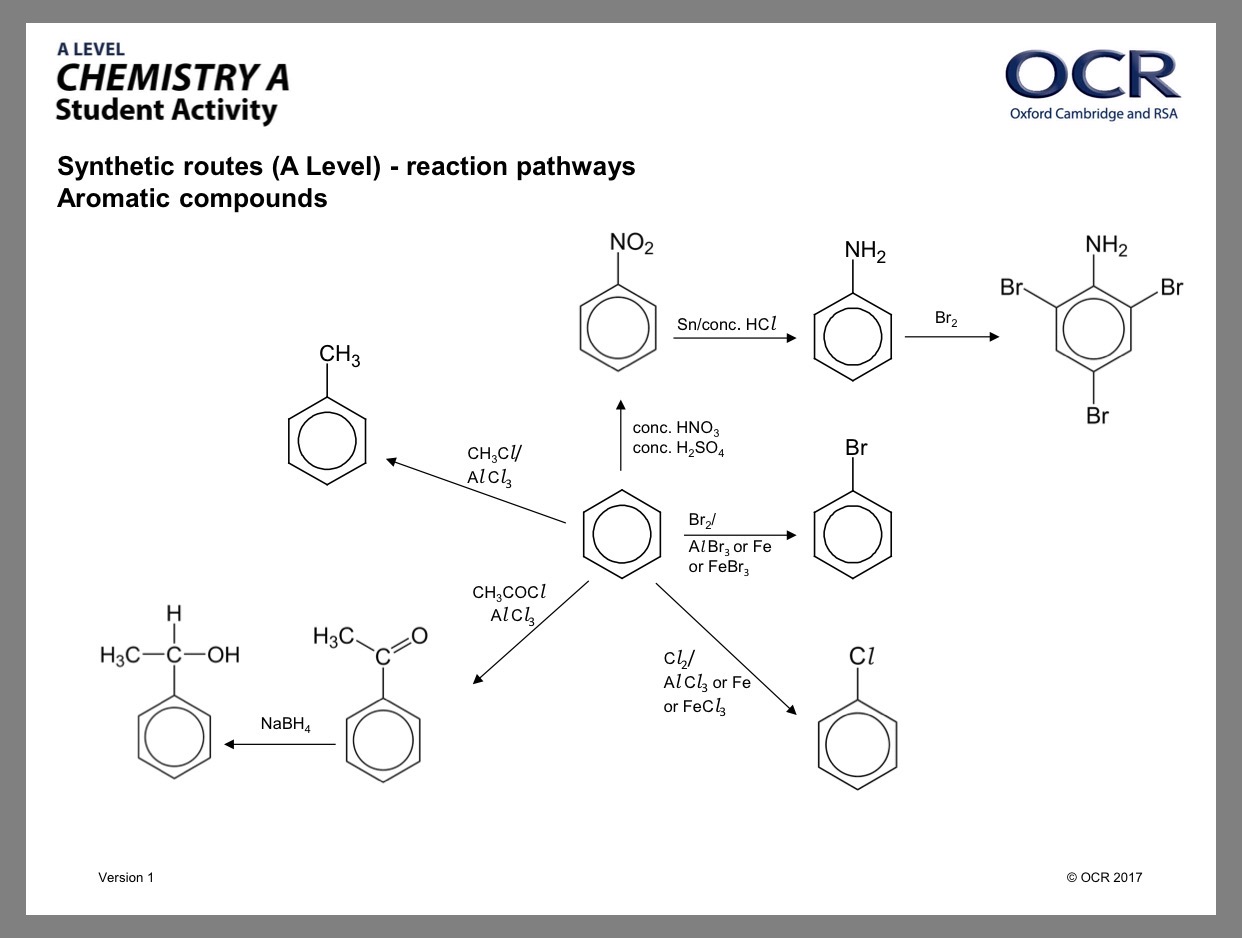
Benzene to methylbenzene
Reagents: chloromethane, AlCl₃ / FeCl₃
Conditions: room temp, reflux under heat for longer alkyl chains
Mechanism: electrophilic aromatic substituition, friedel-crafts alkylation
Benzene to phenylethanone
Reagents: ethanoyl chloride, AlCl₃ / FeCl₃
Conditions: Heat under reflux under 50 °C
Mechanism: electrophilic aromatic substituition, friedel-crafts alkylation
Phenylethanone to 1-phenylethanol
Reagents: NaBH₄
Conditions: Aqueous or alcoholic solution
Mechanism: reduction, nucleophilic addition
Benzene to halo benzene
Reagents: AlCl₃ / FeCl₃, Cl₂ for chloro benzene. AlBr₃ / FeBr₃, Br₂ For bromo be benzene
Conditions: room temp, dark so no free radical
Mechanism: electrophilic aromatic substituition
Benzene to nitro benzene
Reagents: Concentrated HNO₃, Concentrated H₂SO₄
Conditions: 50 °C to prevent further substituitions
Mechanism: Electrophilic aromatic substituition
Nitrobenzene to phenylamine
Reagents: Sn catalyst, HCL
Conditions: Heat under reflux, then adding Aqueous NaOH
Mechanism: Reduction (NO₂ to NH₂)
Phenylamine to 2,4,6-tribromophenylamine
Reagents: Bromine water
Conditions: room temp
Mechanism: Electrophilic aromatic substiution
Observed product: Bromine water decolourised. White precipitate formed
Phenylamine to phenol
Reagents: NaNO₂, HCL, H₂O
Conditions: 0–5 °C step 1, Above for step 2
Mechanism: Diazotization, hydrolysis
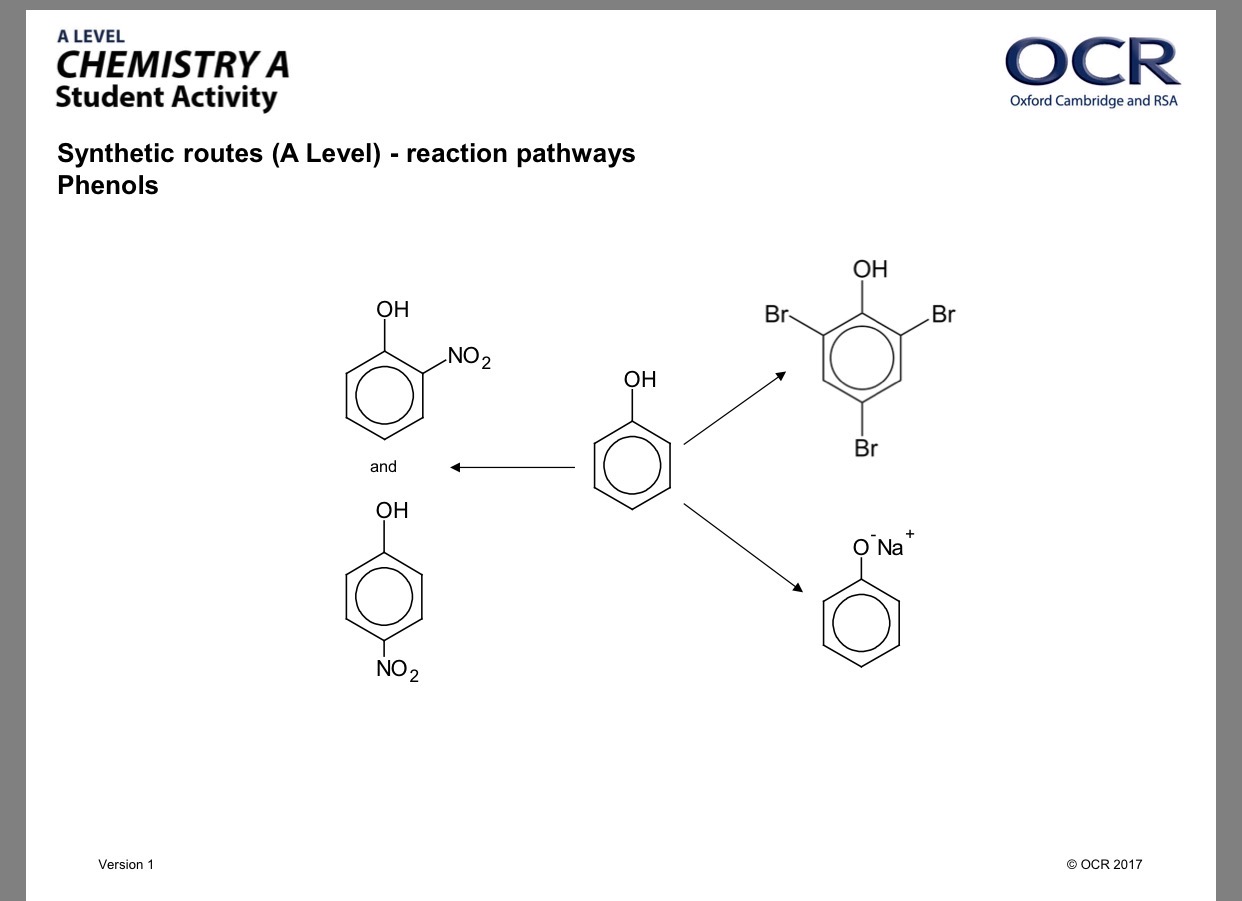
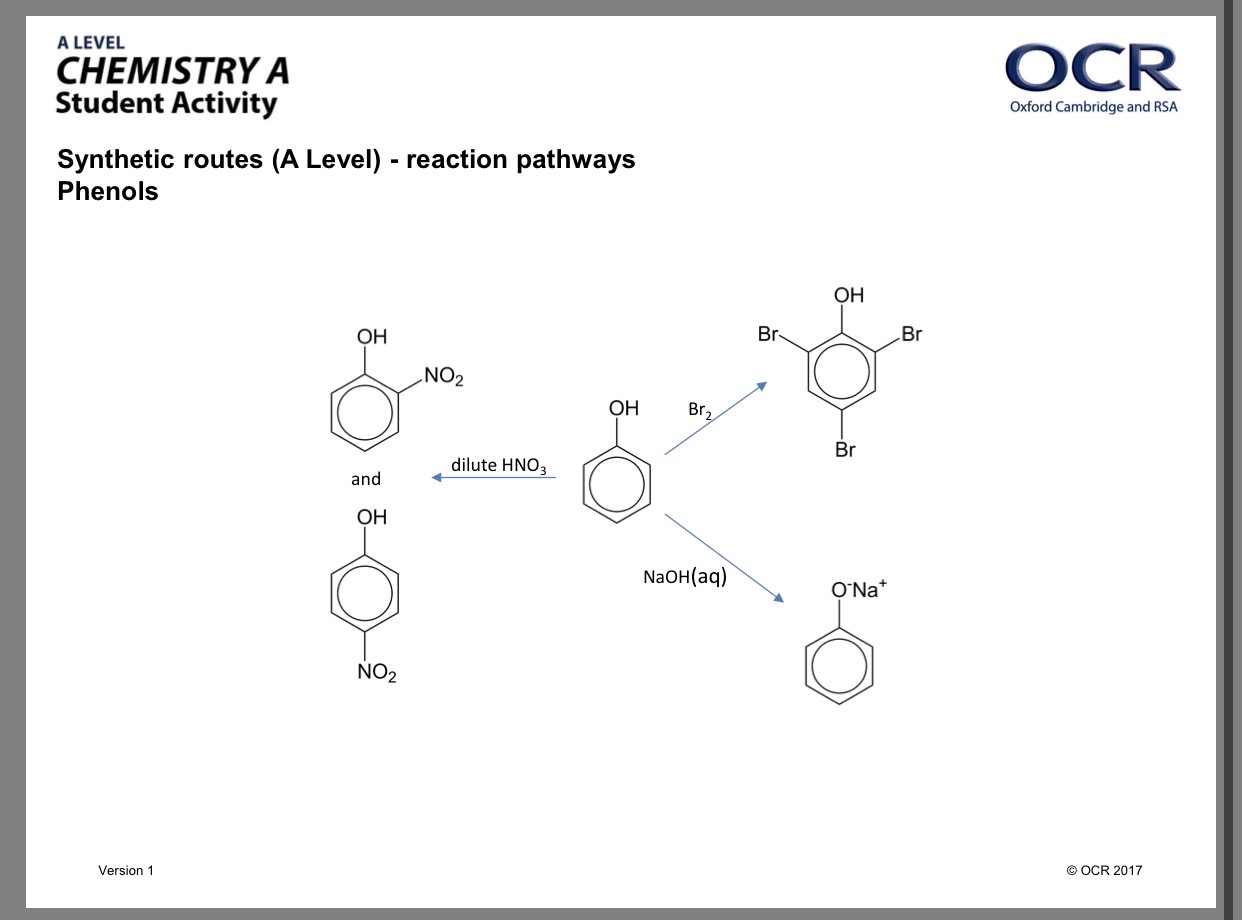
Phenol to 2-nitrophenol and 4-nitrophenol
Reagents: dilute Nitric acid
Conditions: room temp
Mechanism: Electrophilic aromatic substituition
Phenol to sodiumphenoxide
Reagents: NaOH or Na
Conditions: room temp
Mechanism: neutralisation with NaOH, redox with Na
Phenol to 2,4,6-tribromophenol
Reagents: Bromine water
Conditions:room temp
Mechanism: Electrophilic aromatic subsitution