BIOSCI 107- MODULE 4- Cellular processes
 Call Kai
 Learn
Learn Practice Test
 Spaced Repetition
 Match
Match Flashcards
 Knowt Play
1/149

There's no tags or description
Looks like no tags are added yet.
Name | Mastery | Learn | Test | Matching | Spaced | Call with Kai | Chat |
|---|
No analytics yet
Send a link to your students to track their progress
150 Terms
How big is the membrane?
8nm (8 x10 -9 metre)
Fluid mosaic model describes membrane structure as a
sea of lipids in which proteins float like icebergs
A membrane is 50% —- and 50% ——, held together by ————
Lipid, protein, hydrogen bonds
What are lipids role in the cell membrane?
barrier to entry or exit of polar substances
What are proteins role in the cell membrane?
“gatekeepers” -- regulate traffic
3 types of lipid molecules
Phospholipid, glycolipid, cholestrol
75% of lipids are —— which are ——-
Phospholipids, amphipathic (non polar and polar region)
A phospholipid bilayer has a
Hydrophobic core made from non-polar tails and a charged hydrophilic surface made from polar heads
What is a membrane leaflet?
Different sides of the membrane bilayer
Lipids rarely flip flop between membrane leaflets therefore -?
the lipid composition of the leaflets can be asymmetric
Fluidity of the membrane is determined by:
Lipid tail length, Number of double bonds, Amount of cholesterol
How does lipid tail length affect the membrane fluidity?
the longer the tail, the less fluid the membrane
How does the number of double bonds affect the membrane fluidity?
more double bonds increases fluidity, because the double bonds cause kinks
How does amount of cholestrol affect the membrane fluidity?
More decreases fluidity
Integral proteins
extend into or completely across cell membrane (transmembrane protein)
Peripheral proteins:
attached to either inner or outer surface of cell membrane and are easily removed from it
How to remove peripheral proteins?
Salt, it can change the strength of the ionic bonds, allowing peripheral membrane proteins to be stripped away
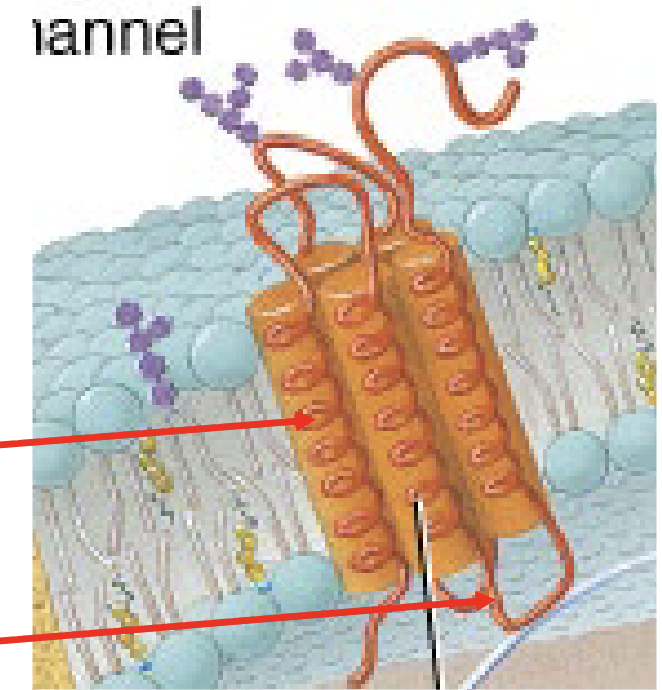
Integral membrane proteins are amphipathic meaning:
They have hydrophobic regions that span the hydrophobic core of the lipid bilayer, consisting of non polar amino acids coiled into helices. The hydrophilic ends of the proteins interact with the aqueous solution
Membrane proteins can act as:
Receptor Proteins, Cell Identity Markers, Linkers, Enzymes, Ion Channels, Transporter Proteins
The molecular organisation of the membrane results in selective permeability
the membrane allows some substances to cross but excludes others
Is the lipid bilayer permeable to uncharged molecules - O 2, N2 benzene?
Yes
Is the lipid bilayer permeable to lipid soluble molecules – steroids, fatty acids, some vitamins?
Yes
Is the lipid bilayer permeable to small uncharged polar molecules: water, urea, glycerol, CO 2?
Yes
Is the lipid bilayer permeable to ?
Is the lipid bilayer permeable to large uncharged polar molecules – glucose, amino acids?
No
Is the lipid bilayer permeable to ions – Na+ , K + , Cl -, Ca2+ , H +?
No
How do large uncharged polar molecules and ions cross the cell membrane?
Membrane proteins mediate the transport of substances across the membrane that can not permeate the hydrophobic core of the lipid bilayer
Diffusion
passive movement of particles from a region of higher concentration to a region of lower concentration until they are evenly distributed (result of the particles kinetic energy)
How does the difference in concentration affect diffusion?
greater the difference in concentration between the 2 sides of the membrane, the faster the rate of diffusion
How does the temperature affect diffusion?
the higher the temperature, the faster the rate of diffusion, therefore faster in humans than reptiles due to higher body temp
How does the size of the particle affect diffusion?
the larger the size of the diffusing substance, the slower the rate of diffusion
How does the surface area affect diffusion?
an increase in surface area, increases the rate of diffusion
How does the distance affect diffusion?
increasing diffusion distance, slows rate of diffusion, therefore across cell membranes it is quick
How does membrane thickness affect diffusion?
Thicker slows it down, therefore cell membranes are thin
How does membrane area affect diffusion?
Larger area available for exchange can increase the diffusion of a substance
What physical limit does the rate of diffusion place on cells?
Cells cannot be bigger than 20 μm
Concentration gradient
non charged molecules will diffuse down their concentration gradients
Electrical gradient
ions will be influenced by membrane potential in addition to their concentration gradient
Movement of ions will be influenced by the
electrochemical gradient (chemical and electrical combined)
What enables concentration gradients to be established?
selective permeability of the membrane
What enables an electrical gradient to be established?
Cells can maintain a difference in charged ions between the inside & outside of membrane (membrane potential)
Where is the msot sodium ions found?
Outside the cell
Where is the most potassium ions found?
Inside the cell
Explain the electrochemical gradient of Na+
Negative charge inside the cell inducing an electric gradient inwards, low concentration of Na+ ions inside cell induces a chemical gradient inwards, therefore an electrochemical gradient into the cell
Explain the gradient of K+
Leaves the cell due to concentration gradient (less k+ outside cell) until the electric gradient is stronger and stops it leaving (equilibrium, sets RMP)
Explain the gradient of Cl-
Electrical gradient pulling outwards, chemical gradient pulling inwards, direction depends on RMP, when its 80mV its at equilibrium and Cl- wont move
Cells use 30% of their energy to maintain-?
concentration and electrical gradients
Gradients represent?
stored energy
Osmosis is the
Net movement of water through a selectively permeable membrane from an area of high water concentration to an area of lower water concentration, occuring when the membrane is permeable to water but not solutes (such as in biological membranes)
If an osmotic gradient exists, what happens?
Water will move to eliminate it and maintain homeostasis
Osmotic pressure
the pressure applied to a solution to prevent the inward flow of water across a semi-permeable membrane
5 processes to cross the cell membrane
Non-mediated transport, mediated transport, passive transport, active transport, vesicular transport
Non-mediated transport
does not directly use a transport protein, instead crosses lipid bilayer
Mediated transport
moves materials with the help of transport proteins
Passive transport
moves substances down their concentration or electrochemical gradients using kinetic energy
Active transport
Uses energy to drive substances against their concentration or electrochemical gradients (Must be mediated as it needs transport proteins to occur)
Vesicular transport
Move materials across the membrane in small vesicles either by exocytosis or endocytosis
Non mediated transport : diffusion through the lipid bilayer
Important for absorption of nutrients and excretion of wastes, nonpolar, hydrophobic molecules (oxygen, carbon dioxide, nitrogen, fatty acids, steroids, small alcohols, ammonia and fat-soluble vitamins (A, E, D and K))
Why is important to phosphorylate/ remove certain substances after they diffuse into the cell?
To maintain the concentration gradient
Diffusion through ion channels is
mediated transport
How does diffusion through ion channels work?
Channels are lined with hydrophillic amino acids through the hydrophobic core of the membrane bilayer (channel has hydrophobic amino acids on the outside), shielding ions from the core and allowing them to pass, transport is slow because ions dont bind to channel
Ion selectivity
An ion channel has specific amino acids lining the pore to determine which ions pass through, enabling the channel to harness the energy stored in the different ion gradients
Channels contain gates that control the
opening and closing of the pore
What controls a channel gate opening and closing?
Different stimuli (voltage, ligand binding, cell volume, pH, phosphorylation)
How does voltage open or close a gated channel?
Through the membrane potential
How does pH open / close gated channels
affects the metabolism
How does phosphorylation affect the opening or closing of a gated channel?
Through cAMP, kinases and cascades that signal to close or open
Patch clamp technique measures
the signal from an isolated channel (helps see when open or closed)
The diffusion of over 1 million ions per second through a channel generates
a measurable current (~10 -12 amp)
Fluctuations in current measured using the patch clamp technique on a channel represents:
conformational changes in channel structure that are associated with channel gating
In Carrier mediated transport:
The substrate to be transported directly interacts with the transporter protein which undergoes a conformational change, making the transport rates slower than channel rates
Properties of carrier mediated transport
similar to enzymes (Specificity, Inhibition, Competition, Saturation)
Because transport proteins do not catalyse chemical reactions, they mediated transport across a cell membrane:
At a faster than normal rate
Mediated transport can be
Passive (facilitated) or active
Specificity
Have a binding pocket within the transport protein designed for a specific molecule
Inhibition
their activity (transport proteins) can be reduced or blocked by certain molecules.
Competition in transport proteins
Isomers of the same molecule can compete for the same binding site
Saturation (transport maximum)
all available transport proteins are occupied and working at their maximum rate.
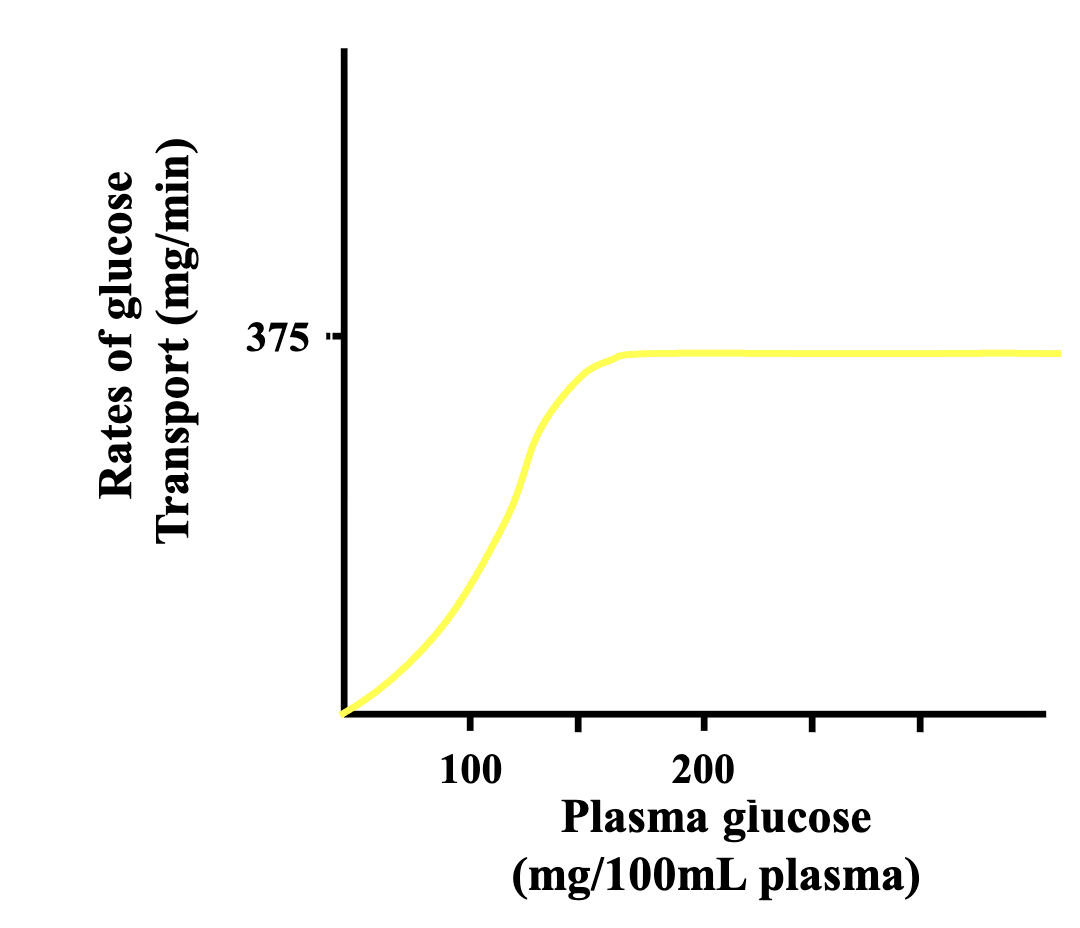
If concentration gradient increases, more ions flow through channel, eventually all channels are flowing at maximum capacity so :
saturation levels off when transport levels off
Transporters (proteins) display
enzyme kinetics
Glucose transport occurs until all binding sites are saturated, after:
theres stil an uptake but not increased uptake despite the concentration gradient still increasing
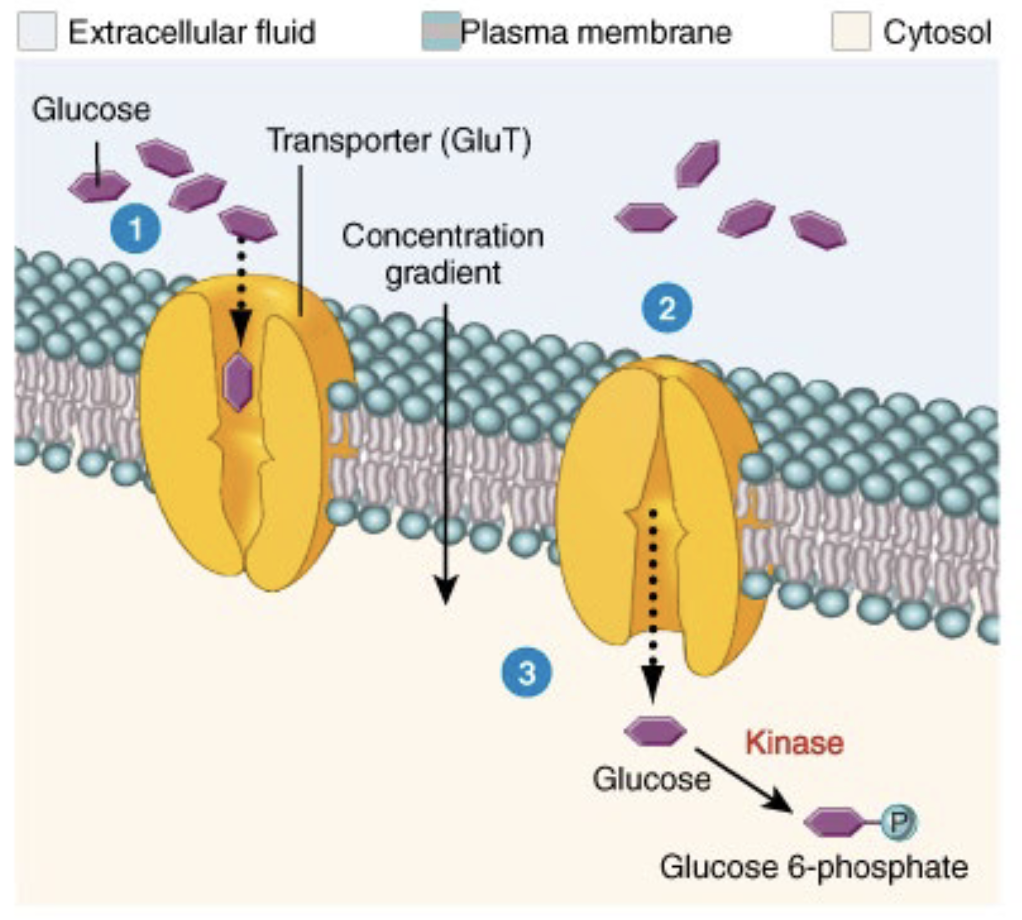
Facilitated diffusion of glucose
Glucose binds to transport protein (GLUT) which then changes shape, glucose moves down concentration gradient into cell, kinase enzyme reduces glucose concentrations inside the cell by transforming (phosphorylating) glucose into glucose-6-phosphate
Conversion of glucose concentration
maintains concentration gradient for glucose entry
Two kinds of active transport
primary and secondary
Primary active transport
energy is directly derived from the hydrolysis of ATP, a typical cell uses 30% of its energy (ATP) on primary active transport
Secondary active transport
energy stored in an ionic concentration gradient is used to drive the active transport of a molecule against its gradient
Active transport is an ——- requiring process that moves molecules and ions against their —————
energy, concentration or electrochemical gradients
Primary active transporters:
Na/KATPase
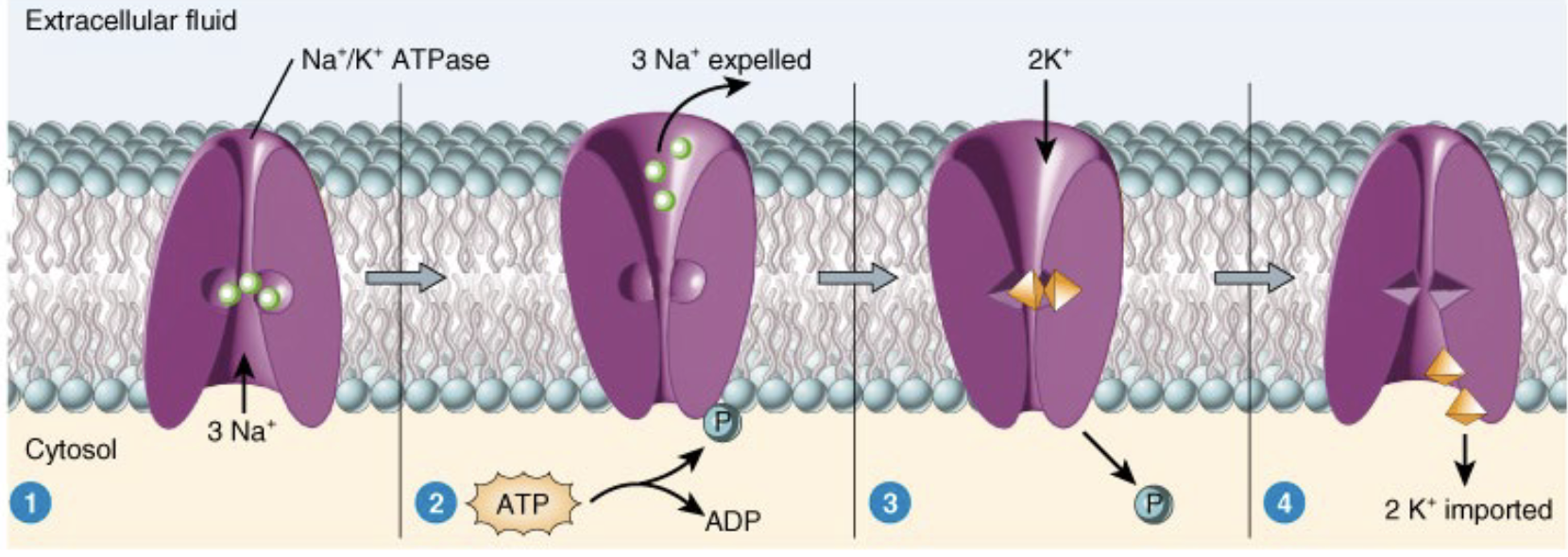
How does Primary active transporters (Na/KATPase) work?
Na+ binding, ATP split/ Na+ pushed out, K+ binding / phosphate release, K+ is pushed in
In primary active transport (NA/ KATPase specifically), 3NA+ ions are removed from the cell as:
2K+ are brought in, therefore the pump generates a nett current and is ELECTROGENIC
Other examples of primary active transport
Ca/KATPase (muscles), H/KATPase (stomach)
What does ATPase mean?
Hydrolysis of ATP
The difference in ion concentrations during primary active transport is important for:
Maintaining RMP, electrical excitability, contraction of muscle, maintenance of steady state cell volume, uptake of nutrients via secondary active transporters, maintenance of intracellular pH by secondary active transporters
Resting membrane potential is influenced by
K+ diffusion
Electrical excitability
turning on / off
contraction of muscle
inflow of Na and Ca enables contraction
Maintenance of steady state cell volume
In normal circumstances there is no change in cell volume because there is no osmotic gradient
Primary active transporters : Na Pump
The Na pump maintains a low concentration of Na + and a high concentration of K+ in the cytosol (opposing the leakage of Na and K down their concentration gradients) called the pump-leak hypothesis
Pump-leak hypothesis
Na and K are continually leaking back into the cell down their respective gradients so the pump works continuously
Secondary active transport uses energy stored in an ion gradients created by primary active transporters to
move other substances against their own concentration gradient thus these transporters indirectly use the energy obtained by hydrolysis of ATP