BIT 4474 Final Exam
 Call Kai
 Learn
Learn Practice Test
 Spaced Repetition
 Match
Match Flashcards
 Knowt Play
1/126

There's no tags or description
Looks like no tags are added yet.
Name | Mastery | Learn | Test | Matching | Spaced | Call with Kai |
|---|
No analytics yet
Send a link to your students to track their progress
127 Terms
Logistics
- The process of planning, implementing and controlling procedures for the effective transportation and storage of products/services and related information from the point of origin to the point of consumption for the purpose of conforming to customer requirements
7 Rs
- Right Product, Right Customer, Right Time, Right Place, Right Condition, Right Quantity, Right Cost
Logistics & SCM to Manufacuring/Services
- Used to generate both cost savings and service enhancements
Containerization
- Contended to be a primary driver of globalization than any other trade agreement
- Quicker, safer and more cost-effective movement of freight
- Improved productivity & scale
Product Tourism
- When there are unnecessary flows of goods to take advantage of a lower tax rate
Key Developments of Logistics/SCM
- Reduced transport intensity of freight
- Falling product prices
- Deregulation of transport
Principal Modes of Transport
- Air, Road, Water, Rail, Pipeline, & potentially Internet
Deregulation of Transport
- Removal of unnecessary barriers to entry/competition
- Increases competition within markets leading to decreased prices and improved service
Criteria Selection of Modes of Transport
- Volume and value of the freight
- Distance travelled
- Availability of different services
- Freight rates to be charged
Intermodal Transport
- The use of two or more modes to transport goods
- Freight is moving with a loading unit or intermodal transport unit (ITU)
- Reduces the amount of time the freight within the container needs to be handled (AKA freight touchpoints)
Third-Party Logistics (3PL)
- Performs one or more of the logistics activities relating to the flow of product, information, & funds that could be performed by the firm itself
Benefits of 3PL
- Expertise
- Efficiency
- Technology
- Focus on Core Competency
- Scalability - Ease in business growth
- Expansion into new markets
Disadvantages of 3PL
- Loss of control
- Cost
- Business understanding
Fourth-Party Logistics (4PL)
- Model of logistics where manufacturers outsource all the organizations and oversight of their supply chain and logistics to one external provider
- Responsible for supply chain's planning, management and design from start to end
Fifth-Party Logistics (5PL)
- Handles all the logistical needs of a company as a close strategic partner
- Focus is on leveraging technology and big data to create efficiencies
International Commercial Terms (INCOTERMS)
- The selling terms that the buyer/seller of goods both agree to during international transactions
- States when the seller's costs and risks are transferred onto the buyer
- 7 for any mode of transport, 4 for sea/inland waterway (11 rules)
Responsibilities of INCOTERMS
- Transportation (Loading, Unloading, Terminal Charges)
- Insurance
- Export/Import
- Customs
- Unloading/Delivery
NOT Responsibilities of INCOTERMS
- Address all sale conditions
- Identify the specific goods or contract price
- Payment information
- Address liability or dispute resolution if goods aren't provided according to the sales contract
INCOTERMS Summary
- EXW: The seller makes the goods available to the buyer at the seller's own premises. Everything else is taken care of by the buyer.
- FCA, FAS & FOB: The seller delivers the goods to a carrier chosen by the buyer and then is 'free' of cost and responsibility. The buyer takes ownership either at the carrier, alongside the ship or on-board.
- CFR, CIF, CPT, & CIP: The seller contracts for carriage but other costs and risks are paid for by the buyer
- DAT, DAP & DDP: The seller bears all costs and risks needed to bring the goods to the place of destination.
Sustainability
- Meeting the needs of the present generation without compromising the ability of future generations to meet their own needs
- Keeping life flourishing for as long as humanly possible
Triple Bottom Line
- Approach to measuring business performance that includes the traditional financial bottom line measured in terms of profits and losses
- Account for social responsibility measured in terms of the organization's effect on people
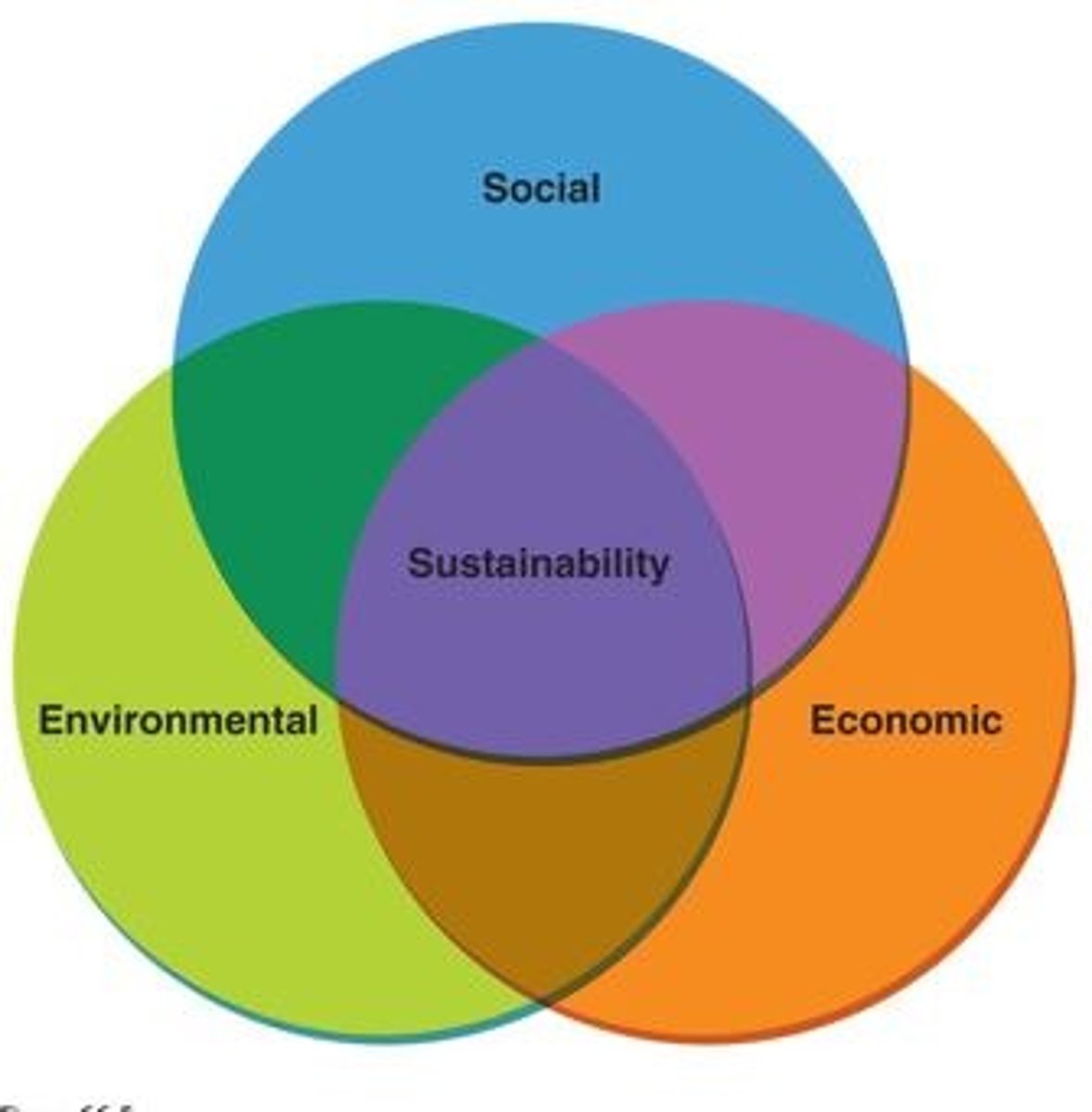
Positive Externality
- Benefit at no direct cost
Negative Externality
- A cost generated by business activity that is shifted from the business onto natural resources, populations, or third parties without consent or compensation
Externality
- Internalizing externalities is a sustainable business across all functional areas
Environmental Offsets
- Positive mitigation measures implemented to help counterbalance negative environmental impacts
Traditional vs. Ecosystem Decision Making
Traditional: Economy (65%), Society (30%), Environment (5%)
Ecosystem-Based: Economy (33%), Society (33%), Environment (33%), Sustainability (20%)
Sustainable Decision-Making
- Radical (Fundamental, root causes)
- Anticipatory (Planning for change)
- Reactive (End of pipe)
Levels of Sustainable Business Practices
- Profit
- Philanthropy
- Marketing
- Control
- Responsibility
Profit
- Motive drives the most basic level of sustainable business
- Sustainability undertaken as a defensive strategy to protect profits
Philanthropy
- Desire to promote philanthropy through charity events & collaborations with nonprofits on various social impact projects
- Donations made to these organizations may be tax-deductible
Marketing
- Companies realize the marketing value created by their preventive and philanthropic sustainability efforts from the previous two stages
- Can be used in promotional material to enhance brand loyalty and corporate reputation if they are genuine, steadfast commitments rather than one-off projects
Control
- Establishing superior control over their risks in operations and supply chains and embedding environmental management systems and corporate codes of conduct into business strategy
- Sustainable performance is benchmarked, goals are set, and performance is monitored throughout the organization and its supply chain
Responsibility
- Conceived to address the needs of civilization through their product or service offering
- Molded to be sustainable
- Businesses are willing to change their strategy to solve global and civilizational problems
Globalization
- Impacts markets, industries, and financial centers that have defined economic structures, leading to implications for many aspects of human life
Challenges of Globalization
- Irrelevancy of Nation State
- Regulatory Arbitrage (moving operations to dodge regulation)
- Under-regulated markets pose the risk of ethical violations
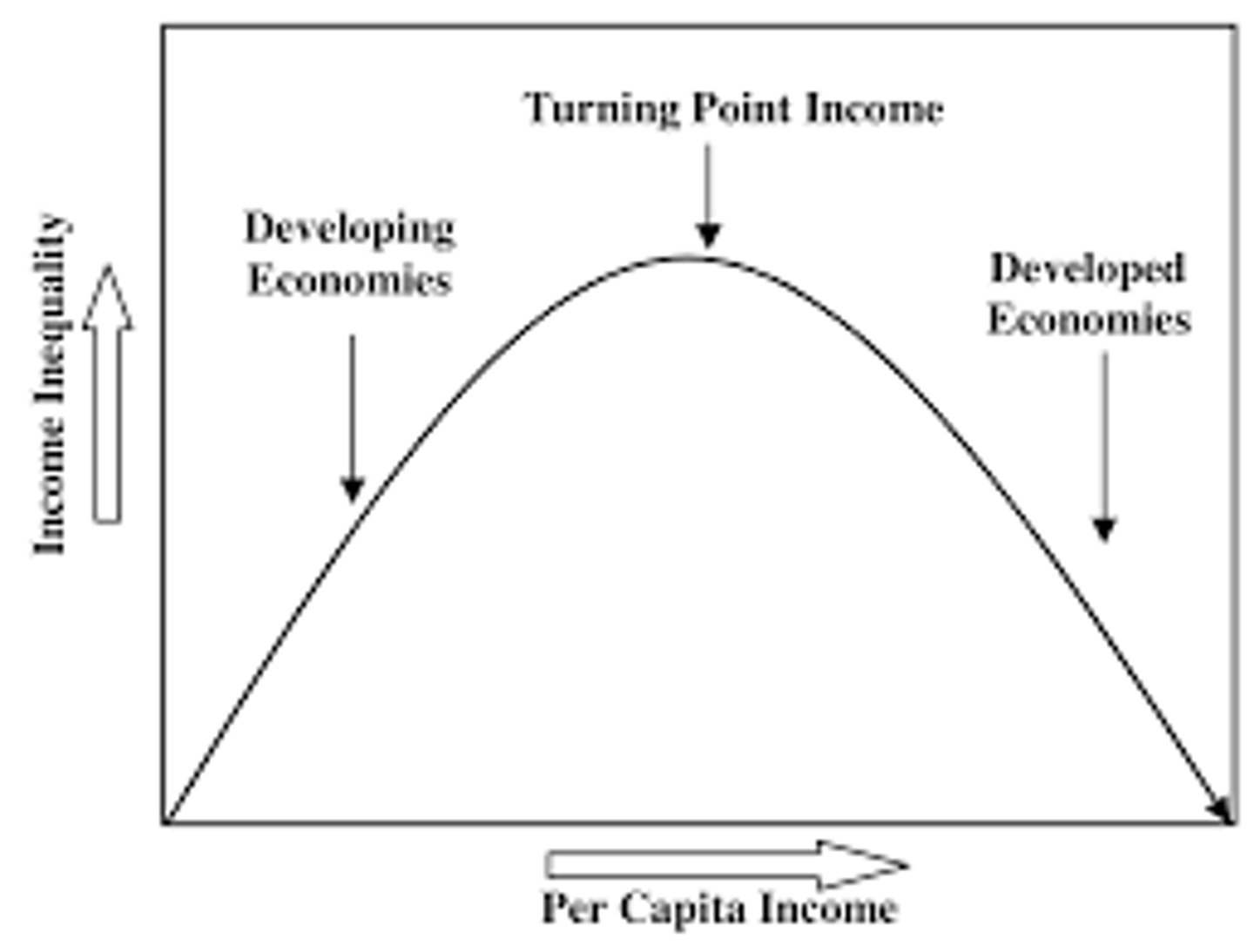
Kuznets Curve
- In the long-run, economic development reduces per-capita environmental damage
- Inverted U-shaped relationship between economic development and environmental damages
Indicators of Environmental Degradation
- Output mix (Pollution)
- Input mix (Resource Consumption)
- State of Technology (Basic or Modern)
- Scale of Production (Small Batch or Large Volume
From "Cradle-to-Grave"
- From the point of origin for raw materials through the production process and on to the point of disposal at a landfill
To "Cradle-to-Cradle"
- Extends the cradle to grave metaphor by incorporating materials back as inputs into the production process rather than diverting them as waste products
- Materials must be able to circulate through ecosystems and industrial processes in perpetuity
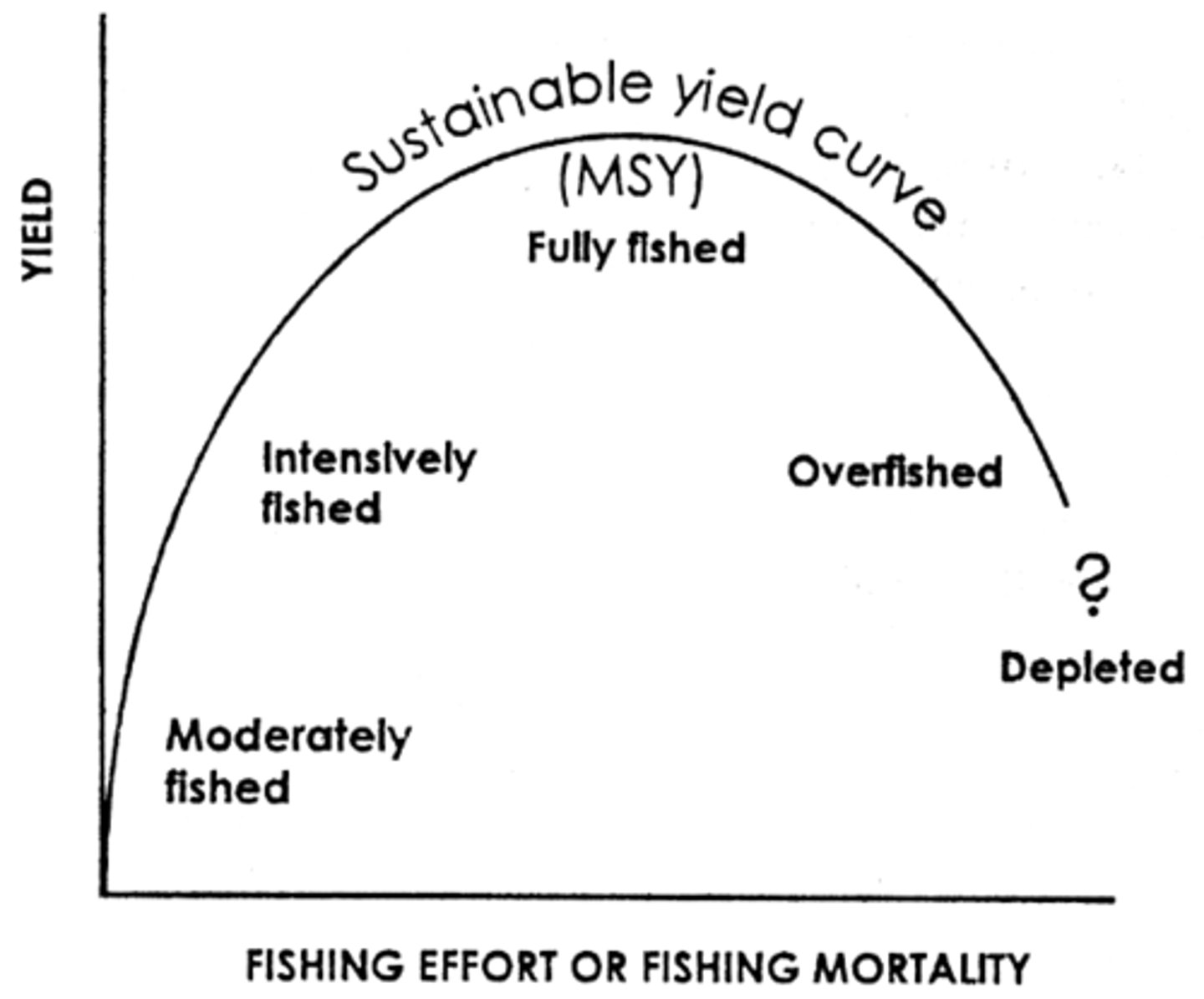
Maximum Sustainable Yield
- The exact point where we can catch as much fish as possible without depleting their population below their most productive levels
- Catching more depletes future populations and catching less sacrifices current food/income
Excludability
- Whether the public can be prevented from using the good
Rivalry
- Whether one person's use of a good reduces its availability to others
Private Goods
- Owned by one person, when consumed, reduce availability for others (Food, Clothing, Houses)
Club Goods
- Can be restricted to paying customers but used by multiple people with diminishing value (Movie Theater, Toll Road)
Public Goods
- All people can use without reducing its availability
- Typically provided by government (Roads, Parks, Public Schools)
Common Resource
- Difficult to restrict access to, but are depleted when used (Fish in ocean, Timber in Forests)
Collective Action Problem
- Situation where everyone in a group have two choices (maximize individual return or cooperate with others to maximize aggregate return)
Freeriders
- Those who benefit from the cooperation of others but are unwilling to reciprocate cooperation
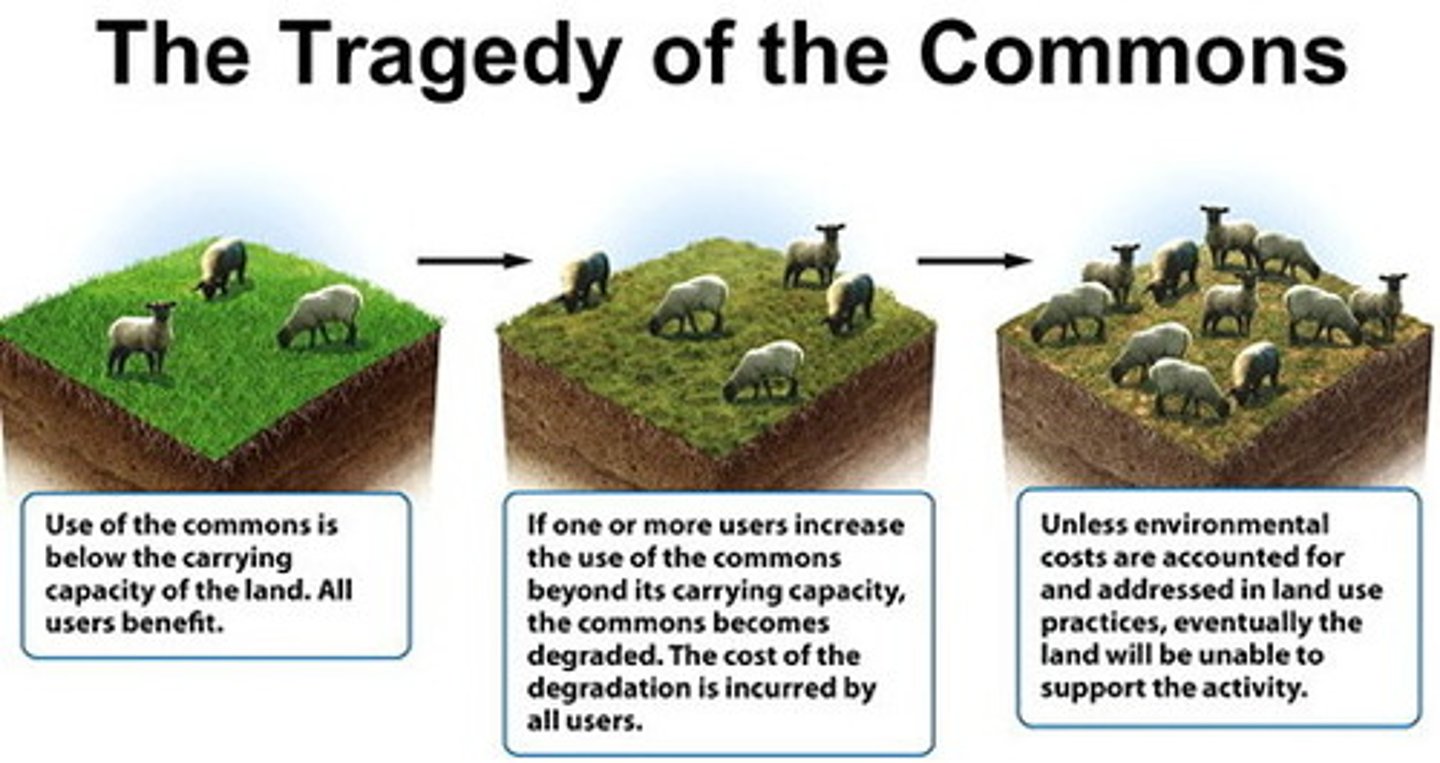
Tragedy of the Commons
- Describes a scenario where people compete with one another for use of a limited resource (Common Resource), yet there is no way to limit competitors' access to the resource
- Individuals, acting in self-interest, deplete a shared resource, despite it not being in anyone's long-term interest
Potential Solutions to Tragedy of the Commons
- Privatization (Quotas given to fishers)
- Regulation (Emissions standards)
- Market-based approaches (Taxes/Subsidies, ex. Carbon Pricing)
Corporate Social Responsibility (CSR)
- Actions of a firm to benefit society beyond the requirements of law and direct interests of firm
- Involves taking voluntary action
Self Regulation
- Socially accountability to itself, stakeholders and the public
Stakeholders
- Any individual or group who can affect or is affected by the actions, decisions, policies, practices, or goals of an organization
- Business success requires creating value for customers, suppliers, employees, communities and financiers
Types of Stake
- Ownership - A legal title to an asset or property
- Interest - When a person will be affected by a decision
- Right - A moral or legal right
Nuances of Stakeholders
- Stakeholders don't need to be shareholders
- Stakeholders can have multiple and simultaneous roles (i.e employee can be customer/shareholder)
Ethics
- Treating stakeholders with dignity and respect is ethical
- The core mission of maximizing shareholder wealth can lead to a short-term perspective
Legal vs. Ethical Compliance
- Legal standards - mandatory, baseline minimum
- Ethical standards - build on baseline
- Principles of business leader or specific organization
Shareholder
- Any person, company or other institution that owns at least one share of a company's stock
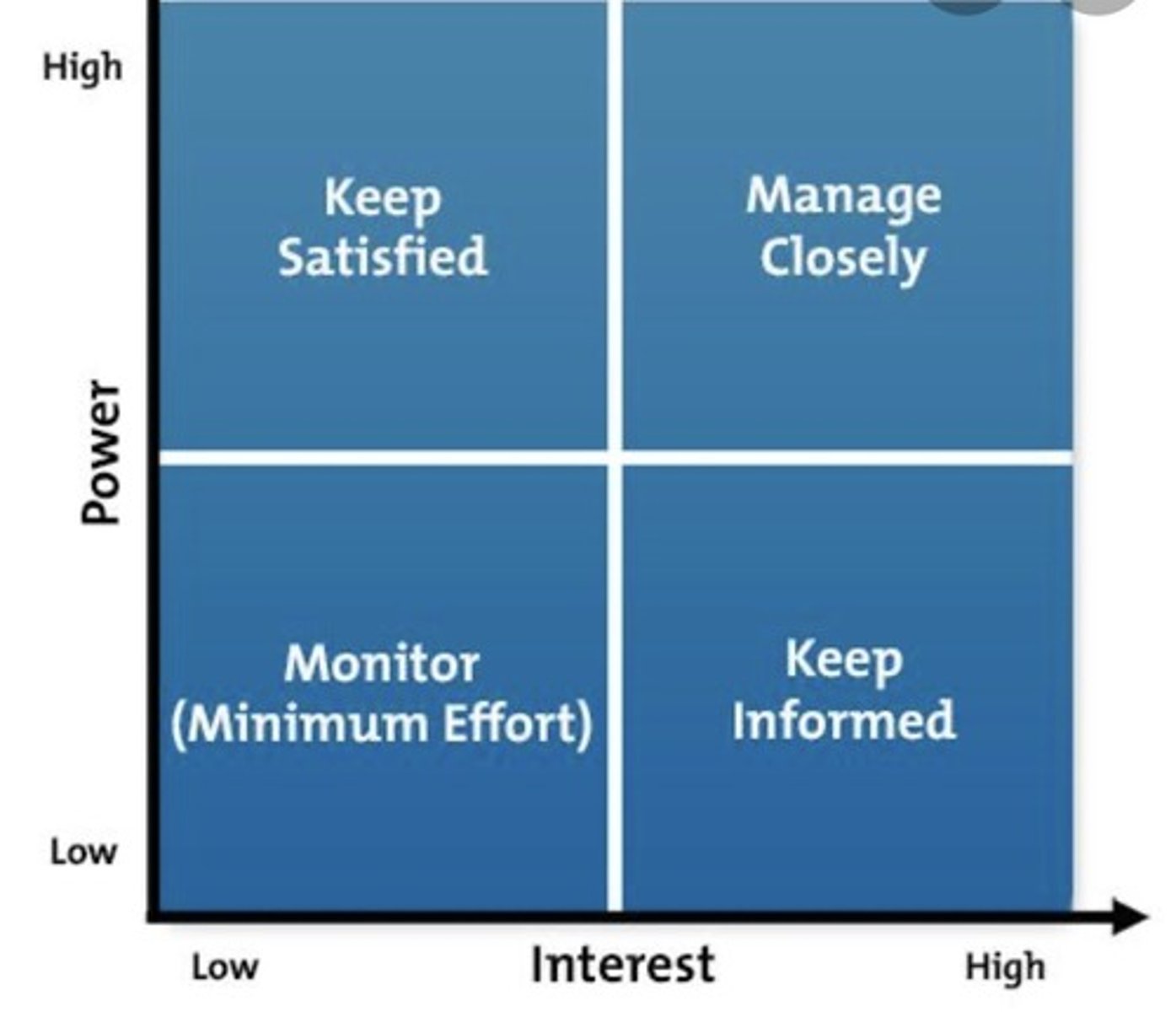
Human Rights
- Currently no universally adopted standard
- A great deal of subjectivity and culturally biased viewpoints exist
- Some basic rights: life, freedom from slavery/torture, freedom of opinion/expression
- Human rights violations still rampant globally
Non-Governmental Organization (NGO)
- Private, not-for-profit organization that seeks to serve society's interests by focusing on social, political, social justice, education, health and the environment
Major Criticisms of MNCs
- Exploitation of low-wage workers
- Environmental abuses
- Intolerable workplace standards
Response to Social Obligations
- Agreements and codes of conduct
- Maintenance of standards in domestic and global operations
- Cooperation with NGOs regarding certain social issues
Sweatshop
- A place of work, usually a factory, that abuses its workers by putting them in immoral and inhumane working conditions
Internal Stakeholders
- Board of directors responsible for defining and evaluating the ongoing mission of a business, products/services offered, salaries, overall goals
- Hires CEO, who hires executives and so on down the line
External Stakeholder
- Those outside organization who most directly influence the bottom line
- Need to be able to trust that products/services are backed by the company
- Customers and clients, suppliers, & governments
Major Challenges About Stakeholders
- Not all stakeholders agree on where the company should strive to land between ethical mins and maxes
Social Perspective
- CSR and Brand Differentiation
- Encourages customer loyalty as many customers are eager to reward value-orientated companies
- Unique selling proposition that differentiates a product/service
Social License to Operate
- The informal requirements placed upon a company by the community in a given location, over and above legal requirements for doing business
Greenwashing
- Using marketing to promote the idea that a company is more socially or environmentally friendly than it is
- Being accused of greenwashing can have long-lasting impacts to a company's reputation
Sins of Greenwashing
- Hidden Trade-Offs
- No Proof/Lying
- Vagueness
- Fake Labels
- Irrelevance
- Lesser of Two E
Sustainability Purchasing
-Sustainable or green attributes can't stand alone as reason to buy (i.e price, quality, conveinence)
Segmenting the Sustainable Product Market
- Lifestyle of Health & Sustainability (Early adopters for planet's sake)
- Naturalites (Seek safer product alternatives for household safety)
- Drifters (Driven by trends with no integration into lifestyle)
- Conventionals (Pursue as a form of cutting costs)
- Unconcerneds (Unlikely to care about sustainability)
Rewards of Sustainable Marketing
- Halo Effect: The tendency of consumers to make inferences about a company's sustainability based on very limited information
Metrics
- Standards of measurement designed to capture critical information about corporate performance in the form of objective data
- Enable companies to measure progress toward goals as well as to determine the business value of sustainability investments
Sustainability Performance Metrics
- Greenhouse Gas Emissions:
- Revenue Share from Sustainable Products
- Real-Estate Efficiency Ratio
- Human Capital Value
Greenhouse Gas Emissions
- Companies monitoring carbon emissions have shown greater financial performance than the average for Global 500 businesses
Revenue Share from Sustainable Products
- The share of annual revenue derived from investments into sustainable products or services
Real-Estate Efficiency Ratio
- Measures the amount of energy, water and resources consumed per square foot of corporate-owned real estate
Human Capital Value
- Attributing capital value to intangible benefits derived from effective HR management, instead of categorizing personnel as an expense
What to Look for in a Metric
- Different metrics and tools are appropriate for specific issues in sustainable business
- Challenge is to choose the right KPIs to serve as metrics
Qualities of Metrics
- Objective
Quantifiable
Standardized
Insightful
- Relevant
- Complete
- Consistent
- Transparent
- Accurate
Life Cycle Assessment (LCA)
- Discloses the full environmental and human health impacts of a product/service
- All stages of a product system, from raw material acquisition or natural resource production to disposal of the product at the end of its life
Steps of Life Cycle Assessment (LCA)
1) Define the Goal and Scope
2) Life-Cycle Inventory Analysis (LCI)
3) Impact Assessment
4) Interpretation
Reporting
- Horizontal View: Focused on behavior/impacts of a single entity/organization
- Vertical View: Focused on impacts associated with a product life cycle
Consumer Issues w/ Reporting
- Performance information is unavailable
- Info is too complex for nonexperts to understand
- Info unsubstantiated by evidence
Environmental Working Group (EWG)
- Mission is to empower people to live healthier lives in a healthier environment
International Organization for Standardization (ISO)
- Independent, non-governmental international organization
Global Reporting Initiative
- A framework providing comprehensive sustainability reporting metrics for organizations to promote economic, environmental and social sustainability
- Creates a global common language for organizations to report their impacts
Certification Programs
- Verification of sustainable marketing claims provided by qualified, independent, third-party entities (credibility)
- Save customers the time and effort of having to scrutinize the marketing claims of companies
Types of Certification Programs
1) Voluntary
2) Standards
3) Mandatory
Criteria that Certifications Program Should Met
- Objectivity
- Specificity
- Consistency
- Functional Equivalency
- Relevancy
- Sufficiency
- Efficacy:
Concerns w/ Sustainable Certification
1) Lack of consensus on criteria
2) Resulting consumer confusion
B Corporations (B for beneficial)
- Businesses that meet the highest standards of verified social and environmental performance, public transparency and legal accountability to balance profit and purpose
Objective Risk
- Determined by experts applying quantitative scientific means
Perceived Risk
- The imprecise and unreliable perceptions of ordinary people
Risk Attitudes
- Risk Averse: Prefers the expected value of the gamble rather than the gamble
- Risk Neutral: Indifferent
- Risk Seeking: Prefers the gamble better than the expected value of the gamble
Utility
- A measure of the relative satisfaction from the desirability of consumption of various goods and services
Process of Decision-Making
- Recognizing decisions and courses of action
- Gathering information for each course of action
- Combining information to form overall impressions of each course of action
Representation of Decision-Making
- Decision Trees: Show structure, understand all that goes into a decision
Robust Supply Chain Management
- Ability to manage regular fluctuations in demand efficiently under normal circumstances