Section One: Understanding Money Laundering
 Call Kai
 Learn
Learn Practice Test
 Spaced Repetition
 Match
Match Flashcards
 Knowt Play
1/45

Earn XP
Description and Tags
Section One: Understanding Money Laundering includes the Introduction Module and three additional modules: Module One - Placement; Module Two - Layering; Module Three - Integration.
Name | Mastery | Learn | Test | Matching | Spaced | Call with Kai |
|---|
No analytics yet
Send a link to your students to track their progress
46 Terms
What is money laundering?
Financial transactions used to conceal the source, ownership, or destination of criminal proceeds and make them appear legitimate.
What constitutes a money laundering offence under Canadian law?
Acts intended to conceal or convert proceeds of designated offences, knowing or believing they are criminal in origin.
What is a designated offence?
A serious Criminal Code or federal offence whose proceeds may be laundered.
Why is environmental crime relevant to AML?
It is a major proceeds-generating crime linked to organized crime, corruption, and money laundering.
Why do criminals launder money?
To avoid seizure, prosecution, and taxes; reinvest profits; and appear legitimate.
What is placement?
Introducing illicit funds into the financial system to make them easier to move.
What is layering?
Complex transactions designed to obscure the origin of illicit funds.
What is integration?
Making laundered funds available for use as seemingly legitimate money.
Who are Organized Crime Groups?
Structured groups, of 3 or more people, committing serious offences for financial benefit.
How do white collar professionals contribute to money laundering?
By using financial expertise, global markets, and complex structures to conceal illicit funds.
What distinguishes a Professional Money Launderer?
They specialize in laundering funds and are rarely involved in predicate crimes.
What are the societal impacts of money laundering?
Economic distortion, crime expansion, reduced tax revenue, and weakened institutions.
Why is fraud closely linked to money laundering?
Fraud generates proceeds that must be concealed and integrated.
Why are cash-intensive and complex financial sectors high risk?
They allow anonymity, rapid movement of funds, and complex ownership structures.
What are the three stages of Money Laundering?
Placement
Entry of illegal funds into the financial system
Layering
Hiding the origin of funds through multiple and/or complicated transactions
Integration
Exit of clean funds from the system without attracting suspicion
What are the Main Categories of Money Launderers?
Organized Crime Groups, White Collar Professionals, Professional Money Launderers
What are high risk sectors?
• Money Service Businesses
• Casinos
• Real estate
• Precious metals and stones
• Securities and wealth management
• Life insurance
• Mortgages
• Virtual currencies
What are the types of environmental crime?
Illegal logging, Illegal clearing, Forestry crime, Illegal mining, Waste trafficking
What techniques are used in crypto layering?
Mixers
Services that combine funds from many users and redistribute them
Tumblers
Moving funds between different cryptocurrencies (e.g., BTC → ETH → XMR)
Chain Hopping
Moving funds between different cryptocurrencies to obscure origin.
Why is Crypto used?
fast placement + powerful layering + risky integration
Money Laundering Cycle
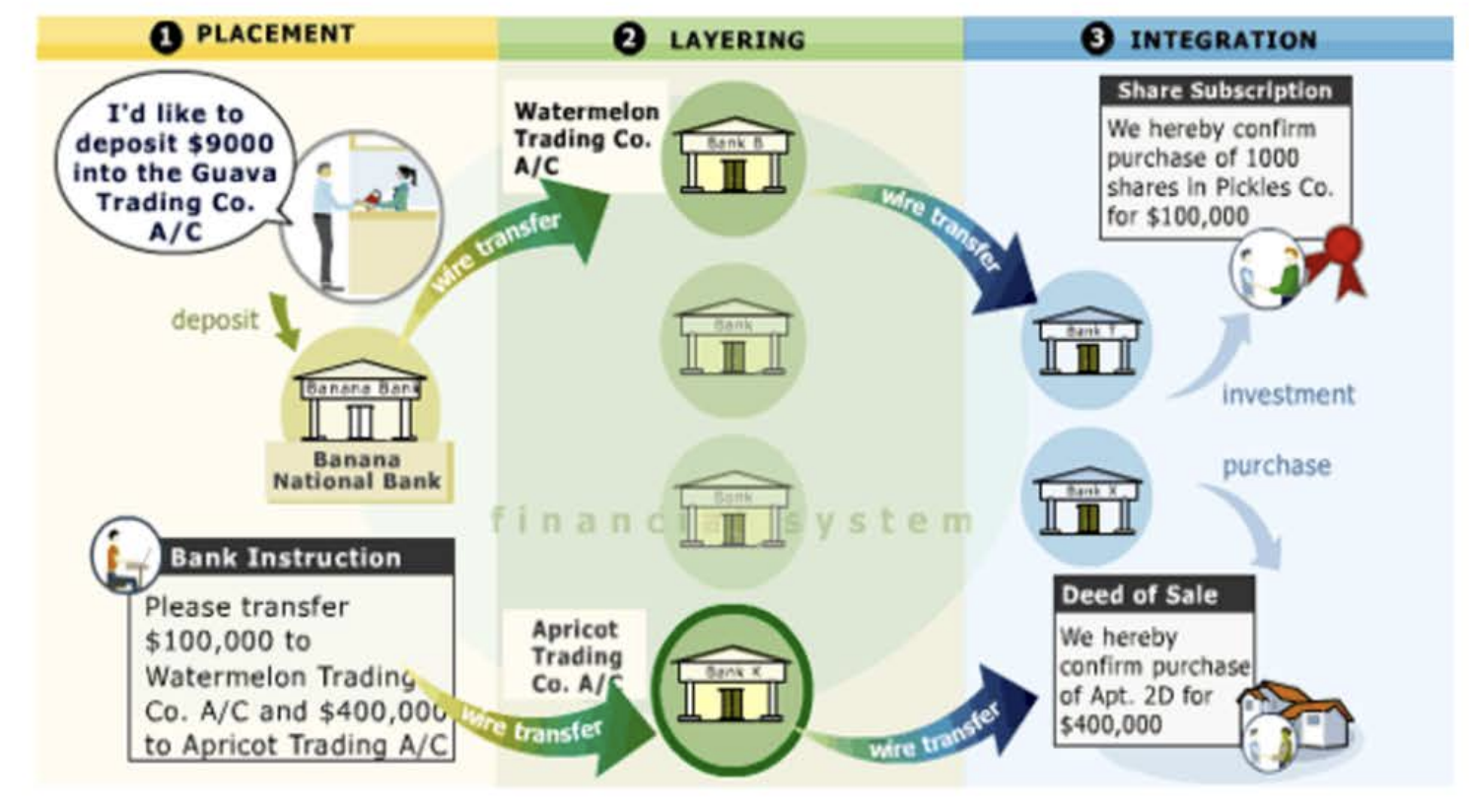
What are the impacts of Money Laundering
Undermines the economy, Makes crime pay, Attacts undesirable criminal elements, Diminishes government revenue
Why is corruption important in money laundering?
It enables criminals to bypass controls, avoid detection, and operate within legitimate systems.
How does corruption support organized crime?
By allowing criminals to influence officials, law enforcement, and businesses to avoid detection and continue operations.
What is the “iron triangle” in organized crime?
Collaboration between corrupt business leaders, government officials, and organized crime groups.
What are the professional ML categories?
Individual PML, Professional ML Org, Professional ML Network
What are common AML red flag patterns across sectors?
• Multiple accounts / transactions
• Inconsistent client information
• Anonymity / concealment
• Third-party involvement
• Unusual or illogical activity
Factors associated with suspicious chequing account activity
• Multiple accounts under different names but same control
• Shared signatories across unrelated accounts
• Similar profiles across different clients (possible structuring)
• Refusal to provide full information / false info
• Use of unrelated contact details
• Frequent changes to personal information
Factors associated with MSBs and money laundering
• High anonymity and cross-border transfers
• High or no transaction limits
• Cash converted to instruments (money orders, cards)
• Transactions inconsistent with client profile
• Transfers between multiple unrelated parties
• Use of agents / third parties
• Reluctance to provide payee details
• Suspicion of undisclosed third-party activity
• False identification
Factors associated with casinos and money laundering
• Cash-intensive environment
• High volume and frequency of transactions
• Conversion between cash, chips, and instruments
• Movement of funds in and out of financial system
• Easy mixing of illicit and legitimate funds
Factors associated with real estate transactions
• Rapid transactions without clear reason
• Repeated buying/selling with value changes
• Property value inconsistent with client profile
• Use of third parties or trusts
• Over- or under-valued transactions
• Late introduction of unknown parties
• Property subdivision or restructuring
Factors associated with financial entities and lending
• Inconsistent or incorrect loan information
• Unusual loan terms or lack of collateral
• Unknown or offshore lenders
• Complex or unjustified loan structures
• Rapid repayment after loan issuance
Factors associated with wealth management risk
• High-net-worth clients with limited transparency
• Multiple accounts across jurisdictions
• Unclear ownership (concealment)
• Preference for secrecy / confidentiality
• Use of secrecy jurisdictions
• Exposure to corruption risk
• Large cross-border fund movements
• Use of pooled/concentration accounts
• Use of credit backed by unclear assets
Factors associated with securities sector risk
• Wholesale and unregulated markets
• Investment and wealth management structures
• Bearer securities and negotiable instruments
• Use of multiple trading platforms (OTC, exchanges)
• Lack of price transparency
• Difficulty identifying beneficial ownership
• Reliance on third-party due diligence
Factors associated with accountants and AML risk
• Creation of complex structures (trusts, offshore, holding companies)
• Obscuring beneficial ownership
• Transfers between unrelated parties
• Use of third-party agents
• Non-face-to-face services
• Risk of facilitating tax evasion
Factors associated with life insurance risk
• Payments from third parties
• Large or unusual payment patterns
• Use of cash or money orders
• Payments outside normal schedule
• Early withdrawals with minimal penalty
• Use as collateral or within trusts
• Large lump sum deposits with liquidity
• “Free look” abuse (refund to third party)
• Changes in beneficiary without visibility
Factors associated with the mortgage sector and money laundering
• Use of mortgages to legitimize illicit funds
• Cash repayments (smurfing)
• Use of shell companies / nominee structures
• Lending through unregulated or hidden channels
• Same-day property flips with inflated values
• Use of straw buyers (third-party front)
• “Loan-back” schemes (criminal lending to themselves)
• Back-to-back loans using illicit funds as collateral
• Passing funds through associates to create fake loans
• Mortgage used to layer funds and obscure origin
• Potential use of funds for terrorist financing
What is a serious offence in Canadian AML context
An indictable offence punishable by five years or more imprisonment or designated by regulation