Emotion/Motivation for Quiz on 11/15 | PSYC 102
 Call Kai
 Learn
Learn Practice Test
 Spaced Repetition
 Match
Match Flashcards
 Knowt Play
1/22

There's no tags or description
Looks like no tags are added yet.
Name | Mastery | Learn | Test | Matching | Spaced | Call with Kai |
|---|
No analytics yet
Send a link to your students to track their progress
23 Terms
Emotion
a positive or negative experience that is associated with a particular pattern of physiological activity
Schacter and Singer Theory
Events --> Physiological Change --> Interpreted based off environment
- Interpretation leads to emotional response
Role of the amygdala
Fast and sensitive threat detector
- Responds before the cortex; direct pathway from the thalamus to the amygdala
Six universal Facial Expression
- Happy
- Sad
- Anger
- Afraid
- Surprise
- Disgust
facial feedback hypothesis
- Emotions cause facial expressions
- Expressions can also cause emotions
evidence that facial expressions are innate
- Cross-Cultural
- People born blind still use them
- Difficult to fake
Duchenne Smile
a genuine smile that involves crinkle around the eyes
- Controlled by a different brain area than consciously controlled muscles; remember the stroke victims
Framing Effects
People evaluate things from a reference point
- One person may be happy with a B on an exam, yet another person may be unhappy
Motivation
Factors that initiate, direct, and sustain goal-directed behavior over time.
Issues with studying motivation
- Can't observe/measure it
- Can ask people about motivations but they could lie or not know their motivations
- hard to induce motivation in another
Drive Reduction Theory
Need to maintain physiological balance; homeostasis
- When balance of our physiological setpoint, we are driven to restore it
Primary Drives
- Food
- Water
- Shelter
- Sleep
Secondary Drives
Money
- Things that allow us to obtain primary drives
Arousal Theory
Everyone has an optimal level of physiological arousal; this varies from person to person
- We are motivated to maintain our optimal level of arousal
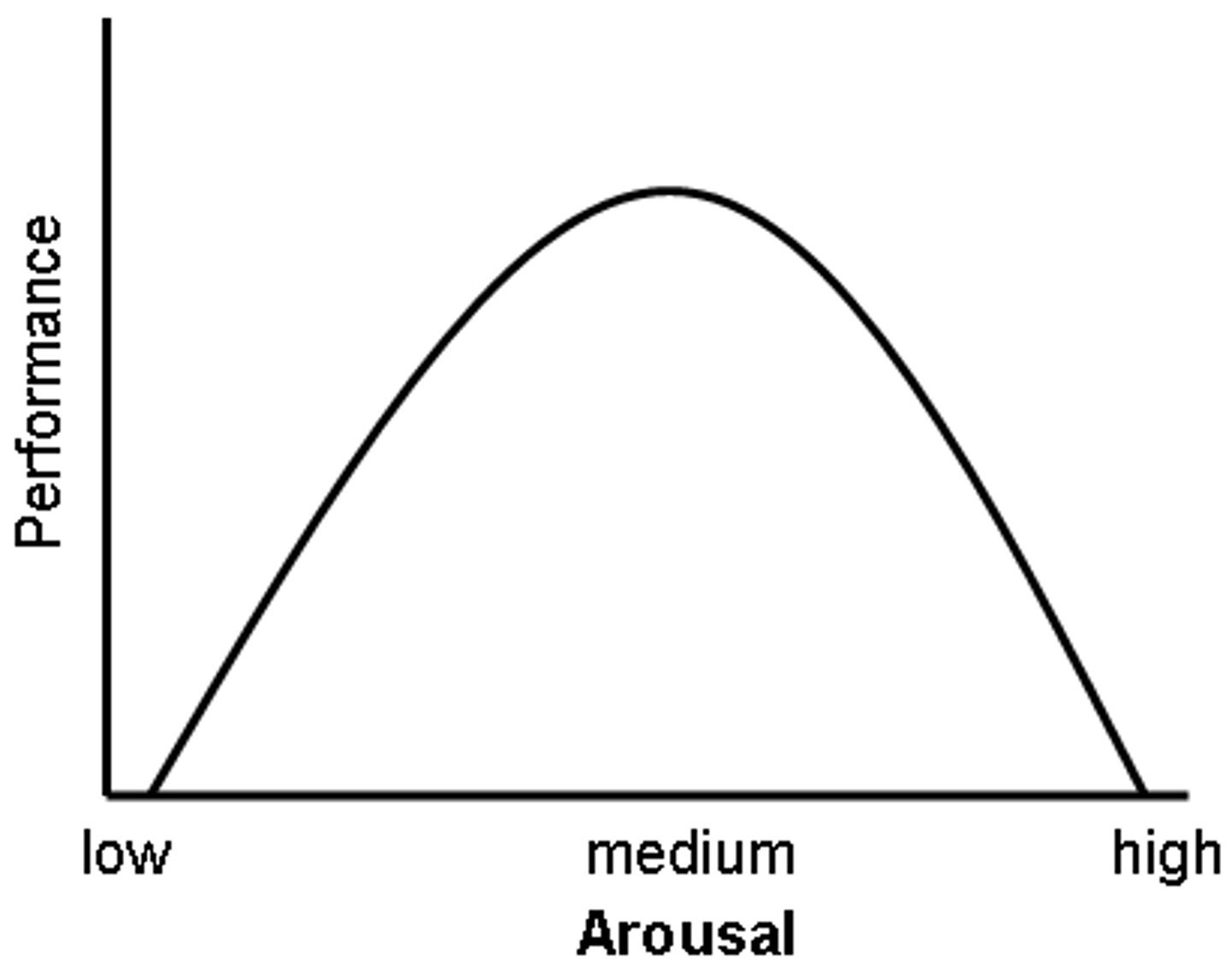
Yerkes-Dodson Law
Low and High arousal leads to poor performance; we need to be somewhere in the middle
Incentive Theory
Motivated from the lure of rewards or threat of punishment
- Strength of the incentive is very important
- Remember: something that is an incentive to one person may not be for another
Characteristics of people with high need for achievement
- Set challenging but realistic goals
- Seek success and are very satisfied by it
- Risk failure
- Want to do things themselves
- Want feedback from competent critics
Characteristics of people with low need for achievement
- Less satisfied by success
- Want to avoid failure
Physiological needs (Maslow's Hierarchy of Needs)
food, water, warmth, rest, shelter
Safety and Security needs (Maslow's Hierarchy of Needs)
Health, employment, property, social ability
Love and belongingness needs (Maslow's Hierarchy of Needs)
Intimate relationships, friends, family
Esteem needs (Maslow's Hierarchy of Needs)
prestige and feeling of accomplishment
Self-Actualization (Maslow's Hierarchy of Needs)
achieving one's full potential, including creative activities