CSB111 Study Guide: Health Concepts and Healthcare Systems
 Call Kai
 Learn
Learn Practice Test
 Spaced Repetition
 Match
Match Flashcards
 Knowt Play
1/150

There's no tags or description
Looks like no tags are added yet.
Name | Mastery | Learn | Test | Matching | Spaced | Call with Kai |
|---|
No analytics yet
Send a link to your students to track their progress
151 Terms
Definition of Health
a state of complete physical, mental and social well-being and not merely the absence of disease or infirmity (World Health Organisation)
Definition of Healthcare
The maintenance or improvement of health via the prevention, diagnosis, treatment, recovery, or cure of disease, illness, injury, and other physical and mental impairments in people.
Definition of digital Health
An umbrella term referring to a range of technologies that can be used to treat patients, promote wellness, and collect and share a person's health information.
definition of One Health
A collaborative, multi-sectoral, and transdisciplinary approach - connects people, animals, plants, and the environment to protect health at all levels — local to global.
Health Literacy
The accessibility of health information and how well it is communicated, understood, interpreted and acted on.
Individual health literacy
Individual skills, such as the ability to find, understand and use health information
e.g.) to complete health care forms or understand and use the health care system.
Health literacy environment
Health system-based elements, such as policies, processes, and materials, that affect the way individuals engage with the healthcare system.
Determinants of Health
Factors that influence health outcomes, categorized into upstream, midstream, and downstream factors.
Upstream Factors
Structural elements such as culture, language affluence, social inclusion, discrimination, political structures, public policy decisions, commercial practices, and media.
Health behaviors
Behaviors that affect health, including tobacco and e-cigarette use, alcohol use, physical activity, dietary behavior, illicit drug use, sexual practices, sleep, and vaccinations.
Biological factors
Physical health indicators such as body weight, blood pressure, blood cholesterol, immune status, and gut microbiome.
Environmental factors
Elements that impact health, including natural and built environments, climate change, and geographic location.
Psychosocial factors
Factors that relate to psychological and social aspects, including stress, trauma, isolation, loneliness, and resilience.
Socioeconomic factors
Factors related to social and economic status, including education, employment, income, family, neighborhood, early childhood experiences, housing, support networks, access to services, digital inclusion, food and nutrition, and security.
Safety factors
Elements that contribute to health risks, including risk-taking behaviors, experience of violence, and occupational risks.
Knowledge, Attitudes, and beliefs
Concepts related to health literacy and health beliefs.
Biopsychosocial (BPS) Model
A model of health that includes biological, psychosocial, and social components.
Aboriginal Model
A model of health that encompasses physical health, emotional and social health, spiritual health, cultural health, environmental health, and community health.
Primary Services
Health services that provide first contact care, such as general practice and community health services.
Secondary Services
Health services that provide specialized care beyond the scope of primary care, such as specialist care and hospital outpatient clinics.
Tertiary Services
Advanced medical and surgical procedures for complex or severe health conditions, including specialized hospitals.
Primary Care
The first point of contact for individuals seeking healthcare, providing continuous care for a wide range of health issues.
Urgent Care
Medical attention for illnesses or injuries that require prompt attention but do not warrant an ER visit.
Emergency Care
Care for severe or life-threatening conditions that require immediate attention.
Medicare
A public health insurance scheme primarily funded through taxation that ensures automatic enrollment for eligible individuals, offering free public hospital care and substantial coverage for GP and specialist services.
Pharmaceutical Benefits Scheme
A scheme that subsidizes the cost of over 5,200 prescription medicines as part of Medicare.
Private Health
Insurance that covers services not fully covered by Medicare, such as private hospital care and dental services.
Role of the Government in the Healthcare System
Includes creating laws, developing health policies, funding medical services, regulating medicines, and maintaining the number of doctors.
Challenges Facing the Healthcare System
ageing population, rising rates of chronic disease, cost of medical research, integration of health technologies, environmental sustainability, and structural challenges.
Role of AHPRA
The regulatory role of the Australian Health Practitioner Regulation Agency, including policy advice, registration of health practitioners, and monitoring compliance.
AHPRA's Registration Requirements
Requirements for registration including qualifications, health impairments disclosure, criminal history checks, English language competency, and professional indemnity insurance.
Patient Centered Care
An approach to healthcare that emphasizes the patient's preferences, needs, and values.
Interprofessional collaborative care
The patient specific multidisciplinary team of health care professionals.
Benefits of interprofessional collaborative care
Provision of specialized knowledge, coordinated care and collaborative decision making/shared decision making, holistic care, patient centered care, improved continuity of care, improved satisfaction of patients and carers.
Roles of interprofessional practice and multidisciplinary team
Identifying current physical and mobility status, ascertaining the patients' goals, collecting patients' social history and home set-up, creating ongoing treatment/care plan, management advice, participate in family meetings, training for families and carers, community referrals.
Patient progression
The advancement of a hospitalized patient through the required care events, actions, and processes to achieve a health status where the patient can be safely and appropriately transitioned to a lower level of care.
Examples of patient progression
Emergency department to intensive care unit, emergency department to ward, intensive care unit to ward, operating theaters to ward, ward to transit lounge.
Preadmission
Initial contact with healthcare system, can be elective or non-elective.
Elective pre-admission
When there is a planned procedure, often by a general practitioner, such as planned knee surgery, scheduled colonoscopy, planned caesarean section.
Non-elective pre-admission
When a patient self refers themselves due to infection, mental health, lack of access to primary care, financial considerations, and minor ailments.
Admission
Where the hospital accepts responsibility for the patient's care and/or treatment interview, assessment, and clinical decision to determine the care a patient needs.
Non-elective admission
Depends on:
A patient's capacity, a bed in an appropriate clinical area, length of admission, doctor, nurse admission, discharge planning
Elective admission
Often done on the morning of surgery, work up done pre-admission clinic admissions desk, theoretically controlled and calmer, often straight to holding before theatre
Diagnostic phase
Typically takes place when the patient is an inpatient and has the purpose of figuring out what disease or condition they have, based on their signs and symptoms.
Diagnosis - Non-analytic
A rapid, subconscious, pattern recognition developed through clinical experience and other non-clinical learning experience.
Diagnosis - Analytic
When patient presentation is complicated or does not fit a known disease pattern.
Treatment phase
Development of a treatment plan based on the patient's diagnosis, including medication administration and dose adjustments.
Monitoring and evaluation phase
Where vital signs continue to be monitored, and clinical observations are made to determine the patient's current condition.
Progress notes
Documenting patients' response to treatment.
Multidisciplinary team rounds
Meetings to discuss progress and review the plan.
Transition OF care
The process of transferring a patient from one level of care to another.
Transfer of care
Occurs when a patient moves between locations or contacts a different healthcare professional.
Australian Commission on Safety and Quality in Healthcare
Leads and coordinates national initiatives to reduce harm associated with transitions of care.
Transitions IN care
Typically increase as a patient's condition becomes more complex.
Vulnerable populations at risk during transitions
Include elderly, disabled, and those with chronic and complex conditions.
Medication errors during transitions of care
More than 50% of medication errors occur during transitions.
Adverse events after discharge
20% of patients experience an adverse event after 3 weeks of discharge.
Pending test results post-discharge
40% of patients had pending test results, 10% of which needed action.
Safety Issues at the transition of care
Include poorly defined models of person-centered care and inadequate discharge planning.
Benefits of digital health
Include real-time patient information, safer care, less paperwork, and improved efficiency.
examples of digital health
electronic health record - stores patient health information.
telehealth - Consultations through video or phone
electronic prescription - Involves real-time prescription monitoring.
Hospital discharge summary
A comprehensive document outlining all pertinent details of a patient's hospital stay.
Importance of hospital discharge summaries
Serves as a key communication tool that ensures continuity of care.
Electronic discharge summaries
Include patient details, hospital/provider details, clinical summary, allergies, medications, recommendations, and follow-up information.
Continuity of care
The ongoing process of care that ensures patients receive appropriate services over time.
Medicare benefits schedule (MBS)
A funding model that outlines the benefits provided under Medicare for various healthcare services.
Pharmaceutical benefits scheme (PBS)
A funding model that provides subsidized prescription medications to residents of Australia.
National immunization program (NIP)
A funding model aimed at providing vaccinations to protect against various diseases.
National disability insurance scheme (NDIS)
A funding model that provides support to Australians with disabilities, their families, and carers.
National diabetes services scheme (NDSS)
A funding model that provides support and services for people with diabetes.
Value Based Healthcare
A healthcare approach that focuses on improving patient outcomes while maximizing the value of healthcare resources.
value of care resources
Cost minimization - reducing costs while maintaining quality.
Cost effectiveness - evaluates the relative costs and outcomes of different interventions.
Reducing low value care- objective to minimize healthcare services that provide little or no benefit to patients.
Focus on prevention - preventing diseases rather than treating them.
Team-based care - healthcare providers work collaboratively to deliver care.
Patient experience or satisfaction - measure of how patients perceive their healthcare experience & quality of care received.
Interprofessional Collaborative Practice (ICP)
A framework that includes mutual respect, shared values, and effective communication among healthcare professionals.
Value/ethics (ICP)
Emphasizes mutual respect and shared values while working with individuals in other professions.
Roles/responsibilities (ICP)
Involves using knowledge of one's own role and those from other professions to provide effective care.
Interprofessional communication (ICP)
Focuses on communicating with consumers and health workers in a responsive and responsible manner.
Teams/team functioning (ICP)
Emphasizes working effectively in different team roles to plan, deliver, and evaluate effective person-centred care.
Interprofessional Education (IPE)
Collaborative learning either 'about', 'from', and with each other to improve patient care.
Primary sources
Original work such as autobiographies, raw data, and firsthand observations.
Secondary sources
Sources that analyze or interpret primary sources such as journal articles, textbooks, or biographies.
Tertiary sources
Sources that compile data on a particular topic such as literature reviews and encyclopedias.
Grey literature
Sources that are not published by academic journals or traditional publishers, often high quality and include government reports and research reports.
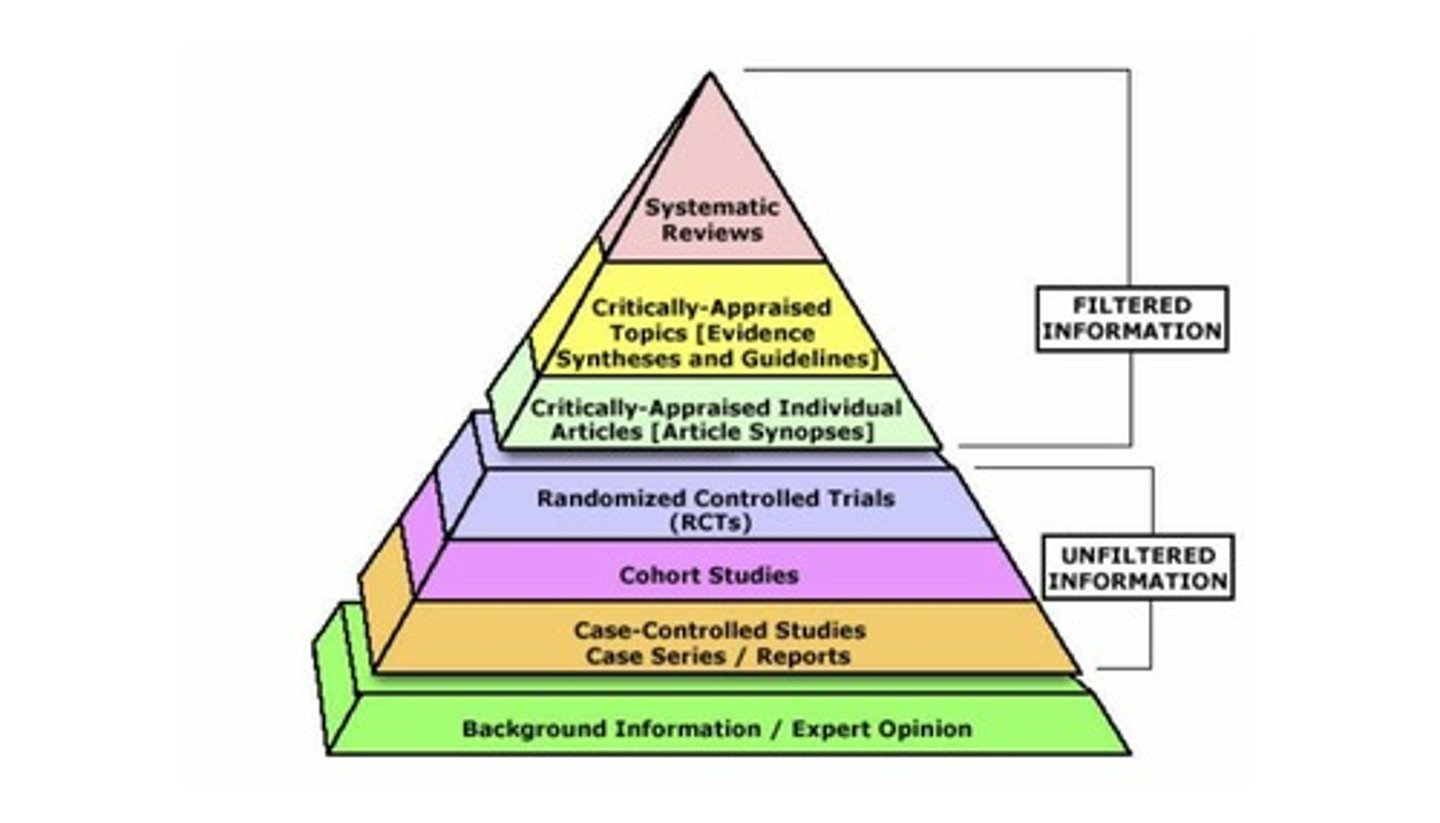
The pyramid of evidence
A visual representation of different levels of evidence to assess the strength of research findings and guide decision making.
Vancouver referencing style
A referencing style where in-text citations are indicated by superscript and the reference list includes author, year, title, place of publication, and publisher.
QUT's 4/5R's Model
A model for reflection that includes Reporting, Responding, Relating, Reasoning, and Reconstructing.
Principal 1 of the Code of Conduct
States that a practitioner must 'put patients first' and provide safe, effective, and collaborative practice.
Deontology
Based on the idea that uses rules to distinguish between right and wrong rather than the consequences.
Consequentialism
Uses the consequences of an action to determine between right and wrong
(may be assessed in a way that asks to compare the difference between deontology)
Autonomy
Refers to the patient being able to act 'autonomously', allowing the patient to make up their mind regarding what is best for themselves.
The patient has to have the mental capacity and sound mind to understand the information.
Beneficence
Refers to doing all within your power to provide maximum benefits to the patient, 'seeking to benefit others'.
Confidentiality
Rules set out to limit access to information discussed between patient and practitioner. As a healthcare professional you are obligated to maintain the confidentiality of a patient.
Equity vs Equality
Equity refers to providing patients what they need (whether it is the same or not) to achieve an equal outcome (inequity = difference)
Equality refers to providing patients the same resources no matter their situation (inequality = disadvantage)
Fidelity
Refers to the duty of care a health practitioner has for their patient.
Justice
Refers to the fairness and even distribution of resources, time, care, and concern.
Non-maleficence
duty to do no harm, provide a safe environment
Examples of Beneficence
Resuscitating a patient, encouraging a patient to quit smoking, and spending equal time and effort on a patient task regardless of their health insurance status.
What does beneficence include (3)?
Allocation of resources & technical factors, personal attitude towards patients, protecting and defending the rights of patients
Duty of Care
A health practitioner must provide the patient with the highest standard of care possible.
Equality of Healthcare
Equality of healthcare for all regardless of age, race, gender, religion, and social status.
Due Care
This includes taking all due care to provide the patient with the best outcome without harming them.