Clinical Use of Bases and Liners
 Call Kai
 Learn
Learn Practice Test
 Spaced Repetition
 Match
Match Flashcards
 Knowt Play
1/78

There's no tags or description
Looks like no tags are added yet.
Name | Mastery | Learn | Test | Matching | Spaced | Call with Kai |
|---|
No analytics yet
Send a link to your students to track their progress
79 Terms
What are the 5 main reasons to use dentin sealers, liners and bases?
* Seal the dentinal tubules to limit fluid movement and decrease sensitivity.
* Seal the dentinal tubules to limit external insult from restorative materials (acids) and bacteria.
* Pulpal medication CaOH and eugenol
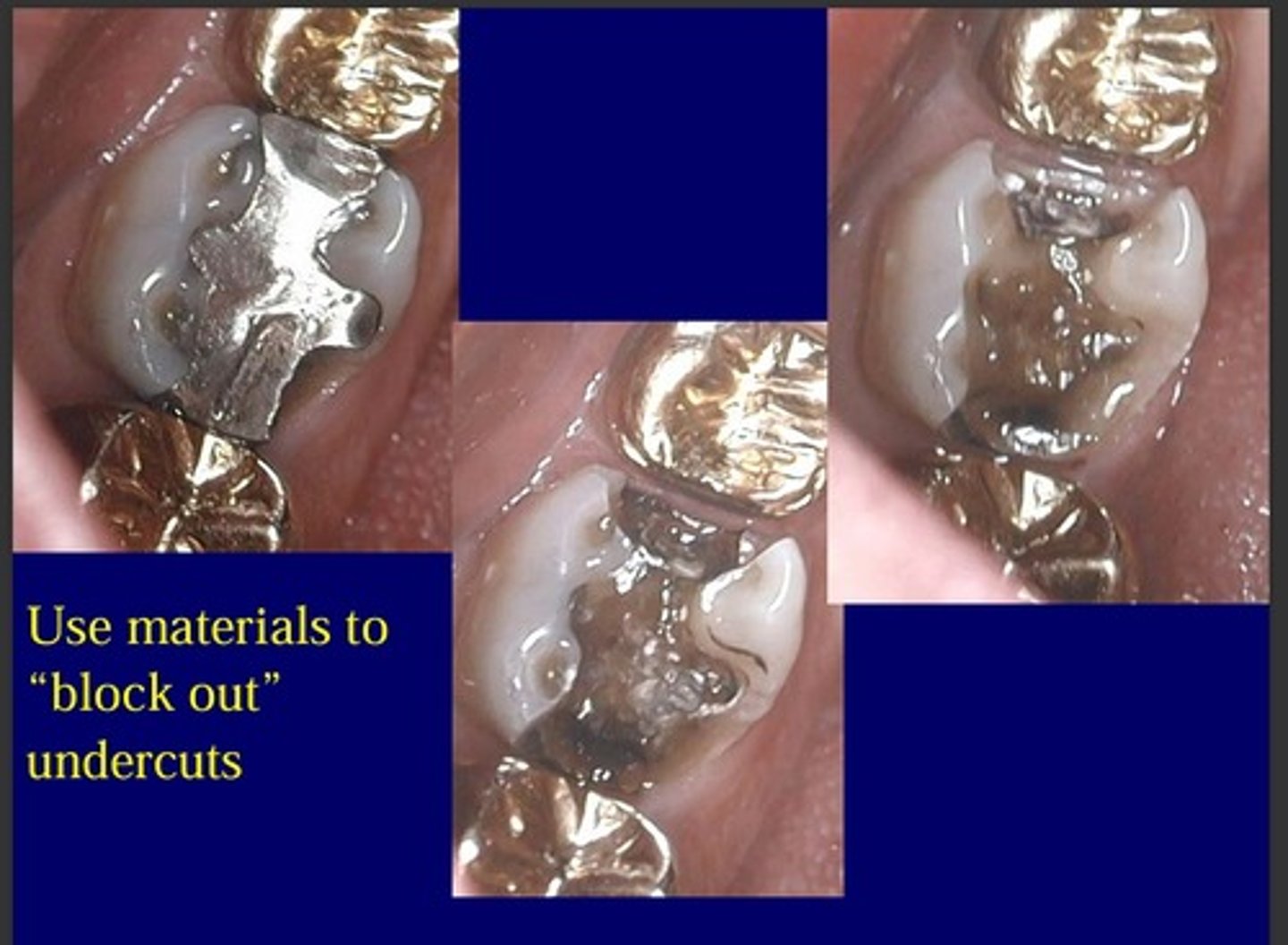
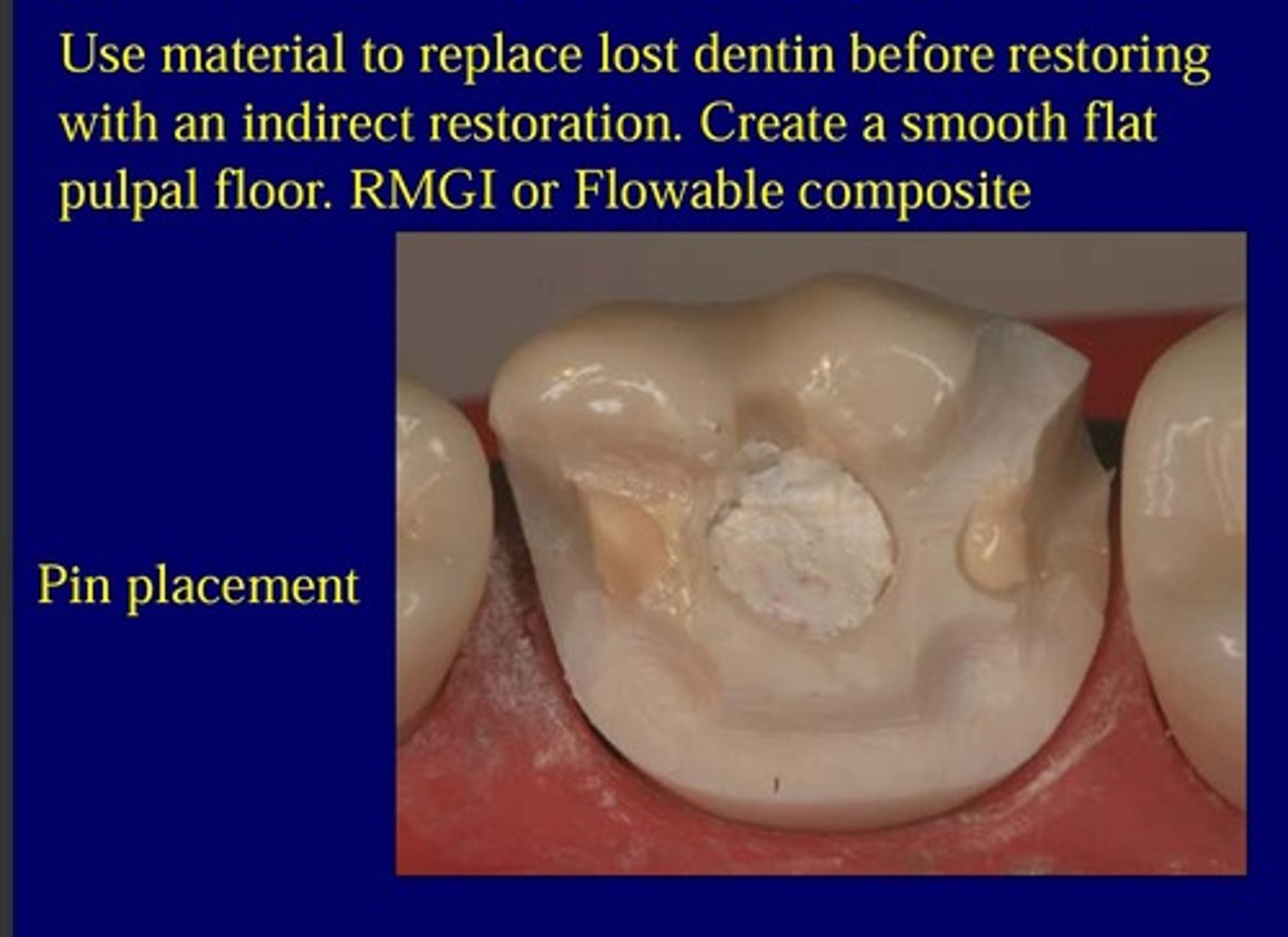
* Replace missing dentin for indirect restorations (bases) "Blocking out"
* Concept of thermal protection for metallic restorations
What is a unique beneficial effect of eugenol?
eugenol is palliative ( sedative) to the pulp
What is a unique benefit of Calcium hydroxide ( Dycal) ?
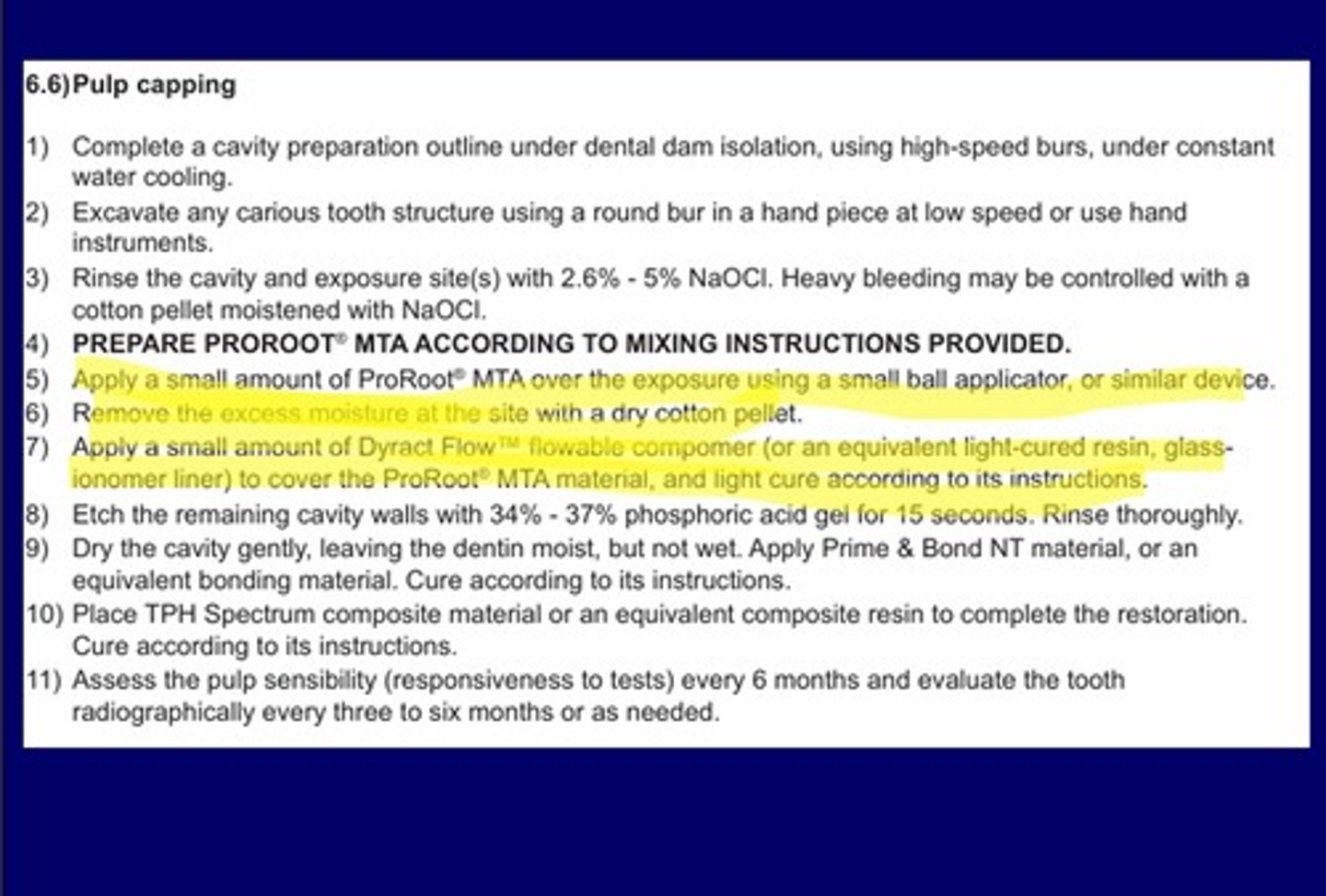
dycal accelerates reparative dentin formation ( MTA)
What is a unique beneficial effect of glass ionomer?
glass ionomer can provide bonding, fluoride release, and protease inhibition.
Clinical need for base placement is determined by_______
this thickness of the remaining dentin
What level of remaining dentin qualifies as shallow?
>2mm remaining dentin
What level of remaining dentin qualifies as moderate?
>1 mm but less than 2mm remaining dentin
What level of remaining dentin qualifies as deep?
< 1mm remaining dentin
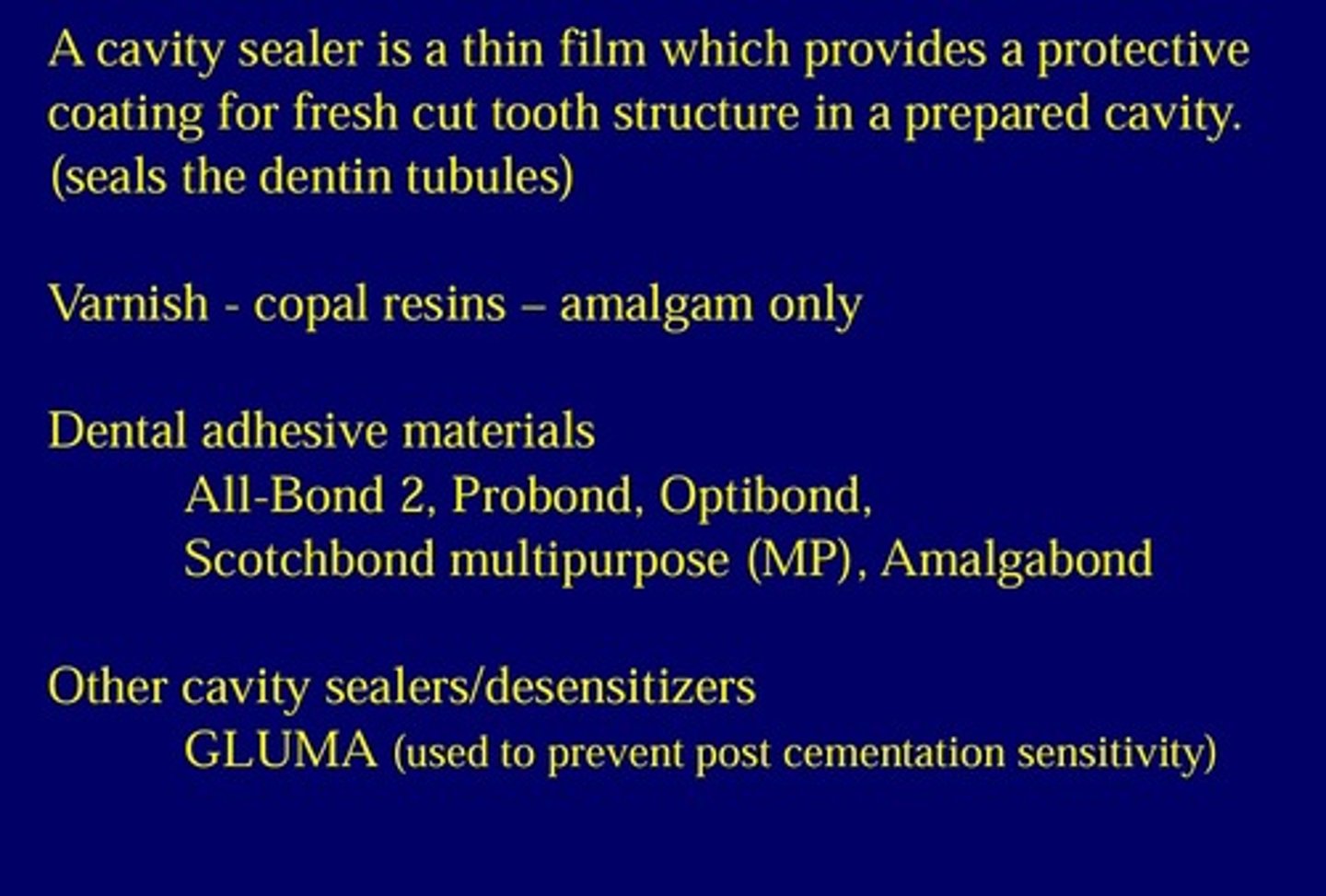
A cavity sealer is a ______ which provides _______
a cavity sealer is a thin film which provides a protective coating for fresh cut tooth structure in a prepared cavity ( seals the dentin tubules).
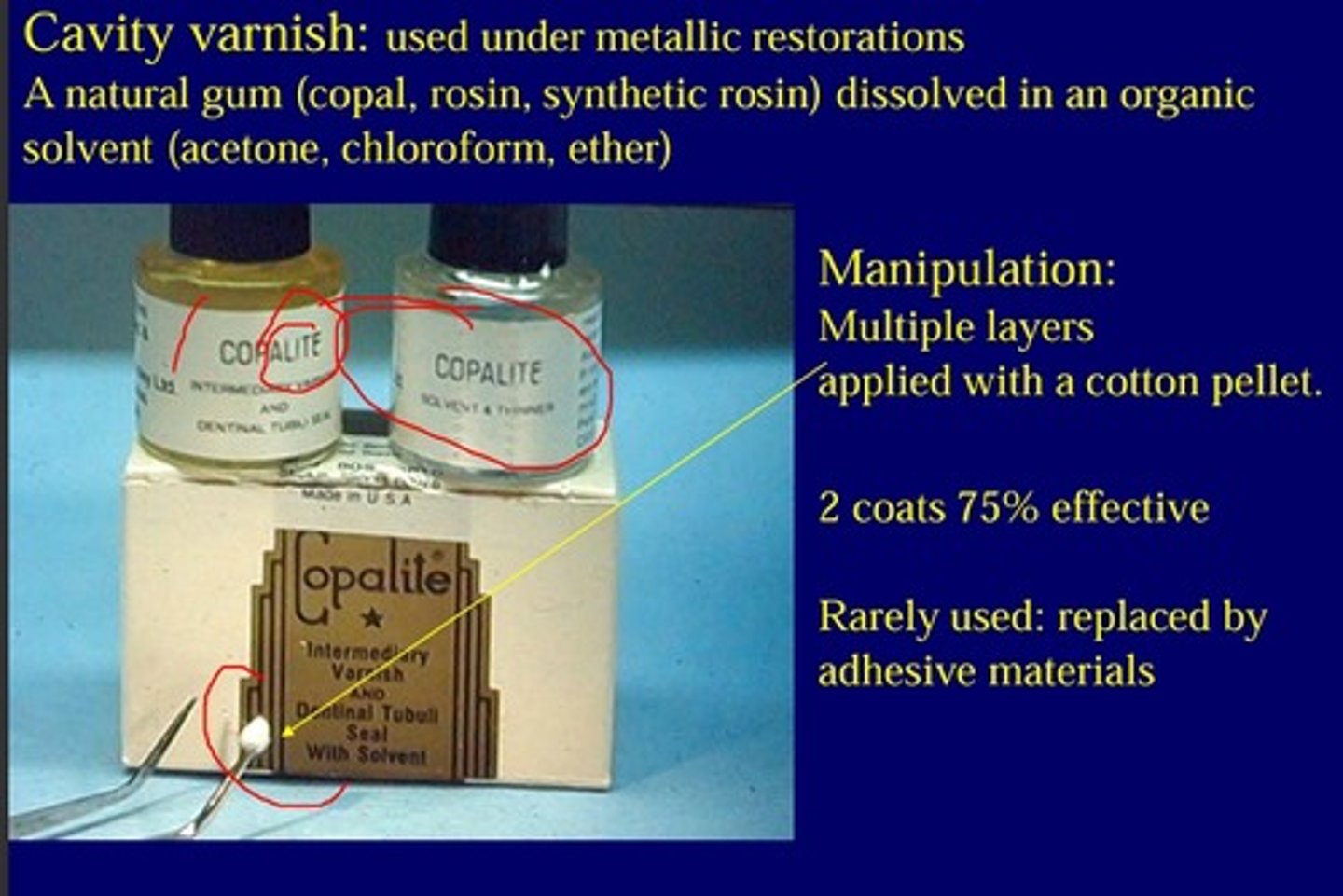
What is varnish? How effective is it?
With what do we use it?
copal resins. i.e: a natural gum dissolved in an organic solvent.
2 coats 75% effective
Rarely used as it has been replaced by adhesive materials
used only with metallic restorations/amalgam
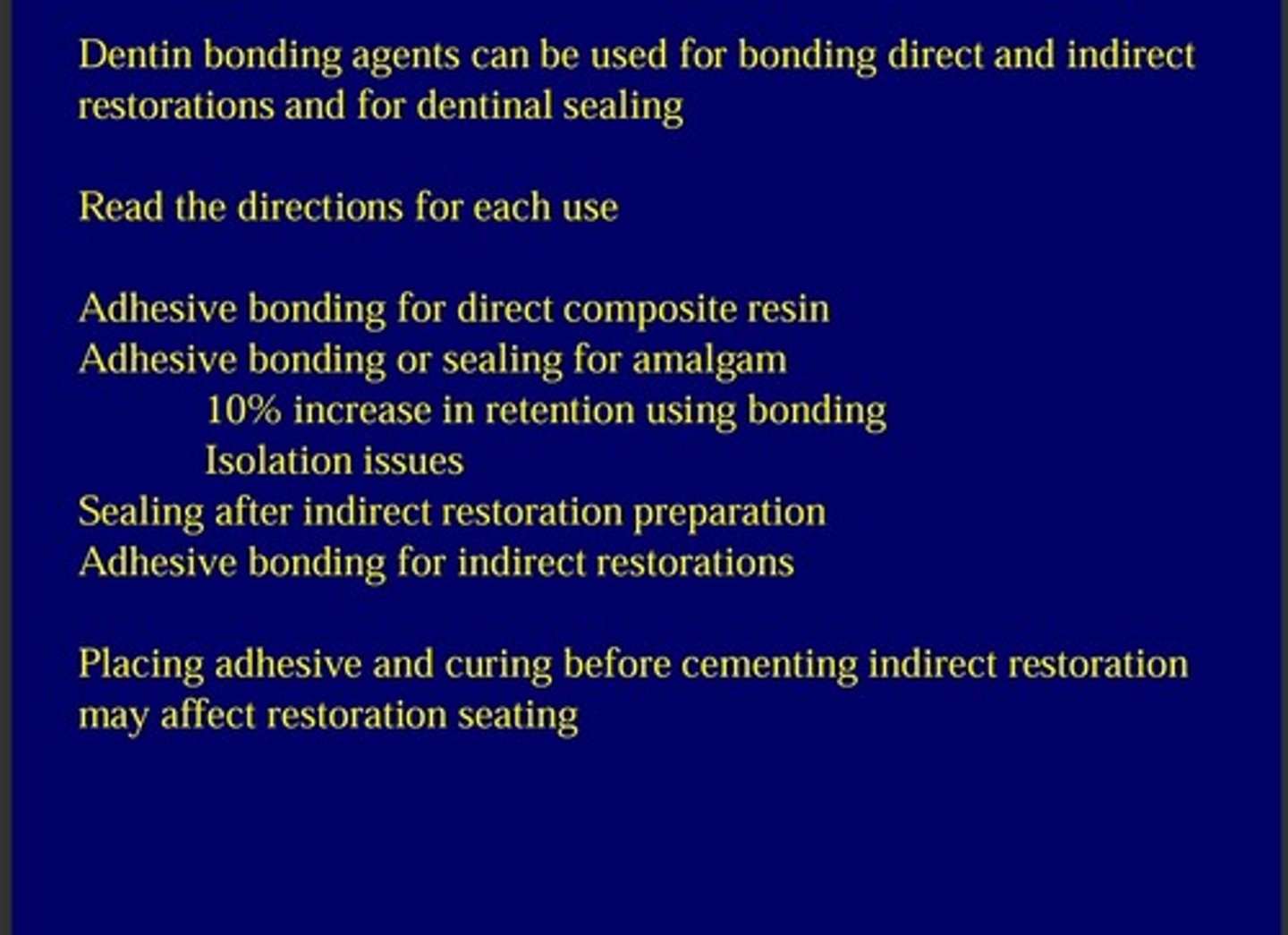
Dentin bonding agent function
creates a chemical and mechanical bond between the tooth structure and the restorative material
Dentin bonding agent mechanism
involves infiltrating monomers into the dentin matrix, forming a hybrid layer, and then copolymerizing with the resin matrix of the composite restoration.
Dentin bonding purpose
ensures longevity and effectiveness of dental restorations by providing a secure and duravle bond.
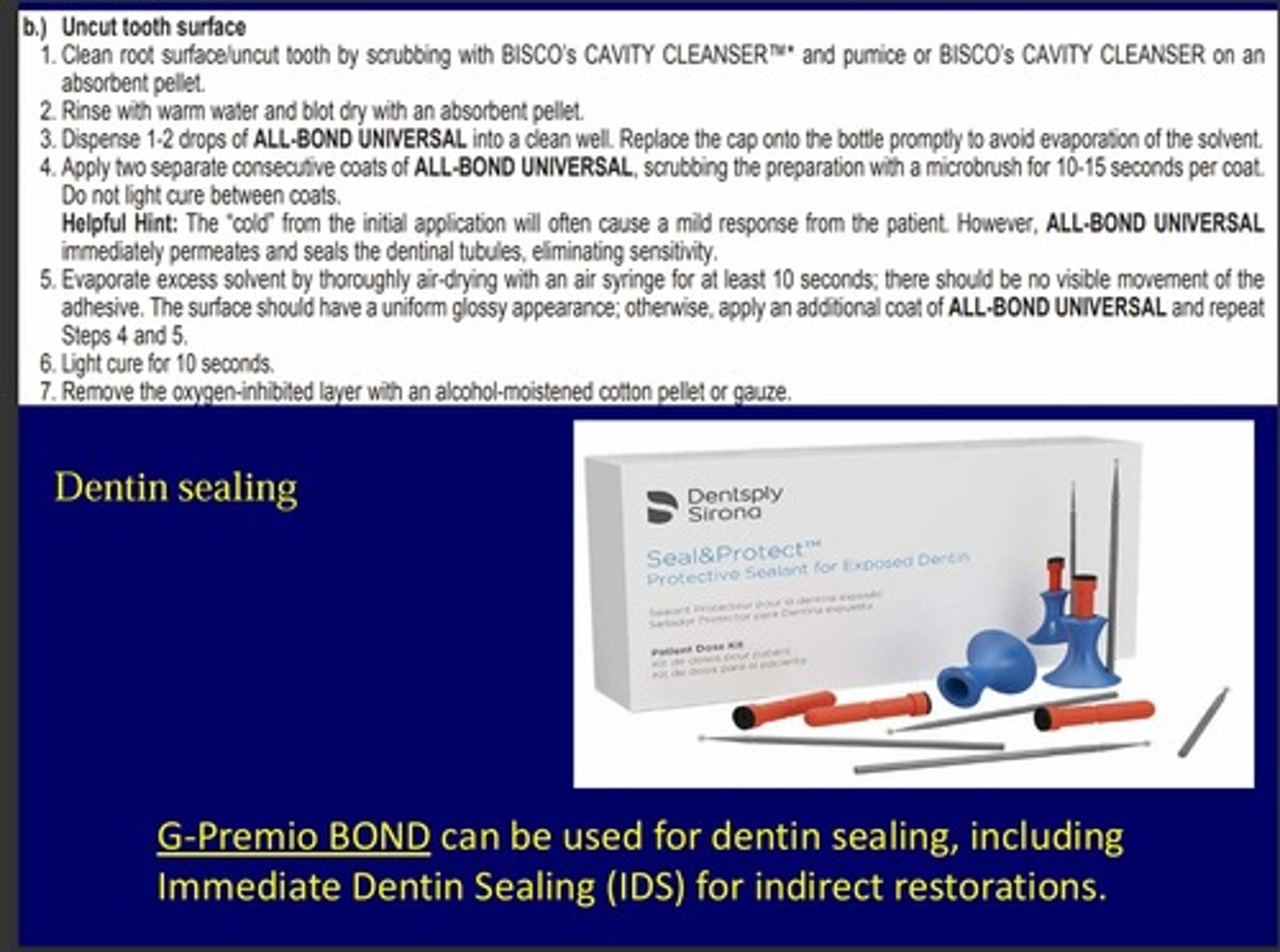
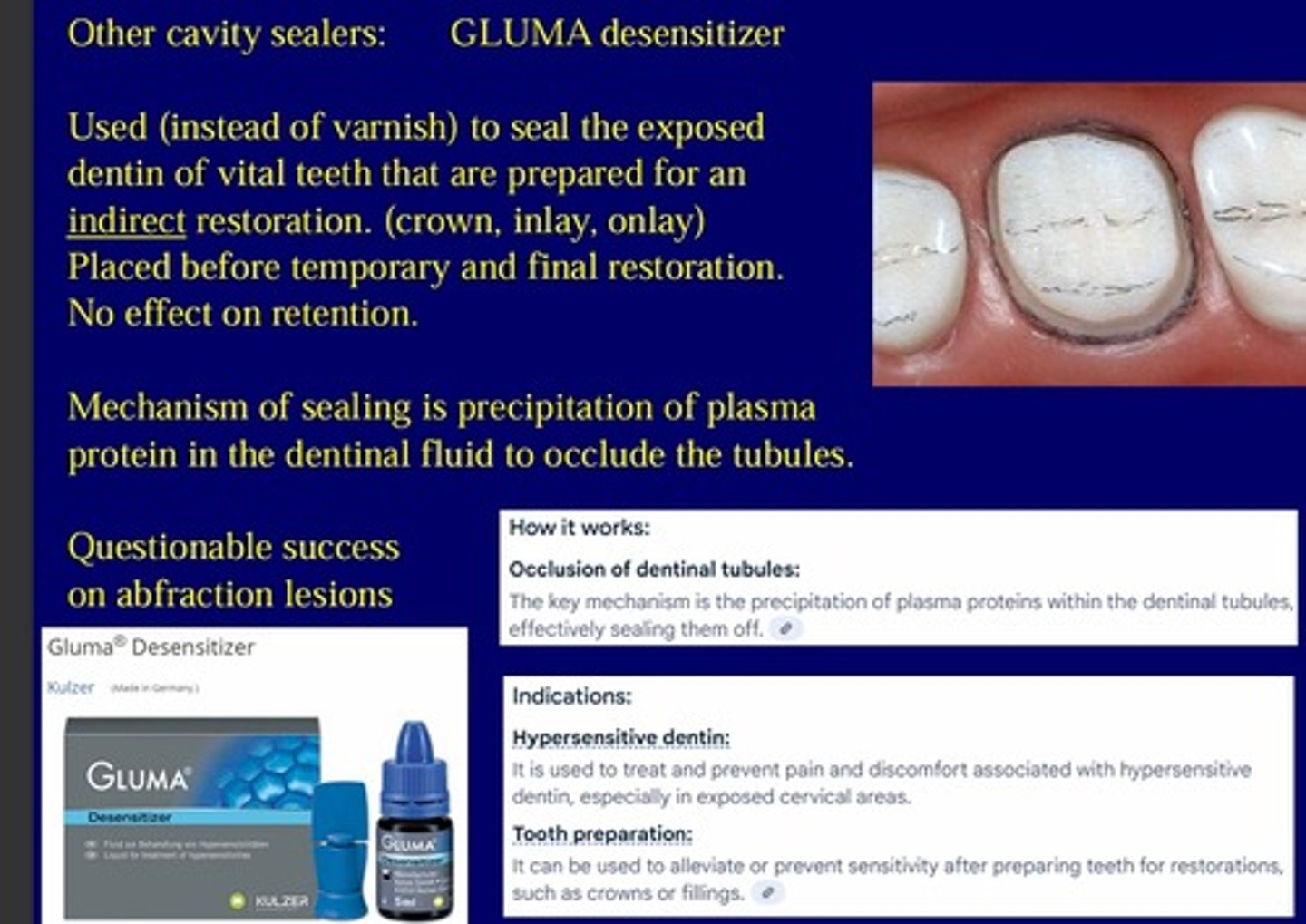
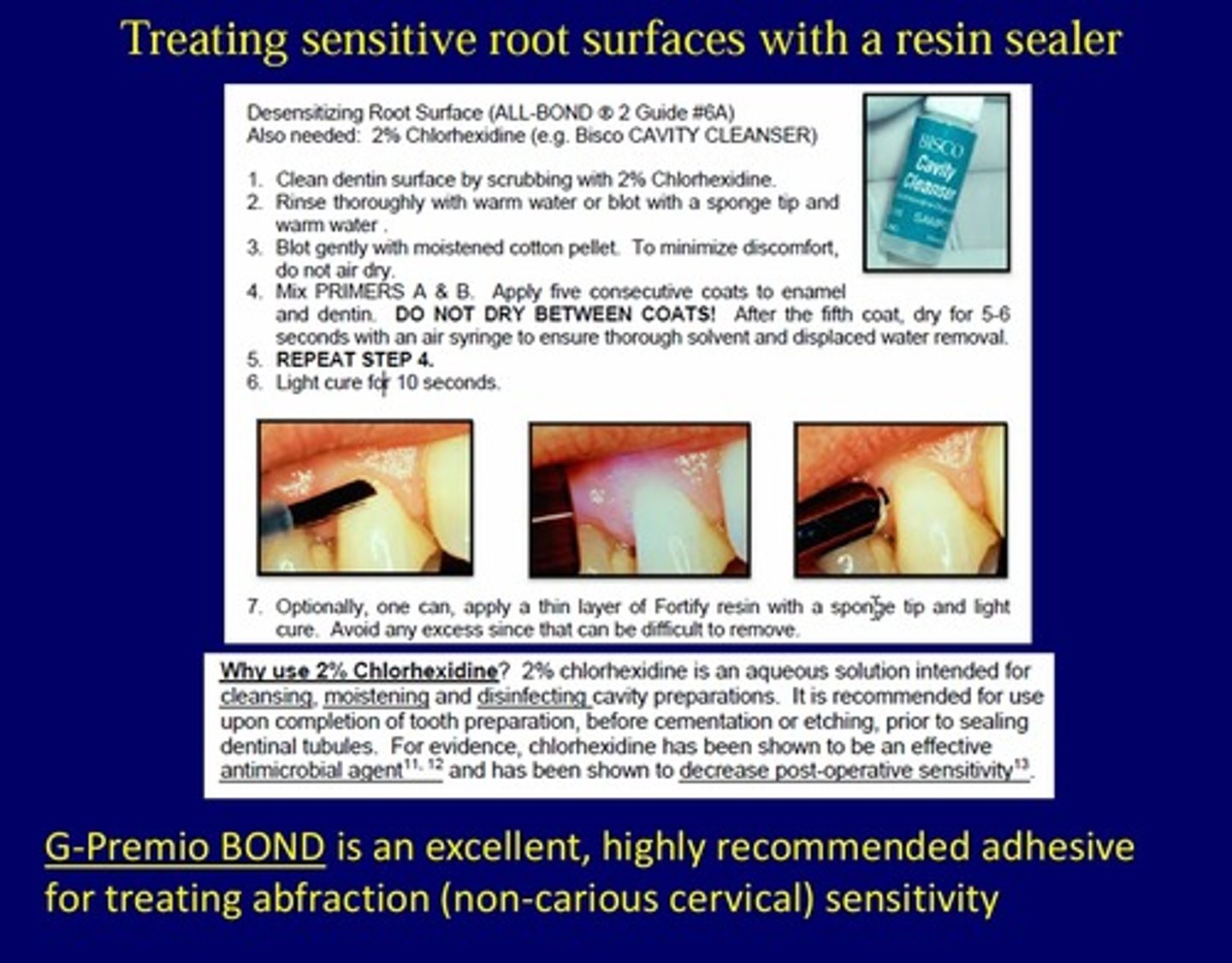
Dentin Sealer function
covers and seals dentinal tubules, protecting them from irritation caused by restorative materials
Dentin sealer mechanism
a self curing ( or light cured), high molecular weight resin that covers the tubules
Dentin sealer purpose
Reduces dentin sensitivity and healps preven leakage under restorations ( under amalgams and crowns)
No cards made
No cards made
No cards made
No cards made
No cards made
What is one example of a low strength base
Calcium hydroxide ( Dycal)
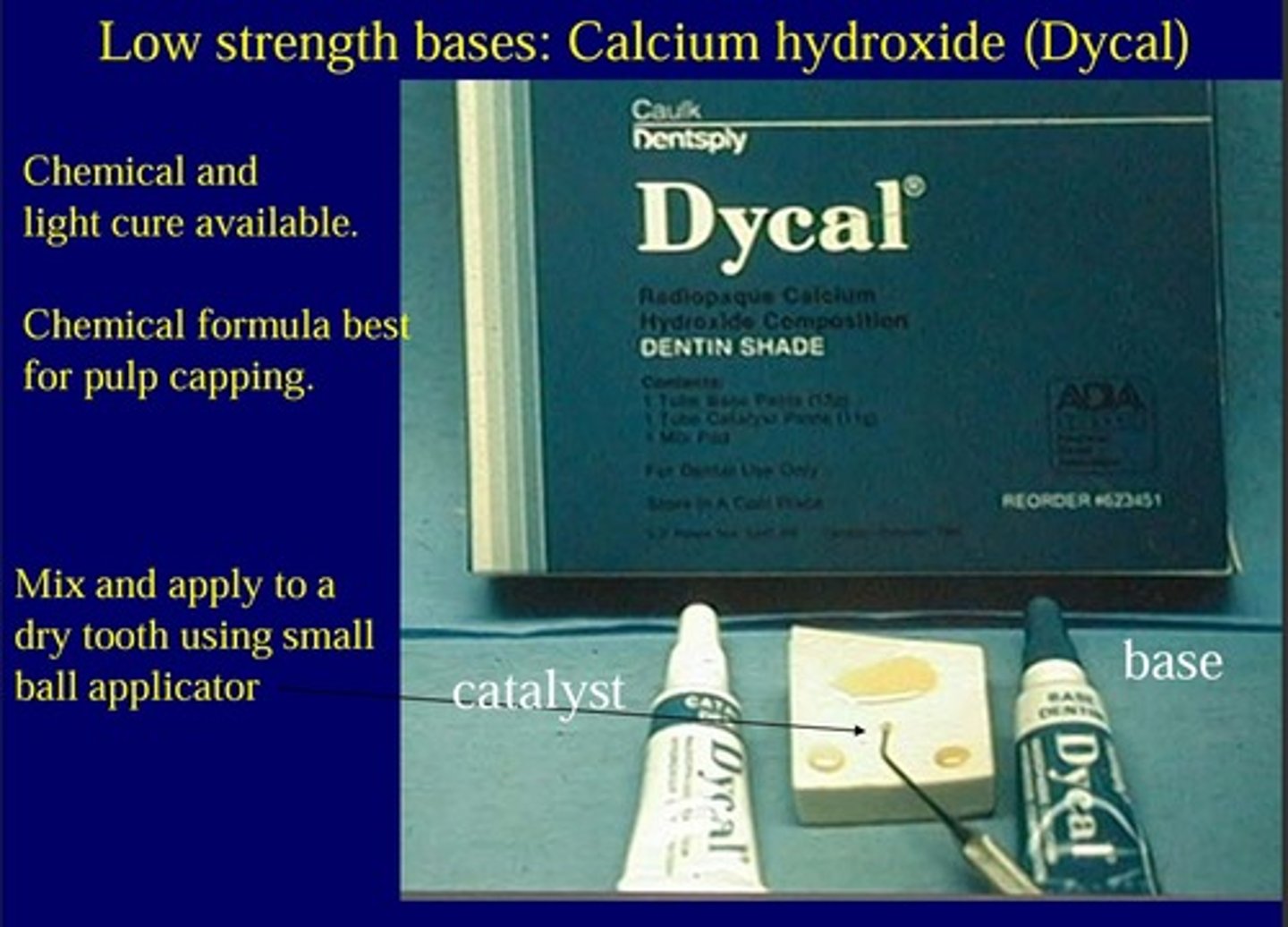
properties and manipulation of Dycal
low strength ( must be covered with a stronger base
extremely soluble: can disappear over time simulating decay
What is the pH of dycal?
9.2 - 11.7
What are some of the beneficial effects of dycal?
stimulates reparative dentin formation if applied directly to the exposed pulp.
shows antibacterial activity ( chemical cure)
aids in producing a sterile environment
t/f dycal weakens the final restoration
true
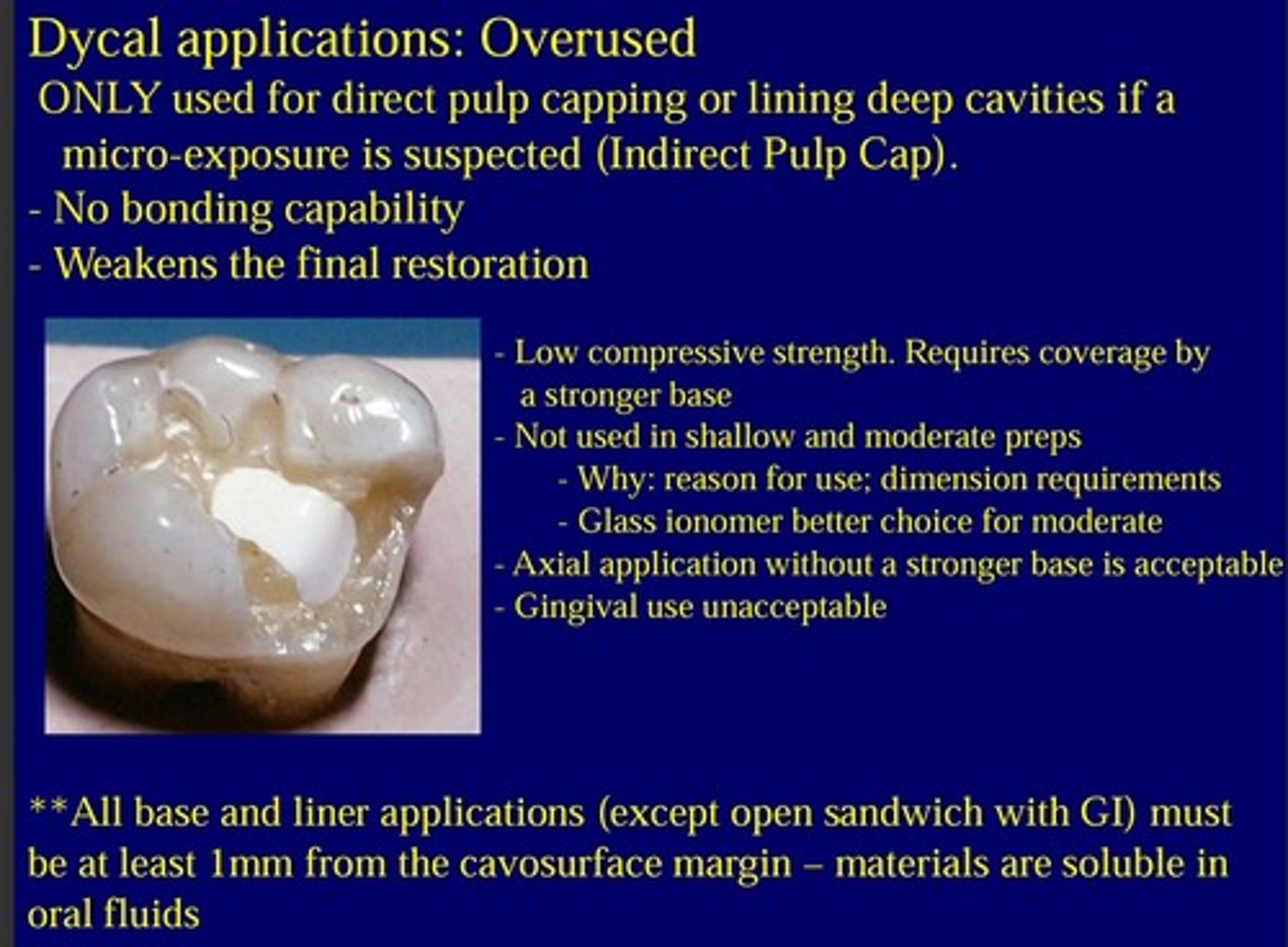
Dycal should only be used for ______ or __________
Dycal, should only be used for direct pulp caping or lining deep cavities if a micro-exposure is suspected
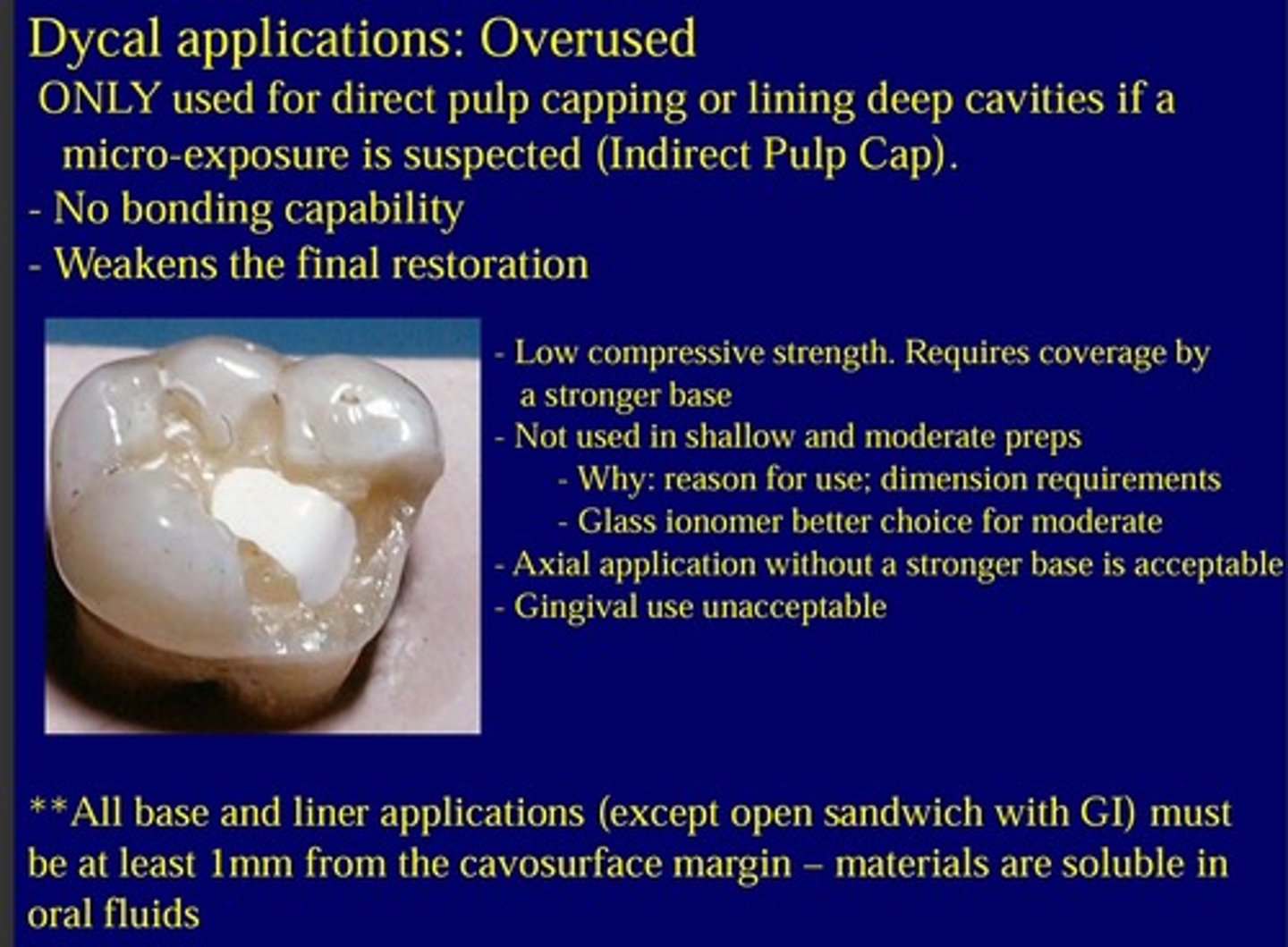
(T/F) Dycal has no bonding capability
true
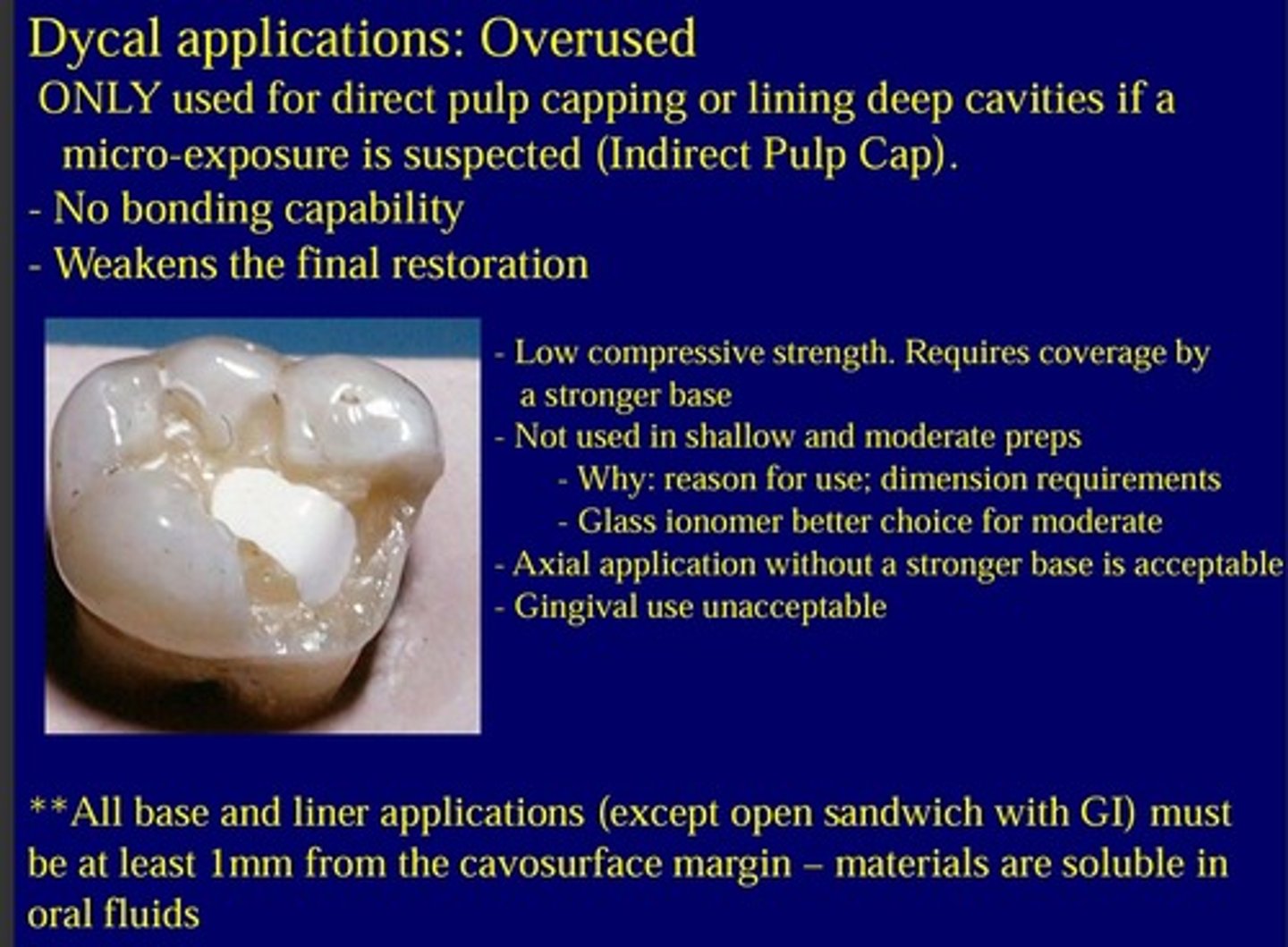
Dycal ________the final restoration
weakens
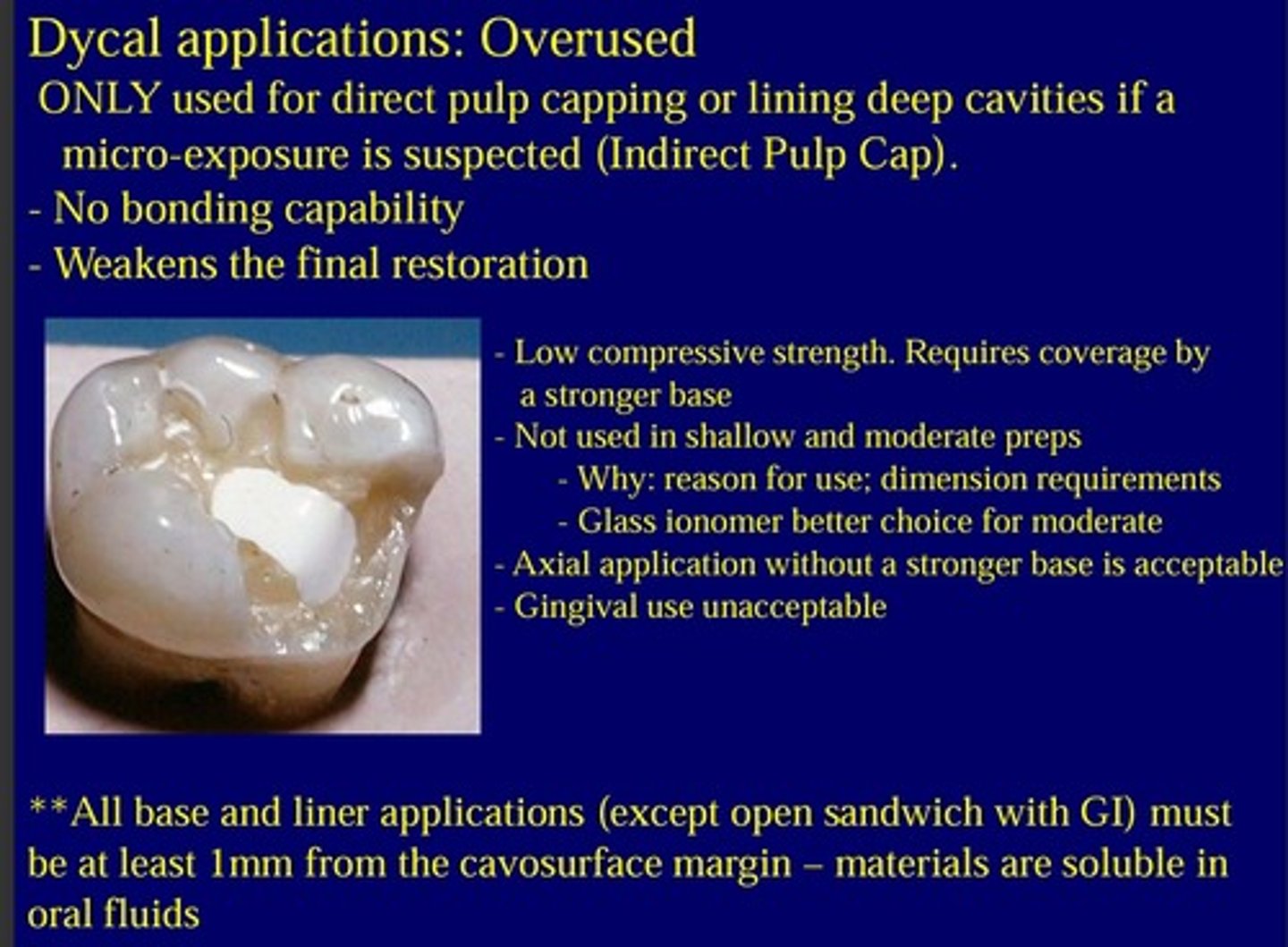
Dycal is not used in _____
shallow and moderate preps
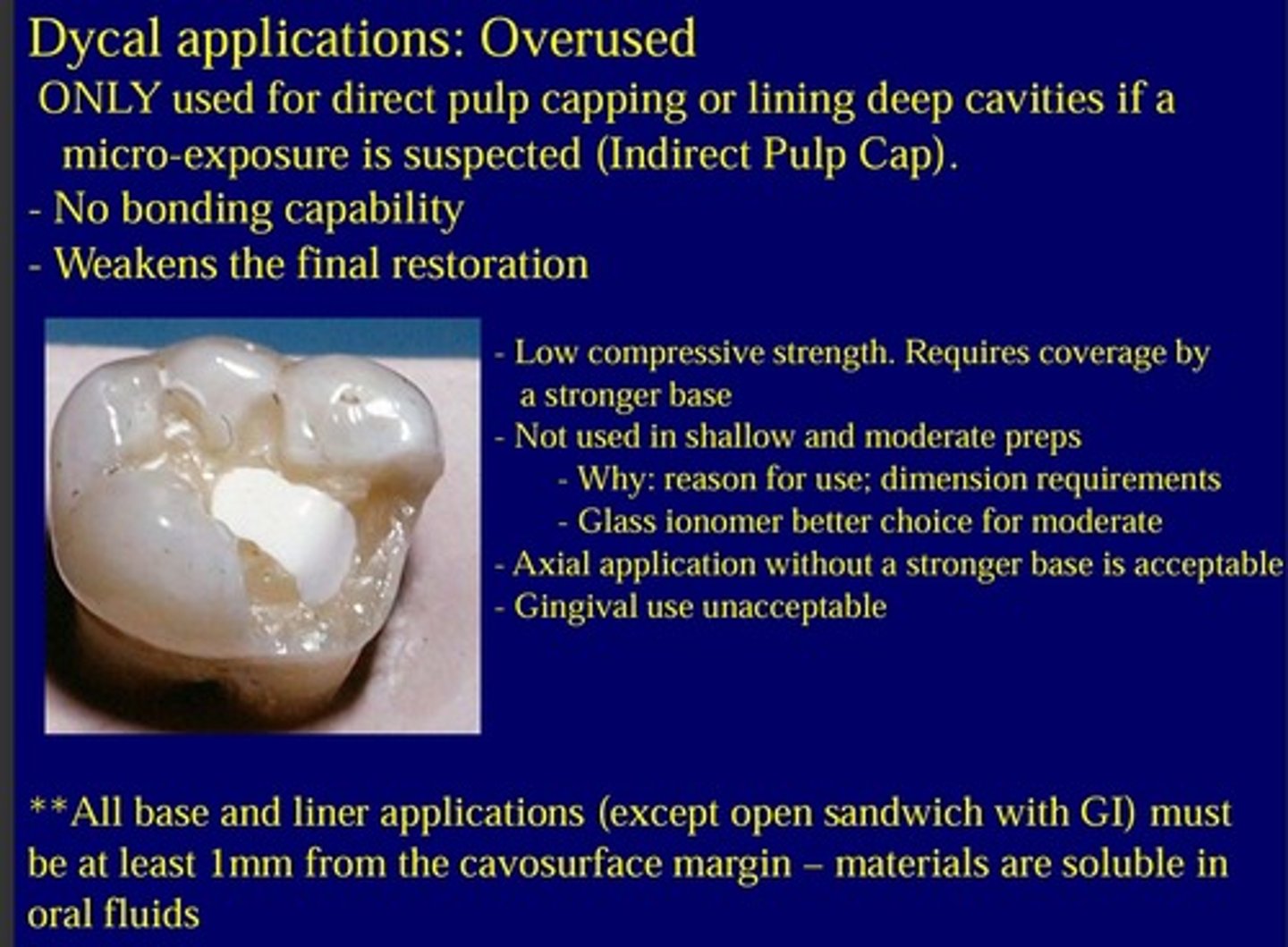
What is a better choice over Dycal for a moderate prep?
Glass ionomer is a better choice for moderate preps over dycal
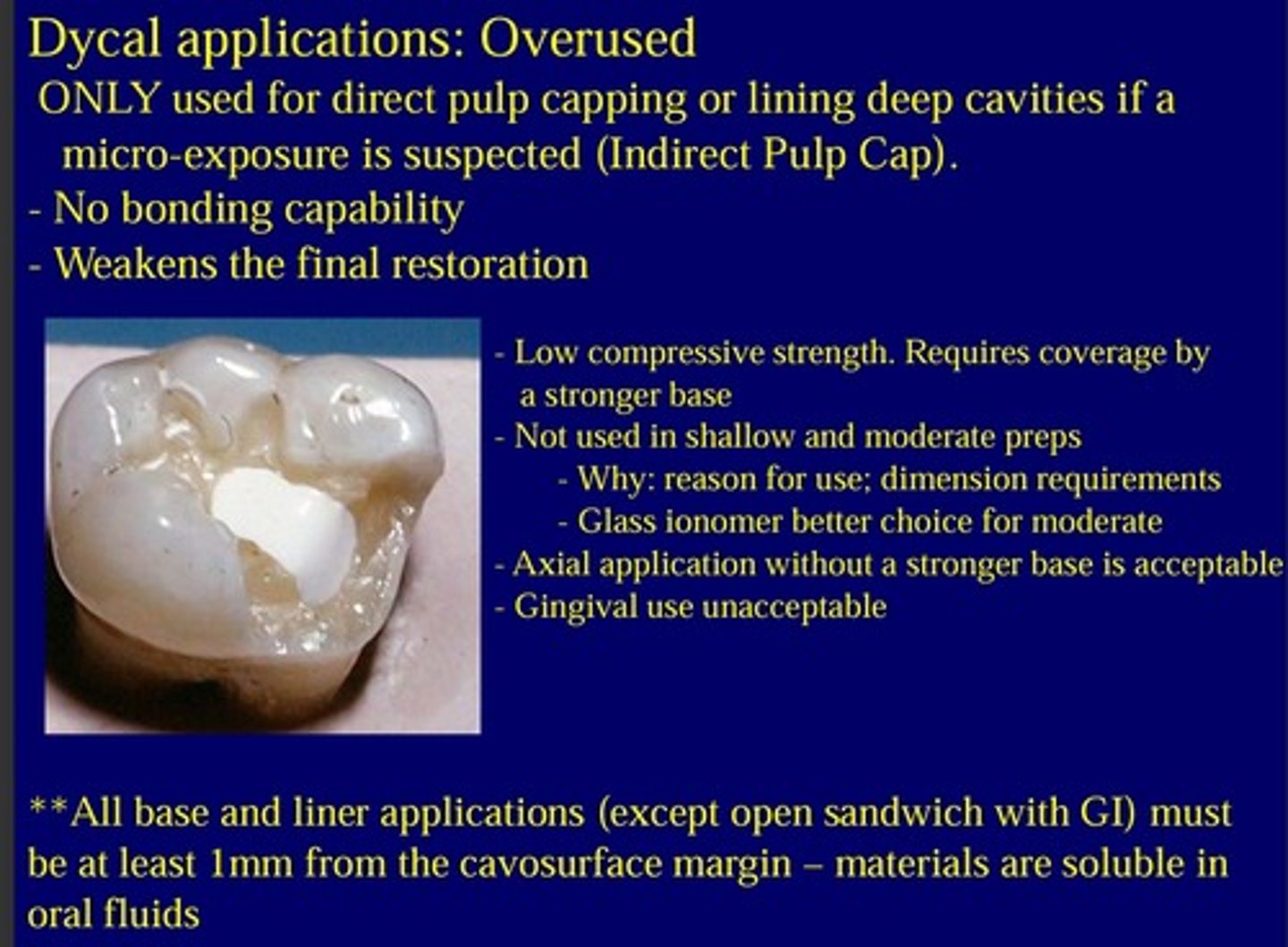
Where is it acceptable to place dycal without a stronger base?
it is acceptable to place dycal on the axial wall without using a stronger base
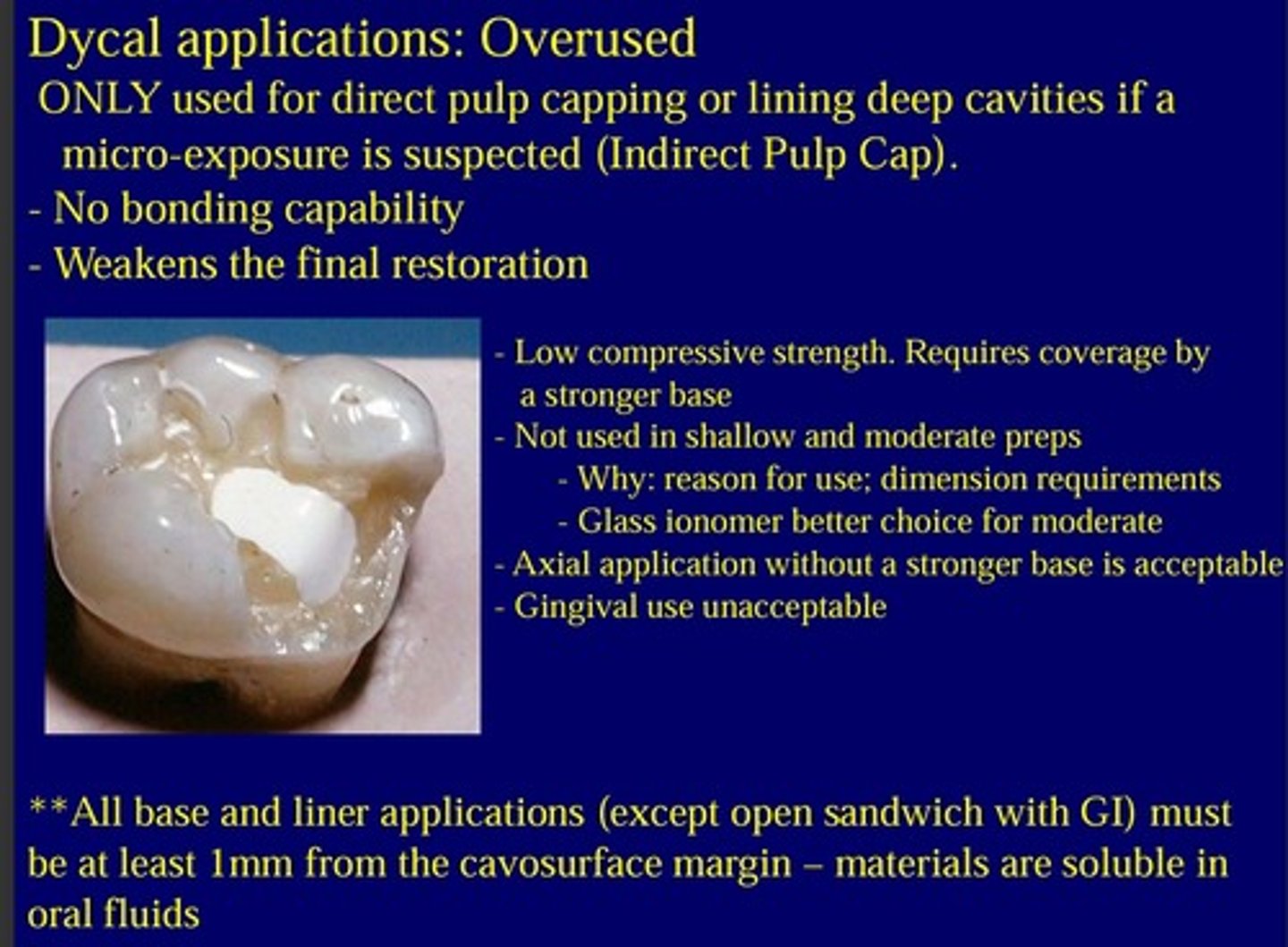
Where is it unnacceptable to place dycal without a stronger base?
it is unacceptable to place dycal on the gingival wall without a stronger base
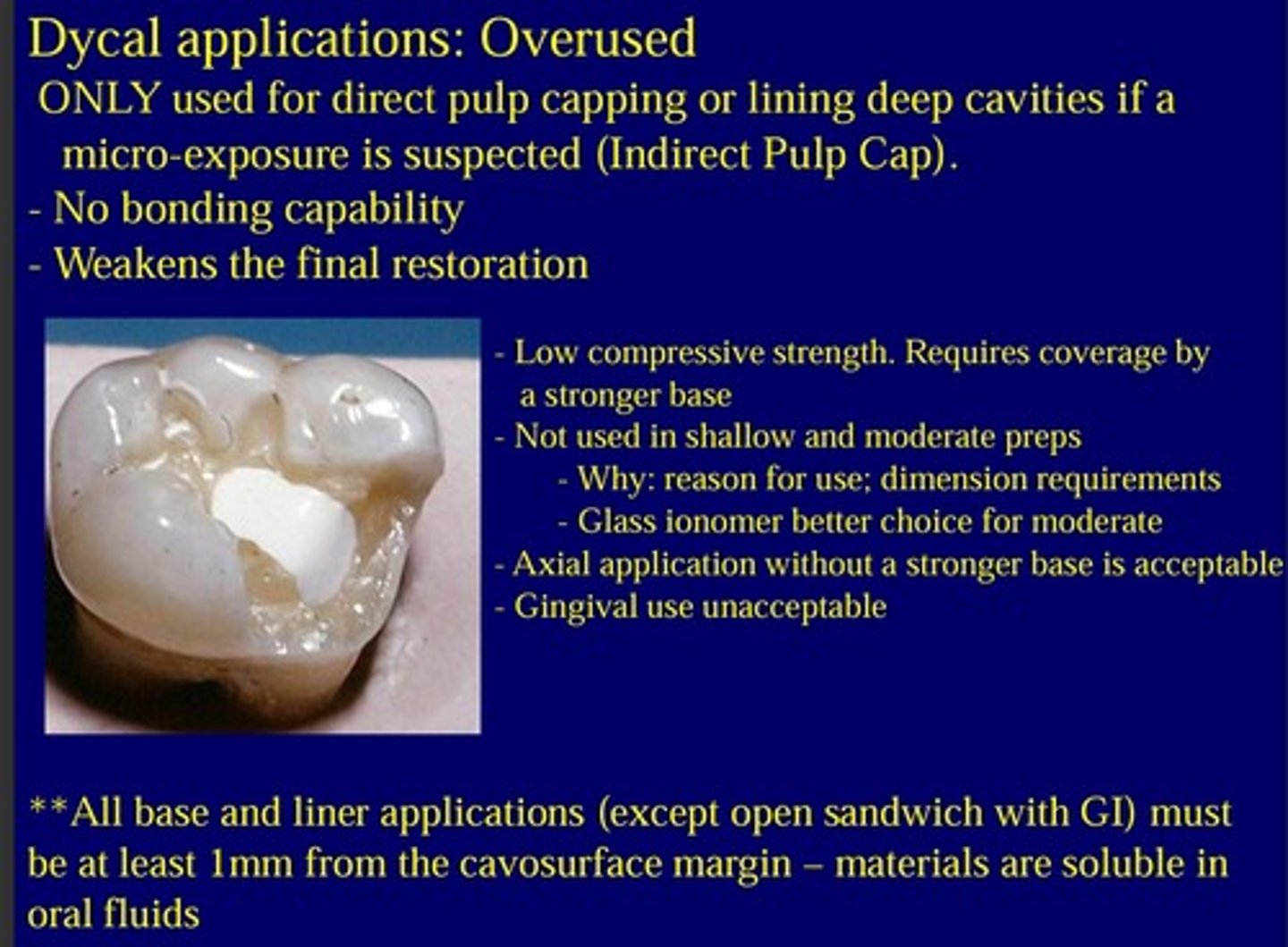
All base and liner applications ( except ______) must be at least _____ mm from _______. Why?
All base and liner applications ( except for open sandwich with GI) must be at least 1mm from the cavosurface margin.
Why? because these materials are soluble in oral fluids.
What is MTA? What is it used for? Why?
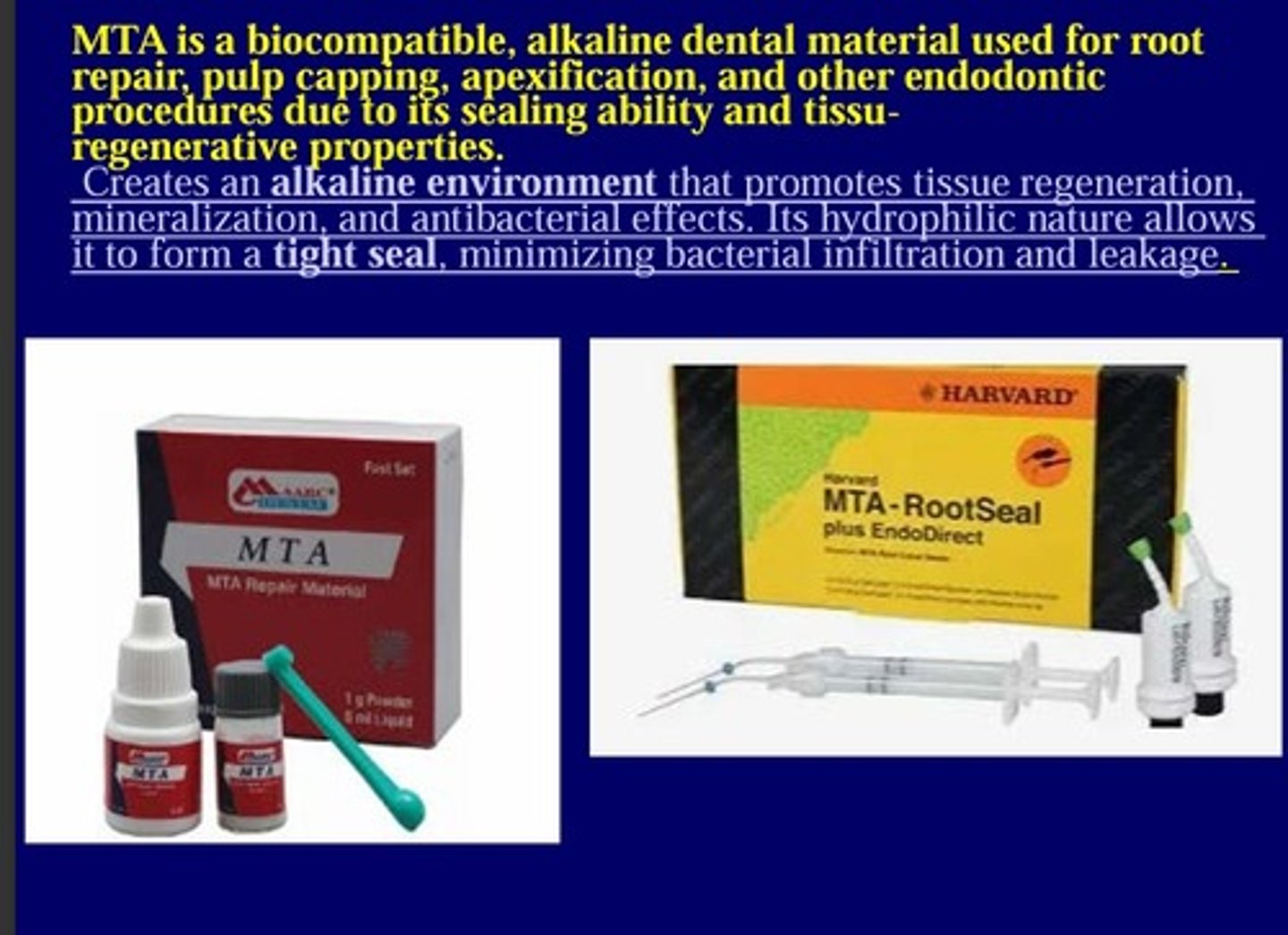
MTA is a biocompatible, alkaline dental material
it is used for root repair, pulp capping, apexification, and other endodontic procedures due to its sealing ability and tissue regenerative properties
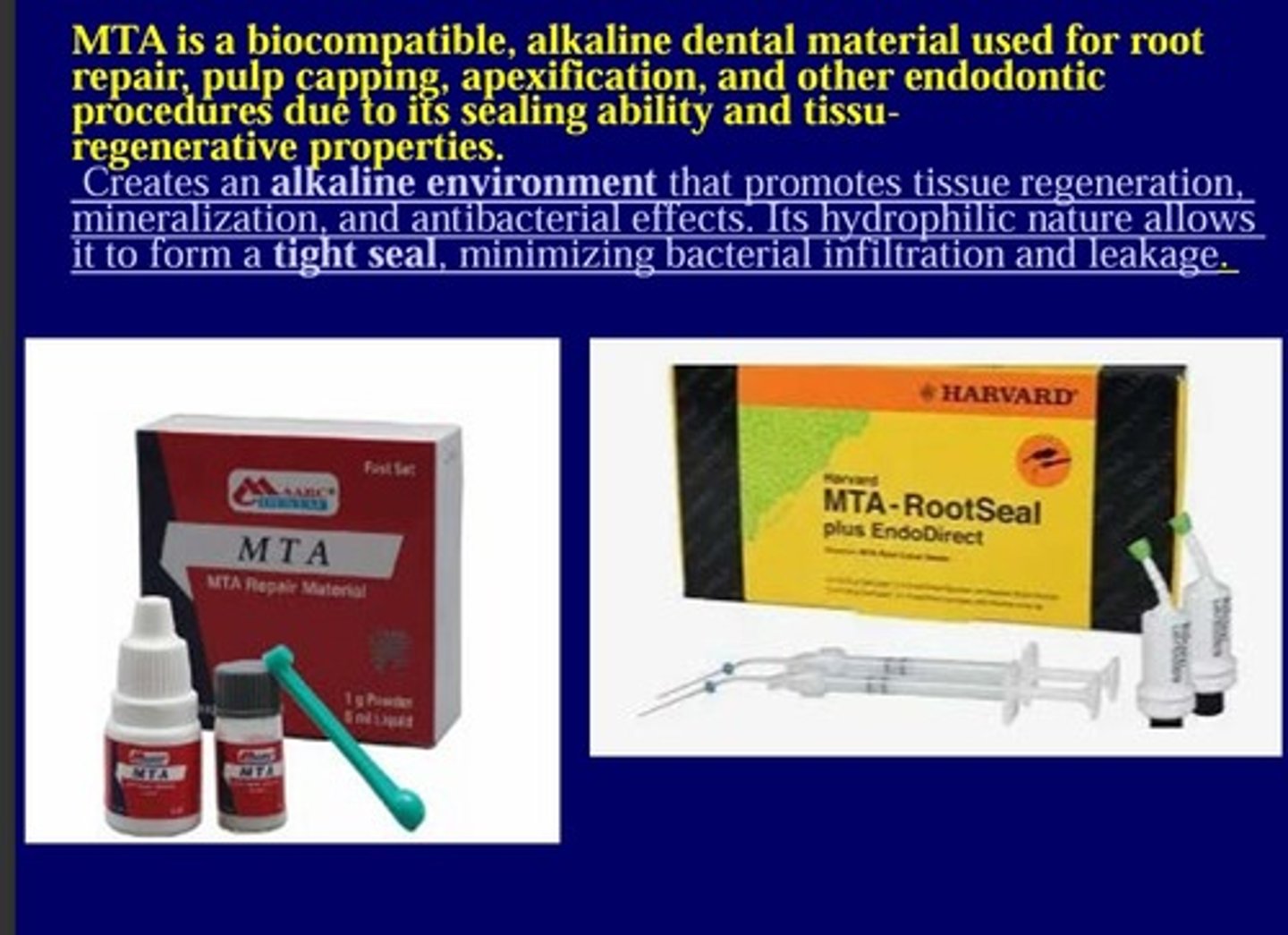
How is MTA able to perform its function?
MTA creates an alkaline nevironment that promotes tissue regeneration, mineralization, and antibacterial effects. Its hydrophilic nature allows it to form a tight seal, minimizing bacterial infiltration and leakage.
No cards made
Cavity liners are used in:
moderate and deep preps
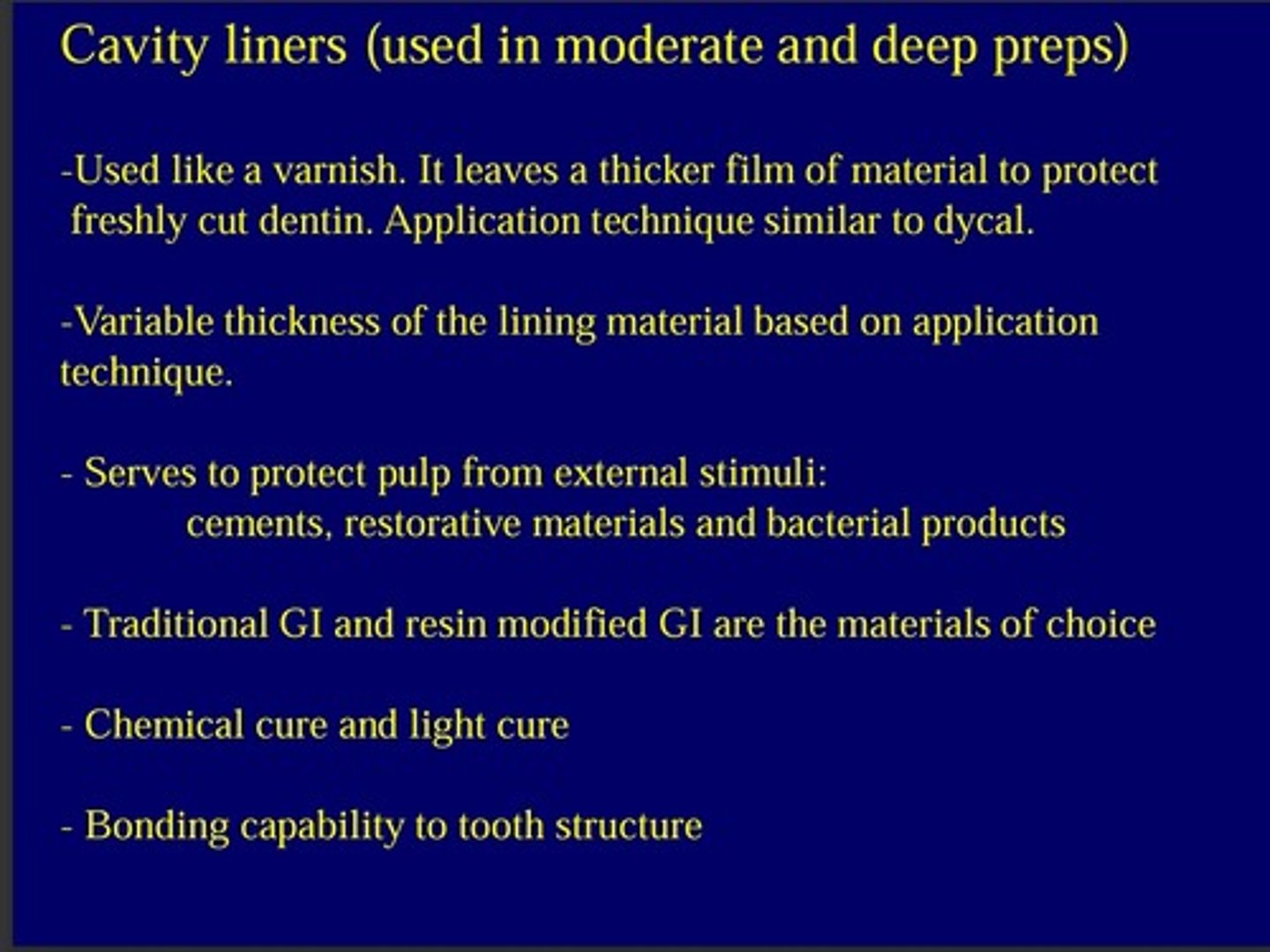
How are cavity liners used? What do they do?
they are used like a varnish. they leave a thicker film of material to protect freshly cut dentin.
They serve to protect pulp from external stimuli like cements, restorative materials and bacterial products
What is the thickness of cavity liners?
they have variable thickness based on application technique
What are the two cavity liners of choice? How are they cured? Do they have bonding capability?
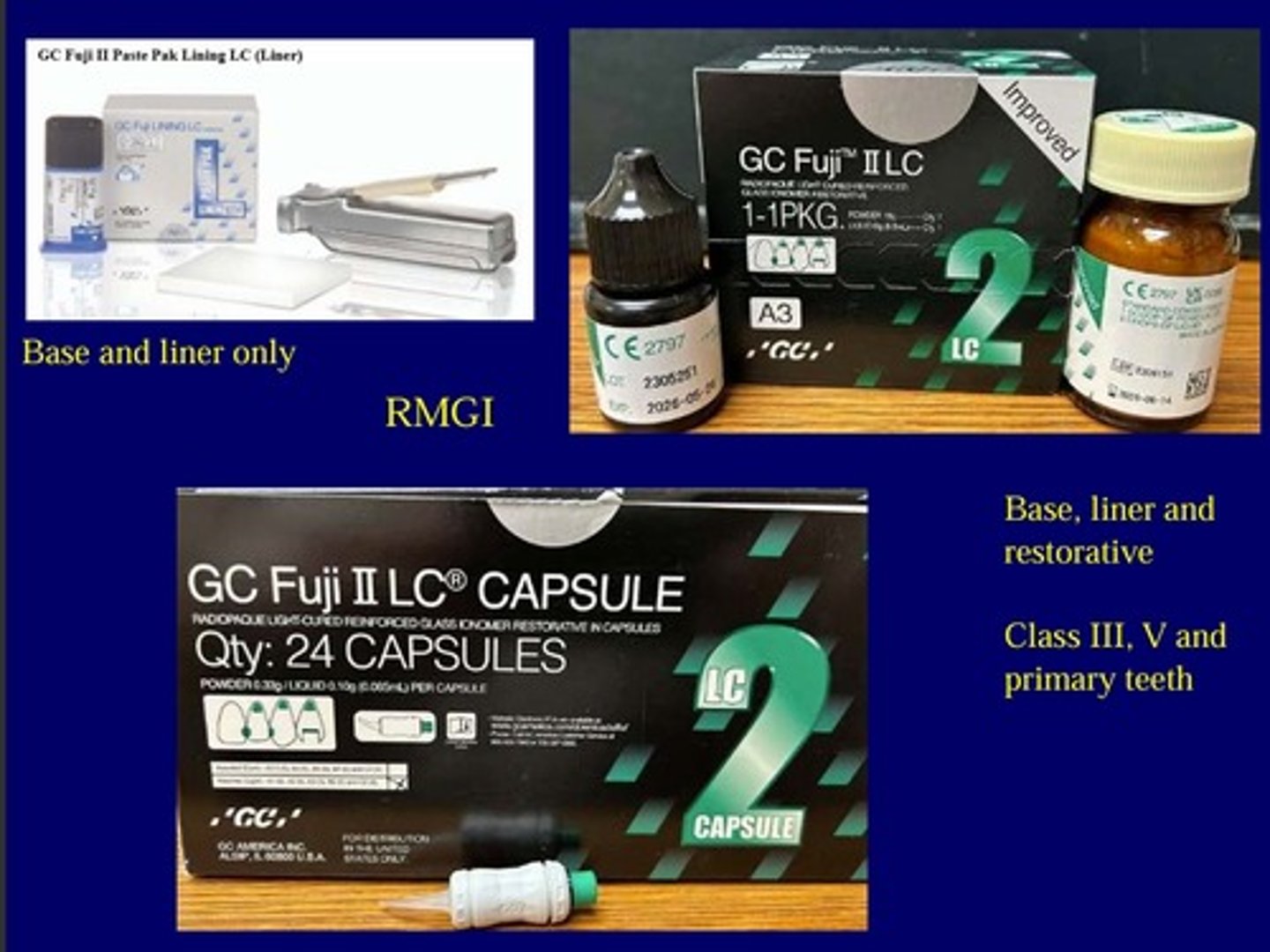
Traditional GI and resin modified GI
which can be chemical and light cured
they both have bonding capability to tooth structure unlike dycal
No cards made
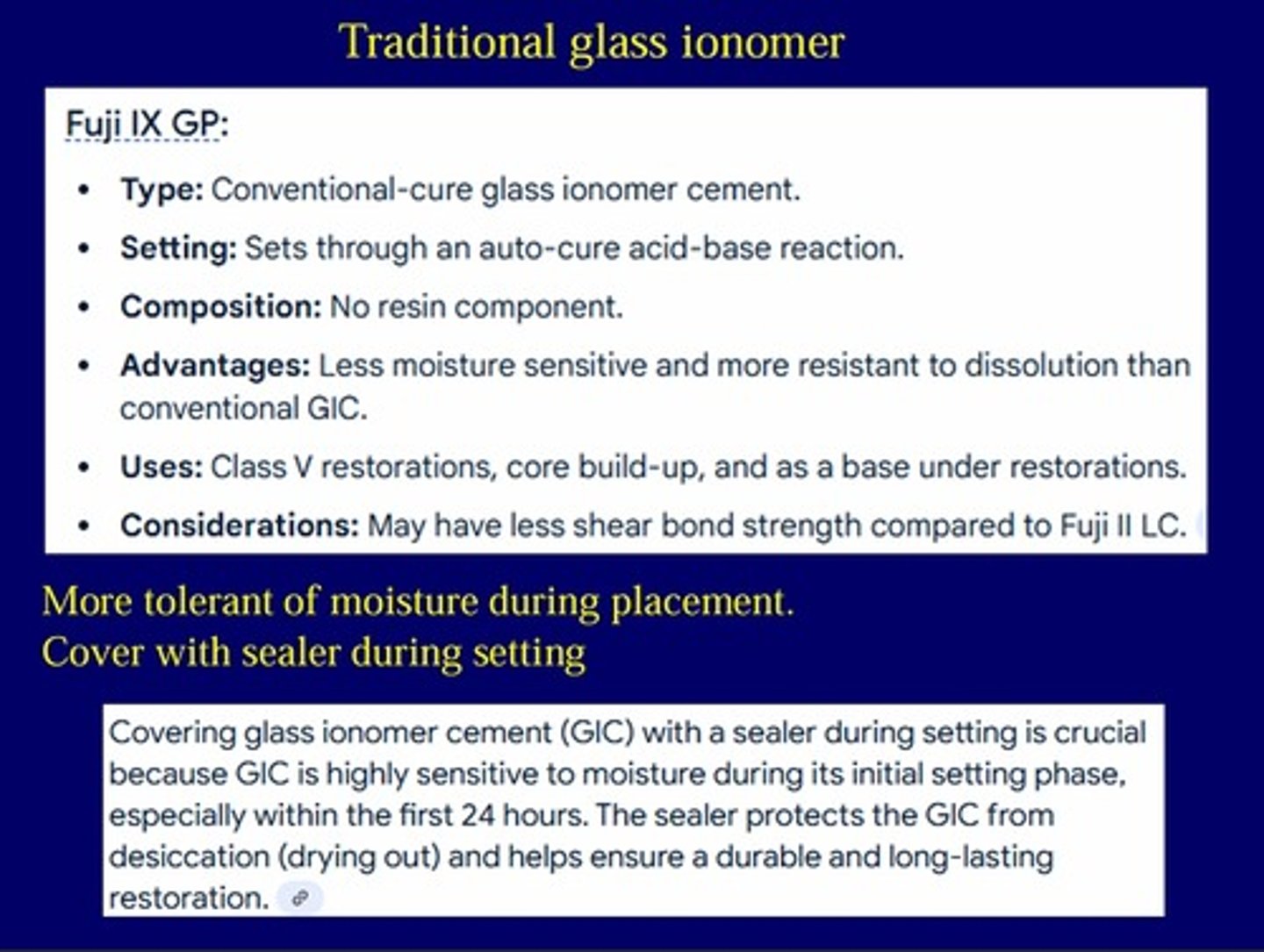
Traditional glass ionomer is more tolerant of ______
moisture during placement
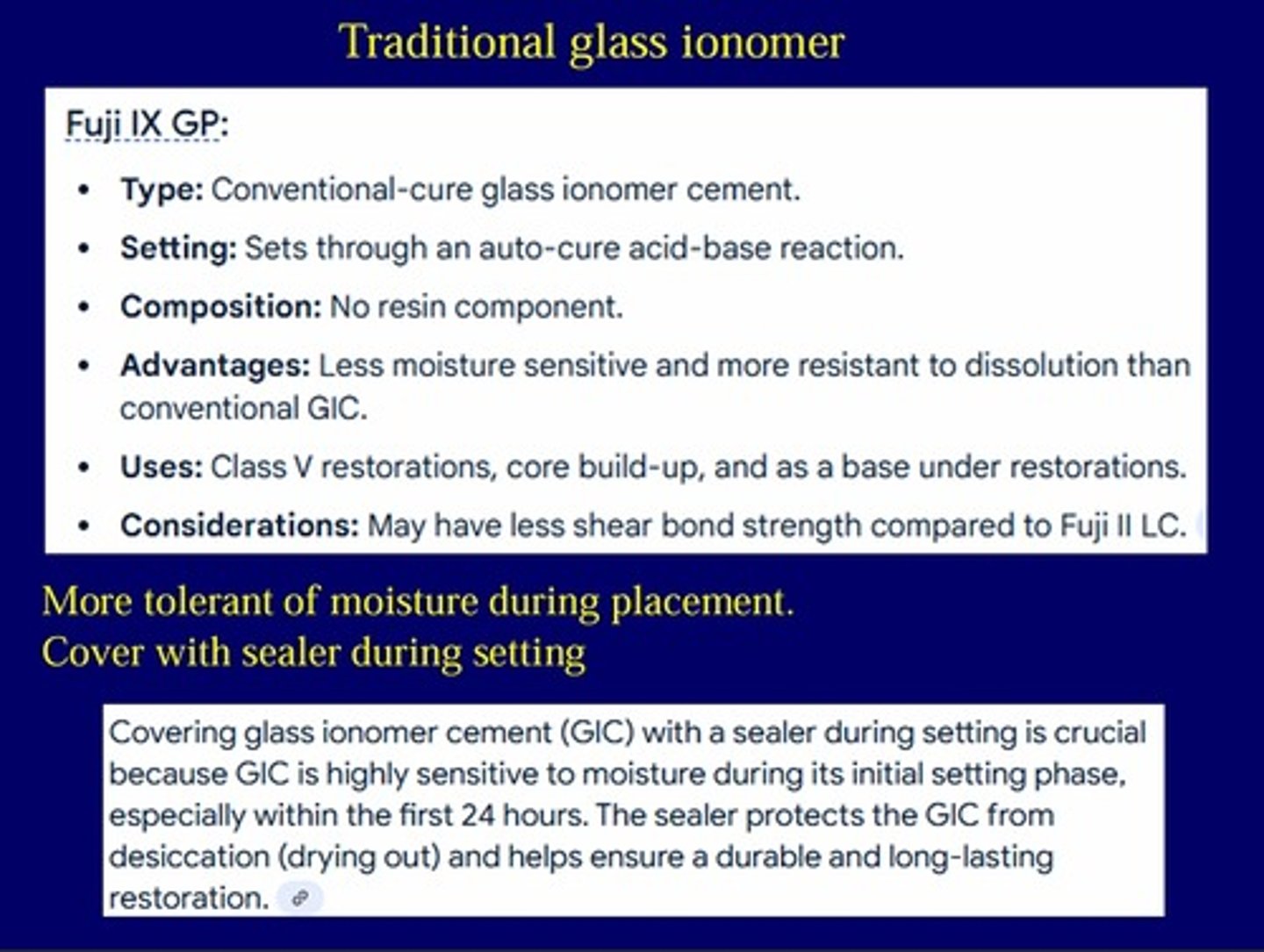
What should be done to GI during setting?
GI should be covered with sealer during setting
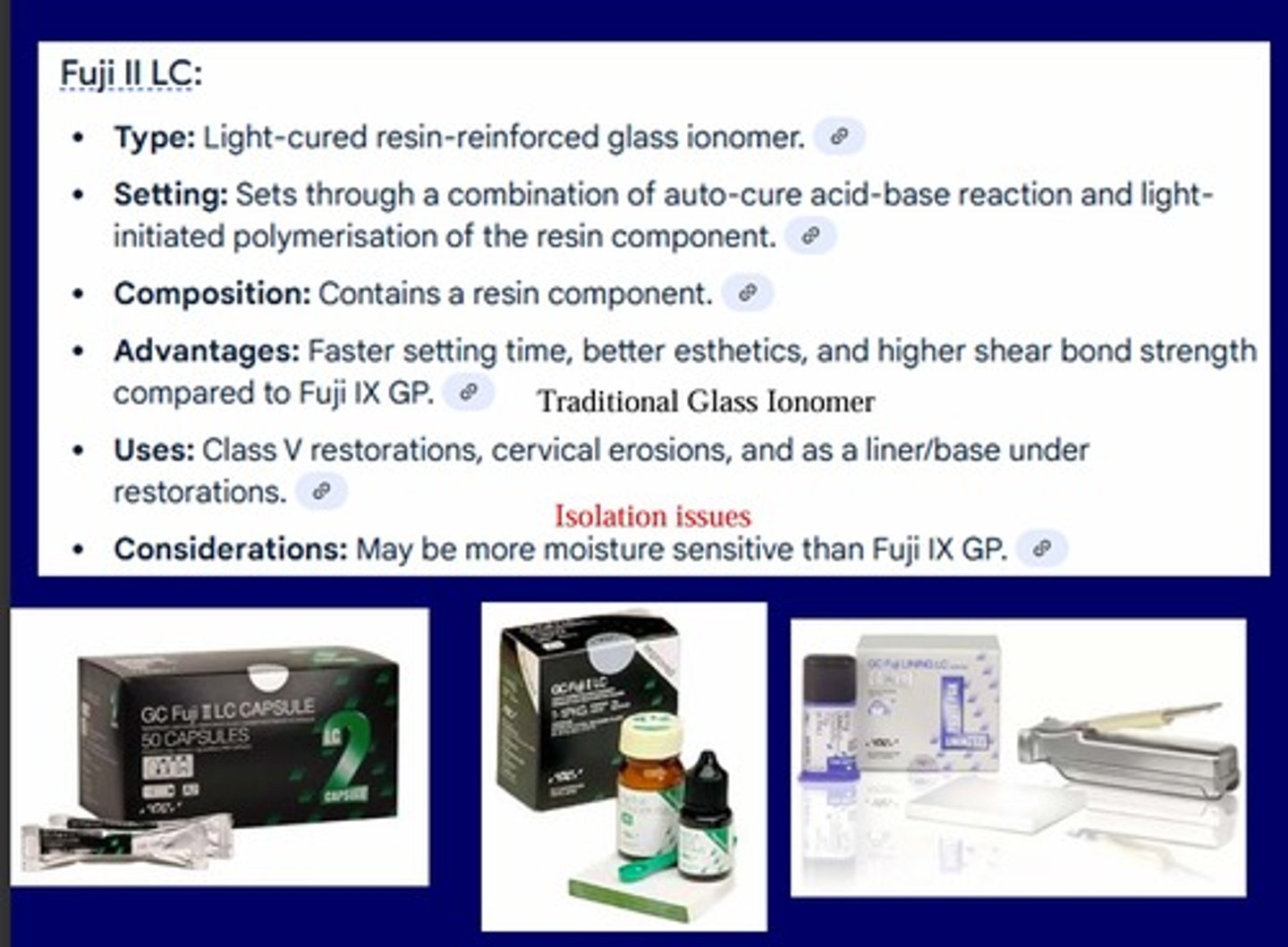
Slide discussing differences between Fuji II LC ( light cure) Vs Fuji IX GP ( traditional glass ionomer)
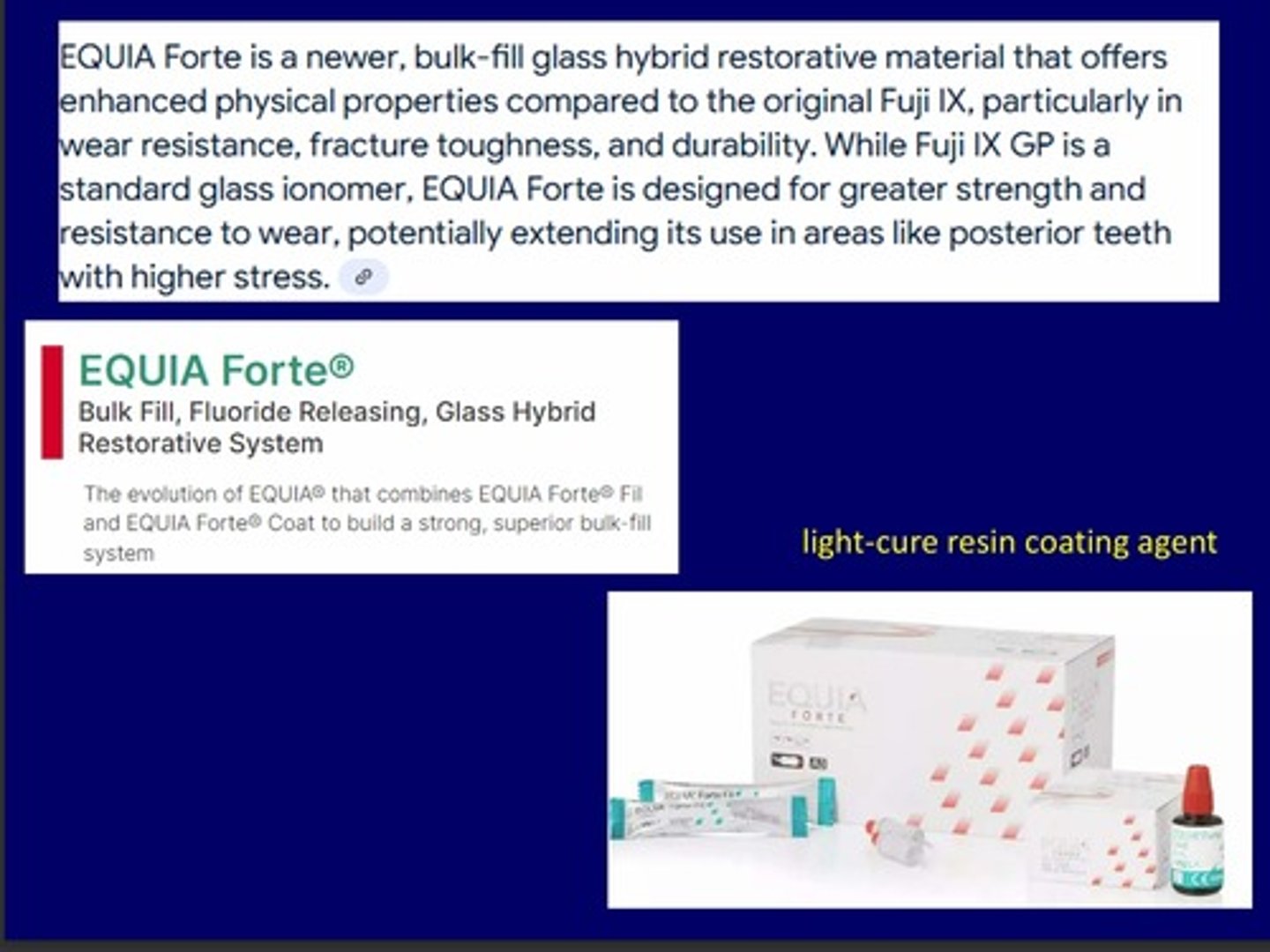
Slide discussing EQUIA Forte - a newer, bulk-fill glass hybrid restorative material
basically uses fluoro-aluminosilicate glasses reinforced with a second, smaller and more reactive silicate particle so has higher molecular weight and improves mechanical properties and handling.
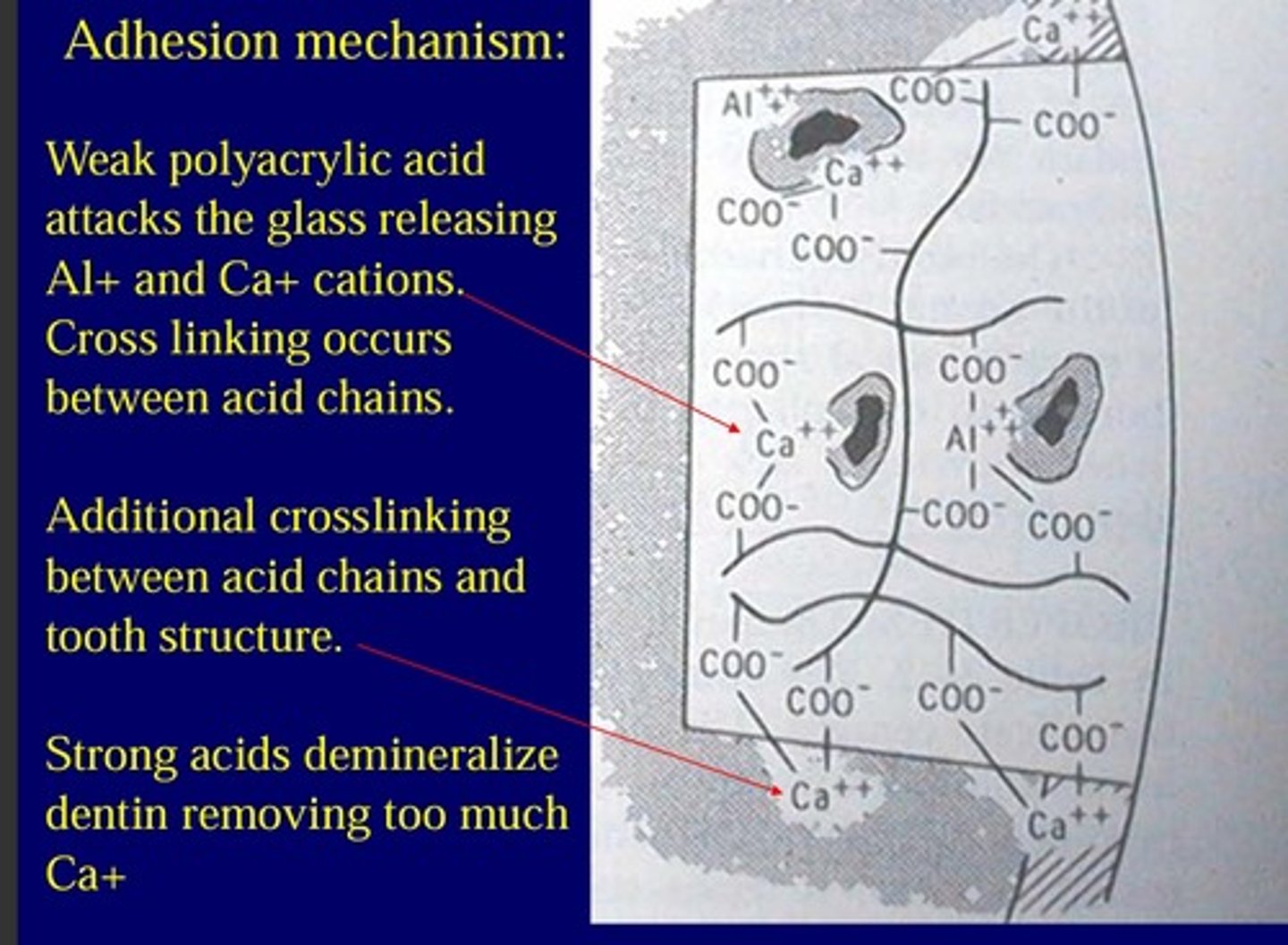
What is the adhesion mechanism of GI ?
Weak polyacrylic acid attackes the glass to release Al+ and Ca+ cations. cross linking then occurs between acid chains
additional crosslinks are made between acid chains and tooth structure
( strong acids demineralize dentin removing too much Ca+)
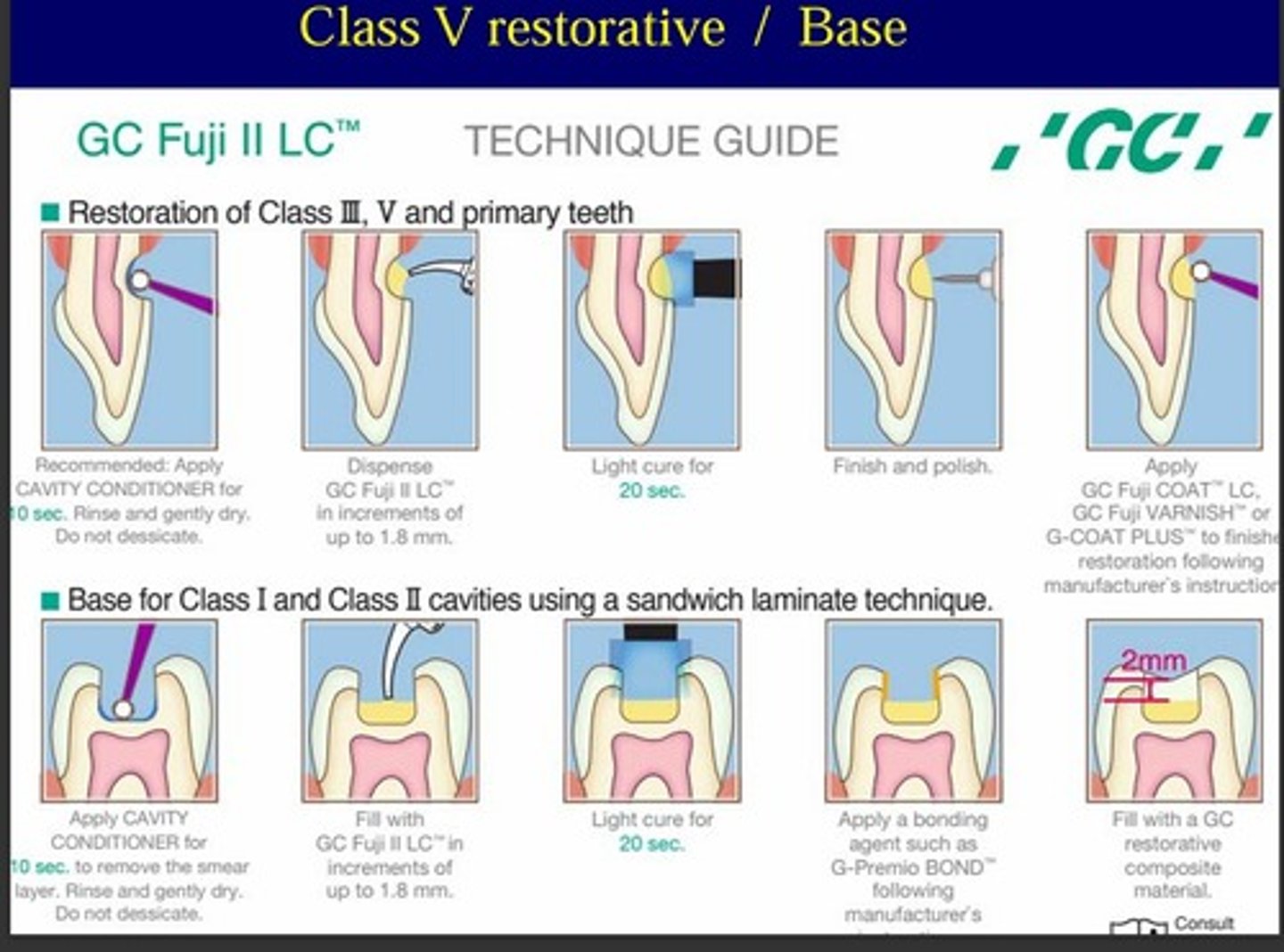
How does the application technique of GC Fuji LC differ between Class3,4,5 , primary teeth vs Class 1 and 2 cavities
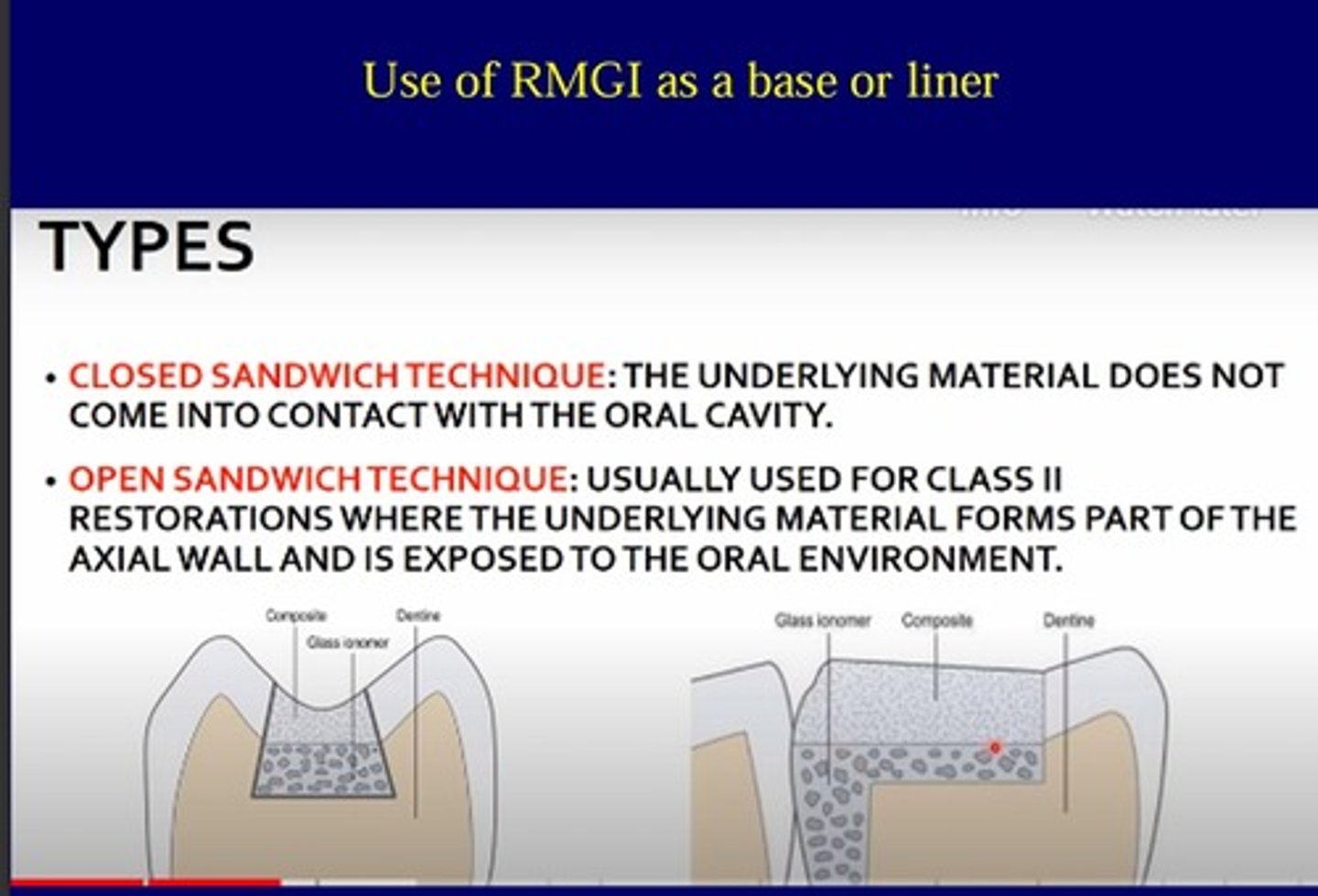
Describe the difference between the closed and open sandwich technique
Closed: the underlying material does not come into contact with the oral cavity
Open: usually used for class 2 restorations where the underlying material forms part of the axial wall and is exposed to the oral environment
Benefits of resin modified glass ionomer cement as a liner
bonds both to tooth structure and the composite
increased retention form
provides better seal when used at non-enamel margins
fluoride in GI material reduces recurrent caries
(*some conflicting research)
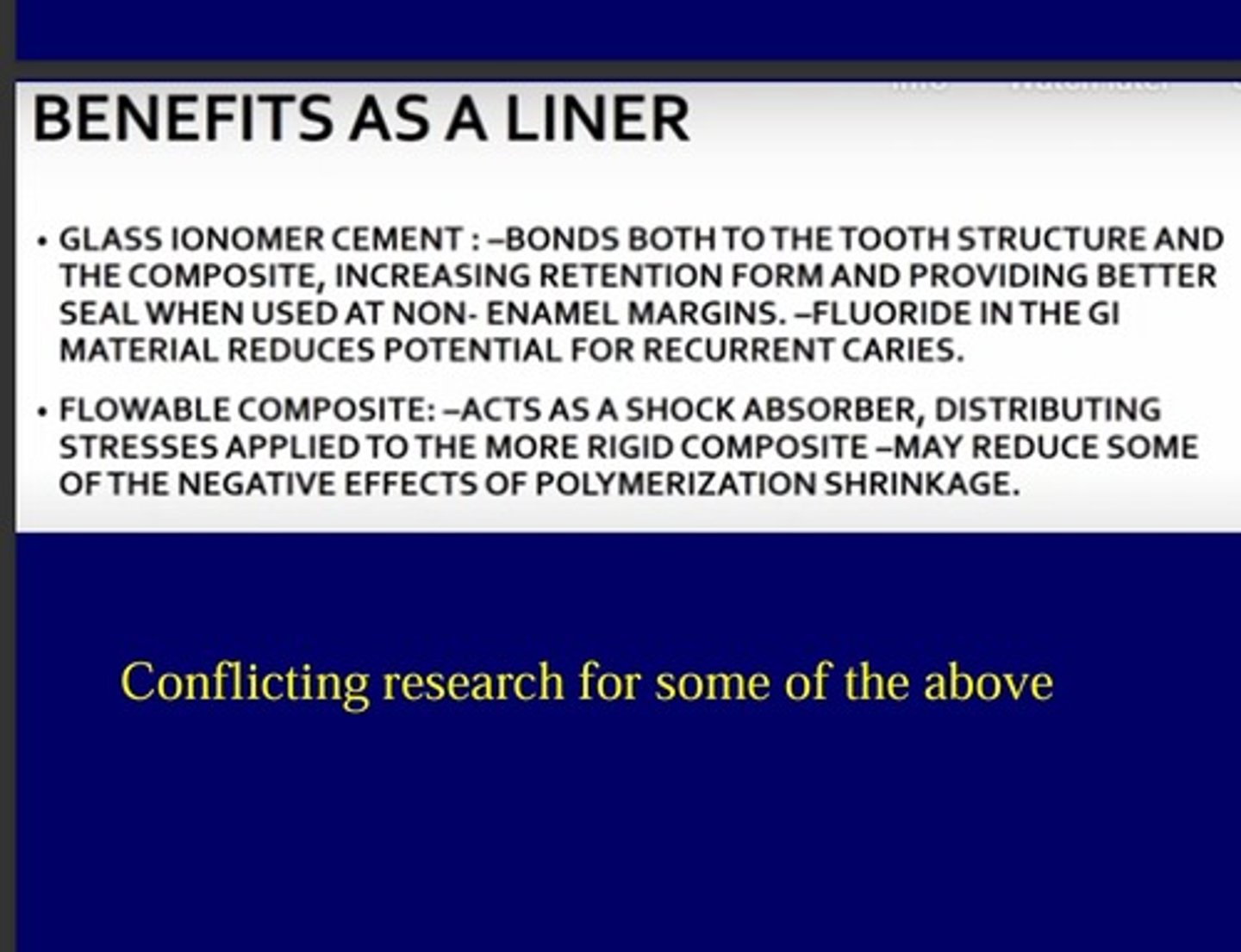
Benefits of flowable composite as a liner
acts as a shock absorber
distributes stresses applied to the more rigid composite
may reduce some of the negative effects of polymerization shrinkage
( * some conflicting research)
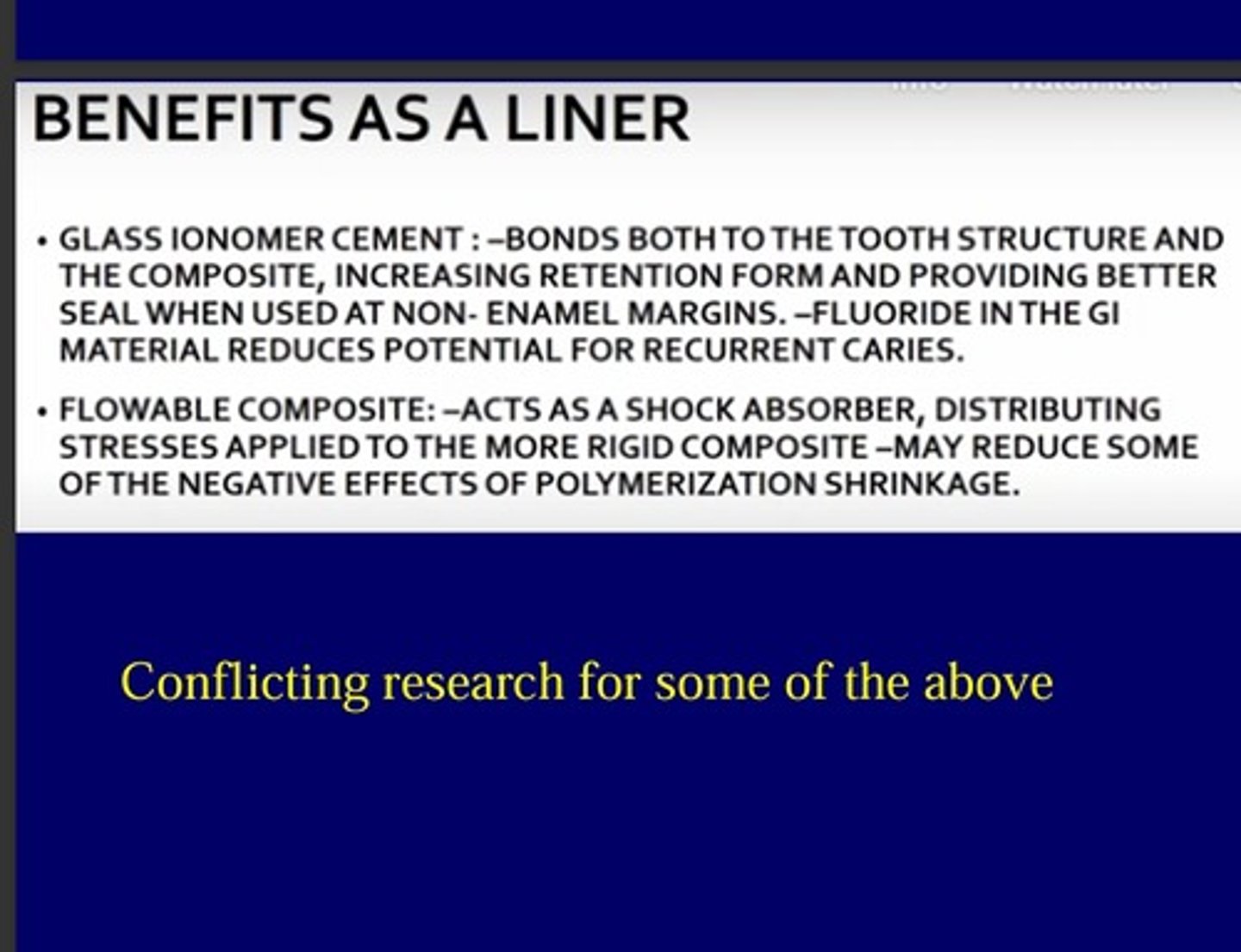
Main indications for use of RMGIC ( ** double check on lecture this is what he is talking about ***)
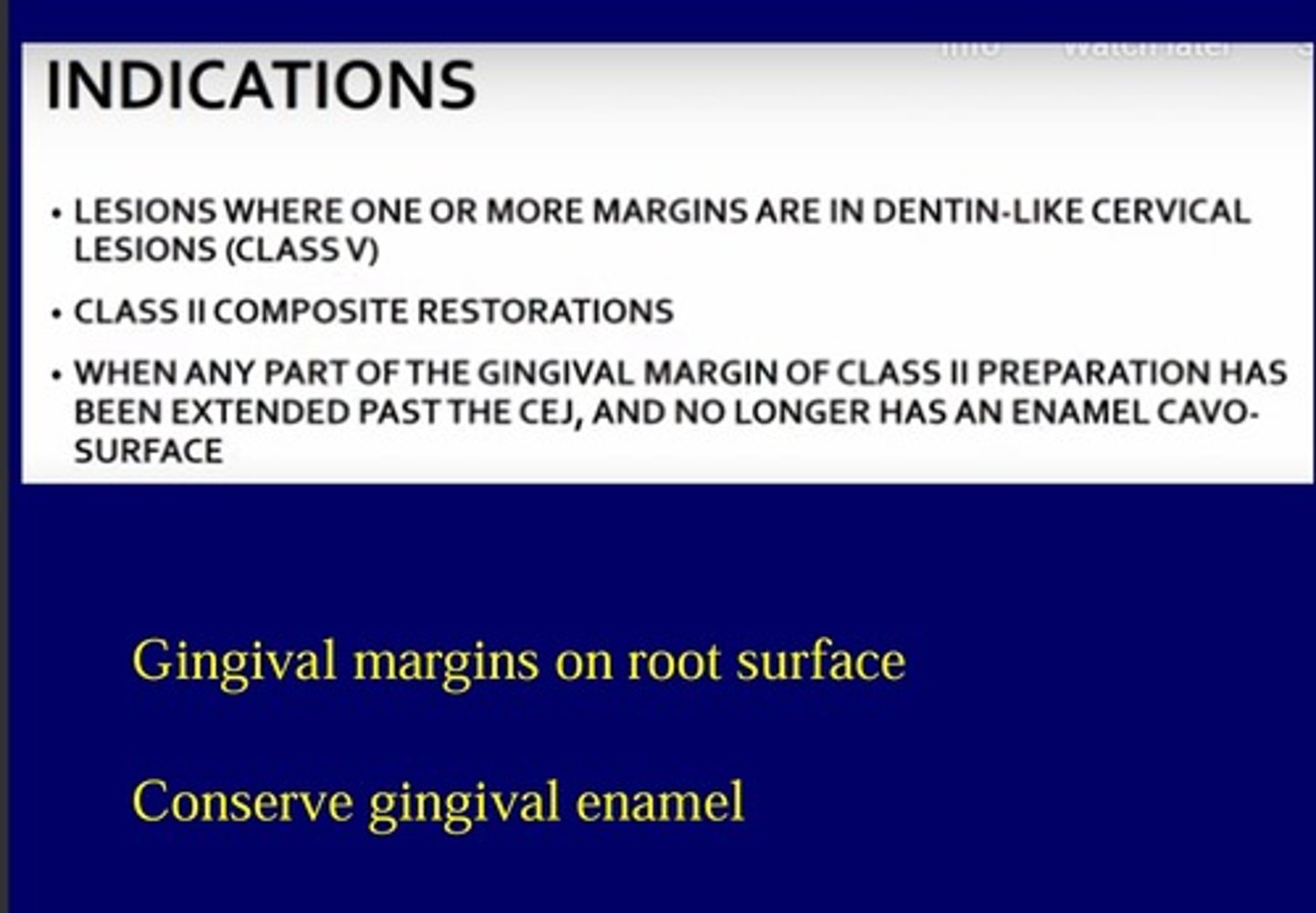
Main advantages of RMGIC (**** double check on lecture that this is what he is talking about)
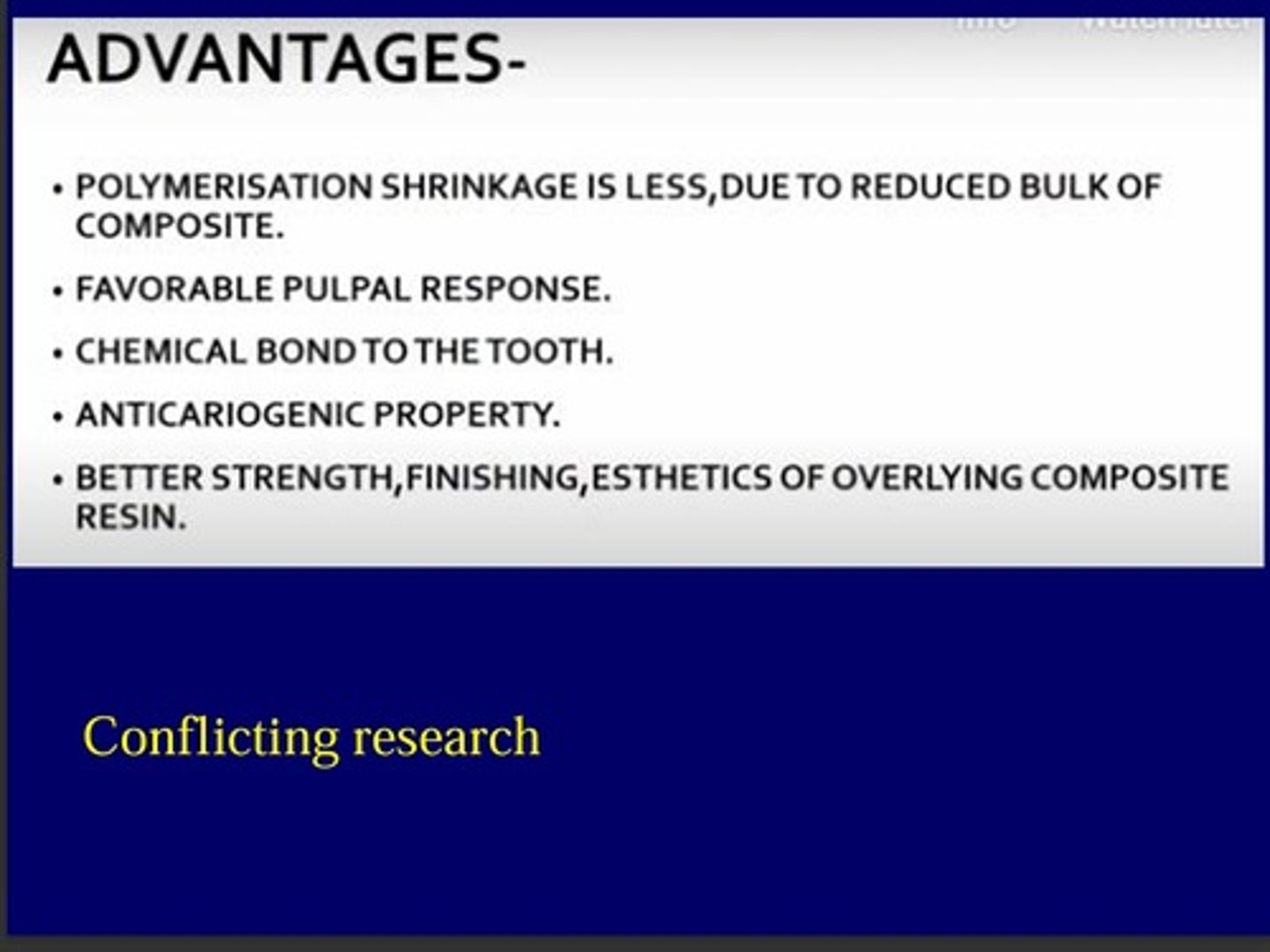
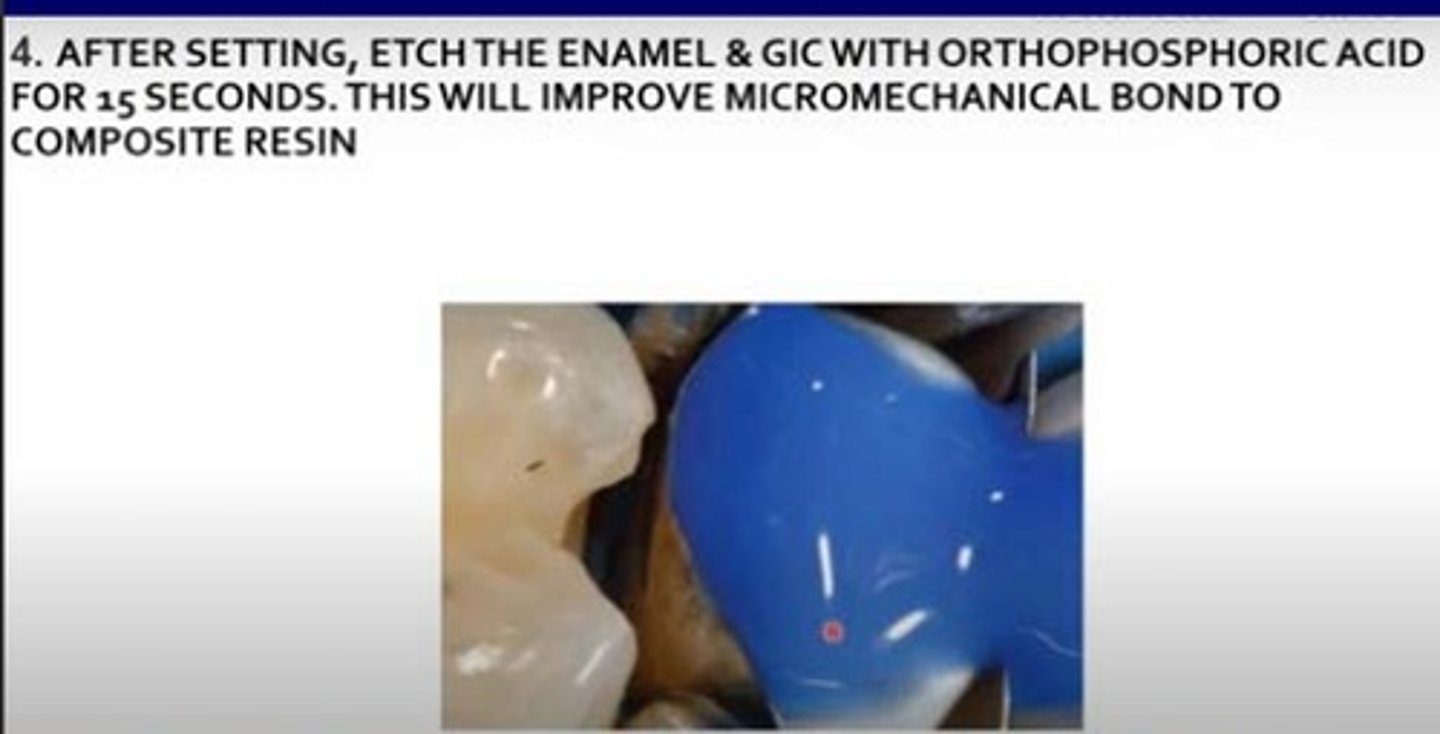
What is the function of conditioner? What are two commonly used conditioners?
creates stronger bond between tooth and GIC by removing smear layer and debris from tooth surface
commonly used conditioners: citric acid and polyacrylic acid
What is indication for sandwich technique?
gingival margin below the CEJ
Next few slides are review of clinical steps for RMGI usage
This card: steps 1 and 2
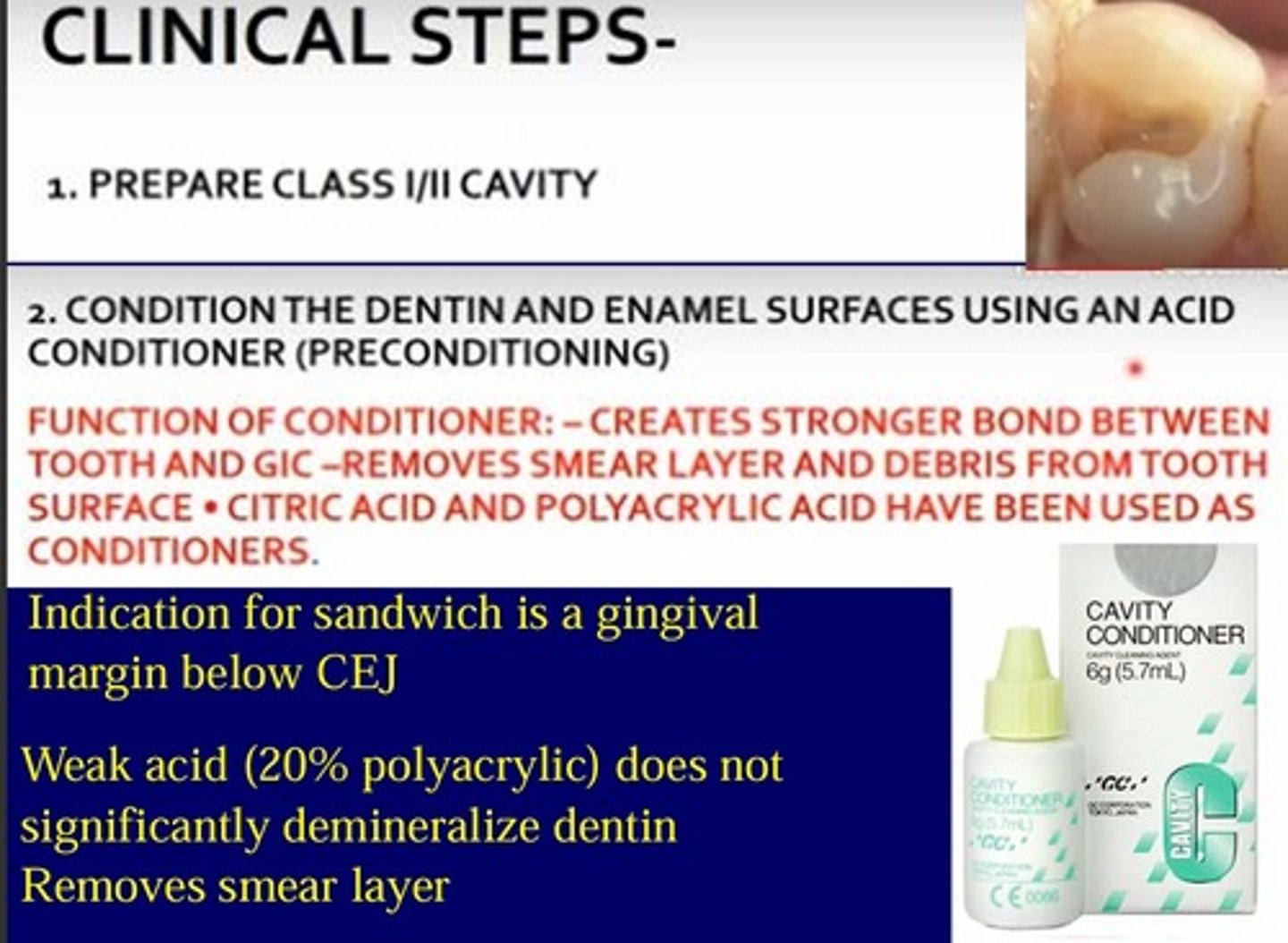
this card: step 3 of RMGI usage
also: describe the difference between open and closed sandwich
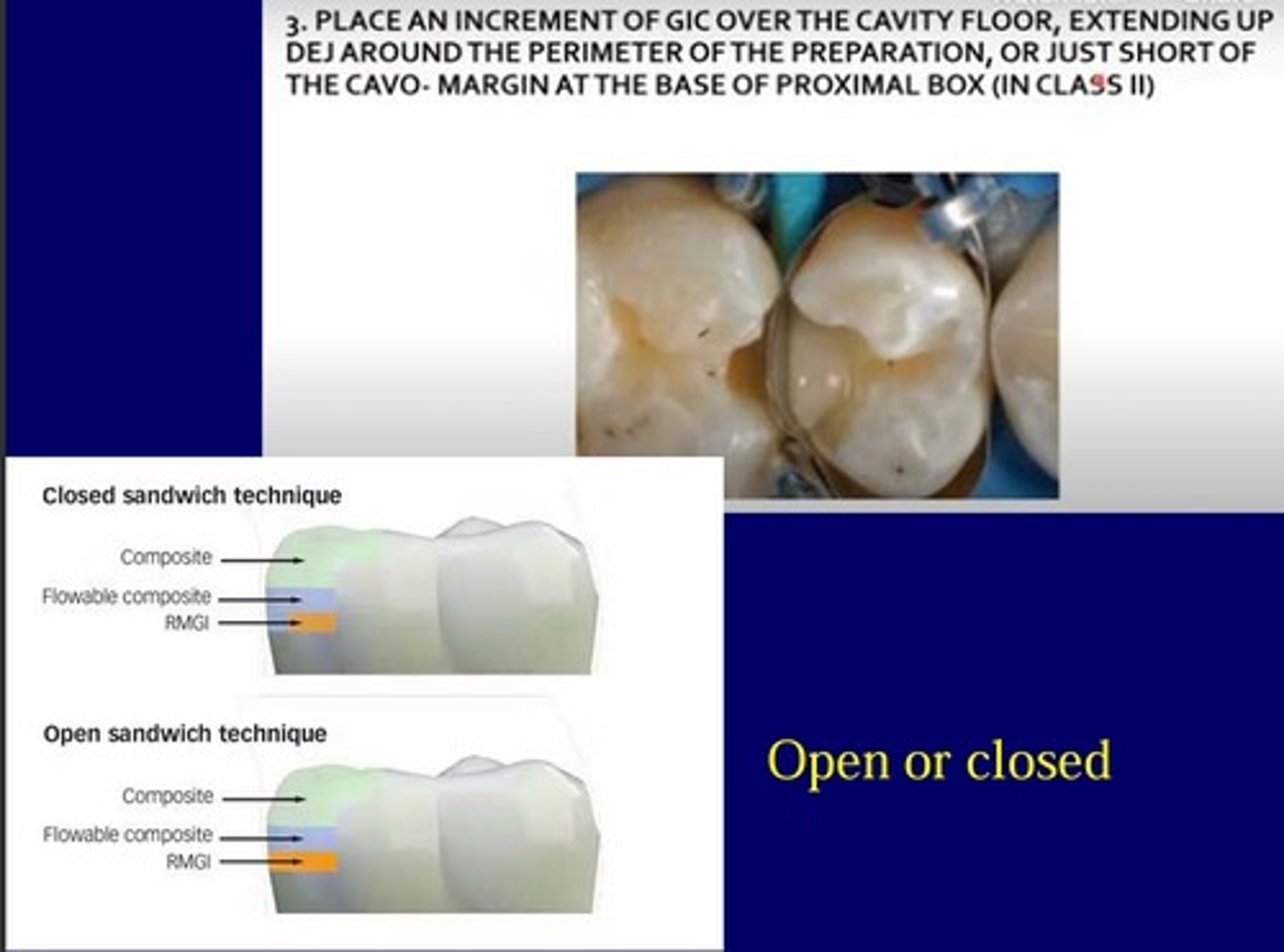
this card: step 4 of RMGI usage
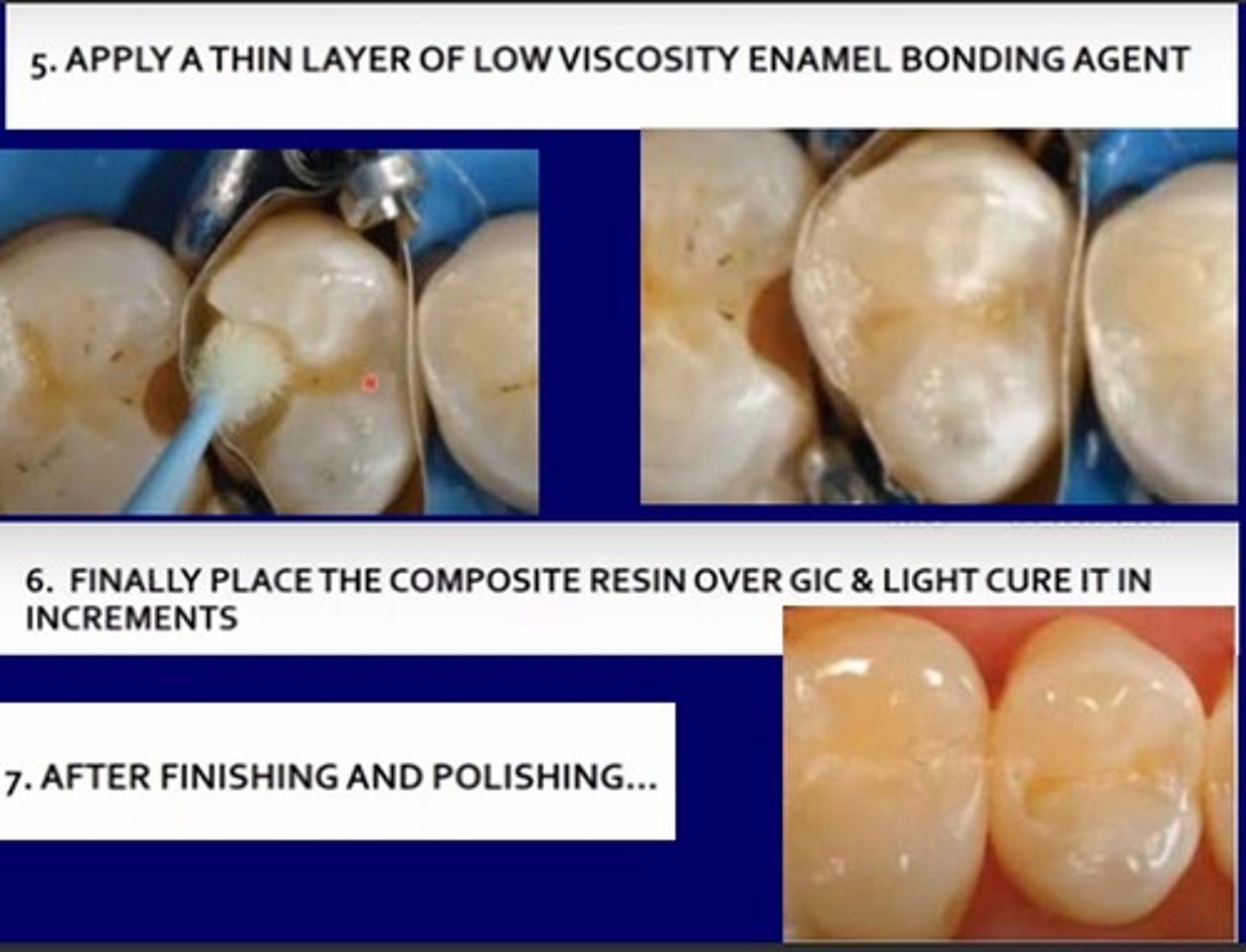
this slide: step 5,6, 7 of RMGI usage
What are the three main benefits of GI over flowable composite
GI is:
more moisture tolerant
bonds to tooth structure
releases fluoride
No cards this slide as I am not sure exactly what he means. Need to rewatch lecture and review
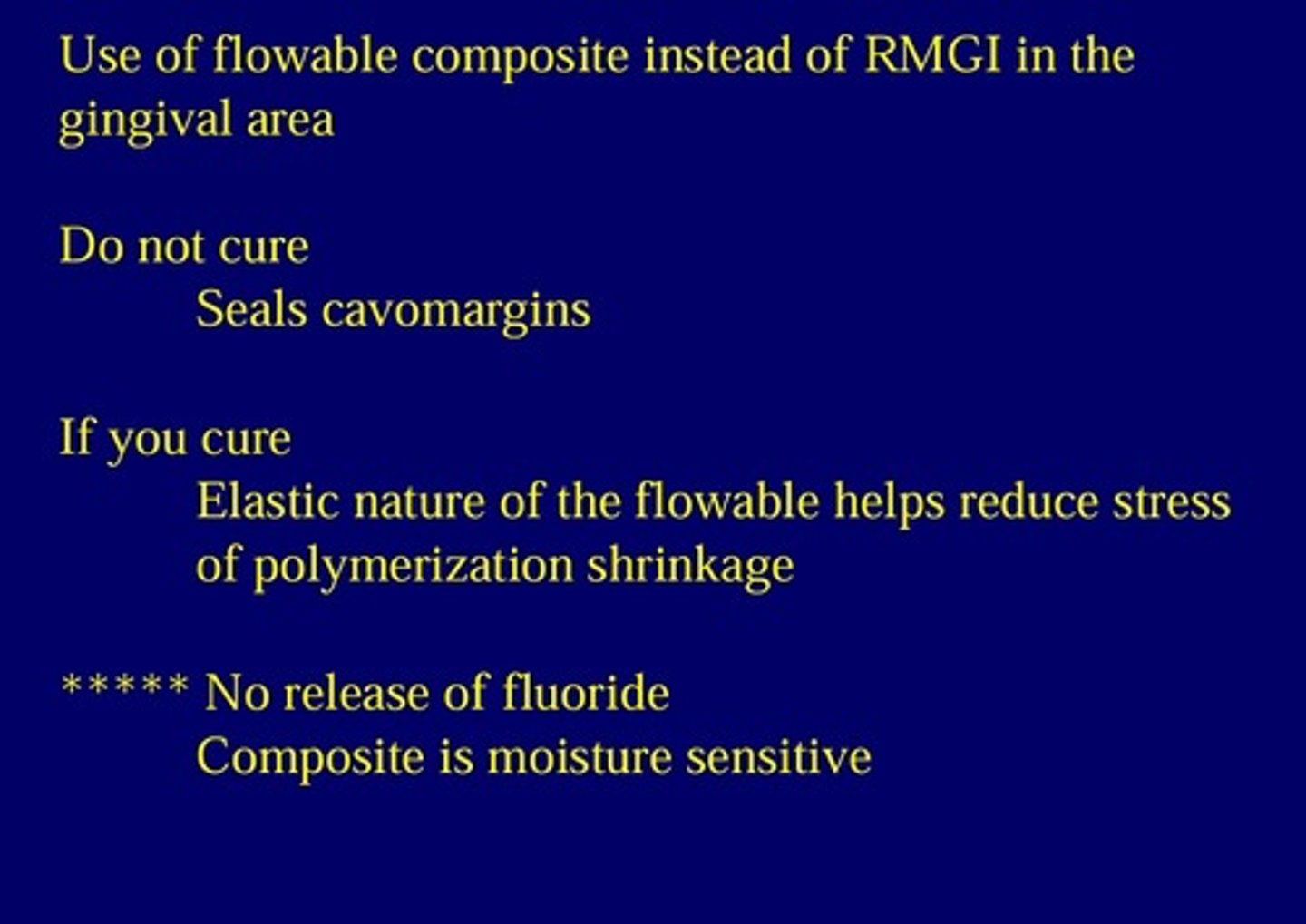
What is the snowplow technique ?
The "snowplow technique" is placing flowable composite in a layer, on the gingival margin of the proximal box as well as on the pulpal floor of a composite resin restoration. This layer of the composite is uncured before the placement of a composite restorative material that is denser filled
How is a cement base placed and why?
cement bases are placed under permanent restorations in order to protect injured pulp and encourage pulp recovery. They also provide thermal protection ( when beneath metallic restorations) and protection from chemical injury.
What thickness is require for cement composite to provide thermal protection?
0.75-1mm thickness of cement base is needed for thermal protection
No cards this slide
No cards this slide
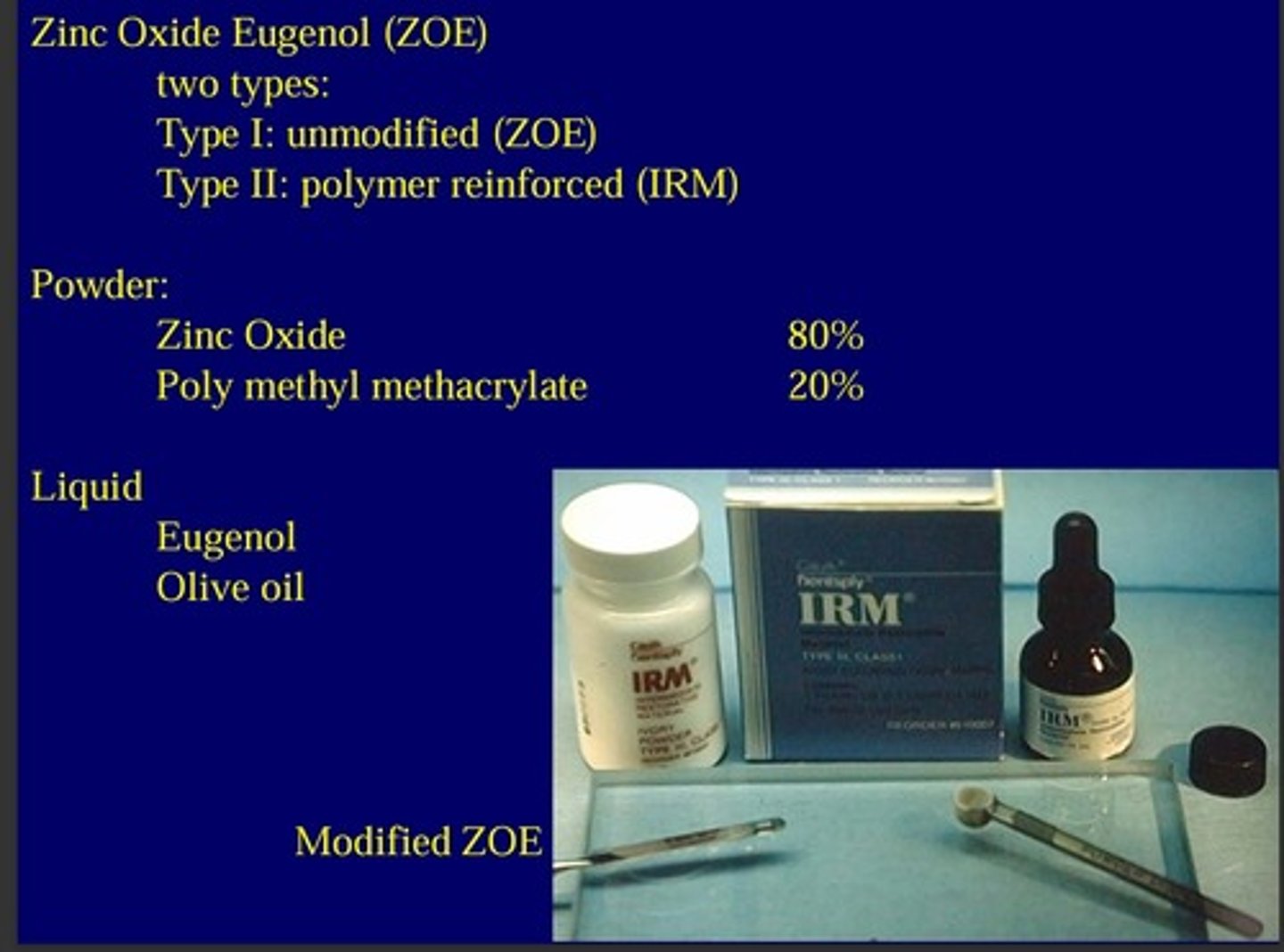
What are the two types of Zinc oxide eugenol (ZOE) / IRM
type 1: unmodified
type 2: polymer reinforced ( IRM)
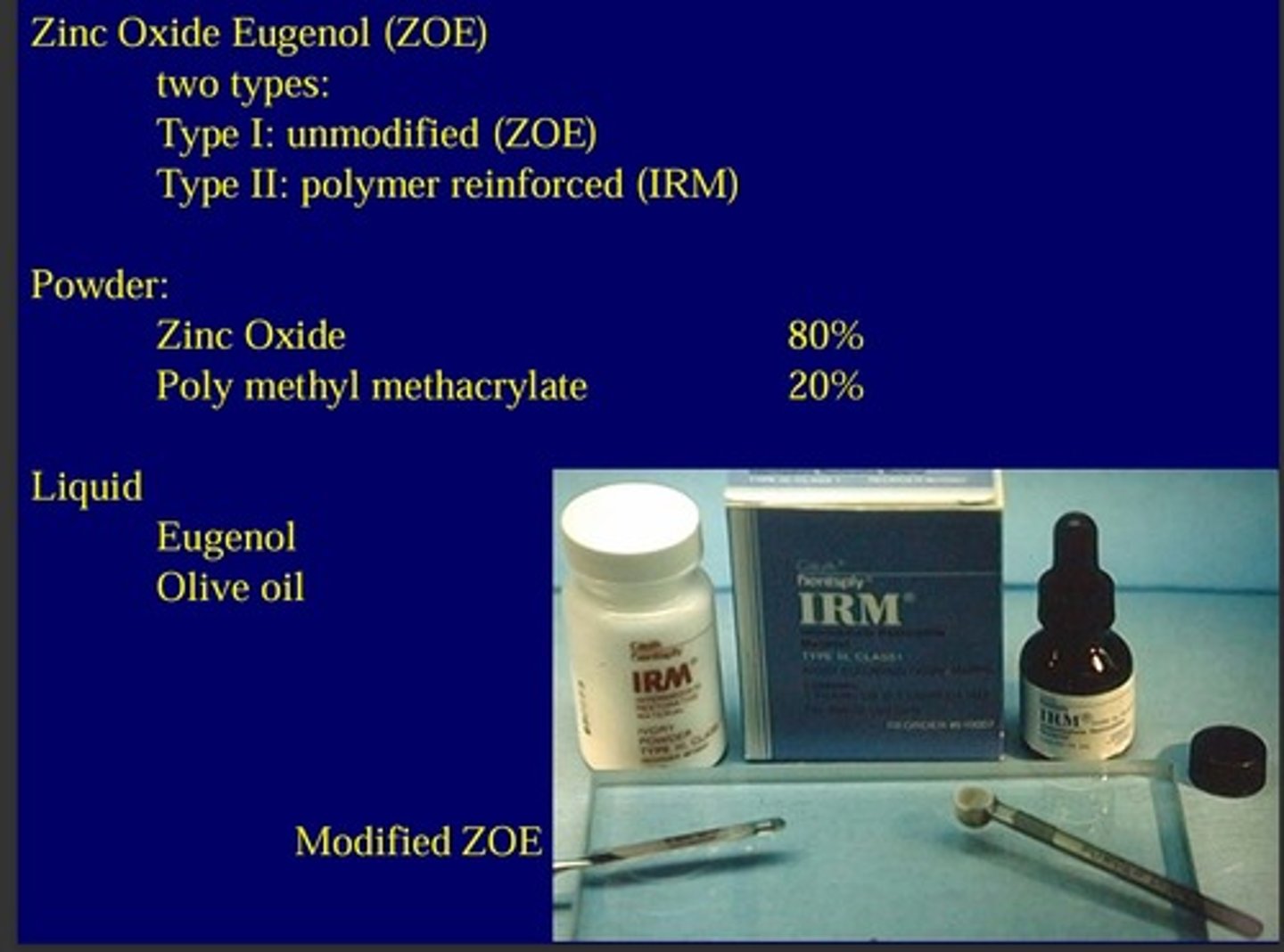
What are the two powder bases used in ZOE / IRM?
zinc oxide
poly methyl methacrylate
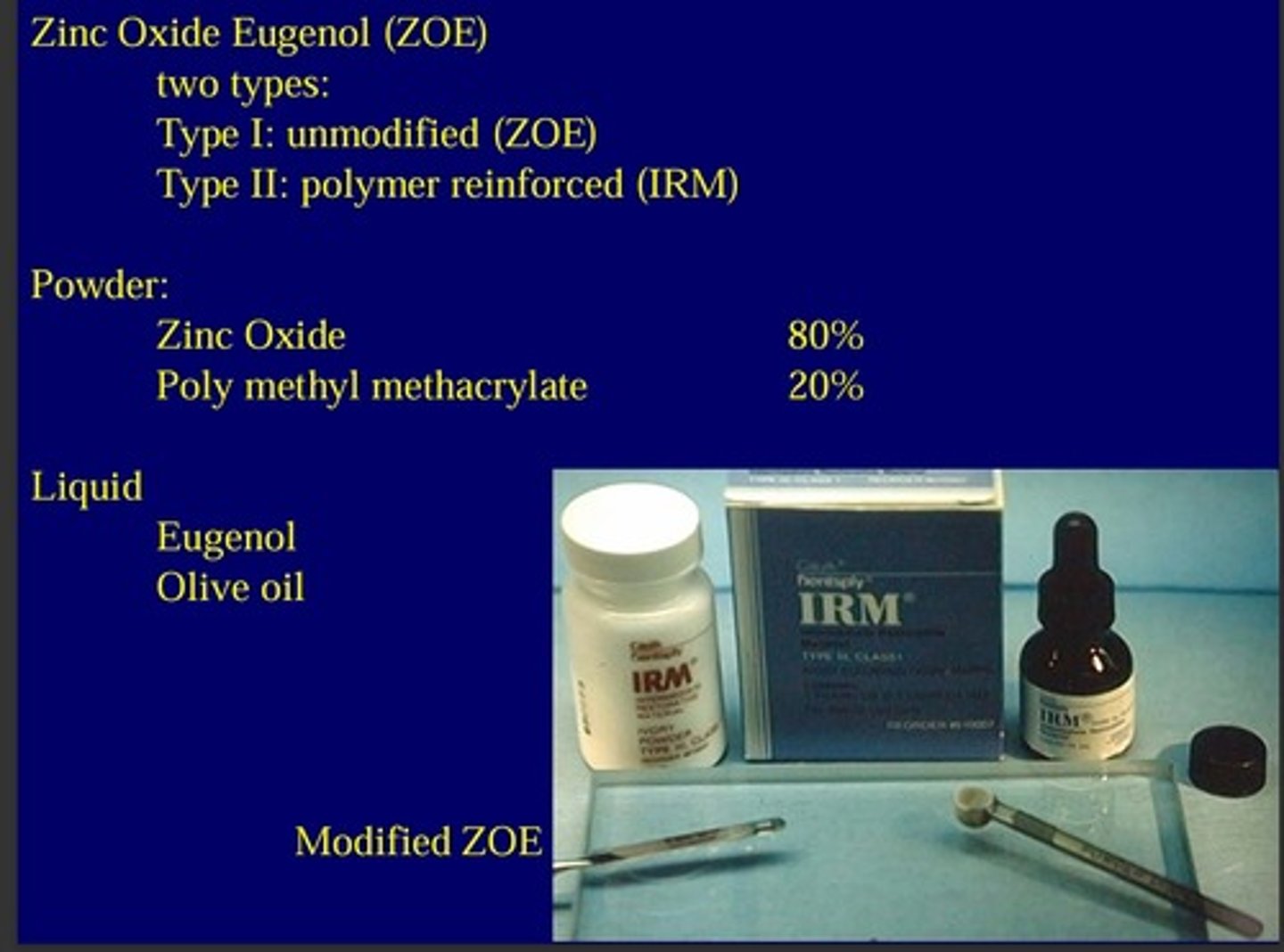
what are the two liquid bases used in ZOE / IRM?
eugenol
olive oil
Mixing ZOE / IRM
final base consists of:
undissolved powder particles surrounded by a matrix
increasing powder content in liquid results in:
increased strength ( until powder becomes excessive)
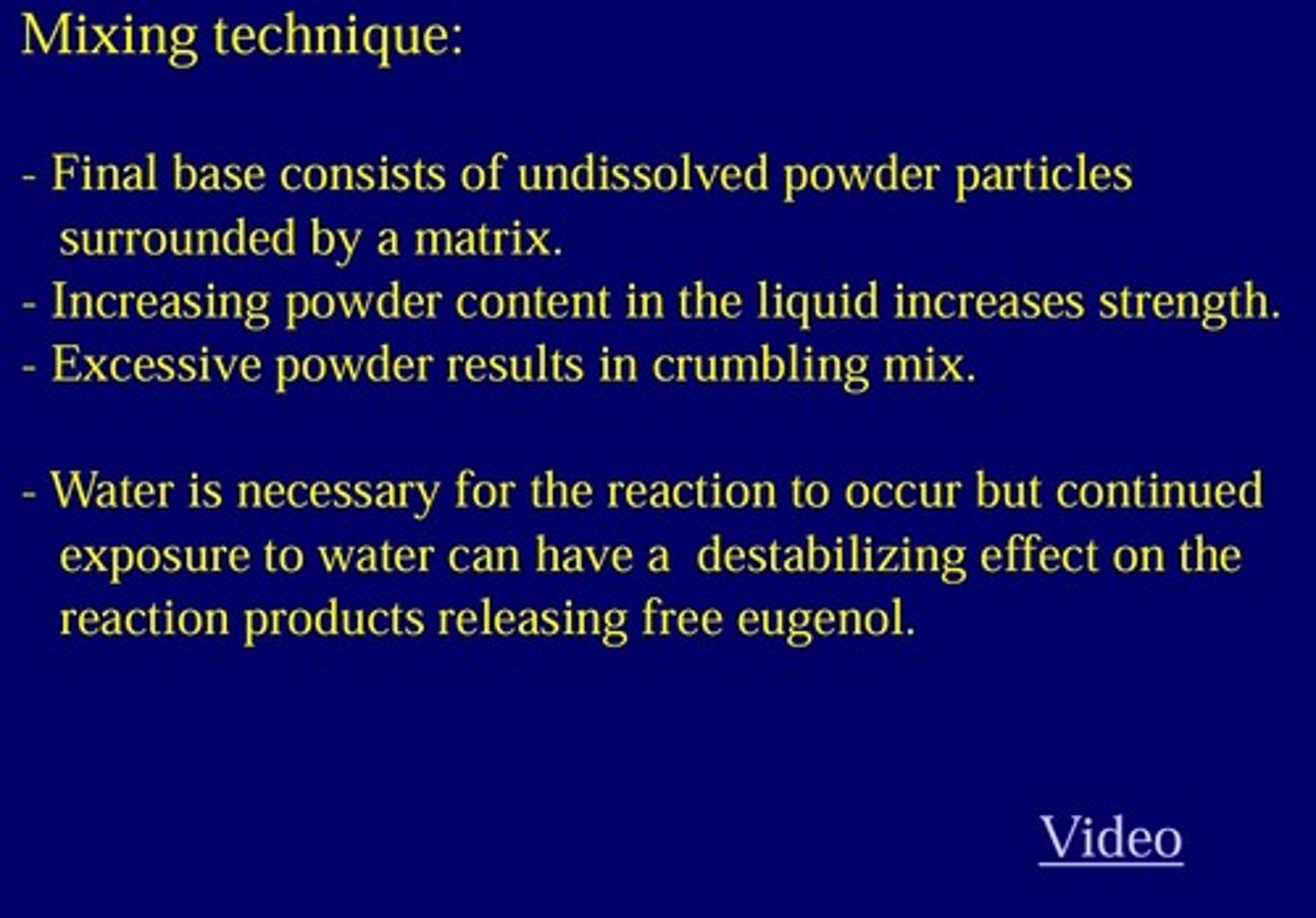
excessive powder results in
crumbling matrix
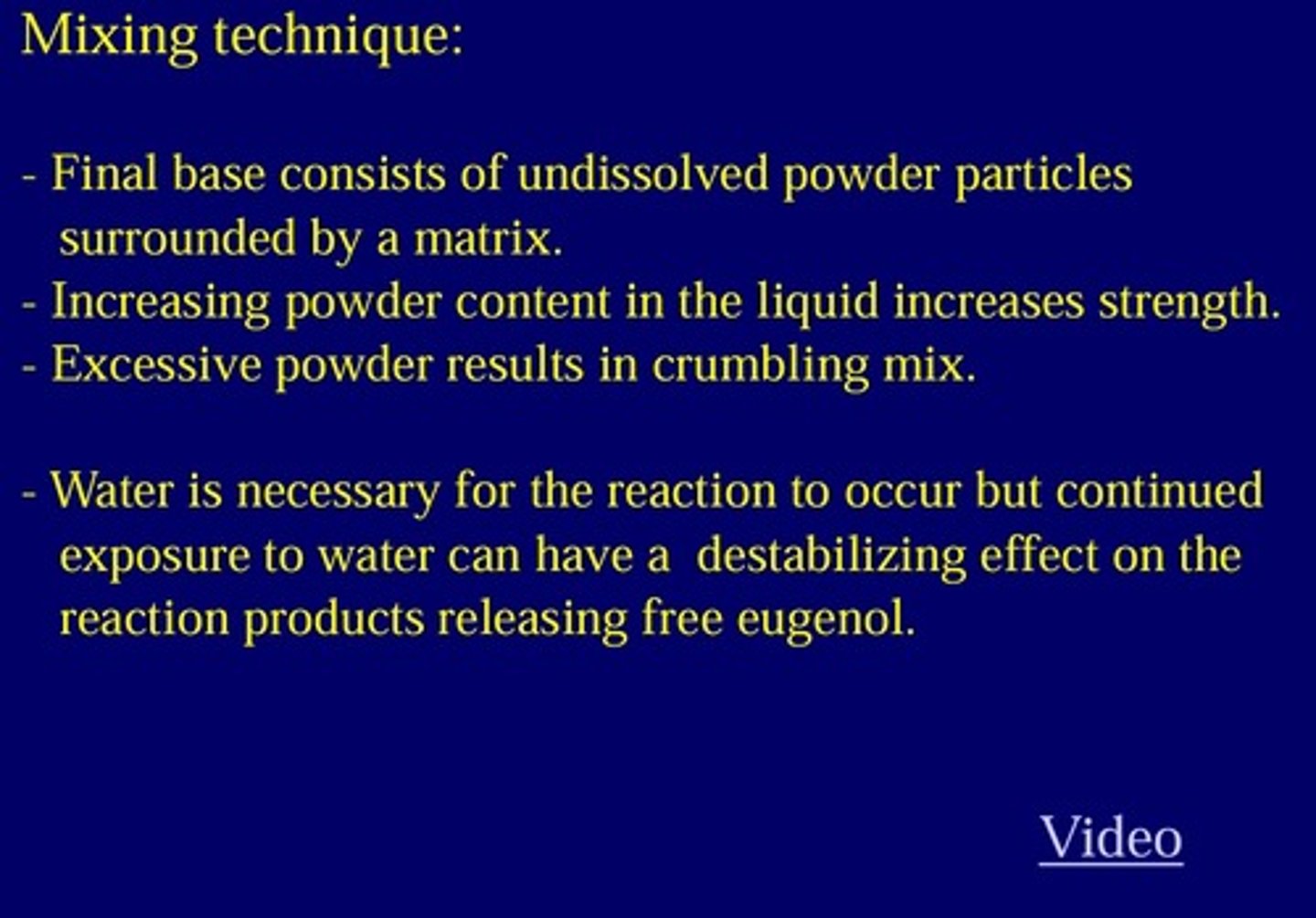
Mixing ZOE / IRM
water is necessary for _____ but continued exposure to water can cause:
Water is necessary for the reaction to occur but continued exposure to ware can cause a destabilizing effect, releasing free eugenol
What is the chemical reaction of ZOE / IRM?
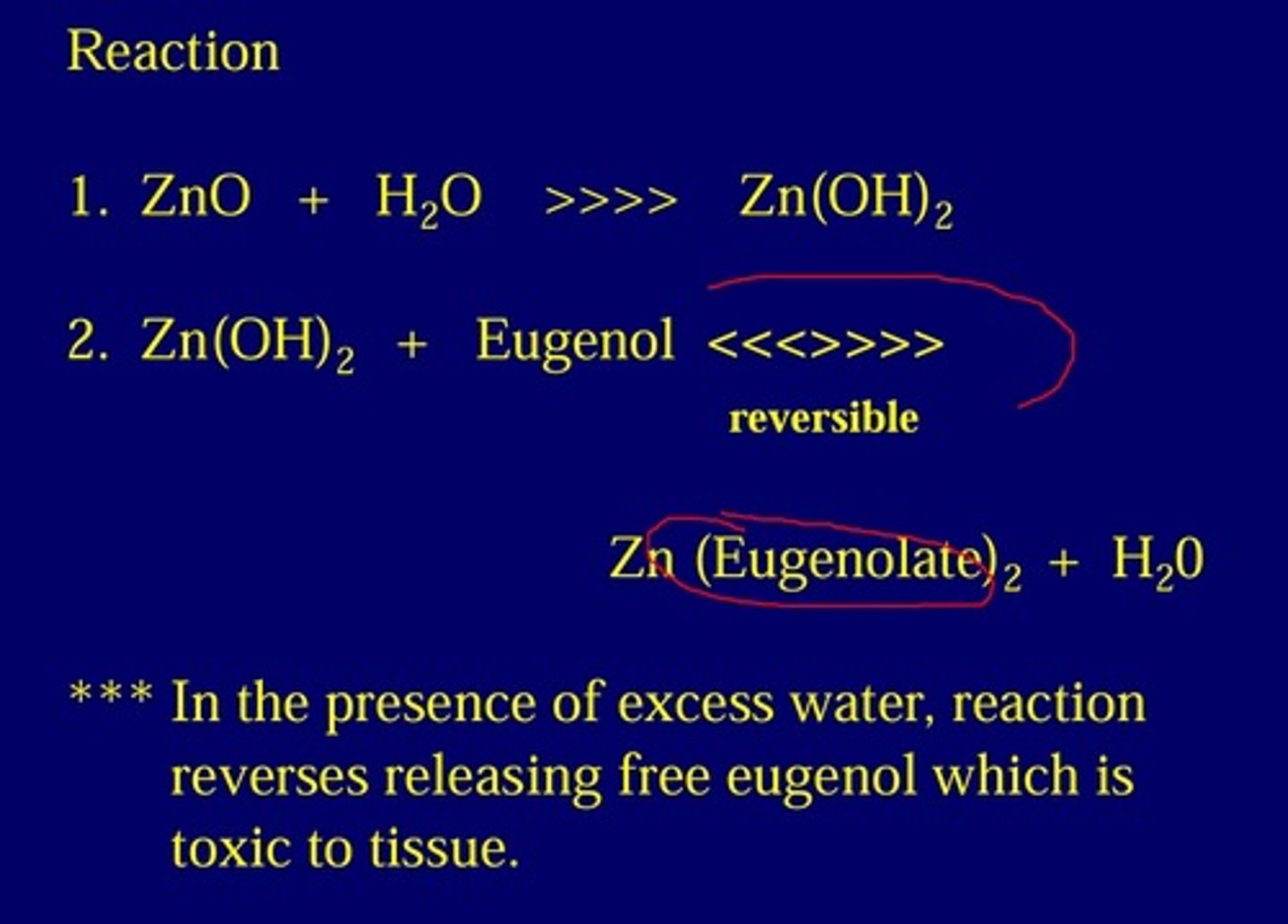
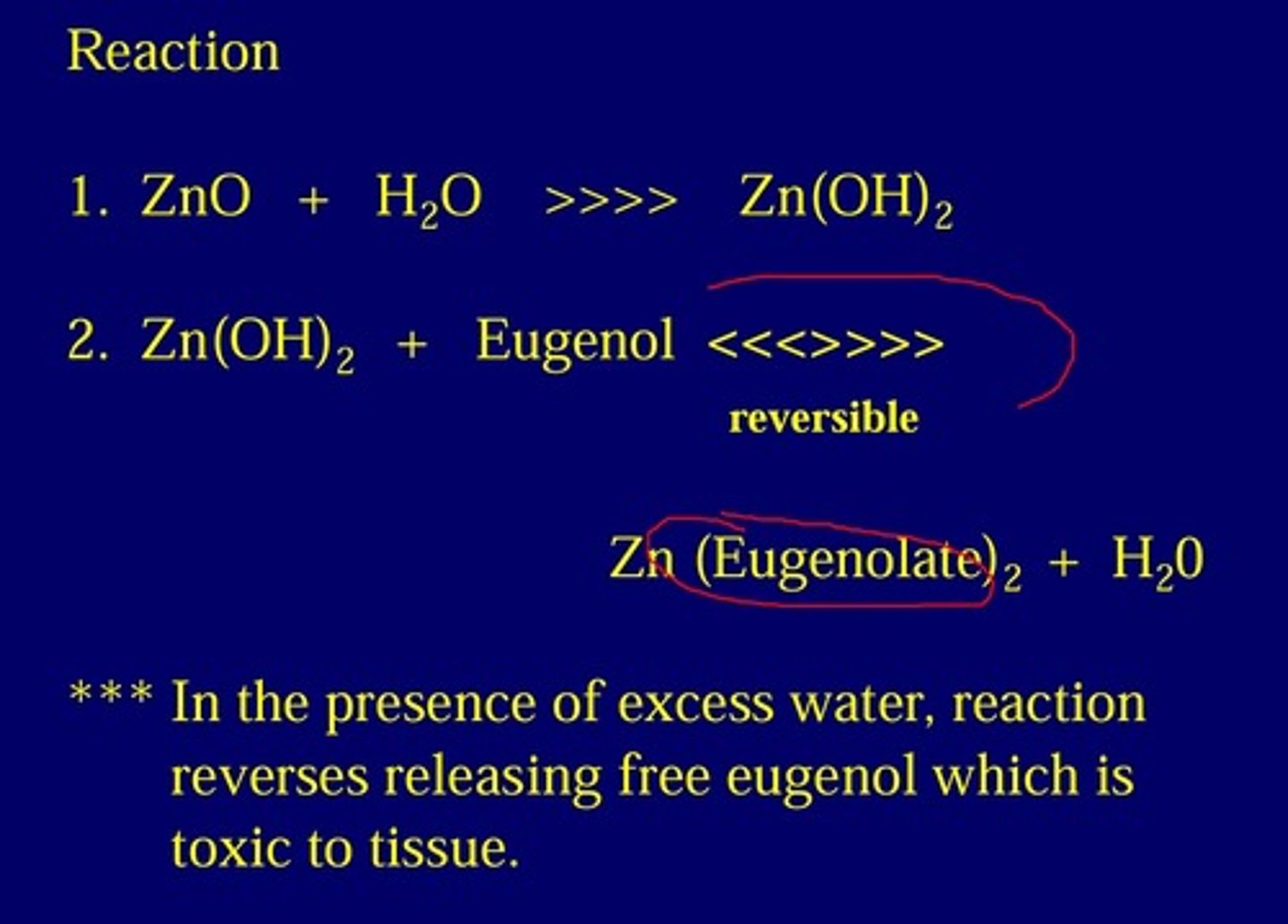
What happens to the chemical reaction of ZOE / IRM formation if there is excess water?
the reaction can reverse resulting in a release of free eugenol
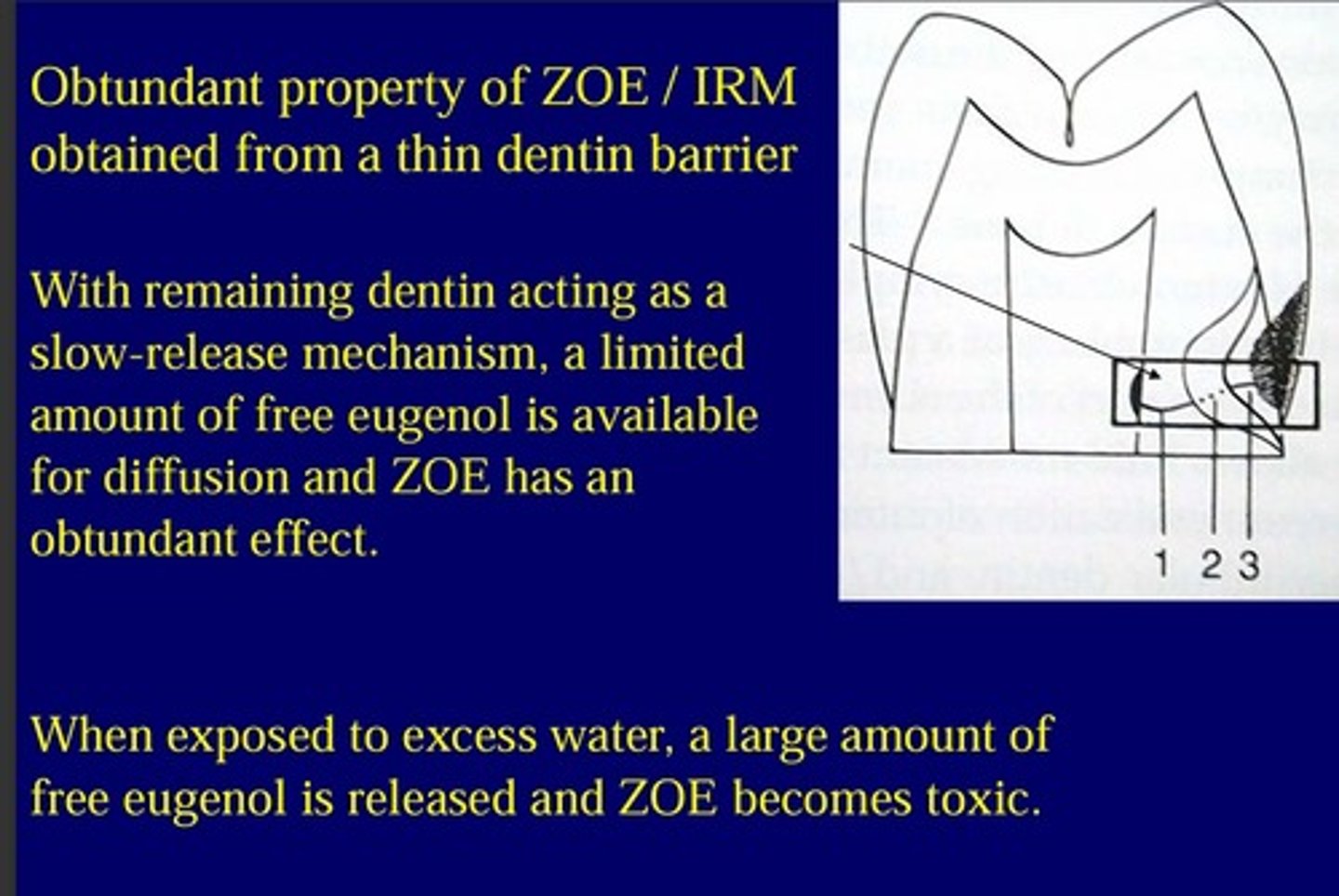
Explanatory slide on ZOE / IRM and releasing mechanisms
4 main properties of ZOE / IRM
1) bacteriocidal / bacteriostatic
2) obtundant in low concentrations ( dentin barrier) * can be toxic in high concentrations
3) pH 4-8; neutral and non irritating
4) Low thermal conductivity
5 ZOE / IRM applications
1) as a high strength base providing obtundant effects
2) use of modified type under temporary restorations
3) crown cementation
4) endodontic sealers
5) tissue management in periodontic treatment
(T/F)
ZOE / IRM is compatible with composite resin
false