Functional biology: Plants
 Call Kai
 Learn
Learn Practice Test
 Spaced Repetition
 Match
Match Flashcards
 Knowt Play
1/45

There's no tags or description
Looks like no tags are added yet.
Name | Mastery | Learn | Test | Matching | Spaced | Call with Kai |
|---|
No analytics yet
Send a link to your students to track their progress
46 Terms
/In wich cells are cholorplasts mainly found?
And where on the leaf are these cells
How many cholorplasts do therse cells contain?
Mesophyll.
The interior of the leaf.
Each Mesophyll contains 30-40 cholorplasts.
Stomata
The CO2, O2. exchanges.
How are the membrane structures called in the chloroplast where photosynthesis actely occurs,
Thylakoids
How do cells pack chloroplast
What happens when to much light?
On the top of the of the cell. In a very optimal way…..
When there is to much light that can damage the chloroplasts the cell can move the chloroplasts to the side so they get less damaged.
What light is not absorbed by Chlorophyll.
Green,
And yellow also not really
Chlorophyll?
The green pignent that absorbs fotons
Chlorophyll A vs Chlorophyll B.
What is the difference?
And how is this difference caused
Do plants contain both, or one of the two?
They absorb slightly diferent wavelengths of light
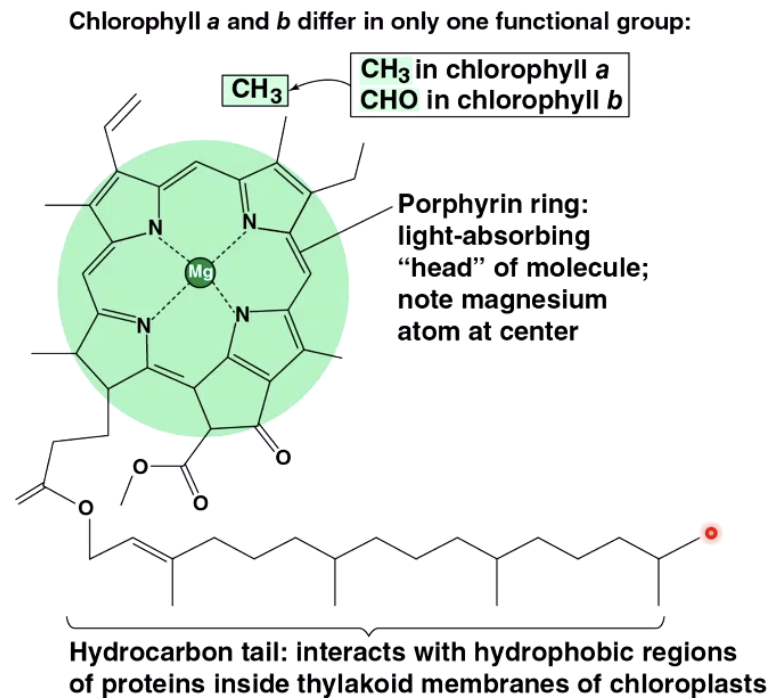
One side group is different:
Chlorophyll a = CH3
Chlorophyll b = CHOYes all plants contain both A and B. So plants have a broader range of light that can be used. Cause thats the point of the chlorophyll to increase the area where light can land.
Chlorophyll structure
Have these carbon rings with magnesium in the center (Why plants need magnesium).
The rings form one big conjugated system. That is specicly tuned to abosrb the high energy light.Side group a of b
Hydrophobic tail, for interactions with protein and membranes
Photosynthesis: reaction equation
Who is first photosystem I or photosystem II
Photosystem II vs Photosystem I
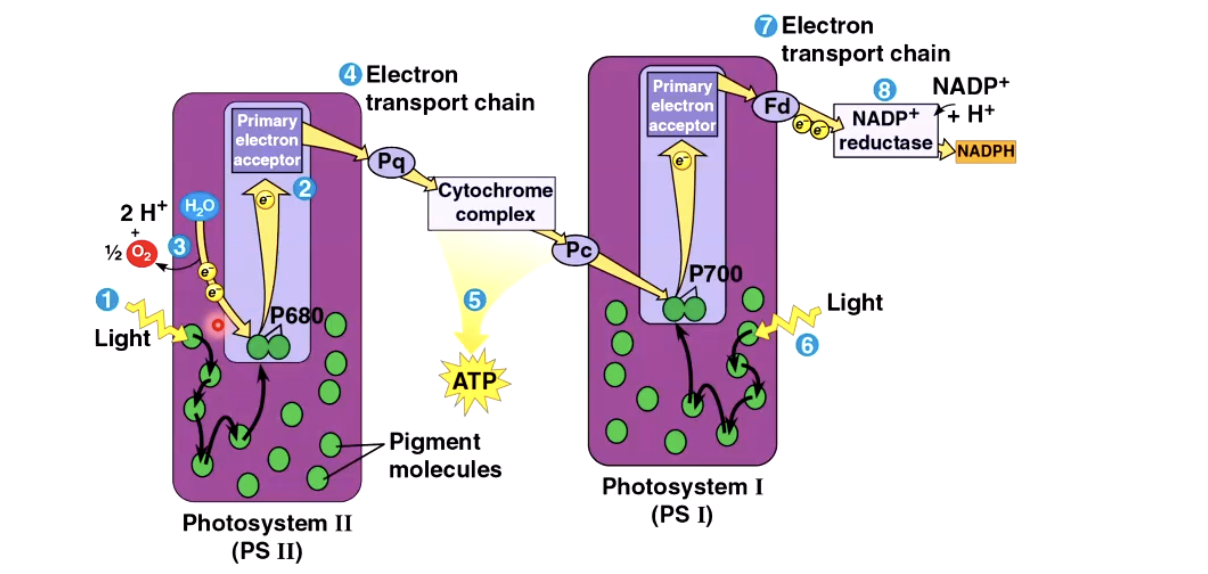
Photosystem II mechanisms.
H2O split by enzymes: H2O → 1/2O2 + 2H+ + 2e-
The 2e- are transfers to P680+ (oxidant)
Light is abosrbed by Chlorophyll.
Light energy bounces from Chlorophyll to Chlorophyll till it eventaily gets to P680 (quantum tunneling is invloved).
When the light energy reaches P680 with the 2e-. The energy exites the 2 e- to the primary elctron acceptor.
P680+ (oxidant)?
What is it
How does it work
The strongest biological oxidant.
Is basically two Chlorophyll molecules stuck together.
It can exite e- to the primary electron aceptor when it takes up the light energy:
P680 + light energy → P680+ + exited e- in primary electron aceptor.Now P680+ (because its a strong oxidizer) rips a e- from one of the water that is hold in place by OEC to become P680 again.
And then light hits again and it repeats.
What is the Oxygen evolving complex (OEC)
OAC, is the molecule that hold 2 water molecules for P680+ to steal the electrons later, its like the anvil for the hamer/vacuum cleaner that is P680+.
The kok cycle
OEC, start holding 2 H2O molecules.
Light with right wavelength hits P680 or chlorophill wich transfers the enegy to P680, wich then becomes P680:
P680 + light energy → P680+ + exited e- in primary electron aceptor.Then because :
P680+ + H2O → P680 + OH + H+.The H+ is then used for an proton gradiant (later usefull)
This cylce repeats 4 times so that the 2 H2O are stripped down to 2O. Where it then forms O2.
So 2H2O —-(kokcycle 4 times)—→ 2O + (4H+ used later) + (4 high energy electron) → O2 as watse.
What happens to the 4 high energy electors
They are taken up by the protein Plastoquinone, two at the time. So need 2 Plastoquinone per Kok cycle.
Plastoquinone
Plastoquinone structure
Plastoquinone is an membrane protein with a area in the Stroma where it takes H+. and a part in the Luman. It can trasfer charge from one side to the other to create a membrane potentail.
Plastoquinone mechanism/function.
Cytochrome bf.
plastocyanin
new Plastoquinone
Mechanism:
On photosystem 2
Plastoquinone takes up two electrons from photosystem 2.
Then because Plastoquinone is now negatifly charged it takes up 2 H+ protonts up from the stroma (oudisde of membrane).
Now it pops of from photosystem 2 and moves to next step.
Plastoquinone moves to Cytochrome bf.
Here the 2 H+ bound on the Plastoquinone are pushed trough to the Luman.
Then the 2e- on the Plastoquinone also disociate.
One of the e- binds to a new protein plastocyanin and used in a later step.
The other e- binds to a new Plastoquinone where it waits for an other e-, so for the second Plastoquinone from photosystem 2 made in the krek cycle to bind to Cytochrome bf so that an nother e- can transfer to the new Plastoquinone.
This new Plastoquinone with 2 e- is used to pump an nother 2H+ from Stroma to Luman
Then these 2 electrons are then also traced back to Fotosystem 1, through a different pathway???????????
Plastocyanin function
Transfers electron from Plastoquinone to Photosystem 1.
Photosystem 1
Structure
Mechanism
(ferredoxin,(Plastocyanin)
Structure:
Structure verry simelear to Photosystem 2. Same constuction with chlorophills
However it does not have P680 but P700 because it asorbs wavelenght of 700nm.
It also misses the OEC.
Mechanism
Light is absorbed and enegy transferd to P700.
P700 exites an electron wich is taken up by ferredoxin.
P700 + is now a strong oxidant so it takes up an electron from a new Plastocyanin protein.This repeats twice so that ferredoxin has 2 electorns
Then the 2 split of electrons (split in Cytochrome bf) also come to photorecptor I. So that an other Ferredoxin with the 2 e- is preduced
Ferredoxin
Wich reaction
Where and why that matters
The Ferredoxin with the 2 e- goes into the Stroma where it causes this reaction:
Ferredoxin with the 2 e- + H+ + NADP+ → NADPH + FerredoxinHappens in Stroma where it then uses one H+ for a reaction. So that the H+ concentration in the Stroma. is futher reduced.
How Manny H+ transferred from Stroma to Luman in light dependent reaction?
From 1 water.
What else does it make?
4 H+ from photosystem 2.
4 H+ from Plastoquinone chain.
So 8
And 1 NADH in photosystem 1, what also reduces H+ concentration in Stroma.
How is NADH used
In the Kalvin cycle
How is the H+ gradiant used to produce ATP
Through ATP synthesis.
That’s the key.
General idea of fotosynthesis.
Light and water used to produce protein gradient. and NADPH
Then radiant used in ATP synthesis. Like a windmail to produce ATP, Where you allow water to go to lower energy state but first spin the water rat so that we can use mechanical force.
Then ATP and NADH used in combination with CO2 to reduce sugar. So that you have stable energy.
SOOOO COOLLLL
How much NADH and ATP produced from 2 H2O
2 ATP
2 NADHP
Cyclic electron flow:
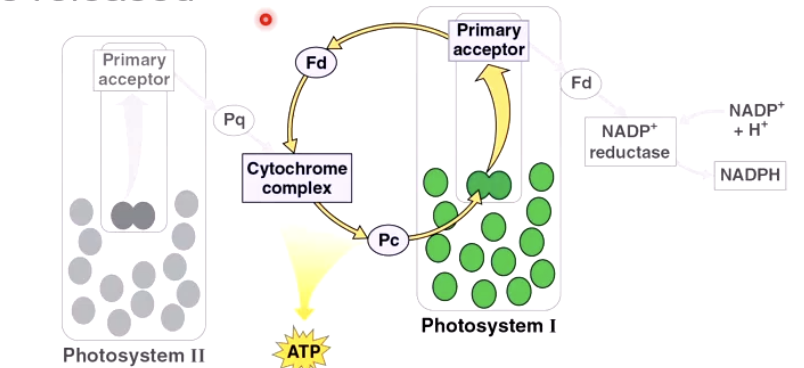
When
How
Preduces
Still O2 preduced
When there is to much light.
Recycles the electrons.
Only preduces ATP
No O2 formed cause no water splitting.
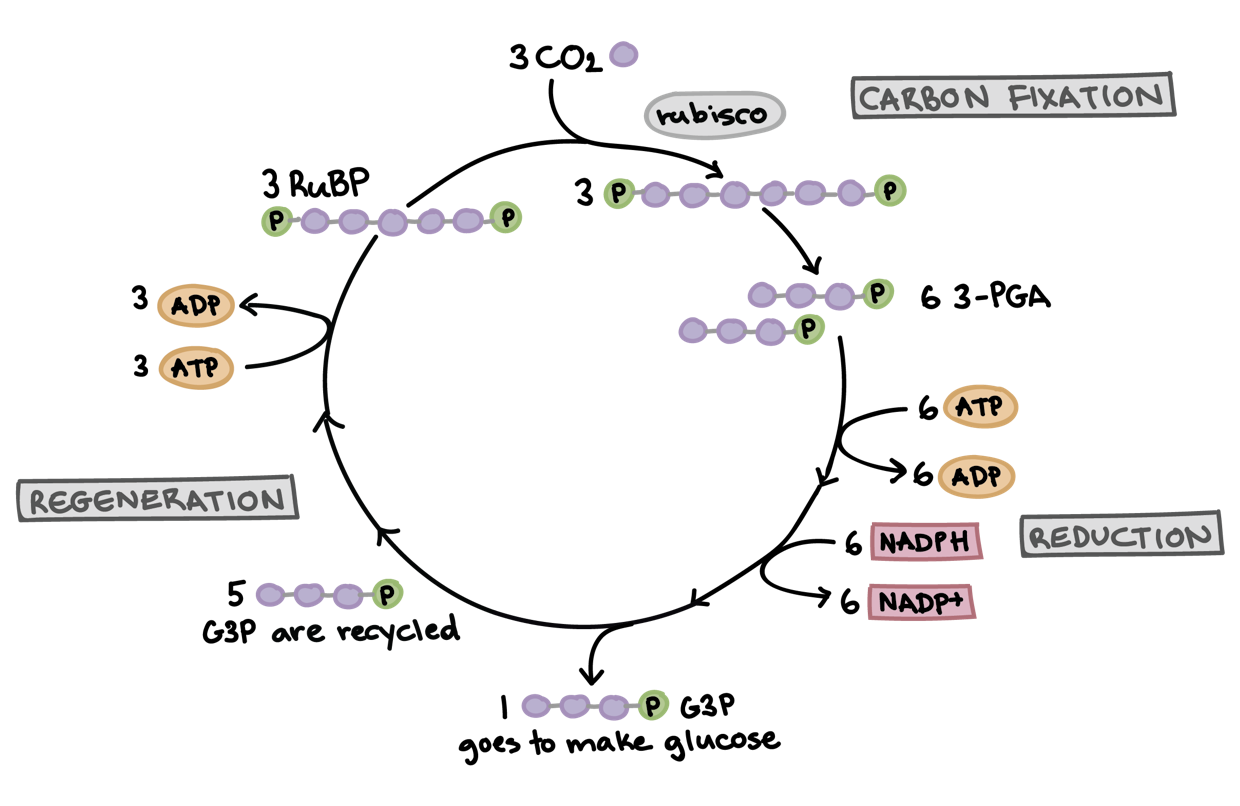
Name the 3 phages on the Calvin cycle
Carbon fixation. (catalyzed by rubisco)
Reduction
Regeneration of the CO2 acceptor (RuBP)
Photorespiration
Bad?
Why
How
When
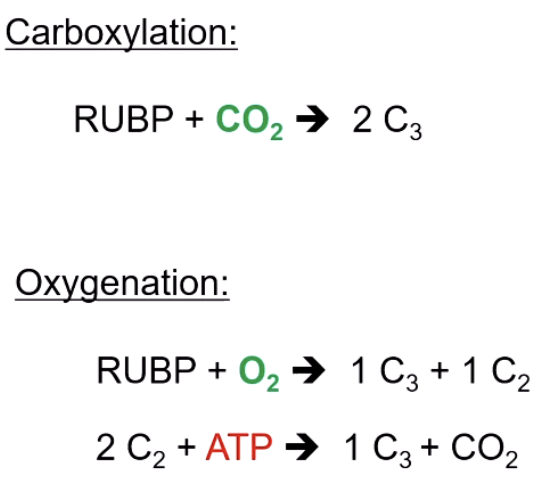
Yes it is bad because it oxidizes the compound what leads to the release of energy not to the storage of it.
Because rubisco also has a site where it can oxidate instead of carboxylation.
Happens when there is to much O2. So that O2 binds to rubisco instead of CO2.
Happens when it is hot and the stroma are closed (to save water loss). Problem is also no CO2 intake so O2 builds up.
Name 3 reasons why rubisco must commence enzyme
Lot of plants
Long turn over rate, so want more of it.
Can go into photorespiration so can make mistakes easily.
C4 plants.
Separates the Calvin cycle in plants. So that the calvin cyvle happens in a diferent cell type.
For hot water plants
CAM plants
Open stoma in night. So Calvin cycle during day
So split up dark and light cycle of photosynthesis up.
For hot water plants
When did plants originate from algae?
About 470 million years ago.
When did plants get traits so they could move up to land?
About 425 million years ago.
Nonvascular plants.
What?
Do they have seeds
Mosses and ferns for example.
No seeds
Embryophytes?
Embryo of plants, have clear seed like structures.
Sets plants apart from alga
Alternation between generations?
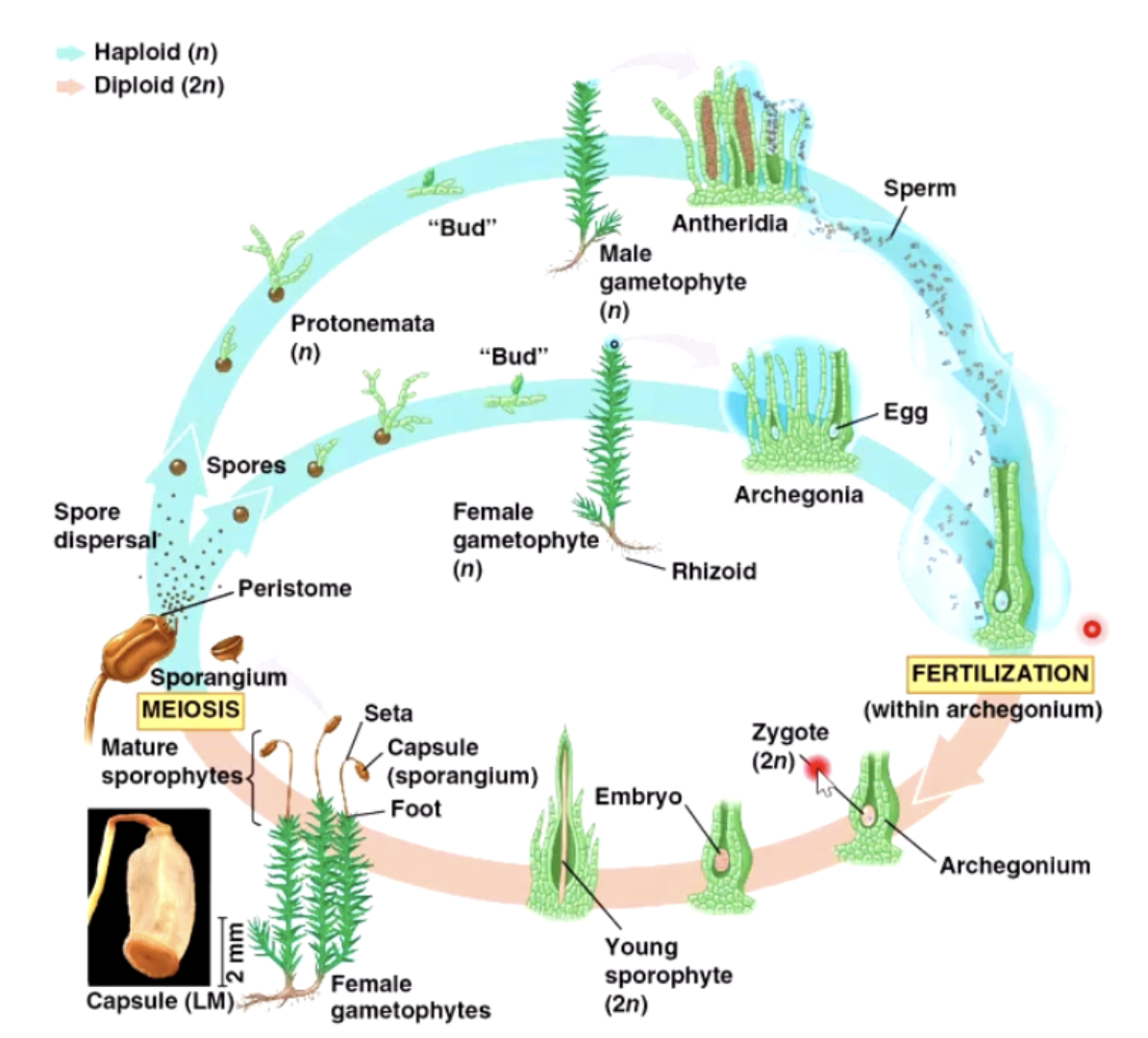
The process by which the life cycle of plants alternate between two types of organisms: Gametophytes and sporophytes.
Gametophytes?
Haploid or diploid?
Mitosis for spores or meiosis?
Haploid produces haploid gametes (sperm and eggs) by mitosis.
So need male and female plant to make baby.
Sporophyte
Haploid or diploid?
Mitosis for spores or meiosis?
Diploid , produces haploid spores trough meiosis
So do Gametophytes become Sporophyte and visa versa?
yes…
Look at the n. Switches between two types. One haploid on diploid. And the one creates the other
Seed plants
Trees
Pollen
flowers
What’s in a seed?
Embryo and some food.
Seed are very durable.
And can wait a long time for germination.
Some are triggered by things like fire. So that after a forrest fire they can dominate.
Evolutionary advantage of seeds:
If egg fertilized then zygote becomes sporophyte embryo.
Ovule develops into seed: With embryo, food suplly and protactive coat.
Protactive coat provide cover and can facilitate dispersal.
Gymnosperms vs angiosperms
Gymnosperms: Naked seeds: Trees
Angiosperms: Flower and fruits. Most deverse planys
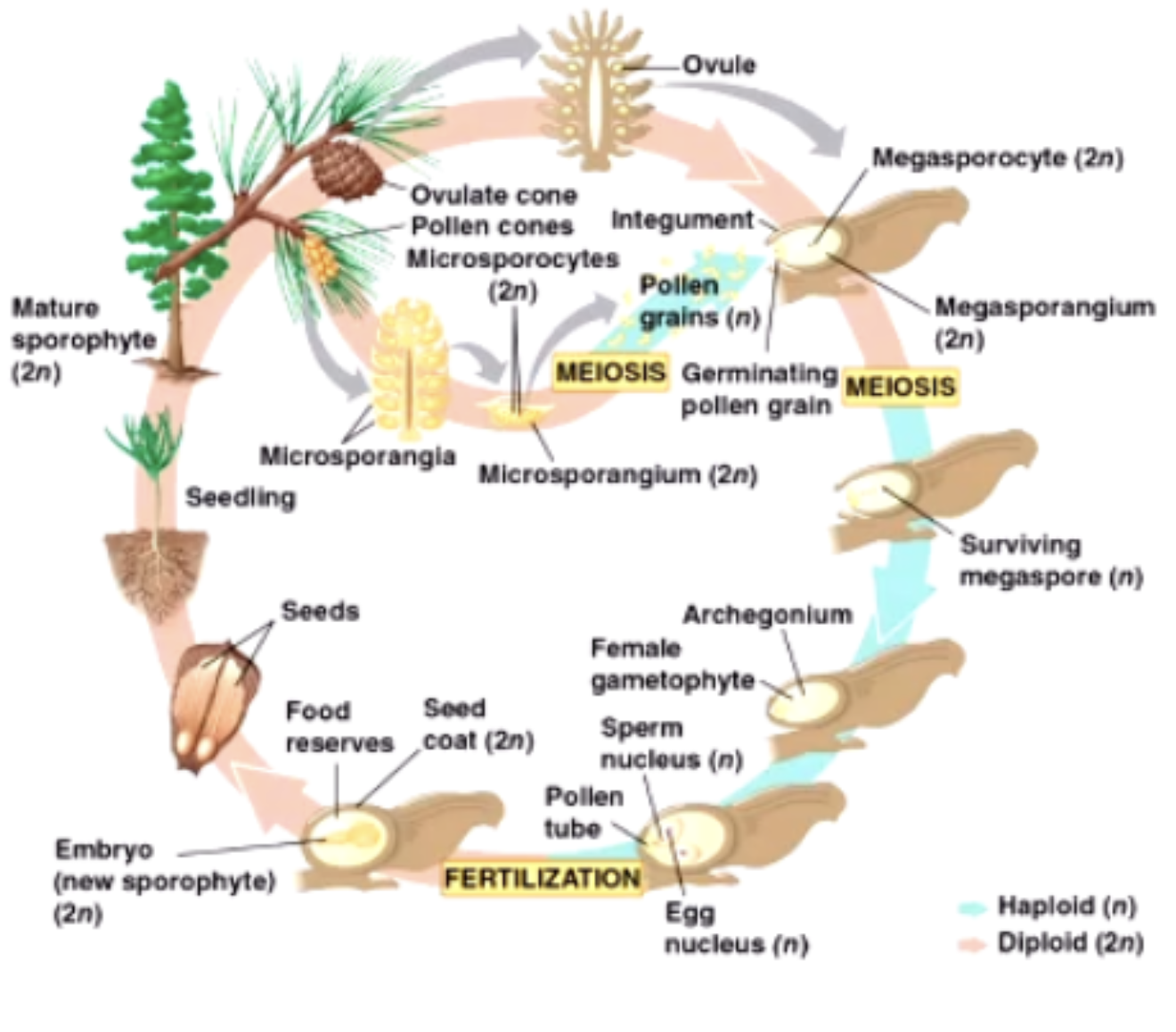
Gymnosperms life cycle
Gametophyte life cycle very short. Compared to Sporophyte cycle.
Gametophyte only happens in embryo making.
So you have a few stages in haploid stage.
Like we have egg ans sperm but they have multiple haploid stages
Angiosperms life cycle
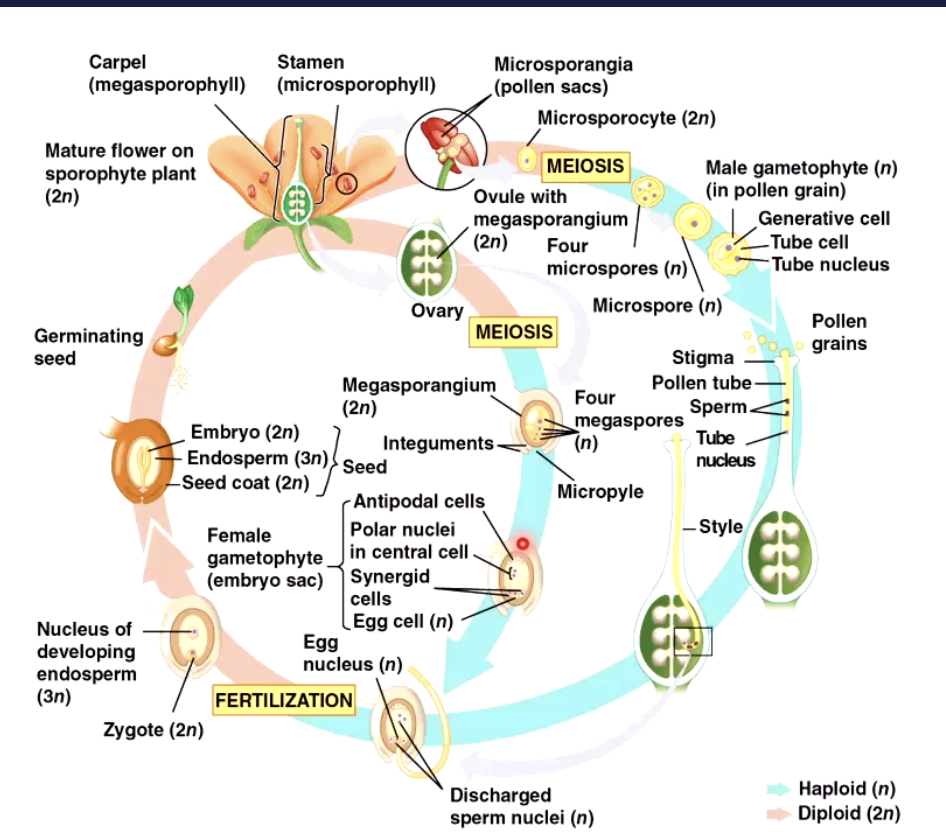
Angiosperms: Monocots vs Eudicots?
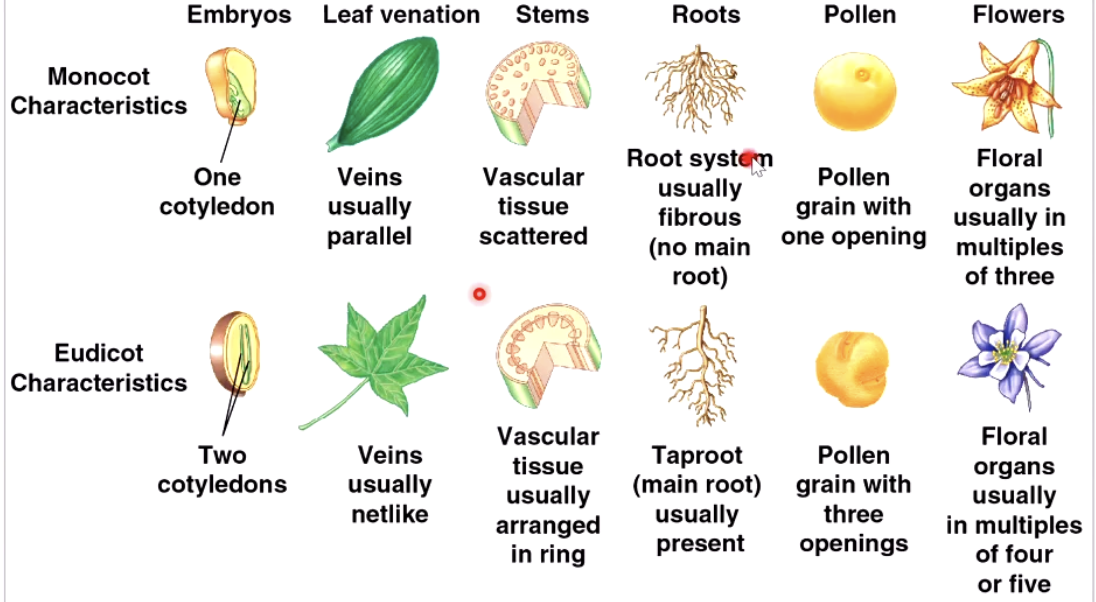
When embroy start growing it starts growing a small embryo lead
1 leaf = Monocots
2 leafs = Eudicots
Monocots: Grasses and palms
Eudicots: Rose familie (also includes appels)
LOOK AT PICTURE FOR MORE COMPARASONS