Exam 3 Questions
 Call Kai
 Learn
Learn Practice Test
 Spaced Repetition
 Match
Match Flashcards
 Knowt Play
1/169

There's no tags or description
Looks like no tags are added yet.
Name | Mastery | Learn | Test | Matching | Spaced | Call with Kai |
|---|
No analytics yet
Send a link to your students to track their progress
170 Terms
Which liver lobe is the largest?
left
What are the most common cells in the liver?
Kupffer cells
Which cells produce insulin?
beta cells
Which of these is NOT a job for the spleen?
metabolizing fats
Which part of the ruminant stomach is the largest?
rumen
What makes it impossible for a horse to vomit?
Well developed cardiac sphincter
Which part of the ruminant stomach has a leaflet structure?
omasum
(DOUBLE CHECK TOPHAT)
Which species has prehensile lips to help it eat?
horse
What is the preganglionic receptor used for both sympathetic and parasympathetic fibers?
cholinergic nicotinic receptors
What is the depolarization rate in the stomach?
16-20 times per minute
Which of these is NOT a function of the spleen?
Metabolism of fats
Where do the sympathetic preganglionic fibers originate from?
T1 and L2
What is the purpose of the rumen?
Uses bacteria to help break down cellulose into digestible products
Compared to other species, the equine (1 word) ______ is very short, and can actually be distinguished from the rest of the small intestine due to its thicker walls, making it firmer on palpation.
ileum
What do the parotid glands produce?
amylase
lipase
pH buffers
The pancreas produces a lot of digestive enzymes, but it also produces things like bicarb to neutralize stomach acid, intrinsic factor, and colipase to help with fat digestion.
true
What is the primary stimulus of peristaltic contractions in small intestine?
Distension of small intestine
To increase stomach motility, CCK and secretin are produced. These hormones promote vagal stimulation in the presence of fats and starches.
false
In the horse, the cardiac sphincter of the stomach is very well developed. This prevents antiperistalsis, i.e. vomiting, from occurring except in very rare incidents.
true
Which organ is the left lobe of the pancreas basically attached to?
stomach
The (3 words) ______ is an important structure of the common bile duct that controls the release of bile into the duodenum
sphincter of oddi
What is the margo plicatus in the equine stomach?
The demarcation between non-glandular and glandular tissue in the stomach
Which blood vessels feeds the stomach, liver, and spleen in a horse?
celiac artery and its branches
Which of these cranial nerves innervate the tongue?
Cranial nerve IX
Cranial nerve VII
Cranial nerve XII
Cranial nerve V
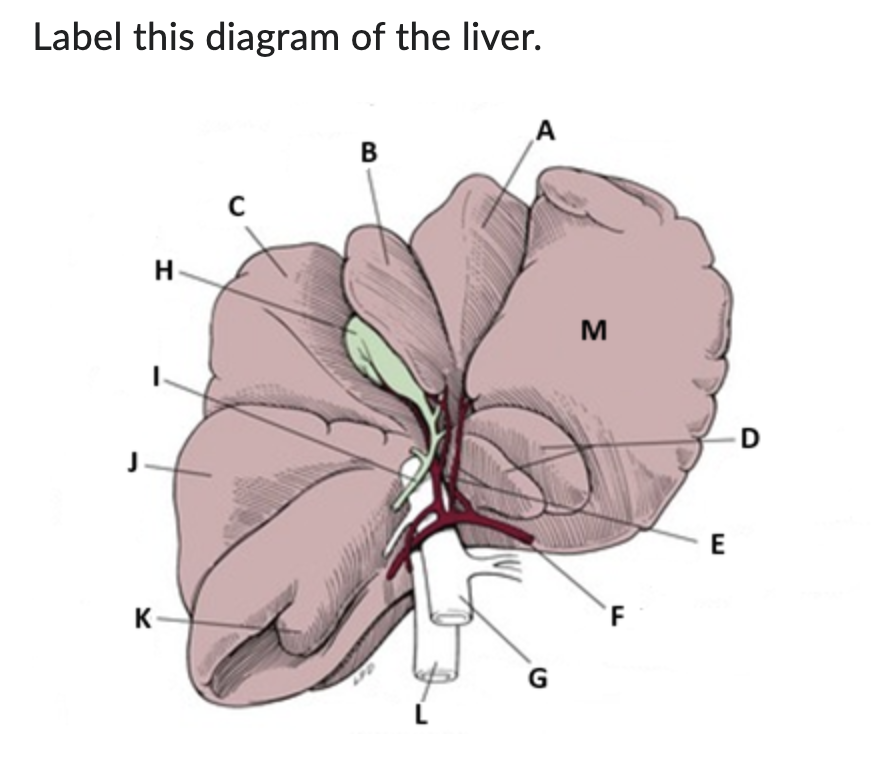
H
gallbladder
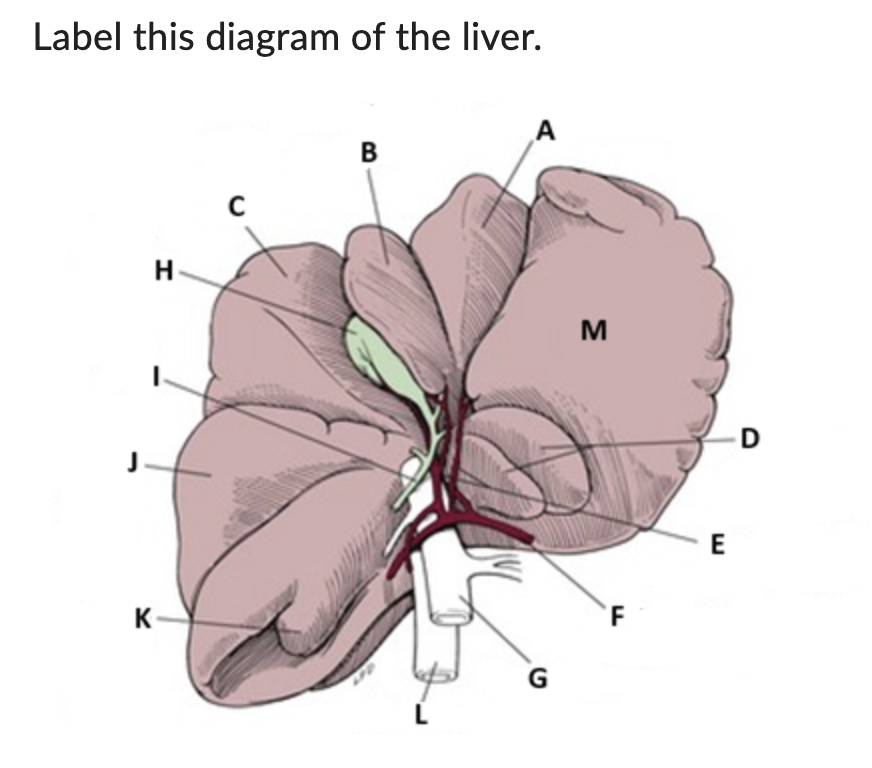
D
Papillary process of the caudate lobe
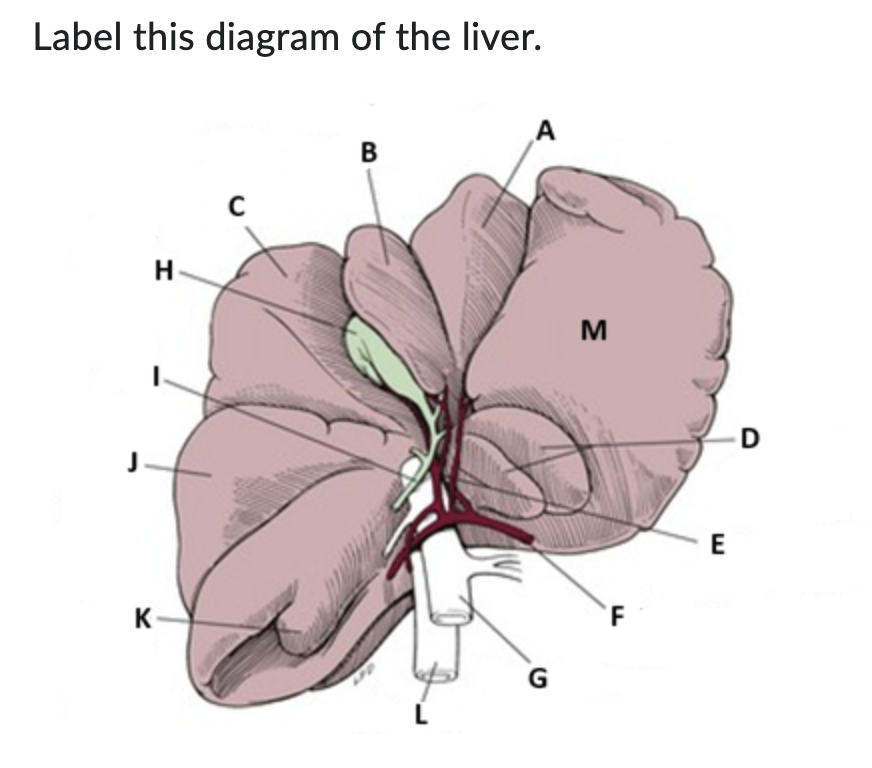
I
common bile duct
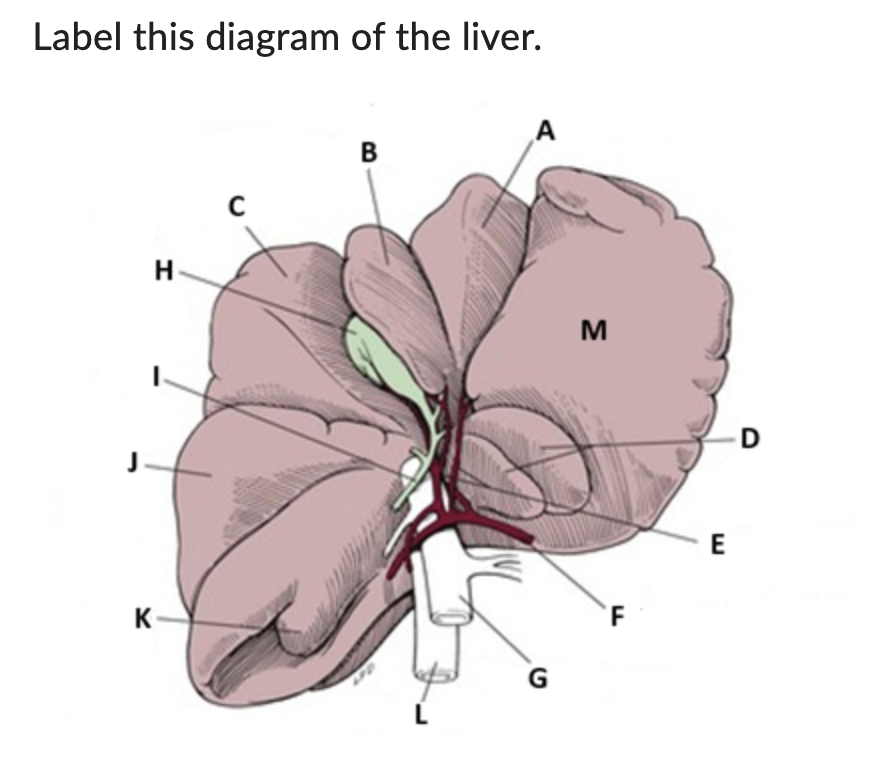
F
common hepatic artery
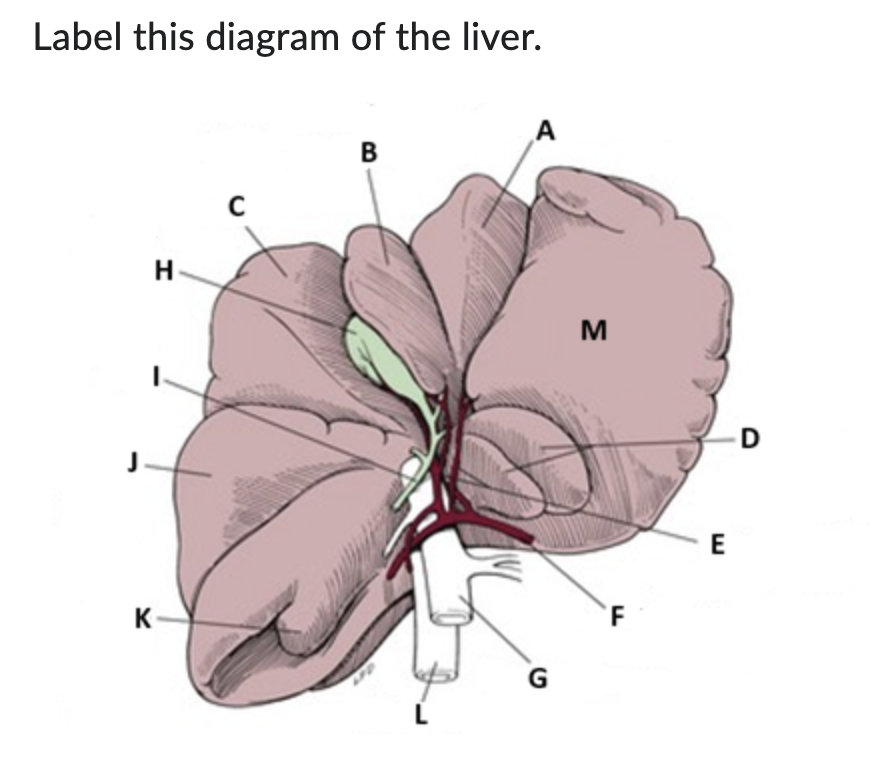
L
Caudal vena cava
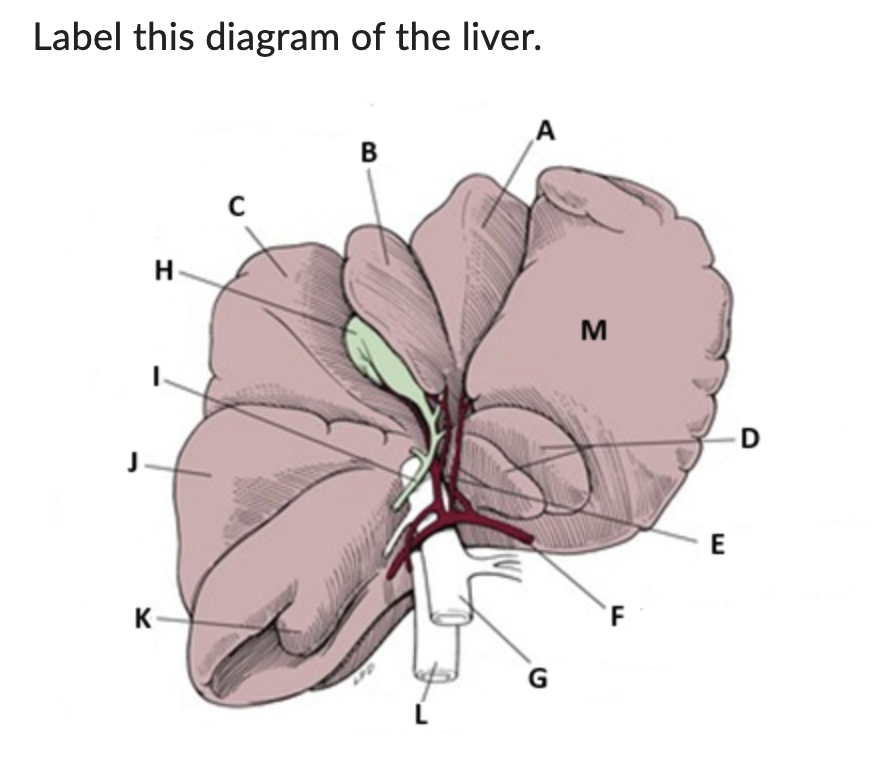
B
Quadrate lobe
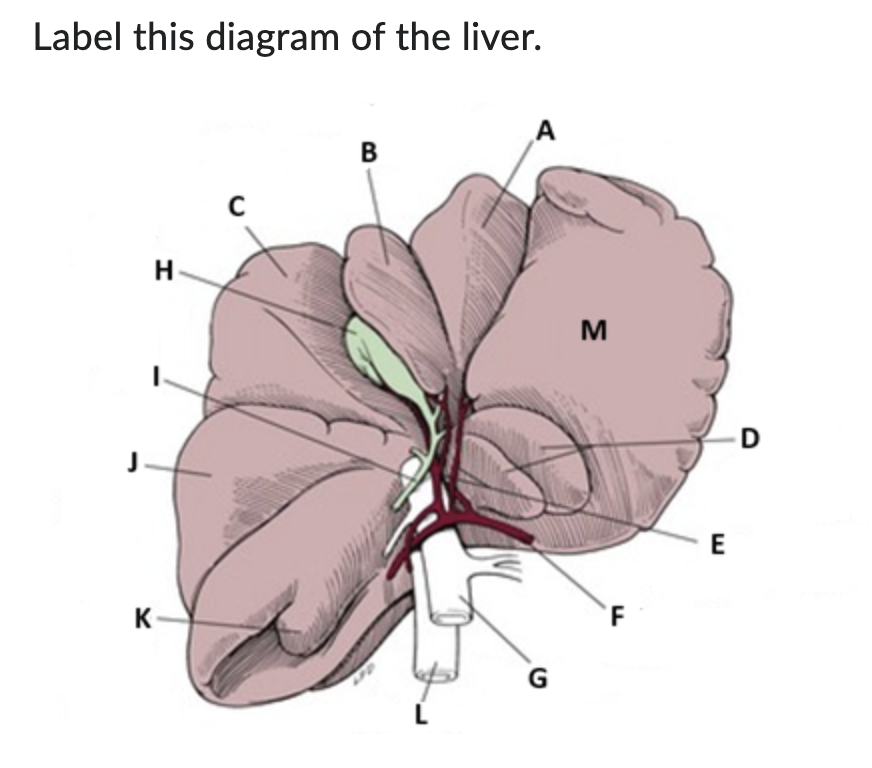
E
Proper hepatic arteries
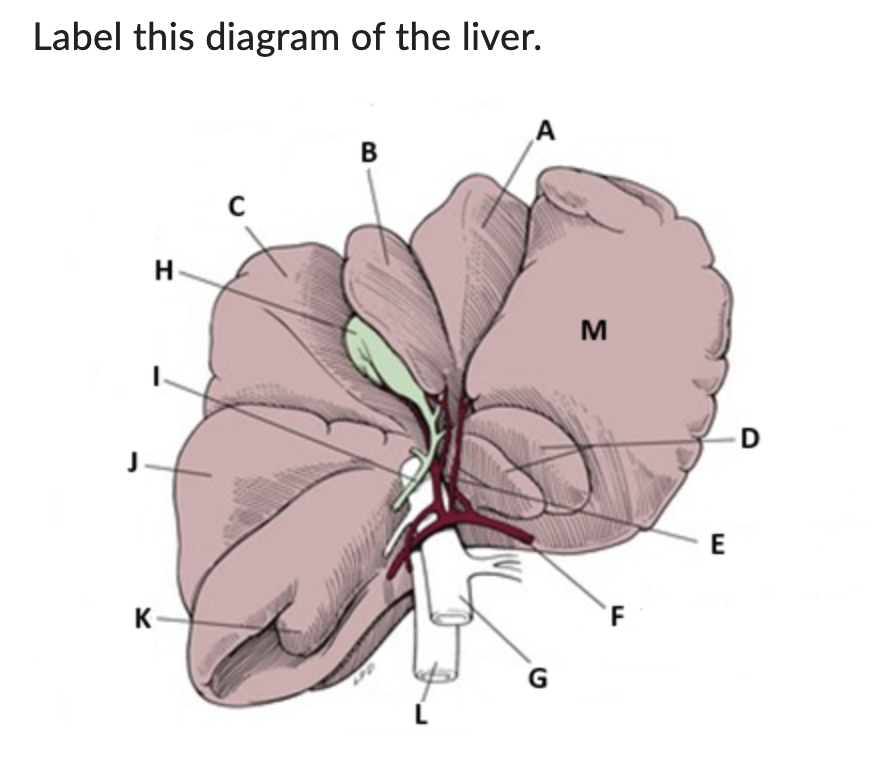
J
Right lateral lobe
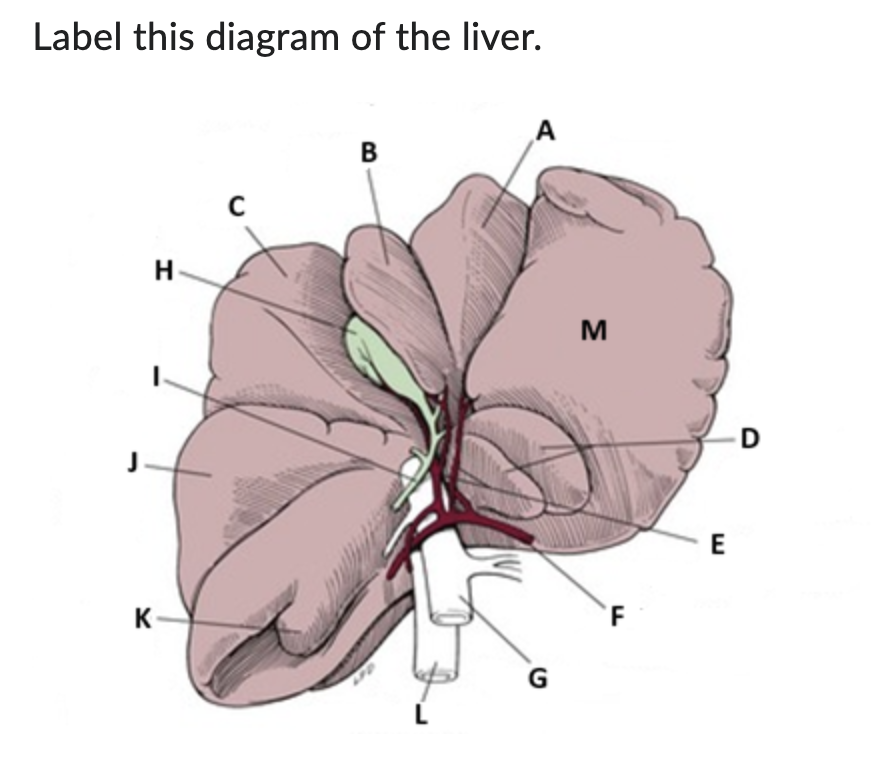
G
Portal vein
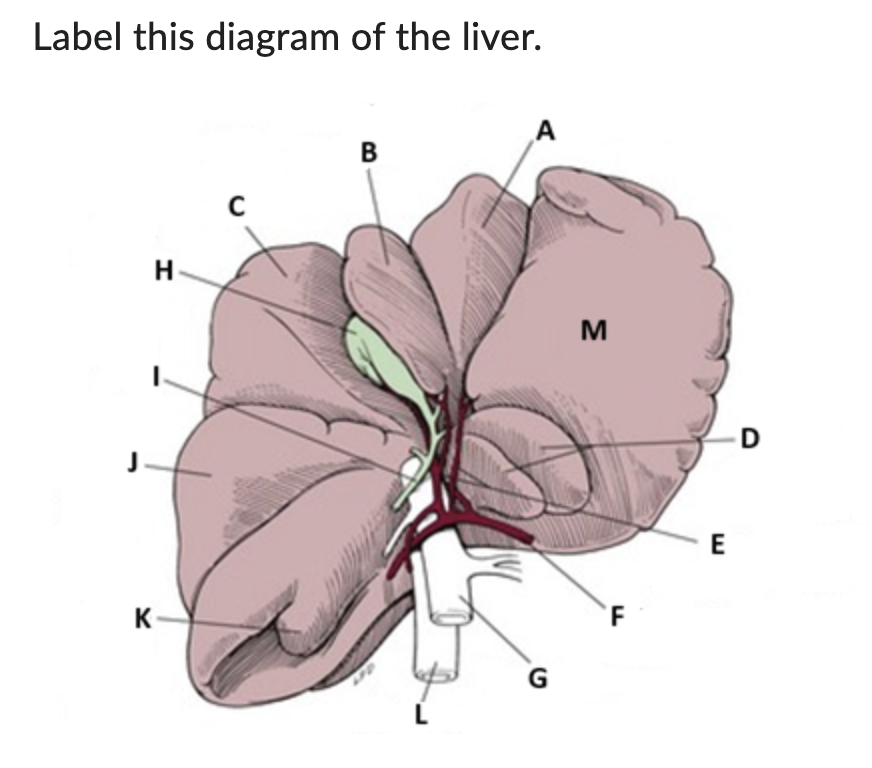
M
Left lateral lobe
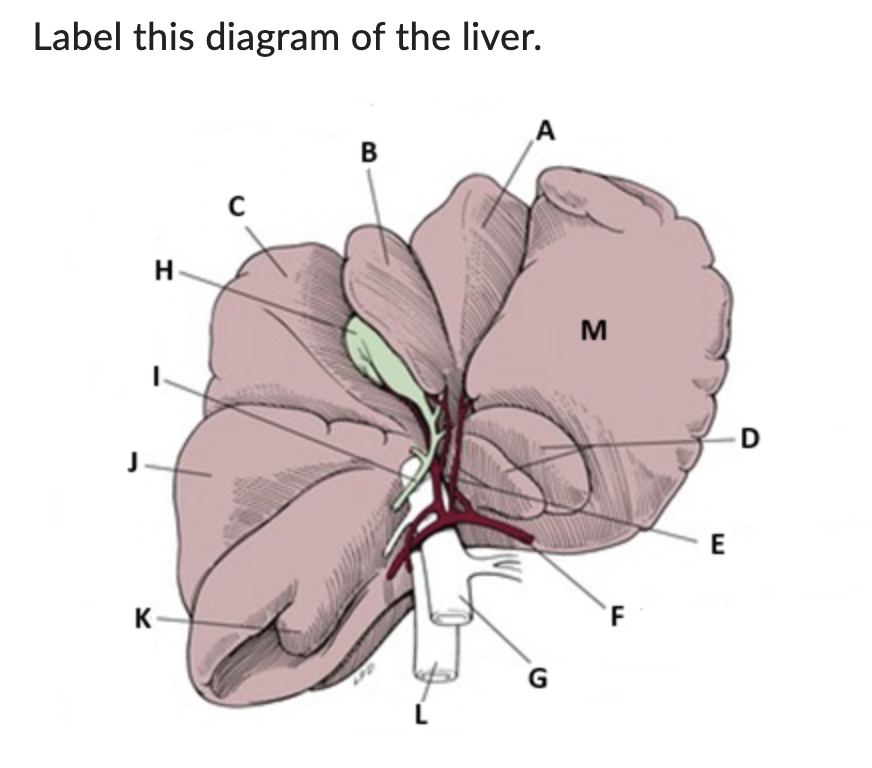
K
Caudate process of caudate lobe
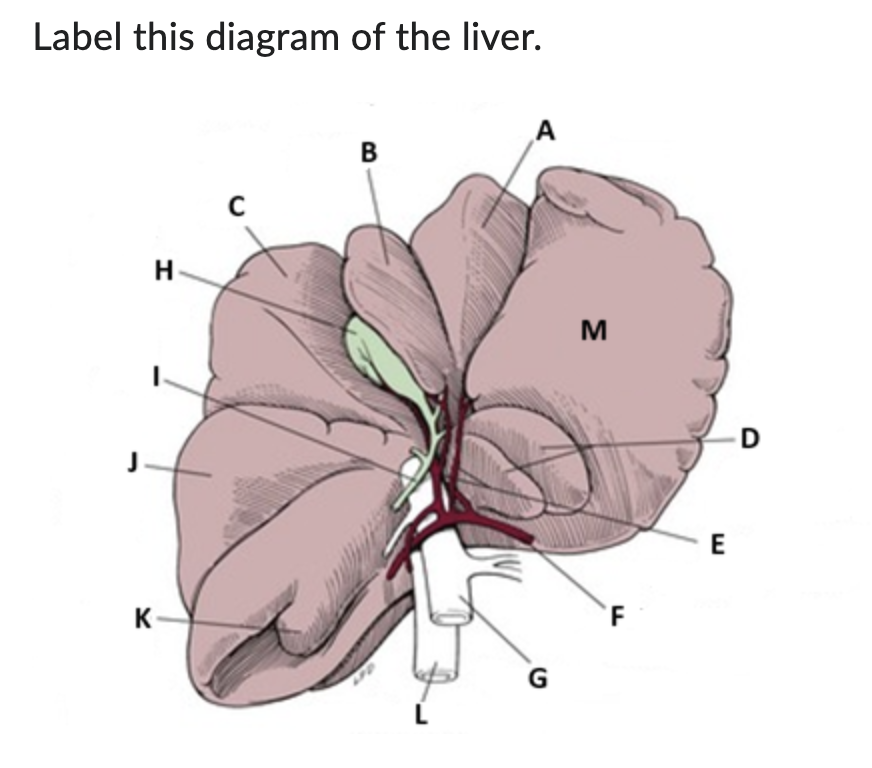
C
Right medial lobe
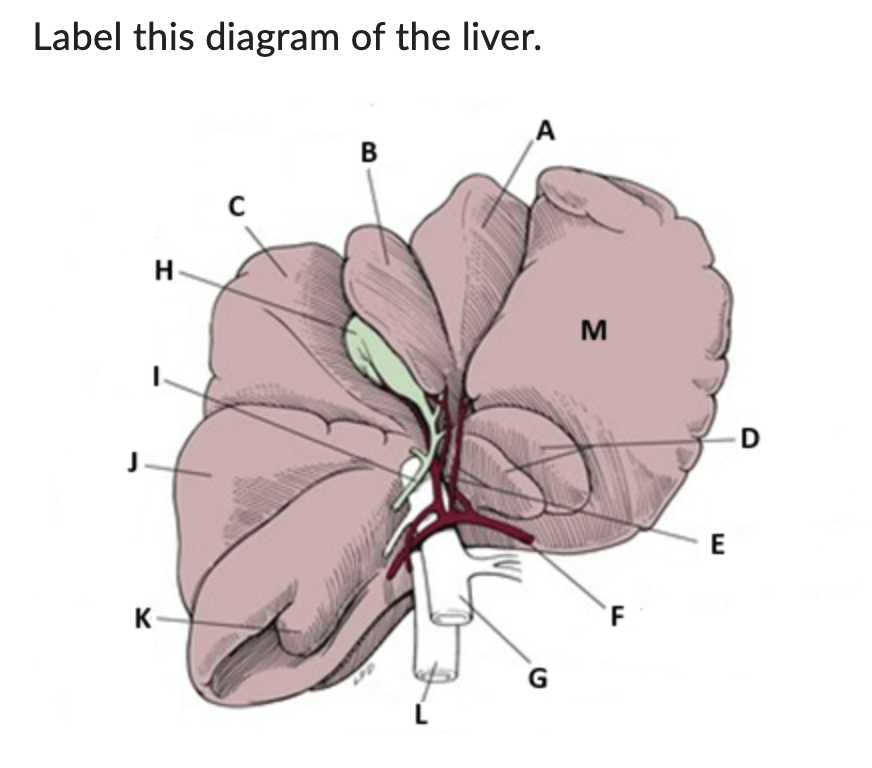
A
left medial lobe
Which chamber of the ruminant stomach is considered the "true" stomach?
Abomasum
What is the name of the papilla that the equine bile duct and greater pancreatic duct enter into the duodenum?
Ampulla hepatopancreatica
In the ruminant stomach, each chamber has very specific structure to the epithelium. In the rumen, the epithelium has ______ like projections. In the reticulum, it has more of a ______ appearance.
papilla
honeycomb
In the ruminant, the (3 words) ______ opens in the descending duodenal limb and the (3 words) ______ opens in the proximal duodenum near the liver. However, in the horse the (3 words) ______ and the (3 words) ______ opens into the duodenum from the same papilla. They also have an accessory pancreatic duct that opens more distally.
accessory pancreatic duct
common bile duct
common bile duct
major pancreatic duct
Where is the spleen located?
Along the greater curvature of the stomach. The head is attached via wide gastrosplenic ligament and the tail is mobile.
Explain the 3 fermentation vats in the horse.
cecum
Segmental contractions mix ingesta with bacteria
Peristaltic contractions near apex push ingesta up and out to right ventral colon via cecocolic orifice
Fills by gravity
Explain the 3 fermentation vats in the horse.
ventral colon
Mixing contractions can occur throughout this section
Peristaltic contractions move ingesta back and forth between left and right ventral colon
Explain the 3 fermentation vats in the horse.
dorsal colon
Segmental mixing and antegrade/retrograde peristaltic contractions ensure thorough fermentation
Where does the preganglionic cell bodies of the parasympathetic innervation of the GI tract originate?
Sacral spinal cord
Describe the path of ingesta in the large intestine of a horse. Start at the cecum.
(1) Once digesta has been fermented in the cecum, it moves into the large intestine
(2) The first section is the right ventral colon
(3) This then makes a turn at the ventral diaphragmatic flexure
(4) And turns into the left ventral colon
(5) This then makes another turn at the pelvic flexure
(6) And turns into the left dorsal colon
(7) The last flexure is the dorsal diaphragmatic flexure
(8) Which turns into the right dorsal colon
(9) This then leads into the transverse colon
(10) And ends in the descending colon, which leads to the rectum
Which of these is NOT involved in the vascularization of the spleen?
cranial mesenteric artery
What is the purpose of white pulp in the spleen?
It is part of the lymph system and makes new B and T lymphocytes
Which of these vessels feed the pancreas?
Caudal pancreatioduodenal artery
Cranial pancreaticoduodenal artery
Match the blood vessels to their locations.
Celiac and cranial mesenteric arteries
duodenum
Match the blood vessels to their locations.
Cranial mesenteric artery only
jejunum
Match the blood vessels to their locations.
Ileocecal artery
Ileum
Match the blood vessels to their locations.
Ileocolic artery
cecum
Match the blood vessels to their locations.
Ileocolic and right colic artery
ascending colon
Match the blood vessels to their locations.
Right and middle colic arteries
transverse colon
Match the blood vessels to their locations.
Middle colic artery
proximal half of descending colon
Helps with metabolic activity of such nutrients like carbohydrates, proteins, lipids, etc.
hepatocytes
Secrete water, bicarbonate, and cations into bile
cholangiocytes
Specialized macrophages localized to sinusoids that express a complement receptor of immunoglobulin family and clears complement system–coated pathogens
kupffer cells
Stores vitamin A in whole body as retinyl palmitate in lipid droplets in cytoplasm
stellate cells
Serve as part of immune surveillance mechanism in hepatic sinusoids
pit cells
Tether WBCs to help migrate into tissues
endothelial cells
What is the difference between segmental and peristaltic contractions?
Segmental contractions affect the circular muscle and helps with mixing ingesta. Peristalsis affects the longitudinal muscle and help propel food forward.
Why does the reticular groove close into a tube in weanling calves?
Prevents milk from entering the rumen, where it would be fermented and potentially could make the calf sick
In the liver, the (2 words) ______ provides 20% of the blood and 50% of the O2. The (2 words) ______ provides 80% of the blood and 50% of the O2
hepatic artery
portal vein
The reticulum has a honeycomb shape to its mucosa, but it becomes less organized and more keratinized the closer one gets to the rumen. What is the purpose of having keratin in the mucosa at the junction of the reticulum and rumen?
Keeps the area protected from damage due to the rough fiber mat in the rumen
What is the purpose of red pulp in the spleen?
It filters out old and/or damaged RBCs, antigens, and pathogens from the blood
Which of these innervate the ruminant stomach?
CHECK ASSIGNMENT 8
The larger of the 2 pancreatic ducts is the greater pancreatic duct and is responsible for transporting most of the pancreatic secretions.
false
The enteric nervous system has (2 words) ______ that can detect a variety of changes within gut: distension (stretch receptors), pH of luminal contents, osmolarity, and presence of certain toxins
sensory neurons
The bovine large intestine has a unique feature of a spiral colon. They have 2 centripetal and 2 centrifugal turns.
true
There are two different groups of cells in the pancreas. The ______ glands have an exocrine purpose and secrete digestive enzymes. The (3 words) ______ is a smaller grouping of various cells that secrete hormones
acinar
islets of langerhans
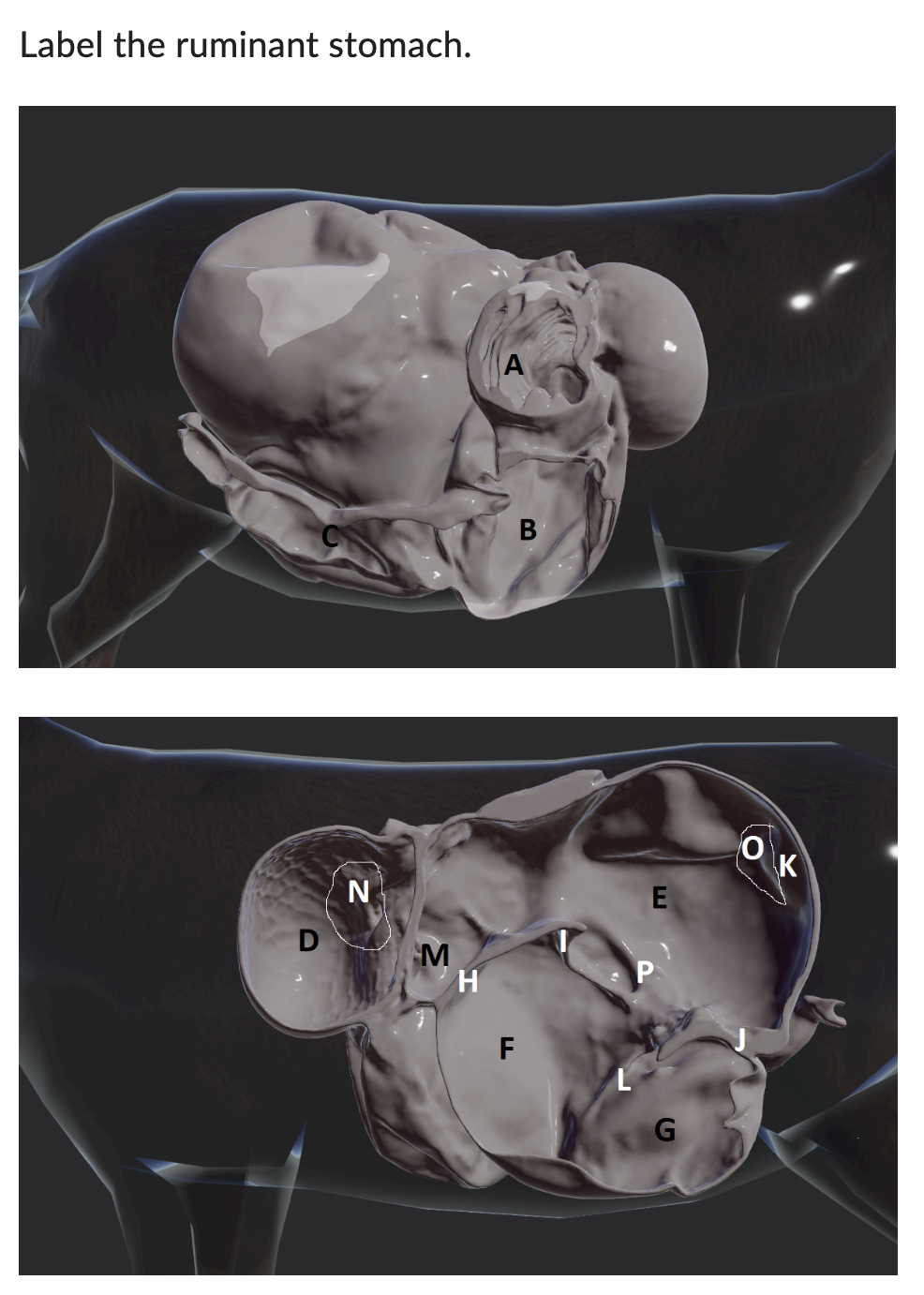
M
cranial sac
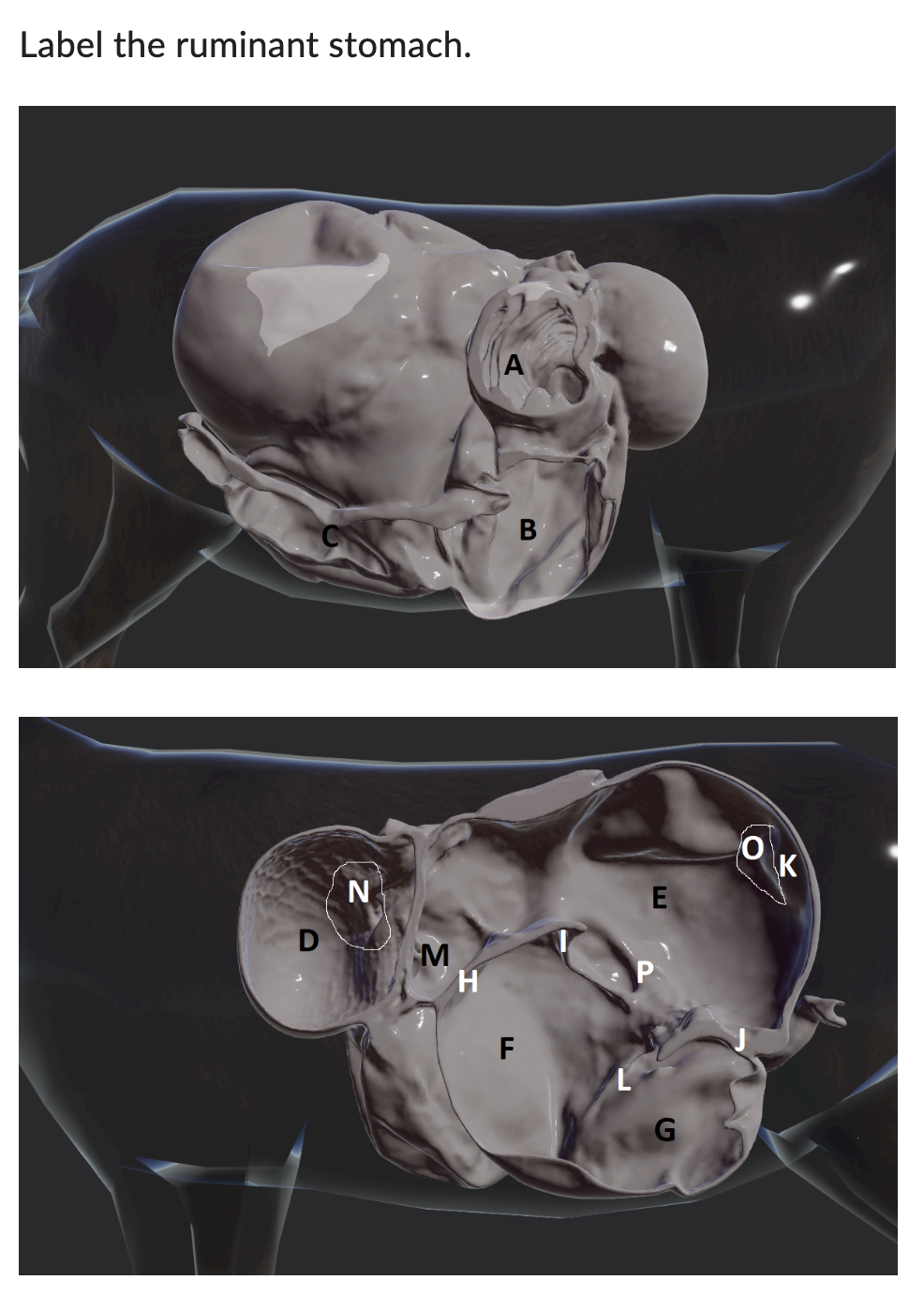
E
dorsal sac of rumen
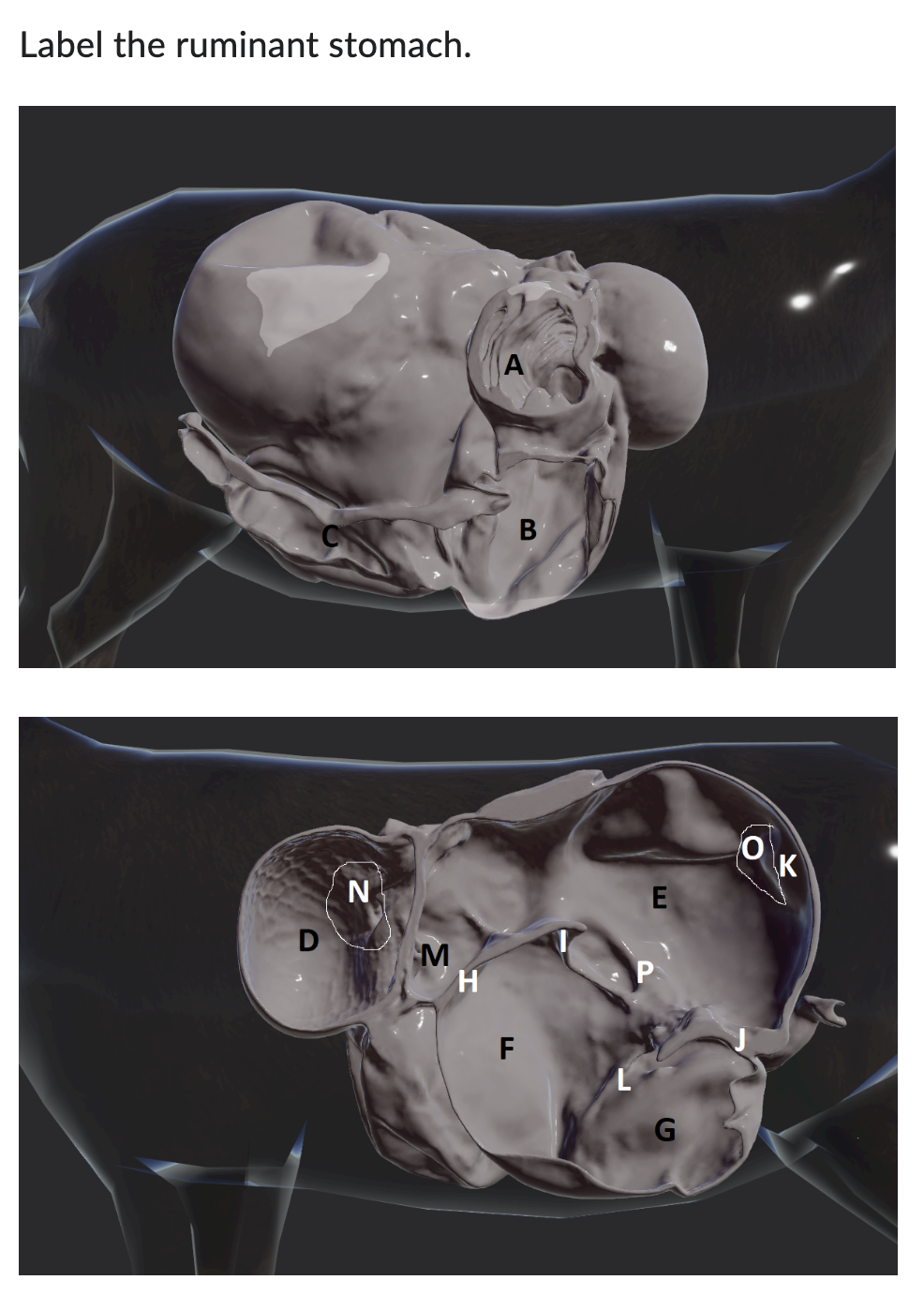
J
caudal pillar
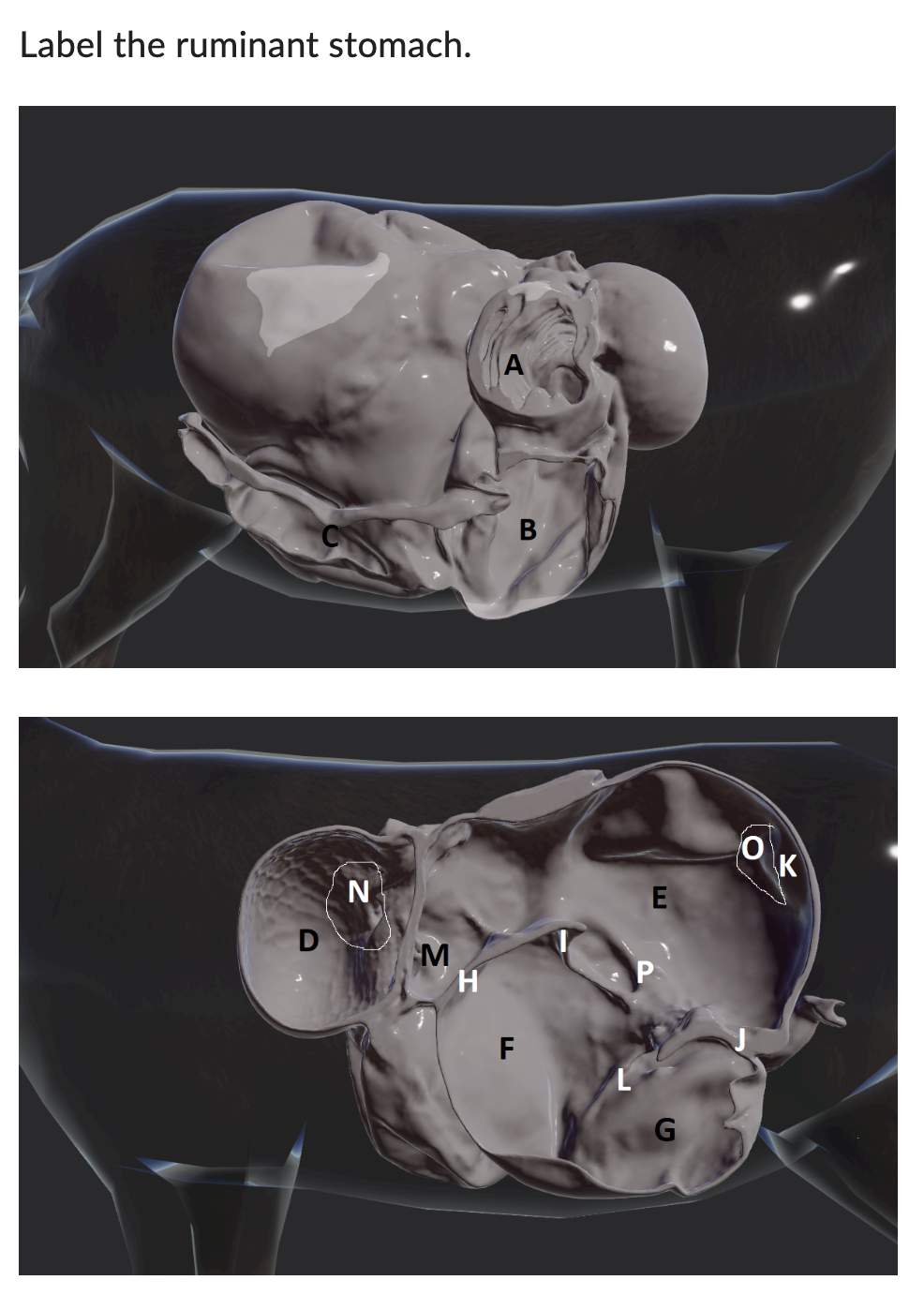
G
caudo-ventral blind sac
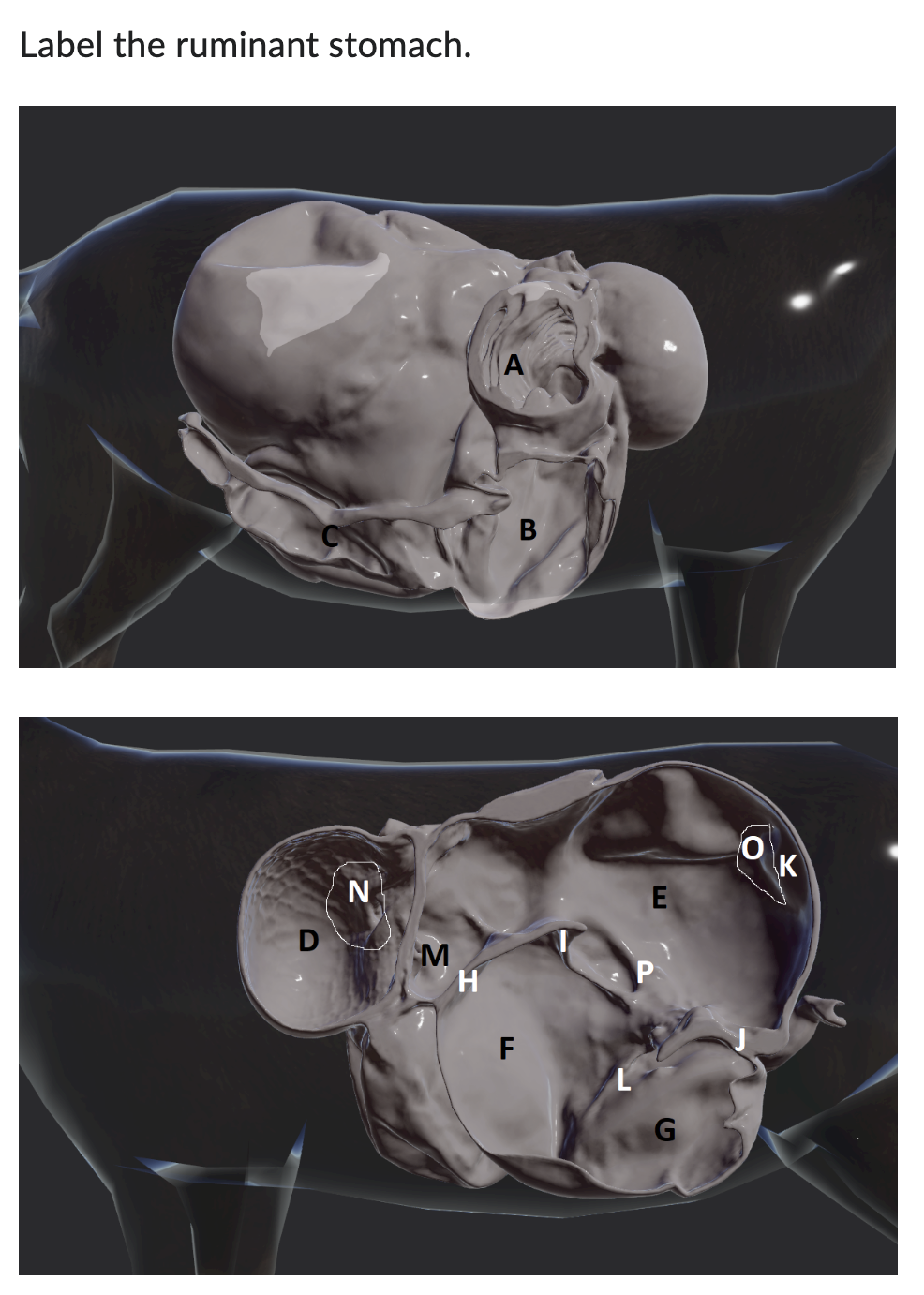
A
omasum
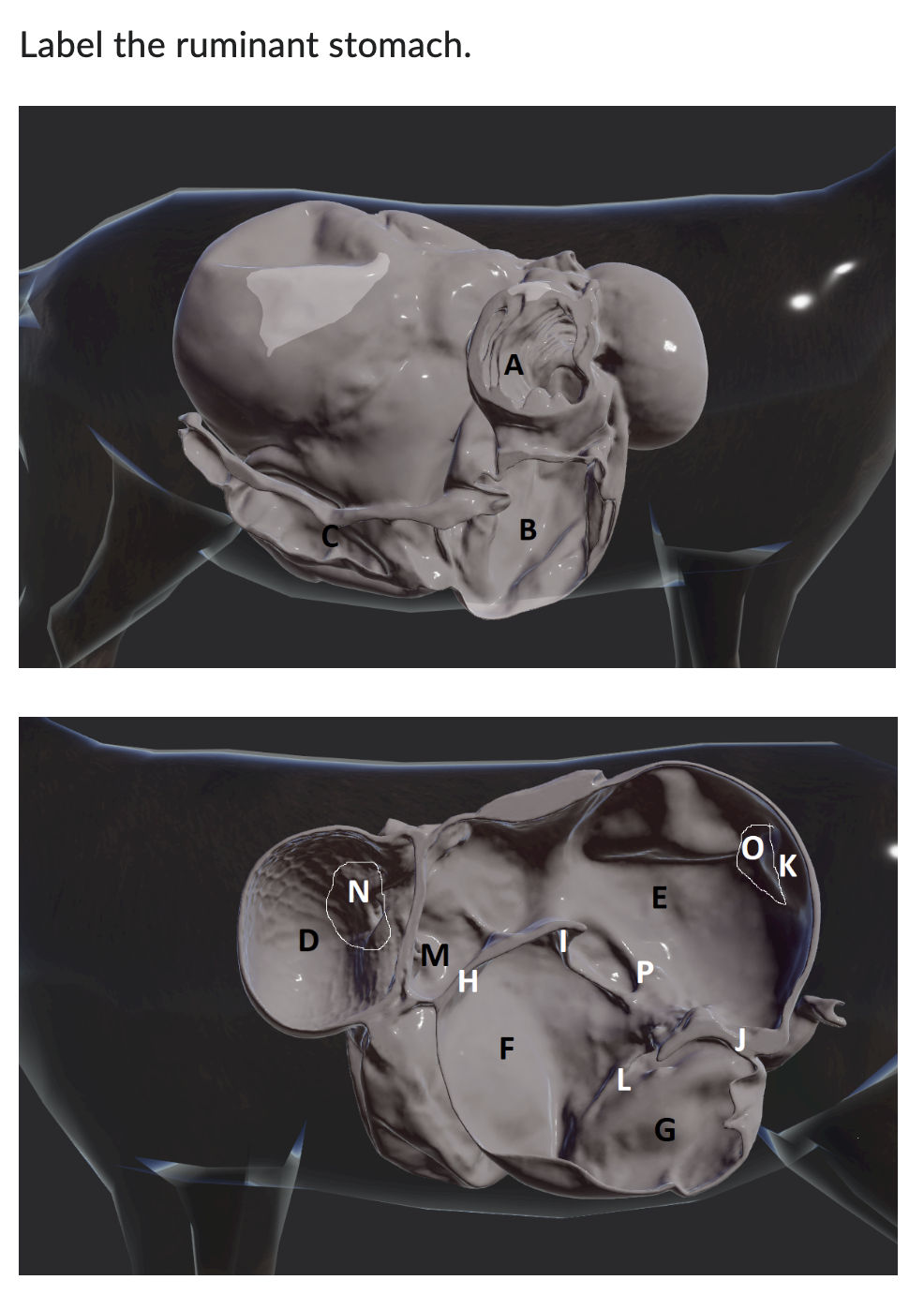
I
right longitudinal pillar
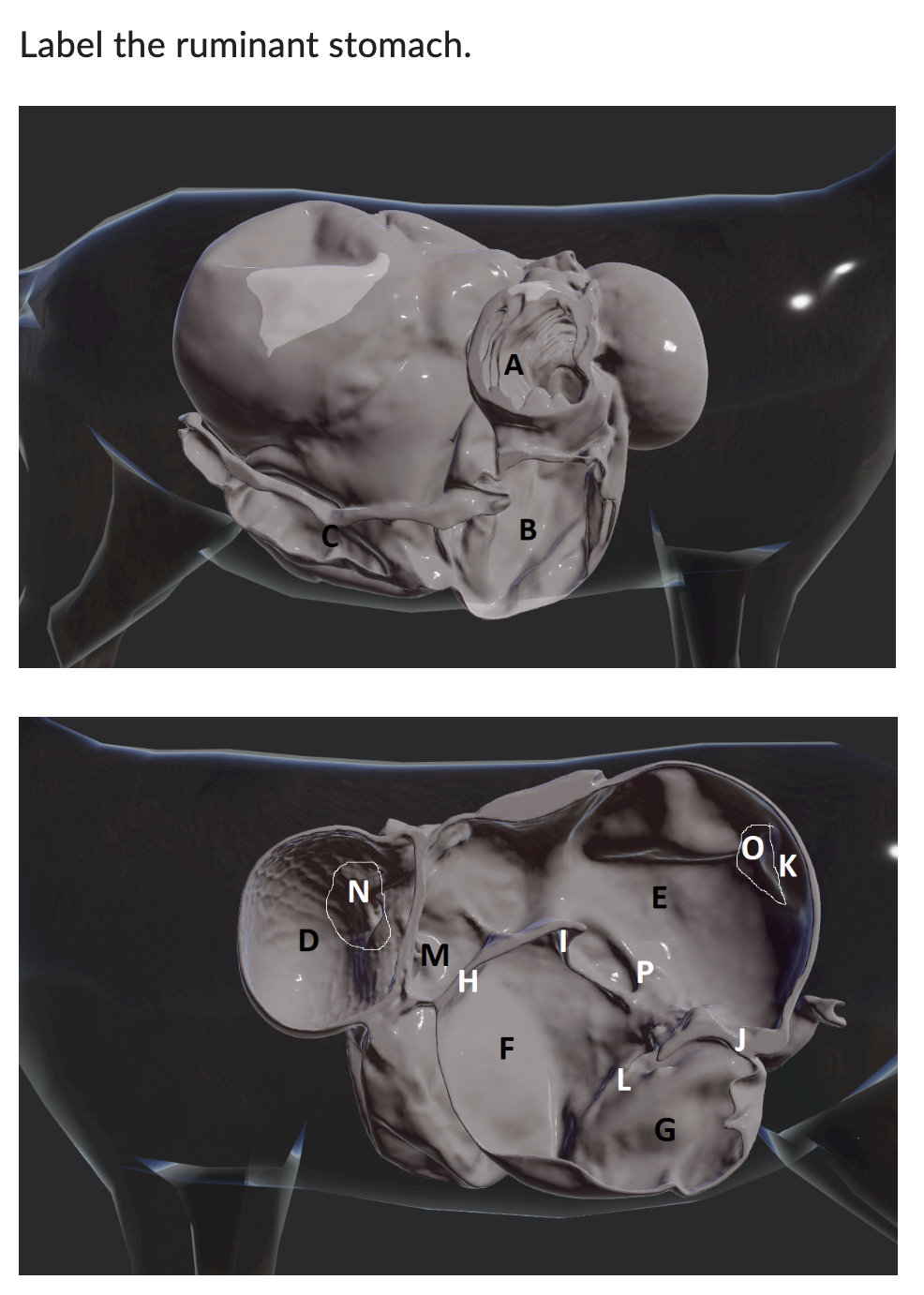
N
reticulo-omasal orifice
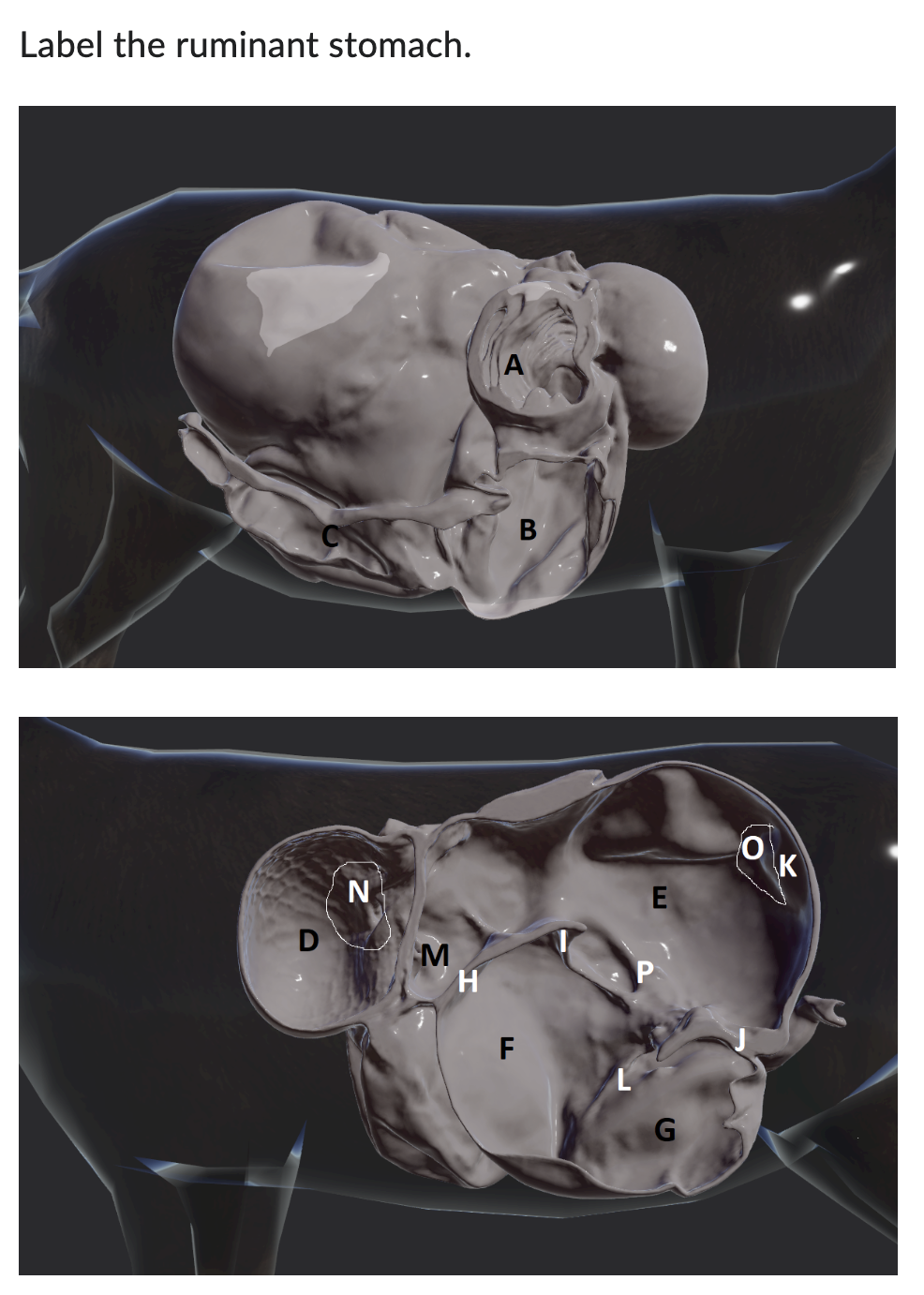
L
ventral coronary pillar
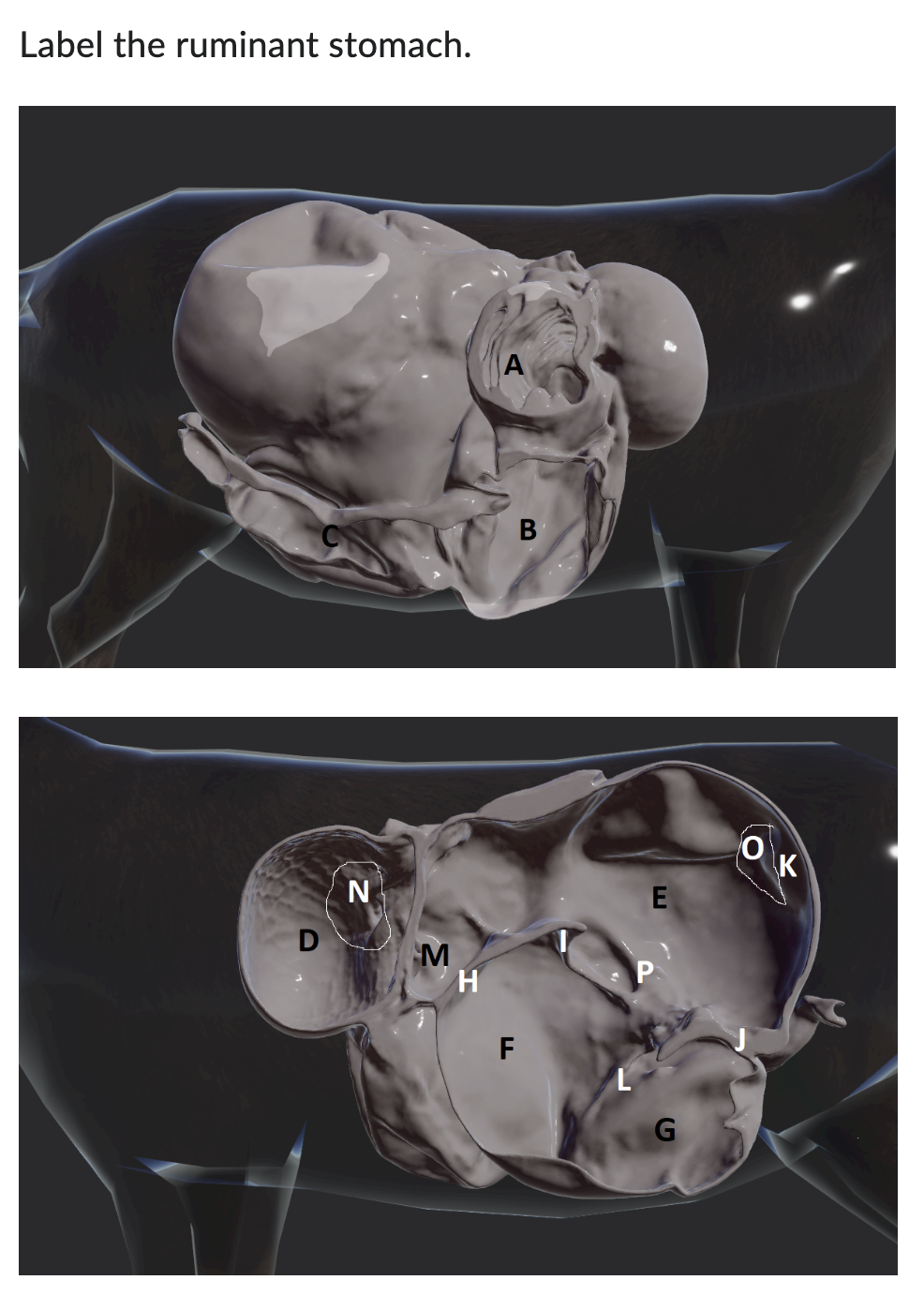
D
reticulum
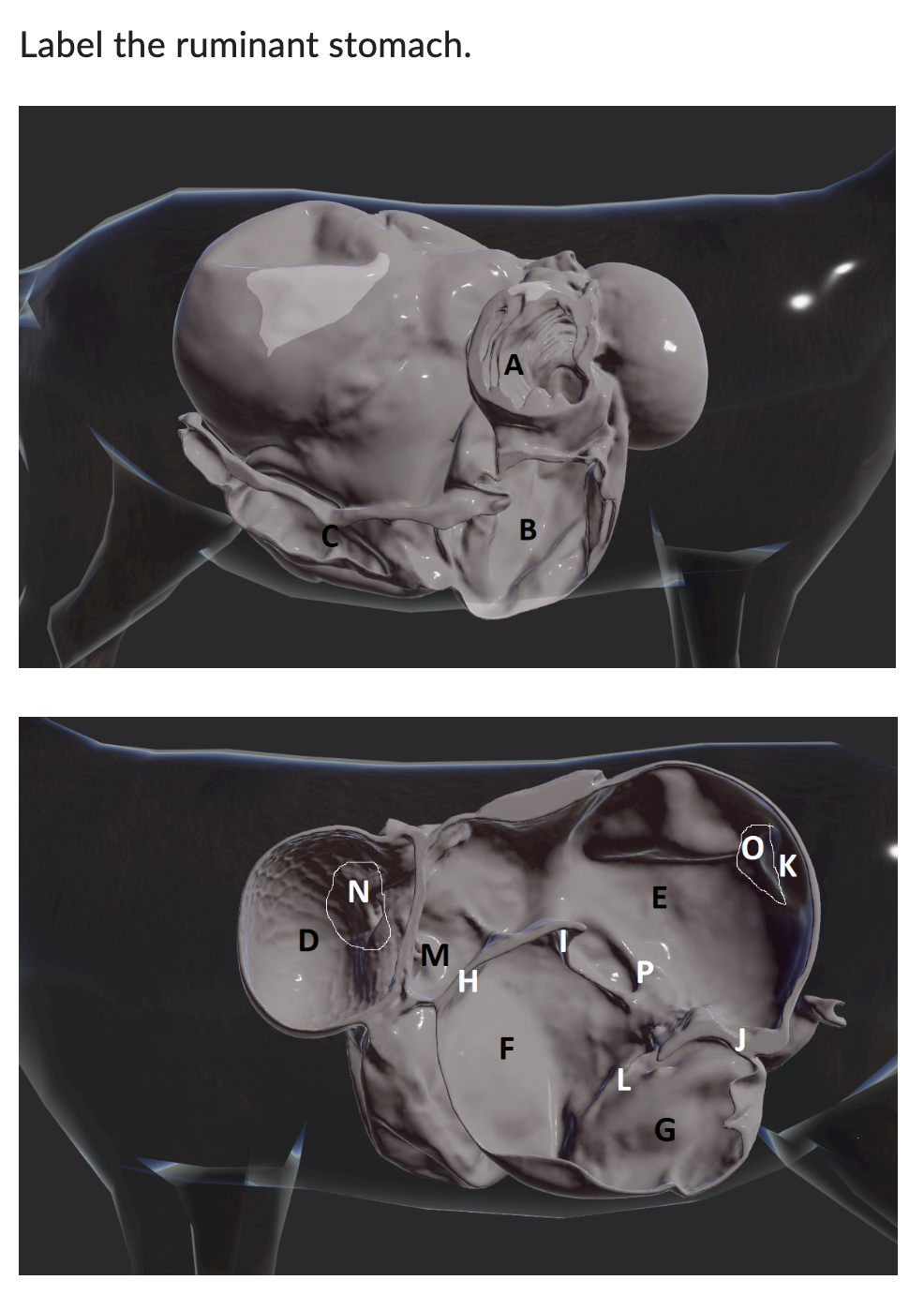
P
right accessory pillar
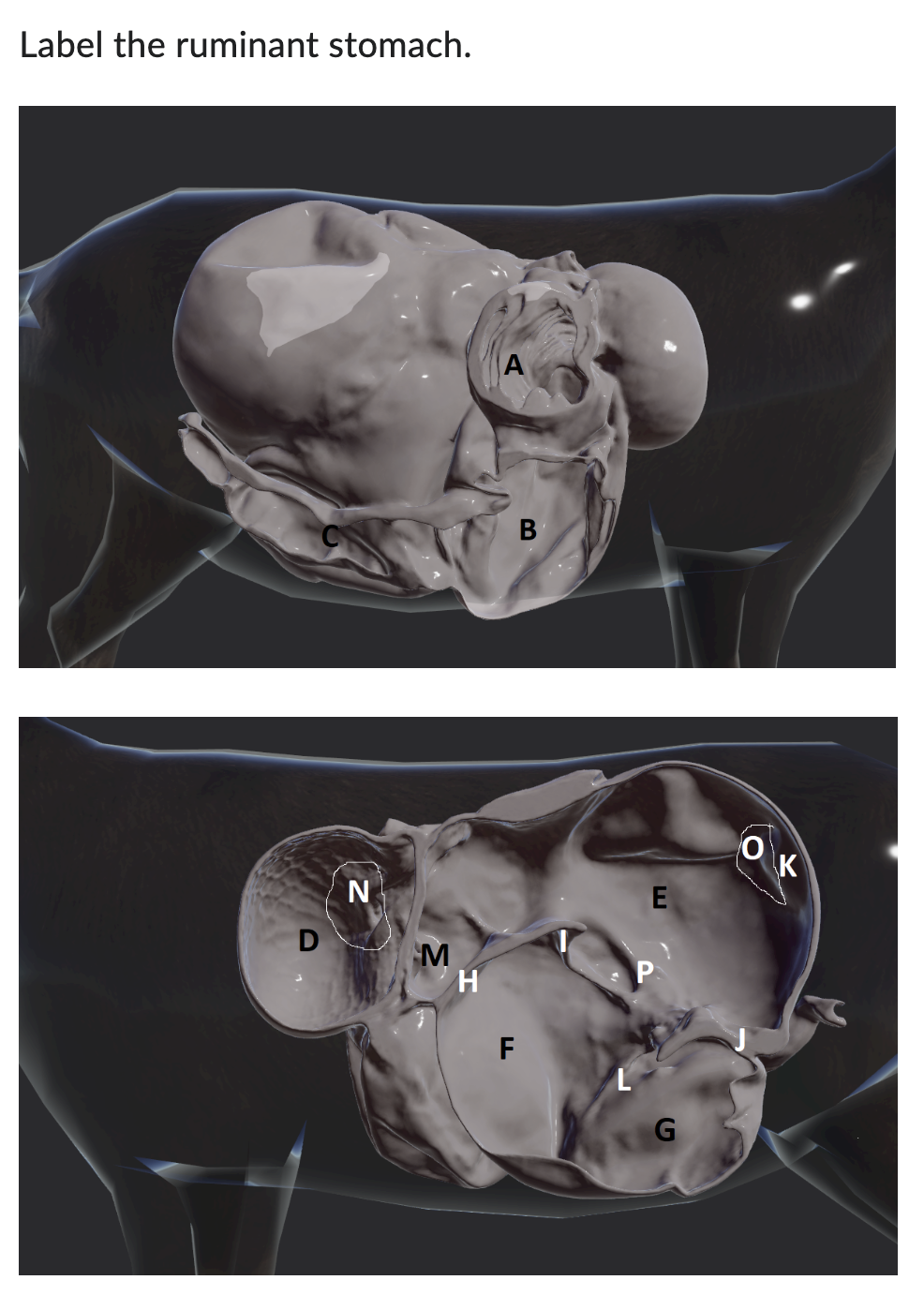
F
right accessory pillar
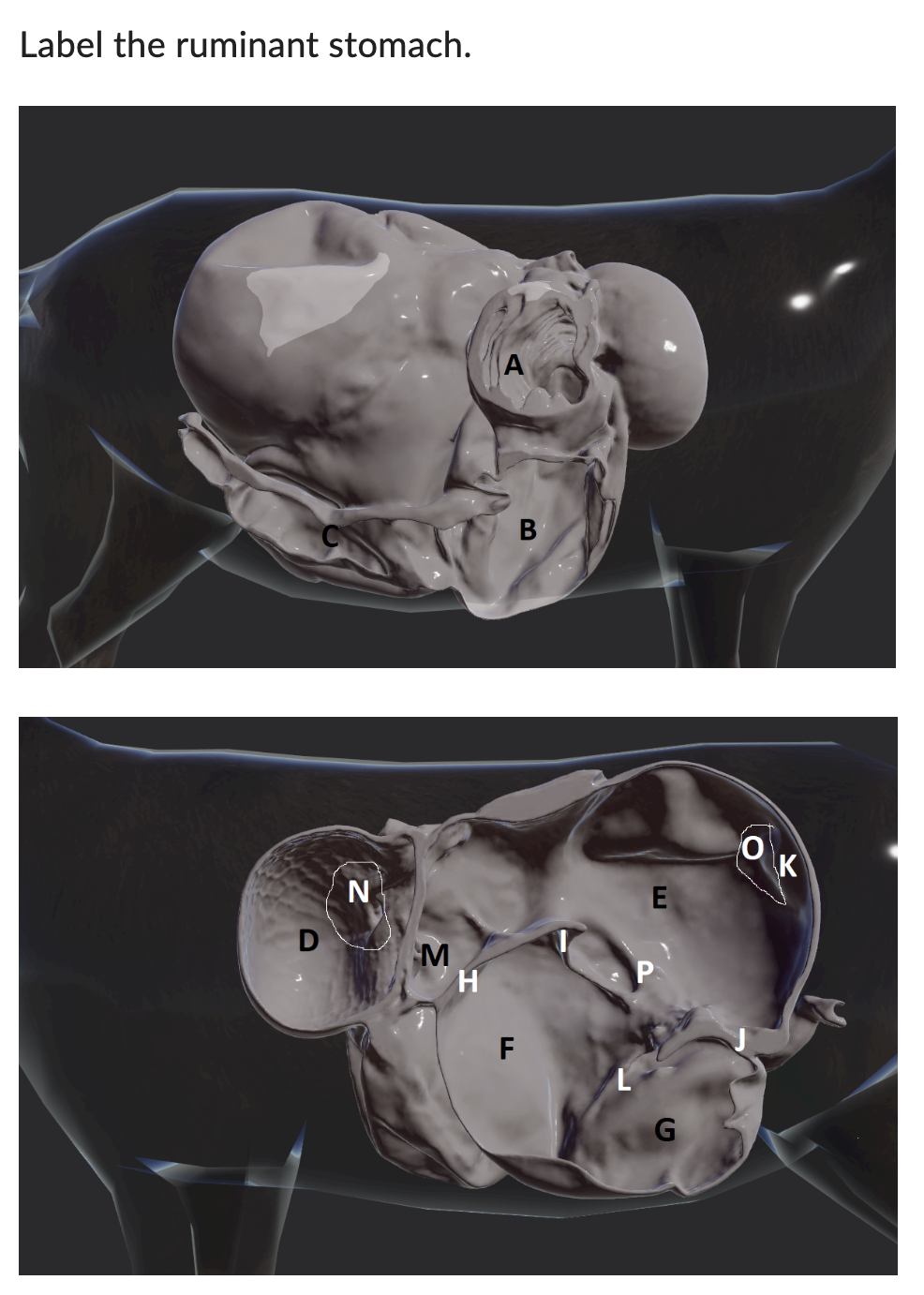
F
ventral sac of rumen
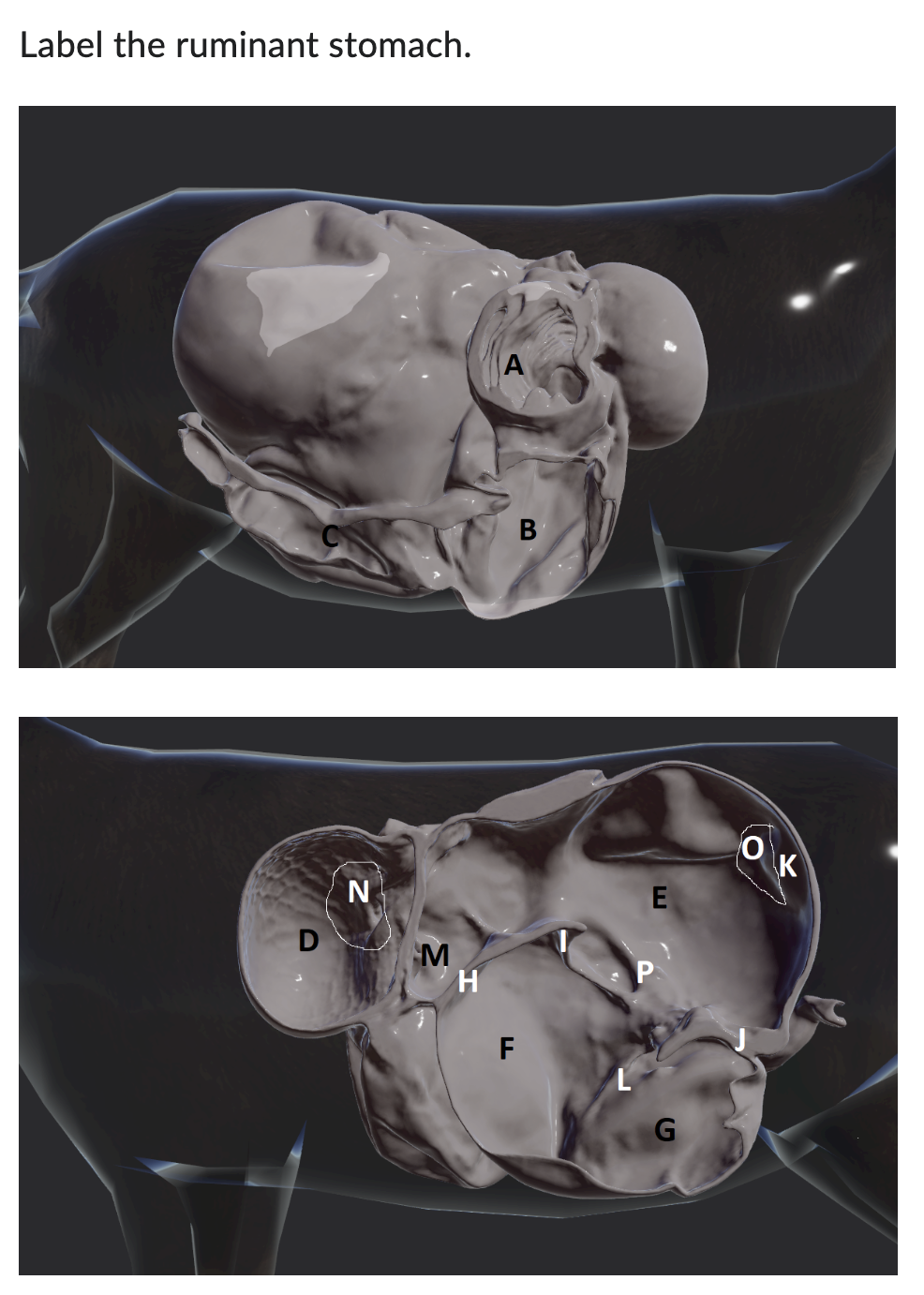
H
cranial pillar
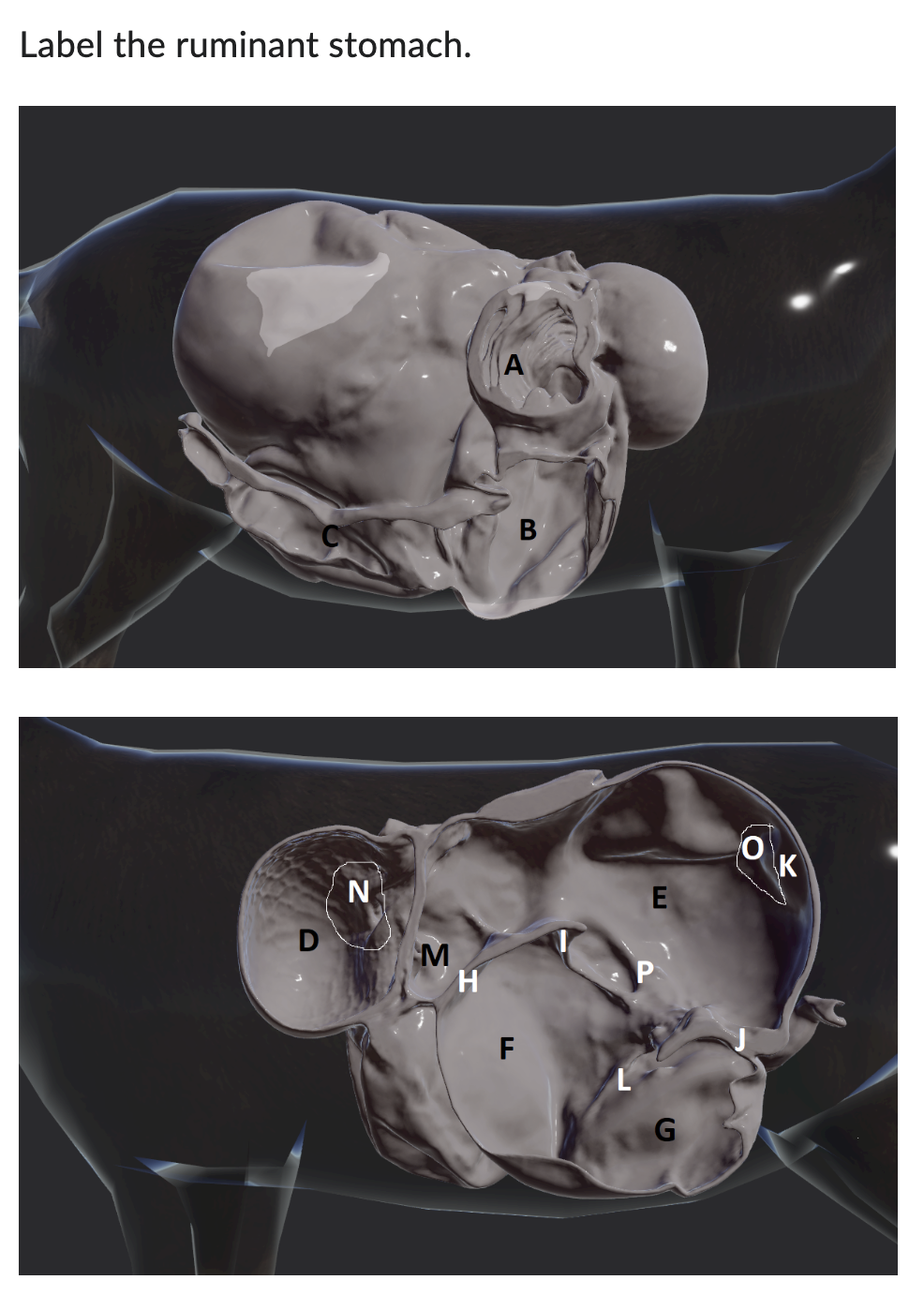
C
pylorus of abomasum
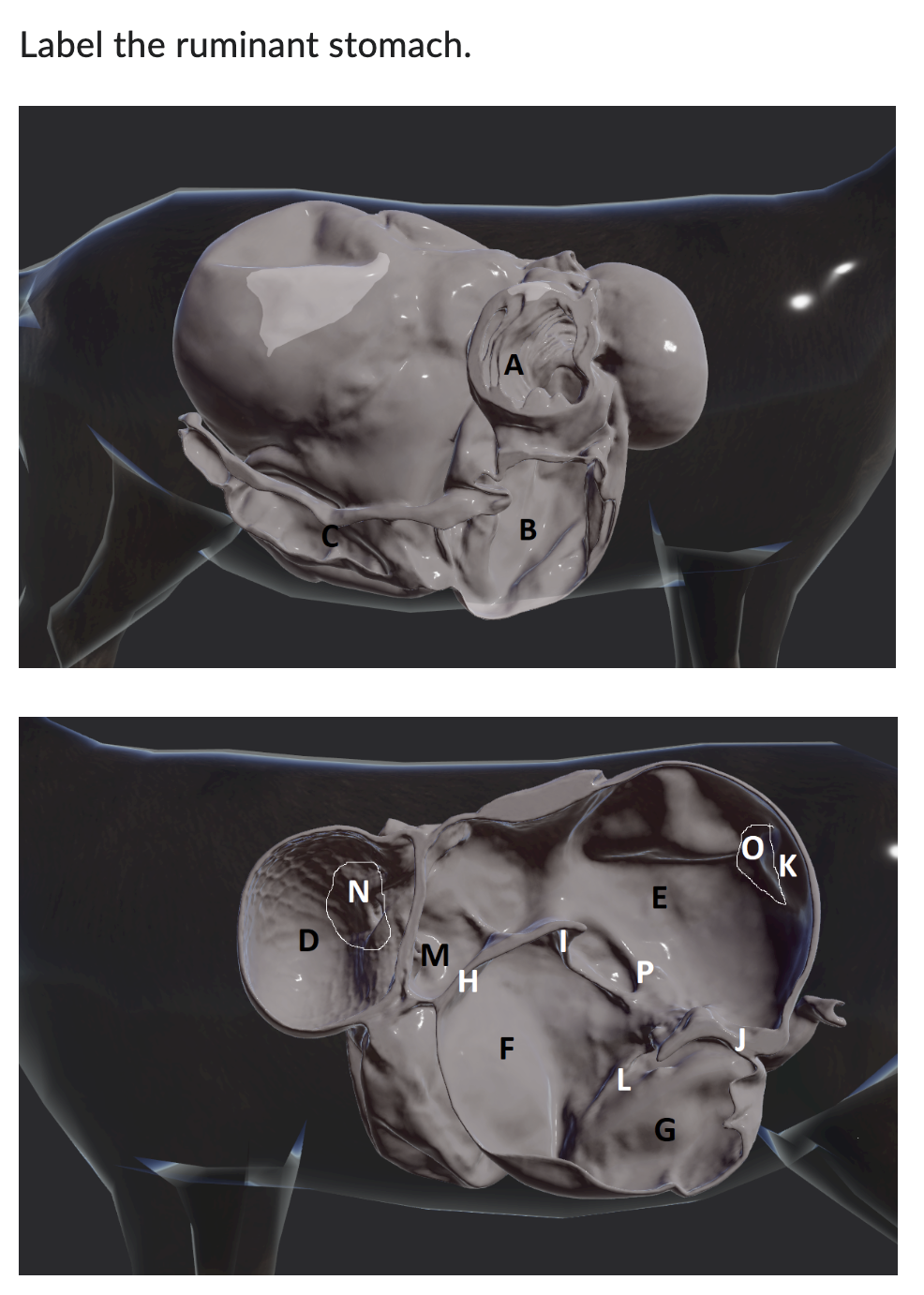
B
fundus of abomasum
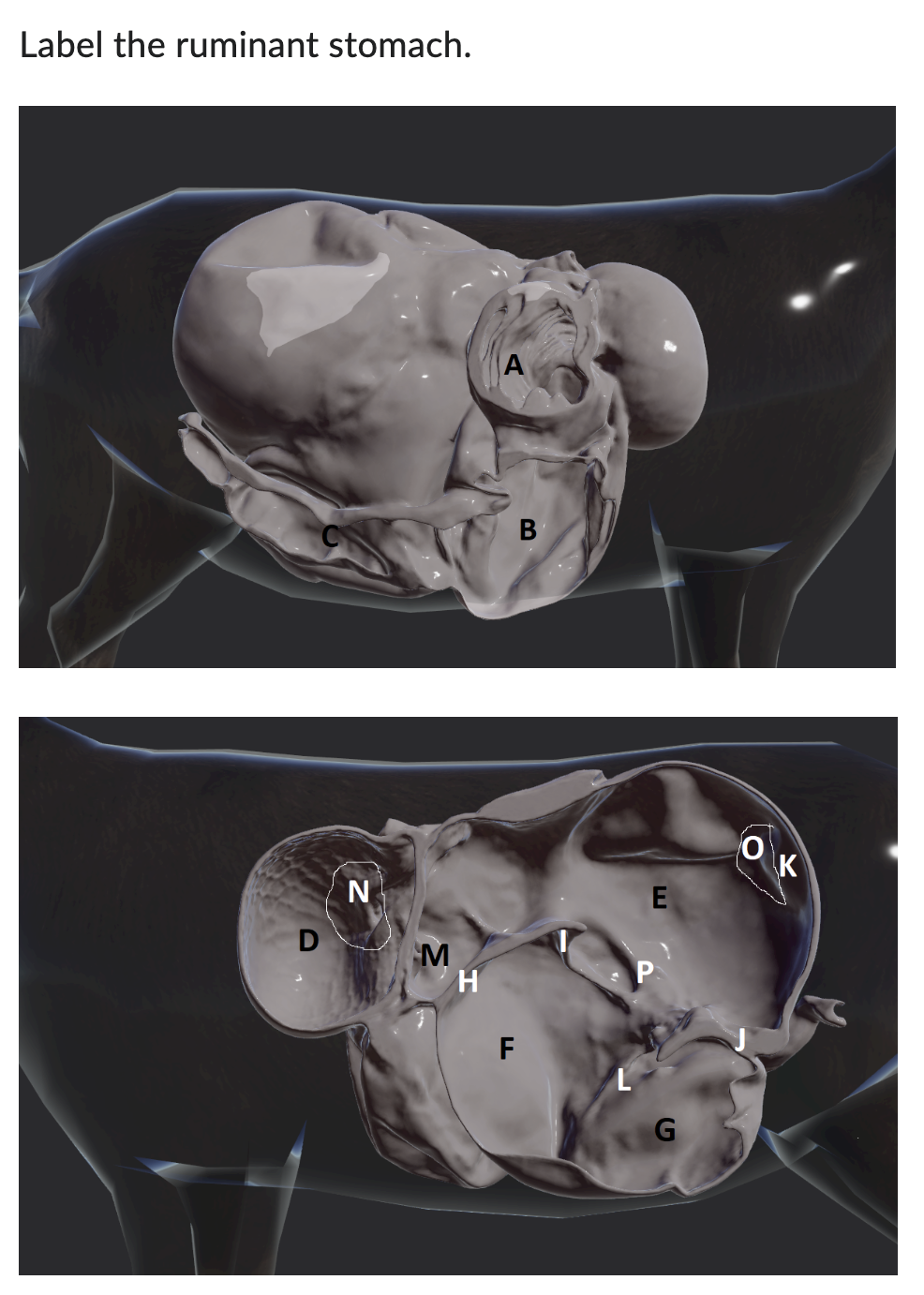
K
caudo-dorsal blind sac
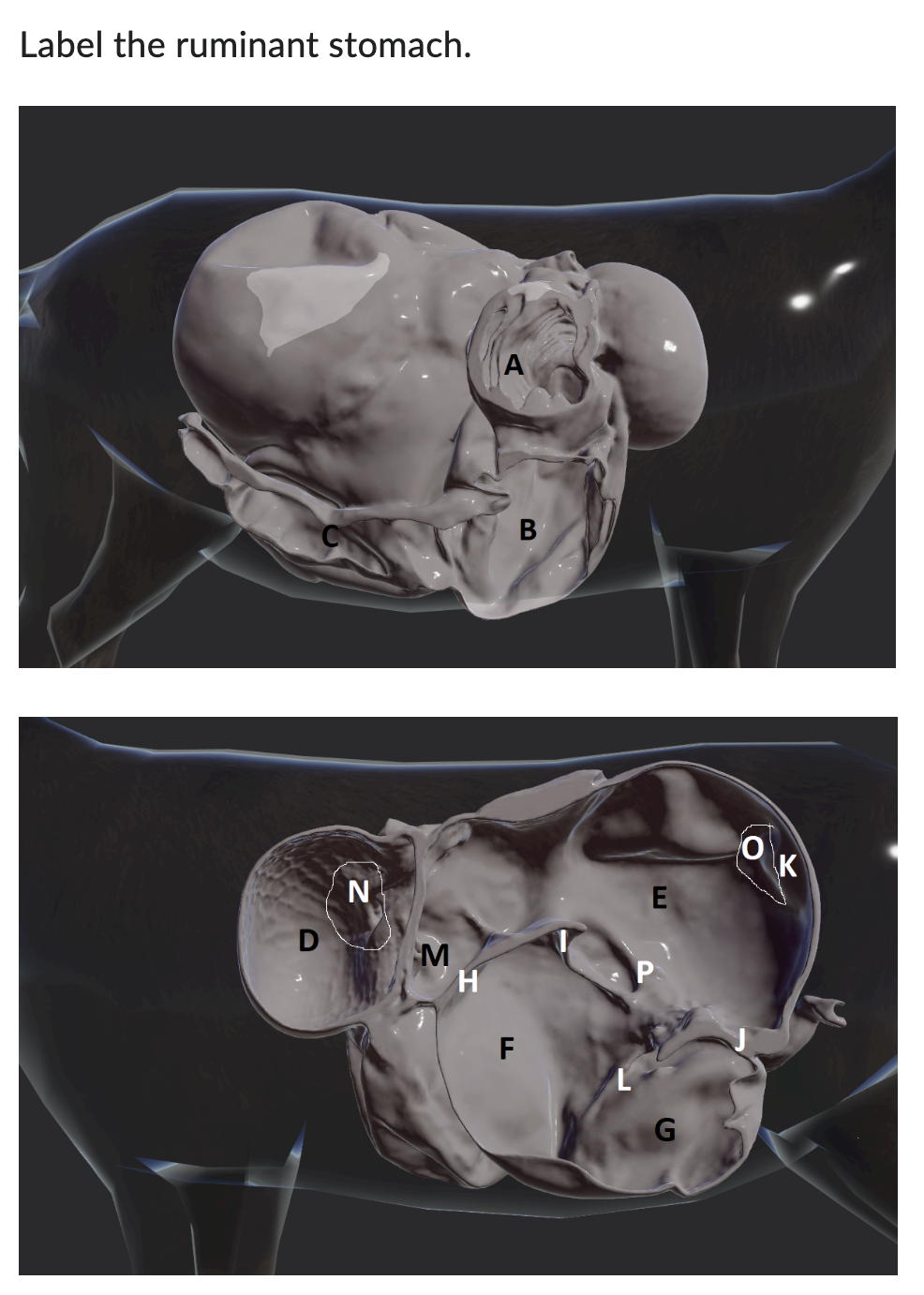
O
dorsal coronary pillar
Which cells produce pepsinogen?
chief cells
Which of these does NOT activate Cl- secretion in the stomach?
CCK
Where can you find stellate cells in the liver?
space of disse
Which of these do the pancreatic enzymes NOT break down?
vitamins
Where are lacteals found?
mucosa
Which cell provides antibacterial protection?
paneth cells
What is the PvO2 of villi?
40 mmHg
Which type of transport of molecules involves carriers?
facilitated
Which of these involves the movement of water to equalize concentrations?
osmosis
When looking at Cl- at the basolateral surface, what is its cotransporter?
K+