Chapter 9: Language & Communication
 Call Kai
 Learn
Learn Practice Test
 Spaced Repetition
 Match
Match Flashcards
 Knowt Play
1/37

There's no tags or description
Looks like no tags are added yet.
Name | Mastery | Learn | Test | Matching | Spaced | Call with Kai |
|---|
No analytics yet
Send a link to your students to track their progress
38 Terms
Language
Language is a defining human characteristic
It allows us to share information with a level of precision not found in other species & is key to complex human culture
It is a multi-faceted developmental process
What is language?
Broad definition
A feature that relates sounds (or gestures) to meaning
Features
It has arbitrary units that are symbolic referents
Structured & meaningful
Units have to be structured/organized for them to convey information to another individual
Displacement: can communicate about events distant in time & space
Generativity: you can produce an infinite number of utterances from a language’s vocabulary provided you follow
Dogs barks cannot convey infinite number of things or variety of ideas
Example: Yesterday at the park, a dog frightened me.
The words themselves are arbitrary, they only have meaning because meaningful has been assigned to those sounds
What are the elements of language?
Phonology
Morphology
Semantics
Syntax
Pragmatics
What is phonology?
Phonology: refers to the sounds of a language
Each unit of sound is a phoneme
Approx. 200 phonemes in all known languages
45 phonemes in English
What is morphology?
Morphology
are the rules of meaning within language
Smallest unit of meaning is a morpheme
Free morphemes
Units of meaning that stand alone
Example: dog, table, jump
Bound morphemes
Units of meaning that are paired with free morphemes to alter the meaning of words
Includes prefixes (ex. un-) and suffixes (ex. -ing, -s)
What is Semantics?
Study of words & their meaning
What is syntax?
Rules specifying how words are combined in sentences
Ex. Noun followed by a verb in English (“ball rolls”)
What is Pragmatics?
How people use language to communicate effectively
Ex. Speakers should be clear in their comments; make comments that are relevant to the conversation; take turns
Perceiving Speech- What is the sucking paradigm?
One month olds can distinguish different phonemes
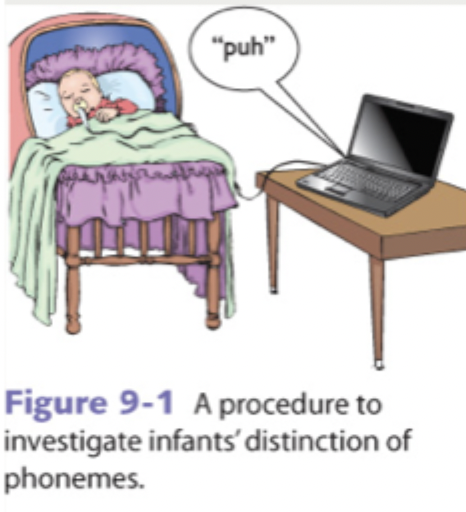
Sucking paradigm:
Infant will suck to hear a phoneme
They will habituate after a few minutes & suck less
If a new phoneme is played, they will increase sucking to continue hearing the convel phoneme
Perceiving Speech- Hindi vs. English babies
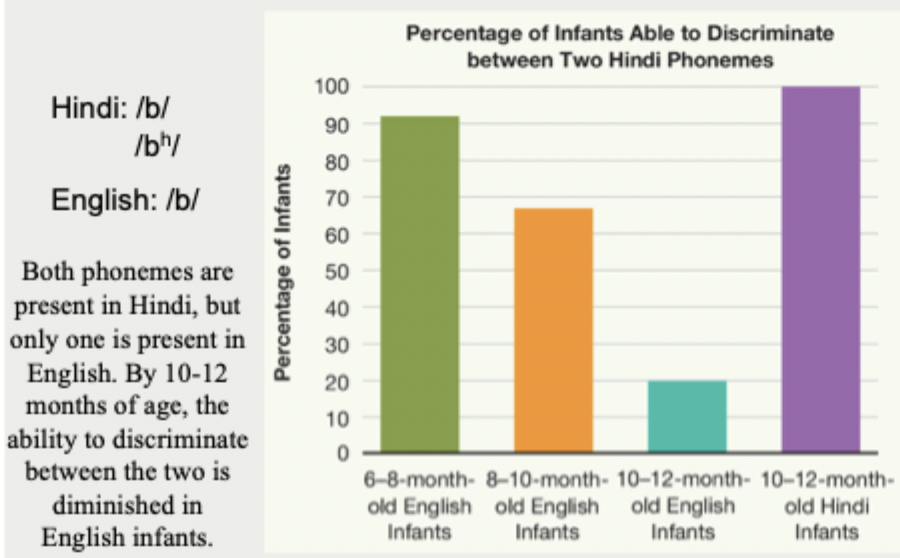
Both phonemes are present in Hindi, but only one is present in English
By 10-12 months of age, the ability to discriminate between the two is diminished in English infants
Most of the youngest infants could make the discrimination, but for children from English-speaking families, the ability decreased with age: Nearly all 6- to 8-month-olds could make the phonemic distinctions for the other two languages, but only half of 8- to 10-month olds had the ability, which was effectively lost by 12 months of age. This loss of phonemic distinction is dependent upon environment
If infants are regularly exposed to more than one language, as in a bilingual family, they do learn the sounds and structural forms of both languages
The decline in phonemic recognition seems to be due to a perceptual reorganization to match the native language
The infant needs continuing experience with the different language phonemes to maintain the ability to perceive and thus to discriminate those phoneme
As babies grow and are more exposed to a particular language, however, they notice only the linguistic distinctions that are meaningful in their own language
Watch Online: Neural Activity of Monolingual & Bilingual Babies
Questions
1) What were the results of the study & what do they suggest about language specialization in 11 month olds?
Half from monolingual (English only households) and other half Spanish-English bilingual households
MEG
Babies listen to stream of sounds such as ‘dah’ and ‘tahs’- some of the sounds specific to English or Spanish and some were common to both languages.
The brains of babies from monolingual families were specialized to process the sounds of English and not sensitive to spanish
Bilingual babies sensitive to the sounds of both languages English & Spanish
Shows by 11 months of age, the infants brain specializes in whatever language or languages present in the environment
2) Which brain areas responded more strongly in bilingual babies? What is the function/role of these brain areas?
Bilingual babies showed stronger responses in prefrontal & orbitofrontal cortex.
Associated with executive function skills
Bilingual babies practice between switching back & forth from different languages
Identifying Distinct Words- What are some patterns that help infants learn words?
Patterns that help infants learn words (not meaning)
Repetition
Ex. words heard frequently, words mentioned over & over during a conversation
Stressed syllables help identify beginnings of words
Ex. doughnut, toothpaste, basket
Infants pay more attention to stressed syllables than unstressed syllables.
Words in more salient positions in sentences are noticed more
Ex. Pauses at the beginning & end of sentences cue words
Using articles to break up a stream of phonemes
Ex. aballabataglove becomes ‘a ball’, ‘a bat’, ‘ a glove’
Noticing syllables & phonemes that often go together
Syllables: syllables that often go together are perceived as the same word ( “dah-bah” is less common than “bay-bee”)
Phonemes: s+t are likely to cue the same word (stink, first), whereas s + d more likely to cue different words (this dog)
Parents & other adults often help infants master language sounds by talking in a distinctive style
Infant directed speech: adults speak slowly & with exaggerated changes in pitch & loudness
because changes in pitch attract an infant’s attention and because the slower pace and accentuated changes help infants detect differences in speech sounds.
Watch Online: Baby Talk From First sound to First Words
1) What are the stages of language development in the first year?
2) What are the characteristics of each stage?
(1) Phonation (birth-2 months)
vowels, consonants, brody sounds
Developing differentiated crying: lets us know baby need to communicate different needs
Helps parents figure out what is going on with baby
(2) Goo stage (2-3 months)
Start to hear cooing and gooing
(3) Expansion Stage (4-6 months)
More speech like
P, B, M
Laughing
Vocalizing excitement & displeasure
Howling, trilling, squealing
Speech game as well as way to communicate
Moving eyes in direction of sound, toys make sounds, listen to music with different purpose
4) Canonical Stage (7-10)
Using non crying sounds to get & keep attention
Babies do things like cough, cough again to get attention
Gestures, imitating different speech sounds
Peekaboo
Respond to simple requests
Recognizing words for common objects
(5) Variegated stage (11-12 months)
Hearing babbling gibberish
Rhythm & pattern of speech
By first birthday, baby has 1-2 words
Some hit milestones early, some later, some RIGHT on time.
Textbook: First Steps to Speech
Cooing
At 2 months of age, infants begin to produce vowel-like sounds, such as “ooooooo” or “ahhhhhh,” a phenomenon known as cooing. Sometimes infants become quite excited as they coo, perhaps reflecting the joy of simply playing with sounds.
Babbling
After cooing comes babbling, speech-like sound that has no meaning. A typical 6-month-old might say “dah” or “bah,” utterances that sound like a single syllable consisting of a consonant and a vowel. Over the next few months, babbling becomes more elaborate as babies apparently experiment with more complex speech sounds. Older infants sometimes repeat a sound as in “bahbahbah” and begin to combine different sounds, “dahmahbah
it is a precursor to real speech.
Intonation
At roughly 8 to 11 months of age, infants’ babbling sounds more like real speech because infants stress some syllables, vary the pitch of their speech
This pattern of rising or falling pitch is known as intonation
Older babies’ babbling reflects these patterns: Babies who are brought up by English-speaking parents have both the declarative and question patterns of intonation in their babbling. Babies exposed to a language with different patterns of intonation, such as Japanese or French, reflect their language’s intonation in their babbling
Understanding Words as Symbols
By 12 months, infants understand words are symbols that stand for something else
Objects (ex. kittens) and their soft properties (ex. soft)
Actions (ex. pet)
Gestures are symbols that children start to use around the time they begin to talk
This is communication but not yet language
Minimal information, focus on here & now
What is fast mapping? The Naming Explosion
Fast mapping
Learning word meanings so rapidly that the child cannot be considering all the possible meanings
Children use a number of heuristics to infer word meanings
Children’s ability to connect new words to their meaning so rapidly that they cannot be considering all possible meanings for the new word.
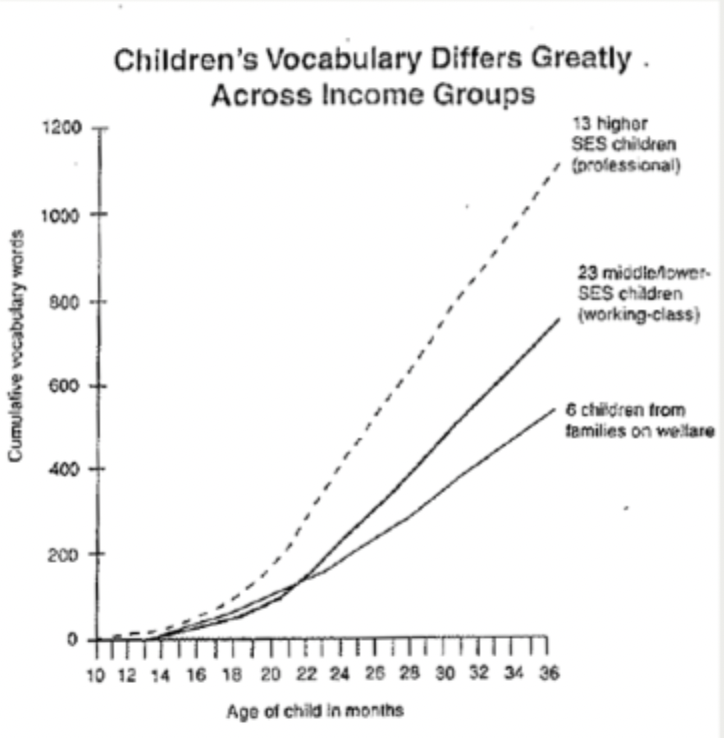
Increase from 12-14 months, begins to be increase taking place when it comes to children vocab
20+ see more expansive
At about 18 months many children experience a naming explosion during which they learn new words-particularly names of objects much more rapidly than before.
What is Joint attention?
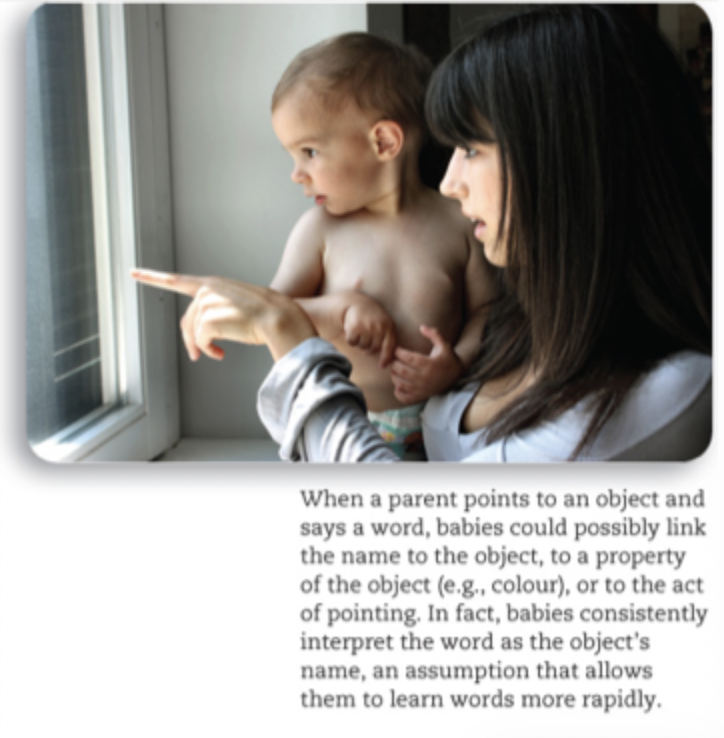
Caregivers label objects that their children are interacting with
Aided by the caregiver pointing or gazing toward the object
When toddlers touch or look at an object, parents often label it for them. When a youngster points to a banana, a parent may say, “Banana, that’s a banana.” Such labelling in the context of joint attention promotes word learning, particularly when infants and toddlers participate actively, directing their parents’ attention
What are someConstaints/Biases on Word Name Learning?
Unfamiliar words refer to objects that do not yet have a name
A name refers to a whole object not its parts or its relation to other objects
For example, when a grandparent points to a stuffed animal on a shelf and says “dinosaur,” children conclude that “dinosaur” refers to the entire dinosaur, not just its ears or its nose, not to the fact that the dinosaur is on a shelf, and not to this specific dinosaur but to all dinosaur-like objects.
If an object has a name already & a new name is given, then the new name denotes a subcategory of the original name (ex. dinosaur, T-Rex)
If the child who knows the meaning of the word “dinosaur” sees their sibling point to another dinosaur and hears the sibling say “T-Rex,” the child will conclude that T-Rex is a special type of dinosaur.
Given many similar category members, a word applied consistently to only one of them is a proper noun (e.g, Dino the dinosaur)
If a child who knows “dinosaur” sees that one of a group of dinosaurs is always called “Dino,” the child will conclude that Dino is the name of that dinosaur.
What are sentence cues?
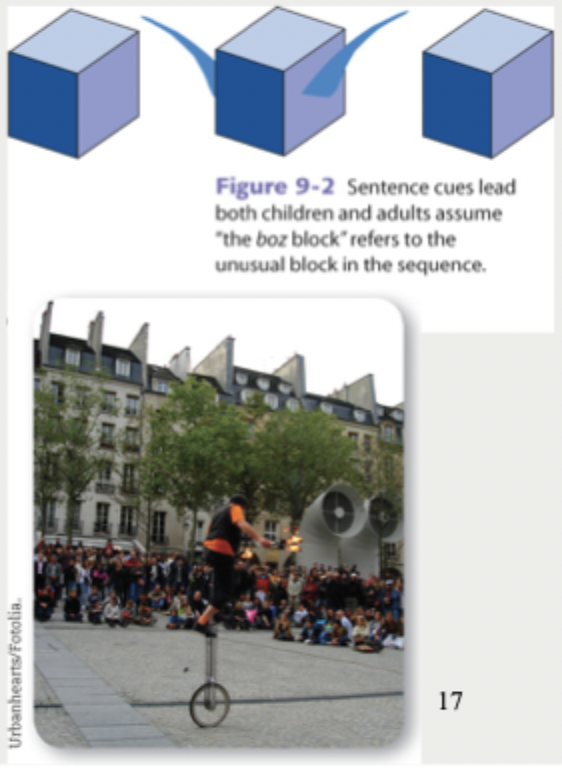
Children hear unfamiliar words embedded in sentences with words they already know, allowing for a process of elimination
Using familiar language cues
ex. a suffix such as -ing cues that the new word refers to an action such as “the man is juggling”
For example, when a parent describes the event in the photo using familiar words but an unfamiliar verb, children often infer that the verb refers to the action performed by the subject of the sentence
When the youngsters hear, “The man is juggling,” they will infer that “juggling” refers to the man’s actions with the balls because they already know “man” and because -ing refers to ongoing actions. Similarly, toddlers know that “a” and “the” often precede nouns, and that “he,” “she,” and “they” precede verbs.
Developmental Change in Word Learning
Before 18 months, infants learn words relatively slowly—often just one new word each day. At this age, children rely heavily on simple attentional processes (e.g., the shape bias) to learn new words.
But by 24 months, most children are learning many new words daily. This faster learning reflects children’s greater use of language cues (e.g., constraints on names) and a speaker’s social cues.
What are common errors?
Underextension: defining a word too narrowly
ex. using ‘ball’ to refer to only a favourite ball
Using the word “car” to refer only to the family car and “ball” to refer only to one favourite toy ball are examples of underextension
Overextension: defining a word too broadly
ex. using ‘doggie’ to refer to all four-legged animals
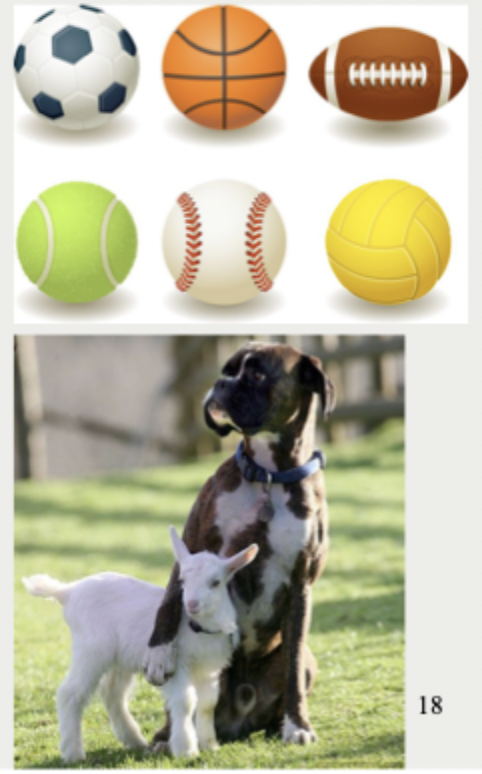
Children may use “car” to also refer to buses and trucks or use “doggie” to refer to all four-legged animals.
The overextension error occurs more frequently when children are producing words than when they are comprehending words.
A 2-year-old may say “doggie” to refer to a goat but nevertheless correctly point to a picture of a goat when asked. Because overextension is more common in word production, it may actually reflect another fast-mapping rule that children follow: “If you can’t remember the name for an object, say the name of a related object
Both underextension and overextension disappear gradually as youngsters refine meanings for words with more exposure to language.
Textbook- Word Learning Styles GO OVER 9.2
Size of vocabulary is not the only way in which young children differ in their word learning. As youngsters expand their vocabulary, they often adopt a distinctive style of learning language
Referential style: Their vocabularies mainly consist of words that name objects, people or actions
For example, Caitlin, a referential child, had 42 name words in her 50-word vocabulary but only two words for social interactions or questions
Expressive style: their vocabularies include some names but also many social phrases that are used like a single word such as “go away”, “what’d you want” and “I want it'
Speaking in Sentences
Speech is often telegraphic in 18-24 month olds in that it consists of only words relevant to meaning with little or no grammar
At about 1½ years of age, children begin to combine individual words to create two-word sentences, like “more juice,” “gimme cookie,” “truck go,” “my truck,” “Mommy go,” “Daddy bike.
Telegraphic speech: consists only of words directly relevant to meaning
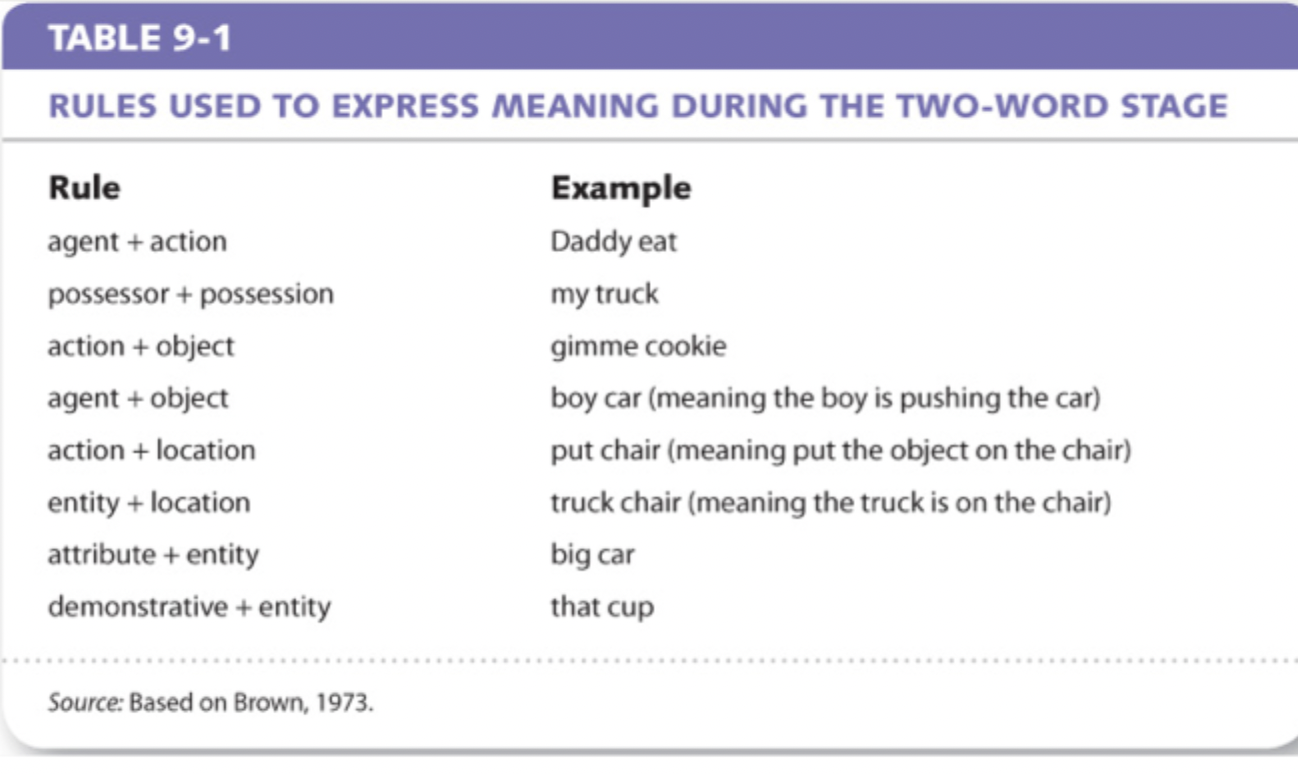
When children are in the two-word stage, they use several basic rules to express meaning
For example, “Daddy eat” and “Mommy fall” illustrate the rule agent + action; “gimme juice” and “push truck” illustrate the rule action + object.
From Two-Word Speech to Complex Sentences
Gradually children add grammatical morphemes
Words (e.g, a, the, at)
Ending of words (ex. -s, -ing)
Make sentences grammatical
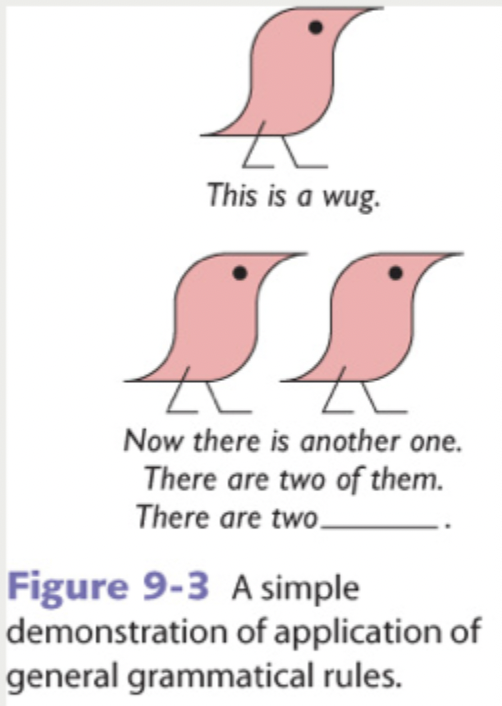
Grammatical morphemes: childrens longer sentences are filled with grammatical morphemes, words or ending of words (such as -ing, -ed, or -s) that make a sentence grammatical
Over regularization
Children master grammar by learning grammatical rules which are evident when children fail to use language in accordance with exceptions to the rules
Examples: “two mans” instead of “two men”, “grandma taked me to the candy store”
Between the ages of 3 and 6, children also learn to use negation (“That isn’t a butterfly”) and embedded sentences (“Jennifer thinks that Bill took the book”). They begin to comprehend passive voice (“The ball was kicked by the girl”) as opposed to the active voice (“The girl kicked the ball”), although full understanding of this form continues into the elementary-school years
Watching Online: Illustrating Common Errors in Children’s Language
Question
(1)What are some examples of the errors children make when (a) trying to pronounce words that include sounds that are difficult to articulate, and (b) applying grammatical morphemes?
a) Sounds difficult to articulate
poon instead of spoon
paghetti instead of spagheti
tuck instead of truck
b) applying grammatical morphemes
“Bestest”
“Someone taked it”
“goed” instead of went
foots instead of feet
mouses instead of mice
How do children acquire grammar? What it the Behaviourist Perspective?
B. F Skinner
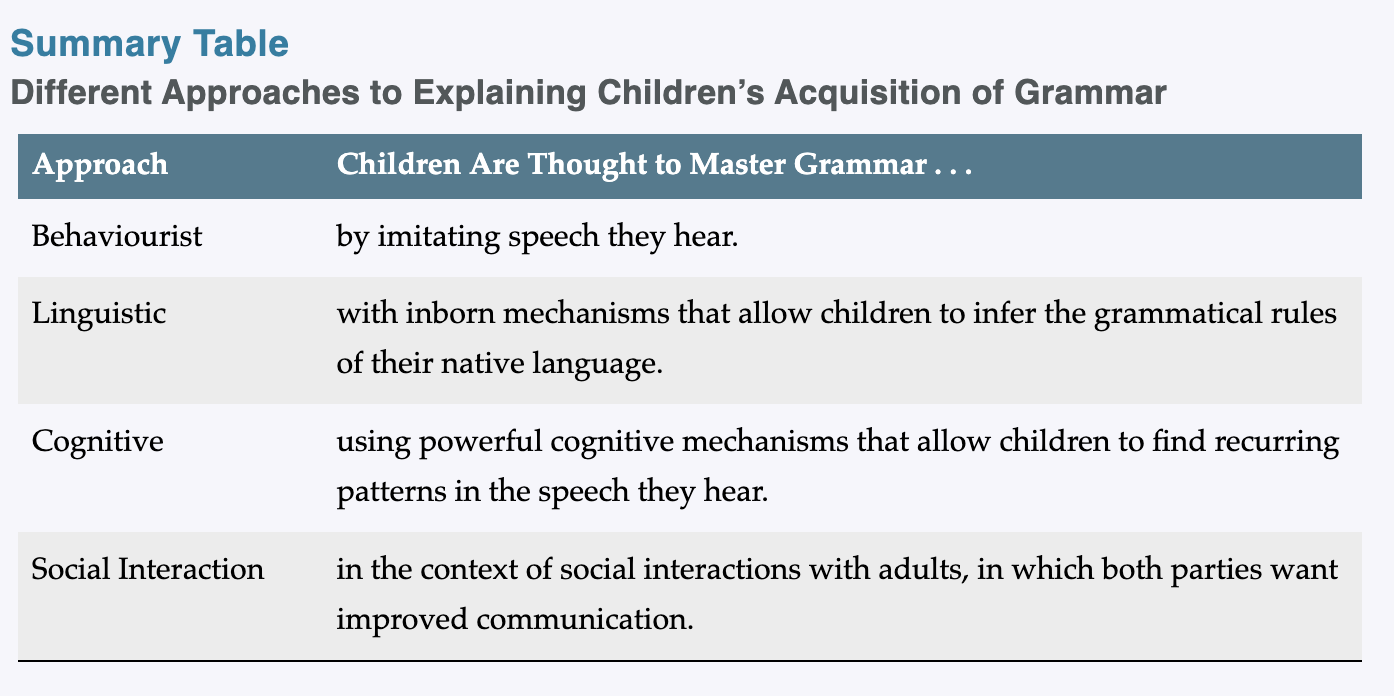
Aspects of language are learned via imitation & reinforcement
Limitations
Cannot account for novel sentences
Children often do not imitate adult grammar
For example, “I am drawing a picture” is repeated by a child as “I draw picture”
How do children acquire grammar? What is linguistic perspective?
Noam Chomsky- nativist answer
Processes that guide grammar learning are built into the nervous system
We are born prepared to learn grammar
Proposed children are born with mechanisms that simplify the task of learning grammar
According to this view, children are born with neural circuits in the brain that allow them to infer the grammar of the language they hear. That is, grammar itself is not built into the child’s nervous system, but processes that guide the learning of grammar are
Semantic Bootstrapping theory argues that humans are born knowing nouns refer to people/objects & verbs are actions. This information is used to infer grammatical rules
Example: Hearing sentences such as “Billy drinks,” “Susan sleeps,” and “Jalena reads,” children infer that noun + verb makes a grammatical sentence in English
Line of Evidence # 1 for Linguistic Perspective: Neuroanatomy
Specific regions of the brain are known to be involved in language processing
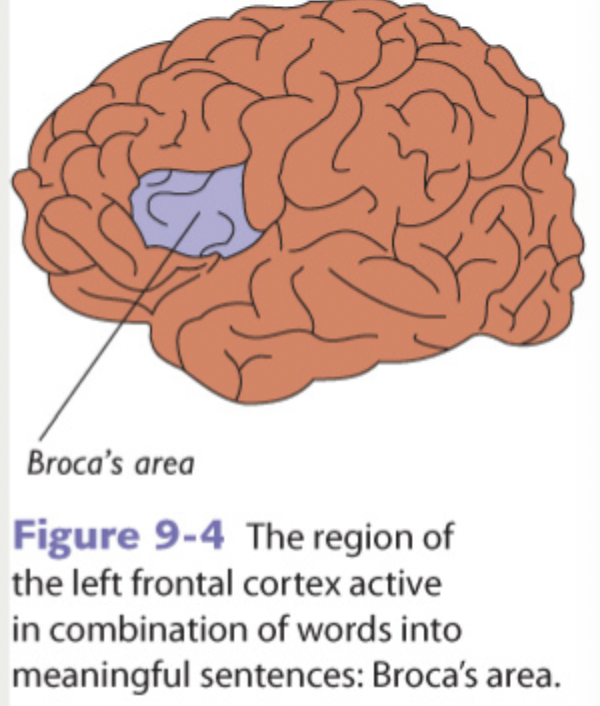
Broca’s area appears to be specialized neural region for processing of grammar
Grammar component of language
Activated when asked to combine different nouns and verbs together in fMRI
Damage to this have issues with proper grammatical forms
Line of Evidence # 2 for Linguistic Perspective: Humans are Unique and only humans learn grammar readily
Only humans learn grammar readily
Imitation & reinforcement are not sufficient to teach grammar to closely related species
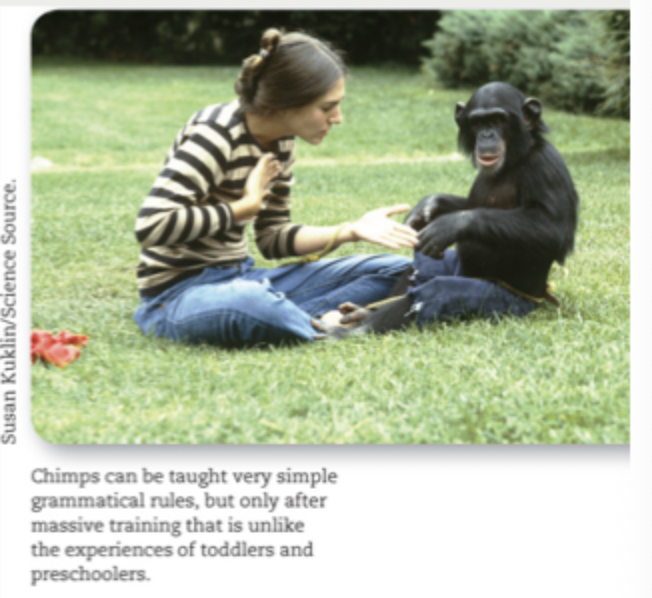
Chimpanzees can only learn simple grammar rules for two-word speech following extensive training
If grammar is learned solely through imitation and reinforcement, then it should be possible to teach rudimentary grammar to nonhumans
If, instead, learning grammar depends on specialized neural mechanisms that are unique to humans, then efforts to teach grammar to nonhumans should fail.
For example, chimps like the one in the photo have been taught to communicate using gestures taken from sign language. Other chimps have been taught using plastic chips to stand for words. The result? Chimps master a handful of grammatical rules governing two-word speech but only with massive effort that is completely unlike the preschool child’s learning of grammar, and the resulting language is unlike children’s grammar in many way
Line of Evidence #3: Children develop linguistic communication with little to no formal input needed
A deaf child will spontaneously produce gestural communication similar to grammatical structure to a hearing childs verbal language
Studies of “home sign” developed by deaf people seem to support the concept of an innate basis for language.
Deaf children brought together in special schools developed basic communication into a signed language with its own grammar
Initially, when people of different linguistic backgrounds come together they may develop a “basic” form of communication called a pidgin, a rudimentary language that allows people to get along
The children of pidgin speakers however then develop and use a more complex form of language called creole
Line of Evidence #4: Critical Period
Early on, we lose the ability to distinguish phonemes are not used in our language
Birth to age 12 years is critical for learning grammar
Second language learning
Extreme cases of early language deprivation
If children do not acquire language in this period, they will never truly master language later.
When Genie was discovered, at age 13, she did not speak at all. After several years of language training, her mastery of grammar remained limited, resembling the telegraphic speech of a 2-year-old

Line of Evidence #5: Vocabulary- Grammar Link
The size of children’s vocabulary, not their age is most closely linked with the level of grammatical sophistication
Suggests vocabulary & grammar are part of the same language system
What is the cognitive perspective?
Grammar is learned through cognitive skills
Information obtained from language exposure is treated as though it were a massive ‘data set’
That has all the speech they have heard in one column and the context in which they heard it in a second column; periodically, infants scan the columns looking for recurring patterns
Children detect recurring patterns in the data to infer grammatical rules
Ex. Learn to use ‘-s’ on the end of a word when there are multiple instances of objects associated with that word.
For example, children might be confused the first time they hear -s added to the end of a familiar noun. However, as the database expands to include many instances of familiar nouns with an added -s, children discover that -s is always added to a noun when there are multiple instances of the object. Thus, they create the rule: noun + -s = plural.
Implies a central role for memory
With this view, children learn language by searching for regularities across many examples that are stored in memory, not through an inborn grammar-learning device
What is social interaction perspective?
Combines the ideas of the learning, linguistic & cognitive perspectives
Emphasizes that language is mastered in social context/interactions
Children are motivated to learn language so they can communicate more efficiently
Caregivers are motivated to understand their children & support their language development
Parent scaffold behaviour
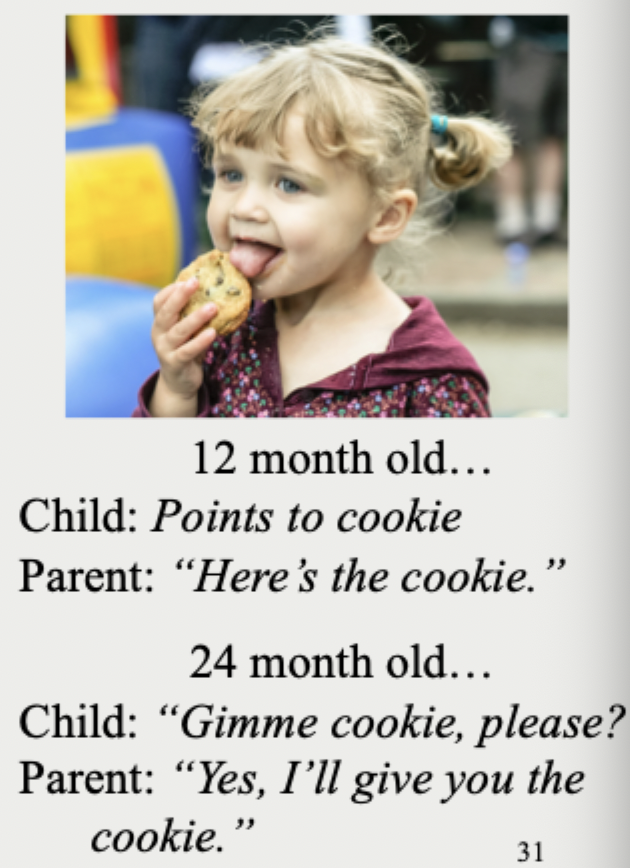
Like the child in the photo, a 9-month-old who wants a cookie might point to it while looking at the parent. In turn, the parent gives the cookie, saying, “Here’s the cookie.” By age 2, a child might say, “Gimme cookie, please?” with the parent responding, “Yes, I’ll give you the cookie.” At 9 months and at 2 years, the child’s desire to have the cookie motivates communication (pointing at 9 months, spoken language at 2 years) and gives the parent opportunities to demonstrate more advanced forms of language.
Highlights what acquiring grammar is for
For communicating more efficiently
How does social element of communication add another layer to different perspectives of how we acquire language
Textbook
Two more recently developed theories relevant to social interaction in language learning are symbolic interaction theory and relational frame theory
Symbolic Interaction theory
Considers human interaction as directed by symbols, the meaning of which is created in human interactions
Language, a way of representing information, provides such symbols, which are used in the context of social interactions to arrive at understanding of meaning. Meaning, however, can be interpreted differently by different people, depending on how they are thinking
Relational frame theory
Considers links between stimuli (ie. the relations between perceived stimuli)
RFT builds on Skinner’s concepts regarding language but differs in key respects. There is similarity with behaviourism in that relationships between stimuli can be taught, with reinforcement for correct responses to verbal cues, for example, but there is a difference regarding consideration of representations of the relationships between stimuli
Theorists from the RFT perspective take the view that how we classify a behavioural response depends on the source of the stimulus
Summary Table Different Approaches to Explaining Children’s Acquisition of Grammar
Watch Online: Building Blocks of Communication
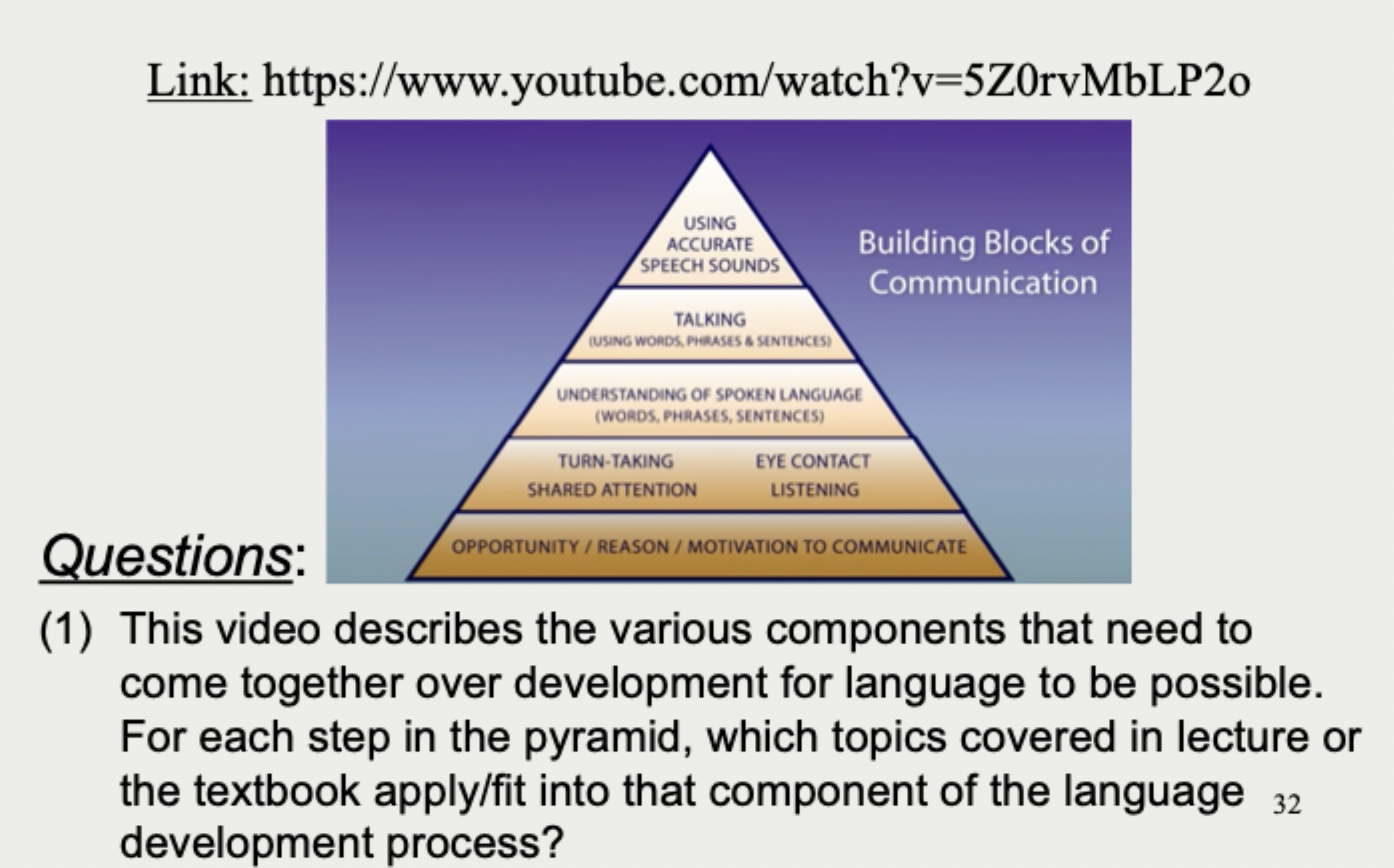
FINISH LAST TWO SECTIONS