Intro Day 1
 Call Kai
 Learn
Learn Practice Test
 Spaced Repetition
 Match
Match Flashcards
 Knowt Play
1/64

There's no tags or description
Looks like no tags are added yet.
Name | Mastery | Learn | Test | Matching | Spaced | Call with Kai |
|---|
No analytics yet
Send a link to your students to track their progress
65 Terms
Tight junction
seals neighboring cells together like a ziplock bag
desmosomes
anchors adjacent cells together like velcro
gap junction
connects cells by hollow cylinders
phospholipid bilayer is made up of what 2 things
polar heads and fatty acid tails
5 functions of proteins
structure, communication, signaling, maintenance, identification
3 types of endocytosis
phagocytosis, pinocytosis, receptor mediated endocytosis
facilitated diffusion
particles move from high to low concentration with the help of a transport protein
voltage gated channel
opens only when a membrane reaches a specific potential
ligand gated channels
open when a specific molecule (typically a neurotransmitter) binds
filtration
movement of water and small solutes through a membrane due to pressure gradient (greater pressure on one side of the membrane than the other pushes water through it)
osmosis
water moves from higher water (aka lower solute) concentration to lower water (aka higher solute concentration
hypertonic solutions
solution has a higher concentration of solute then cell
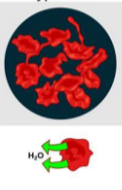
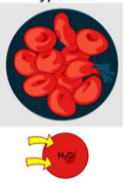
hypotonic solutions
solution has lower concentration of solute then cell
in active transport __Na move out of cell and __K move into cell
3; 2
list the types of movement through membranes
endocytosis, simple diffusion, facilitated diffusion, filtration, osmosis, active transport
4 basic tissue types
epithelial, connective, nervous, muscle
epithelial tissue functions
sheet of cells that covers a body surface, lines a body cavity, or forms glands; forms boundaries between diff environments
protection, absorption, secretion, ion transport, filtration
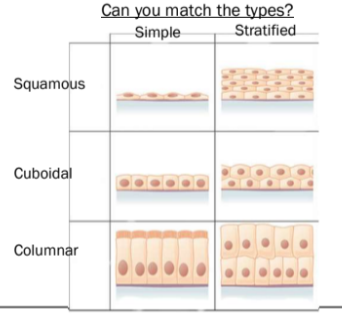
list the shapes and thicknesses of epithelial tissue
simple or stratified
squamous, cuboidal, or columnar
connective tissue main functions
protect, support, and bind together other tissues; storage of reserve fuel; transportation of substances
4 types of connective tissue
connective tissue proper (loose, dense regular, dense irregular), cartilage, bone, blood
loose connective tissue
adipose tissue
dense regular connective tissue
collagen fibers run parallel
dense irregular connective tissue
collagen fibers do not run parallel
elastic connective tissue
contains collagen and elastin fibers
3 types of cartilage
hyaline, elastic, fibrocartilage
hyaline cartilage
covers end of bones
elastic cartilage
provides stretch
fibrocartilage
found in intervertebral discs
cartilage info
withstands tension and compression; lacks nerve fibers and is avascular; primary cell type is chondroblasts
3 types of muscle tissue
skeletal, smooth, cardiac
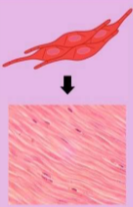
smooth muscle tissue
lines wall of hollow organs; squeezes substances through those organs
glial cells
part of nervous system; supports, nourishes, and protect neurons
function of circulatory system
deliver oxygen and nutrients; remove carbon dioxide and waste
artery
carries blood away from the heart
vein
carries blood towards the heart
capillary
exchange of gases and nutrients
why does an artery have a thicker wall then a vein
because of pressure… the start of arteries are closer to the heart and need to withstand the pressure of the heart pumping blood through them
blood moves from ____ to _____ pressure
high to low
systolic pressure is ventricular ____________ and diastolic pressure is ventricular __________
contraction; relaxation
as cross sectional area increased, the velocity _______ and vice versa
decreases (because the velocity of blood is so slow in the capillaries, the cross sectional area is going to be way larger there)
velocity of blood flow is inversely proportional to cross sectional area (retype)
velocity of blood flow is inversely proportional to cross sectional area
vasodilation leads to increased or decreased blood flow
increased
vasoconstriction leads to increased or decreased blood flow
decreased
vasodilation/constriction is affected by what
sympathetic/parasympathetic nervous system, H concentration, O2 and CO2, hormones
blood info
type of connective tissue; transports O2, CO2, and nutrients; regulates temp, pH level, and fluid volumes
3 components of blood
plasma, buffy coat, hematocrit
plasma
55% of blood is made of this, it’s about 90% water but also contains proteins, nutrients, and hormones
buffy coat
made of white blood cells and platelets
what are the 3 formed elements of blood
platelets, white blood cells, and red blood cells (make up 45% of blood)
platelets
small cell fragments that are helpful in coagulation; fragments of megakaryocytes; lifespan is 5-10 days; disc shaped with no nucleus
normal blood is made up of about __% hematocrit (RBCs)
40-50%
RBCs are also called what
erythrocytes
RBCs/Erythrocytes
biconcave shape to increase surface area; strong and flexible plasma membrane; no nucleus or other organelles; lifespan of 100-120 days; contains oxygen carrying protein hemoglobin
how many heme groups per hemoglobin
4 globin groups or polypeptide chains
hemoglobin transports __% of total CO2
23
white blood cells/leukocytes
defend against infectious diseases and foreign invaders; contain mitochondria and nuclei; majority have lifespan of several hours to days; grouped into granulocytes and agranulocytes
granulocytes
neutrophils, eosinophils, basophils
agranulocytes
monocytes, lymphocytes
monocytes
3-8% of white blood cells; nucleus is U shaped; development takes 2-3 days; lifespan is months long
function: develop into macrophages in tissues and to do phagocytosis to remove foreign invaders
eosinophils
make up 2-4% of white blood cells; nucleus bilobed; develops in 6-9 days; lifespan is 8-12 days
function: kills parasitic worms; destroys antigen-antibody complexes; inactivates some aspects of allergic response
basophils
0.5-1% of white blood cells; nucleus is lobed; develops in 3-7 days; lifespan is a few hours-days; associated with allergic reactions
function: release histamine and other allergic response mediators; contains heparin, an anticoagulant
lymphocytes
20-40% of white blood cells; T-cells and B-cells; nucleus is spherical or indented; develops in days to weeks; lifespan is hours to years
function: kills viruses, releases cytokines, produces antibodies; T-cells direct the attack; B-cells attack through antibodies
neutrophils
60-70% of white blood cells; nucleus is multilobed; develop in 6-9 days; lifespan is 6hrs to a few days
function: phagocytize bacteria, undergo chemotaxis
hematopoesis
production of blood cells
starts with stem cell is bone marrow, this proliferates and becomes blood cells through growth factors and other mediators and they do not divide any further after leaving the bone marrow
within hematopoesis hormones regulate cell production, list the hormones we discussed and what they effect
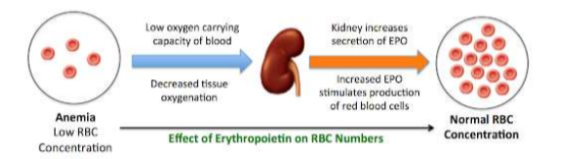
erythropoietin/EPO (RBCs); thrombopoietin (platelets); colony stimulating factors/CSF and interleukins (WBCs)