Zoology 101 Exam 3: Gas Exhange Lecture
 Call Kai
 Learn
Learn Practice Test
 Spaced Repetition
 Match
Match Flashcards
 Knowt Play
1/95

There's no tags or description
Looks like no tags are added yet.
Name | Mastery | Learn | Test | Matching | Spaced | Call with Kai |
|---|
No analytics yet
Send a link to your students to track their progress
96 Terms
Gas Exhange
The uptake of O2 from the environment (to produce energy) and the expulsion of CO2 into the environment (getting rid of waste)
Requires specialized exchange surfaces
Which gases are exhanged during respiration
Oxygen (O2) and carbon dioxide (CO2)
Diffusion
The passive movement of oxygen (O2) and carbon dioxide (CO2) across respiratory membranes driven by partial pressure gradient ( region of higher partial pressure to region of lower partial pressure - down the partial pressure gradient)
Where does O2 and CO2 move through in diffusion with gas exchange
O2 moves into low concentration inside the blood cell
CO2 moves from high pressure blood cell to outside of environment
What is required for gases to diffuse across a surface
Moist, thin membrane with large surface area
Passive Respiratory Systems
Respiratory compartments open to environment across entire body
Drives pressure gradient
Gas exchange due to pressure gradients
Active Respiratory Systems
Dedicated locations for respiratory compartments
Gas exhchange requires ventilation: Movement of a respiratory medium across respiratory surface
What do insects use to extract gas from their environment?
Spiracles
Tracheal system
Ventilation through movement
Spiracles - Insects
Holes in insect’s body surfaces that allow air to enter
Tracheal system - Insects
Network of arborized tubes which brings air close to most of the body cells of the insect
Carries gas to its needed location
How do insects perform gas exchange?
Ventilation
Tracheal system
How do animals with gills perform sufficient gas exchange?
1) Large surface area - Gill filaments (a lot of folds increases surface area) and lamellae
2) Ventilation - One-way flow of water (oxygen-containing medium) over gills (respiratory surface)
3) Gas exchange occurs via countercurrent exchange in the lamallea of the gills
Where does gas exchange occur via gills?
Lamella
Countercurrent Exchange
Water and blood flow in opposite directions setting up a concentration gradient that causes oxygen from water to enter the blood stream efficiently.
How do birds perform gas exchange?
One-way flow of air (only use fresh air)
Two-cycle ventilation (Require a breaths to move y units of air)
Crosscurrent exchange
How do birds perform gas exchange (One-way flow of air)
Air sacs and lungs (infoldings of body) keep fresh air from mixing with stale air
How do birds perform gas exhange (Ventilation)
Flow of oxygen-containing medium across respiratory surface
One-way flow of air over blood capillaries through parabronchi within
Crosscurrent Exchange
Air and blood pathways cross allowing oxygen to enter part of the capillaries efficiently
Air and blood flow aren’t in opposite directions
How do amphibians perform gas exchange?
Ventilation through passive diffusion, movement, and inspiration/expiration
Skin, gills, and lungs all possible respiratory organs dependent on species and stage of life.
How do amphibians perform gas exchange - Large surface area
Skin as respiratory organ
How do amphibians perform gas exhange - Ventilation
Passive diffusion from air contacting moist
Respiratory Medium - Fish
Water - Contains a lot less oxygen compared to air
Respiratory Surface - Fish
Lamella in Gills
Ventilation Mechanism - Fish
Mouth movements and swimming brings one-way flow of water over gills
Direction of Blood Flow - Fish
Blood flows through gill capillaries in the opposite direction to water flowing over gill lamellae (countercurrent exchange)
Respiratory Medium - Grasshopper
Air (atmospheric oxygen)
Enters through spiracles
Respiratory Surface - Grasshopper
Parabronchi in lungs
Ventilation mechanism - Grasshopper
Body movement allows air to enter the body through spiracles
Respiratory Medium - Bird
Air
One-way flow of air
Two-cycle ventilation
One-way flow of air - bird
Use of fresh air only, no stale air (air that has already gone through gas exchange)
Two-cycle ventilation - Bird
Requires a amount of breaths to y unit of air
Respiratory Surface - Bird
first inhalation - posterior air sacs (store and move fresh air) - lungs - anterior air sacs (holds stale air thats released into environment)
Ventilation Mechanism - Bird
Negative pressure
One way air flow through air sacs and lungs
Respiratory Medium - Human
Air
Respiratory Surface - Human
Alveoli in lungs
Ventilation mechanism - Humans
Negative pressure breathing
Two-way tidal air flows through lungs
Negative pressure breathing - Humans
Pulling air - vaccum effect
Contraction - Atmospheric pressure is greater than lung interior pressure bringing air in
Relaxation: Atmospheric pressure is less than lung interior pressure allowing air to travel out
Tidal exchange - Humans
Mixing of old and new air not as efficient method of exchange
Only occurs across some legth of the alveolar capillary ( limited area)
Oxygen enters the blood and carbon dioxide exits the blood in the lungs during in and out breathing
Ranking of modes of exchange (efficiency wise)
Countercurrent exchange
Cross-current exchange
Tidal exchange
2 main functions of circulatory systems
Transport and exchange respiratory gases
Transport nutrients, hormones, and immune cells to critical sites
Do all animals have circulatory systems?
No some use diffusion of gases and nutrients because they are thin, flat, and have a gastrovascular cavity inside of their body providing lots of exchange surface
live in moist environments
Gastrovascular cavity important
3 main features of circulatory systems?
Circulating fluid (blood or hemolymph)
Muscular pump (heart)
Tubes/vessels
Open circulatory system
Common in invertebrates (i.e. insects and other athropods)
Fluid: Hemolymph
Arteries but no veins
Ostia
Primary function of open circulatory systems
Transport nutrients and waste (not gas exchange)
Ostia
Allow Hemolymph to diffuse back into the heart (valves close them when the heart contracts)
Open Circulatory System Visual

Closed Circulatory Systems
Found in all vertebrates and some invertebrates
Blood: Circualtory fluid
Fluid is contained within/doesn’t leave vessels
Pump: Heart
Instertitual fluid surrounds cells that are outside of vessels/heart
Closed Circulatory Systems: Primary Functions
Gas exchange
Resource transport
Closed Circulatory System Diagram
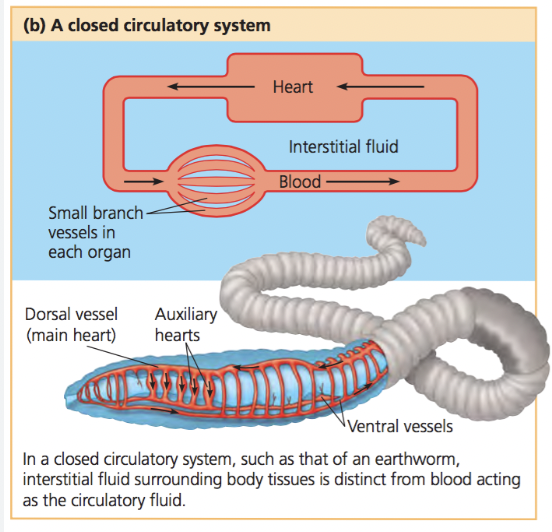
Hemolymph
Mixture of blood and interstitual fluid
Distinct from blood and interstitual fluid found in organisms with closed circulatory systems
Arteries Function
Move blood away from the heart
Built to absorb and dampen busatile flow
Arteries Structure
Thick muscular walls (smooth muscle) that can withstand the pressure of blood coming from the heart.
Capillaries
Where exchange occurs C
Capillary Walls Structure
Single, thin layer of cells to facilitate exchange
Capillary beds
Provide a large surface area for exchangeW
Why does blood flow slow down when going through capillary beds?
when all of the capillaries in a bed are considered, the diameter through a capillary bed is larger, so the velocity decreases
Why is the slowed down blood flow through capillary beds advantegous for organisms?
The capillary beds are where exchange occurs
Slower flow = more time for exchange
Type of heart - Fish
Two-chambered heart
Structure of 2 chambered heart
One atrium (where blood enters; cycle restarts), one ventricle
Type of blood circulation in 2 chambered heart
Single, blood goes through two capillary beds, passes through the heart once per “turn” throughout the entire cirulatory system
Disadvantages of the 2 chambered heart
Sluggish blood flow through systemic capillaries
Where does oxygenated blood travel to in the fish circulatory system
the body capillaries
none in heart
in capillary beds
Fish Two-chambered heart Visual

Which animals have a 3 chambered heart
Amphibians
Structure of the 3 chambered heart?
2 atria one ventricle
What type of circulation occurs within the 3 chambered heart?
Double circulation
Double circulation - 3 chambered heart
Blood goes through 2 capillary beds with pump of heart between each bed, pulmocutaneous and systemic circuit
Disadvantage of the 3 chambered heart
Mixing of oxygenated and deoxygenated blood, but allows for intermittent breathing
Advantage of the 3 chambered heart
More vigorous blood flow than single circuit, intermittent breathers
3 chambered heart visual

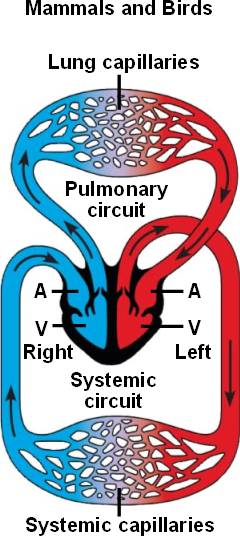
What animals have a 4 chambered heart?
Mammals, birds
Structure of the 4-chambered heart?
Two atria and two ventricles
What do the right ventricles do in the 4 chambered heart?
Sneds blood to lung
What do left ventricles do in the 4 chambered heart?
Sends blood to capillaries
What type of circulation do 4-chambered hearts use?
Double: Blood goes through two capillary beds with pump of heart between each bed, pulmonary and systemic circuit
Advantages of 4 chambered heart?
No mixing of oxygenated and deoxygenated blood, vigorous blood flow
Structure of 4 chambered heart
4 major components of Blood
Plasma’
Red blood cells
Platelets
White blood cells
Plasma (Blood component)
Liquid portion → Contains dissolved nutrients, hormones, gases
Red blood cells (Blood component)
Transports oxygen
Platelets (Blood component)
Helps form blood clots
White blood cells
Immune defenses against invaders
Function of red blood cell (erythrocite)
Transports almost all of the oxygen we bring into our body
Hemoglobin
Protein where majority of oxygen is bound to
Cooperative Binding of oxygen to hemoglobin
Hemoglobin has 4 subunits, each binds one molecule of O2
Once one molecule of oxygen binds, the next 3 molecules bind in quick succession
Binding of first O2 changes the shape of hemoglobin
Making hemoglobin have a higher affinity for O2 than when none is bound
O2 unbinds from hemoglobin in a cooperative manner - once the first O2 leaves, the others then leave in quick succession
Respiratory Adaptations found in deep-sea diving animals: Weddel Seal
More blood (can store more oxygen), more myoglobin, blood is not routed to muscles when they dive (muscles use oxygen stored in myoglobin, while other tissues use oxygen stored in hemoglobin to blood stream
Respiratory Adaptation found in Humans
Enlarged spleen leads to increased diving endurance
Spleen: Stores oxygenated blood cells, and then releases them into the bloodstream during dives.
Myoglobin
Oxygen-storing protein found in muscles
Cardiac Output
Measure of the total volume the heart pumps every minute
Heart rate to stroke volume
CO = HR x SV
Stroke Volume (SV)
Volume of blood ejected from left ventricle/beat
Aerobic excercise training
Has been shown to increase SV which reduces resting Heart Rate
Increasing Cardiac output
Helps maintain elasticity of arteries
Heart Failure
Heart’s inability to provide enough blood ( and oxygen and nutrients) to the tissues
Left ventricular failure (heart failure)
more common
Can cause pulmonary edema
Swelling/fluid retention
Right ventricular failure (heart failure)
Can cause swelling/edema in the legs
Other systemic circulation
Veins
Carry blood back to the heart
Capillaries/capillary beds
Small vessels in the tissues
Sites of gas and nutrient/waste exchange
Massive total surface area
Slowest blood velocity