gen chem
 Call Kai
 Learn
Learn Practice Test
 Spaced Repetition
 Match
Match Flashcards
 Knowt Play
1/300

There's no tags or description
Looks like no tags are added yet.
Name | Mastery | Learn | Test | Matching | Spaced | Call with Kai |
|---|
No analytics yet
Send a link to your students to track their progress
301 Terms
Group 2 elements have what kind of orbitals and are they filled or half filled? Are their electron affinities high or low?
have filled s orbitals so they have stable electron configuration and so electron affinity is low
Group 15 elements have what kind of orbitals and are they filled or half filled? Are their electron affinities high or low?
½ filled p orbitals so their electron affinities are LOWER than group 14 of the same PERIOD
Noble Gas elements are they filled or half filled orbitals? Are their electron affinities high or low?
filled so electron affinities is close to 0
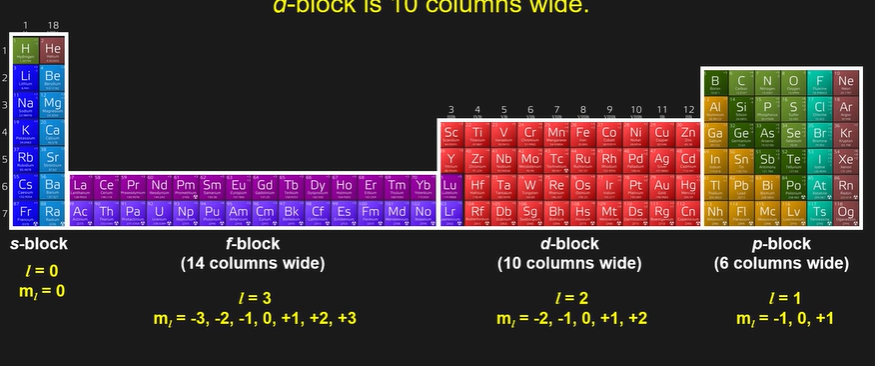
MEMORIZE which elements have what type of orbital
How many electrons fill 1s orbital
2
How many electrons fill 3p orbital
6
how many electrons fill 5d orbital
10
how many electrons fill 7f orbital
14
What are lanthanides
metal elements along Period 6 AND the bottom top period which have lustrous, silvery, high melting point/etc characteristics
What number is the most prominent oxidation state for transition metals
+2
Which groups on the periodic table have s block (orbitals)
Group 1 and 2 (Alkali metal and earth metal)
Which groups on the periodic table have p block (orbitals)
Nonmetals excluding He and H, metalloids, and post transition metals group 13-18
Which groups on the periodic table have d block (orbitals)
transition metals groups 3-12
Which groups on the periodic table have f block (orbitals)
Transition metals Periods 6 and 7 on the bottom most section
What oxidation states do inner transition metals (lanthanides and actinides) have mostly
3+
Where are the actinides on periodic table
Period 7 bottom most on the periodic table below lanthanides
What is the effective nuclear charge equation and what does each component represent
Zeff = Z - S
Z → atomic number (# of protons)
S → # of shielding electrons or inner-shell electrons (EXCLUDING ❌❌VALENCE)
Describe trend of effective nuclear charge (Zeff) on periodic table
increases from left to right across a period and increases moving up a group
Isoelectric series
the same number of electrons (e-) but different number of protons (+)
Monatomic elements
single atom
like Na
Diatomic elements
paired up with another identical atom
How many electrons can the d subshell hold and how many total orbitals are in d subshell
10 electrons, 5 subshells
How to determine Ion Product (IP) contant
write out reaction (reactants → products) and then write out the equation
IP= [product1][product2]
then substitute the concentrations of the two given products stated in the problem but CONVERT into M (so if mM, convert to M)
multiply the two values
this is your IP value
How to determine if a precipitate will form using IP constant
we have to compare ion product constant (IP) value to the given Ksp value in the problem
If IP > Ksp, the rxn is supersaturated and will favor the left side so a PRECIPITATE WILL form
if IP < Ksp, the rxn is not saturated enough, will favor the right side so a Precipitate will NOT form
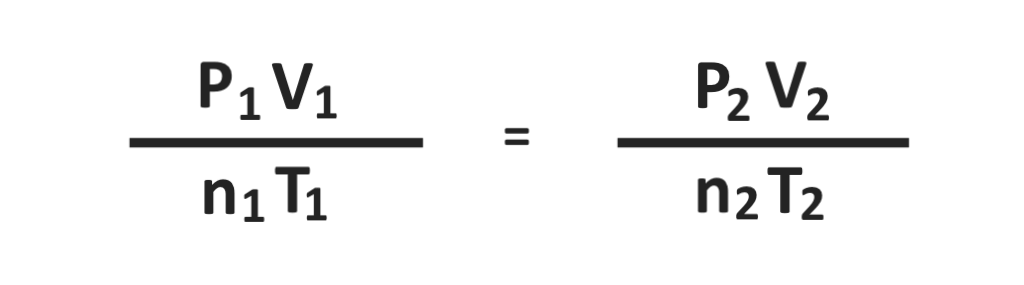
When to use this equation and what unit of T should I use
when the problem states the volume of gas in L,
and pressure usually in atm,
and a temperature in Celsius.
If the problem mentions any of these variables changing like “pressure decreasing without a change in temperature”
T should be converted to Kelvin
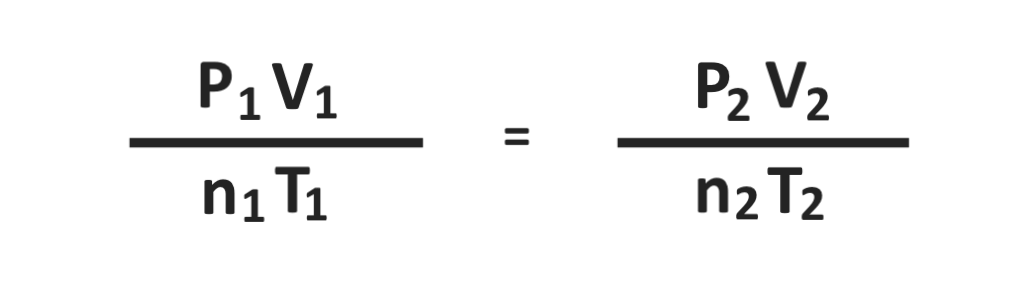
What equation should I use for this problem “A container holds 4.0L of gas at 3.5 atmospheres and a temperature of 27oC. If the pressure is reduced to 0.8 atmospheres without a change in temperature, what would be the volume of the gas?”
How to calculate Kelvin value when given Celsius
Celsius + 273
How to solve for this problem “A NaOH solution has a molarity of 2.00 M and is titrated with 75.0 mL of 0.500 M H2SO4. What volume of NaOH is needed to reach the second equivalence point?”
write chemical rxn and balance it
H2SO4 + 2NaOH → Na2SO4 + 2H2O
find the moles of H2SO4.
find # of moles NaOH is needed to neutralize 1 mol H2SO4 so use the written rxn equation to find this
calculate the volume
linear molecule
bond angles are 180 ex: CO2
trigonal planar
bond angles are set to 120.
ex: BF3
Tetrahedral
four bonds on all 1 central atom. Bond angles are 109.5.
Ex: CH4
Bent/V shape
non linear shape. Angle 105
ex: H2O
common ion effect
if a solution has 2 salts that have same common ion, the common ion supplied by one salt causes this effect that disturbs the solubility equilibrium of the other salt, causing the equilibrium to shift left towards reactants.
According to the following reaction, how many grams of hydrogen gas is formed when 15g of aluminum reacts with excess acid?
2Al + 6HCl → 2AlCl3 + 3H2
use limiting reagent which in this case is Al
convert grams of Al to moles of Al using molar mass
then find out moles of Hydrogen made relative to number of moles of Al in reaction
convert moles of Hydrogen to grams using molar mass
Which of the following pairs are typically found in alkaline buffer solutions?
Weak base and its conjugate acid
Buffers
resist changes in pH when small amounts of acid or base are added
consist of a mixture of either a weak acid and a salt of its conjugate base, or a weak base and a salt of its conjugate acid.
The acidic component of a buffer can neutralize an added base while the basic component of a buffer can neutralize an added acid. This means that large changes in pH will be repressed
What kind of acid/base is found in alkaline solutions (pH > 7)
weak bases and their conjugate acid
what kind of acid/base is found in acidic solutions (pH < 7 )
weak acid and conjugate base
Which of the following is TRUE for a reaction occurring at 25°C that has a positive ΔH value?
the reaction will be spontaneous if ΔH < ΔS. Why? using ΔG = ΔH -TΔS, where if ΔG is exothermic/spontaneous it has to be (-) so ΔH must be negative or overall value of ΔH - ΔS makes (-) value
specific heat equation
q = mcΔT
q = heat gained (+ value) or lost (- value) in Joules (J)
c = specific heat capacity of an object at a given state
(changes depending on whether it's liquid, solid or vapor phase)
m → mass in grams
ΔT = final temperature - initial temperature
Alkaline earth metal properties
Appear shiny, silvery-white
Are somewhat reactive metals🔥
Have high melting and boiling points
Form 2+ cations since they have a valance of 2 electrons in their outer shell
Equivalence point
point in which the added titrant is chemically equivalent to the analyte in the sample.
convert M to moles
Molarity (M) x Volume (L)
Molarity unit (M)
mol/L
vaporization is which type of process?
endothermic
all reactions that break bonds are endothermic.
from liquid to gas, we are breaking bonds and thus require the input of heat (endothermic) to derive the reaction forward.
Le Chatelier’s principle
if a system that is in equilibrium is disturbed by changes in temperature, pressure, and concentration of components, the system will tend to shift its equilibrium position to counteract disturbance effect

Which of the following changes to the system would result in an equilibrium shift towards the reactants?
Increasing the volume of the system
increasing the volume of the system would result in an equilibrium shift towards the reactants because this system involves gas molecules, therefore an increase in the volume is accompanied by a decrease in pressure and concentration.
How to find Partial pressure
multiply total pressure by mole fraction of gas
how to find mole fraction
divide the moles of selected gas by the total mole in a system
bronsted lowry base
proton H+ acceptor
Arrhenius bases
dissociate to form hydroxide (OH-) ions.
Arrhenius acid
dissociate in water, forming proton (H+) ions.
Lewis base
electron pair donors
Lewis acid
electron pair acceptors
Bronsted lowry acid
at donates a proton
Rate law problem solving
compare 2 rates that have same [] for A or B ‘
divide one rate over the other
simplify and solve to find x or y variable
now substitute the new x or y variable found into exponent and solve the other one using two other rates
![<ol><li><p>compare 2 rates that have same [] for A or B ‘</p></li><li><p>divide one rate over the other </p></li><li><p>simplify and solve to find x or y variable </p></li><li><p>now substitute the new x or y variable found into exponent and solve the other one using two other rates </p></li></ol><p></p>](https://assets.knowt.com/user-attachments/c86b8531-2ce4-4668-833e-46d991b88beb.png)
Colligative properties
properties of solutions that depend on the ratio of the number of solute particles to the number of solvent molecules in a solution, and not on the nature of the chemical species present.
ex:
vapor pressure depression 💨💨
boiling point elevation 🔥🔥
freezing point depression 🧊🧊
osmotic pressure 🌊💧
What are the properties of enzymes
biological catalysts which accelerate chemical reactions by providing an alternative route for the reaction with a lower activation energy
catalysts increase the rate constant (k) of a reaction
activation energy is lowered
critical point
A point where the maximum temperature and pressure that allows gas to remain at equilibrium between gaseous and liquid phase
triple point
A point at a given temperature and pressure in which the chemical is present in both the solid, liquid and gaseous phase
Half equivalence point
equal numbers of acid and its conjugate base is present.
Equivalence point
when equal moles of base and acid are present during a titration.
Combustion reaction
hydrocarbon or alcohol react with oxygen and products → are CO2 and H2O
empirical formula
formulas that show only the most reduced whole number ratio of each atom
% composition
find the molecule’s molecular weight and then find the desired atom’s total mass in that 1 molecule and then divide that by the big number (molecule’s mass)
“what is the empirical formula of a compound that is 17.3% H and 82.7% C?
assume 100g of total sample. So 17.3% would be 17.3g. Then divide that number by that element’s atomic mass. Same for carbon. Then divide those numbers by which ever number was smaller. If you get decimal number where you cannot round easily, multiple by whole number
“if we have empirical formula C2H5 how do we find molecular formula if molecular weight is 58.12 amuu?”
divide molecular weight by the weight of my empirical formula. Then multiply each subscript of empirical formula with the answer you just got
% yield
actual/theoretical x 100
how to determine which of the two is limiting reagent
smallest value
hybridization how to find
count number of bonds to that carbon (triple and double bonds count as 1 only) and each lone pair counts as 1
For a triple bond, how many sigma and pi bonds are there
1 sigma bond and 2 pi bonds
rank bond lengths based on hybridization
Bond length increases in the order: sp < sp2 < sp3.
Most stable resonance structure will have what characteristics
smallest # of charges on overall molecule, and negative charges on most electronegative atoms and positive charges on the least electronegative atoms
Radicals
molecules or atoms with unpaired electrons
“greatest resonance contributor” meaning
which resonance structure is most stable
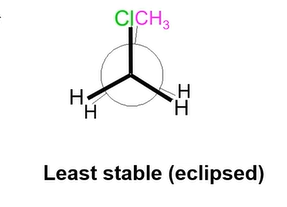
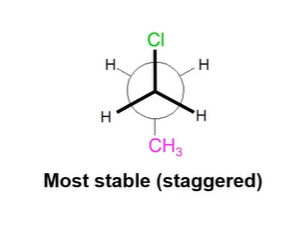
Newman projections: Eclipsed
least stable
Newman projection": staggered
most stable
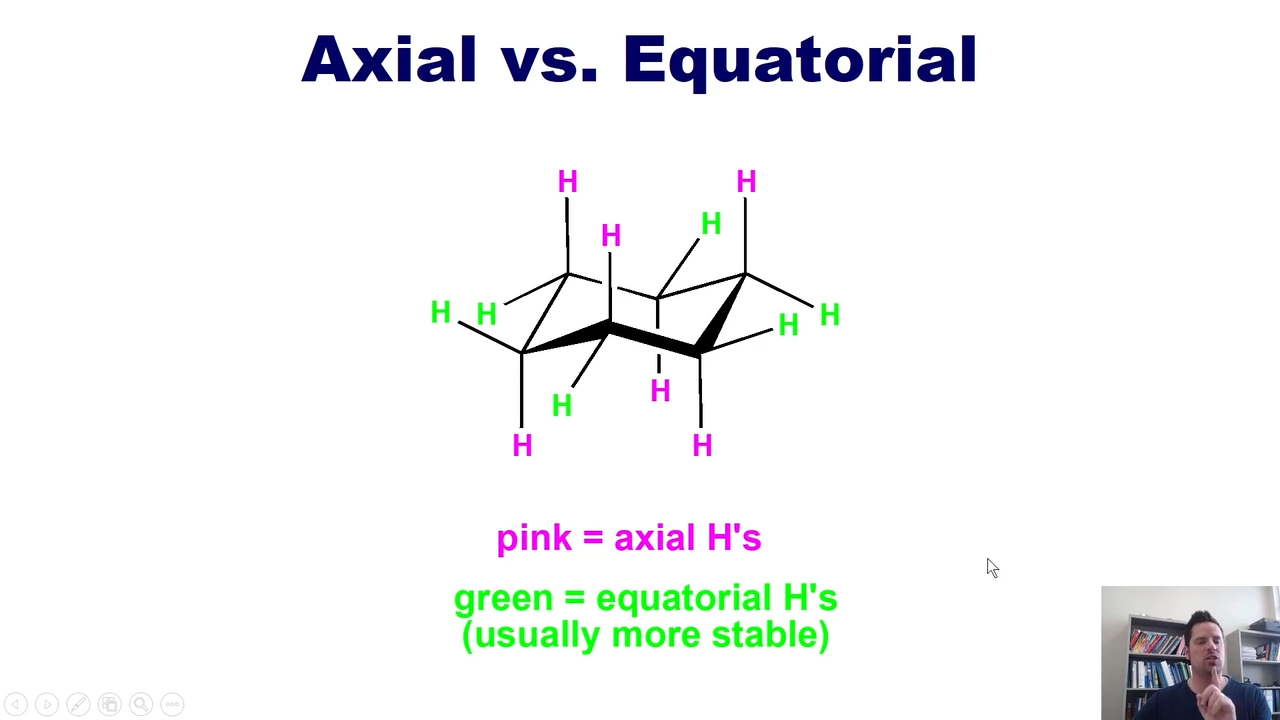
Chair confirmation
mass percent equation

at STP, what is the ratio of moles of ideal gas to liters?
1 mole ideal gas / 22.4L
metal oxide
compounds containing oxygen and at least one metal. An example of a metal oxide is iron oxide, which is a major component of rust that forms when iron reacts with oxygen in the air.
Mole fraction
divide the desired molecule’s moles by the total moles of the entire solution with the desired molecule moles
elements in the same group or column have the same
properties
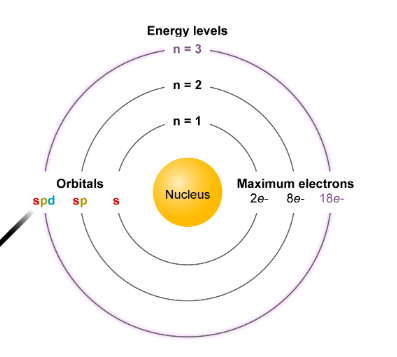
how many electrons are in s subshell
2 electrons
how many electrons are in p subshell
6 electrons
How many electrons are in d subshell
10 electrons
how many electrons are in f subshell
14
How many electrons are in each orbital
2
how many orbitals are in s subshell, p subshell, d subshell, and f subshell
s subshell → 1 orbital
p subshell→ 3 p orbitals
d subshell → 5 d orbitals
f subshell → 7 f orbitals
memorize
memorize
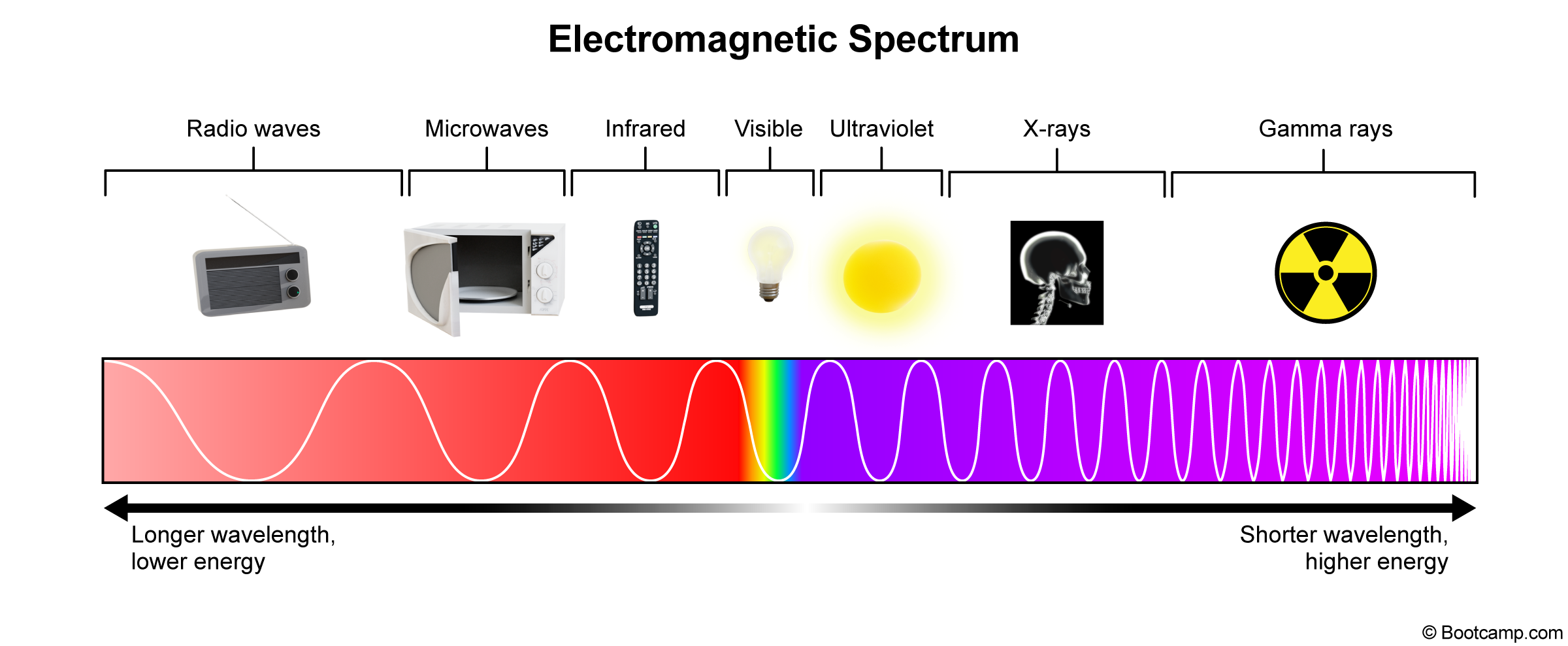
Radio waves (lowest energy) → Microwaves → Infrared → Visible light → Ultraviolet → X-rays → Gamma rays (highest energy)
mnemonic
Roman
Men 👯♂️
Invented
Very
Unusual
X-ray 🩻
Guns 🔫🔫
what are some possible values for quantum number n
1,2,3,4…
what are some possible values for quantum number l
0,1,2,3…n-1 where n is the type of orbital and n value given
s=0;
p=1;
d=2;
f=3
what are some possible values for quantum number ml
-l,…0…+l
what are some possible values for quantum number ms
+/- (1/2)
how to find electron configuration of an element using noble gas
locate desired element and find the noble gas a period above it (precedes it)
then remaining subscripts should add up to remaining electrons
*HOWEVER if the desired element is a cation, electrons have to be removed from the highest energy level first (so from the last letter configuration so if the last letter was 4p, then take away the electrons from this)
What is the order of filling of electron configuration?
1s, 2s, 2p, 3s, 3p, 4s, 3d, 4p, 5s, 4d, 5p, 6s, 4f, 5d, 6p, 7s, 5f, 6d, 7p
then draw out arrows from right to left going down and across
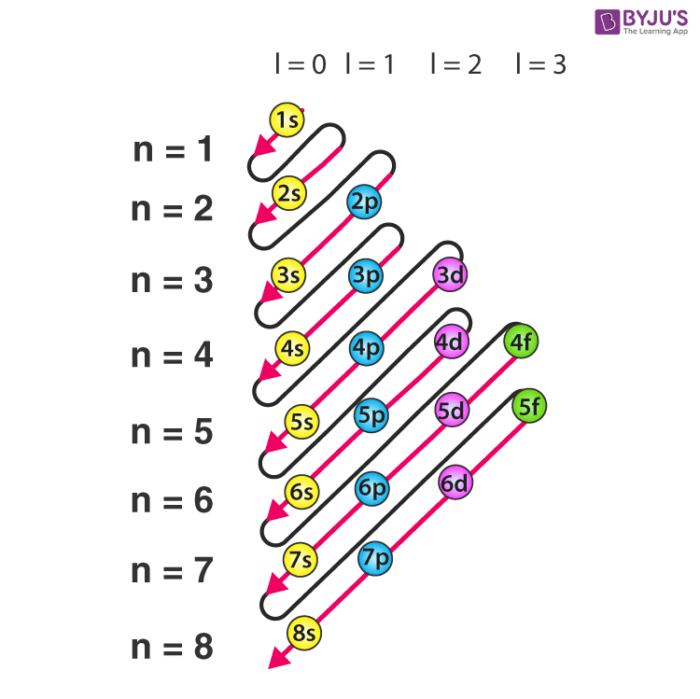
what is Cr electron configuration
[Ar] 4s^1 3d^5
what is Mo electron configuration
[Kr] 5s1 4d1
what is Cu electron configuration
[Ar] 4s1 3d10