ch 12 and 13 study guide draft 2
0.0(0)Studied by 5 people
Build your Mastery score
 Multiple Choice & FRQ
 Call Kai
Card Sorting
1/60

Earn XP
Description and Tags
61 Terms
1
New cards
Renaissance
"the rebirth" of classic antiquity in Italy between 1350 and 1550
2
New cards
esates
divisions of European society based on heredity and quality rather than wealth or economic standing, consists of those who pray (clergy), fight (nobility), workers (everyone else)
3
New cards
individualism
highlighting the unique traits of each human/person
4
New cards
secularism
a characteristic of the Italian Renaissance; focusing on material, worldly, temporal things and less with spiritual and religious things
5
New cards
humanism
intellectual movement in Italy that focused on the study of Greek and Roman Classics
6
New cards
civic humanism
an intellectual movement in the Italian renaissance that shared that humanists should play a role in the government and use their rhetorical training in the service of the state
7
New cards
Neoplatonism
an intellectual movement about the synthesis of Christianity and the ideas of Platonism
8
New cards
hermeticism
an intellectual movement that taught that divinity is embodied in all aspects of nature
9
New cards
pantheism
a statement saying that all things in the universe equates to God
10
New cards
new monarchies
renaissance states; England, France, and Spain; rulers thrived greatly by reestablishing or extending centralized royal authority, suppressing the nobility, controlling the church, and insisting on the loyalty of all peoples living in their territories
11
New cards
nepotism
unqualified family members who were appointed to a certain political position
12
New cards
Petrarch (1304-1374)
the father of Italian renaissance Humanism, first to give thought that the Middle Ages was the dark ages, emphasized use of classic latin and using Cicero as a prose and Virgil for poetry
13
New cards
Charles VII of France (1422-1461)
est. royal army (cavalry and archers), granted the right by the estates general to levy the Taille, taxation on land or property
14
New cards
King Louis XI, the spider king (1461-1483)
made the taille permanent taxation leading to a regular source of income, not successful in overpowering the French nobility, created a base for the development of a strong monarchy
15
New cards
Differences between art from the Middle Ages and Renaissance art
Renaissance Art focused more on naturalism, individualism, and humans, includes lots of geometric perspective, persuading the audience of the reality of the object or event, includes complex movement
Medieval art did not include perspectives, not realistic, stiff, and not as vibrant colors
Medieval art did not include perspectives, not realistic, stiff, and not as vibrant colors
16
New cards
three factors that led to economic recovery during the late fifteenth century
Increased trade, Woolen Industries, and Banking
17
New cards
Black Death, Hundred Years' war, the great schism
What was the Renaissance an "age of recovery" from?
18
New cards
Machiavelli's political philosophy vs Erasmus (Christian humanist)
Machiavelli focused on the fact that a great leader should be feared more rather than loved and Erasmus focused on Christian Morals
19
New cards
importance of the invention of the printing press
helped express and spread the ideas of scholars, intellectuals, writers efficiently so they could become standardized
20
New cards
confession
one of the seven sacraments of the Catholic church, it provided for the forgiveness of one's sins
21
New cards
Catholic Reformation
the movement for the reform of the Catholic Church in the 16th century; Council of Trent (1547) reaffirmed Catholic doctrine and beliefs, the Index of Forbidden books was established, stopped abusing indulgences but maintained the practices, the Jesuits (Society of Jesus) helped the sick and poor and provided education, the Roman Inquisition was established in 1542 to combat Protestantism (in their eyes, heresy)
22
New cards
justification
the primary doctrine of the Protestant Reformation, teaching that humans are not saved through good works but by the grace of God, bestowed freely through the sacrifice of Jesus (sola fide)
23
New cards
Huguenots
french calvinists
24
New cards
transubstantiation
a doctrine of the Roman Catholic Church that during the Eucharist, the substance of the bread and wine is miraculously transferred into the body and blood of Jesus
25
New cards
politiques
a group that emerged during the French Wars of Religion, they placed politics over religion and believed that no religious truth was worth the ravages of the civil war
26
New cards
millenarianism
the belief that the end of the world is at hand and the kingdom of God is about to be established on Earth
27
New cards
Puritans
English Protestants inspired by Calvinist theology who wished to remove all traces of Catholicism from the church of England; no songs, paintings, no distractions and wanted white walls; "pure"
28
New cards
predestination
the belief, associated with Calvinism, that God as a consequence of his foreknowledge of all events, has predetermined those who be saved (the elect and those who will be damned; God chose a "predestined" path for you and has chosen your fate
29
New cards
pluralism
the practice of holding several church offices simultaneously; a problem of the late medieval church
30
New cards
Christian Humanism
main goal was the REFORM OF CHRISTIANITY; an intellectual movement in northern Europe that combined interests in the classics of the Italian Renaissance with an interest in the sources of early Christianity, including the New Testament and the writings of church fathers
31
New cards
Habsburg-Valois Wars
a rivalry between France (Francis I) and the Holy Roman empire (Charles V), fighting because of disputes over territories
32
New cards
Catholic practices
selling indulgences for money to go onto salvation, confession, baptism, the seven sacraments
33
New cards
Luther's Core Practices
faith and faith alone, the sole authority was the bible
34
New cards
political conflicts during the Reformation
Peasant's War
35
New cards
Diet of Worms (1521)
after Emporer Charles V was angry that Luther did not recant his beliefs, this made Martin Luther an outlaw in the empire, burned his works and captured Martin Luther, led to start of Lutheeranism
36
New cards
English Reformation
Henry VIII broke away from the Catholic Church to get a divorce and eventually a male heir.
Beliefs and practices remained largely the same as the Catholic Church, only difference was who is the head of the church. (Act of Supremacy -1534)
Henry VIII wrote The Defense of the Seven Sacraments in response to Luther.
Confiscated Catholic land and property as a result of the Act of Supremacy.
Church of England moved towards protestantism following Henry VIII’s death.
37
New cards
Eucharist: Zwingli vs Luther
Zwingli: interpreted figuratively and spiritually
Luther: interpreted literally
Luther: interpreted literally
38
New cards
Saint Bartholomew's Day Massacre
Guise family convinced Catherine de Medici that a gathering of Huguenots was a threat, Convinced her son to get rid of Huguenots, 20000 Protestants were killed by Catholics
39
New cards
Spanish Armada of 1588
started with the revolt of the Netherlands where Philip II wanted to inherit his father's territories and advocate for Catholicism, so he tried to gain control of Netherlands and crush Calvinism, he upset the Calvinists who then rebelled and received support from Elizabeth of England (sent armies to help fight), Philip II sent out the Spanish Armada to deal with the power of Elizabeth and take over England, but they never made it so they failed
40
New cards
Peace of Augsburg 1555
end of religious war fares; formally acknowledged division of Christianity with Lutheranism granted equal legal standing with Catholicism
41
New cards
Machiavelli's the Prince
how to be a leader and do what ever is necessary to be an effective leader
42
New cards
themes of humanism
classic antiquity, secularism, individualism, nepotism, pantheism, naturalism, idealism, hermeticism
43
New cards
Council of Trent
apart of the Catholic/ Counter Reformation, reaffirmed the Catholic doctrine and they stood by their beliefs, established Roman inquisition, to fight against Protestantism (heresy)
44
New cards
Charles V of the Holy Roman Empire
Politically: wanted to maintain his dynasty's control over his enormous empire
Religiously: hoped to preserve the unity of the Catholic faith throughout his empire
he spent a lifetime accomplishing his goals, dealt with four problems: French, papacy, Turk's, and Germany's internal situation
Religiously: hoped to preserve the unity of the Catholic faith throughout his empire
he spent a lifetime accomplishing his goals, dealt with four problems: French, papacy, Turk's, and Germany's internal situation
45
New cards
Martin Luther
destroyed religious unity of the western Christendom, entered a monastic order of Augustinian Hermits, in Erfurt, Major concern = assurance of salvation; believed humans are saved through faith in the promises of God
46
New cards
John Calvin
ideas were similar to Lutheranism, he emphasized predestination, the absolute sovereignty of God (absolute power), Calvinism ideas became main Protestant idea/religion after Peace of Augsburg 1555
47
New cards
Henry VIII of England
requested annulment from Pope Clement VII who refused, went against Catholic Church and made himself head of the English Church, had six wives, killed them because they didn't meet his needs of producing a male heir
48
New cards
Isabella of Castile and Ferdinand of Aragon
they wanted religious unity to gain centralized authority, Inquisition (1478), they drove out Jews (1492) and Muslims (1502)
49
New cards
Erasmus (Christian humanist)
most influential Christian Humanist, formed and popularized the reform program of Christian Humanism, wrote The Priase of Folly (1509)
50
New cards
Thomas More (Christian humanist)
strong believer of civic humanism, known as a model of Christian Family life by his contemporaries, wrote the Utopia (1516):idealistic life and institutions, refused to acknowledge King Henry VIII as head of the Church of England->death
51
New cards
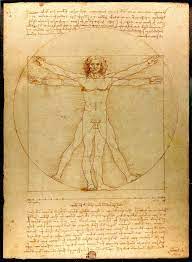
Vitruvian Man, Leonardo da Vinci, 1490
Characteristics of Art:
- Classicism: focusing on the classics of ancient Greece and Rome
- geometry
- factors that led to the Renaissance starting in the Italian peninsula (trade location, birthplace of classic antiquity)
- Classicism: focusing on the classics of ancient Greece and Rome
- geometry
- factors that led to the Renaissance starting in the Italian peninsula (trade location, birthplace of classic antiquity)
52
New cards
“Council of Trouble”
Etching depicting the Dutch William Duke of Orange (right) and the Spanish Duke of Alva (left) who has come with his “Council of Troubles” to the rule the Netherlands for Philip II of Spain, 1573; Catholic unity, Challenges to monarchical authority
53
New cards
95 theses
Luther's explanation of the abuse of church in selling indulgences, his reaction to Pope Leo X selling to support financially; nailed to church door or sent to superior; translated and spread
54
New cards
Lutheranism
Salvation by faith and faith alone.
Bible was the ultimate authority.
95 Theses (1517) called out Catholic Church corruption and sale of indulgences.
Address to the Nobility of the German Nation (1520) - called on German princes to overthrow “Roman tyranny” a.k.a. - the Catholic Church.
The Babylonian Captivity of the Church - attacked the seven sacraments.
1521 - Diet of Worms (Luther refused to recant and officially broke with the Church.
1555 - Peace of Augsburg ended the Schmalkaldic Wars and allowed German Princes to choose between Lutheranism and Catholicism.
55
New cards
Zwinglianism
Founded by Ulrich Zwingli in the Swiss Cantons.
Influenced by Luther’s 95 Theses
Agreed with Luther on almost everything but disagreed on the interpretation of the Eucharist. (Zwingli had a more figurative interpretation)
Got rid of all art, music, and dancing during church services. Focused on the Bible only.
Was injured, captured and killed in a war against Catholics in the Swiss Cantons.
56
New cards
calvinism
Founded by John Calvin (born in France but lived in Geneva, Switzerland)
Main ideas found in Institutes of the Christian Religion
Believed in predestination (people were either saved or damned at birth). Only a select few were saved.
Calvinism spread from Geneva to southern France (Huguenots), the Spanish Netherlands, and Scotland leading to the French Wars of Religion and the Dutch Revolt.
English Calvinists became known as Puritans and eventually fled England to Holland and the Americas.
57
New cards
Anabaptism
believed in adult baptism (people should not be forced into religion)
consisted of different types of anabaptists
viewed as radical by both Catholics and Protestants.
believed in separation of church and state
consisted of different types of anabaptists
viewed as radical by both Catholics and Protestants.
believed in separation of church and state
58
New cards
Schmalkadic League
An alliance of Protestant German states; fearful of Charles V's intentions after Peace of Augsburg, they created this defensive alliance. Vowed to assist each other when attacked.
59
New cards
Martin Luther, An Open Letter to The Christian Nobility of the German Nation Concerning the Reform of the Christian Estate, 1520
-abuses within the Catholic Church
-printing press + public sermons/debate = spread of ideas
-conflict between monarchs and nobles
-printing press + public sermons/debate = spread of ideas
-conflict between monarchs and nobles
60
New cards
Letter from Lorenzo de Medici to Pope Innocent VIII, 1489
-Machiavelli’s relationship with the Medici family and The Prince
-The “Renaissance Popes”: economic and political power
-The “Renaissance Popes”: economic and political power
61
New cards
Henry IV, The Edict of Nantes, 1598
-Edict of Nantes was a response to what the French Wars of Religion
-religious tolerance
-How did Henry IV’s policies compared to Elizabeth I’s
-religious tolerance
-How did Henry IV’s policies compared to Elizabeth I’s