Max prices analysis + Evaluation (in markets)
 Call Kai
 Learn
Learn Practice Test
 Spaced Repetition
 Match
Match Flashcards
 Knowt Play
1/4

There's no tags or description
Looks like no tags are added yet.
Name | Mastery | Learn | Test | Matching | Spaced | Call with Kai |
|---|
No analytics yet
Send a link to your students to track their progress
5 Terms
Max prices
A maximum price occurs when a government sets a legal limit on the price of a good or service – with the aim of reducing prices below the market equilibrium price
Diagram for max prices
If suppliers only produced at Q3, some consumers would be willing to pay P2. The shaded area shows the consumer surplus that can be produced with the higher price
A quantity of Q3 would require or auctioning since the quantity demanded is Q2
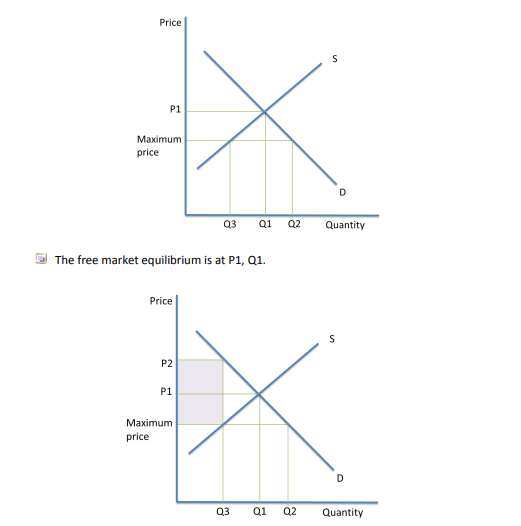
Maximum price analysis
This restricts the highest price sellers can charge, aiming to improve consumer welfare and increase market output
This means that collusive oligopoly firms are unable to maintain high collusive prices, forcing them to compete on price which often causes the collusion to collapse
This leads to an increase in consumer surplus as firms are forced to charge lower prices, this may lead to an increase the allocative efficiency as the price is closer to marginal costs
Productive efficiency has the potential to increase as lower revenue may lead to firms cutting costs and becoming more efficient to maintain profit margins
maximum prices Evaluation
Maximum prices can lead to significant shortages, particularly in collusive oligopolies where firms already have an incentive to restrict output. When a price ceiling is set below the equilibrium price, quantity demanded exceeds quantity supplied, creating excess demand in the market.
Qd>Qs
Firms in an oligopoly may respond strategically by reducing supply further, as the lower price reduces profitability. Since these firms are already coordinating to maximise joint profits, the price cap may reinforce their incentive to limit output rather than increase it. As a result, consumers may face not only lower prices but also reduced availability of goods, leading to non-price rationing such as queues or declining product quality.
This can be considered a form of government failure, where intervention leads to a net welfare loss. Governments may lack accurate information about firms’ cost structures, leading to a price being set too low and worsening shortages. Additionally, enforcement is difficult in oligopolistic markets, as firms may comply with the price cap while manipulating supply or engaging in tacit collusion. Administrative and monitoring costs further reduce the effectiveness of the policy, and unintended consequences such as black markets or firm exit may arise.
However, the extent of this limitation depends on how the policy is implemented. If the maximum price is set close to the equilibrium level and supported by effective regulation, shortages may be limited and consumer welfare could improve. Furthermore, in cases where firms were previously charging excessively high prices, the policy may still increase allocative efficiency. Therefore, while shortages and government failure are significant limitations, their impact depends on the accuracy of the policy and the ability of regulators to enforce it effectively.
Application (Tuition caps)
In the United Kingdom, undergraduate tuition fees are capped at £9,250, acting as a maximum price in a market with oligopolistic characteristics. While this aims to improve access, universities may respond by limiting places or increasing recruitment of higher-paying international students, leading to potential shortages and demonstrating government failure