L6- Cellular senescence, apoptosis & maintaining genome stability I
 Call Kai
 Learn
Learn Practice Test
 Spaced Repetition
 Match
Match Flashcards
 Knowt Play
1/27

There's no tags or description
Looks like no tags are added yet.
Name | Mastery | Learn | Test | Matching | Spaced | Call with Kai |
|---|
No analytics yet
Send a link to your students to track their progress
28 Terms
what are the barriers replicative immortality
senescence- non proliferative, viable state
crisis- cell death
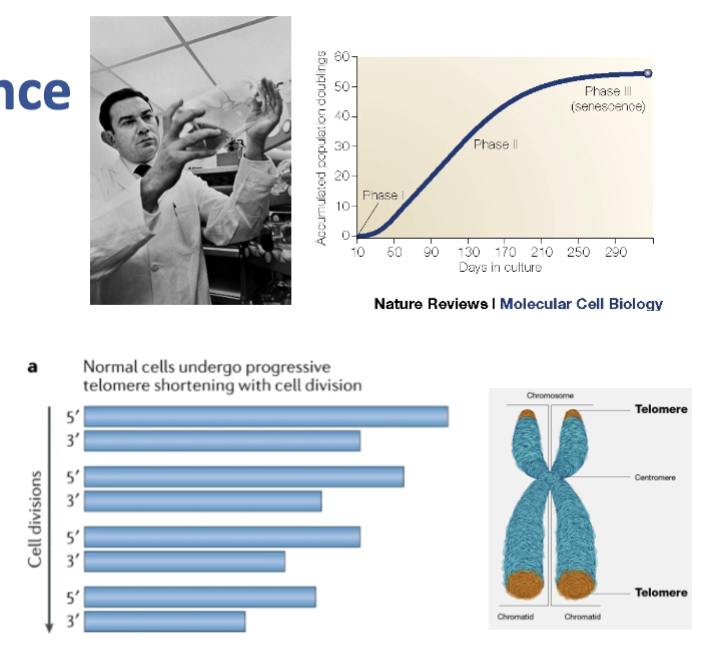
what is the Hayflick limit
Leonard Hayflick - normal human cells in culture have limited capacity to divide, after which they become senescent
• Phenomenon now known as the ‘Hayflick limit’
• State of permanent cell cycle exit, not proliferating but viable
• Associated with morphological, metabolic and biochemical changes (pathway changed)
• Potent anti-cancer mechanism (together with apoptosis)
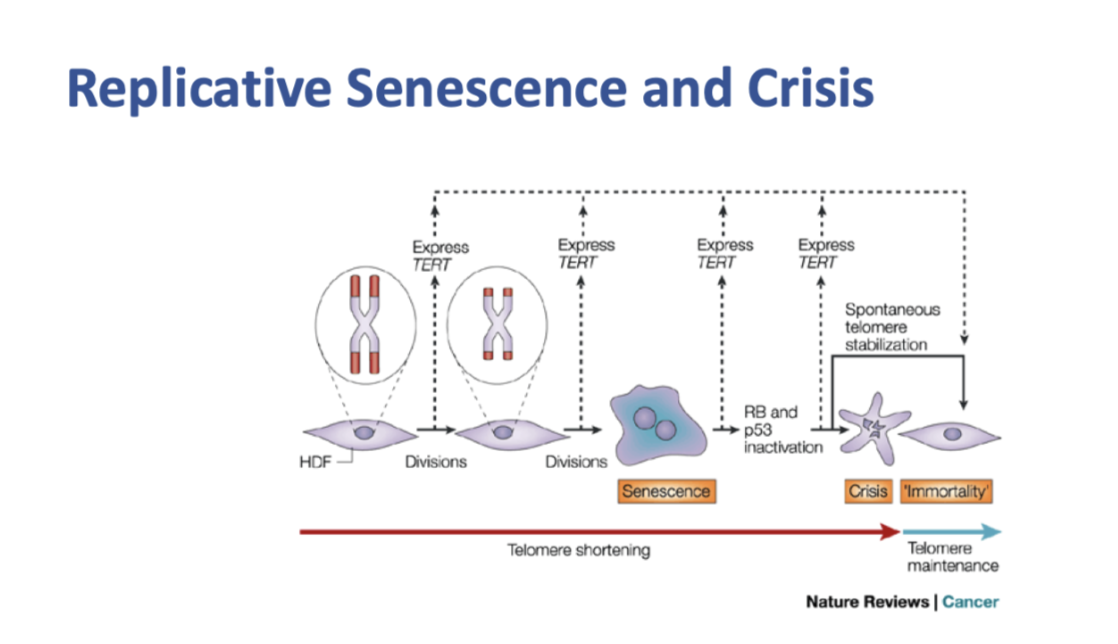
• Replicative senescence is linked to telomere erosion
what is a passage in cell culture
Passage- when you split the cells
Stop growing at phase II
Discovered process of senescence
Limit where cell stops proliferating- Hayflick's limit
Irreversible no matter how many nutrients given
Cells seen as very large and very flat
Various conditions that stress a cell and cause the cell to enter
Eg oncogene, chemo
what are telomeres
Telomere (Greek word telos “an end”)
• Essential for maintaining genetic integrity
• Specialised DNA-protein structures (“protective caps”) that protect the linear ends of chromosomes from being recognised as damaged DNA
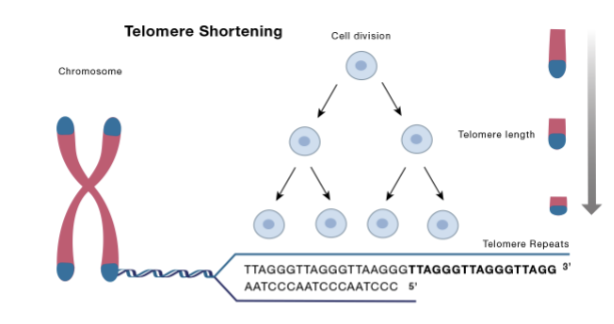
• Comprised of thousands of copies of tandem repetitive hexanucleotide sequence 5’ –TTAGGG – 3’
• Protein complex - Shelterin
what is the function of telomeres
To protect DNA- maintain genomic integrity and stability
Hexanucleotide repeats
With each cycle of replication- get shorter
Eventually get so short to trigger replicative senescence
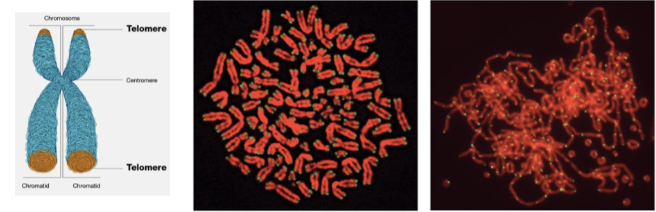
what happens to telomeres when a component of the shelterin complex is knocked out
Knockout of key component of shelterin protein complex
Dysfunction where chromosomes no longer stable, start to fuse together
what are the different features of telomeric DNA
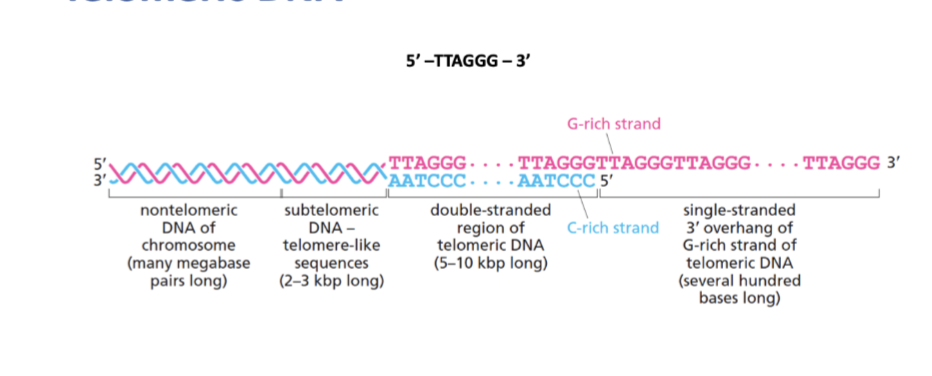
non telomeric DNA of chromosome (many megabase pairs long)
subtelomeric DNA- telomeric like sequences (2-3 kbp long)
double-stranded region of telomeric DNA (5-10 kbp long)
single stranded 3’ overhang of G rich strand of telomeric DNA (several hundred bases long)
what is the function of the T loop
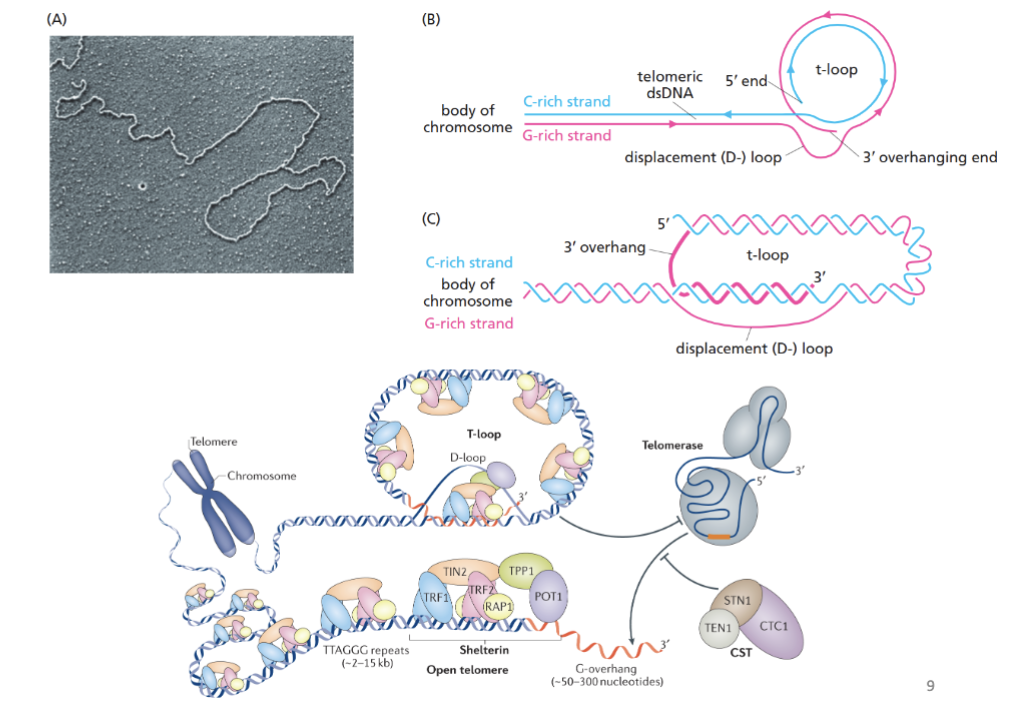
To protect free DNA- g rich strand loops around and tucks its end back in to form complementary pairing with c strand
In doing so displaces a portion of G strand DNA to make a D loop
Forms loop that hides free ends of DNA from damaging agents
what proteins make up telomeres
Telomeres also made of protein
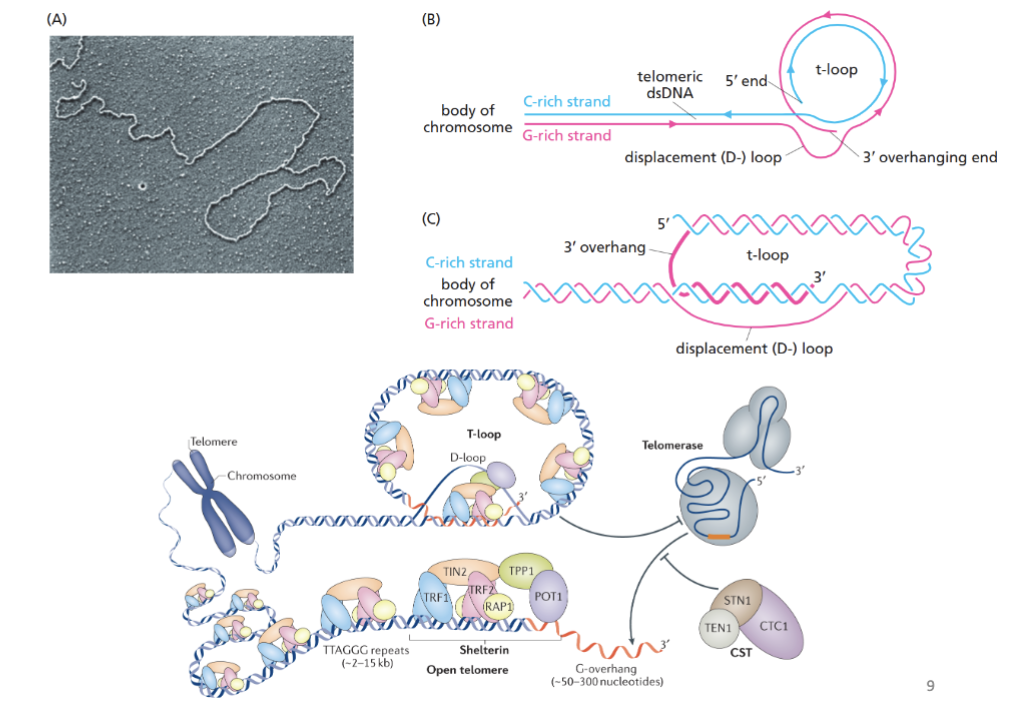
shelterin- 6 member protein complex that binds to telomeric repeats and help to stabilise T loop, so ends stay protected
Loops needed for shelterin to bind and protect structure
what proteins make up shelterin
6 member complex
RAP1
telomeric binding factor 1 (TRF1)
TRF2
TERF1- interacting nuclear factor 2 (TIN2)
TPP1
protection of telomeres protein 1 (POT1)
what does Shelterin do
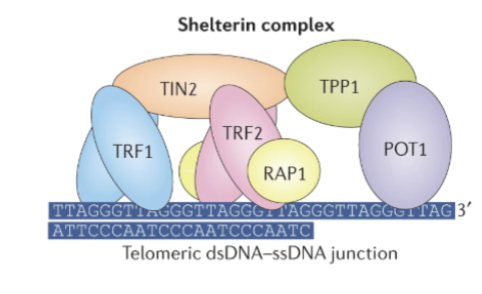
Engages both double-stranded DNA (dsDNA) and single- stranded DNA (ssDNA) regions of a telomere.
POT1 binds telomeric ssDNA.
RAP1 binds at junction between ss and ds DNA
TRF1 and TRF2 are protein homodimers that bind telomeric dsDNA
Prevents telomeres being recognised as damaged DNA- may cause DNA to bind together to be repaired
what is the end replication problem
the shortening of telomeres
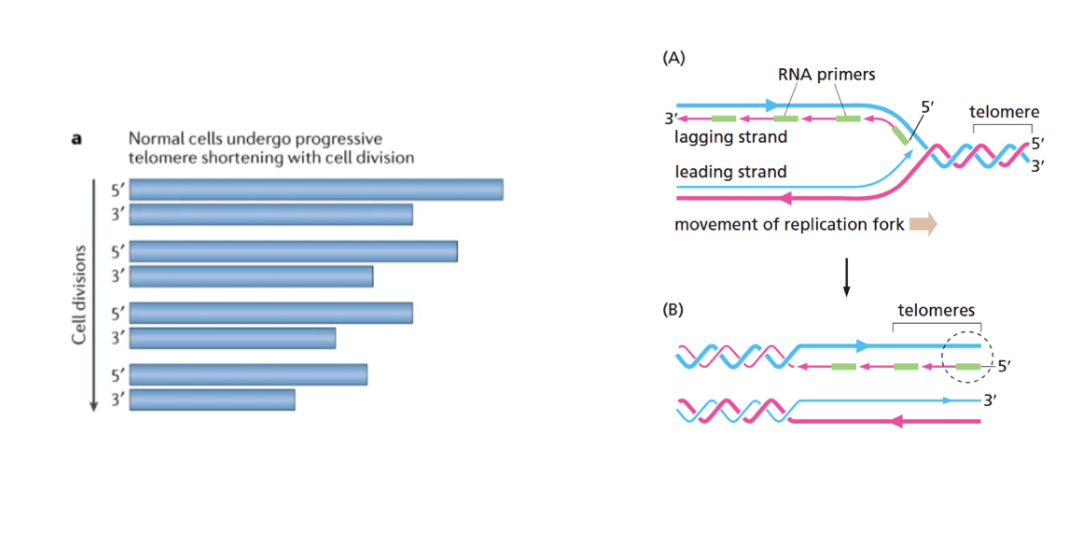
what happens due the end replication problem
Due to end replication problem
in replication- lagging strand has rna primers that ultimately need to be removed
Always have an area where the primer has been bound and hasn’t been replicated-
If primer bound right at end of telomeric sequence- sequence is very similar, if primer didn’t prime right at end- the region it hasn’t primed will be lost
To maintain overhand- exonucleases cleave that so loop can be made- also shortens
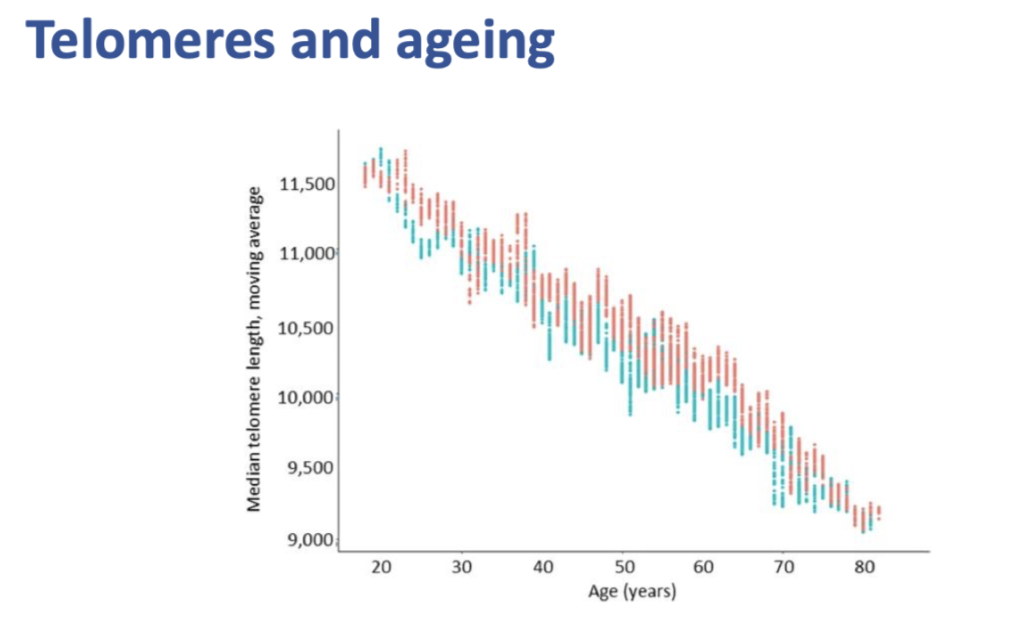
what happens to telomeres with age
Increasing age is a risk factor to developing cancer- telomere shortening may be a factor
why do cells enter senescence
At some point in cell some chromosomes become so short that they enter senescence
Not all chromosomes shorten at the same time
Takes 1 or 2 chromosomes to start activating senescence
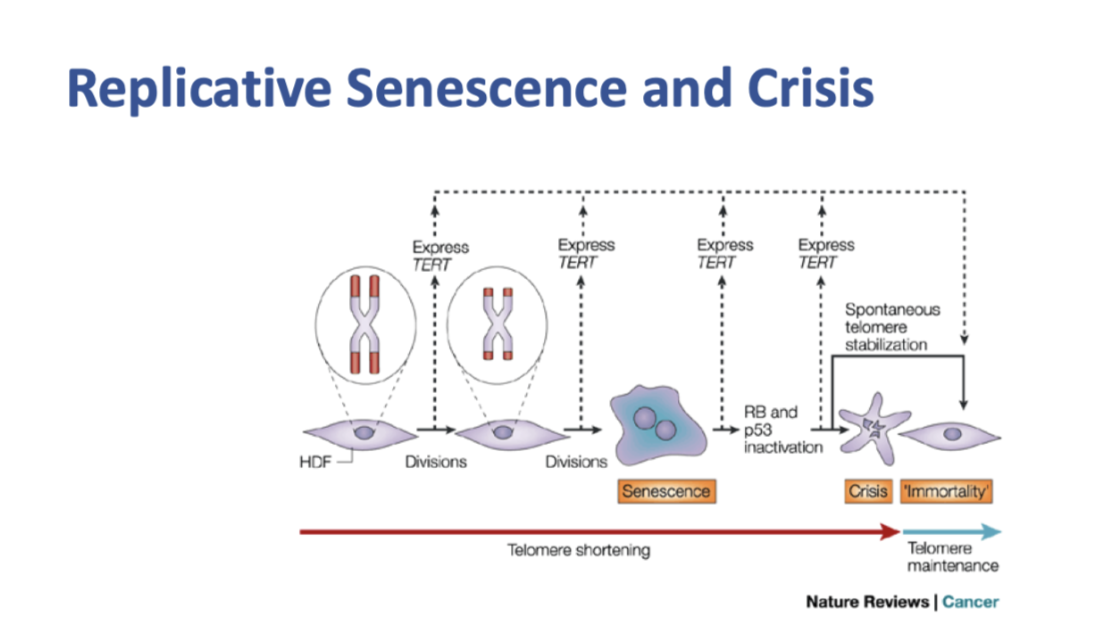
what do cells do if they avoid senescence
If avoid senescence, they get critically short so no longer protect chromosome- through repair mechanisms, get joining of chromosomes (or cell death)
This is the 2nd barrier in most cases
This is recognised and in most cases causes cell death to prevent carcinogenesis
However if cell is able to activate telomerase it can re stabilise the cell
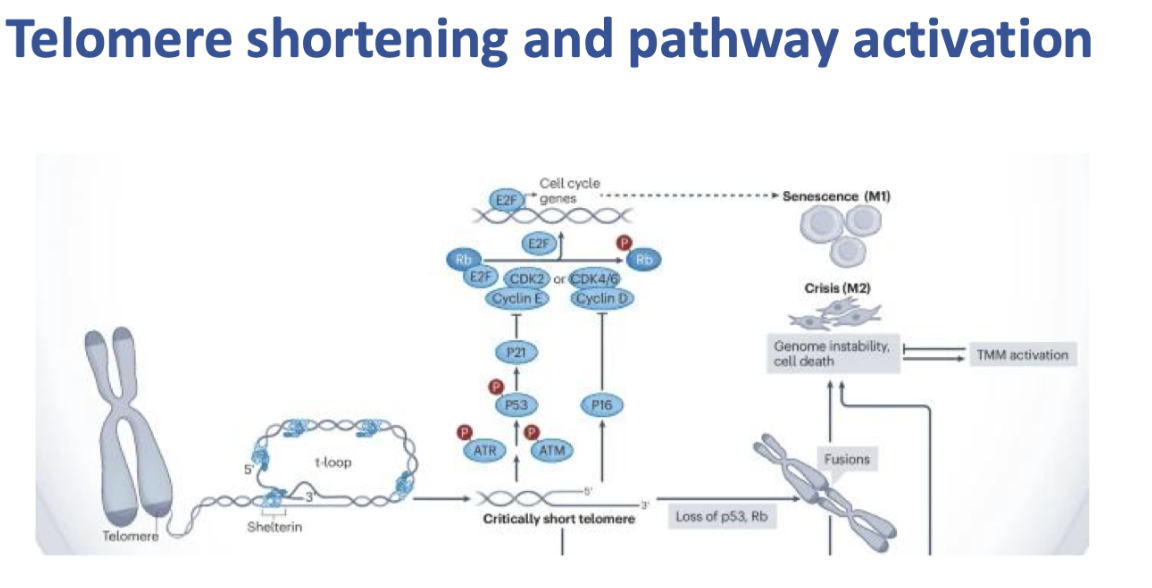
what is the senescence activation pathway (when telomeres are too short)
When telomeres become critically short, Shelterin can no longer protect them effectively.
Short telomeres activate DNA damage response pathways.
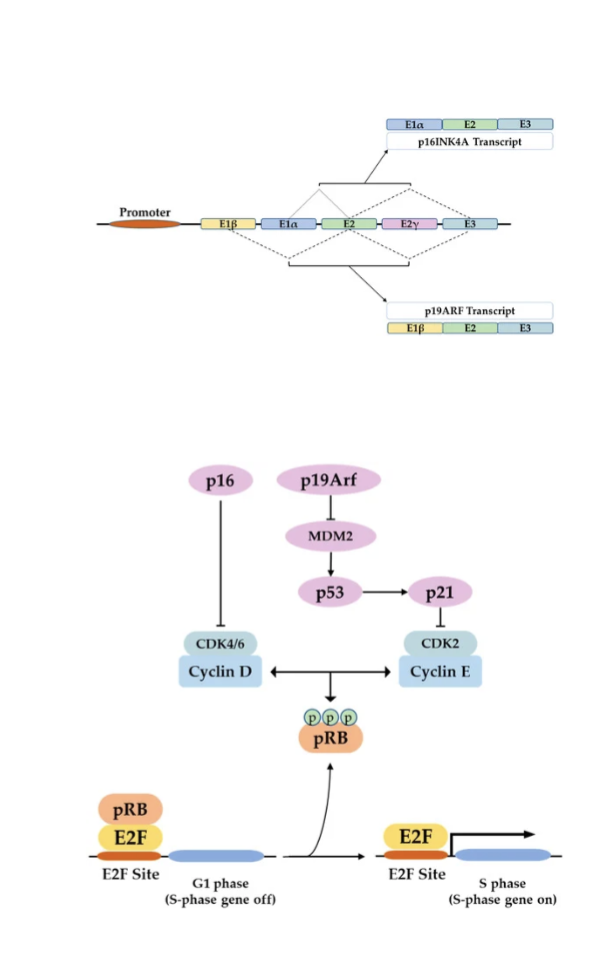
p53 is activated, which activates p21 and causes cell-cycle arrest.
p16 is also activated.
p16 inhibits cyclin D/E-CDK activity, keeping Retinoblastoma protein active.
Active Rb binds E2F and prevents progression through the cell cycle.
Result: permanent cell-cycle arrest (senescence).
what happens f the senescence activation pathway is bypassed
If bypassed- through loss of p53 or Rb, common in cancer, escape senescence- telomeric DNA critically short, enter crisis to avoid instability
Need to stabilise- they ay develop this mechanism before catastrophic
what is the breakage-fusion-bridge (BFB) cycle
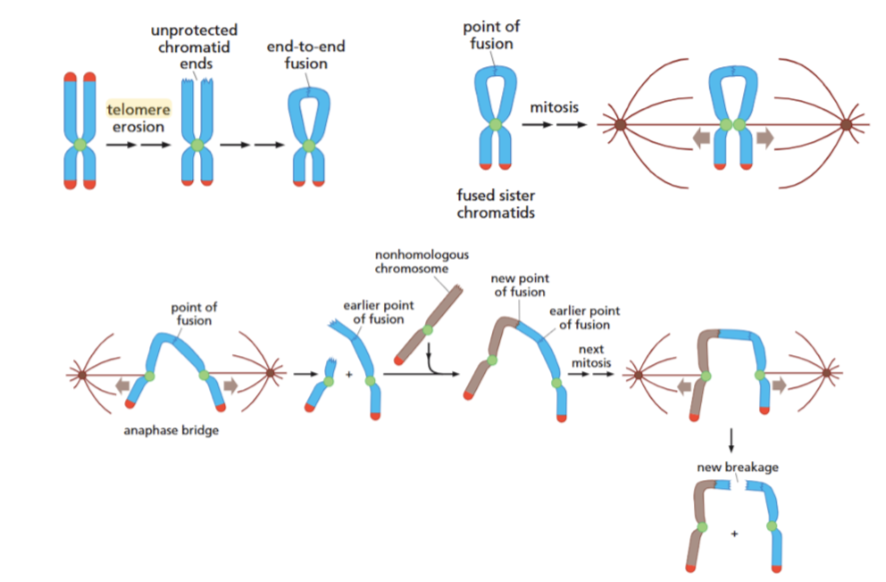
During crisis- repeated cycles of BFB event
all chromosomes have different telomere length
Sister chromatids usually the same length
Free ends of DNA join together making a fused chromosome
When pulled apart in mitosis- leads to chromosome snapping at a weak point
One slightly smaller and one larger chromosome
Doesn’t always happen in sister chromatids can be in any chromosome
Cycle repeats itself
what does telomere maintenance mechanisms allow for
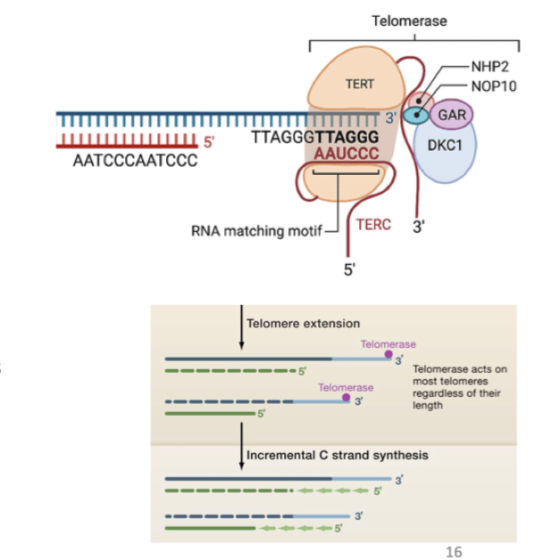
Allow telomeres to be extended- doesn't occur in normal cells, upregulated in lots of cancers
TMM must be developed by cancer cells if they want to be replicative immortal
what are the 2 telomere maintenance mechanisms (TMM)
increased telomerase expression; ~85-90% of cancers
Alternative Lengthening of Telomeres (ALT) ~10-15%
describe increased telomerase expression (a TMM)
increased telomerase expression; ~85-90% of cancers
Ribonucleoprotein complex
Catalytic subunit hTERT - enzyme telomerase reverse transcriptase
RNA subunit – provides template hexameric repeats- Non-coding human telomerase RNA (hTR)
Expression highest in in stem cells, progenitor cells, germ cells and very low or absent in normal somatic cells
describe Alternative Lengthening of Telomeres (ALT) (a TMM)
Alternative Lengthening of Telomeres (ALT) ~10-15%
Telomerase-independent telomere maintenance mechanism
Recombination mediated synthesis
Phenotypic characteristics: C-circles and ALT-associated promyelocytic leukaemia nuclear bodies
Associated with mutations of ATRX and DAXX (death domain-associated protein) – complex partner of ATRX (chromatin remodelling members)
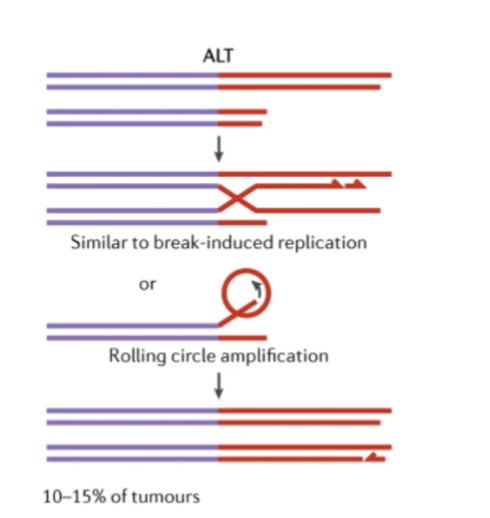
which TMM occurs in cells that dont express telomerase
ALT
in small amount of cancer cells - most common in mesenchymal origin cancer cells
Similar to recombination mediated synthesis
Telomere template from a different cell used for elongation
Diff to telomerase as these templates are thousand of base pairs linger
what are HeLa cells
Generated from Henrietta lacks
Fist immortal cell lines in culture
Can get hTERT-immortalised cells for research to avoid Hayflick limit issue
what are the 5 inducers of cellular senescence
oxidative stress
telomere dysfunction
oncogene activation
DNA damage
inflammation
describe oncogene induced senescence
Key concept
When cells overexpress oncogenes- can lead to sate of oncogene induced senescence
Senescence is a barrier to
Via p16 and p14- lead to oncogene induced senescence as a barrier of carcinogenesis
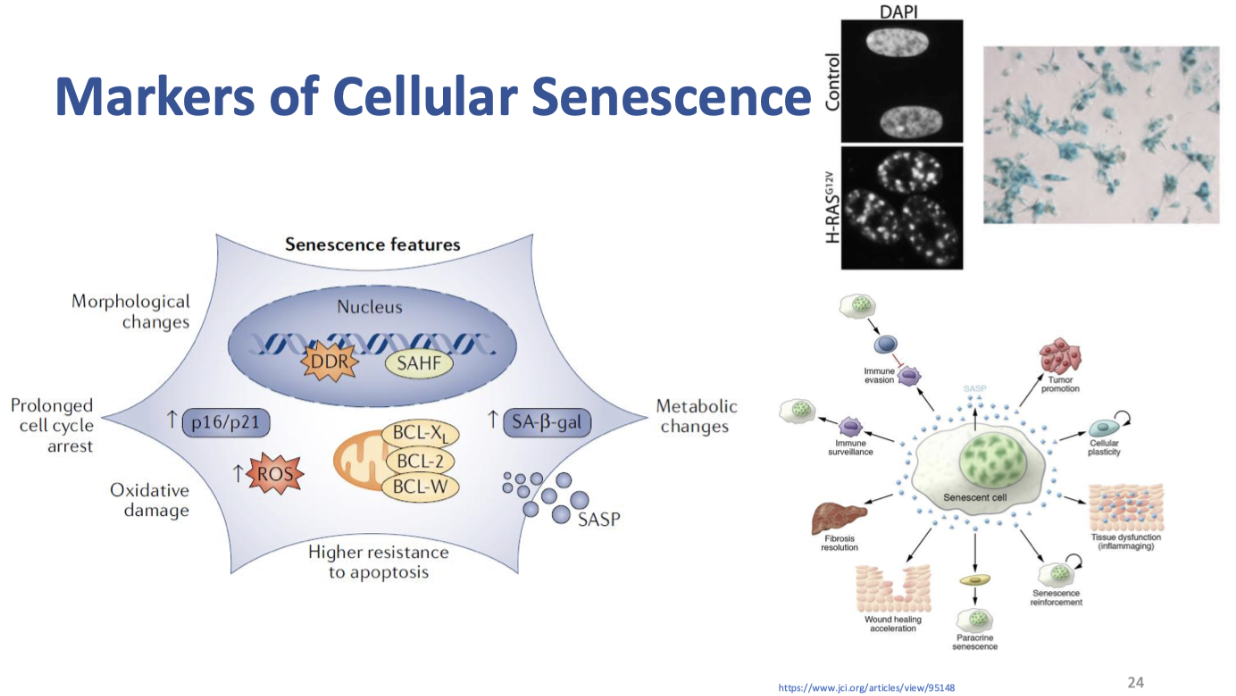
what are the markers of cellular senescence
Flat, spread out and large
Can use beta galactosidase- stained blue as a marker
Look for upregulation of biochemical markers like p16
Look for downregulation of apoptotic markers