hearing/ear
 Call Kai
 Learn
Learn Practice Test
 Spaced Repetition
 Match
Match Flashcards
 Knowt Play
1/16

There's no tags or description
Looks like no tags are added yet.
Name | Mastery | Learn | Test | Matching | Spaced | Call with Kai |
|---|
No analytics yet
Send a link to your students to track their progress
17 Terms

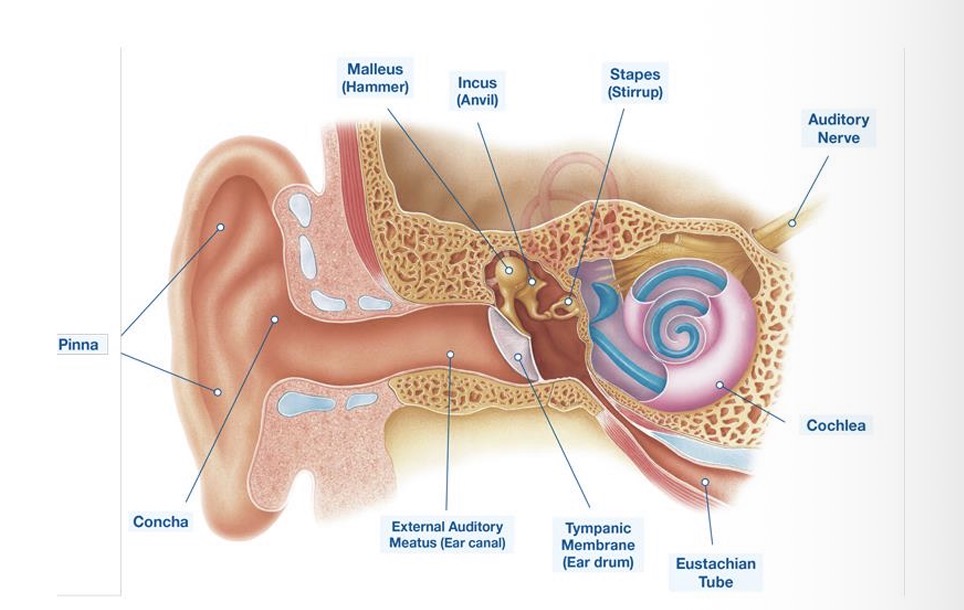
Parts of the ear
pinna/outer ear
Eardrum
Hammer/stirrup/anvil
Eustachian tube
Cochlea
Pinna/outer ear:
exterior of the ear
Eardrum:
vibrates when sound waves hit it, separates outer ear from middle and inner ear
Hammer/stirrup/anvil:
Amplify the vibration from the eardrum
Eustachian tube:
equalizes the pressure between the air outside the ear and in the air in the middle ear
Cochlea:
has tons of tiny hairs, converts vibrations into electrical signals
Pitch (frequency of a sound wave):
how high or low the sound is
Loudness/volume (amplitude of a sound wave):
Loudness/volume (amplitude of a sound wave): how loud or soft the sound is
Theories on How We Hear
place theory
Frequency
Theory
Volley theory
Place theory:
the brain perceives pitch based on the location of vibration in the cochlea
Frequency theory:
the brain perceives pitch based on the number of signals sent to the brain per second
Volley theory:
Volley theory: the brain perceives pitch by firing neural impulses at slightly different times to create a greater frequency of messages to the brain (works to perceive high pitched noises)
Sound localization
helps us determine where a sound is coming from, easiest when the sound is directly to our left or right
Conductive hearing loss
sound waves are blocked from reaching the inner ear, hearing aids are a solution
Sensorineural hearing loss
damage inside the inner ear, cochlear implant is a solution
McGurk effect
if you hear someone saying something but see their mouth moving in a different position, you might hear it differently to align with their mouth movements